Sannin Yoreba (三人よれば, Toshio Sugie, 1964)

vlcsnap-2016-06-02-01h37m01s384Hibari, Chiemi and Izumi reunite in 1964 for another tale of musical comedy and romantic turmoil in Sannin Yoreba (三人よれば). Beginning as teenagers in So Young, So Bright and Romantic Daughters before progressing to the beginning of their adult lives in On Wings of Love, the girls are all grown up now so the plot of Sannin Yoreba centres around the eternal conflict in the youth of every young woman in ‘60s Japanese cinema – marriage!

At the beginning of the film the three girls are intrigued and excited to receive a call from their old high school teacher who has recently retired. Meeting up to go visit her, the girls relive some old memories with the help of a few repurposed scenes from So Young, So Bright spliced in plus a few additional bits so that it looks like Izumi was also a classmate with them (in the movie she played an apprentice geisha Chiemi and Hibari met in Kyoto) as well as replacing the actress who played the teacher with the woman we’re about to meet. The trio even sing the title song to the first film, Janken Musume, as they drive over to their teacher’s house.

However, once they get there the nostalgic mood begins to dissipate as they realise their teacher has ulterior motives for inviting them. It seems, now that she’s retired, she’s opened a dating agency and wants to introduce our still single ladies to a few “eligible bachelors”. Horrified, the girls each quickly claim to have serious boyfriends already even though Hibari is the only one actually in a relationship. The teacher seems satisfied but invites them all back beaus in tow to give her final verdict. Thus begins the complicated road to true love for our musically inclined heroines.

It’s been seven years since the last Sannin Musume movie and truth to tell things have moved on the meantime leaving the Hollywood inspired musical glamour looking a little old fashioned. Much of Sannin Yoreba is a nostalgia fest despite the fact that it hasn’t really been all that long. Harking back to the first film by singing the title song and reusing the high school era footage seems primed to pull the similarly aged ladies of the audience back to screens across the country.

Sannin Yoreba has the fewest musical sequences and steers clear of large scale production numbers in favour of smaller solo showcases for the leading ladies. There’s more of a blur here into what are really fantasy sequences again taking place as the girls daydream or worry about various things – Chiemi at her place of work (in the production booth of a TV studio), Izumi in her salon, and Hibari at a bar after having a serious argument with her fiancee (once again played by Akira Takarada). That said, the girls end up at a theatre again as they did in the first two movies where they watch themselves perform a tripartite musical set piece which splits off into individual numbers for each one of them. A kind of Chaplin meets Marx Brothers meets Easter Parade theme, the girls dress up as tramps wandering through Times Square where they spot adverts for various shows which inspire their routines including Madame Butterfly where Chiemi plays both the captain and the geisha, and a bullfighting bolero number with Hibari giving it her full on Zorro.

Once again its an elegantly put together fluff fest intended to showcase the entertaining personalities of the three leading ladies who are now some of the biggest performing stars in post-war Japan. As usual the girls have great chemistry together and make a convincing group of lifelong friends whose relationship transcends that of any potential romance on offer. The movie ends with a wedding and another musical finale which incorporates three all three singers so, as expected, everything works out OK in the end which is mostly what people what from a cosy musical comedy starring three giants of the entertainment world. It may be a little sluggish in places and lacks the absurd comedic touch of the earlier movies, but Sannin Yoreba is a welcome return for the idol supergroup even if this kind of movie was evidently on its way out by the mid 1960s.


This is the last of the Sannin Musume movies  😦

Nothing from the film but here’s a video of the three girls some years later singing one of the songs which crops up throughout the movies:
Gate of Flesh (肉体の門, Seijun Suzuki, 1964)

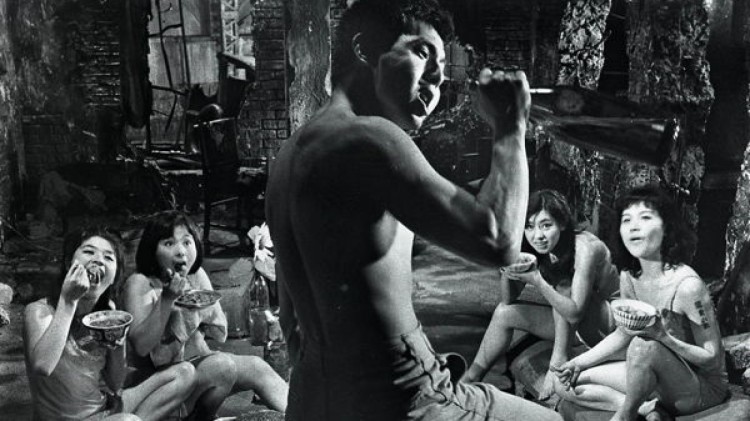
nikutai_no_mon_2_film-1600x900-c-defaultWhat are you supposed to do when you’ve lost a war? Your former enemies all around you, refusing to help no matter what they say and there are only black-marketers and gangsters where there used to be merchants and craftsmen. Everyone is looking out for themselves, everyone is in the gutter. How are you supposed to build anything out of this chaos? Perhaps you aren’t, but you have to go one living, somehow. The picture of the immediate post-war world which Suzuki paints in Gate of Flesh (肉体の門, Nikutai no Mon) is fairly hellish – crowded, smelly marketplaces thronging with desperate people. Based on a novel by Taijiro Tamura (who also provided the source material for Suzuki’s Story of a Prostitute), Gate of Flesh has its lens firmly pointed at the bottom of the heap and resolutely refuses to avert its gaze.
A nervous young woman, clearly tired, starving and alone wanders through a marketplace in desperation before a yakuza offers to buy her something to eat. She is wary but has little choice. Soon after she meets toughened prostitute Sen who is the de-facto head of a small group of streetwalkers committed to supporting and protecting each other. They have few rules but the biggest one is no giving it away for free. Maya joins their “merry” band and things are going OK for them until they make the fateful decision to take in a wounded ex-soldier on the run from the American military police. Shin puts a great big wedge between the members of the group, deepening the cracks which were present all along. Sure enough, Maya starts to fall for this damaged man threatening to fall foul of the gang’s single taboo. When you’ve lived like this, without hope, without a future, can you ever go back to being a “real human being” ever again?

Make no mistake, this is a ruined world. Almost post-apocalyptic, it’s populated by the starving and the desperate. The sweet potato seller is king here – the working girls are depicted like packs of rabid animals, descending on any passing male ready to extract any amount of loose change which they immediately run out to thrust into the hands of anyone who has food. The great horror is hunger.

The other great horror is, of course, violence and particularly male violence against women. Maya is assaulted early on and a truck carrying two army officers and a priest tries to make a quick escape after noticing her lying wounded by the roadside. The Americans aren’t going to help her, she’s just another raped Japanese woman after all, but the priest stops and offers another kind of salvation shining from his dangling crucifix. He repeatedly turns up later and tries to convince Maya to come back to church but you can’t live on a communion wafer alone and eventually Maya puts a definite end to the idea of any kind of religious solution to her predicament.

Sex is business for the woman under Sen’s command. They sell their bodies, hence the prohibition on giving them away. Breaking the rules will get you cruelly beaten and humiliated before being thrown out of the group and it’s near impossible to survive alone. The other women have all been injured by the war, they’re all among those left behind. One of them, Machiko, stands a little to the side as a middle class war widow rigidly sticking to her kimono and dreaming of becoming someone’s wife again. Needless to say, she and Sen do not always see eye to eye as Machiko’s desire to return to a more innocent age conflicts with Sen’s hard nosed pragmatism.

This is Japan in defeat. The girls live in a warren of ruined buildings haunted by visions of the past. Shin has returned from the war to a land devoid of hope. He’s a broken man and, as the woman have been “reduced” to prostitution, he has been “forced” into crime. There aren’t any real people here anymore, just animals willing to do whatever it takes just to stay alive.

When Suzuki was given this assignment, they wanted him to make a soft-core exploitation pic full of the sleazy lives of the red light district. Suzuki doesn’t give them that, he gives them another round of beautifully composed, surrealist social commentary in which the downtrodden citizens of Japan are defeated for a second time by the corrupting influences of the American occupation. The final shot of the ascendant Stars and Stripes flapping in the wind while the Japanese flag lies drowned in the muddy river speaks for itself and though Suzuki shows us those defiantly trying to live his prognosis for them is not particularly hopeful. He uses multiple exposure here more than in any other film as the past continues to haunt the traumatised populace in quite a literal way where one scene of degradation leads on to another. Extended metaphor, surrealist examination of the post-war world and also the low level exploitation feature Suzuki was hired to direct (albeit in more ways than one) Gate of Flesh proves one of his most complicated and accomplished features even given his long and varied career.


Gate of Flesh is available with English subtitles on R1 DVD from The Criterion Collection.

Manji (卍, Yasuzo Masumura, 1964)

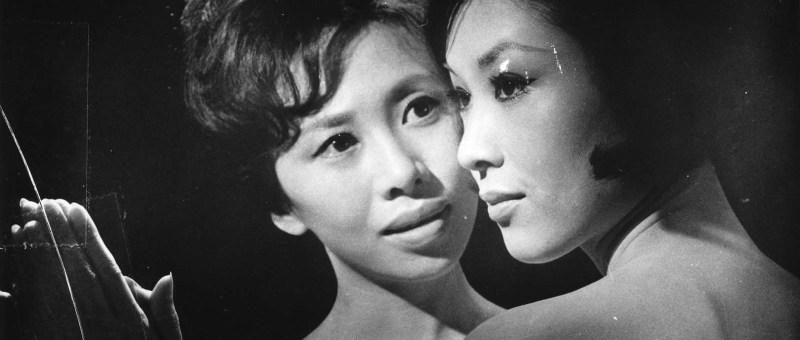
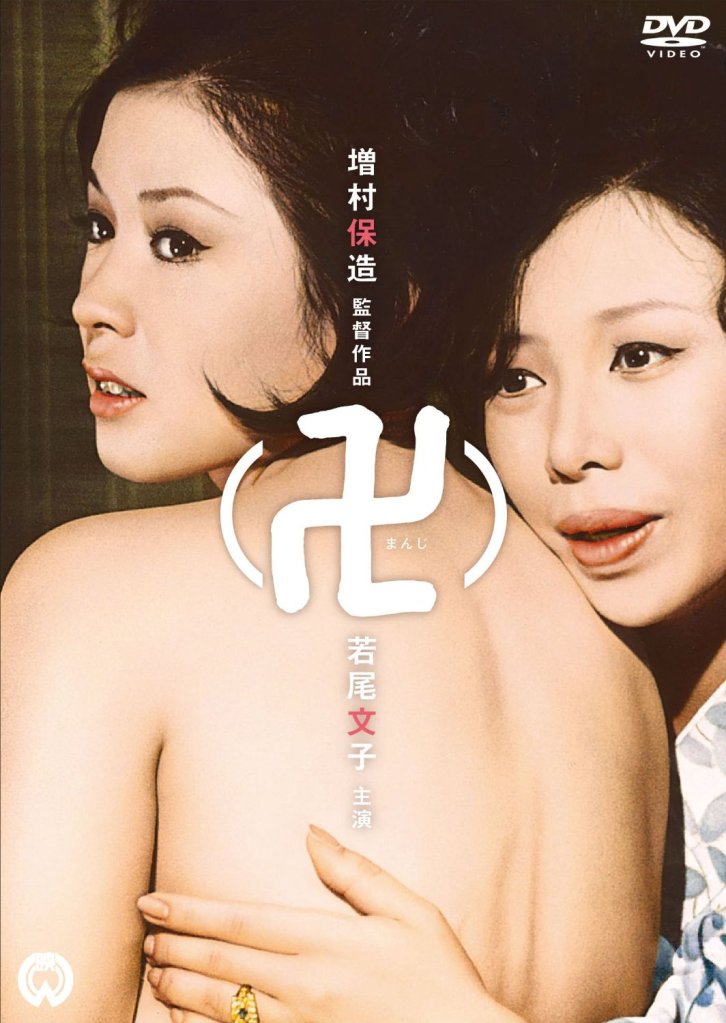
8127Ur2xnXL._SL1500_For arguably his most famous film, 1964’s Manji (卍), Masumura returns to the themes of destructive sexual obsession which recur throughout his career but this time from the slightly more unusual angle of a same sex “romance”. However, this is less a tale of lesbian true love frustrated by social mores than it is a critique of all romantic entanglements which are shown to be intensely selfish and easily manipulated. Based on Tanizaki’s 1930s novel Quicksand, Manji is the tale of four would be lovers who each vie to be sun in this complicated, desire filled galaxy.
The story begins with a framing sequence in which Sonoko sits down with a male mentor to recount her sorry tale from some later vantage point. As she would have it, she was an unfilled, unhappy housewife taking a series of art classes when the principal of the college noticed that the face in her sketch of the Goddess of Mercy doesn’t look much like the model. Her technique is good though so he asks her why she gave her drawing a different face and who it might belong to. She tells him it’s merely an ideal and isn’t based on any real person. However, it does look quite like another, very beautiful, pupil at the school – Mitsuko, and a rumour quickly starts that the two women are lovers. Though barely knowing each other before, the pair laugh it off and decide to become friends anyway. Gradually, something more than friendship begins to grow but not everyone is being honest with each other and the added complication of the men in their lives is set to make the road even harder for Sonoko and Mitsuko’s love affair than it might otherwise be.

Sonoko narrates things from her perspective, though you get the feeling she may not be a completely reliable narrator. She seems shy, innocent, wounded though she speaks of her great tragedy with ease and a surprising frankness considering its sensitivity. The object of her obsession, Mitsuko, by contrast plays the innocent but also seems to know perfectly well what she’s doing. Manipulative in the extreme she plays each of the other three lovers off against each other in an attempt to become the centrifugal force in each of their lives. All things to all people, Mitsuko doesn’t seem to know what she wants, other than to be adored by anyone that’s around to adore her.

At the beginning of the film Mitsuko reveals that she’d been involved in marriage negotiations with a young man from a high profile family and she believes the rumours at the art school were started deliberately to try and disrupt her matrimonial ambitions. Sure enough that liaison falls through but she neglected to mention that she also has another fiancee, the slimy Watanuki, that she longs to be rid of but can’t seem to shake off. After Sonoko finds out about Watanuki, Mitsuko feigns not only a pregnancy but a bloody miscarriage to get her female lover to return to her. However, Watanuki fights back by trying to form a bilateral alliance with Sonoko to ensure Mitsuko doesn’t suddenly take up with a third party – he even gets her to sign a contract saying that she’ll help get Mitsuko to marry him and in return he won’t interfere with the two women’s relationship even once they’re married.

Sonoko’s husband completes the quartet, becoming increasingly frustrated by his wife’s infatuation with another woman, her coldness towards him and her growing boldness. Sonoko labels Kotaro cold and passionless and claims never to have enjoyed any of their married life together. She’s also been taking illegal birth control medication to avoid having children with him. Trying to be an understanding husband, Kotaro ends up tangled in a web of desire after being seduced by Mitsuko. For a time, the three form an unlikely romantic trio (with Watanuki hanging around disdainfully on the edges) though even between the three of them petty jealousies sap their strength and keep them all guessing as to the exact motives of the other pair.

Just like the four pronged arms of the manji itself, our four lovers lie in a tangled and twisted crisscross of desire, each trying to eclipse the other in the eyes of the radiant Mitsuko. Anything but merciful herself, Mitsuko adeptly plays on the insecurities of the others to keep them all dancing along to her tune. This is not a story of true love, but of misused desires, almost of the inverse of love where lust becomes a weapon of control and self satisfaction. Even at the end, Sonoko can’t decide if she’s been saved or betrayed and if what happened to her was love or a kind of madness. Whatever it was, each has paid a high price for their selfish pursuit of romance or dominance or whatever Mitsuko really represents for them (clearly not the reincarnation of the Goddess of Mercy after all). Years ahead of its time and still just as dark and fascinating as it always was, Manji is a sadly universal tale of the destructive power of love that plays almost like a ghost like story and is likely to haunt the memory long after the screen falls dark.


Manji is available with English subtitles on R2 UK DVD from Yume Pictures.

Original trailer (no subtitles)

Kwaidan (怪談, Masaki Kobayashi, 1964)

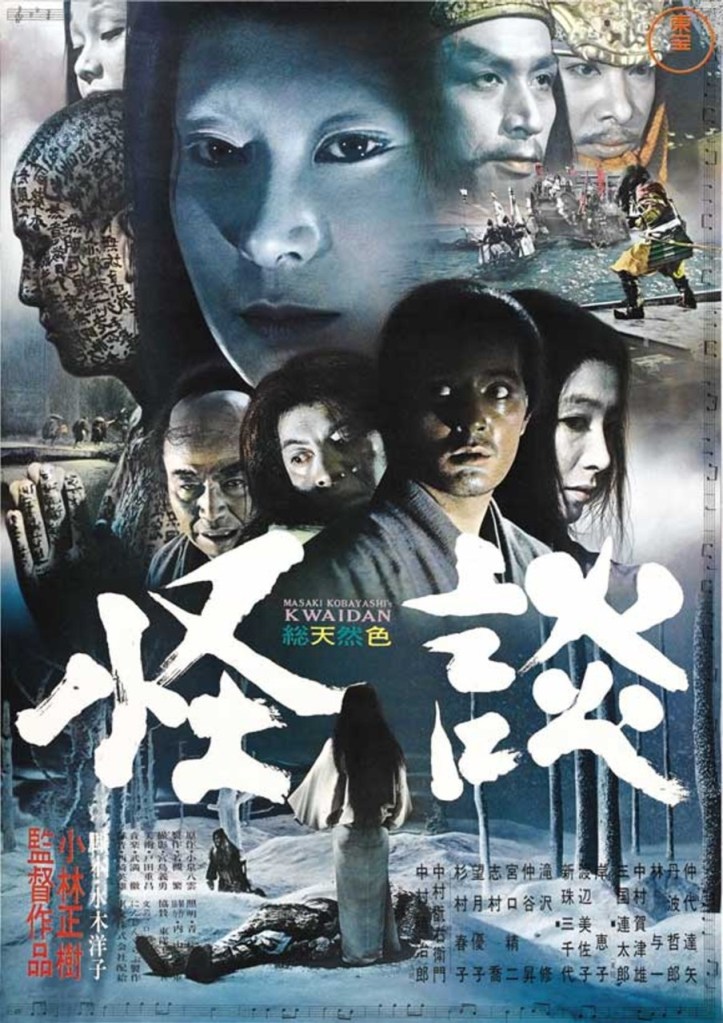
tumblr_ly5zbgdNH61rn3yrmo1_1280Kwaidan (怪談) is something of an anomaly in the career of the humanist director Masaki Kobayashi, best known for his wartime trilogy The Human Condition. Moving away from the naturalistic concerns that had formed the basis of his earlier career, Kwaidan takes a series of ghost stories collected by the foreigner Lafcadio Hearn and gives them a surreal, painterly approach that’s somewhere between theatre and folktale.

The first tale, Black Hair, is the story of an ambitious young samurai (Rentaro Mikuni) who abandons his one true love to marry a wealthy woman and advance his career. However, his second marriage is far from happy and he begins to appreciate just what it is he’s cast aside. Eventually returning home he meets his former wife again and harbours the desire to start afresh. However, when the sun comes up all is not as it seems.

Tale two, The Woman of the Snow, begins when two woodsmen are caught in a blizzard and a mysterious woman appears to suck one of them dry of blood. She spares the other, Minokichi (Tatsuya Nakadai), because she’s moved by his youth but she instructs him never to reveal the events of that evening or she will return to finish what she started. Minokichi returns home and meets another mysterious woman who later becomes his wife and bears him three children but will he remember to keep his secret even from the love of his life?

The third tale is perhaps the most famous, Hoichi the Earless, and features the sad tale of a blind biwa player (Katsuo Nakamura) whose storytelling ability is so great that the dead themselves petition him nightly to recount their story. Eventually the head monk finds out and disapproves of Hoichi’s dealings with the supernatural so the monks paint sutras all over his body to protect him from the malevolent spirits. However, like achilles and his vulnerable heel, they forget to paint Hoichi’s ears…

The fourth tale, A Cup of Tea, is a little more whimsical and opens with a framing sequence lamenting the fact that some ancient tales were never finished for one reason or another. The tale within the tale features a samurai who keeps seeing a face appear in his tea. Obviously this is quite disturbing, but eventually he just decides to drink it anyway only for the owner of the face to suddenly appear and complain about soul having been stolen.

Like all good fables the stories each have a moral to offer but also, crucially, paint the protagonists as victims of circumstance more than rash or unwise people. The samurai feared poverty so he abandoned his love in search of riches only to discover he’d been chasing the wrong kind of dreams. Minokichi momentarily forgot himself, perhaps entrapped by the Snow Woman’s final trick, Hoichi just wanted to play his biwa but his desires were frustrated by the powers at be who further mess things up for him by botching the sutra application. The protagonist of A Cup of Tea does choose to drink the tea himself but the resultant madness is not something that could ever have been reasonably expected. These are worlds of spirits where the doorway to the supernatural is always ajar, waiting for some ordinary person to tumble through accidentally.

Though employing slightly different styles for each of the four segments, Kobayashi sets his stage with a deliberately theatrical, almost hyperreal set design. Obviously shot on a soundstage, the tales take on the feeling of stories which have been told and retold, replayed countless times across the great theatre of life. Black Hair steers closest to a traditional kabuki play, an effect aided by Toru Takemitsu’s more traditional score but The Woman of the Snow gives way to intense color play full of cold blue ice vistas mixed with impressionistic, passionate red skies. Hoichi’s tale begins with an overlay of a scroll painting recounting the famous The of the Heike of which Hoichi sings his song. Full of epic battle scenes, ghostly apparitions and a whole load of biwa music, this segment is the lengthiest but also the meatiest when it comes to subtext. The final tale by contrast is much more straightforward and brings a little chanbara exuberance to the otherwise heavy atmosphere though it does leave us with one of the most haunting images in the entire film.

Kwaidan may look like an exercise in style for Kobayashi – it was also his first colour picture and he makes full use of that aspect of the film. However, that isn’t to say he’s abandoned his recurrent concerns. The people in the stories are all ordinary, they’re flawed but they aren’t evil. The samurai comes closest to bringing his fate on himself when he makes the selfish decision to abandon his loving wife for money and status though he pays a heavy price when he finally realises his foolishness. Minokichi’s crime is a loss of faith of perhaps of having doubted the truth of his tale in itself. In the end, he simply forgot his promise rather than making a conscious decision break it like the samurai. Hoichi is something of a passive player here as his blindness renders him unable to understand his plight – he is unable to keep his promise to the fallen samurai firstly because of the physical toll it’s taking on him and secondly as he’s prevented by his superiors. The protagonist of the final tale simply gives in to temptation and then to madness perfectly symbolising human weakness. Kobayashi maybe more artful here than acerbic but his bleak view of human nature still wins out. However, what Kobayashi crafted in Kwaidan is a beautiful, dreamlike canvas of supernatural visions which continue to dazzle in their artistry long after the screen has gone dark.


Kwaidan is available on blu-ray in the US from Citerion and on DVD in the UK from Eureka Masters of Cinema.


Masahiro Shinoda’s Pale Flower (Kawaita Hana) Criterion Collection Blu Ray

Masahiro Shinoda’s 1964 film Pale Flower (Kawaita Hana) is a total break from the romanticised yakuza films that had been common prior to its release. Heavily influenced both by American Film Noir and by the French New Wave, Shinoda’s gangster underworld is dark and empty. There maybe pretty girls and oh so shiny fast cars but these yakuza spend their off time in bowling alleys and in other ordinary daily pursuits not so different from your average salaryman. As the film begins we meet recently released Muraki (Ryo Ikebe) who is traveling back to Tokyo having completed a three year sentence for committing a murder ordered by his gang boss. We hear him reflect less than fondly on his crime, but at the same time wonder why he’s been punished for ‘slaughtering one of these stupid animals’ which crowd around him, seemingly barely alive. On arrival he pays a visit a to an old girl friend who seems to be much more fond of him than he is of her. Then he goes gambling and sees the young, beautiful but perhaps just as empty as he is, Saeko (Mariko Kaga). Presumably from a wealthy background, Saeko spends her nights gambling vast sums of money, little caring if she wins or loses, living only for the brief thrill of chance. Together Mariko and Saeko wander aimlessly through night time Tokyo desperately trying to find some kind of meaning to this chaos but pushing each other ever further down into a spiral of thrill and transgression.

Shinoda’s direction and Masao Kosugi’s photography are really fantastic here. The Noirish light and shadows perfectly depict this murky, uncertain and claustrophobic world the protagonists are constrained by and totally establish this mood of alienation which is so central to the film. This is further assisted by the wonderful score provided by Toru Takemitsu. Relying heavily on dissonance and incorporating exaggerated or found sounds – tap dancing over the sound of the cards for example, the score brilliantly brings out the underlying menace of this environment. Indeed, the sound design is one of the most distinctive attributes of this film and is extraordinarily important in establishing the mood. The final set piece accompanied by a section from Purcell’s Dido and Aeneas is absolutely pitch perfect and has obviously become hugely influential.

This new blu ray release from the Criterion Collection is absolutely stunning, the picture quality and clarity are excellent. The contrast in the black and white photography is beautiful to behold. The remastered lossless sound is also richly delivered, with no problems of audibility. This fascinating film is a must for any fan of Japanese Cinema, Film Noir or New Wave. Highly recommended.