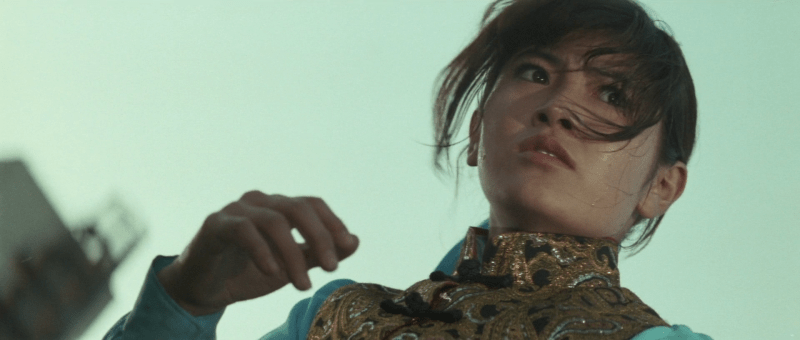
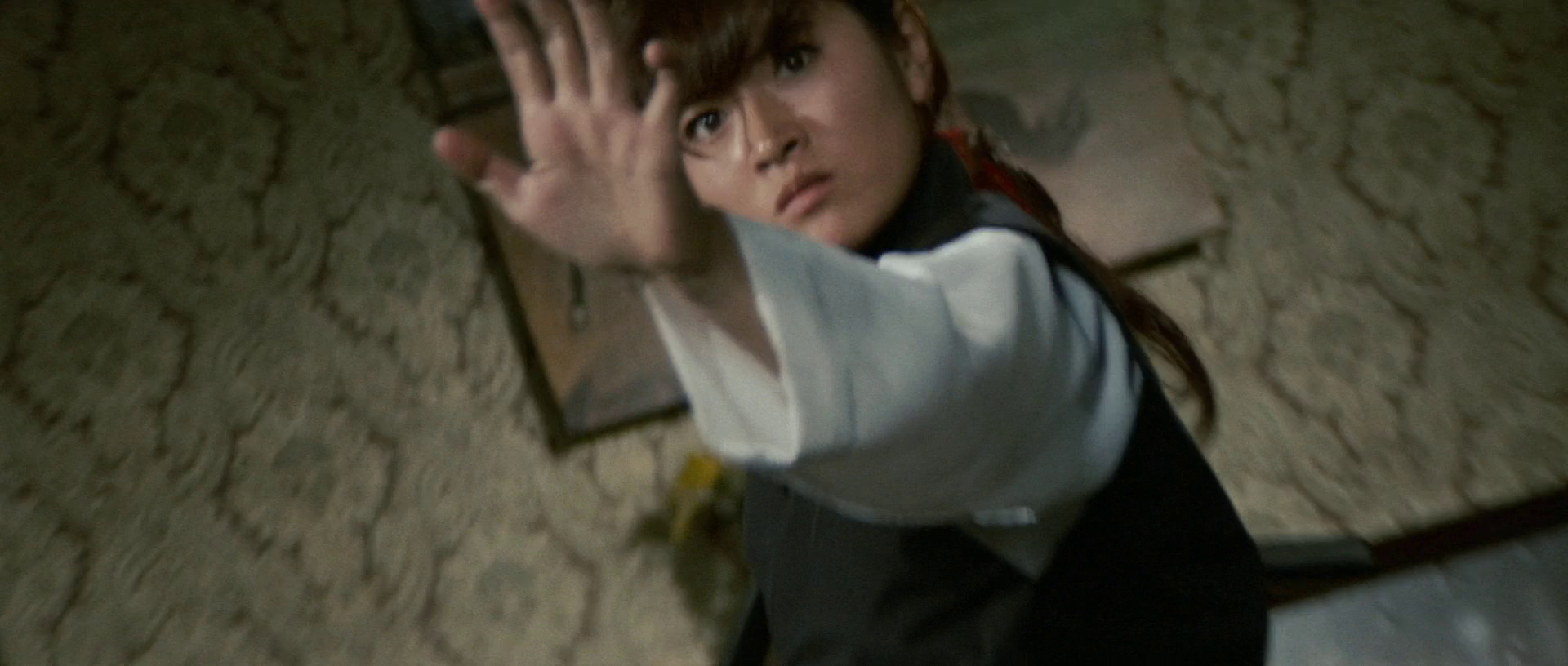
Sister Street Fighter: Hanging by a Thread (女必殺拳 危機一, Kazuhiko Yamaguchi, 1974)

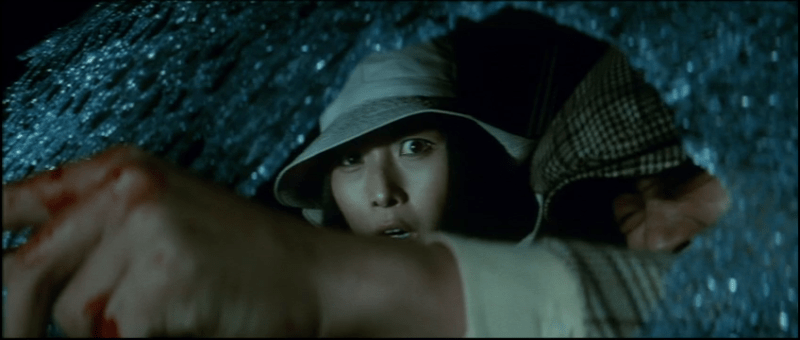
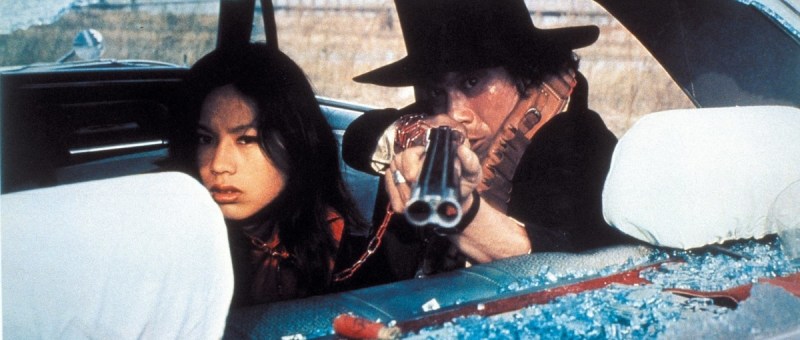
Li Koryu (Etsuko Shihomi) returns to fight crime in Japan in the second in the Sister Street Fighter series, Hanging by a Thread (女必殺拳 危機一, Onna hissatsu ken: Kiki ippatsu). The first film apparently tested so well so that studio execs ordered a second one right away to fill a big New Year slot. That might in one sense explain why the film is pretty much the same in terms of narrative, yet this one does go a little further while swapping the drugs subplot for diamonds.

Koryu comes to the aid of a man being attacked by thugs in a Hong Kong marketplace and is somehow completely unfazed when he plucks out his false eye with instructions to give it to Professor Enmei (Hideaki Nagai) who is also known to Koryu because he’s the father of her old school friend, Birei (Hisako Tanaka). Unfortunately, the false eye contains microfilm that suggests Birei has been kidnapped by vicious Japanese gangsters. The professor therefore sends her to Tokyo on a rescue mission and we discover that she also has an older sister, Byakuren (Kanya Tsukasa), who was never mentioned in the earlier film, who is living in Japan having chased her dream of becoming a jewellery designer.

This time around, it’s diamonds not drugs, but the gangsters still haven’t cracked this smuggling business and have come up with the very weird idea of hiding them in the bum cheeks of attractive young women. Meanwhile, they also force the women into sex work. Osone’s (Hideo Murota) female business partner Mayumi, played by Madam Joy, a drag queen who starred in several Toei films in the mid-70s, films them from a distant window to get material for blackmail. Nevertheless, she only cares about the diamonds, unlike the boss and several of the gang which once again includes a rival martial arts outfit who have in it for the Shorinji temple. 

Shinichi Chiba does not appear in the film, but Koryu does gain a kind of sidekick in the form of Tsubaki (Yasuaki Kurata), a sleazy-looking guy whose intentions are permanently unclear. The film goes a little bit further with its awkward orientalism opening in a Hong Kong marketplace with some offensively stereotypical music and a bunch of fire crackers, even if once again in trends in the opposite direction from most films of the time in that the crooks are all Japanese and it’s a half-Chinese woman who’s coming to sort them all out. The gangsters have apparently been trafficking the women abroad for sex work, then bringing them back with the diamonds in their bums which seems like a plan with a lot of potential problems even if they hadn’t made the huge mistake of kidnapping a friend of Koryu and then later her sister. 

But then again, Koryu’s cases seem to be fairly isolated. Once she takes out these bad guys, that’s it. There’s no wider conspiracy save a general sense that the world itself is corrupt and indifferent to human suffering. Osone has a strange love of taking people’s eyes, which might be a way to stop them seeing who he really is. He has, after all, already taken the stars from Byakuren’s along with her dreams of a new life in Japan finally becoming the jewellery designer she always dreamed of being. Despite her determination to save her sister, Byakuren soon realises that Osone is most definitely not a man of his word. His curiously old-fashioned outfits and demeanour suggest he’s seeking a place with the elites of an earlier time while indulging in some fairly odd behaviour. 

Once again, Koryu squares off against his equally weird henchmen who start attacking her the moment she lands in Japan, and eventually ends up stabbing someone with the severed arm of another enemy still holding his knife. Still, the tone is generally cheerful and upbeat despite the strangeness of the tale and series of losses Koryu experiences including a challenge to her pride when she’s bested by one of the martial arts goons. In this continually uncertain and increasingly surreal world, Koryu’s fists, it seems, are one of the few things that can absolutely be relied upon along with evil smugglers and their bizarre new plans for circumventing the law of the land out of nothing other than lust and greed.


Original trailer (English subtitles)
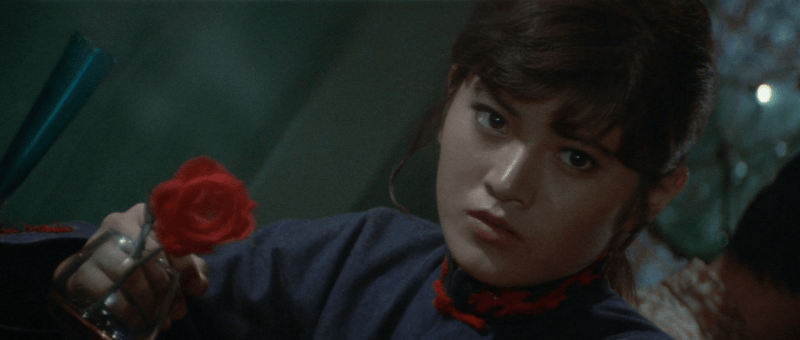
Sister Street Fighter (女必殺拳, Kazuhiko Yamaguchi, 1974)

As the Japanese cinema industry continued to decline in the face of competition from television, there was perhaps paradoxically more space available for small-scale genre films. Shinichi Chiba had ushered in a new age of unarmed combat with his Bodyguard Kiba karate movies. The Street Fighter series followed hot on its heels and was enough of a hit for the studio to take notice. They suggested a new spin-off line that would feature a female action star with Chiba appearing in a supporting role and so Sister Street Fighter (女必殺拳, Onna hissatsu ken) was born.

Producers apparently first wanted Taiwanese-born Hong Kong actress Angela Mao who had starred with Bruce Lee in Enter the Dragon by which the film is clearly influenced. Angela Mao was, however, unavailable, which is what led them to take a chance on Chiba’s then 18-year-old protégé Etsuko Shihomi. Shihomi had joined his Japan Action Club out of high school to study stunts, martial arts, and gymnastics and had only limited acting experience but soon proved up to the challenge of carrying a movie as a female action lead. 

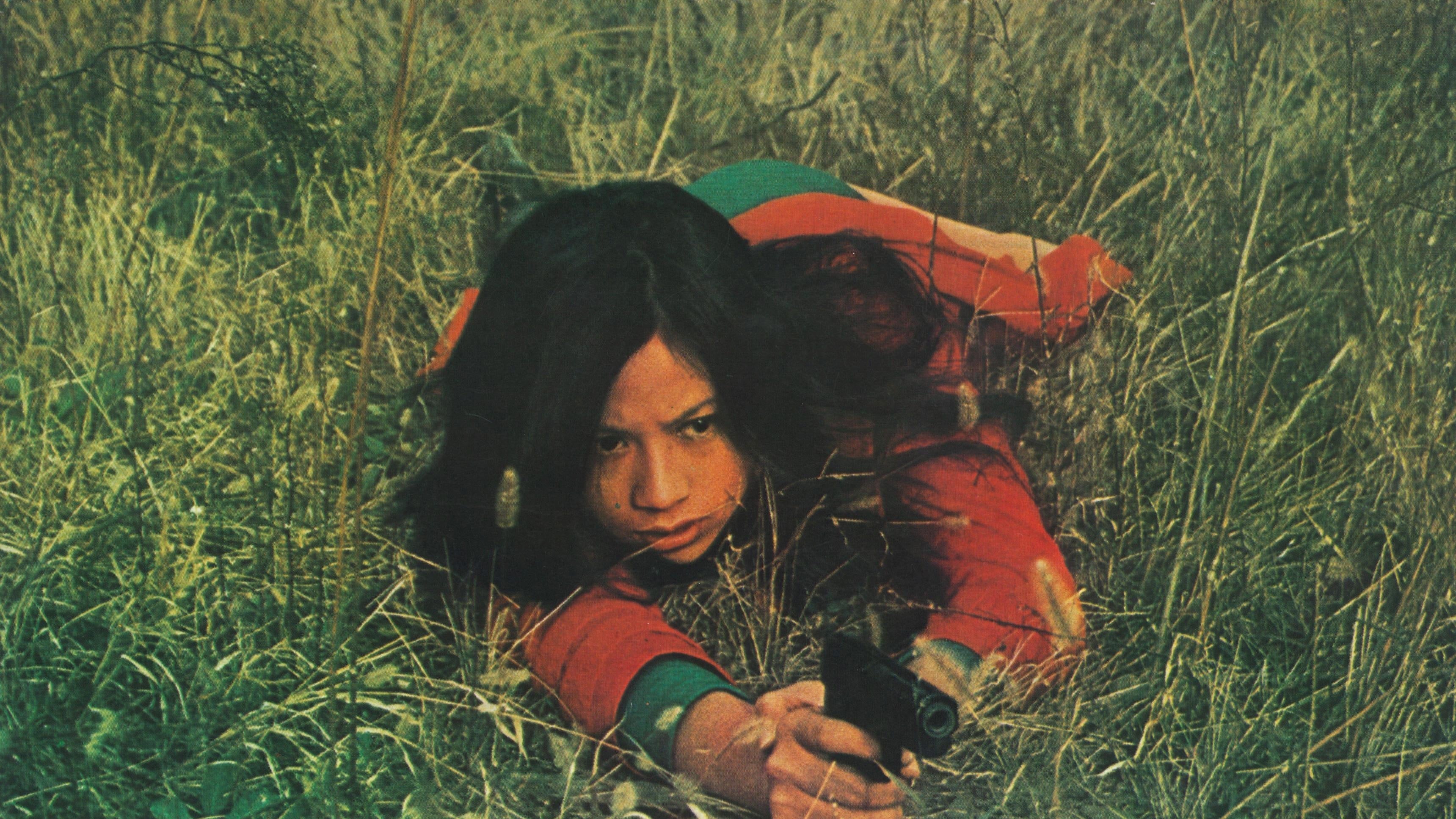
Koryu is the sister of a martial arts champion who has gone missing in Japan. She then finds out from his boss that he was actually an undercover narcotics agent trying to break a Japanese drug ring. As Koryu’s mother was Japanese and she still has family in Yokohama, the police inspector thinks she’d be a perfect fit to head out there, find out what’s happened to her brother Mansei (Hiroshi Miyauchi), and maybe take out the drug dealers too. 

In some ways, it’s an interesting subversion of the Sinophobia often found in Japanese films of this era that this time it’s a half-Chinese woman squaring off against Japanese drug dealers. Her brother was apparently so upset about not being able to stop the drugs flooding Japan that he decided to do something reckless that directly led to his disappearance. The Hong Kong police also have a second operative, a woman, working inside the gang but have lost contact with her. In contrast to Koryu, Fang Shing (Xie Xiu-rong) has been sent in as a classic honey trap to use her femininity as a weapon by becoming the boss’ mistress to get the lowdown on the gang. But as a consequence, Fang Shing has also become addicted to drugs which the boss uses as a means to control her. 

Koryu, by contrast, immediately stands up against male patriarchal control by beating up a bunch of guys that were trying to hassle her in a bar. Nevertheless, Mansei’s martial arts master says that her brother was hoping she’d get married and have a “normal life”, which does seem like quite a chauvinistic thing to say and especially to the martial arts-obsessed Koryu. Even so, he introduces her to another young woman, Emi, who got into Shorinji Kempo when Mansei saved her from being raped. These skills do after all give them the means to defend themselves against an often hostile and violent society along with granting them a greater independence than they might otherwise have.

Still, there are a selection of strange villains on show with death by blowgun and ex-priests along with the Amazon Seven team of Thai kickboxers and “Eva Parrish”, apparently the karate champion of the Southern Hemisphere. The action is quite obviously influenced by Hong Kong kung fu films and most particularly Enter the Dragon, though to a lesser extent Shaw Brothers in the warring schools subplot that sees the Shorinji Kempo love is power philosophy challenged by the gang’s very own martial artist, who feels he must wipe them out to overcome his humiliation in being defeated. Nevertheless, Koryu effortlessly takes out the bad guys as she battles her way towards saving her brother, whom the gang have started experimenting on in an effort to acquire more complex data about tolerance and safe levels for consumption of drugs. The bad guys have a full on lab in their basement where they’ve come up with an innovative solution to the smuggling issue by using wigs! It’s all quite surreal and cartoonish even when it starts getting grim, but rest assured Koryu is here to sort it all out, and sort it out she will.


Original trailer (English subtitles)
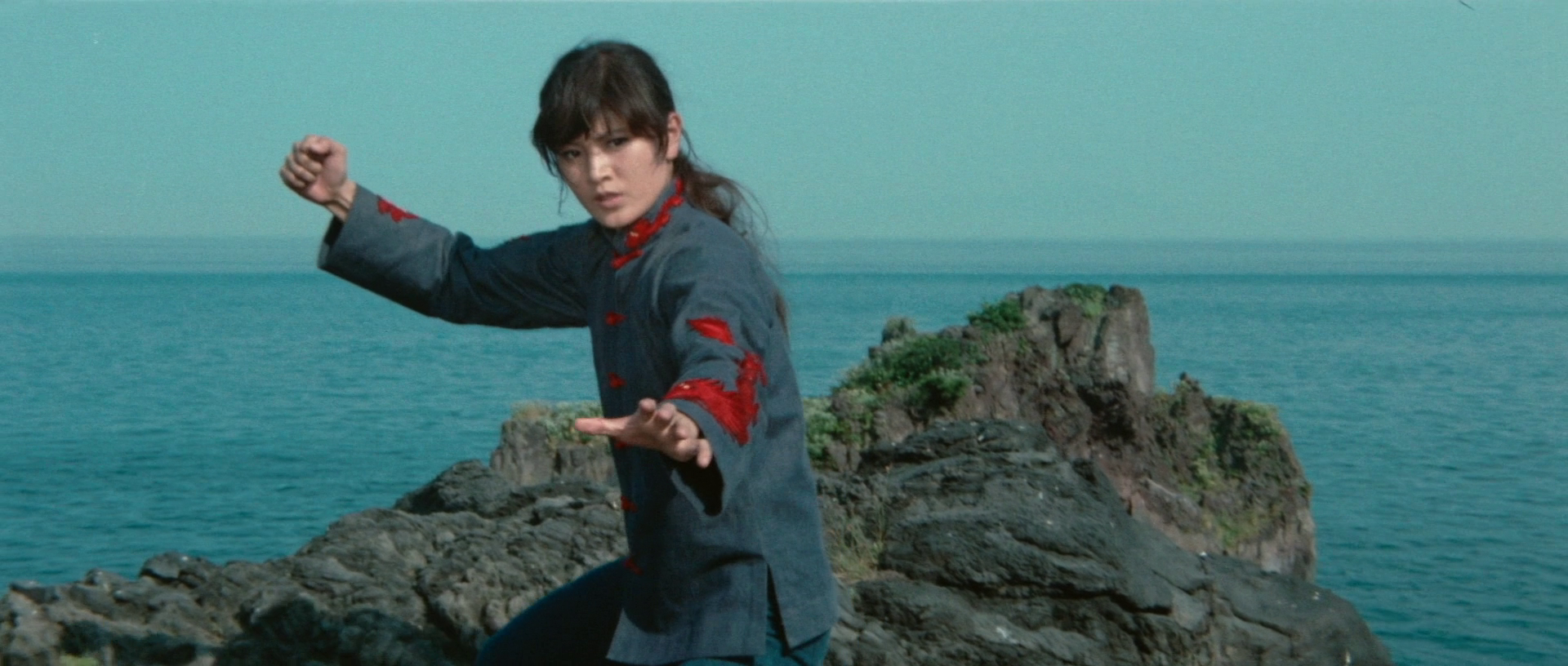
Jeans Blues: No Future (ジーンズブルース 明日なき無頼派, Sadao Nakajima, 1974)

Nihilistic lovers on the run make a break for the sea only to find their pathway blocked in Sadao Nakajima’s anarchic love tragedy, Jeans Blues: No Future (ジーンズブルース 明日なき無頼派, Jeans Blues: Asu naki Buraiha). As the title suggests, the heroes find themselves devoid of hope, pressing the accelerator as far it’ll go with no clear destination in sight and nothing really left to lose while discovering a twisted kind of salvation in their unlikely connection.

Sensing danger in the air, grave-digging drifter Jiro (Tsunehiko Watase) decides to run off with all the money after his gangster friends off a moneylender on the orders of a businessman. Meanwhile, across town, bar lady Hijiriko (Meiko Kaji) decides to walk out on her unsatisfying life taking some money from the till and her boyfriend’s car for good measure. The pair quite literally collide, but realise that they are much the same in their growing sense of emptiness and impossibility. Nothing really really interests Hijiriko anymore, and watching the car burn after Jiro tossed a cigarette is the only thing that’s made her feel alive in eons. Running through his many and various jobs, Jiro reflects that work is “no fun” either and that the reason he wanted the money was for his sister who he says has run up huge debts paying for medical treatment for a close friend and is now facing the threat of being forced into sex work. 

His sense of impotence is palpable in his desperation and the knowledge that there is no good way to come by large amounts of money especially for a young man from the country with limited prospects. At one point he is beaten by a man with a golf club, a symbol of the class privilege and middle class success that will always elude him. The money, much more than he needs for his sister, gives him a new sense of confidence and possibility even if he remains somewhat frugal, picking up an old banger from a second hand car salesman that immediately blows a tire and apparently belonged to “Koji the murderer” which explains the huge dent in the bonnet. Yet he does at least pay his way, even leaving a collection of notes next to the body of a man he ran over intended to pay for medical treatment which casts him as something of a naive innocent cast adrift in a corrupt society and driven into criminality by desperation.

Trapped inside a shipping container and fearing he may be about to die, Jiro comes to see his fate as karmic retribution for having taken the money that was earned by killing others. Inside the container, the pair are in a sense already dead but also undergo a kind of rebirth if only one fuelled by desperation and the connection that has arisen between them. Hijiriko appears to be suffering from some kind of trauma, experiencing a flashback to the orgy going on at the bar which she had been invited to join but declined much to her customer’s disappointment. He remarks that she always did before, a comment which seems to annoy her though perhaps not as much as the arrival of an older woman a male voice tells her on the phone is a actually quite wealthy and doesn’t need the money but does sex work as a kind of hobby. 

It’s Hijiriko who begins to fight back against the world, dressed in the stylish black leather suit Jiro buys her while he struts around in a cap and three-piece tartan suit. Jiro does not actually kill anyone, but Hijiriko does without a second thought perhaps because she herself is already dead. Using her sexuality as a weapon, she asks a hunter if she can hold his gun and trying his luck he lets her only to end up getting shot when he tries to fight back. The pair rob a petrol station for money but come up with only a few notes and coins while the attendant reveals they’ve already made their daily deposit at the bank signalling just how out of luck these lovers really are. They’re bound for the sea, but travel to the mountains and find there only danger and disappointment. Nakajima lends their flight from a dissatisfying existence a kind of desperation in its breakneck pace and frenetic camera work but equally injects a sense of cosmic irony in the many coincidences and reversals that frustrate the lovers’ escape and in the end leave them only one way out from the society which constrains them.


Original trailer (no subtitles)

The Homeless (無宿 やどなし, Koichi Saito, 1974)

Two men are released from prison on the same day. One, dressed in a 1920s-style white suit and straw hat, tries to befriend the other, in black kimono and geta, but he ignores him. Soon, they arrive at a fork in the road. The man in the kimono walks down a well worn grass path cut between the fields while the man in white, looking back and a little disappointed, continues along the modern roadway making his way towards civilisation.

In some ways, the heroes of Koichi Saito’s The Homeless (無宿 やどなし, Yadonashi) are embodiments of past and future. Jokichi (Ken Takakura), the kimonoed man in black, chooses the path of vengeance. On his release from prison, he learns that his gang leader older brother has been killed while his sister was sold to a brothel. He goes there to find her, but is told that she is already dead. The madam says she died of a chronic illness and that she did for her what she could but treating such a cruel disease is only throwing good money after bad. Sakie (Meiko Kaji), a sex worker who appears to have a childlike quality and possibly impaired mental state, tells a different story claiming the madam had Jokichi’s sister killed for reasons she doesn’t explain but may have more to do with the drama going on with Jokichi’s gang than a desire to cut costs and her losses. 

Gen (Shintaro Katsu), meanwhile, seemingly chooses the path of prosperity. He returns to his wife, Ume (Murasaki Fujima), who is a member of a moribund theatrical troupe, and asks her to return to him what he believes is a treasure map marking the location where his father saw a ship sink during the Russo-Japanese war that may be filled with gold. On finding out Jokichi used to be a diver, Gen becomes determined to bring him onto his mission but Jokichi is set on revenge firstly on a man called Senzo (Noboru Ando) he thinks killed his sister and then on whoever ordered the hit on his brother. This bad news for Gen who realises that if he achieves his vengeance, Jokichi won’t be available to help retrieve the gold because he’ll be in prison so he starts by warning Senzo that his past’s about to catch up with him. 

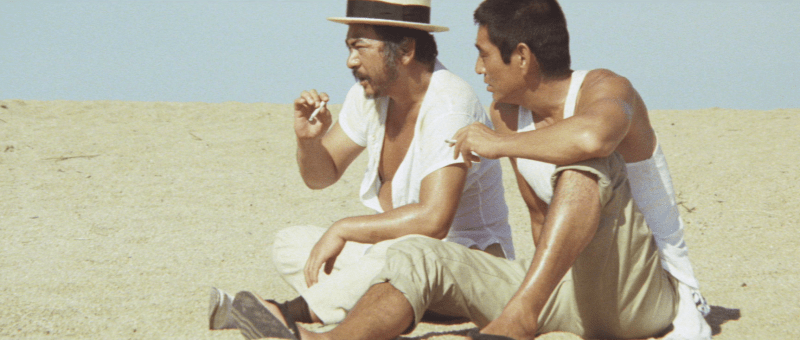
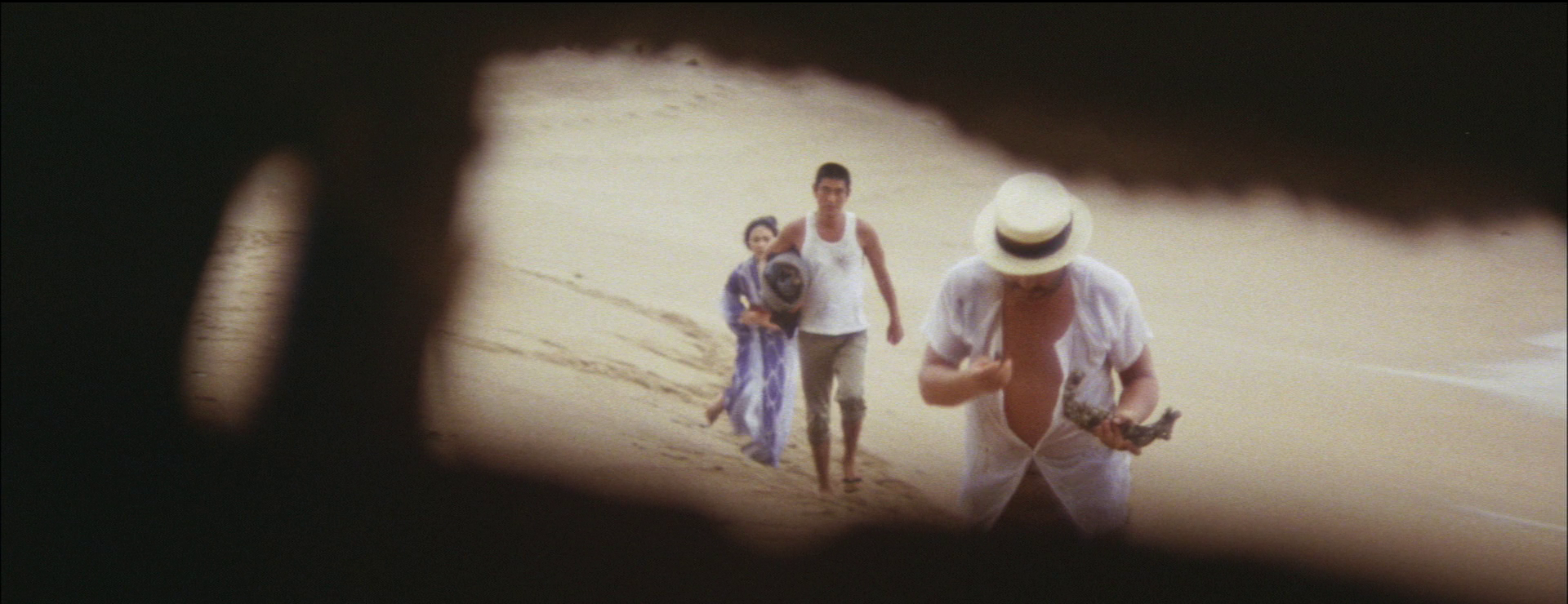
But it’s also Gen that helps Jokichi escape from the rival gang by suggesting he help rescue Sakie from her indentured servitude as sex worker. Childlike and ethereal, Sakie claims not to remember where she was from and has a simple desire to see the sea which represents to her a kind of freedom while for each of the men it may in fact form a kind of border they will eventually be backed up against and unable to escape. Though Sakie develops a fondness for Jokichi, and then begins to love Gen after he ends up taking care of her along the road, the three form a relationship that seems more fraternal or perhaps even forged on the homoerotic tension between the two men who light their cigarettes one from the other and finally find a home on an idyllic beach where they devote themselves to the search for buried treasure.

Sakie may say that the real treasure is her new life of freedom and warmth, but the hint of riches the two men find is itself rooted in warfare and imperialism which are the same forces by which they were each displaced amid the rising militarism of the 1930s. The three of them remain homeless in this environment, unable to fit into the changing society and by degrees exiled from it. An early title of the film was apparently Jingi no Okite (仁義の掟) which means “the law of honour and humanity” and that is in a way what Jokichi is bound by in his desire for vengeance, while Gen is clearly an anarchistic force unable to submit himself to authority and lusting after a more prosperous modernity. Sakie meanwhile is powerless as a woman with few rights, sold into sex work and technically a fugitive from the gang-backed brothel that owned her contract.

As beautiful as the beach is, we have the feeling that in some senses the three of them are already dead and living in their temporary paradise. Indeed, the past eventually catches up with them as if these three homeless fugitives cannot be allowed to survive in resistance to an authoritarian culture. Their existence is elegised by the beautifully composed cinematography along with the childlike rapport between the two men and the sense of domesticity which arises between the trio before reality bites and even their beachside idyll is invaded by the forces of darkness.


Original trailer (no subtitles)

School of the Holy Beast (聖獣学園, Norifumi Suzuki, 1974)

“Why is sex wrong?” a rebel nun enquires, hinting at the hypocritical atmosphere of the convent which comes to stand in for the patriarchal superstructure of the contemporary society. That it does so might in a way be surprising given that Christianity has relatively little cultural relevance in Japan save its stance as a persecuted religion during the feudal era. Director Norifumi Suzuki jumps on the nunsploitation bandwagon but does so with a baroque romanticism mixed with punkish youthfulness as two young women find themselves rebels in the house of God.

They are both there for reasons largely unconnected to religion. 18-year-old Maya (Yumi Takigawa) is searching for the truth behind her birth and her mother’s death, while Sister Ishida (Emiko Yamauchi) claims she’s been sent there by a wicked stepmother. Ishida also kicks up a stink during a class by questioning the truth of immaculate conception which is quite odd for someone who wanted to become a nun, while otherwise punished for drinking whisky in the middle of the night. Punishment does seem to be the main thrust of their religious practice with the transgressions of “adultery”, which includes all impure thoughts, murder (!), and theft taken the most seriously. On her first night at the convent Maya is woken by the sound of another nun furiously whipping herself though in fairness there just isn’t much else to do. 

Suzuki rams home the erotisicm of ritual in the baptism Maya undergoes during her initiation as a nun in which she is totally nude and instructed to stand with her arms out as if on the cross in front of the altar. She must then bend to kiss the crucifix before receiving her veil as a bride of Christ. The nuns talk of lives of eternal virginity while burying themselves in asceticism in an effort to deny their natural desires but have to a degree sublimated their lust in violence. The most common form of punishment is whipping, while Maya is later tortured with thorns and artfully battered by roses. When one nun steals money in guilt for having abandoned her impoverished family to begin her spiritual journey to Christ, she confesses herself to a priest who offers her the same amount so that she can help her family and ease her conscience by returning it. But in reality the priest has tricked her. He resents that she feels as if her sin has been forgiven and she may forget her guilt, cruelly telling her that she will never hear the voice of God before going on to violate her. 

The act of betrayal, of himself breaking the code to which he should subscribe, is only a echo of an societal corruption which allows men to abuse their power often with the complicity of the women around them such as the abess who has long been in love with him. Kakinuma (Fumio Watanabe) is a man whose faith has been shaken. He bears the scars from exposure to the atomic bomb in Nagasaki which is centre of Christianity in Japan. After telling Hisako (Yayoi Watanabe) that God will not see her, he asks if anyone has actually seen him and why he does nothing when his people suffer. 

Both he and the abbess are trapped in a hell of their own making, though as the girls both say the convent is akin to a prison. When Hisako’s sister visits her they talk to each other through glass as if she were a prisoner, though in many ways she is oppressed by her own repressed desires while those of the other nuns have begun to drive them quietly out of their minds and into sadomasochistic fury. This peculiar madness is only deepened by the arrival of a new Mother Superior who returns from Europe insistent on rooting out “witches” in league with the devil. Suzuki signals the absurdity by playing a chorus of elation when a tortured nun wets herself over a tablet featuring a crucifix in the inversion of a bizarre Edo-era ritual designed to identify secret Christians who were at that point illegal. 

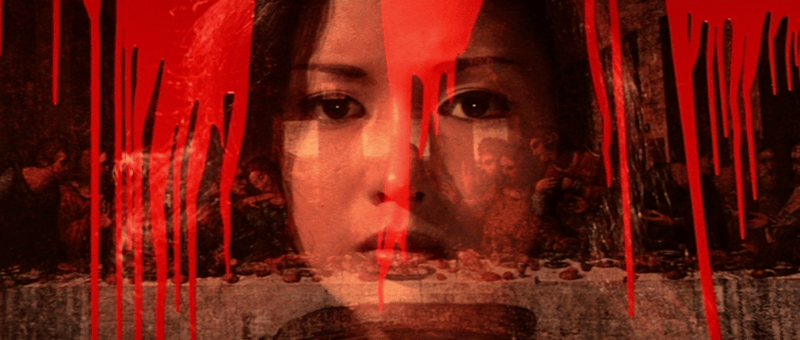
To break free of the covent and return to her liberated life in contemporary Japan as seen in the cheerful opening sequences of her date with Kenta (Hayato Tani), Maya must also free her mother’s ghost and the souls of her sisters by forcing Kakinuma to reckon with his crimes if in the most ironic of ways. Suzuki shoots with febrile romanticism, the pastel colours of the church lending it a hellish glow even before the resurrection of a ghost enacts karmic revenge in a feverish atmosphere of romantic jealously and masochistic repression.


Original trailer (no subtitles)

*Norifumi Suzuki’s name is actually “Noribumi” but he has become known as “Norifumi” to English-speaking audiences.

Zero Woman: Red Handcuffs (0課の女 赤い手錠, Yukio Noda, 1974)

“Your sense of duty is too strong! The world isn’t a pretty place,” barks an irate policeman, scolding a female officer with a tendency to take things, in his view at least, too far. Yukio Noda’s kidnap drama Zero Woman: Red Handcuffs (0課の女 赤い手錠, Zeroka no onna: Akai Tejo) is on the extreme end of pinky violence and soaked in the political concerns of the 1970s along with all their concurrent paranoia but nevertheless positions its fearless avenger as a lone arbiter of justice in an incredibly unjust world. 

We know this from the start as we see Zero (Miki Sugimoto) almost date raped by an apparent serial killer who has his own torture suitcase and apparently killed her friend. Knowing that he is a diplomat and therefore has diplomatic immunity, she simply shoots him in the balls in the film’s extraordinary opening sequence. But even though it could be argued what she did was self-defence, Zero is kicked off the force and thrown into a woman’s prison for an indefinite period of detention to keep the lid on any possible scandal. Zero is only reprieved when the daughter of a politician is kidnapped by thugs and, wanting to keep things quiet, they need someone to rescue her and also wipe out all of the kidnappers to ensure no one ever finds out.

Kyoko (Hiromi Kishi), the politician’s daughter, claims that her father will do “anything” to ingratiate himself with the prime minister and has in fact already arranged her marriage to his son. Kyoko, however, already has a boyfriend who, inconveniently, is quite obviously a student protestor given his yellow construction hat and other paraphernalia. The pair are accosted while sitting in a car near an old American base, and as Kyoko is gang raped, firstly by the gang leader Nakahara (Eiji Go) who is wearing a hoodie with the words US Navy printed on the back, US planes fly over her as if she were being raped by America in an obvious metaphor for the legacy of the occupation. 

Indeed, the flashbacks later experienced by Nakahara are of his mother whom he describes as a sex worker who worked at the base suggesting a very literal allusion to the corrupting influence of American servicemen. The gang operate out of a bar called “Manhattan” which is surrounded by other similar bars with Western names in a neon-lit area, while they constantly run across various signs written in English in fact peeing directly on a no peeing sign outside a largely disused residential area on the edge of the base where they later take hostage some kind of amateur dramatics / English-language class currently in the middle of a production of Romeo and Juliet. 

Yet the big bad turns out to be essentially homegrown in the form of the corrupt lackey policeman Osaka, and the politician Nagumo (Tetsuro Tanba), who is more concerned with his political capital than his daughter’s safety keen that the police keep everything out of the papers otherwise the wedding will be called off and he’ll have a problem with the prime minister. Seeing a very pale Kyoko, her clothes torn, barely conscious having been drugged by the gang, he says he no longer cares to think of her as his daughter and perhaps it would be better if she simply passed away in an “accident”, instructing Osaka to care of loose ends like Zero too. 

It’s very clear that women’s lives have little currency in this very patriarchal world, something Zero seems to know all too well even if at the beginning of the film she was content to work for the oppressive organisation of the police force though she later tears up her warrant card in disgust. The fact that division zero, operating like a secret police force on the behalf of an authoritarian government, exists at all is a clear indication that this is already a police state though one subverted by Zero who uses her red handcuffs to deliver ironic justice to all those who deserve it. Then again, unlike other pinky violence films there’s precious little solidarity that arises between herself and Kyoko whom she later describes as nothing more her mission objective seemingly caring little for her as a fellow human being. Noda cuts back between the Diet building and police HQ as if actively critiquing the latent authoritarianism of the early 70s society but even if Nagumo gets a kind of comeuppance it’s abundantly clear that nothing really will change and Zero stands alone wilfully freeing herself of the handcuffs of a controlling society. 


The Tattooed Hitman (山口組外伝 九州進攻作戦, Kosaku Yamashita, 1974)

The close brotherhood between two men is disrupted by changing times in a more contemporary gangster drama from Kosaku Yamashita, Tattooed Hitman (山口組外伝 九州進攻作戦, Yamaguchi-gumi gaiden: Kyushu shinko-sakusen). As many are fond of saying, times have changed and the yakuza must try to change with them or else meet a melancholy end. But as the hero admits, change is something he has no intention of doing even as his old school gangsterism leaves him increasingly at odds with the corporatising ways of the contemporary yakuza. 

The change in the times is obvious from the film’s opening sequence set in 1957 in which an attempt is made on the life of petty boss Ishino (Tatsuo Umemiya) by a gunman who shouts “die, for the good of the world” before firing a pistol and running away. Ishino has been targeted in a dispute over construction rights connected with the regeneration of hot springs resort, Beppu. The hit seems to have been ordered by rival gang, Sakaguchi (Eizo Kitamura), the leader of which is also a prominent local politician who is content to abuse his power for his own financial gain. So confident is he in his safety, that Sakaguchi even gets the police involved rather than deal with it himself. 

Ginji (Bunta Sugawara) has been Ishino’s sworn brother since their teenage delinquent days and determines to get revenge by raiding the Sakaguchi offices and killing one of their high ranking officers. Seeing as he’s already wanted by the police for a previous murder, Ishino sends Ginji to Osaka to lay low while working for an associate, Daito, mainly as a debt collector. It’s this act of separation which introduces a rift between the two men. While Ginji waits patiently to be recalled, Ishino climbs the ranks of corporatised gangsterism by learning to play by the new rules. 

To fill the void, Ginji takes on a new “brother” or perhaps surrogate son in the wayward Ken (Tsunehiko Watase) whom he first meets cheating at pachinko at a parlour where his pregnant wife Fusako (Mayumi Nagisa) is working. It’s Ken who first drags him into a brewing turf war as Korean gang Soryu threaten to disrupt the local equilibrium not least by selling drugs of which Ginji does not approve. Ginji “saves” Ken from joining Soryu by essentially making him his one of his guys though he doesn’t really have much of a position in Daito’s gang, offering him a sense of grown-up responsibility by handing him a pistol with the only the instruction to make sure he shoots with two hands. Unfortunately, Ken will follow his advice but otherwise ends up almost causing an incident with another gang by shooting a man who disrespected him in the street. Ginji marches straight down there to sort things out, but on arrival discovers an arrangement has already been made with his boss which further strains his sense of pride and confidence in his position as a yakuza.

Ginji feels something similar on being invited to a party to celebrate Ishino’s promotion only to be seated with the lowly footsoldiers and ignored by Ishino all night. Ishino rejects him still further in agreeing to plan to send him back to Kyushu out of the way hoping that his old school hotheadedness can finally be tempered. Others meanwhile voice concern that Ginji may have forged a relationship with rival Kobe gangs during the 18 months he abruptly disappeared from Osaka and has only come back to cause trouble. Ginji perhaps knows that he has no more future in the contemporary society, others remarking that seems like someone who is in a sense already dead for having accepted that he will die and most likely in Hakata, the town he had wanted to conquer with Ishino who had crushed his dreams in his newfound pragmatism by calmly explaining that they would never have the power to take it. 

Koji Takada’s screenplay positions Ginji’s gradual decline as an allegory for the yakuza himself while citing the new legislation that this particular series of incidents made necessary creating the new offence of assembly with dangerous weapons as a decisive moment in weakening the yakuza as an institution. Ginji remains a man displaced by his times unable to move forward into a new society in the way that Ishino has but stuck in a permanently post-war mentality despite the constant reminders that “times have changed”. Yamashita adopts the trappings of the jisturoku drama with frequent references to real life events and narrative voiceover but otherwise maintains his classicist formalism while ending on a note of ambivalence that tells us a certain kind of justice may have been served but the cycle of violence may not yet be completed.


Original trailer (no subtitles)

Father of the Kamikaze (ゝ決戦航空隊, Kosaku Yamashita, 1974)

By the mid-1970s, Japanese cinema at least had become much more comfortable with critiquing the wartime past, considering it from a greater distance than the often raw depictions of war in the films from the previous two decades. 1974’s Father of the Kamikaze (ゝ決戦航空隊, A Kessen Kokutai), however, is among the few to skew towards the nationalist rather than the ambivalence or simple anti-war messages of other similarly themed films of its era. 

Starring ninkyo icon Koji Tsuruta who served in the air force himself, the film is a kind of biopic dedicated to Admiral Onishi who oversaw the kamikaze operations at the end of the war. As is pointed out, Onishi had been against the war in general terms even before its inception and is originally against the philosophy behind the kamikaze squadrons but as Japan’s fortunes continue to decline he becomes its biggest advocate citing a kind of sunk cost fallacy that it would be in someway unfair to the men that have already died to surrender while insisting that suicide missions are the only feasible way to turn the tide because one kamikaze could take out a hundred men by destroying battleships singlehandedly. 

The film in part attributes this extreme solution to the prevailing with your shield or on it philosophy of the contemporary society which placed extreme shame on the act of being taken prisoner. In the prologue that opens the film, a squadron of downed pilots whose heroic deaths have already been recorded is discovered alive in an American prisoner of war camp but as being a prisoner of war is so shameful and would reflect badly on the military, the decision is taken to fix the books by sending the men on a mission from which they are not intended to return. Onishi is opposed to the plan, he asks why they can’t find a way for the men to live, but the decision is already made. In any case, he describes the action of a suicide mission as a “beautiful ideal” even when insisting that a war cannot be fought in that way not least for purely practical reasons in that they do not have the resources to be wilfully sacrificing skilled pilots and their planes. 

Having come round to the idea, however, Onishi is a crazed zealot who cannot accept the idea of surrender and even goes so far as to barge into a cabinet meeting to urge ministers against a truce even though the war is clearly lost. To his mind, the only way to honour the sacrifices of those who’ve died is to fight to the last man. Kozono (Bunta Sugawara), another officer opposed to the kamikaze, eventually meets a similar fate in refusing to obey the order to lay down his arms and ending up in a psychiatric hospital. His objection had partly been that it’s wrong to turn men into ammunition, but also that the kamikaze project is itself defeatist and self-defeating when there are men such as himself who are committed to fighting on.  

In this the film leans into the image of militarism as a death cult in which dying for the emperor is the only noble goal of the whole imperial expansion. In its eventual lionising of Onishi’s image, his bloody suicide atop a white cloth resembling the flag of Japan while his parting words scroll across the screen in text, it does not shy away from his more problematic aspects in which he fails to object to a request from a junior officer that soldiers should be allowed to test their swords on American prisoners of war, roundly telling a subordinate who breaks protocol to insist that such a thing is not only morally wrong but will ruin their international reputation that he has no need to think of consequences because Japan will win this war. He claims to want to find a way of defeat that will satisfy the living and the dead, but in reality cannot accept it not least in that it would entail admitting that he sent 2600 young men to their deaths for nothing. 

Tsuruta brings the same level of pathos to his performance as he did in playing conflicted yakuza stoically committed to a destructive code, but there’s no getting away from the fact that the film focuses mainly on Onishi’s personal suffering as a man who sent other men to die for a mistaken ideal and then could not admit his mistake offering an apology only in his death in which he urged the young people of Japan to work to rebuild the nation in the name of peace. In switching to the present day and showing us Onishi’s dilapidated former residence and in fact the room in which he died with its tattered shoji and peeling paintwork, he veers towards the nationalistic in uncomfortably reinforcing the nobility of his death rather than the folly of war or absurdist tragedy of the kamikaze programme. Adopting a quasi-jitsuroku approach with frequent use of onscreen text, a narratorial voiceover, and stock footage of kamikaze in action Yamashita may portray war as madness in Onishi’s crazed devotion but cannot help depicting it as a “beautiful ideal” even in the undignified violence of Onishi’s ritual suicide. 


Violent Streets (暴力街, Hideo Gosha, 1974)

“Nothing’s like it used to be anymore” sighs a woman who’s had to betray herself but has tried to make break for it only to discover there is no way back. Hideo Gosha’s Violent Streets (暴力街, Boryoku Gai) is like many films of its era about the changing nature of the yakuza in an age of corporatised gangsterdom. Now “legitimate businessmen” who claim to no longer deal in thuggery, their crimes are of a more organised kind though a turf war’s still a turf war even if you’re fighting from the boardroom rather than simply getting petty street punks to fight it for you in the streets. 

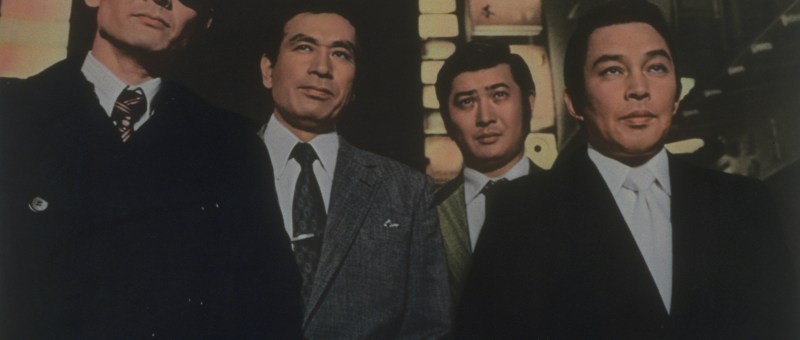
In a touch of irony, former yakuza Noboru Ando stars as a man who’s tried to leave the life behind but is pulled back into underworld intrigue when his former foot soldiers mount an ill-advised bid for revenge against the clan they feel betrayed them. After serving eight years in prison for participating in the last turf war, Egawa was given flamenco bar Madrid on the condition that he dissolve his family and attempt to go straight as a legitimate businessman. The Togiku gang has since gone legit and distanced itself from most of its old school yakuza like Egawa. But now a yakuza conglomerate from Osaka is moving in on their old turf and the Togiku want the Madrid back as a bulwark against incursion from the west which is why they’ve been sending the boys round to cause trouble in the bar. 

Egawa is the classic ex-gangster who wants to turn himself around but is largely unable to adapt to life in a changing society. He is technically in a relationship with a bar hostess who has a severe drinking problem in part exacerbated by his inability to get over his former girlfriend who left him and married the boss, Gohara, while he was in prison. His former foot soldiers attempt to convince him to get the gang back together and take revenge, resentful of having been used and discarded, but he tells them to let it go, that they’ve all got “honest jobs” and that they should try to live as best they can. Like him, the guys are ill-equipped to make new lives in the consumerist society and cannot move on from the post-war past. Hoping to engineer a turf war between the Osaka guys and Togiku, they kidnap a popular TV personality/pop singer (Minami Nakatsugawa) attached to a station which Togiku controls and frame a rival affiliated with the Osakans for taking her. 

This just goes to show the various ways in which newly corporatised yakuza have expanded their business portfolio, heavily participating in the entertainment industry moving beyond bars, clubs, and the sex trade into mainstream television and idol stars. Egawa’s old friend Yazaki (Akira Kobayashi) is his opposing number, just as caged but trapped within the confines of the new gangsterdom, reprimanded by his boss for raiding the rival studio’s offices and undoing the gang’s attempt to rebrand themselves as legitimate businessmen rather than violent street thugs. “I can’t stand being humiliated” he explains as Gohara points out he’s stepped right into their trap now giving the Osakans an excuse for retaliation. “The Togiku group is a defanged, domesticated dog” Yazaki barks, “I can’t pretend to be an obedient company employee forever and do nothing”. 

Neither man is able to progress into the new era of rising prosperity, both little more than caged animals thrashing around trying to break free but continually crashing into the bars. Just as Egawa’s old guys had tried to engineer a turf war hoping that the two gangs would take each other out and leave a vacuum they could fill, arch boss Shimamura (Tetsuro Tanba) flies above the city in a helicopter as the “worms fight among themselves” and observes the chaos below as he completes his silent conquest of the contemporary economy like some modern day Nobunaga of corporatised gangsterdom. 

Taking over the Togiku through a process of corporate infiltration and gradually ridding themselves of all the old school yakuza ill-suited to the shady salaryman life, the contrast between the world of cabaret bars and back street dives and Shimamura’s smart suits and helicopters couldn’t be more stark. A slightly sour note is struck by the use of a transgender assassin (Madame Joy) who performs a lesbian floorshow by day and kills by night while working with a bald sidekick who carries a parrot on his shoulder, her coldness bearing out the tendency of yakuza movies to associate queerness with sadistic savagery. Gosha rams his point home with the otherwise surreal scene of a pile of abandoned mannequins by a swamp that becomes a popular yakuza kill site homing in on the emptiness of their eyes and the uncanniness of dismembered bodies, mere empty shells just like the men who die in this literal wasteland. Egawa perhaps feels himself to be a man already dead long before being pushed towards his act of futile rebellion, somewhere between sitting duck and caged dog fighting for his life between the chicken coops of a moribund small-town Japan. Marching to a frenetic flamenco beat of rising passions and barely contained rage, Violent Streets leaves its former foot soldiers with nowhere to go but down while their duplicitous masters continue to prosper riding the consumerist wave into a new and prosperous future.


Violent Streets opens at New York’s Metrograph on Dec. 16 as part of Hideo Gosha x 3

Trailer (English subtitles)

Tomodachi (ともだち, Yukihiro Sawada, 1974)

As the Japanese studio system began to implode in the late 1960s, Nikkatsu which had specialised in youth cinema, pivoted towards softcore pornography rebranding itself as Nikkatsu Roman Porno. At the same time, however, they also launched an unexpected sideline of family films with strong educational aims under the Nikkatsu Children’s Films banner. Selected by the Ministry of Education and recommended by various educational and parent and teacher associations, the second feature put out under the label, 1974’s Tomodachi (ともだち), is in its own way instructional with a strong anti-bullying theme but also has something to say about the literal pollution of the contemporary society. 

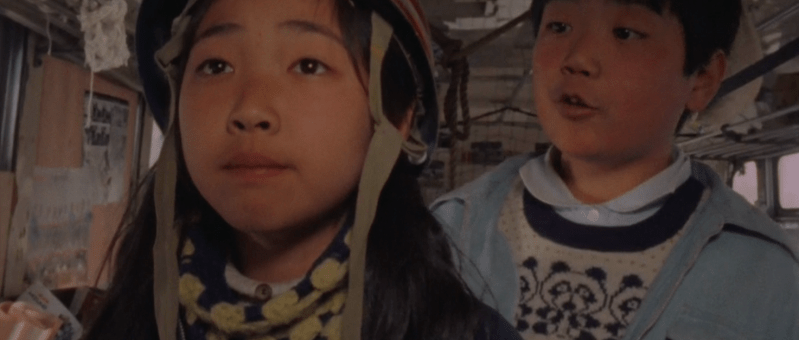
As such, the film revolves around the originally unsympathetic hero, Shinta (Hitoshi Abe), who openly bullies a girl in his class by kicking a football at her because she alone has been excused the after school duty of sweeping the school yard. Having transferred from rural Tohoko, Yoshiko (Noriko Suzuki) has developed serious asthma from living in the centre of industrial Kawasaki and has been instructed to avoid physical exertion or activities which might cause her to breath in additional dust and smoke. Shinta and his friends are however entirely insensitive, literally surrounding Yoshiko while they hound her with questions insisting she’s not really “ill” and merely shirking her duty. When the teacher tries to explain to them that Yoshiko has been excused because it would be bad for her heath to be sweeping dust, Shinta and his friends all immediately claim to be ill too, fake coughing and wheezing despite having just been playing football rather than doing their after school chores like the other kids. 

What doesn’t occur to Shinta is the loneliness, isolation, and embarrassment Yoshiko must feel on being singled out because of her illness. Rather poignantly, the school nurse and others describe how cheerful and friendly Yoshiko was when she first arrived only to reflect on how depressed and withdrawn she’s since become. This is partly as Shinta later learns because her classmates rejected her once she became ill. Asthma is obviously not a contagious disease, yet many of the other parents stopped their kids playing with her because of the stigma surrounding any kind of “illness” while simulataneously unwilling to bear the responsibility of needing to care for her if she should undergo an asthma attack while in their home or under their care fearing they would then suffer a reputational loss if they failed to treat her properly. 

For his part, Shinta is intensely resentful when the teacher sits him next to Yoshiko in the hope that his cheerfulness will help bring her out of her shell. Exclaiming that he hates sick people and thinks that Yoshiko is boring and creepy because she doesn’t really say anything, he begins to have second thoughts when the teacher implores him to help “as a man” suddenly discovering a sense of honour and justice that he doesn’t want to let down. His first action however is to continue kicking footballs at her, but strangely it works rather well providing a physical activity which is compatible with her asthma in not needing to move around while allowing her to feel part of the game. As he gets to know her more, Shinta comes to sympathise with his new friend and is angry with the other kids who reject her but discovers that his own parents are not much different refusing him permission to invite Yoshiko over on talking to other parents at the PTA in part because they run a bento store and are nervous of coming under suspicion if anyone notices a girl with a heavy cough coming and going and questions their hygiene practices. 

Shinta does, however, visit her small apartment which is unfortunately right behind a dusty construction site. As she explains, Yoshiko’s parents were part of a new agricultural drive which later failed and left them with massive debts which is why they had to leave the country to work in a factory in Kawasaki. As her parents often work late shifts for the extra money, she has to look after not only herself but her younger brother with only a pet squirrel for company. Constant references are made to other children having to change schools because their parents moved into a company dorm, while the poor quality of the air is repeatedly given as the cause of Yoshiko’s illness literally choked by the thoughtless post-war economic drive that continues to disrupt not only family lives but the local environment, Shinta also revealing that his parents used to farm seaweed but were forced to stop because of industrial pollution in local rivers. 

This destructive industry also creates unintended divisions among the children along class lines between those whose parents work manual jobs in the factories and those whose families are wealthier and involved in white collar work. The ring leader of the girls who reject Yoshiko, Ayako (Masayo Koga) is the daughter of a wealthy conservative family living in a large house with a mother (Yoshie Kitsuta) who wears kimono. When Ayako shuns her the other girls follow, Yoshiko inviting them to her birthday party only to discover them all together eating cake at Ayako’s house instead. She’d invited them partly out of worry that they were offended she hadn’t invited them to her small apartment, only then realising that they rejected her because of the stigma towards her illness leaving her feeling hopeless and dejected. As Shinta later points out, this kind of emotional pain negatively impacts her medical condition coming to despise the adult world describing his father as the worst in his class for his insistence that he should accept the way the world works rather than idealistically trying to help his new friend. 

The message of the film, however, is that it’s wrong to leave people out and that children in particular should always attempt to friendly with each other. Developing appendicitis, Shinta comes to a new appreciation of how difficult it can be being ill while his mother too starts to regret her decision finally inviting Yoshiko to come and visit them at their home after spotting her sadly walking around outside uncertain if it’s alright to come and visit Shinta on his sickbed. Shinta’s two best friends had also been not entirely supportive of his decision to bring Yoshiko into their group, referring to her as “goldfish poo” in her tendency to trail along behind them, though partly out of jealousy along with the natural awkwardness of a girl suddenly being introduced into a previously all male club but even they eventually come round and decide to reaffirm their friendship. Despite this rosy conclusion in which the other children are convinced to abandon their unfair prejudices and become friends with each other, the eventual conclusion seems rather cruel if returning to the minor theme of the destructive effects of increasing industrialisation even as Shinta’s father is also reminded of the importance of friendship in stating an intention to attend his own primary school reunion. A touching coming-of-age tale, Tomodachi puts its young hero through the emotional wringer but also allows him to discover a strong sense of justice and empathy towards those rejected by their society.