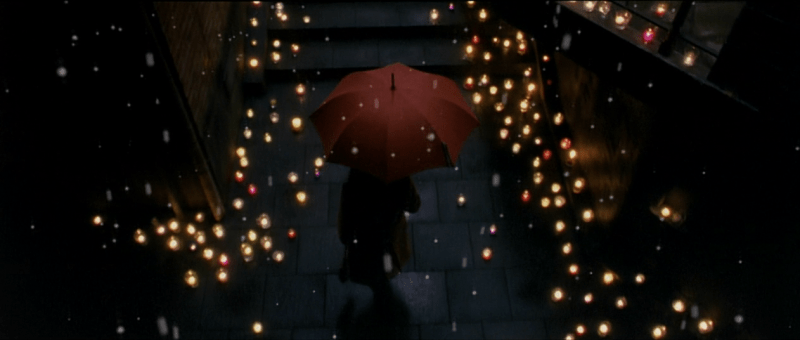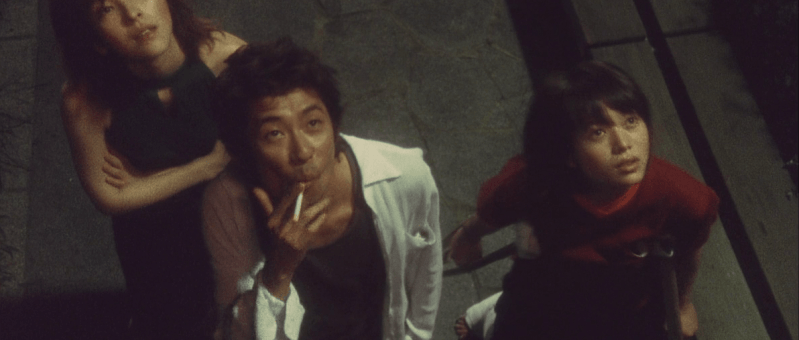

Mundane History (เจ้านกกระจอก, Anocha Suwichakornpong, 2009)

mundane history posterIs it possible to live without past or future, exist entirely within the pureness of the now? Anocha Suwichakornpong contemplates the bubble existence in her complex debut, Mundane History (เจ้านกกระจอก, Jao Nok Krajok). Class conflict jostles with the fading grandeur of a declining bourgeoisie while two young men lament their broken dreams, one believing himself a prisoner of his privilege and the other trapped by economic inequality. Yet despite their differences, the familial disconnections, and the austerity of their “soulless” environment, a connection is eventually formed making way for a rebirth, new life birthed in the ashes of the old.

Pun (Arkaney Cherkam), a nurse from a humble background, has travelled from the north to take a job as the full time carer for the son of a wealthy man, Ake (Phakpoom Surapongsanuruk), recently paralysed from the neck down after a mysterious accident. As Pun tells an intimate acquaintance, perhaps his sister, on the telephone, the house is beautiful but drenched in hopelessness and everyone within it seemingly dead inside.

Moody and resentful, Ake is now a virtual prisoner within his father’s household. Enraged by his new found impotence, he treats Pun with contempt, ironically enough embodying the role of the young master which is perhaps the key to his anger with his distant, austere father who has essentially outsourced his son’s care and then had him walled up at home like a guilty secret. Ake angrily refuses visitors, either embarrassed by his disability or not wanting to witness their pity, and spends his days doing nothing at all but staring blankly into the middle distance, unable to reconcile himself to the terrifying “mundanity” of his repetitive, unchanging existence.

As Ake becomes used to Pun’s gentle presence and allows himself to be cared for, a friendship begins to arise. Both men dreamed of becoming writers, one developing an interest in photography and the other film, but neither of them found their dreams fulfilled. Ake’s sense of defeat is palpable as he finds himself literally trapped by his father’s legacy, unable to escape the claustrophobic world of the family home and consumed by resentment as he convinces himself that his dream of becoming a film director is now unattainable thanks to his disability. Pun, meanwhile, is equally melancholy, perhaps secretly resentful but outwardly making the best of the hand he’s been dealt. From a humble background and orphaned young with siblings to support, his artistic dreams were taken from him by bad luck and socio-economic oppression though it hasn’t killed his kindly heart. 

The austere coldness of Ake’s father and the mansion’s emotional deadness perhaps represent an older generation’s longing for the safeties of an authoritarian world of rigid class boundaries and feudalistic loyalties. Ake’s housekeeper, the prim and proper Somjai (Anchana Ponpitakthepkij), is a relic of this all but forgotten world – a career servant who has silently watched Ake grow as her own youth faded and finally decides to puncture the class divide only to ensure its survival in urging Ake to maintain his stiff upper lip and avoid giving in to despair. Somjai resents Pun’s awkward, liminal status in the house as the only other member permitted to walk freely in the upstairs world and seeks to him keep down, eating with the other servants where he belongs. Pun, like the cook Kaew – also a northerner, doubts he can stay in this world indefinitely, already tired of its energy sapping rigidity and entrenched class-based social codes.

Ake’s resentment towards his father is also a rebellion against his old fashioned authoritarianism which stifles the natural desire of the young for freedom. Now literally unable to escape unaided, Ake feels as if his father has trapped him, deliberately, within the confines of his own value system with no possibility of salvation. The house is, in a sense, the eternal present that Pun and Ake talk about in one of their few moments of blissful togetherness as they lie alone on the grass lawn staring at the blue sky, but the inertia crushes them, driving young men to despair. A trip to the planetarium coupled with Ake’s youthful student films provides an opportunity for rebirth if only in destruction. Stars burn out, destroy themselves, but become nebulas in the process. Anocha Suwichakornpong’s fragmentary narrative is indeed nebulised, pulsing in brief fragments until the whole somehow connects and sparks into life. The spiritual rebirth echoes the political, the desire of youth to break free reasserts itself and the mundane history of an ordinary life regains its cosmic grandeur.


Original trailer (English subtitles)

Running Turtle (거북이 달린다, Lee Yeon-woo, 2009)

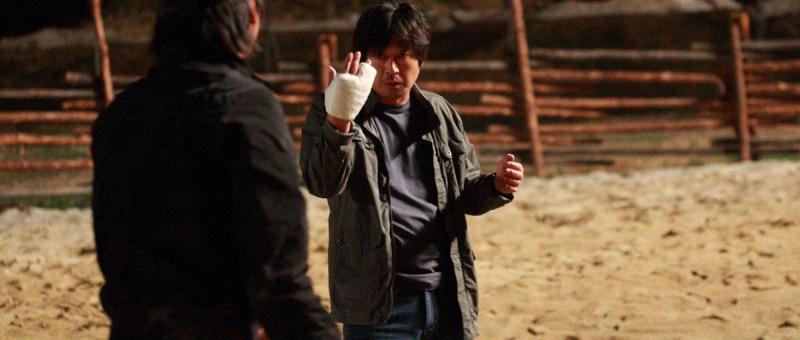
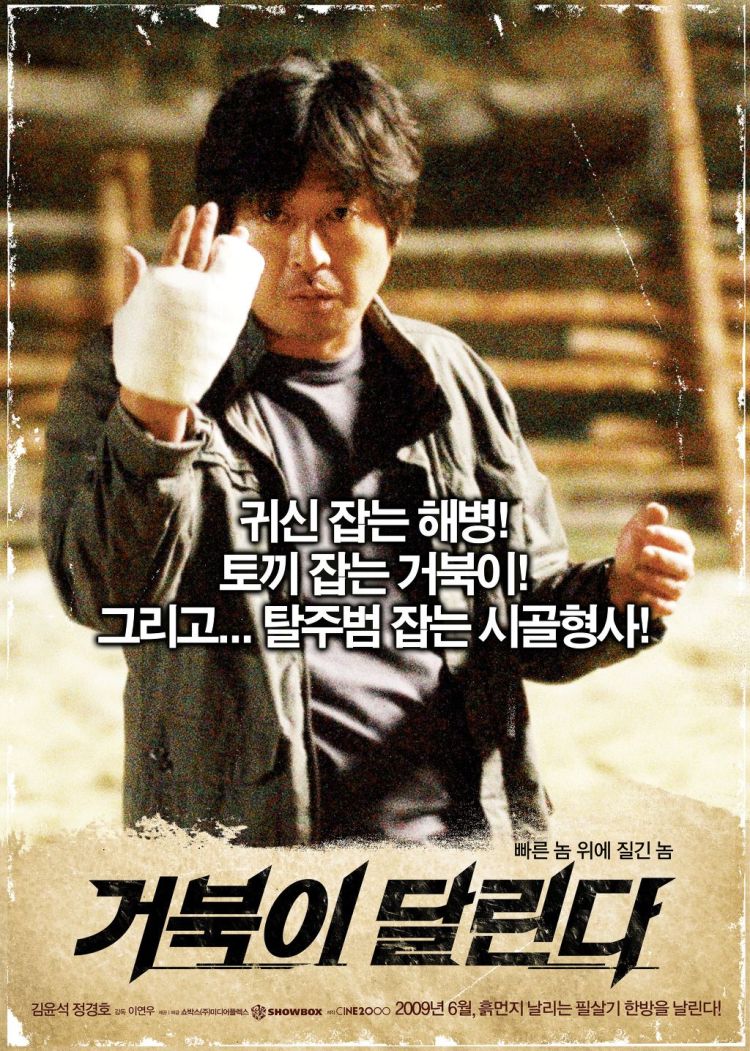
running turtle posterOne has to wonder why anyone becomes a policeman in Korea, or at least in the world of Korean movies. A policeman’s work is never done, yet they rarely prosper and often succeed in making themselves look ridiculous. The hero of Running Turtle (거북이 달린다, Geobuki Dalinda), played by The Chaser’s Kim Yoon-seok, is a case in point. Unlike Joong-ho, Pil-seung is still on the force (for the time being) but even for a small town beat cop he’s pushing his luck. It’s not surprising then that he gets himself all fired up when he comes into contact with a notorious fugitive from justice.

Pil-seung (Kim Yoon-seok) is among the least well-respected on a small team of police officers nominally upholding justice in a tiny fishing village. Mostly his day job involves harassing local sex workers which he mostly does by means of entrapment whilst hanging out with petty crooks like local loser gangster Yong-bae (Shin Jung-geun). Looked down on at work, things don’t improve much for Pil-seung at home where, despite the admiration he receives from the older of his two daughters, Pil-seung fails to pull his weight leaving his wife to supplement the family income by running a moribund manwha cafe whilst reduced to folding socks for the extra pennies. Then again, home is a place Pil-seung rarely goes, preferring to waste his life drinking and gambling.

On a rare occasion of busting his gut for justice, Pil-seung takes things too far with a pimp who’s a little on the heavier side and ends up almost dying after an “undue force” provoked heart attack. Suspended, Pil-seung has another set of problems in being without money for three months and being too afraid to tell his wife the truth. Stealing her savings and betting them on a local bull-fight Pil-seung’s luck comes up only to go down again when escaped fugitive and martial arts expert Gi-tae (Jung Kyung-ho) pinches the money off Yong-bae in payback for Yong-bae getting fresh with his girl (to be fair, Yong-bae had it coming).

What follows is a locking of horns as filled with macho posturing as the central bullfight between the “Bear” and “Typhoon”, though possibly not as elegant. Gi-tae, softly spoken and melancholy, has returned to an old love and means to leave the scenes of his crimes behind him for good. This whole thing with Pil-seung is a major irritation but he has no especial interest in the portly policeman other than needing to get rid of him long enough to escape with his patient lady-love.

Pil-seung’s motivations are different. Yes, he’s originally pissed off and wants his money back, but Gi-tae also represents an opportunity for him prove himself as everything he’s hitherto failed to be – a success, a strong man, someone worthy of respect. Sadly, Pil-seung will have to work quite hard to convince himself he can be any of these things, let alone convince anyone else. Trapped in his tiny rural town, Pil-seung has long felt impotent and oppressed. He can’t provide for his wife whose lack of respect for him is real enough, though noticing the holes in her underwear as he goes in for a not altogether romantic overture reminds Pil-seung that perhaps he needs to shape up and make something of himself before it’s too late. Generally he eases his feelings of inadequacy and existential despair through alcohol, gambling, and being the big guy around petty gangsters to whom he is useful but again, not a figure to be feared, loved, or respected.

Going up against a top criminal like Gi-tae all alone is a fairly stupid proposition in the first place, one only someone as deliberately pig-headed as Pil-seung would ever attempt. It’s his particular quality of bloodymindedness which becomes Pil-seung’s trademark as he absolutely refuses to give up on clawing his way back into the hearts of his wife and family through an act of officially recognised heroism though it’s true enough that if he’s going beat a man like Gi-tae (who often seems the unfair target of Pil-seung’s petty quest) he’ll need to reawaken some of those little grey cells to do it. The turtle of the title, Pil-seung chases his hare with furious, if plodding, determination only to see victory within his grasp through no fault of his own. It just goes to show, slow and steady wins the race but obsessive hard headedness doesn’t hurt either.


Currently available to stream in the UK (and possibly other territories) via Netflix.

Original trailer (English subtitles)

Honey and Clover (ハチミツとクローバー, Masahiro Takada, 2006)

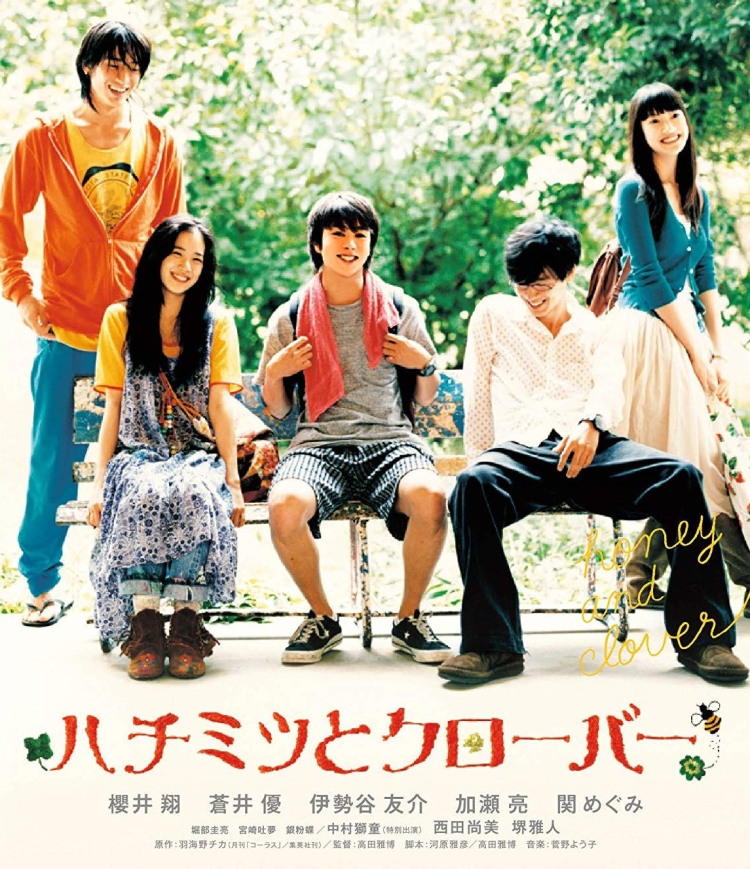
honey and clover blu-rayAh youth! Chica Umino’s phenomenally popular manga Honey and Clover (ハチミツとクローバー, Hachimitsu to Clover) is, essentially, a coming of age story in which love, requited and otherwise, plays a significant part. Masahiro Takada’s adaptation is no different in this respect as its central group of friends learn to come into themselves through various different kinds of heart break leading to soul searching and eventual self actualisation. The path to adulthood is rocky and strewn with anxieties, but has its own charms as our self branded Mr. Youth seems to have figured out, romanticising his own adolescence even while he lives it.

The action kicks off at an art college in Tokyo where a circle of friends is temporarily shaken by the arrival of a new student – a distant relative of a popular professor, Hanamoto (Masato Sakai). Our youth loving hero, Takemoto (Sho Sakurai), falls instantly in love with Hagu (Yu Aoi) – a genius self-taught painter with a dreamy, ethereal personality and negligible interpersonal skills. Hagu, however, seems to have developed a strange connection with conceited sculptor Morita (Yusuke Iseya) who continues to struggle with his conflicting interests in art and commerce. Meanwhile, geeky design student Mayama (Ryo Kase) has a problematic crush on his boss, Rika (Naomi Nishida), whose husband went missing some years ago, and has begun semi-stalking her. Unbeknownst to him, Mayama is also being semi-stalked by Yamada (Megumi Seki) – a spiky ceramicist who refuses to give up on her unrequited crush despite being fully aware of his one sided love for a brokenhearted middle-aged woman.

In actuality all of our protagonists are a little older than one might assume – all past the regular age for graduating college and either hanging around after being unable to complete their studies or pursuing additional training in the hope of furthering their art. They are all also hopelessly lost in terms of figuring out who they are – perhaps why they haven’t quite got a handle on their art, either. Hagu, younger than the others, seems to have an additional problem in existing outside of the mainstream, experiencing difficulties with communication and needing some additional help to get into the swing of college life. Perhaps for this reason, maverick professor Hanamoto palms her off on the “least arty” (read “most responsible”) of his students, Takemoto, who is tasked with accompanying her for meals – something for which he is quite grateful given his first brush with love on catching sight of her at her easel.

Hagu is also, however, the most sensitive and perceptive of the students even if she can only truly express herself through canvas. Her most instantaneous connection is with Morita, whose instinctive approach perhaps most closely mirrors her own though where Hagu is quiet and soulful, Morita is loud and impetuous. Watching him creating his centrepiece sculpture, Hagu is honest enough to tell Morita that he’s overdone it. Morita agrees but ends up exhibiting the piece anyway and not only that – he sells it for a serious amount of money despite knowing that it lacks artistic integrity. Hagu is unimpressed and her disapproval only adds to Morita’s sense of self loathing in his ambivalence towards to the fleeting rewards of superficial success versus the creation of artistic truth.

A similar sense of ambivalence imbues the romantic difficulties which neatly divide the group into a series of concentric love triangles. Takemoto, the selfless hero, realises the best thing he can do for Hagu is try to help Morita be less of a self-centred idiot while simultaneously dwelling on his fleeting youth and actively pursuing himself while debating whether or not to hit the road and leave his lovelorn friends to it. Mayama and Yamada, by contrast, are content to dance around each other, understanding the irony of their respective unreturned crushes while not quite bonding over them but both determined not to give up on their dreams (romantic and professional).

Despite the central positioning of our shy hero as he walks towards the end goal of being able to state his feelings plainly, the drama revolves around the enigmatic Hagu whose descent into an intense depression after an ill-advised moment on a beach is only eased by the careful attentions of her new friends finally realising that their artistic souls benefit from compassion for others rather than remaining solipsistically obsessed with their own romantic heartbreak. Despite its noble intentions, Honey and Clover misses the mark in charting the heady days of youth though our confused heroes do eventually manage to find themselves and each other along the road to adulthood as they chase down disappointments romantic and professional and discover what is they really want in the process.


Original trailer (no subtitles)

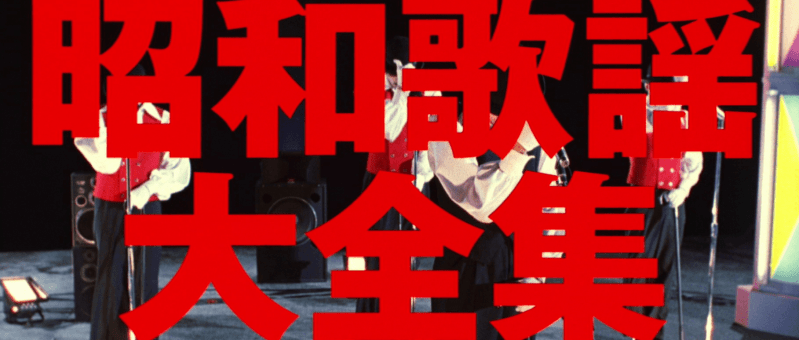
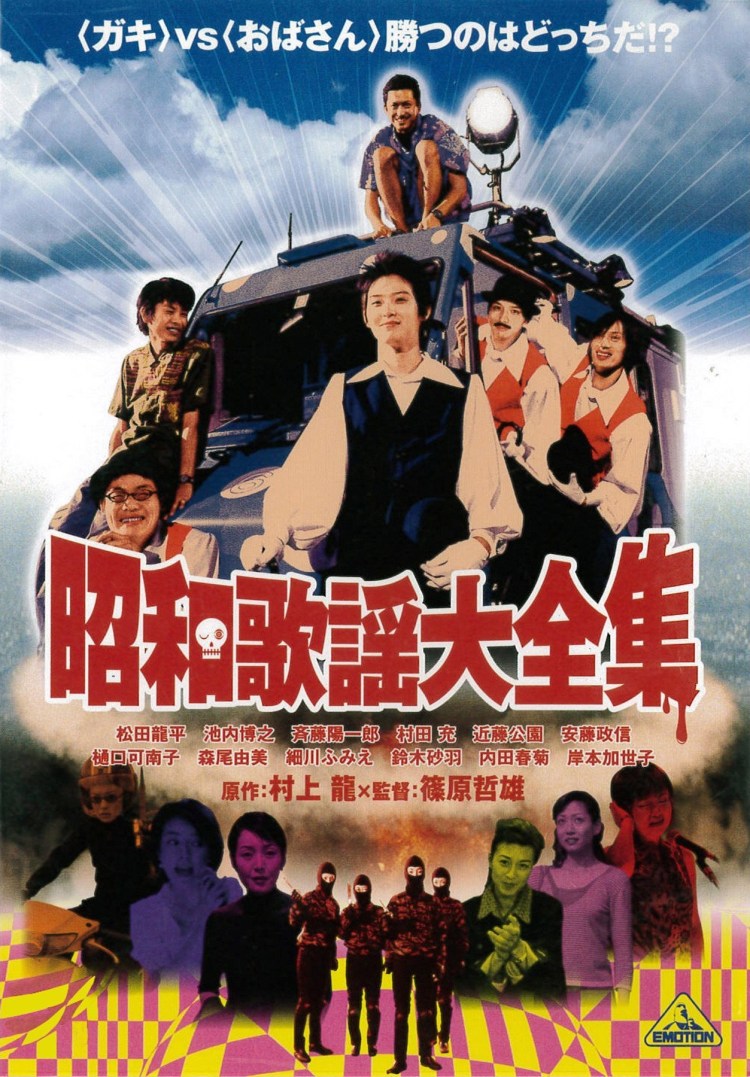
Karaoke Terror (昭和歌謡大全集, Tetsuo Shinohara, 2003)

karaoke terror poster.jpgEver since its invention karaoke has provided the means for many a weary soul to ease their burdens, but there may be a case for wondering if escapism is a valid goal in a society which seems to be content in stagnation. The awkwardly titled Karaoke Terror (昭和歌謡大全集, Showa Kayo Daizenshu), adapted from the book Popular Hits of the Showa Era by Audition’s Ryu Murakami, pits two very different groups of karaoke enthusiasts against each other – aimless adolescent males, and jaded middle-aged women. Despite the differences in their ages and experiences, both enjoy singing the wistful bubblegum pop of an earlier generation as if drunk on national nostalgia and longing for the lost innocence of Japan’s hopeful post-war endeavour to rebuild itself better than it had been before.

We open with the slackers and a voice over from the presumed “hero” of the film, Ishihara (Ryuhei Matsuda), who informs us that he can’t really remember how he met most of the guys he hangs out with but that he always knew the one of them, Sugioka (Masanobu Ando), was a bit cracked in the head. In a motif that will be repeated, Sugioka catches sight of a middle-aged woman just on the way back from a shopping trip and decides he must have her but his attempts to pick her up fail spectacularly at which point he whips out his knife and slashes her throat.

Meanwhile, across town, a middle-aged woman, Hemmi (Kayoko Kishimoto), offers to let a co-worker share her umbrella but the co-worker misinterprets this small gesture of courtesy as romantic interest and crudely asks her “how about a fuck?” to which Hemmi is quite rightly outraged. Rather than apologise, the co-worker shrugs and says his “direct” approach works six times out of eight and some women even appreciate it. Once she manages to get away from her odious aggressor, Hemmi ends up stumbling over the body of the woman murdered by Sugioka and realises she knows her. The murdered woman was one of six all named Midori who were brought together for a newspaper article about the lives of middle-aged divorced women and have stayed “friends”. Outraged about this assault not just on their friend and their sex but directly against “women of a certain age” who continue to be the butt of a societal joke, the Midoris decide they want revenge and hatch a plan off Sugioka, but once they have, the slackers hit back by offing a Midori and so it continues with ever-increasing levels of violence.

Which ever way you slice it, you can’t deny the Midoris have a point and Hemmi’s continuing outrage is fully justified. When the boys rock up at a mysterious general goods store out in the country looking for a gun, the proprietor (Yoshio Harada) is only too happy to give it to them when they explain they need it for revenge and that their targets are middle-aged women. The proprietor has a lot to say about ladies of a certain age. In fact he hates them and thinks that bossy, embittered, unproductive women “too old” to fulfil their only reason for existence will be the only ones to survive a nuclear apocalypse that even the cockroaches cannot overcome. The boys appear timid and inexperienced but ironically enough can’t take their eyes off the middle-aged woman from across the way and her sexy dance routines. They feel entitled to female deference and cannot accept a woman’s right to decline. The Midoris are sick of being “humiliated”. They’ve fallen from Japan’s conformist path for female success in getting divorced or attempting to pursue careers. They’ve lost their children and endured constant ridicule as “sad” or “desperate”, made to feel as if their presence in the workplace past a certain age was “inappropriate” and the prices they have paid for their meagre successes were not worth the reward. They strike back not just at these psychotic boys but at a society which has persistently enacted other kinds of violence upon them.

Meanwhile, the boys remain boys, refusing adulthood and responsibility by wasting their time on idle pursuits. Truth be told, karaoke performances involving dance routines and elaborate costumes is not a particularly “cool” hobby by the standards of the time but it appears that none of these men have much else in their lives to invest themselves in. With the economy stagnating and the salaryman dream all but dead, you can’t blame them for their apathy or for the rejection of the values of their parents’ generation, but you can blame them for their persistent refusal to grow up and tendency to allow their insecurities to bubble over into violence.

As it turns out, adolescent males and middle-aged women have more in common than might be thought in their peripheral existences, exiled from the mainstream success which belongs exclusively to middle-aged and older men who’ve been careful to (superficially at least) adhere to all the rules of a conformist society. Neither group of friends is especially friendly, only latterly realising that “real” connections are forged through direct communication. Their mutual apathy is pierced only by violence which, ironically, allows their souls to sing and finally shows them just what all those cheerful songs were really about. Darkly comic and often surreal, Karaoke Terror is a sideways look at two diametrically opposed groups finding unexpected common ground in the catharsis of vengeance only for their internecine warfare to graduate into world ending pettiness.


Original trailer (English subtitles)

The greatest hits of the Showa era:

Koi no Kisetsu – Pinky & Killers

Hoshi no Nagare ni – Akiko Kikuchi

Chanchiki Okesa – Haruo Minami

Shiroi Cho no Samba – Kayoko Moriyama

Linda Linda – The Blue Hearts

Sweet Memories – Seiko Matsuda

Kaze Tachinu – Seiko Matsuda

Minato ga Mieru Oka – Aiko Hirano

Sabita Knife – Yujiro Ishihara

Hone Made Aishite – Jo Takuya

Kimi to Itsumademo – Yuzo Kayama

Mata Au Hi Made – Kiyohiko Ozaki

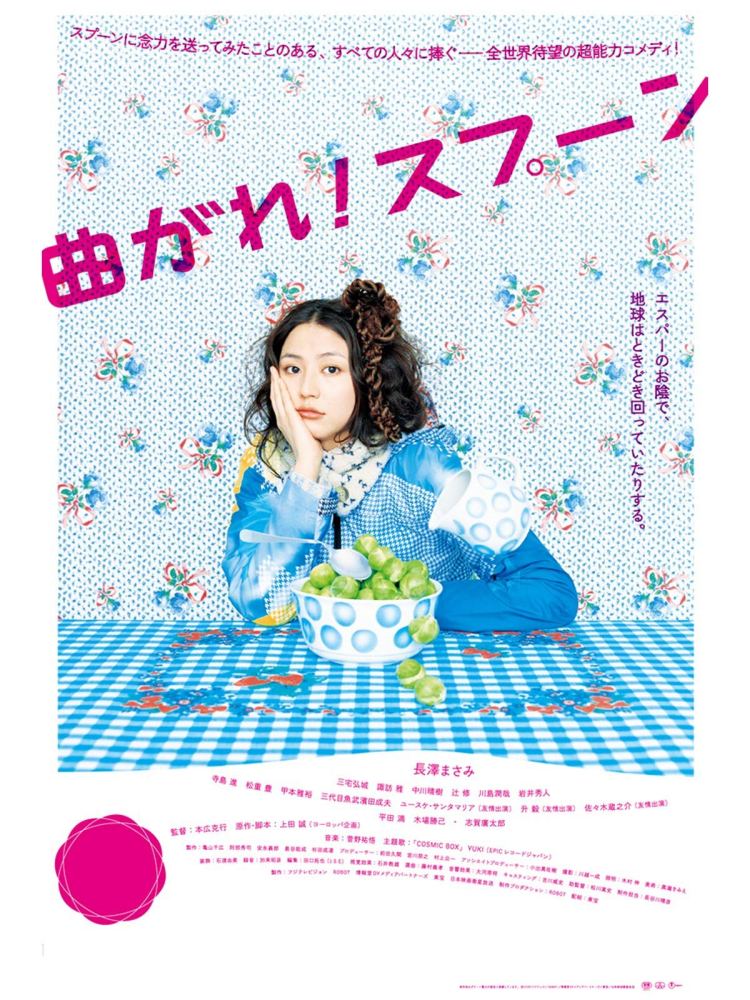
Go Find a Psychic! (曲がれ!スプーン, Katsuyuki Motohiro, 2009)

go find a psychic posterHow old is too old to still believe in Santa? Yone Sakurai (Masami Nagasawa), the heroine of Katsuyuki Motohiro’s Go Find a Psychic! (曲がれ!スプーン, Magare! Spoon) longs to believe the truth is out there even if everyone else thinks she must be a bit touched in the head. If there really are people with psychic powers, however, they might not feel very comfortable coming forward. After all, who wants to be the go to sofa moving guy when everyone finds out you have telekinesis? That’s not even factoring in the fear of being abducted by the government and experimented on!

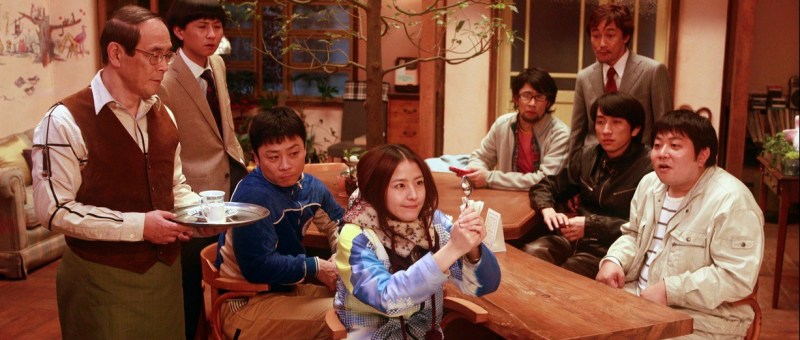
In any case, Yone has her work cut out for her when the TV variety show she works for which has a special focus on paranormal abilities sends her out out in search of “true” psychics after a series of on air disasters has their viewer credibility ratings plummeting. Ideally speaking, Yone needs to find some quality superhero action in time for the big Christmas Eve special, but her lengthy quest up and down Japan brings her only the disappointment of fake yetis and charlatan monks. That is until she unwittingly ends up at Cafe Kinesis which holds its very own psychics anonymous meeting every Christmas Eve so the paranormal community can come together in solidarity without fearing the consequences of revealing their abilities.

Based on a comic stage play, Go Find a Psychic! roots its humour in the everyday. The psychics of Cafe Kinesis are a bunch of ordinary middle-aged men of the kind you might find in any small town watering hole anywhere in Japan. The only difference is, they have a collection of almost useless superhuman abilities including the manipulation of electronic waves (useful for getting an extra item out of a vending machine), telekinesis (“useful” for throwing your annoying boss halfway across the room), X-ray vision (which has a number of obvious applications), and mind reading (or more like image transmission). The bar owner is not a psychic himself but was once helped by one which is why he set up the bar, hoping to meet and thank the person who frightened off an angry dog that was trying to bite him. Seeing as all the guests are psychic, no one is afraid to show off their talents but when a newcomer, Mr. Kanda (Hideto Iwai), suddenly shows up it creates a problem when the gang realise his “ability” of being “thin” is just the normal kind of skinniness. Seeing as he’s not a proper psychic, can they really let him leave and risk exposing the secrets of Cafe Kinesis?

Meanwhile, Yone’s quest continues – bringing her into contact with a strange man who claims he can withstand the bite of a poisonous African spider. Needless to say, the spider will be back later when the psychics become convinced Yone’s brought it with her presenting them with a conflict. They don’t want her to find out about their psychic powers and risk getting put on TV, but they can’t very well let her walk off with a poisonous spider trapped about her person. Despite small qualms about letting Kanda leave in one piece, the psychics aren’t bad guys and it is Christmas after all. Realising Yone just really loves all sort of psychic stuff and is becoming depressed after getting her illusions repeatedly shattered, the gang decide to put on a real Christmas show to rekindle her faith in the supernatural.

Just because you invite a UFO to your party and it doesn’t turn up it doesn’t mean it doesn’t exist. Some things can’t be explained by science. Maybe those old guys from the bar really can make miracles if only someone points them in the right direction. Like a good magic trick, perhaps it’s better to keep a few secrets and not ask too many questions about how things really work. For Yone the world is better with a little magic in it, even if you have to admit that people who want to go on TV aren’t usually going to be very “genuine”. That doesn’t mean that “genuine” isn’t out there, but if you find it you might be better to keep it to yourself or risk losing it entirely.


Original trailer (no subtitles)

Until the Lights Come Back (大停電の夜に, Takashi Minamoto, 2005)

Until the Lights Come Back posterChristmas is, among other things, conveniently held on the same day every year. As such, it can’t help but become a moment of minor introspection inviting a thorough investigation of a life’s trajectory. In Japan, Christmas is also about romance which means it can also be an intense or melancholy occasion in which relationships past and present come up for reappraisal. Takashi Minamoto’s ensemble drama Until the Lights Come Back (大停電の夜に, Daiteiden no Yoru ni) spins a tale of city life as it catches hold of a number of accidentally connected souls and puts them through the emotional ringer thanks to an artificial psychological pause engineered by a power cut on Christmas Eve,

A melancholy barman sets a record going. A boy tracking satellites sees a girl hovering dangerously close to edge of the roof opposite. A conflicted salaryman finds out a dark family secret. A mistress is dumped while a wife wonders how much longer she should wait. A pregnant woman is chased by a yakuza, and an old lady gets an unexpected phone call.

Somehow, all of these events are connected though it takes a moment to figure out how. Christmas is a time for romance, but for the dejected salaryman, Ryotaro (Tomorowo Taguchi), it’s about to become a very difficult day indeed. When his terminally ill father decides to tell him the secrets of his birth, it prompts him into a mild bout of introspection concerning his own familial relationships. Ten years with the patient Shizue (Tomoyo Harada) haven’t cured his philandering and the marriage is strained to breaking point. Still, he thinks nothing of cancelling their special Christmas Eve dinner together to go meet his mistress even if his true purpose is to end things before they get any more complicated.

Missed connections and frustrated love stories continue to dominate. The mistress, Misuzo (Haruka Igawa), gets into a lift with Chinese bellboy Dongdong (Tsuyoshi Abe) who was supposed to be going back to Shanghai to visit his long-distance girlfriend who he worries is losing interest. Meanwhile, the melancholy barman, Mr. Kido (Etsushi Toyokawa), is pining for a failed love of his own – a woman he foolishly abandoned and then tried to pick back up again only to learn she had married someone else and that the marriage was unhappy. Mr. Kido gave up his musical dreams to open a jazz bar in the hope his love would someday return to him, only to be visited by “hope” in a different form – that of the strange young woman, Nozomi (Tomoko Tabata), from the across the way who’s about to have a very big business night in her off the beaten track artisanal candle shop.

Meanwhile, the recently released ex-yakuza, Gin (Koji Kikkawa), pines for his lost love in the form of the heavily pregnant Reiko (Shinobu Terajima) who swore to wait for him but eventually drifted away and married someone else though she seems to be happy enough which, strangely, he seems to find a comfort. When the lights go out there’s nothing much else to do but talk and think and so each of our wounded protagonists is forced to put their pain into focus, considering the wider context of an emotional landscape and attempting to find accommodation within it. Mr. Kido can’t quite let go of his failed love, however much he might want to, but Gin can perhaps learn to be thankful that the woman he loved found someone nice who looked after her when he couldn’t.

While the older generation swap stories of the eerie wartime blackouts and those of the comparatively less worrying power outages born of an inability to keep up with a rapidly recovering economy, the young make the best of it – swapping the twinkling lights of Christmas displays for the wonder of the stars. Candlelight and unexpected friendships give birth to new ways of thinking and create their very own Christmas miracles which seem set to pave a way towards a happier future for all in which forgiveness and understanding rule. Strangely warm yet never sentimental, Until the Lights Come Back captures a brief moment of stillness in a lonely city as its disconnected heroes find themselves pulled into a series of concentric epiphanies, putting the past to rest while learning to embrace an as yet unseen future.


Original trailer (no subtitles)

It’s Only Talk (やわらかい生活, Ryuichi Hiroki, 2005)

It's Only Talk poster“I’m scared of wanting to die” the heroine of Ryuichi Hiroki’s It’s Only Talk (やわらかい生活, Yawarakai Seikatsu) confesses during an awkward car ride with a childhood friend, perhaps one of the only absolute truths she offers in her infinite quest to escape existential loneliness through the false connection of mass tragedy. Yuko (Shinobu Terajima) tells people that her parents died in the Kobe Earthquake, but they actually died in a house fire a few years later. She tells people that her best friend died in 9/11 (she died in New York in the early 2000s but in a car accident), and that her former lover died during the sarin gas attacks on the Tokyo Subway (this one might even be true, but who really can say). She lies, not about facts only details, in the belief that her private pain is somehow not relatable enough and if she ties herself into a wider sense of national or global tragedies then others can share in her grief and she won’t be so alone in her sadness.

Following the deaths of her parents when she was 29, Yuko was diagnosed with bipolar and has been in and out of hospitals for the past six years. Now 35, single, and unemployed, Yuko has found herself cast out from mainstream society and fulfils her (minimal) needs for human connection through meeting “perverts” on specialist message-boards. Through one of these illicit connections she meets K. (Tomorowo Taguchi) – a 50-year-old husband and father who drives her all the way out to provincial suburb Kamata to ensure the liaison (which extends only to watching a porn film together in a public cinema and a cup of tea afterwards) remains secret. Taken with the suburb’s retro charm and unassuming air of faded grandeur, she decides to move and starts life over again in the somewhat nostalgic past which brings her into contact with two men from her youth and another still battling his own.

A portrait of inescapable loneliness, Yuko’s life is both as frozen as the photographs she takes of local landmarks to post on her fledgling blog and permanently in flux as she tries to navigate the constantly shifting tides of her condition. After moving to Kamata she unexpectedly reencounters an old university friend who recalls their spirited discussions of world politics from the fall of the Berlin Wall to Tiananmen Square when they were both bright and engaged students. Like Yuko, Honma (Shunsuke Matsuoka) has wound up in Kamata as a kind of retreat from the harshness of life in Tokyo. Unwilling to embrace life in the public eye, he’s decided to concentrate on a career in local politics instead hoping to work his way into the ministry of education as a civil servant. He is also unmarried – partly as a result of debts accrued during unsuccessful electoral campaigns, and, as we later find out, erectile dysfunction. Honma reintroduces Yuko to another old friend, “Bach” (Nao Omori) who has gone the opposite way and become a venture capitalist but apparently still holds a torch for the young Yuko all these years later. Meanwhile, she’s been meeting up with a lonely yakuza, Noboru (Satoshi Tsumabuki), who also has bipolar and longs for the world of childhood safety and innocence he associates with the strange Godzilla tyre park Yuko photographed and put on her blog.

The most significant relationship in her short-lived period of connection is in fact with her childhood friend and cousin, Shoichi (Etsushi Toyokawa), who abruptly turns up at her flat unannounced. Shoichi, also depressed but perhaps in a less extreme way and hiding it much better, left his marriage because he felt pushed out when the baby was born and then ran after a younger woman who went to Tokyo but ultimately did not want him. The two share a strange sort of intimacy born of their long history which is almost fraternal but laced with minor awkwardness and ancient resentments. Though his wife berated him for his refusal to help out at home, Shoichi tenderly cares for Yuko just as she is at her most vulnerable having entered an extreme depressive episode – washing her hair, doing her laundry, and picking up her medication while trying to remain patient even when Yuko rejects his gestures of help. The giving and receiving of care provides each with a new sense of purpose and connection but their paths are perhaps set on different courses in the immediacy of the need to deal with the unresolved past.

Waking up from her depression, Yuko discovers life has delivered her yet another cruel blow, witnessing others moving on in one way or another and leaving her once again all alone marooned on the sidelines. Yet she lives on, “scared of wanting to die” but daring to remove the towel which hides an ugly scar from a previous suicide attempt to revisit a public bath which holds a memory perhaps both happy and sad. Melancholy in the extreme, It’s Only Talk is not a tragedy but an aching portrait of spiritual loneliness in a society only too happy to exclude.


Original trailer (no subtitles)

This Charming Girl (여자, 정혜, Lee Yoon-ki, 2004)

This Charming GirlIt’s strange how, even in this increasingly interconnected world, our relationships with those around us are often wilfully superficial. Trapped within our own self-obsessed perspectives, we often fail to see beneath the surface of social conformity to realise that others are also lonely or troubled, wishing someone would see them but also afraid to make plain the various ways they don’t measure up to a social ideal. The heroine of Lee Yoon-ki’s This Charming Girl (여자, 정혜, Yeoja, Jeong-hye) is just such a woman – “charming” in her perfectly composed exterior, in many ways an embodiment of traditional femininity in her near invisibility as she gets on with her life and work quietly and with efficiency. There are however tiny cracks in the surface of her ordered existence that betray an ongoing, perhaps incurable anxiety.

Jeong-hae (Kim Ji-soo), a young woman in her late twenties, has an ordinary job working on the counter in the local post-office. As we later find out, she was once married but walked out on her new husband on their wedding night and, following the death of her mother, lives alone in the same apartment she has lived in all her life. Despite being well liked at work and taking lunch with the office ladies, Jeong-hae is perhaps not quite part of the group and finds it hard to relate to her noisy colleagues who gossip about her behind her back and when all is said and done probably regard her as a fellow employee rather than friend. Jeong-hae’s days are mostly spent alone, her interactions with others outside of work extend only to awkward telephone conversations with an unkind aunt, and an angry neighbour complaining about her extremely loud alarm clock.

Despite her shyness and self-imposed isolation, Jeong-hae is a kind and caring person with a gentle, nurturing personality. In the absence of human connection, she lovingly tends to her plants but is wary of taking on responsibility for more complex creatures and it’s only after a few mornings of noticing a melancholy, mewling kitten on her way to the bus stop that she decides to pick it up and take it to a vet. Suddenly being a cat owner has a profound impact on Jeong-hae’s way of life even if the skittish creature echoes her own sense of mistrust born of previous trauma in insisting on hiding under the sofa. Bonding with a living creature brings back painful memories of her traumatic past which threaten to impede her new sense of forward motion even as she attempts to outrun them.

The kitten isn’t the only stray Jong-hae picks up, later she takes pity on a sad young man who became involved in a drunken bar fight and alienated all his friends. Generally speaking, for reasons we later come to understand, Jeong-hae is wary of men and of male physicality. A rare visit to a shoe shop provoked by an unpleasant meeting with her ex-husband who has only got back in touch to express how much she hurt him by walking out without explanation, makes plain her distress even with perhaps “ordinary” everyday interactions. Though she does her best to endure it, Jeong-hae’s discomfort with the salesman’s hard sell tactics as he uses overfamiliar language and roughly manhandles her feet into a pair of sandals (which do not really suit her) eventually results in an extremely rare instance of self-assertion as she tells the assistant off, politely, before stopping to advise the woman behind the counter that perhaps men should not be selling women’s shoes or at any rate they should treat their customers as “people” rather than sales targets. Nevertheless, something about the drunken young man tells her that he is not a threat, only another person who seems to be in a dark place and probably in need of a stranger’s ear.

It’s perhaps this same sense of “recognition” that prompts her into making an extremely forward and uncharacteristically bold overture towards a shy young writer (Hwang Jung-min) who comes to the post office regularly to send off his manuscripts. If we get the sense that Jeong-hae is a mostly invisible person, then the writer is much the same. We catch sight of him often in the background, shopping in convenience stores, sitting at outdoor tables, waiting to cross the road. He’s the kind of person that perhaps only someone like Jeong-hae, equally invisible, a supernumerary even within her own world, might recognise. The tragedy is that Jeong-hae has a lot of love to give but has been robbed of the knowledge of how to give it safely thanks a traumatic incident in her past in which her innocence and naivety were abused by a person of trust who left her with no one to turn to for protection and a deeply internalised sense of shame and rage.

Her traumatic memories surround her like living beings, occupying the same space, occasionally poking their heads into her everyday life to remind her of an unpleasant association she couldn’t forget if she tried. Jeong-hae no longer sleeps, she naps fitfully on the sofa or wanders around all night at markets and cafes; she craves connection, but cannot access it. Thanks to the cat, the ex, the writer, even the overbearing shoe shop assistant and drunk man, she begins to find a way forward even if it pushes her towards an equally dangerous conclusion, and suddenly perhaps it’s not quite all so hopeless as it seemed.


This Charming Girl was screened as part of the 2018 London Korean Film Festival.

Original trailer (no subtitles)

Grain in Ear (芒种 / 망종, Zhang Lu, 2005)

Grain in Ear posterChinese-Korean director Zhang Lu has made a career of exploring the lives of those living on the margins of modern China and most particularly those of the ethnic Korean minority. 2005’s Grain in Ear (芒种, Máng zhòng, 망종, Mang Jong) brings this theme to the fore through the struggles of its stoic heroine who bears all her troubles with quiet fortitude until the weight of her despair threatens an already fragile sense of civility, consistently eroded by multiple betrayals, misuses, and an unforgettable othering. Yet she is not entirely alone in her outsider status even if there is precious little value in solidarity among the powerless in a world of circular oppressions.

32-year-old Cui Shun-ji (Liu Lianji) has moved to a small town with her young son Chang-ho (Jin Bo) following her husband’s conviction of a violent crime. Unable to find work, she ekes out a living illegally selling kimchi from a cart without a permit while Chang-ho busies himself playing with the neighbourhood kids in the rundown industrial town. Isolated not only as a newcomer but as a member of the ethnic Korean minority, Shun-ji keeps herself to herself but can’t help attracting the attentions of the locals some of whom are merely curious about her spicy side dishes while others are intent on helping themselves to things which aren’t actually on sale.

There is something peculiarly perverse about Shun-Ji’s decision to make her living selling kimchi. It is both an act of frustrated patriotism and a kind of commodification of her ethnicity though she seems to have intense pride in her ability to produce her national dish even if there is not often as much calling for it as she would like. Meanwhile, at home, Shun-ji virtually tortures little Chang-ho into trying to learn the Korean alphabet as a way of fastening him closely to his heritage and community, but Chang-ho is a Chinese boy to all intents and purposes. He may understand Korean, but he doesn’t want or need to speak it and resents his mother’s attempts to reinforce his Koreanness.

Meanwhile, despite her aloofness, Shun-ji eventually forms a kind of relationship with a lonely Korean-Chinese man, Mr. Kim (Zhu Guangxuan), who visits her cart. Brought together by a shared sense of loneliness and a connection born only of a mutual ethnicity, the pair drift into an affair but Shun-ji’s dreams of romantic rescue will be short lived. Her lover is a weak willed man married to a feisty Chinese woman who will stop at nothing to recapture her henpecked husband. Cornered, Kim tells his wife it’s not “an affair” because money changed hands, branding Shun-ji a prostitute and getting her arrested by the police to prove his point.

To be fair, Shun-ji’s married lover is another oppressed minority afraid of the consequences of non-compliance, but he’s also just one of the terrible men that Shun-ji will encounter in her quest towards independence and self sufficiency. Her husband killed a man for money and left his family to fend for themselves when he went to prison for it. Her lover called her a whore and left her at the mercy of the police. A man who offered to help with a lucrative kimchi contract turned out to be after another kind of spice, and the kindly policeman who stopped by her cart with tales of his impending marriage turned out not to be so nice after all.

In this fiercely patriarchal world, women like Shun-ji have no one to rely upon but each other. Marginalised by poverty, ethnicity, and unfamiliarity, Shun-ji and Chang-ho live in a small shack behind the railway next to the local sex workers. Chang-ho, too small to understand why everyone calls the women next-door “chickens”, treats them all like big sisters while a kind of solidarity emerges between Shun-ji and the melancholy youngsters from far away towns who’ve travelled to this remote place to ply their trade out of desperation, too ashamed to stay any closer to home. One of the sex workers tries to warn Shun-ji about Kim – men who buy their services are not especially good romantic material, but it’s advice that falls on deaf ears. Shun-ji wants to believe better of her compatriot, but her faith is not repaid.

Zhang, in a familiar motif, foregrounds Li Bai’s famous ode to homesickness, giving it additional weight in the mouth of little Chang-ho whose longing is for another kind of home in contrast to his mother’s continued need to believe in the solidarity of her community. Yet even she eventually loses faith, tearing up Chang-ho’s Hangul cards and finally allowing him to give up on his Koreanness. Having endured so much, Shun-Li’s broken spirit eventually leads her towards an inevitable explosion and a grim, strangely poetic revenge against the society which has so badly wronged her. Only in this final moment of transgression does Shun-ji begin to harvest her own freedom, but escape is still a long way off and her final act of defiance may only further condemn her in world of constant oppressions.


Grain in Ear was screened as part of the 2018 London Korean Film Festival.

Original trailer (Mandarin and Korean with Korean subtitles only)

Camel(s) (낙타(들), Park Ki-yong, 2001)

Camel(s) posterFour years after his breakthrough Motel Cactus, Park Ki-yong returned to narrative filmmaking with the comparatively subdued Camel(s) (낙타(들), nagta(deul)). Like Cactus, Camel(s) adopts a thirsty, desert-bound title in its titular dromedaries, casting its two lonely heroes as a pair of solitary travellers in search of an oasis in an otherwise barren existence. An adulterous couple in early middle-age, these wandering souls are destined to connect only briefly before returning to their unsatisfying lives filled only with a defeated sense of relief intended to see them through until the next stream appears on the horizon.

40-something Man-sup (Lee Dae-yeon) arrives to collect 30-something Myeong-hui (Park Myeong-shin) from an airport. She’s a little put out because he’s late and she didn’t quite see him because he’s driving a different car. Evidently not a married couple, the pair must have met before but their conversation is awkward – they exchange superficial pleasantries and discuss name Hanja which suggests they don’t know each other terribly well. They were supposed to be going to an island, but it’s too late now and so they’ll have to make do with the nearby tourist resort of Sorae.

Lest it be forgotten, adultery was technically illegal in Korea until 2015. Man-sup and Myeong-hui have been careful enough to venture a long way from home in order to minimise the chances of being caught out on what has every likelihood of becoming an illicit one night stand between two desperately lonely people trapped in unfulfilling marriages and seemingly boring lives. They chat over dinner, discuss their failed hopes, sing their hearts out at karaoke and then, once the ice is broken, make their way to a love hotel for the true purpose of their visit.

Before they get there, over an awkward dinner, both Man-sup and Myeong-hui relate tales of friends who live lives of freedom and travel. Unmarried and fancy free, they go where they please and live without restraint. Myeong-hui, perhaps part in resentment, decries these lives as mere egotism, as if the desire to enjoy life in itself is an act of unforgivable selfishness. Man-sup partially disagrees. He doesn’t see too much wrong with the concept of “egotism”. After all, isn’t it alright to look after yourself as long as you consider how your actions might affect others? Man-sup is honest at least about his envy. He’d like to be free too, but doesn’t have the courage. This small digression from the everyday sameness of his life is his minor rebellion, isolated within a tiny bubble of artificial “freedom” set to burst and be forgotten.

Despite the strangeness of the situation, the awkwardness dissipates after they reach the hotel, allowing for deeper conversation and a tentative, temporary sense of connection. Though some years apart in age, Myeong-hui and Man-sup attended college in the same town and visited the same market but apparently never met. Their lives since have followed similar trajectories. Myeong-hui wanted to marry her college sweetheart but her family didn’t approve and she didn’t have the strength to fight them. It ended, and she eventually submitted herself to an arranged marriage. Man-sup too failed in romance and ended up married to a woman he was introduced to, though they dated for a year first so perhaps it amounts to the same thing. Superficially “happy” with their conventional relationships each resents the unfairness of lost love, regretting their failure to fight for their own futures and capitulation in accepting that merely presented to them.

Futility continues to define their lives. The easiness between them passes, and the old emptiness returns. Bearing their sadnesses separately they return to feigning politeness, biding their time until it’s time for them to part. The idea of reuniting is floated, but gathers only a mute response. Each of them knows they won’t meet again. Wounds given and received are smoothed over with money as a kind of salve to cure a sense of mutual responsibility. Park’s melancholy meditation on the impossibility of true connection and the enduring loneliness of existential longing finds only increasing despair in its middle-aged anti-romantics who find themselves alone in the desert, travelling onwards in silence but encountering only an ever distant horizon with no oasis in sight.


Camel(s) was screened as part of the 2018 London Korean Film Festival.