YMCA Baseball Team (YMCA 야구단, Kim Hyun-seok, 2002)

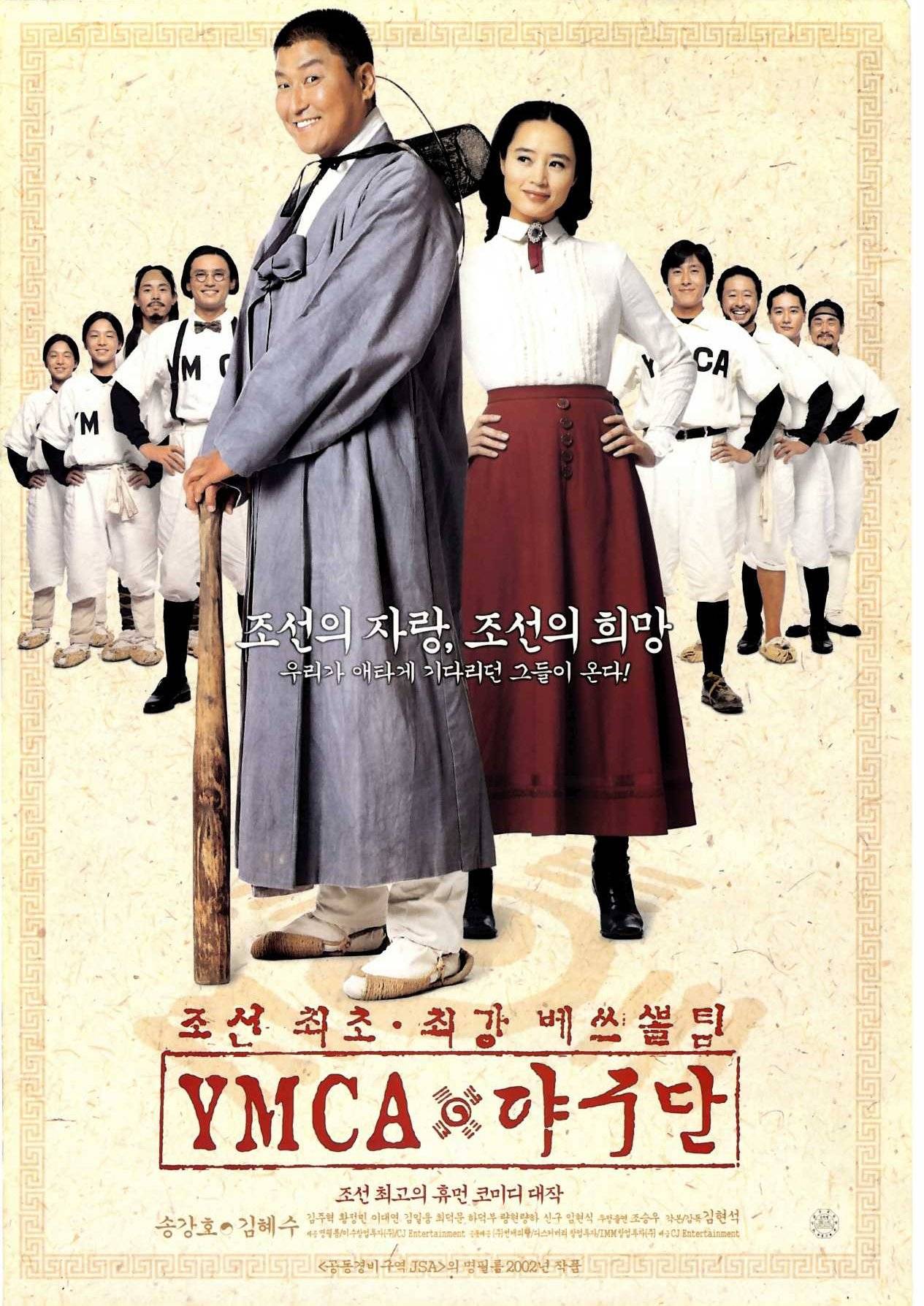
Kim Hyun-seok’s sporting comedy YMCA Baseball Team (YMCA 야구단, YMCA Yagudan) opens with sepia-tinted scenes of Korea in 1905 in which most people still wear hanbok and live little differently than their distant ancestors. Modernity is, however, coming as evidenced by the streetcar that runs through the centre of town even if it’s surrounded on both sides by unpaved ground. Reluctant scholar Hochang’s (Song Kang-ho) father (Shin Goo) complains that the cranes no longer stop in Seoul. Too many scholars have picked the wrong side, he says, but Hochcang counters him that these days you can get to Incheon in hour by train. Maybe the cranes are saying there’s no need to emulate them anymore. 

Hochang doesn’t want to be a scholar or take over his father’s school. His father wanted his brother to do that anyway, but he’s run off and joined the resistance to the Japanese. Just as Hochang discovers the new sport of baseball thanks to a pair of American missionaries and the pretty daughter of a diplomat, the Japanese further increase their dominance over Korea by forcing it to sign the Eulsa Treaty in which they effetively ceded their sovereignty and gave additional provisions for Japanese troops to remain in their nation.

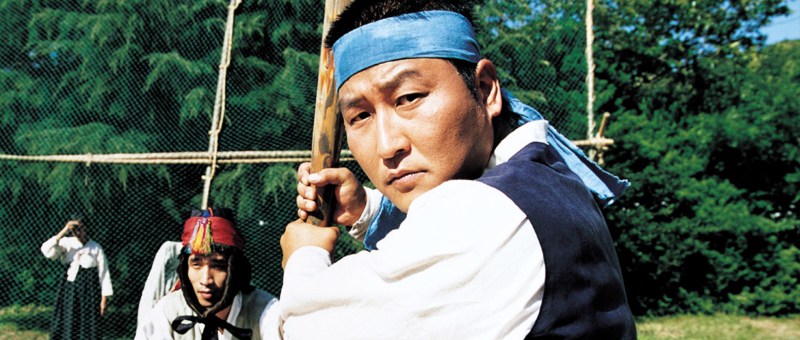
Hochang had been playing football alone as his friend practised reading English before he kicked a ball into Jungrim’s (Kim Hye-soo) garden and found a baseball instead. The early scenes see the local population adopting this Western game in makeshift fashion, using paddles and tools as bats while putting festival masks on their faces in weaponising their culture to make this sport their own. In baseball, Hochung finds the vocation he hasn’t found in scholarship or anywhere else. As a child, he wanted to be a King’s Emissary, but the Korean Empire is drawing to a close and the position no longer exists. His battle is in part to be able to live the life he chooses rather than simply continue these ancestral traditions and be a teacher like his father. In a cute public event unveiling the team, children sing a song in which little boys sing about how they don’t want to be an admiral as their fathers wanted them to be but want be something else, while the girls don’t want to marry a powerful man as their mother’s advised, but would rather marry someone else. The joke is that they both want to be or be with the YMCA Baseball Team, which has, in its way come, to represent a new modernising Korea that is keeping itself alive by embracing the new.

To that extent, Jongrim herself comes to represent “Korea” in that Hochang uses his scholarly skills to write her a love scroll in beautiful calligraphy, but it somehow gets mistaken for her father’s will and read out at his funeral after he takes his own life to protest the Eulsa Treaty. Hochang’s heart felt and rather florid poem is then reinterpreted to reflect her father’s “love” for Korea which has been stolen from him by the Japanese. Jungrim and her Japanese-educated friend Daehyun (Kim Joo-hyuk) are secretly in the Resistance and later forced into hiding when Hochung’s friend Kwangtae (Hwang Jung-min) figures out that it was Daehyun who attacked his politician father for betraying the nation by letting the Eulsa treaty pass. 

The baseball team becomes another resistance activity, with Jongrim admitting that the people “became one and felt proud” every time the team won. When they discover that their training ground has been commandeered by Japanese troops, they end up agreeing to play them to reclaim their lost territory. But the Japanese still have superiority over an underdeveloped Korea as seen in the opening footage as they started playing baseball 30 years earlier. Just as Hochang didn’t want to be a scholar, general’s son Hideo (Kazuma Suzuki) didn’t want to be a soldier either, but in a world of rising militarism he had little choice. His father thinks baseball’s a silly waste of time too, and like Hochang’s father is secretly proud of his son when he’s doing well, but is very clear that this game cannot be lost because the great Japanese Empire cannot be seen to lose to the nation it is currently in the process of subjugating. The day is saved, ironically, by Hochang’s royal seal, given to him by Jongrim, who seems to have returned his affections even if she had a greater cause. The baseball team even allows a snooty former nobleman to accept that class divisions no longer exist and he can in fact be friends with a peasant, especially when they’re uniting in a common goal like kicking out the Japanese. Sadly, the Japanese turned out to be not such good sportsmen after all, and predictably sore losers, but Hochang has at least found a way to resist and fight for a Korea that is free of both onerous tradition and colonial oppression.


YMCA Baseball Team screened as part of this year’s London Korean Film Festival.
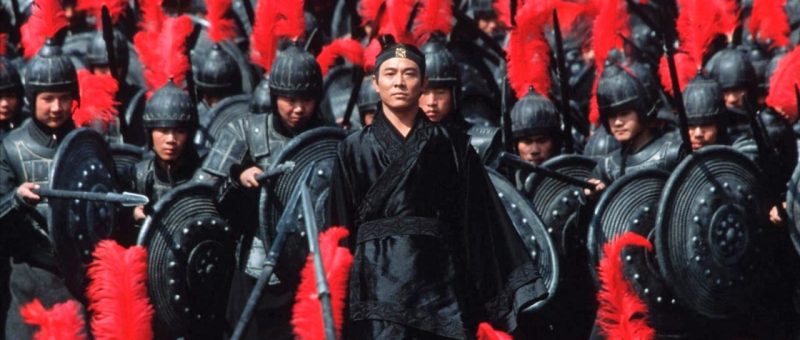
Hero (英雄, Zhang Yimou, 2002)

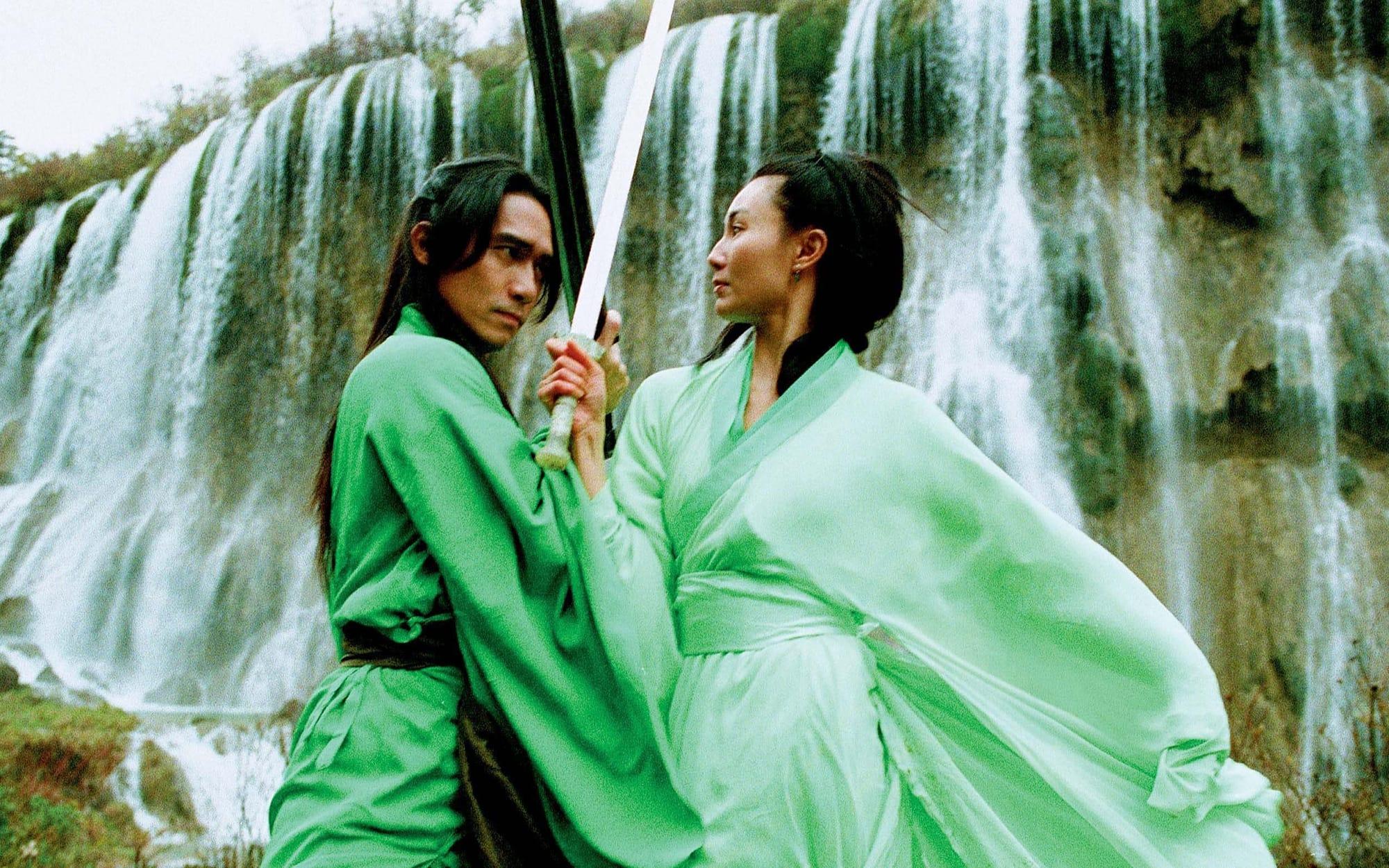
In the closing moments of Zhang Yimou’s Hero (英雄, Yīngxióng), what we see is an empty space. The outline of a person surrounded by arrows, or perhaps the doorway they protected with their body that nevertheless remains closed. On its initial release, Zhang’s film received criticism for what some saw as an overt defence of authoritarianism. After all, what we may come to understand is that the hero of the title is the Qin emperor (Chen Daoming), the founder of the modern China, but also in historical record a brutal tyrant whose tyranny is therefore justified in the name of peace, just as contemporary authoritarianism is justified in the name or safety and order.

This reading is only reinforced by the demeanour of Qin himself who condemns the nameless “hero” to death because he has chosen authority and this is what authority demands. No forgiveness, no compassion, only brutality and an iron first. Yet he cries because he is a compassionate man and understands the sacrifice he is asking his remorseful assassin to make. He does not do it because he is cruel or out of vengeance or anger, but because he believes it necessary to ensure peace for “all under heaven”. Now we may find ourselves asking again if the assassin is the hero after all because he willingly submits himself to and sacrifices himself for a tyrannous authority because he believes it to be the best and only choice that he can make for the wider society.

Nevertheless, there is something chilling in the vision of a thousand arrows flying toward one man who does not flinch while the man who ordered them sent appears to shake with his own power. The soldiers retreat, and the king is left alone, dwarfed by the immense architecture of the palace and the blood-red calligraphy of the character for sword reimagined by another potential hero whose name echoes his final conviction that in the end the apotheosis of the swordsman lies in the realisation that there is no sword. It’s this that leads him to abandon is own desire to assassinate the king and submit himself to a greater authority in the name of peace. In the end what he rejects is the tyranny of the sword itself, yet the king is also an embodiment of that tyranny because his authority is only possible through terrifying violence. 

In this way, the assassin, ironically named “Nameless” (Jet Li), may stand in for the everyman refusing to bow to the authority of a corrupt king who cares only for power. In one of the many tales he tells, Nameless remarks that he fought with the first of Qin’s three assassins in his mind and it’s true enough that what passes between the two men is a duel of words which is eventually won by the king. Qin tells Nameless of his desire to increase his influence beyond the other six kingdoms of Warring States China and create an empire that encompasses “all under heaven”, but Nameless later cautions him to remember those who gave their lives for the highest ideal, peace, and refrain from further killing. The closing title card is displayed over the Great Wall, making plain that Qin did in fact stop after conquering the six other kingdoms to unite all of China while building the wall to protect his citizens from “northern tribes,” or perhaps competing imperialists.

But walls keep people in as well as out and are in fact another facet of the king’s tyranny and a symbol of enduring authoritarianism. The problem is that it isn’t tyranny or authoritarianism that any of the assassins oppose for they are driven only by hate and vengeance and have no greater ideology or vision for the future. The argument is that peace under the iron fist of Qin is better than the chaotic freedom of the Warring States society, yet what we’re left with is nihilism. The love between assassins Flying Snow (Maggie Cheung Man-yuk) and Broken Sword (Tony Leung Chiu-wai ) is disrupted in each of the tales Nameless relates of them, firstly by romantic jealously and then secondly ideological divide. The conclusion that Broken Sword comes to is that they must not resist, but Flying Snow cannot live without recrimination with the past and the sealing of its tragic legacy. Her revolution fails, and as such “all under heaven” there is only death and only in death is freedom to be found.

The sense that these assassins are already dead is echoed in the choice of white for the final sequence of the film. Zhang frames each of his sequences in vibrant colour, the red of the first tale in which the lovers are destroyed by a supposed love triangle, the blue of the second in which tragedy and sacrifice do not so much destroy as deify it, the green of the penultimate in which jade curtains billow and fall inside the imperial palace, and finally the cold white of death in which the lovers eventually find their home leaving their surrogate child alone in a windy desert of futility. Yet each of these sequences is filled with an intense beauty and the romanticism found in classic wuxia. What remains in the mind is the balletic fight between the tragic heroine Flying Snow and the orphaned pupil Fading Moon (Zhang Ziyi) in an autumnal forest that’s suddenly drenched in red, or feet dancing across the water, an image of an idealised past and lost love among wandering ghosts with no home to go to. Here there are no heroes, only lonely souls and frustrated ideals. 


So Close (夕陽天使, Corey Yuen Kwai, 2002)

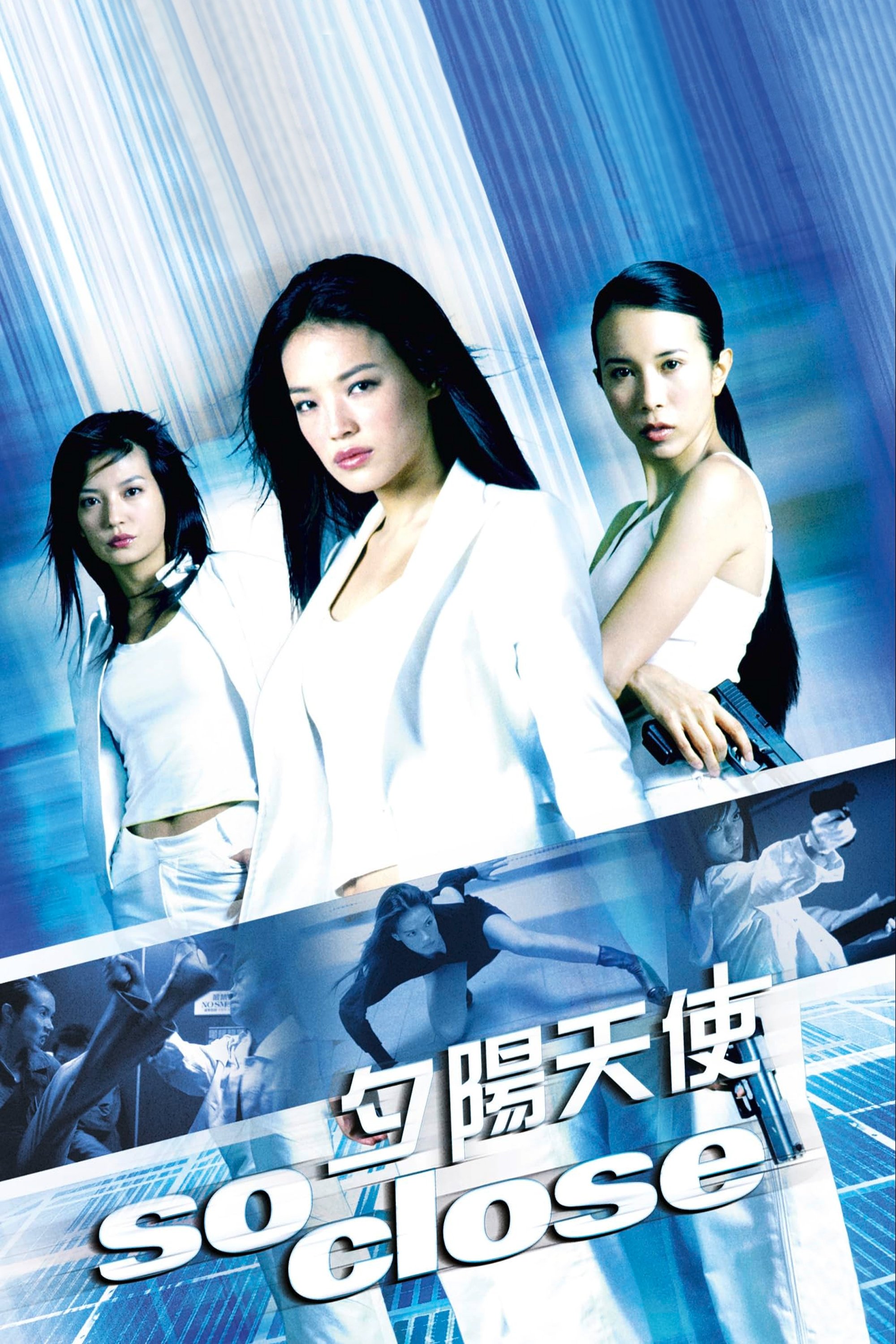
A latish entry in post-millennial cyber thrillers, Corey Yuen’s So Close (夕陽天使) finds two hit women sisters safeguarding next generation technology in keeping it out of the hands of corrupt businessmen who in fact murdered their father to get it. They claim he always intended to gift his all-powerful mass surveillance tool to the police, which either seems politically uncomfortable or incredibly naive, but have been using it themselves to earn their keep as killers for hire albeit justifying themselves in insisting on the moral bankruptcy of their targets.

In this case, that would be Chow Lui (Shek Sau) who according to “Computer Angel” made his “evil fortune” through drug smuggling. Infinitely smug, Chow thinks he has better technology but is soon proved wrong as Computer Angel admits she also sent the virus, or more accurately manifested it, to teach Chow a lesson. Yuen fills the film with 90s cyberpunk motifs, even having Computer Angel, later identified as Lynn (Shu Qi), jump off a building in a shot that is a clear homage to Ghost in the Shell while otherwise employing electronic imagery of cables and wires though the “World Panorama” system largely works through satellite.

In the opening sequence, Chow’s company is also revealed to be a global enterprise connected around a large table via the internet while futuristic systems allow him to have video calls with associates speaking Japanese and English. He suggests they simply pay the hackers to save their reputation which is apparently built on their world-class security systems though he himself perhaps remains sceptical abruptly shutting down his younger brother’s attempt to broker a deal investing in a company called Dragon. His office meanwhile has a bonsai tree in the background and his brother Nunn seems to have very close ties with a Japanese gangster hinting at a possible economic anxiety.

This fraternal conflict is eventually reflected in the fracturing relationship between the two sisters as field agent Lynn informs her sister Sue (Zhao Wei) that she wants to give up the killing trade after reuniting with an old boyfriend and deciding to get married. Techno wiz Sue has no other means of supporting herself and is resentful that Lynn always takes charge and won’t let her participate in missions, though Lynn is later vindicated when Sue’s hasty decision to take on a solo job goes just about as wrong as it can go. Meanwhile, their relationship is also strained by the presence of Hung (Karen Mok), a policewoman investigating Chow’s death who, as she later says, is strangely drawn to Sue who rollerblades around her at a record store with thinly concealed desire. 

There might be something in the fact that the actresses playing Sue and Lynn are from the Mainland and Taiwan respectively each performing their scenes in Mandarin but dubbed into Cantonese for the local release. They are indeed outsiders, firstly because of their unusual profession and secondly because of their all-powerful surveillance tool that allows them to carry out their missions yet also acting as a moral authority even if as Lynn later says they kill for money not conviction. World Panorama allows them to edit surveillance footage, placing fake avatars of themselves in the digital space and allowing them to otherwise recreate reality in a way that seems in keeping with the film’s otherwise low-key special effects which have an almost tongue-in-cheek quality parodying other more serious cyber thrillers from the mid-90s. 

The film’s English title comes from Yuen’s use of the Carpenters’ track (They Long to Be) Close to You, yet the Chinese is the more melancholy Sunset Angel which is most obviously refers to the film’s final scene if also perhaps calling time on the sisters’ roles of guardians of next-gen tech and avenging ghosts of the machine working out the bugs of corrupt gangster businessmen. In any case, they move through the “real” world like digital avatars performing incredible feats of human agility and not least in the high impact action scenes culminating in a lengthy katana fight in a tatami mat room which both echoes the cyberpunk aesthetics and reinforces an idea of corporatising colonialism finally blown away by the forces of female solidarity and an unlikely loves story between a soldier and a bandit. 


Trailer (English subtitles)

Coo-Coo 043 (一家子兒咕咕叫, Chan Ching-lin, 2022)

Why would a pigeon, or a child, return to you if you failed to make them a home? The enigmatic title of Chan Ching-lin’s gritty familial drama Coo-Coo 043 (一家子兒咕咕叫, yījiāzi ér gū jiào) refers to a homing pigeon that unexpectedly arrives seven years late but bringing with it less joy than an unwelcome confrontation with the unresolved past. A tale largely of male, patriarchal failure the film revolves around the taciturn figure of a middle-aged man obsessed with pigeon racing who attempts to build a coop an in abandoned field for the birds he no longer has means to care for even as his own home crumbles.

Old Ching (Yu An-shun) appears to be a broken man who’s never quite recovered from the massive success of having won a lot of money on a pigeon race several years previously though most of his birds since have never returned at all. Gambling is technically illegal in Taiwan, and the sport of pigeon racing is itself a little taboo though popular enough at least in the small town where Ching lives. It appears the family is mostly supported financially by his second wife Ming’s (Yang Li-yin) banana farm, while ironically enough his daughter Lulu (Rimong Ihwar) dreams only of flying the coop for a less depressing life somewhere else. Part of the reason for the difficult atmosphere in the family home is the sense of absence left by Shih, Ching’s son from his first marriage who disappeared on his way to school aged 12 more than a decade earlier.

Ching continually blames Ming for Shih’s disappearance because on that day she did not drive him to school as usual, ignoring the fact that she stayed to clean up the house after he trashed it in a violent fit after losing at gambling and told the boy to walk. Ching’s irony is that he is always waiting for something to come back to him, but never gives any reason why it should. Though he is often seen tenderly caring for his pigeons, he treats his family members with coldness and contempt and is on occasion violent towards Ming who has a sideline working as part of a troupe conducting death rituals and is considering leaving him. She takes pigeon 043’s miraculous return after seven years as a sign that they should look into having Shih declared legally dead to help them accept he won’t come back but Ching refuses to do so and continues to wallow in his own violent and angry grief unable to see that it may be him that drove his son, and later his daughter, away.

His limp also hints at a violent past as do his ties to a group of local gangsters who seem to be well into the pigeon racing scene, while gang young toughs make a living kidnapping birds and ransoming them back to their owners or else killing them for fun if they don’t pay. Ching finds a surrogate son in the orphaned Tig (Hu Jhih-ciang), Lulu’s sometime pigeon-catcher boyfriend, but fails to see him as such until it’s too late. Unlike Lulu, Tig is a man looking for a coop. He slides into the vacant space in the family longing to be accepted, but finds only coldness and abandonment left behind while everyone else flies away in search of a better life. 

Often captured behind bars, the two men are just as caged as the pigeons though the kind that don’t fly away when the doors are opened. Some of those who leave do so for the after life, no longer seeing any point in continuing this miserable existence which shows no sign of improvement and unable to envisage any other kind of escape. Even Lulu’s flight to the city to become a nightclub dancer seems as if it may just be another kind of cage from which she cannot fly. Ching’s pigeon coop is eventually ruined by a more literal kind of storm, but mainly because he failed to protect it unable to look past his personal despair and indifferent to the vulnerabilities of his home. Bleak in the extreme, Chan paints a grim picture of life on the margins in rural Taiwan in which the wings of all have long been clipped and those who return do so only because they have nowhere else to go.


Coo-Coo 043 screened as part of this year’s London East Asia Film Festival.

Original trailer (English subtitles)

Doing Time (刑務所の中, Yoichi Sai, 2002)

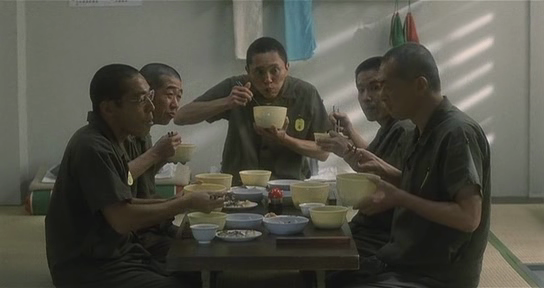
Who ever thought that life in prison could be so…peaceful? Adapted from the autobiographical manga by Kazuichi Hanawa, Yoichi Sai’s 2002 drama Doing Time (刑務所の中, Keimusho no Naka) is a slice of life dramedy somewhat typical of the early 2000s save its unexpected setting in a state penitentiary. Unlike the average prison movie, the main thing that Hanawa discovers is that life inside is incredibly dull, yet he approaches his brief sojourn in this other world with anthropological precision observing and mimicking the behaviour of his fellow prisoners while making the most of this hopefully once in a lifetime experience reflecting that he’ll likely never have the opportunity to wear such worn out undergarments ever again. 

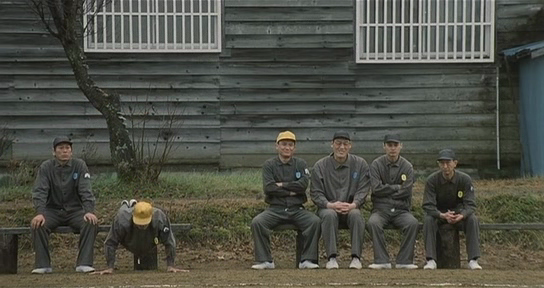
A quiet man already in middle age, Hanawa (Tsutomu Yamazaki) is no dangerous criminal merely a firearms enthusiast who liked to fire modified pistols into bottles of water. He’s got three years for illegal possession of weaponry and explosives, which seems to be quite a harsh penalty considering another man is doing seven for murder after shooting a man he says waved an axe at him when he went to collect a debt. There are clearly men who have committed violent crimes in Hanawa’s immediate vicinity, yet this is not a traditional tale of prison gangs and factional infighting, the only violence we witness concerns one prisoner who appears to have broken the rules accidentally in thoughtlessness or ignorance rather than direct rebellion. Rather it is, ironically enough, almost like a summer camp in which Hanawa and his four cellmates attempt to amuse themselves during the little free time they are offered for contemplation and relaxation. 

Even so, every inch of the prisoners’ lives is micromanaged by the guards from the way they walk to when they are allowed to move or speak. So entirely stripped of their dignity are they, that they must ask for permission even to use the toilet in their own cell while in solitary confinement and dutifully report back once they’ve finished. The communal squat toilets at the back of the workshop where Hanawa works crafting wooden tissue boxes are entirely open with only knee-height doors on each stall for privacy. The prisoners’ days are tightly ordered, early to bed and early to rise with work in-between and only the promise of rest to look forward to on weekends and holidays. 

Ostensibly a shy man, Hanawa dislikes having to ask permission all the time though not so much as an affront to his autonomy as simply bothersome. Surprisingly he begins to warm to the rhythms and routines of prison life discovering in them a kind of liberation, finding his time in solitary for “unauthorised communication” the most enjoyable of his sentence free as it is of the necessity of interacting with other people. Like the bug collector in Woman of the Dunes, he finds freedom in simplicity appreciating the mindlessness of his absurd new job folding paper bags for medical prescriptions. He can abandon any sense of responsibility for his life, submitting himself entirely to the guards’ authority and surrendering the need for control, happy to allow his existence to be managed for him without needing to decide on anything for himself. 

That aside, it’s difficult to see what other purpose prison could serve for a man like Hanawa who merely had an unusual if potentially dangerous hobby save providing him with a unique life experience he seems to be treating as a kind of adventure. He may at times look down on his cellmates who have their own routines, but otherwise appears grateful for their input and advice regarding prison life often listening to their explanations for behaviour he regards as strange such as removing one’s trousers before entering the bathroom and then deciding to do as they do. With so little stimulation the mundane becomes exciting, each meal a culinary adventure listening to a cellmate recount his group treat of a film screening (Takeshi Kitano’s Kid’s Return) as if he had returned from exotic land relishing his description of the chocolate biscuits and cola he was given to snack on. Time is what Hanawa is doing, but he does at least gain the opportunity of experiencing life in slow motion learning to appreciate the beauty of a single dandelion while observing the absurdity of the world all around him which is perhaps no more absurd than that which exists outside. 


Graveyard of Honor (新・仁義の墓場, Takashi Miike, 2002)

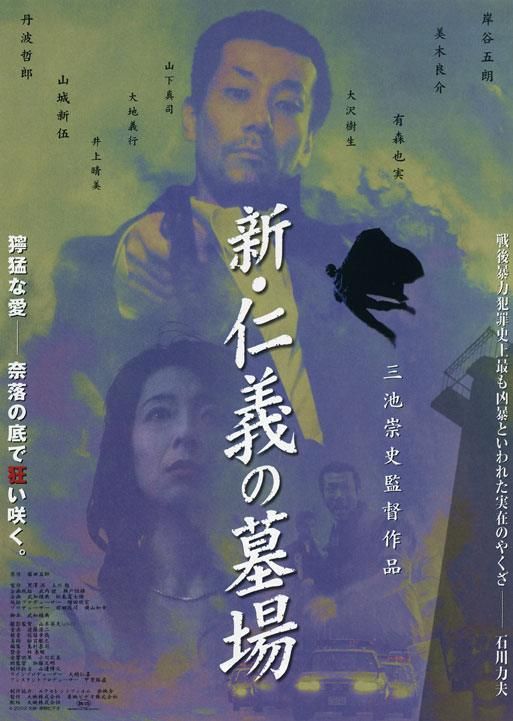
In Kinji Fukasaku’s 1975 jitsuroku eiga Graveyard of Honor, a collection of voices open the film musing on whether the hero was corrupted by the times in which he lived or merely born crazy. Like most jitsuroku or true account gangster movies of the ‘70s, Fukasaku’s Graveyard of Honor is a post-war story about a man who failed to adapt himself to the rules of his society which was of course in constant flux though the rules of the yakuza are perhaps as fixed and timeless as any. Inspired by the same source material Takashi Miike’s comparatively subdued, contemplative Graveyard of Honor (新・仁義の墓場, Shin Jingi no Hakaba) maintains the moody, noirish feel of the ‘70s gangster drama complete with melancholy jazz score but updates the legend of Rikio Ishikawa to late 20th century Japan which again finds itself in crisis, floundering for direction and filled with despair. The bubble has burst in more ways than one as the young in particular awaken to the fact they have been deceived by the false promise that the good times of the Bubble years were cost free and would last forever leaving them abandoned in a world they no longer recognise as their own. 

Unlike Rikio Ishikawa who, we are told, always wanted to be a gangster, Rikuo Ishimatsu (Goro Kishitani) falls into the gokudo world by chance, his life thereafter one long fall until the bloody suicide with which the film opens. A bleach blonde dishwasher at a Chinese restaurant, he gets an offer he can’t refuse when he calmly defuses a would be assassin by hitting him on the head with a chair, earning the eternal gratitude of boss Sawada (Shingo Yamashiro) who takes him on and makes him his protege. This meteoric rise in the yakuza ranks, however, is not without its drawbacks especially in that it destabilises the internal politics of the Sawada gang with old retainers instantly resentful that this young upstart has leap frogged them to sit at the boss’ side while they’ve patiently put the work in only to be sidelined. 

A stretch in prison for avenging the boss’ honour brings him into contact with Imamura (Ryosuke Miki), later his sworn brother but also his opposing number, possibly the last honourable yakuza. “A yakuza without honour isn’t worth shit” Imamura’s boss later remarks, instructing him that Rikuo is a liability he’ll have to take responsibility for, but in this graveyard of honour that kind of responsibility is the one that will get you killed. Honourable yakuza can no longer survive in the world of corporatised thuggery that is the modern gokudo existence. Later we realise that the tale is being narrated by Rikuo’s former underling, Kikkawa, who reminds us that “even yakuza are human beings” existing within a social structure with clearly defined rules which must be followed, yet the rules themselves are largely superficial and Kikkawa survives because he subverts them, abandoning the reckless Rikuo for the certainty of Sawada and setting himself on the traditional gokudo path of sucking up to the boss in the constant hope of advancement. 

Kikkawa is, in a sense, the grovelling salaryman to Rikuo’s frenzied maverick, one as much they symptom of the age as another. Rikuo’s rise occurs against the economic boomtown of Japan in the ‘80s which is as much a paradise for gangsters as for anyone else but also a kind of twilight, the yakuza as an institution relegated to the Showa era and the post-war past. Gangsters forced out of their families like the desperate ronin of the feudal era further destabilise an already chaotic environment which, like that of the post-war years, is filled with despair and disillusionment only to be further disrupted by the advent of natural disaster and economic collapse. 

Like the yakuza of the jitsuroku, those of Miike’s Graveyard of Honor struggle to reorient themselves in a changing society, no more equipped to deal with economic stagnation than their forbears were for the end of occupation and the increasing irrelevance of gangsterdom in a world of economic prosperity. Increasingly paranoid and anxious, Rikuo sees betrayal in all quarters and remains essentially powerless, eventually imprisoned in what appears to have been previously used as a child’s bedroom. He seeks escape in drugs which he finds by chance, and then in romance with an equally powerless woman who bizarrely seems to have fallen in love with him after he brutally raped her though their strange, drug-fuelled quasi-wedding ceremony is the tenderest, most vulnerable we ever see them. Yet as the opening scene implied, all there is is futility. Knowing what he knows, Kikkawa meditates on his memories of happier days when he was just a minion at Rikuo’s side. In this graveyard of honour only the slippery survive and the only way to be free is to fall, and fall hard. 


Original trailer (English subtitles)

The Laughing Frog (笑う蛙, Hideyuki Hirayama, 2002)

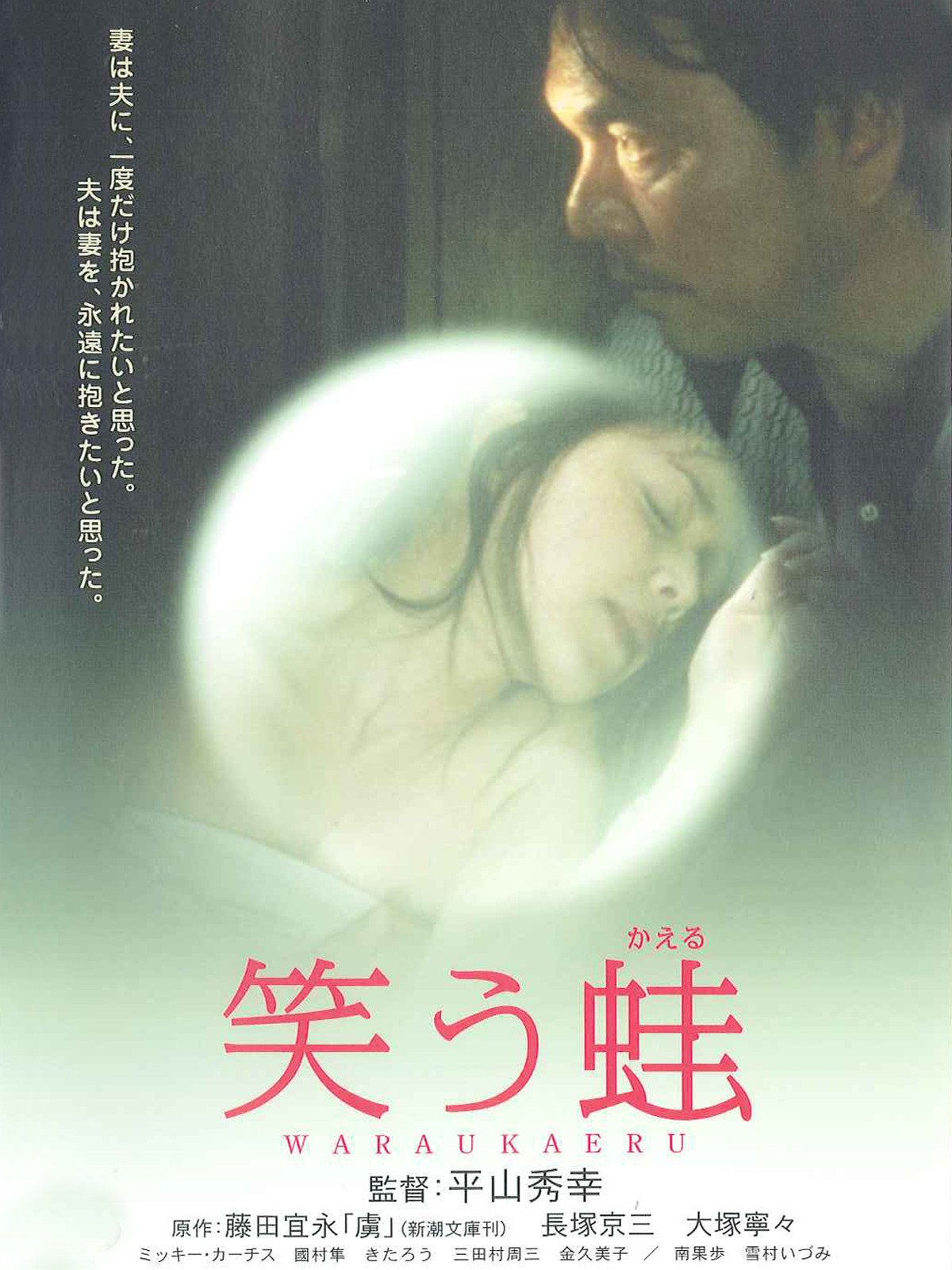
laughing frog posterEver have a day (or perhaps a lifetime) where you feel so stupid that even the frogs are laughing at you? That’s pretty much how it is for disgraced former bank manager Ippei when he turns up one day at a family holiday home he assumed would be empty but turns out not to be. In Laughing Frog (笑う蛙, Warau Kaeru) director Hideyuki Hirayama deftly dissects the modern family, the gradual redundancy of the middle-aged man, and the way society seems to have of anointing the lucky and the unlucky, in a darkly humorous satire in which even mother nature seems to be mocking our petty human concerns.

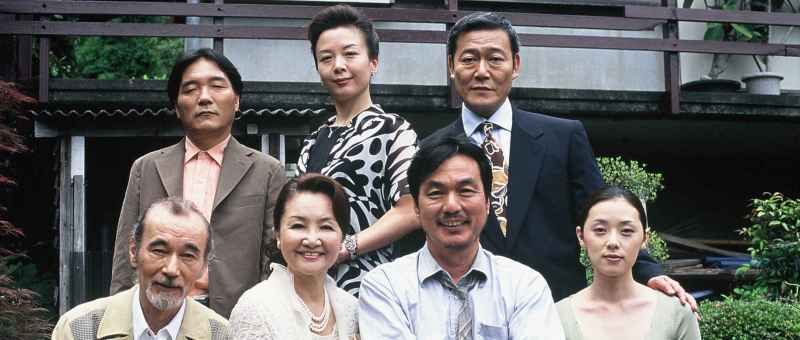
33 year old Ryoko (Nene Otsuka) is attending the third memorial service for her late father at which her greedy sister-in-law (Kumija Kim) asks for various things in an attempt to get some of the inheritance in advance while Ryoko’s brother (Shuzo Mitamura) wanders off to chat about silkworms in Chinese on his mobile phone. The event ends with Ryoko’s sprightly mother (Izumi Yukimura) and the sister-in-law urging her to sort out some kind of marital difficulties in order to ease the awkwardness surrounding her lack of external connections.

Meanwhile, Ryoko’s missing husband, Ippei (Kyozo Nagatsuka), rocks up at a rural station and climbs into a familiar house through an open window. Wandering around in his pants, he hears a noise and realises someone lives there after all. Ryoko has moved into her father’s old house in the country and started a whole new life for herself. After a brief discussion, Ryoko agrees to let him stay for a while on the condition that he finally sign the divorce papers but Ippei soon finds himself confined to an especial kind of irrelevance as he starts his new life in the hall cupboard observing his wife’s new freedoms by means of a tiny hole in the wall.

No one seems to have much of a good word to say about Ippei, which is fair enough seeing as he apparently became obsessed with a bar hostess and embezzled money from his bank to pay for a lavish affair before running away and leaving his wife to deal with the fallout. He is, however, paying for it now as his own irrelevance is once and truly brought home to him as he lives out his days like an impotent ghost trapped in a storage cupboard undergoing his wife’s strange mix of kindness and revenge.

Ryoko, the goodly wife, is not quite all she seems. Ippei’s mistress makes a surprise appearance to try a spot of extortion on the wealthy wife but she’s no match for Ryoko’s perfectly practiced poise. One of the oddly cruel accusations the mistress has to offer is that Ippei once referred to a kind of boredom with his wife’s properness, branding her a “fancy pet cat” whilst apparently avowing the mistress’ bedroom superiority. If Ippei’s sheepish behind the wall expression is anything to go by he is guilty as charged but then perhaps the uncomfortable statement leads right back to his uncomfortable place within Ryoko’s upperclass family who seem to look down on a mere bank manager, affecting politeness while secretly bemoaning the fact that their daughter has married beneath herself.

The model upperclass family is a simulacrum. Feigning politeness, elegance and dignity they attempt to disguise their otherwise distasteful affectations. Ryoko’s sister-in-law is at least honest in her constant harping on about the inheritance, plan to steal grandma’s house out from under her to knock it down and build a new one, and constant asides to her apparently hopeless (and unseen) son away at a (not great) university. Meanwhile her husband, Ryoko’s brother, pretends to chat silkworms in Chinese on his phone but is really talking to a Chinese mistress and Ryoko’s mum is planning to get married again to a (possibly dodgy) antiques dealer (Mickey Curtis) who is so deeply in debt there won’t even be any inheritance anyway.

Ryoko too has moved on. Ippei is forced to watch as she entertains her new boyfriend (Jun Kunimura), a stonemason whose main line is headstones, while the frogs outside work themselves into some kind of frenzy. Little by little all his manly affectations are worn away – he’s forced to realise how foolish he’s been, how irrelevant he is in Ryoko’s life, and how perfectly pointless his fugitive existence really is. Ryoko meanwhile remains calm and calculating. She “lies” and she wins in a bloodless victory, allowing her opponents to sentence themselves to the punishments they feel themselves to deserve. Ippei, it seems, is just a weak, unlucky man doomed to ruin himself through a series of poetic failures and petty self involved mistakes. Meanwhile the frogs look on and laugh at our human follies. Makes you feel small doesn’t it….


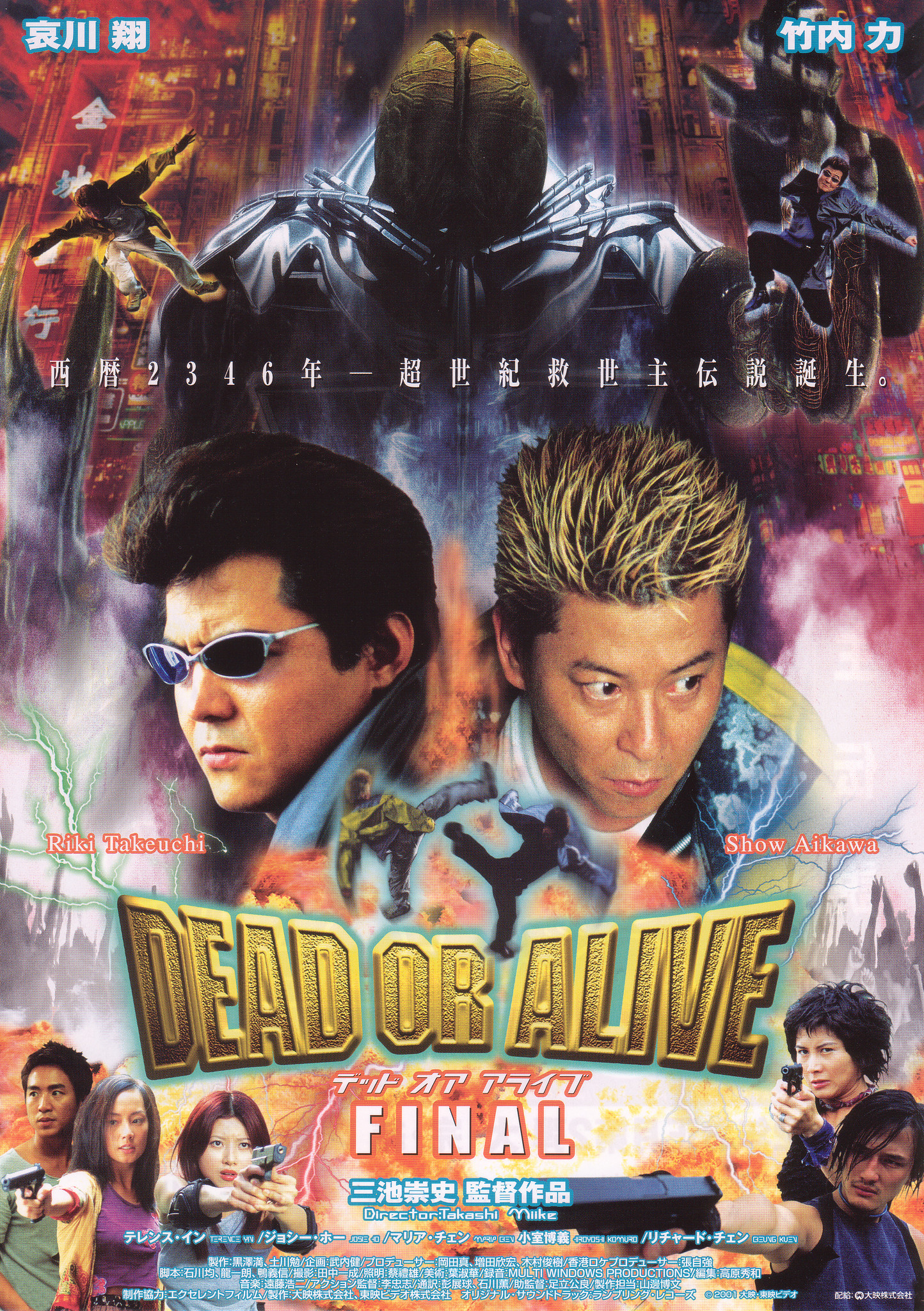
Dead or Alive: Final (Takashi Miike, 2002)

dead_or_alive_final_jap_chirashiThe Dead or Alive Trilogy began in a furious, drug fuelled hymn to violence in which a petty vendetta between the opposing forces of good and evil (mingled and bloody) eventually destroyed the entire world. Dead or Alive 2: Birds was an altogether more contemplative affair in which two orphaned boys rediscover each other as jaded hitmen and decide to put their talents to “good” use by donating the hit money to pay for medicinal drugs for impoverished children around the world. Strange and surreal, Birds moved beyond the first film’s absurd ending for an altogether more abstract approach to universe building but Final pushes the idea to its limit in a cyberpunk infused far future tale of rogue robots and sexual dictatorship.

Yokohama, 2346. A new society is being forged, a new social order has been created. All powerful Mayor Wu (Richard Chen) has decreed that the only true love is gay love and made heterosexuality taboo. Births are strictly controlled to maintain population numbers with contraception ruled mandatory. The heterosexual resistance has gone into hiding in a ruined part of the city, living in a free love commune in which the birth of children is a primary goal. Lead by Fong and his first lady Jun, the resistance aims to liberate the people from the yoke of the crazed dictator and create a better, freer world for the as yet unborn children of the future. Teaming up with a rogue “Replicant”, Ryo, (Sho Aikawa) the gang attempt to further their cause by kidnapping the young son of Wu’s chief of police, Honda (Riki Takeuchi), who later discovers some uncomfortable truths about his own existence.

The use of the world “Replicant” is a pointed one and an overt reference to Final’s key text – Blade Runner, though its intentions amount much more to a pastiche than an examination of the existential questions so central to the seminal cyberpunk classic. Online captions state the action is taking place in Yokohama – an industrial harbour town close to Tokyo, but is in reality a thinly disguised Hong Kong with a green tint. Nevertheless, Miike makes the most of rundown industrial complexes now overrun by nature and the symbols of historical hubris. Aside from the flying cars and other CGI touches, the dystopianism is all too real in its sense of economic and social failures which have allowed a man like Wu to run a strange fascist police state even in the absence of the necessary infrastructure.

In keeping with the Hong Kong setting the Yokohama of 2346 is largely Chinese with broad mix of intermingled languages. Once again the nature of family is called into question but this time more through a large scale change in the social order which sees birth strictly controlled through medical and cultural enforcement. The largely Cantonese speaking resistance movement want to create a world where children can be born and then grow up freely, neatly echoing the previous films’ preoccupation with the fates of children as considered by orphans. Aside from their idealism, the Resistance turns out not to be so far removed from the petty gangsters of the previous instalments as they ultimately turn on each other with deadly consequences.

Sho Aikawa and Riki Takeuchi face off once again with Aikawa playing a Rutger Hauer-esque android who proves his “humanity” through his affiliation with children. A “Replicant” from a long forgotten war, Ryo has superpowers which allow him to stop bullets in mid-air or send out sparks of energy but is also at home playing the clown as he brushes his teeth nonchalantly in the middle a fist fight or plays dead to entertain a little boy. Takeuchi’s Honda, by contrast, is the stereotypical gestapo inspired secret police chief whose family life is a hollow one devoid of genuine feeling and maintained solely for professional expectation.

If Miike has been playing Blade Runner all along, his finale jumps ship for Tetsuo: The Iron Man as the trilogy’s leading men relive the totality of their experiences across three different plains of existence before merging into one as a kind of angel of destruction. The cycle of violence has reached its apotheosis as the twin angels are sent to wreak revenge on those who have misused their authority. Shot on high grade video, Final makes the most of its more modest production values but can’t help suffering in comparison to its predecessors. The B-movie opening is a helpful clue to Miike’s intentions as he creates his own kind of sci-fi dystopia inspired by pop culture memories, but even if the overarching themes lack integrity, Final provides the perfect ending for this often frustratingly absurd series, defying rational explanations until the end of time.


Available now in UK from Arrow Video!

Original trailer (English subtitles)

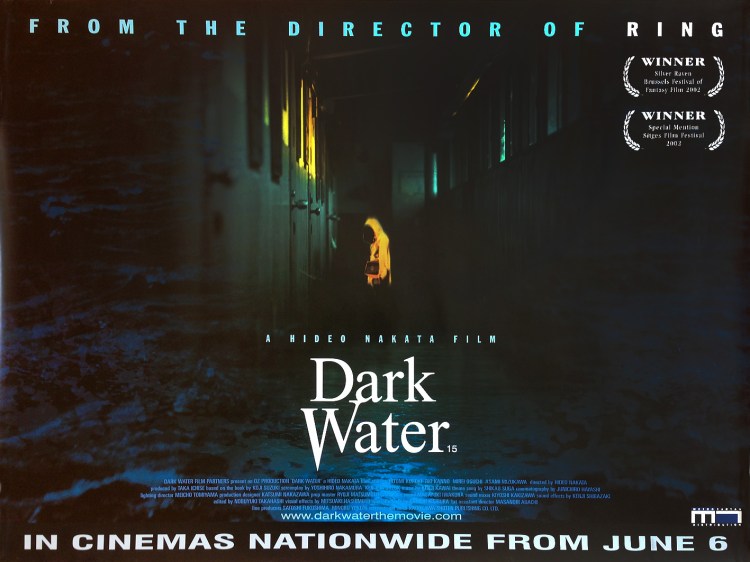
Dark Water (仄暗い水の底から, Hideo Nakata, 2002)

dark-water

Review of Hideo Nakata’s Dark Water first published by UK Anime Network.


For good or ill, the J-horror boom came to dominate Japanese cinema at the turn of the century and if anyone can be said to have been instrumental in ushering it in, director Hideo Nakata and novelist Koji Suzuki, whose landmark collaboration on The Ring has become symbolic of the entire genre, must be at the head of the list. Dark Water (仄暗い水の底から, Honogurai Mizu no Soko Kara) finds the pair working together again on another supernaturally tinged, creepy psychological thriller. Neatly marrying the classic J-horror tropes of freaky children and dripping wet ghosts, Dark Water also embraces aspects of the uniquely Japanese “hahamono” or mother movie which prizes maternal sacrifice and suffering above all else.

Yoshimi (Hitomi Kuroki), a nervous middle aged woman, is in the middle of a messy divorce with her exceedingly smug salaryman husband. Despite having been less than present during the marriage, Yoshimi’s husband now wants full custody of the couple’s five year old daughter, Ikuko (Rio Kanno). In order to aid her case, Yoshimi quickly finds an apartment and starts looking for a job. All seems to be going well except for the mysterious dripping stain on the ceiling which the building manager doesn’t seem very interested in fixing. Before long, strange events begin unfolding including unexplained puddles, a mysterious red children’s shoulder bag which keeps reappearing after being thrown out, and brief sightings of a little girl in a yellow raincoat….

Nakata opens the film with what is in effect a flashback sequence as Yoshimi waits for her own mother to pick her up from primary school. It quickly becomes apparent that Yoshimi’s relationship with her birth mother was an imperfect one which later ended in neglect and abandonment. Yoshimi continues to have frequent flashbacks to her childhood and harbours and intense fear of inflicting the same kind of damage her mother inflicted on her onto her own daughter. Ikuko is also left waiting at school when Yoshimi is kept late at a job interview – something which is eventually used against her in the court case. Though Yoshimi’s aunt reassures her that she’s doing a much better job than her mother did for her, Yoshimi is filled with doubts as to her suitability as a mother which are only further compounded by her intense love for her daughter and fear of losing her.

On top of her maternal worries and residual abandonment issues, Yoshimi also has a history of mental distress which her ex-husband uses to discredit her. It’s open to debate exactly how much of what appears to be happening is actually happening and how much a manifestation of a possible nervous breakdown, but aside from the supernatural shenanigans there are also real world dangers to consider including the missing posters for a girl who was around Ikuko’s age when she disappeared two years previously. The primary school headmaster is convinced that the girl was abducted by a third party but it also transpires that Mitsuko, like Yoshimi and as Yoshimi fears for Ikuko, was abandoned by her mother.

When it comes right down to it, Dark Water lays the blame for its supernaturally tinged evil firmly at the feet of divorce and family breakdown. The supposedly progressive primary school in which the main aim is to allow children freedom of expression is quick to tell the already overwrought Yoshimi that the “strange behaviour” they’ve been witnessing in Ikuko is essentially all her fault because of the divorce and disruption to Ikuko’s home life. Similarly, the central supernatural threat is born of maternal neglect, a symptom of the selfish individualism of the mother who has chosen to leave her child behind. Yoshimi has been jettisoned by her controlling ex-husband and her only thought is to keep her daughter with her, yet she is being made to pay for a social prejudice against atypical families such as those resulting from a “selfish” decision to dissolve a marriage.

Dark Water cleverly recasts Yoshimi as an idealised mother willing to sacrifice all to protect her child. As the situation intensifies, Yoshimi begins to feel as if she’s becoming a toxic presence in her daughter’s life. Rather than risk the same fate befalling her own daughter as has befallen her, Yoshimi opts to make herself the last link in the chain of abuse, freeing her daughter from her own baggage. In contrast with both Yoshimi and Mitsuko, Ikuko will always know that her mother loved her and will always be with her even if protecting her from afar.

Nakata conjures up a supremely creepy atmosphere filled with everyday horrors. The run down apartment complex in which Yoshimi finds her (presumably very reasonably priced) apartment is an unsettling world of its own with its strangely moist, dripping walls, eccentric residents, and rapidly decaying exterior. One of the most effective and visually interesting entries in the J-horror genre, Dark Water perfectly mixes creepy, supernatural horror with psychological drama culminating in a final sequence which doesn’t stint on the scares but proves emotionally devastating in the process.


Original trailer (English subtitles)

Copycat Killer (模倣犯, Yoshimitsu Morita, 2002)

copycatYoshimitsu Morita had a long standing commitment to creating “populist” mainstream cinema but, perversely, he liked to spice it with a layer of arthouse inspired style. 2002’s Copycat Killer(模倣犯, Mohouhan) finds him back in the realm of literary adaptations with a crime thriller inspired by Miyuki Miyabe’s book in which the media becomes an accessory in the crazed culprit’s elaborate bid for eternal fame through fear driven notoriety.

Following a non-linear structure, the film first introduces us to an old man who runs a tofu shop where he lives with his middle aged daughter who is in the middle of a breakdown following the end of her marriage, and his grown up granddaughter who has become the woman of the house during her mother’s illness. Though not without its difficulties his life was happy enough but after granddaughter Mariko goes out one evening and never comes home, nothing will ever be the same again.

A severed arm and a handbag are discovered in a flower bed by a teenage boy whilst walking a dog, though a mysterious distorted voice later contacts the media to inform them that the arm and the handbag do not belong to the same woman. The boy, oddly enough, is the sole survivor of his family who were all murdered some years previously. He was interviewed at the time by press reporter Yumiko whose soba shop owning brother may have a connection to the crimes. The cold blooded killer knows all of this and is engineering coincidences into a grand plan in which he will harness the power of mass media to earn himself a kind of national respect as an “expert” on the crimes which he has himself been committing.

Hitting a style somewhere between The Black House and Keiho, Morita opts for a dreamlike atmosphere filled with dissolves, soft split screens and hacker inspired graphical touches. Not only is the killer interested in appearing on TV either in voice or in person but can also manipulate mass media by hacking commercials and billboards to proclaim his own messages. As well as the early computer inspired effects, photo zooms, and contemporary methods of evidence presentation, Morita wrong foots the audience by zigzagging through the chronology of crime beginning with the central murder then switching back to the killers as they are now, then their childhoods, and cutting back to each of the other protagonists – the grandfather, teenage boy, and reporter.

Possibly inspired by the Leopold and Loeb case, the killers are a duo of psychotic young men who think they can achieve everlasting fame and personal satisfaction by committing the kind of murders which have never been committed before. The true motivator of the crimes even tells one of his victims that she ought to be grateful. That she was leading a “pointless” life and now she’s being given the opportunity to “serve” in something greater as a component in his master plan. Before, he explains, she’d just have gone on living until she died and been forgotten but now she’ll be a star – everyone will remember her name as a victim in the crime of the century and the world will mourn her death.

At another juncture, the killer also remarks that absolute faith in the family unit is the reason a relative of a suspect or victim of crime is routinely targeted by the press and a source of recrimination even though they themselves had nothing to do with it. Family issues are also a factor as rejection and abandonment by parental figures is offered as a reason for why a person may eventually become deranged. Thus, the killer’s intention to harness mass media for worldwide fame through committing heinous, terrible crimes is painted as a quest for the attention and recognition he never received from his parents. The family is both nothing and everything, but as we reach the conclusion it’s family that engenders hope as we’re presented with a potential new family committing to proving that nurture can trump nature with happy childhoods building mentally balanced adults.

The grief stricken grandfather tells the killer that his selfish actions are cowardly and pointless. That if he really wanted to cause a sensation in this cruel world, he should have become a hero and taught people how to love instead of hate – that would be the true radical action. Morita’s essential world view is once again resolutely bleak but offered with a wry and cynical sense of humour. The final messages are of acceptance and moving on no matter how hard it may be, and of trying to create something good out of even the very worst occurrences. The film’s extremely strange, oddly explosive expressionist finale takes things a step too far and the youthful, contemporary electronic score with its link to the stereotypical hacking iconography occasionally calls attention to itself but Copycat Killer still proves an entertaining, multilayered crime thriller filmed with Morita’s characteristically experimental approach and necessary dose of oddness.


Unsubtitled trailer:

https://www.youtube.com/watch?v=njpSMv81tUk