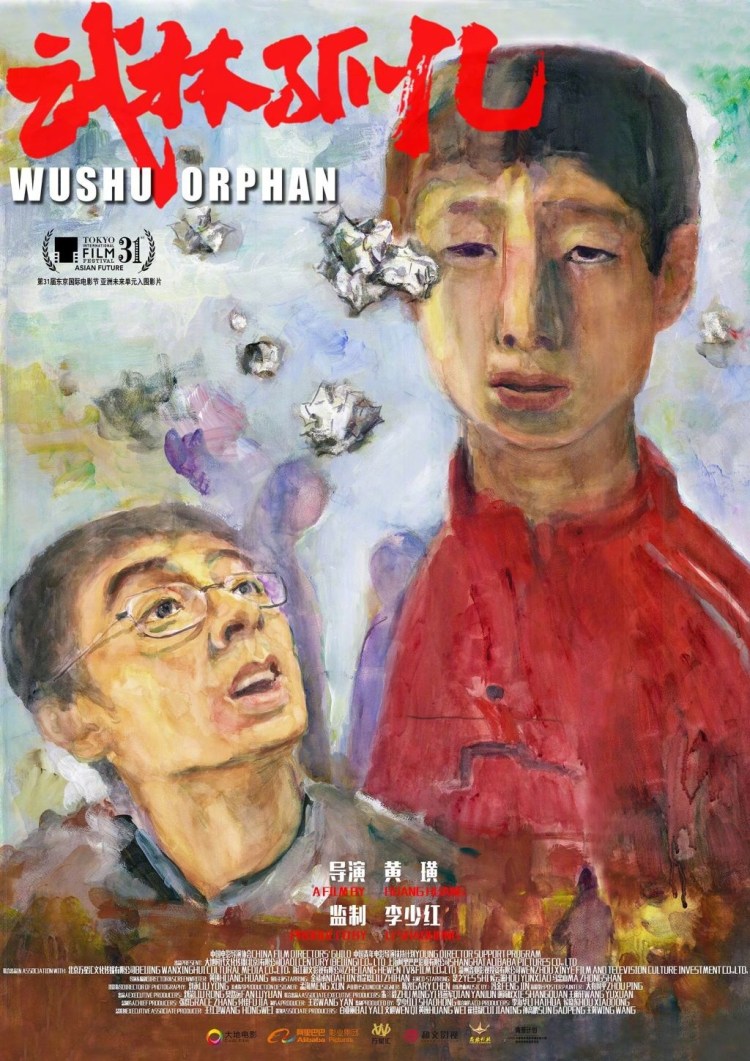
Wushu Orphan (武林孤儿, Huang Huang, 2018)

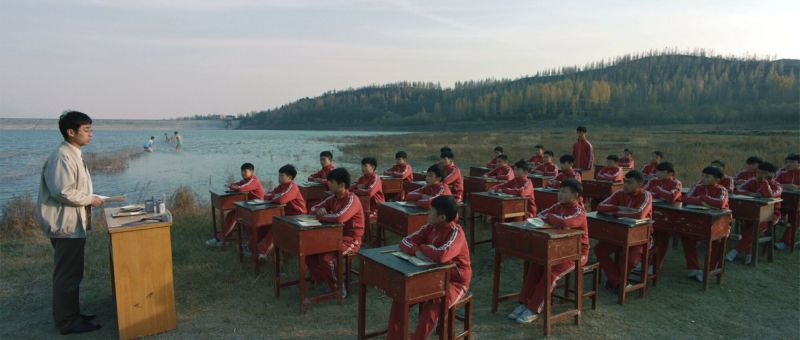
Wushu orphan poster 1Anti-intellectualism comes in for a subtle kicking in Huang Huang’s whimsical ‘90s drama Wushu Orphan (武林孤儿, Wǔlín ér). Less a tale of martial arts, Huang’s poetic debut suggests that perhaps brawn is always going to win over brain, but as brain has the moral high ground it needs to keep fighting all the same even if all it can do is mentally resist. Set in the modernising China of the late ‘90s, Wushu Orphan conjures an achingly nostalgic picture of sleepy rural life, burdened as it is by visions of the past as the next generation pin their hopes on becoming the new Bruce Lee, Jackie Chan, and Jet Li all while neglecting their studies in expectation of martial arts glory.

Our hero, Lu Youhong (Jin Jingcheng), has just transferred to Zhige Wushu Academy to take up a post as their new Chinese teacher. In actuality, Youhong doesn’t have much of an education himself. He has no degree and is almost entirely self-taught which is why he’s wound up here after being turned down by everyone else. In fact, he only got this job because his uncle (Ma Zhongshan), who works at the school, has brought him in as a “catfish” to stir up the otherwise stagnant educational environment which is mainly inhabited by meat headed martial arts fanatics.

Unfortunately for Youhong, no one is very interested in education. All the kids just want to be the next Bruce Lee, and you don’t need to memorise the story of Mulan to become a martial arts master. Zheng Cuishan (Hou Yunxiao), however, has already memorised Mulan, and all the other poems in their reader too. He read them in their entirety when they were first assigned. The problem is, that Zheng Cuishan has been labelled a “special case”. With no aptitude for wushu, he’s mercilessly bullied by his classmates and is forever trying to run away. All he wants is to go home to his family, but they’re fishermen and Zheng Cuishan is afraid of the water so they can’t take him with them on their boat.

As might be assumed, the nerdy, bespectacled Youhong quickly notices an affinity with the obviously bright Cuishan who effortlessly aces all his tests and outright refuses to engage in violence. During one of his earliest lectures, Yuhoung breaks down the character in the name of their school which means “wushu”, explaining that it’s made up of the characters for “stop” and “weapons” because the point of martial arts is to preserve “peace”. His rationale provokes only bored stares from boys who’d rather be outside and a cynical laugh from feckless headmaster’s son Qin (Shi Zhi), lurking outside the window, while he struggles to impress upon his pupils the importance of knowledge as a compliment to physicality.

Going through their tests one day, after being unexpectedly asked to teach maths (and English) after the other teachers quit, Youhong notices that one of the boys got all the questions right but erased his answers before turning in the paper. Confused, he turns to his uncle for an explanation only to be told not to press the issue. This is a martial arts school. It’s considered deeply uncool to be seen succeeding in anything that’s not wushu, as if that were somehow a betrayal or a sign that one has not dedicated oneself entirely to martial arts. That’s one reason Cuishan is so mercilessly bullied, because he’s the intellectual holdout in a school full of meat headed cowards too afraid to buck the system or too brainwashed to know why they should.

In a moment of madness, Youhong snaps, cruelly crushing the dreams of his young charges when he tells them that martial arts are useless in the modern world. They’ll never be the next Bruce Lee, all they can hope for is a life of petty crime and street performance. Predictably he’s silenced by a fist headed straight for his face as if to say that violence is always going to win over rational thought, but Youhong refuses to be beaten. Even if he cannot “fight” these ideas he can still resist them by sticking to his principles and refusing to go along with the inherent weirdness of the school.

In this Cuishan follows him, no longer quite so afraid of the water and one step closer to achieving his dream of learning to swim. Perhaps if Youhoung has encouraged one mind away from the groupthink he’s done enough, emerging with a new conviction as he bravely stands up to a rude woman and her son “threatening” him with a toy gun on the train. Meanwhile, a 70-year-old martial arts master gets of out prison and pointlessly tracks down his geriatric rivals in order to prove himself the master of masters. Filled with nostalgic ‘90s Mandopop and an evocative retro score, Huang Huang’s debut is a visually striking tribute to the solidarity of outsiders swimming against the tide as they strive to keep hold of themselves in the oppressive groupthink of a relentlessly conformist society.


Wushu Orphan screens as part of the 2019 New York Asian Film Festival on June 30.

Original trailer (English subtitles)
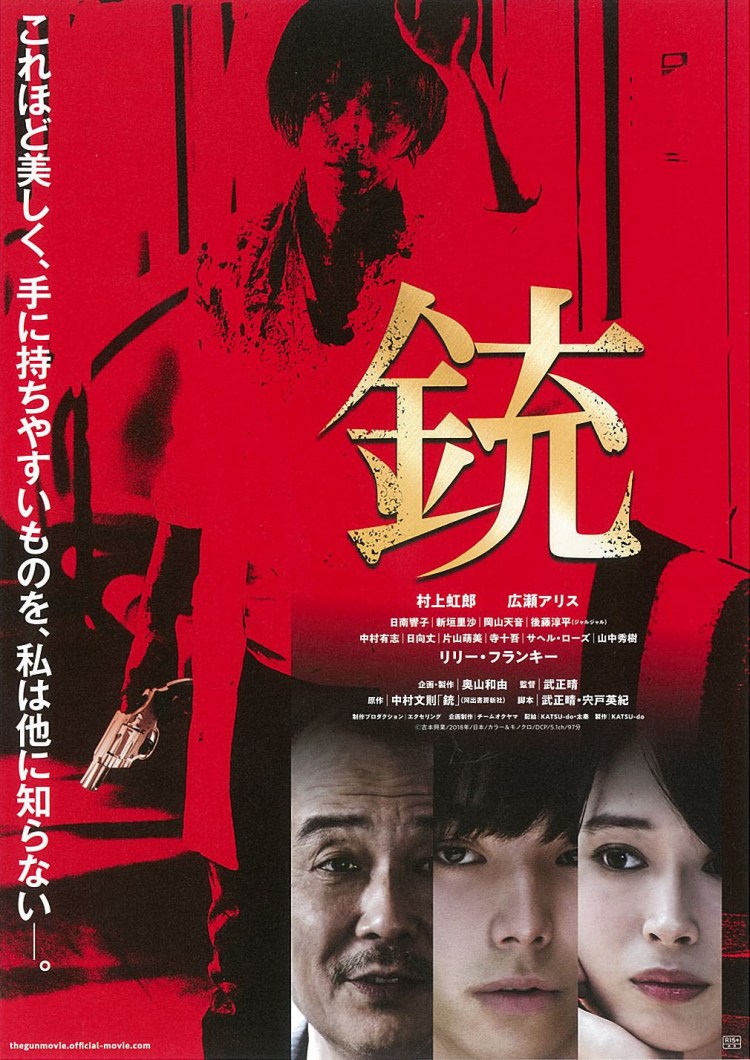
The Gun (銃, Masaharu Take, 2018)

The Gun poster 1Much as Haruhiko Oyabu had in the post-war era, Fuminori Nakamura is fast becoming the go to voice for nihilistic noir in Japanese cinema. Several of his famously dark novels have already been adapted for the screen, most recently the grisly mystery Last Winter We Parted, but it’s only now that his lowkey debut The Gun (銃, Ju) is getting a suitably detached adaptation from 100 Yen Love’s Masaharu Take.

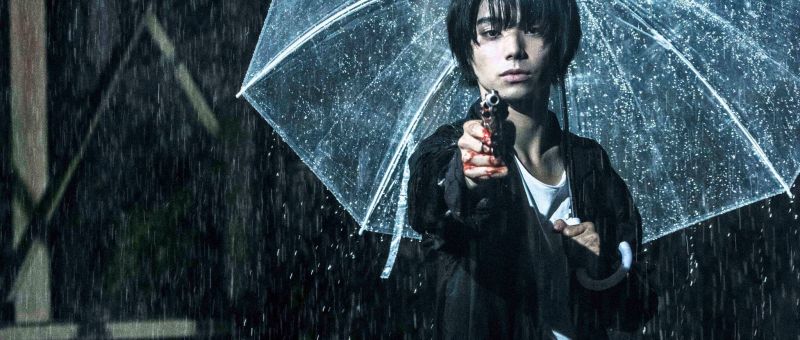
Like many of Nakamura’s “heroes”, Toru Nishikawa (Nijiro Murakami) is a disaffected youngster who thinks “it’s completely worthless to live”. His life changes one day when he comes across the body of a middle-aged man with a pistol lying next to it. For reasons he doesn’t quite understand, Toru picks the gun up and takes it home with him. Gradually its presence begins to obsess him as if he were literally being seduced by it. Believing he can communicate with the gun through touch, he lovingly caresses it, buys it trinkets, and lingers over thoughts of all they could do together.

Even when he takes a casual hookup (Kyoko Hinami) to bed, all Toru can think about is the gun. In the morning he tries to make her hate him by coming on strong, but it backfires because it appears to be what she likes, at least she suggests they hook up again, possibly on a regular but casual basis because she already has a boyfriend. Meanwhile, another prospect walks onto the scene – Yuko (Alice Hirose), a young woman Toru may or may not have forgotten meeting in the past. With Yuko Toru decides to do everything “properly” in a quest to win her heart rather than just her bodily submission.

Detached and very possibly a sociopath, Toru does indeed begin to show something of a more sensitive side in dealing with the similarly depressed Yuko. His gentlemanly act may be just that (and as one might expect, it largely works) but does at least display an acute emotional intelligence even if it’s being wilfully misused. Similarly, his first reaction to hearing alarming sounds suggesting the woman next door is mistreating her child is to turn his stereo up and ignore them, but he later finds himself trying to talk to the little boy in the street and eventually even calling the police only to have his mistrust of authority confirmed when they admit they’re aware of the situation and will send someone but probably not until the next day.

The woman next door, a bar hostess who rolls in late and kicks her kid out of bed to sleep on the porch so she can entertain her gentlemen callers, drags up unwelcome memories of the woman who abandoned him to an orphanage. To be fair, Toru does not seem any more misogynistic than his sleazy friends but has a fairly utilitarian idea of “romance”, viewing it as a game of conquest either fast and loose like with the casual hookup or slow and deep as in his careful pursuit of Yuko. Gradually his separate pursuits of the two women become confused, leading Yuko to confront him over whatever it is that’s so obviously “wrong” with him. Upset as she is, Yuko sees the darkness in Toru but must also see the light, affirming that she has her darkness too but is willing to help him with his if only he gives her a little time and waits for her forgiveness.

Toru, meanwhile, is still fixated on his beloved gun which he has begun to carry about with him in a little bag for added frisson. Living largely without feeling, the thrill of carrying such an illicit object becomes a peculiar kind of drug, as does the intoxicating thought of the act of actually firing it and finally of taking a life. A wily police detective (Lily Franky) cuts straight through Toru’s smug facade to the gaping void beneath, trying to prevent him from jumping straight into the abyss but confident he will fail. As the detective predicted, Toru’s sense of reason continues to fragment leaving him unsure of what is real and what isn’t while he obsesses over the gun and what he might do with it but in a purely intellectual sense without considering the real world consequences of his actions. An exercise in style, The Gun is a noirish tale of existential ennui and dark obsession filled with nihilistic dread as its soulless hero commits to living his “worthless” life only to wilfully rob himself of the possibility of salvation.


The Gun screens as part of the 2019 New York Asian Film Festival on June 30.

Original trailer (no subtitles)

Han Dan (寒單, Huang Chao-liang, 2019)

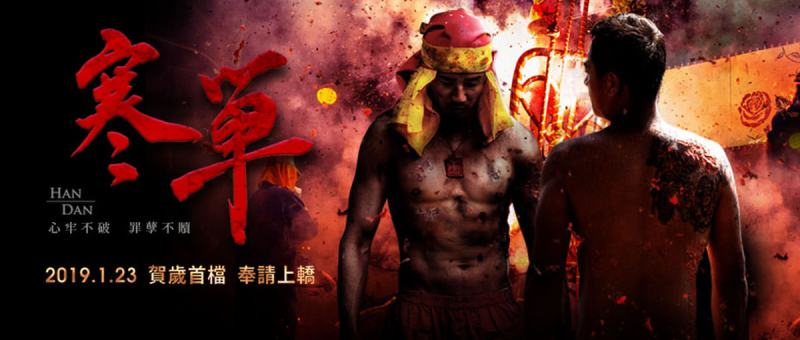
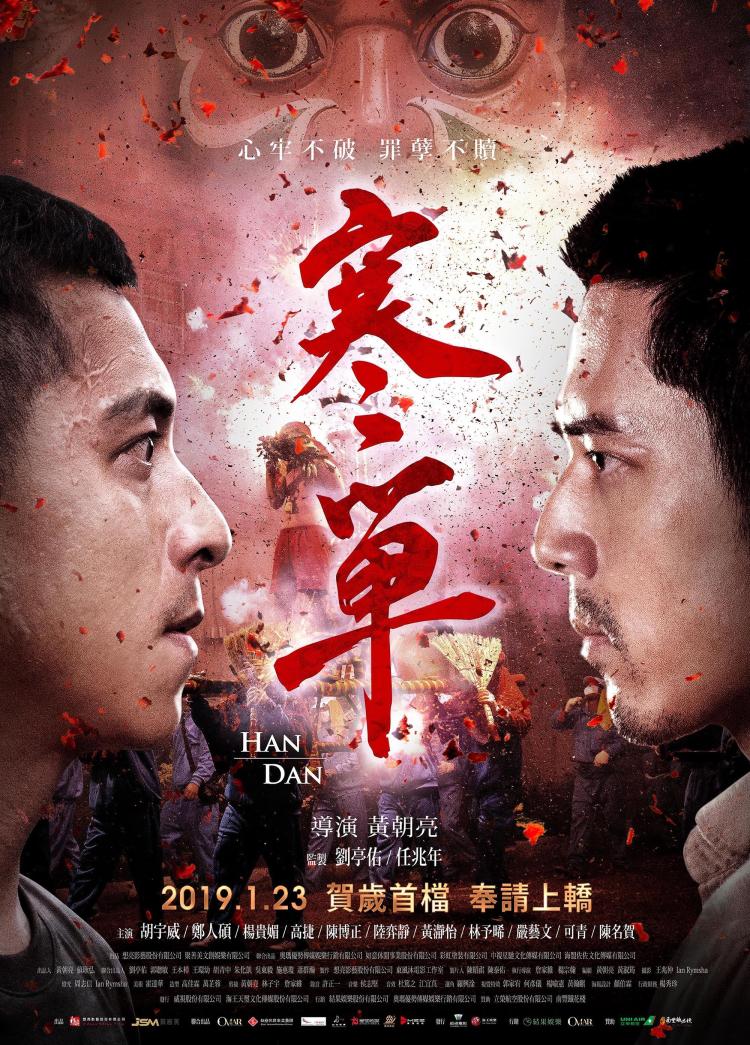
Han Dan poster 1Military deity of wealth “Han Dan” is said to be afraid of the cold, so those who worship at his altar try to keep him warm with firecrackers during a ritual still practiced in the Eastern cities of Taiwan in which young men embody the god and brave the fiery assault in a daring show of their masculinity. Some volunteer to play the god for money, others for pride, and a few for atonement but there are some crimes you can’t simply burn away either with fire or by hate. The heroes of Huang Chao-liang’s Han Dan (寒單) bond through tragedy and try push past their pain through brotherhood but only one of them is aware their present relationship is founded on twisted hate fuelled revenge even as a genuine connection forms underneath.

Nerdy, earnest school-teacher-to-be Zheng-kun (George Hu Yuwei) has been fostering a lifelong crush on the girl next door, Xuan (Allison Lin), who went away to Taipei and only rarely returns home. Too shy to declare himself, he is enraged and hurt to discover that she has been secretly dating a guy they went to high school with – popular kid Ming-yi (Cheng Jen-shuo) who used to bully him for being only a trash collector’s son. Ming-yi is set to play Han Dan at this year’s Lantern Festival and his show of manly bravado is almost more than Zheng-kun can bear. In a moment of madness, he throws his lighter into a pile of firecrackers hoping to injure his rival, but Xuan runs to warn him and is caught in the crossfire. She dies from her injuries, leaving both men feeling guilty and bereft though no one else knows that it was Zheng-kun who started the fire. 

While Zheng-kun gives up on his teaching career and retreats into gloomy introspection, Ming-yi, who lost his hearing and the use of his hand in the accident, has become a drug addict and petty criminal. Riddled with guilt, Zheng-kun commits to “saving” his former enemy – locking him up while he goes cold turkey and then bringing him into the recycling business he’s started on his father’s land, but still harbours hate in his heart both for himself and for the man Ming-yi used to be.

“If only we were real friends” Zheng-kun mutters under his breath during an otherwise idyllic moment at the river. Learning more about his “blood brother”, Zheng-kun discovers that a toxic family situation is what made him such a terrible person in high school which might ordinarily have fostered compassionate forgiveness but only makes things worse for Zheng-kun who continues to hate Ming-yi to avoid having to think about how much he hates himself for what he did to Xuan. In an effort to atone, he forces himself through the Han Dan ritual year after year, scorching his body with firecrackers but finding little in the way of cathartic release.

“Feeling the pain means I’m alive” he tells a melancholy woman who seems to have had a thing for him ever since he was a shy student with a part-time job in the sleazy snack bar where she works. Now violent and angry, he’s not such a sensitive soul anymore but she loves him all the same and resents the intrusion of the late Xuan into their awkward relationship. Like the lovelorn hostess and the song they find themselves listening to, Zheng-kun too has a secret in his schoolbag that’s becoming impossible to keep but speaking it threatens to upset the carefully balanced semblance of a life that he’s forged with an oblivious, wounded Ming-yi.

Both men struggle to move on from the past, unable to forgive themselves not only for what happened to Xuan but for the choices they did or didn’t make in their youths that leave them afraid to move forward and locked into an awkward brotherhood bonded by love and hate in equal measure. A final cathartic explosion may provide a path towards a new life but only through shattering the fragile bond born of shared tragedy and irretrievable loss. A beautifully lensed morality tale, Han Dan is an acutely observed portrait of the corrosive effects of guilt and trauma but also a tragedy of misplaced male friendship as two lost souls find each other only in losing themselves as they battle the inescapable shadows of the past.


Han Dan screens as part of the 2019 New York Asian Film Festival on June 30.

Original trailer (English subtitles)
A Resistance (항거:유관순 이야기, Joe Min-ho, 2019)

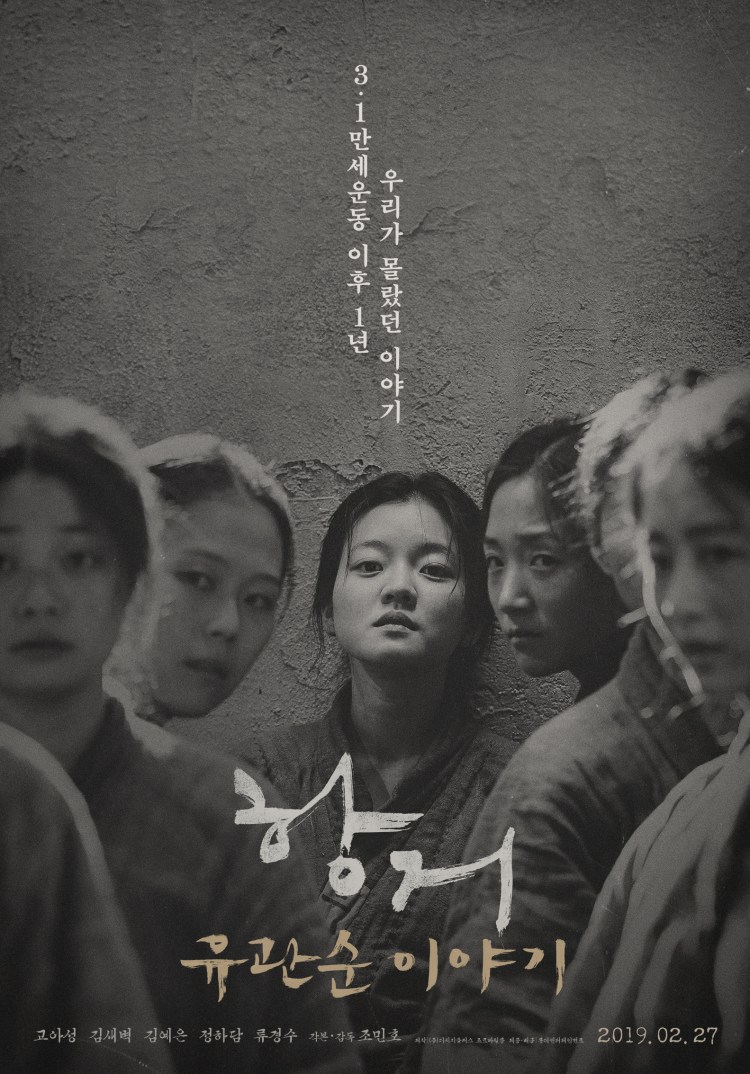
A Resistance poster 1March 1, 2019 marked the centenary of the Korean Independence Movement which began with a peaceful protest on 1st March, 1919 that was brutally put down by Japanese forces who fired on innocent protestors killing thousands and imprisoning many more. One of the key leaders of the protest was a teenage girl, Yu Gwan-sun, who died in prison a little over a year later aged just 17. Joe Min-ho’s A Resistance (항거:유관순 이야기, Hanggeo: Yu Gwan-sun Iyagi) is the story of her struggle in which she remains defiant in the face of unfair and inhuman treatment at the hands of her Japanese captors.

The film opens with Gwan-sun (Go Ah-sung) being roughly pulled off a cart, unable to see thanks to the straw hat placed over her face. When the mask is removed for her prison registration card photo, we can see that (just as in the real photo which still exists and is on display in the Seodaemun Prison History Museum) her left eye and cheek are swollen from a previous beating. Taken inside, she is led to women’s cell 8 and shocked to see 24 other women already standing inside it when the door opens. There isn’t even enough room to sit down, and so the women have to take turns to rest, walking endlessly in circles to try and prevent their legs cramping up from standing too long in the same place.

On her first meeting with the prison warden who is surprised she has received such a comparatively long sentence (5 years, reduced to 3 on appeal), she is reminded that her best chance for survival is to keep her head down and do as she’s told. Gwan-sun intends to do just that but finds herself constantly infuriated by the injustice of the prison guards and the inhumane conditions in which the political prisoners are kept. Most of the women in the cell with Gwan-sun are there solely for having been at the protests and supposedly shouting “Manse”, they have committed no other crime save refusing to accept the primacy of Japanese authority.

The trouble starts when the women burst into a chorus of Arirang – a patriotic Korean folk song, which proves intolerable to the guards and gets Gwan-sun inducted for her first bout of extreme torture at the hands of her block warden and a Korean recruit working for the Japanese, Nishida (Ryu Kyung-soo). From a poor background, Nishida has thrown his lot in with the Japanese hoping for advancement but is unable to see that to them he will always be just another Korean minion to be discarded when no longer useful. Though he seems conflicted when directly ordered to participate in the torture of Gwan-sun, who is after all a defenceless 16-year-old girl, which involves acts of sexual humiliation and insidious violence, he fails to resist and dutifully obeys the orders of his Japanese commander.

Though her primary goal is Korean Independence, Gwan-sun is also working to end the kind of class oppression which has pushed Nishida into the arms of the Japanese. This much she reminds one of her cellmates (Jeong Ha-dam) who worries it would be inappropriate for them to be friends because she is just an uneducated woman working in a coffeeshop. Another of her cellmates is a “famous” gisaeng who finds herself looked down on by some of the other women because of her participation in sex work. Inspired by a real life character, Kim Hwang-hwa (Kim Sae-byuk) was another key figure in the Independence Movement who began mobilising gisaeng to participate in the protests, motivated by the often cruel treatment they received from Japanese customers. The coffee shop girl laments that if she were a man she’d go to Manchuria or fly around the world. Kim Hwang-hwa reminds her there’s nothing stopping a woman from doing that anyway and eventually ends up in Manchuria herself looking for the Independence Movement in exile in Shanghai. 

Despite emphasising the solidarity of the women in prison, Joe’s retelling of Yu Gwan-sun’s last days perhaps misses an opportunity to explore the important role that women played in the Independence Movement or the various ways it intersected with early feminism and progressive socialist politics. Nevertheless it does its best to pay tribute to a brave woman who suffered terribly in the belief that a better world was possible, refusing to give in even at the very end.


A Resistance screens as part of the 2019 New York Asian Film Festival on June 30.

International trailer (English subtitles)
Jinpa (撞死了一只羊, Pema Tseden, 2018)

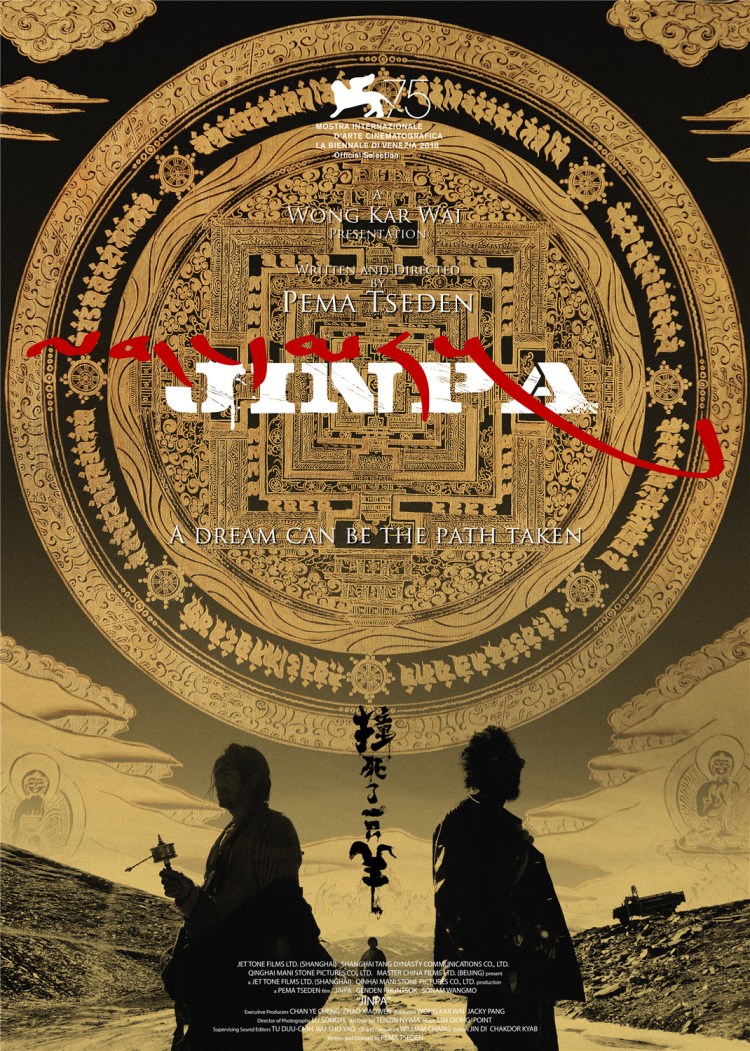
Jinpa poster 1Dreams, reality, and memory intertwine in Pema Tseden’s surrealist Tibetan western Jinpa (撞死了一只羊, Zhuàng le Yī ZYáng). Cycles of revenge and regret, killings accidental and deliberate, lost love, and inescapable karma bind two men or two parts of one whole as two travellers meet each other on the road, part, and then are perhaps reunited if in a more spiritual sense than literal. Moving away from the realism of Tharlo into mystical abstraction, Pema Tseden’s sixth feature is as obtuse as it is beguiling.

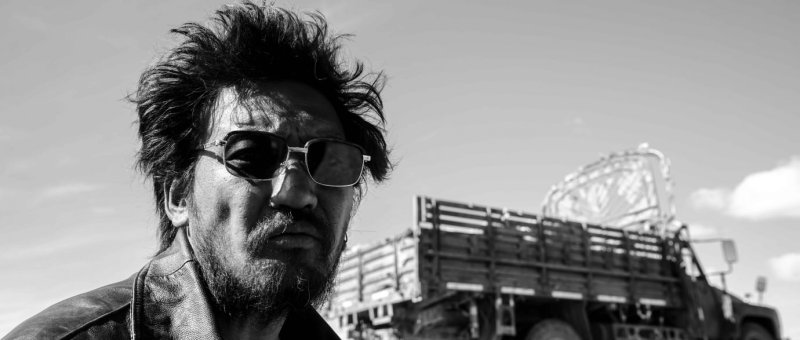
The titular Jinpa is an ultra cool truck driver in black leather and sunshades whose main jam is, incongruously enough, a Tibetan cover of O Sole Mio. Out on the road one day and distracted by the swooping flight a nearby bird, he accidentally hits and kills a sheep. Remorseful, Jinpa bundles the poor creature’s body into his cab, only to have to shift it into the back when he gets another passenger – a young wanderer (Genden Phuntsok) who later abandons his silence to explain that his name is also “Jinpa” and he’s on a quest for revenge against the man who killed his father 20 years ago. A decade long search has led him to Sanak where he hopes to find the man he’s looking for.

The men part company at the next turning, but the older Jinpa can’t seem to forget about his strange encounter. He takes the sheep for a proper funeral (before stocking up on lamb from a street stall), and pays a visit to lover where he unable to perform to anyone’s satisfaction. Jinpa hits the road again to look for his hitcher, either eager to prevent a crime which may add to his own karma, or simply to discover the end to the mystery.

Jinpa’s accidental slaughter of a sheep and the younger man’s quite deliberate quest for blood become somehow linked. Tracking the other Jinpa he finds himself at a tavern with a flirtatious barmaid (Sonam Wangmo) who gives him a few more clues, most particularly a possible identification of the man the other Jinpa might have been looking for but her tale is a strange one. The tavern goers’ background conversation is identical to the present moment, implying this is either one very boring spotlight hogger or that events are somehow occupying the same temporal space.

Shifting into hazy black and white for his flashbacks, Pema Tseden hints at the malleability of memory – as if one figure could easy be swapped out for another, past and present uncomfortably overlapping with memory as the unstable glue at their centre. The younger Jinpa’s prospective target, we discover, also has a son. Would he grow up to seek revenge against the man who killed his father? One circle closes, but another envelopes it just as quickly. A man kills a sheep, by accident, but perhaps there’s more that he’s atoning for than simply inattentive driving.

“If I involve you, it becomes your dream too” the opening text tells us citing a Tibetan proverb. Could the older Jinpa simply be dreaming a version of himself, or are the two men somehow inhabiting the same dreamscape? Events repeat, the two men walk the same path at different times, diverging and reuniting as they make their way towards whichever realisation is lying in wait for them.

Played by real life poet and actor himself called “Jinpa”, the eponymous hero oozes cool in his edgy rockstar getup and ever present sunshades, embodying the stranger in town a little too consciously as he wanders in search of his younger self. Produced by Wong Kar-wai and adapting Tsering Norbu’s novel The Slayer, as well as the director’s I Ran Over a Sheep, Jinpa is an unabashed exercise in style and mood, swapping the washed out iciness of the road for the colourful warmth of taverns, stores, and temples while memory remains a blur of radiating black and white frustratingly difficult to see in its entirety. Jinpa’s circular travels mimic his life, caught between cycles of violence and regret but hoping for forgiveness and eventual release. Abstract and inscrutable, Jinpa’s mythic fable nevertheless retains its strange power as its hero(es) attempt to free themselves from an inescapable spiral of existential despair.


Jinpa screens as part of the 2019 New York Asian Film Festival on June 29.

Original trailer (no subtitles)

Samurai Marathon (サムライマラソン, Bernard Rose, 2019)

Samurai Marathon posterAfter two and a half centuries of peaceful slumber, Japan was jolted out of its isolation by the arrival of Commodore Perry’s Black Ships. The sudden intrusion proved alarming to most and eventually provoked a new polarisation in feudal society between those who remained loyal to the Shogun and the old ways, and those who thought Japan’s best hope was to modernise as quickly as possible to fend off a foreign invasion if it did eventually arise as many feared it would. Lord Itakura (Hiroki Hasegawa) has a foot in both camps. He has no desire to move against the Shogun, but fears that centuries of peace have made his men soft and complacent. His solution is to institute a “Samurai Marathon”, forcing his retainers to run 36 miles to prepare for a coming battle.

If you’ve spent your life sitting around and occasionally waving a sword at something just to keep your hand in, suddenly trying to run 36 miles might not be the best idea, as many samurai keen to win favour through racing glory discover. There is, however, an additional problem in that, unbeknownst to anyone, samurai accountant Jinnai (Takeru Satoh) is a secret ninja spy for the shogun. Confused by the preparations for the race, he reported that a possible rebellion was in the offing only to bitterly regret his decision on realising Itakura’s anxieties are only related to external, not internal, strife. All of which means, the Shogun’s men are on their way and Itakura’s retainers are sitting ducks.

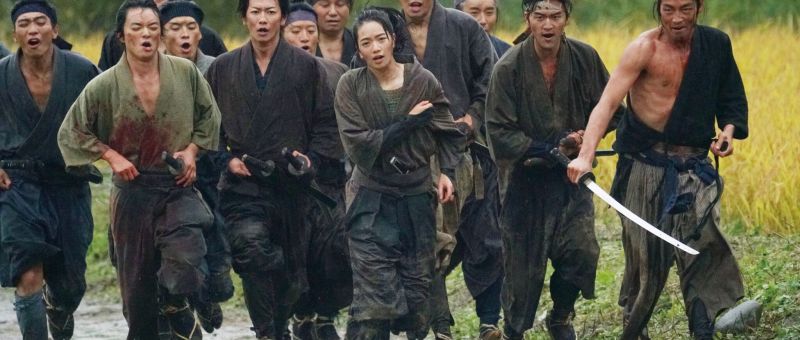
Helmed by British director Bernard Rose, Samurai Marathon (サムライマラソン) plays out much more like a conventional European historical drama than your average jidaigeki. Where samurai movies with an unusual focus tend to be comedic, Rose opts for a strangely arch tone which is somewhere between po-faced Shakespeareanism and post-modern irony. Rather than the stoical elegance which defines samurai warfare, the violence is real and bloody, if somewhat over the top in the manner of a gory Renaissance painting complete with gasping severed heads and gruesome sprays of dark red blood.

A chronicle of bakumatsu anxiety, the film also takes a much more pro-American perspective than might perhaps be expected, taking the view that the arrival of the Americans heralded in a new era of freedom and the origins of democracy rather than the more ambivalent attitude found in most jidaigeki which tend to focus much more strongly on the divisions within samurai society between those who wanted to modernise and those who just wanted to kick all the foreigners back out again so everything would go back to “normal”. Itakura, like many, is suspicious of foreign influence and the gun-toting, yankee doodle humming Shogunate bodyguard is indeed a villain though it’s Itakura himself who will end up firing a gun as if conceding that the future has arrived and the era of the sword has passed. 

Ramming the point home, Itakura is also forced to concede to the desires of his wilful daughter, Princess Yuki (Nana Komatsu), who wanted to travel and see the world while her society (and conventionally minded though doting father) insisted all there was for her was marriage and a life stuck inside castle walls. Managing to escape and disguising herself by cutting her hair and putting on peasant clothes, Yuki is able to evade detection longer than expected precisely because few people have ever seen her face. She also gets to make use of some of the samurai training she’s received by holding her own out on the road, though it seems improbable that her father would let her ride out alone even if he finally allows her free rein to go where she chooses.

Meanwhile, other ambitious retainers try to use the race to their own advantage though there’s poignant melancholy in one lowly foot soldier’s (Shota Sometani) dreams of being made a samurai considering that in just a few short years the samurai will be no more. The final sepia shift into the present day and a modern marathon may be a stretch, as might the unnecessary final piece of onscreen text informing us that we’ve just watched the origin story for the Japanese marathon, but the main thrust of the narrative seems to be that the samurai were running full pelt into an uncertain future, preparing to surrender their swords at the finish line. An unusual take on the jidaigeki, Samurai Marathon perhaps takes an anachronising view of Bakumatsu chaos in which the samurai themselves recognise the end of their era but finds its feet on the road as its self-interested heroes find common purpose in running home.


Samurai Marathon screens as the opening night gala of the 2019 New York Asian Film Festival on June 28 where actress Nana Komatsu will be in attendance to collect her Screen International Rising Star Asia Award.

Original trailer (no subtitles)

The Last Recipe (ラストレシピ〜麒麟の舌の記憶〜, Yojiro Takita, 2017)

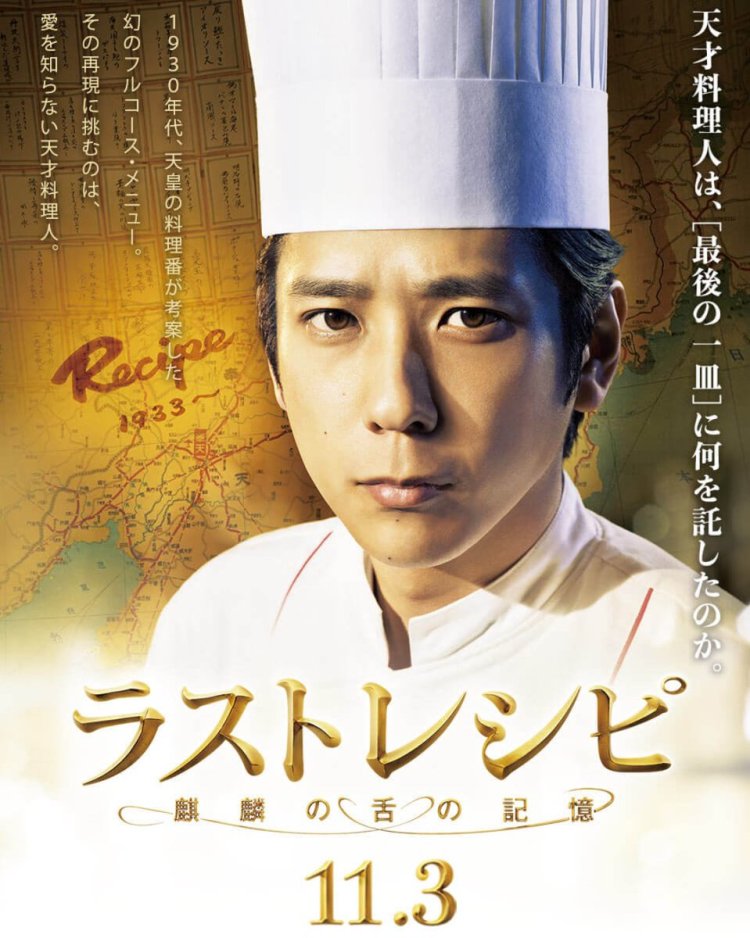
Last Recipe Poster 2Is it really possible to be “successful” and a terrible person? Some might say it’s impossible to become successful and stay nice, but in Japanese cinema at least success is a communal effort. Prideful selfishness is indeed the reason for the downfall of the hero of Yoijro Takita’s historically minded cooking drama The Last Recipe (ラストレシピ〜麒麟の舌の記憶〜, Last Recipe: Kirin no Shita no Kioku). Adapted from a novel by the director of the Iron Chef TV show, The Last Recipe offers a somewhat revisionist portrait of Japan in the 1930s but, perhaps ironically, does indeed prove that no one gets by on their own and all artistic endeavours will necessarily fail when they come from a place of self absorbed obsession with craft.

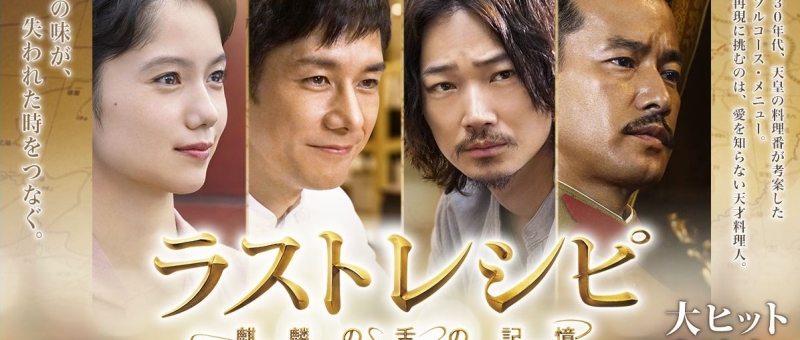
In 2002, failed chef Mitsuru (Kazunari Ninomiya) is eking out a living by cooking “last meals” for elderly people desperate to crawl inside a happy memory as they prepare to meet their ends. Mitsuru’s special talent is that he has a “Qilin” tongue which means that he can remember each and every dish he has ever tasted and recreate it perfectly – for which he charges a heavy fee in order to pay off the vast debts he accrued when his restaurant went bust. When a mysterious client in Beijing offers him an improbably lucrative job, Mitsuru jumps at the task but it turns out to be much more complicated than he could have imagined. His client, Yang (Yoshi Oida), wants him to recreate the mysterious “Great Japanese Imperial Feast” as designed for an imperial visit to the Japanese puppet state of Machuria in the late 1930s.

Somewhat controversially (at least out of context), Yang sadly intones that the years of Japanese occupation were the happiest of his life. Through the events of the film, we can come to understand how that might be true, but it’s a bold claim to start out with and The Last Receipe’s vision of the Manchurian project is indeed a generally rosy one even if the darkness eventually creeps in by the end. A perfect mirror for Mitsuru, the chef that he must imitate is a Japanese genius cook dispatched to Manchuria on a secret culinary mission which turns out to be entirely different to the goal he assumed he was working towards. Nevertheless, though not exactly an outright militarist, Yamagata’s (Hidetoshi Nishijima) view of the Manchurian experiment echoes that which the state was eager to sell in that he hopes to create a legendary menu that will unite the disparate cultures of the burgeoning Japanese empire under a common culinary banner, building bridges through fusion food.

Yang, his Chinese assistant, is the only dissenting voice as he points out that Japan is often keen to sell the one nation philosophy but reserves its own place at the top of the tree with everyone else always underneath. In any case, Yang, Yamagata, and his assistant Kamata (Daigo Nishihata) eventually bond through their shared love of cooking but the problems which plague Yamagata are the same ones which caused Mitsuru’s restaurant to fail – he was too rigid and self-obsessed, a perfectionist unwilling to delegate who alienated those around him and wasted perfectly good food for nothing more than minor imperfections. Yamagata’s kindly wife (Aoi Miyazaki) is quick to point out his faults, but it takes real tragedy before he is able to see that the reason his dishes don’t hit home is that he was not prepared to embrace the same communal spirit he envisioned for his food during its creation.

Mitsuru, however, is much slower to learn the same thing, decrying Yamagata as a loser who sold out and allowed his emotional suffering to turn to turn him soft, assuming this is the reason that his recipe was never completed. As expected, Mitsuru’s mission mirrors Yamagata’s in being not quite what he assumed it to be, eventually learning a few truths about himself as he gets to know the historical chef through the eyes of those who remember him. Eventually Mitsuru too comes to understand that the only thing which gives his craft meaning is sharing it and that he’s never really been as alone he might have felt himself to be. Though its vision of the Manchurian project is somewhat idealised as seen through the naive eyes of Yamagata, The Last Recipe nevertheless presents a heartwarming tale of legacy and connection in which cooking and caring for others, sharing one’s food and one’s table with anyone and everyone, becomes the ultimate path towards a happy and harmonious society.


Original trailer (English/Chinese subtitles)

Nervous Translation (Shireen Seno, 2017)

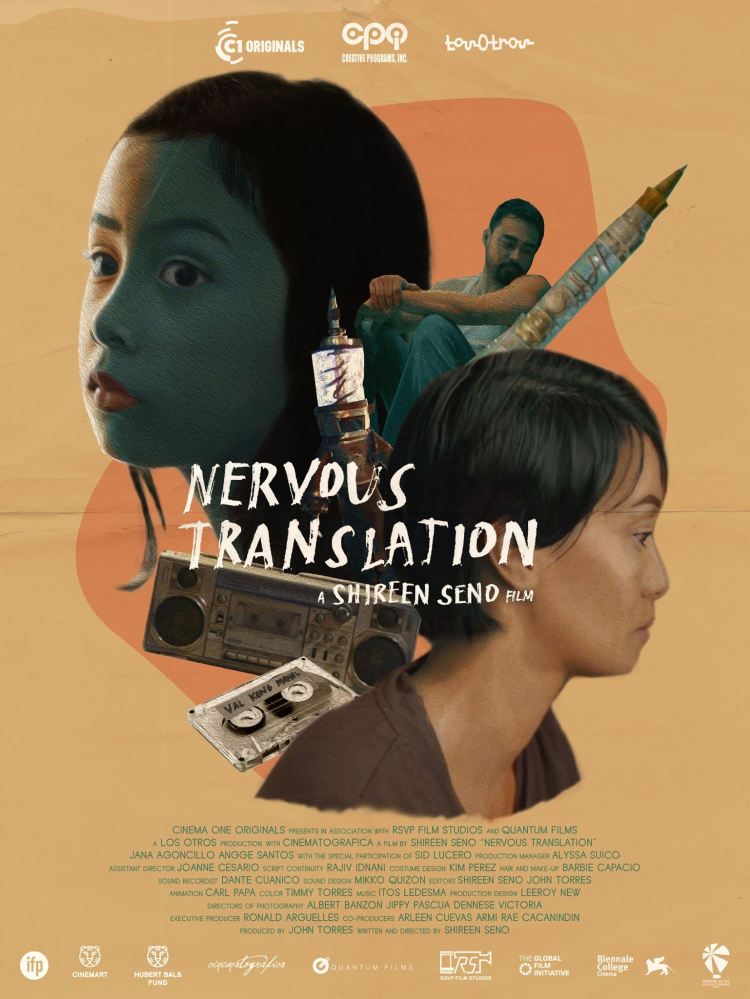
Nervous Translation poster 1If you knew of a device which would give you “a beautiful human life”, wouldn’t you want to get hold of it? The heroine of Shireen Seno’s Nervous Translation longs to do just that, tantalised by its promise of the ability to write simply and convey one’s thoughts to others with ease. Living in anxious times, Yael is an anxious little girl who knows little of the chaos going on outside her ordinary home but continues to find herself uncertain even here.

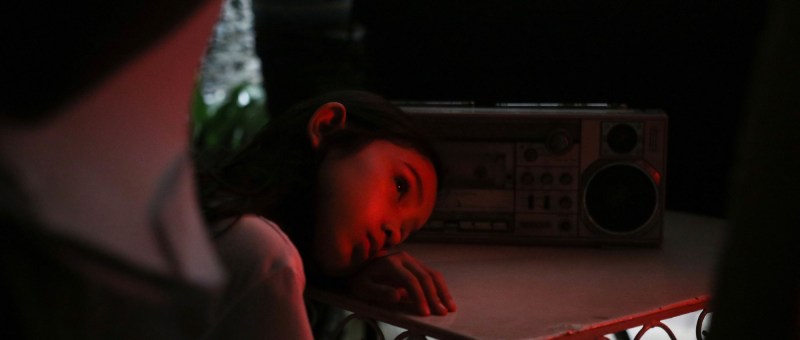
Yael (Jana Agoncillo), often home alone, is a shy little girl left largely to her own devices until her harried mother, Val (Angge Santos), gets back from her job in a shoe a factory. Taking some advice from her absent husband a little too literally, she “retires” from being a mother for the first 30 minutes after arriving home, insisting on total silence and shutting herself away in her room as if her daughter did not exist. Meanwhile, Yael pines for the father she only really knows from the voice recordings he sends home on cassette tape and which she is not, technically, allowed to listen to despite their being addressed both to her and her mother. On the tapes, her father seems to be employing some kind of code so the messages will be suitable for a little girl’s ears (her mother is not quite so careful in her replies), but talks of how much he misses his family and regrets missing out on so much of his young daughter’s life.

Painfully shy, Yael’s only other real contact is a friend from school, Wappy, whom she calls up on the telephone for a “mad minute” of maths. It’s also to Wappy that she turns when she realises she’s accidentally taped over quite a sensitive moment in one of father’s messages, hoping her male friend could help by putting on a deep voice to re-record the words she’s already memorised only for him to remind her that he’ll still be eight years old and probably no help even if they wait ’til later.

Yael’s innocent attempts to repair the broken tape hint at both her childish worldview and her ongoing desire to “translate” herself through the medium of mimicry. She is captivated by a very bubble-era Japanese ad on television for the “Ningen Pen” (human pen) which promises that it is easy to write with and makes expressing yourself to others simple. One could, of course, say this is true for almost any kind of pen but Yael, still a child, is more interested in the promise of the shiny magic gadget than actively keyed into the power of writing as a path out of her shyness.

We never learn the reason for Yael’s bandages or the skin complaint which seems to affect only her arms and possibly keeps her wary of other children, at least if her cousin’s “are you some kind of mummy?” question is anything to go by. We do know, however, that her father was shy, like her, and also had a physical “deformity” as someone later puts it in that one side of his body was much shorter than the other. His twin brother (Sid Lucero), by contrast, is a handsome rockstar now living the highlife in Japan where his wife complains about their expat existence and her inability to make friends with the “picky” Japanese. Possibly down to the soap operas which too closely reflect her own life, Yael seems to pick up on an awkward tension between her mother and uncle but in the end he is the one who tries to “restore” the family by fixing the broken boom box and saving Yael’s bacon by swapping out the damaged tape for another one at just the right moment.

Given the external chaos, however, the family cannot yet be fully repaired. The adults are just as lost and confused as Yael, struggling to parse the sudden changes in society and in their own lives. Val resents her husband’s absence and the economic instability which provoked it while also resenting her labour intensive job in the shoe factory (perhaps a slightly ironic touch given the former first lady’s mania for footwear). She has no time for her daughter, and perhaps resents also the loss of her youth in service of the traditional family life of which she has now been robbed, longing for the intimacy of her long absent husband. Yael “translates” all of her anxieties into a rich fantasy life, reordering her experience in miniature as she cooks tiny meals on a candlelight stove, determined to get the money together to buy “a beautiful human life” in the form of a shiny Japanese pen. Charmingly whimsical but with irresolvable anxiety at its core, Nervous Translation is a beautifully fraught picture of difficult childhood set against the backdrop of political upheaval which manages to find the sweetness in its heroine’s self-sufficiency even while casting her adrift in uncertain times.


Nervous Translation was streamed online by Mubi and screened as part of the Aperture: Asia & Pacific Film Festival courtesy of Day for Night.

Festival trailer (dialogue free)

Die Tomorrow (พรุ่งนี้ตาย, Nawapol Thamrongrattanarit, 2017)

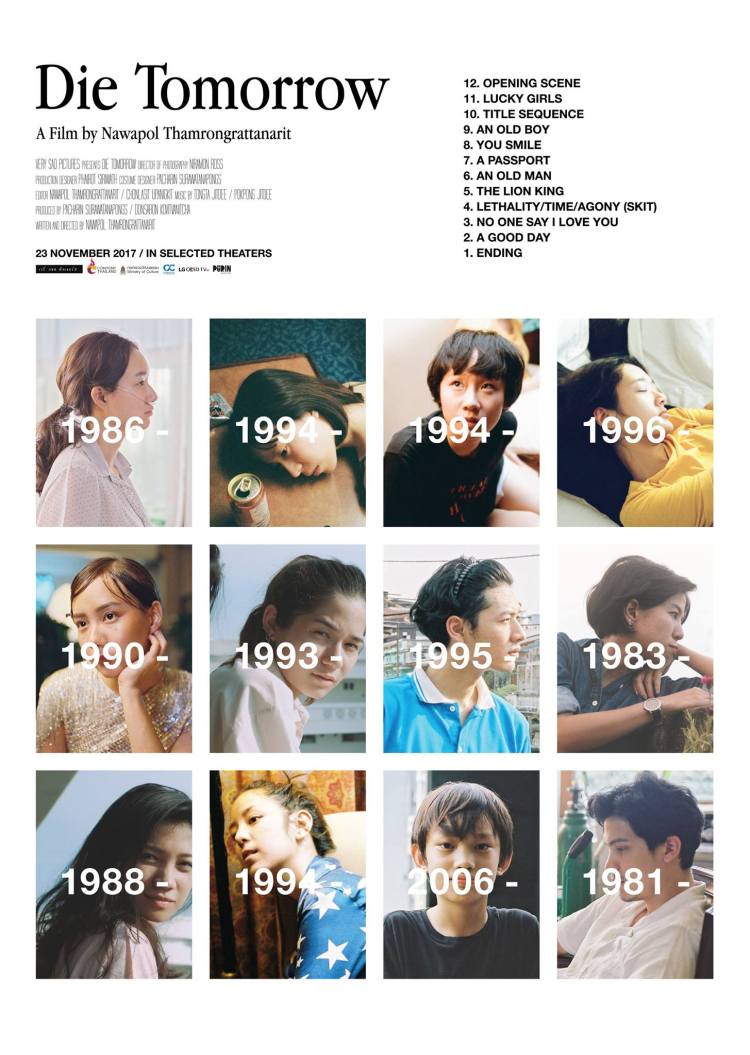
Die Tomorrow posterDeath gives life meaning, so they say, but if death is such a normal part of being alive, why do we live continually in its shadow? We spend our lives talking about a tomorrow which might never come, but it’s those tiny moments of mundanity which make life worth living. Nawapol Thamrongrattanarit’s Die Tomorrow (พรุ่งนี้ตาย) examines the “last day” of a number of oblivious citizens of Bangkok who are busy living life “as normal” little knowing that everything they do will be for the last time.

Shooting mainly within an oppressive square, Nawapol Thamrongrattanarit rams his point home with his first vignette in opening with a newspaper report recounting the death of a student in a road traffic accident the night before her college graduation. He then introduces us to a gaggle of excited students eagerly talking about horoscopes and their dreams for the future. We never quite figure out which of them will be dispatched to get more beer. It could be anyone, anywhere – even you, even right now.

As the ticking clock and time card remind us, 2 people die every second all over the world making dying possibly the world’s most popular activity. Most people dread it, but for one very elderly gentlemen it would be a relief. Convinced that his advanced old age is either a result of genetics or a mistake by someone upstairs, he selfishly wishes that he’d died before his wife and son so he wouldn’t have to go on enduring the pain of their loss. Meanwhile, a little boy quizzed on his beliefs about the afterlife is convinced that death is peaceful because everything just stops. He feels pretty much OK with the idea because he googled it straight away as soon as he found out so it all seems very straightforward. Nevertheless, he’d rather not know when death is coming because that would just make him “sad” and then he wouldn’t be able to enjoy his remaining time.

Death is, however, something you have almost no control over. A melancholy man gets his toenails clipped by his loving wife who is suffering from a terminal disease and awaiting a transplant. Grimly, he tells her that with every death there is fresh hope as he prepares for a trip abroad unaware that, as the preceding title card told us, a plane is about to go missing in the skies between Thailand and America. Meanwhile, across town a man pushes a stool up to his balcony and prepares to jump. Before he does so, he leaves a message for a friend instructing him to pass on his thanks and apologies to the others, affirming that he had no desire to bother them but he has tried his best and life is cruel. An old lover, presumably having her reasons and well within her rights, refuses to open her door to him and remains unrepentant even when her friend suggests she may regret it if he really does do “something stupid”.

With each death the frame expands to its fullest, as if echoing the sense of emptiness in the very present absence of the recently deceased. A brother somewhat irritated by his sister’s abrupt and unexplained return from the US, declares that her death (in a freak accident while parking his motorbike to take a picture of a cute puppy) has reminded him of the preciousness of life. He might have been embarrassed before, but now he makes a point of hugging and kissing his parents, telling those close to him they are loved in case there is no later opportunity to do so. The sad death of a salaryman, in his sleep in the stock exchange lying undiscovered for five hours, seems all the more absurd and pointless while that of a veteran musician, soon after getting his head massaged by his loving daughter, seems like the best of all ends – lying peacefully at home in the summer breeze. Yet as the old man tells us, those who are “young” should have no fear and simply live. Less about the omnipresence of death than the ephemerality of life, Die Tomorrow is a quiet paen to the small pleasures of being alive, discovered in mundanity and the knowledge that every breath may be one’s last.


Die Tomorrow was screened as a special preview at the BFI Southbank and opens in UK cinemas on 26th July courtesy of Day for Night. It is also currently available to stream in the UK via MUBI.

International trailer (English subtitles)
Dawn Wind in My Poncho (ポンチョに夜明けの風はらませて, Satoru Hirohara, 2017)

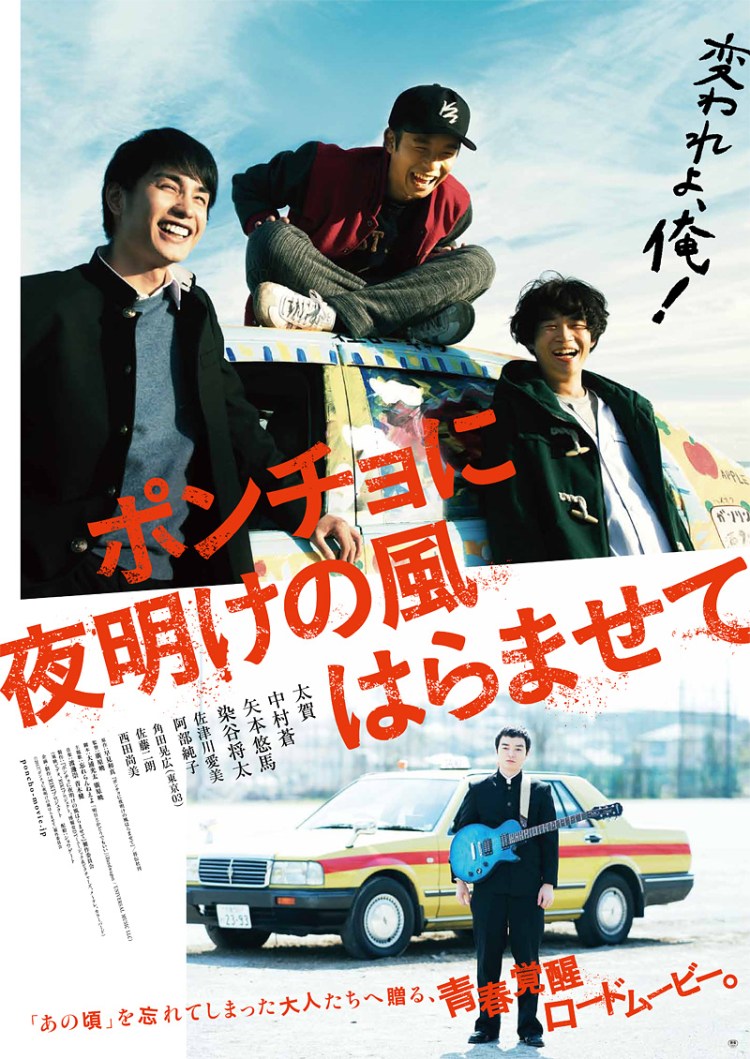
Dawn Wind in My Poncho posterThe end of high school might signal impending doom for some, but it also provides a valuable opportunity for one last hurrah before surrendering to the demands of the adult world. That’s more or less how the heroes of Satoru Hirohara’s Dawn Wind in My Poncho (ポンチョに夜明けの風はらませて, Poncho ni Yoake no Kaze Haramasete) feel about it as they set off on an impromptu road trip to track down a Peruvian folksinger making his first visit to Japan in 18 years. Youthful irresponsibility and an openness to all things send our boys on a strange odyssey of self discovery in flight of a future that is almost certain to be disappointing.

Right before graduation, Janbo (Yuma Yamoto) and Matahachi (Taiga) are preparing to celebrate their friend Jin (Aoi Nakamura) getting into Uni. Only, Jin didn’t make the grade which has rather put a damper on the occasion. To make matters worse, new driver Matahatchi seems to have scratched the car belonging to Janbo’s dad which they weren’t supposed to be driving in the first place. Trying to fix the problem, they run into dejected idol Ai (Aimi Satsukawa) who dreams of chart success but is being pressured into a gravure career by her agency. Ai manages to upset some delinquents in a convenience store car park, leaving our guys wondering if they should step in but coming to the conclusion it’s not worth it unless the girl is pretty. Nevertheless, they end up driving off with Ai in the back of the car anyway with the delinquents in hot pursuit.

That’s only the beginning of the boys’ adventure, but they can’t go home yet anyway because by the end of the chase they’ve completely destroyed the car and will be extremely dead when Janbo’s dad finds out. Lovingly showing off a picture of his beloved new (secondhand) car, Janbo’s dad tells a young man coming into the bar owned by Matahachi’s single mother that if he works really hard for a very long time, he too could have a car like this. It’s a fairly depressing prospect, but it does seem like there might not be much more out there for these small town guys as they prepare to leave high school behind. Jin was the guys’ bright hope with his university dreams. Janbo is going to work for his dad and Matahachi is looking for a job. All there is to look forward to now is constraint. A boring low pay job with no prospects, followed by marriage, fatherhood, and death.

You can’t blame them for cutting loose, though in essence our guys are mild-mannered sorts well and truly outrun by Ai’s anarchic flight from her own disappointment with her faltering career. Of course, the boys are all interested in her nevertheless only Janbo is facing an embarrassing problem of his own which has him wondering if he’ll ever be able to have a “normal” sex life, marriage, or family. The problem eventually takes him to the “Banana Clinic” which is actually a front very specific sex services but does introduce him to a nice young lady (Junko Abe) who might be able to cure his sense of insecurity if in a roundabout way.

Meanwhile, the guys have blown off the fourth member of their “band” (Shhota Sometani) who is still hanging around waiting for them to turn up for practice ahead of their graduation show. A poignant radio message attached to a song request in which he reveals how lonely he was until some guys invited him to join their band goes unheard by the gang leaving him to gatecrash graduation all alone with an impromptu performance in which he sings about how school was pointless and no one cares about the future, starting a mini riot among the other kids in the process. The trio are still busy with a series of zany adventures as Matahachi tries to convince the guys to come with him on strange quest to hear the elusive folk singer, only latterly explaining to them why exactly this means so much to him. A typically teenage road trip ends up going nowhere in particular, leaving the guys in limbo as they run from their depressing futures towards the last traces freedom far in the distance. Silly, if endearing, Dawn Wind in My Poncho is a strangely sympathetic tale of youthful rebellion towards impending adulthood which ultimately places its faith in the strength of male friendship as the last refuge from a relentlessly conformist society.


Dawn Wind in My Poncho was screened as part of the 2019 Nippon Connection Film Festival.

Original trailer (no subtitles)