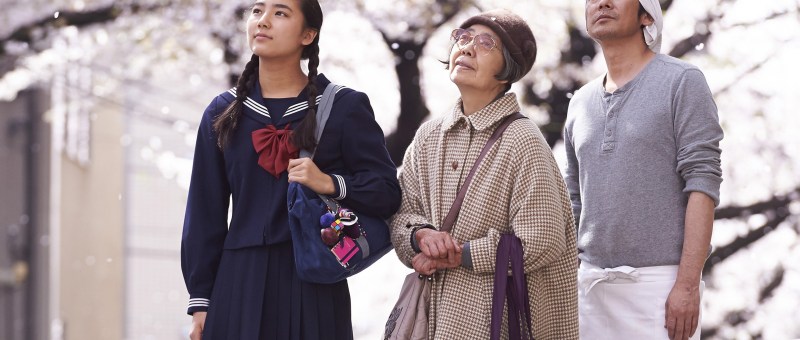
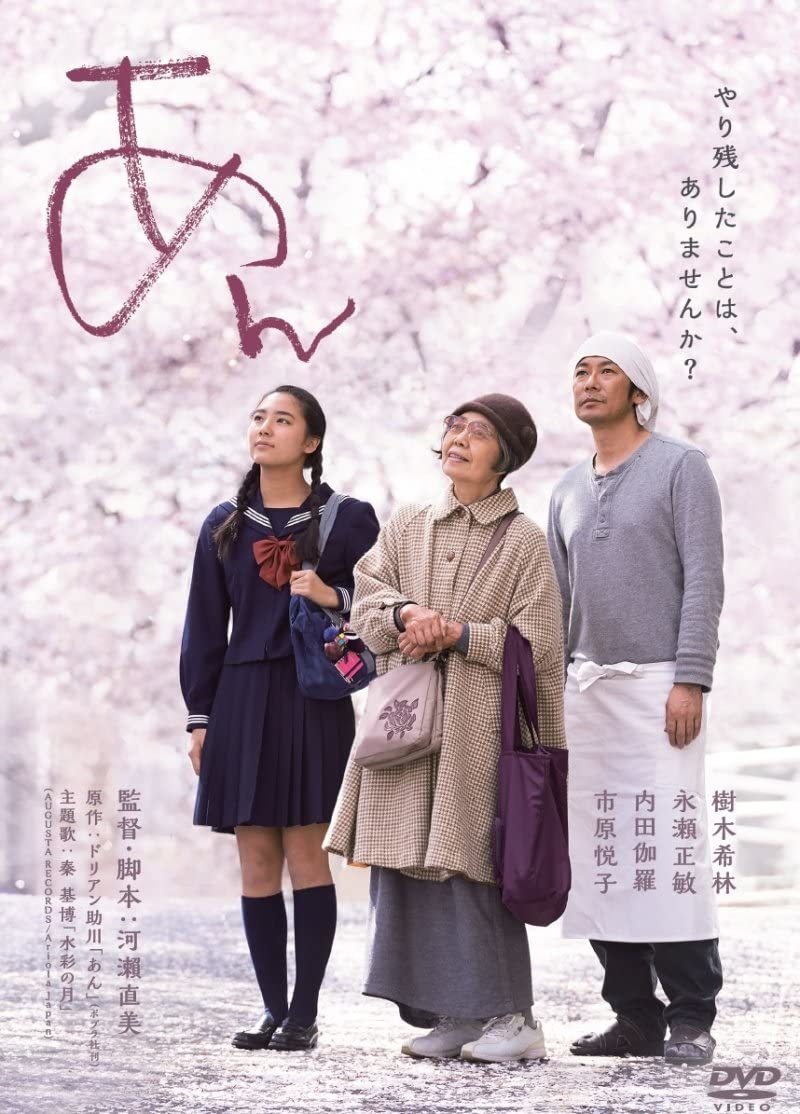
Naomi Kawase has been a festival favourite since becoming the youngest Camera D’Or winner in 1997 with Suzaku, picking up the Grand Prix 10 years later with The Mourning Forest. Her work has however proved divisive with some decidedly unconvinced by her new age aesthetics and wilful obscurity. Set in suburban Tokyo rather than picturesque Nara, Sweet Bean sees Kawase for the first time working on a literary adaptation rather than her own original script, producing her most accessible and narratively straightforward work to date.
The film opens with one of Kawase’s trademark handheld sequences that sees a dejected, middle-aged man trudge to work at a job he clearly hates and is perhaps not particularly good at. For reasons which will be explained later, Sentaro (Masatoshi Nagase) does not even like dorayaki but is currently the proprietor of a small, unsuccessful store selling them mainly to a group of irritatingly excitable teenage girls. One day, an old woman surprises him by responding to his help wanted sign. Despite clarifying there was no age restriction on the position, Sentaro turns her away with the gift of a free sample only she later returns and takes him to task. The pancakes were not too bad, she tells him, but the filing is intensely disappointing. Unbeknownst to Tokue (Kirin Kiki), Sentaro has been bulk buying the “an” sweet red been paste from a catering company. She’s been making an for over 50 years and has brought along a sample which Sentaro first bins in irritation but then thinks better of it, realising as he tastes some that Tokue is the real deal.
As Tokue later says, she decided to approach the dorayaki shop after noticing the sadness in Sentaro’s eyes, wanting to ask him what it was that made him suffer. She remembers a time where her eyes were full of just that sadness, feeling a similar sense of hopeless imprisonment, in her case reflecting a fear that she would never again be able to walk through the outside world after being quarantined in facility for those suffering from Hansen’s disease when she was a teenager (the Leprosy Prevention Law was lifted only in 1996). Yet having suffered so much, as we later learn even denied the opportunity to become a mother because of her condition, 76-year-old Tokue is full of joy and positivity enjoying her life to its fullest while envying the “freedom” of the annoying trio of high school girls at the dorayaki store, sadly relating that at their age she dreamed of becoming a Japanese teacher reading poetry with her students, another dream denied.
The other high school girl, Wakana (Kyara Uchida), who comes into the store just before closing so she can take home the rejected pancakes, is perhaps feeling equally constrained, is touched by Tokue’s tale because her own mother isn’t even keen for her to finish high school proclaiming that studying doesn’t put food on the table. The three of them generate an intergenerational friendship as Tokue begins transmitting her knowledge, painstakingly teaching Sentaro how to make “real” an, which as it turns out is an art which can’t be rushed. Seeing the world on a microlevel she communicates with the beans, “I always listen to the stories the beans tell” she explains, visualising the sun and rain and wind which brought them on the long journey to be a part of this bean paste, even going so far as to thank them for their service. As she tells Sentaro, “We all have our stories” realising it’s not perhaps yet time to hear his or share hers. Yet for all her positivity, “sometimes we are crushed by the ignorance of the world”. Tokue’s bean paste generates a lengthy queue outside the store, but custom dries up after a rumour gets round that the old lady who makes it is a leper.
Like Tokue Sentaro too had once been isolated from the world, now burdened by guilt and obligation that perhaps make him cynical and aloof but is eventually touched by Tokue’s earnestness, not just her lust for life but the fact that she works hard and possesses great skill. His boss tells him to unceremoniously fire her, but he is struck by the unfairness of it all, that she’s still being discriminated against for nothing more than outdated prejudice. It’s her kindness and generosity of spirit which begins to show him the “sweetness” of life, finally converted to the charms of the dorayaki despite proclaiming himself not possessed of a sweet tooth.
The protagonists of Kawase’s previous films often found spiritual release in traditional dance which is notably absent in the urbanised Sweet Bean, though the positivity perhaps extended more to finding accommodation with the sadness of life than actively embracing its joys. Tokue had in her own way freed herself and hoped that others could learn to do the same, urging both Sentaro and Wakana to find the confidence to follow their own paths while affirming that “we were born into this world to see and listen to it, I think whatever we become each of us has meaning in our lives”. A recognisably Kawaseian evocation of mono no aware shot against the cherry blossoms, Sweet Bean is uncharacteristically direct in message but even in its essential melodrama quietly moving in its awestruck love for the natural world and for the liberating power of simple human kindness as a path to existential happiness.
Trailer (English subtitles)


 Windows on Worlds