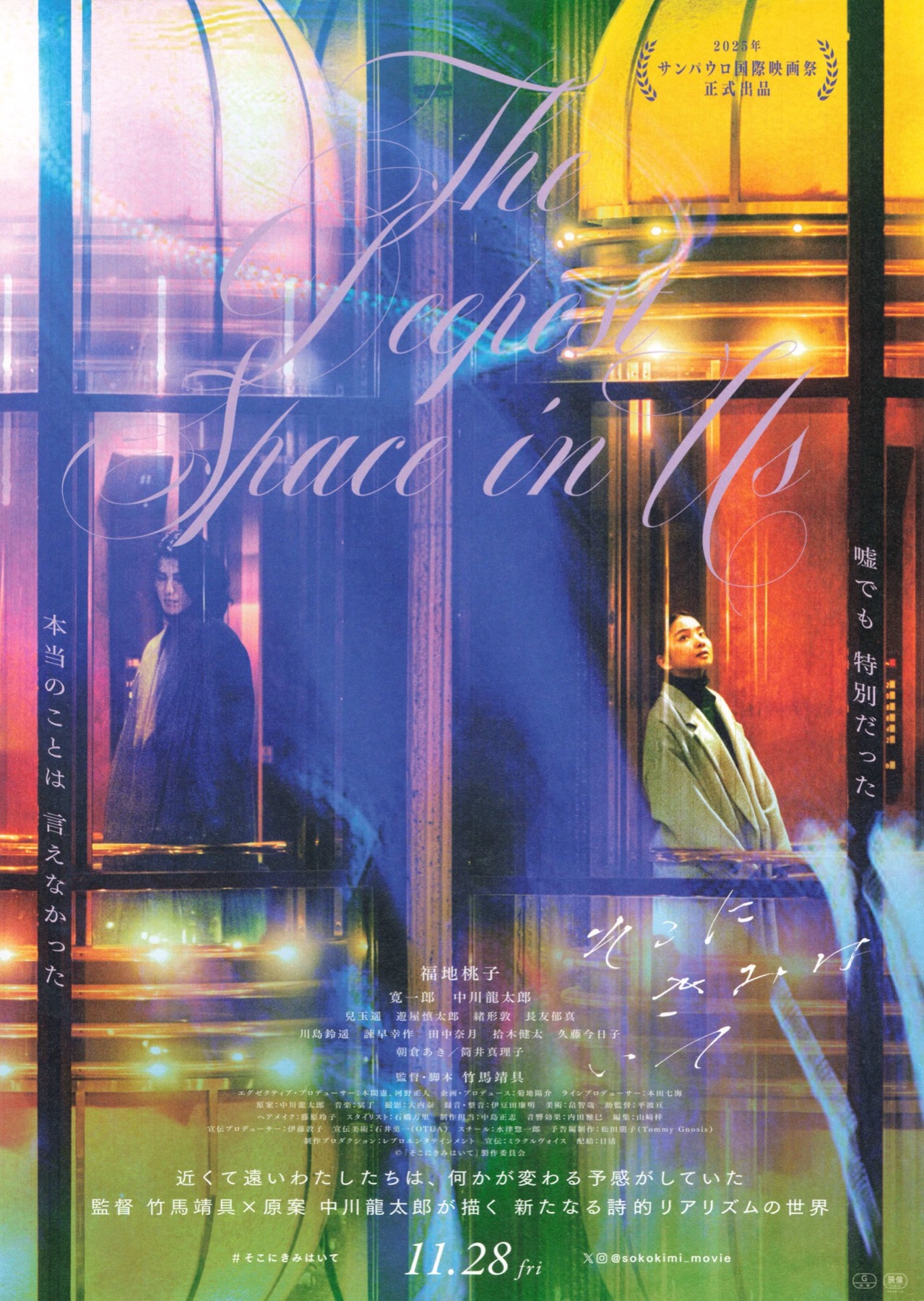
The Deepest Space in Us (そこにきみはいて, Yasutomo Chikuma, 2025)

The dress code at Kaori’s office doesn’t seem to be all that formal, but for some reason she alone looks like she’s going to a funeral. As it turns out, there’s a reason for that, but it also reflects the way that her job makes her feel dead inside and how she’s made to feel by a judgemental society that refuses to accept her as she is but punishes and excludes her for living outside of its expected norms and social codes.

Kaori (Momoko Fukuchi) doesn’t usually attend the team’s after work drinking parties, but is dragged along this time only to sit impassively ignoring everyone until a couple of drunk guys press her for her first love story and then ask a series of invasive questions about what kind of guys are her type. There are obviously a lot of assumptions in play here, and their obsessive probing borders on harassment. Kaori eventually gets up and leaves, but is chased by one of the guys who tries to ask her out. She tells him directly that she’s not interested because she doesn’t experience sexual attraction or desire, but that’s like a red flag to a bull for a certain sort of guy and this one laughs in her face after tearing her shirt as she tries to get away. People simply don’t believe her when she tells them, or else they conclude that there’s something wrong her that needs to be cured. She too feels as if she’s “not normal”, and is pressured by a society in which it’s still marriage and children that are the benchmarks of social success for a woman.

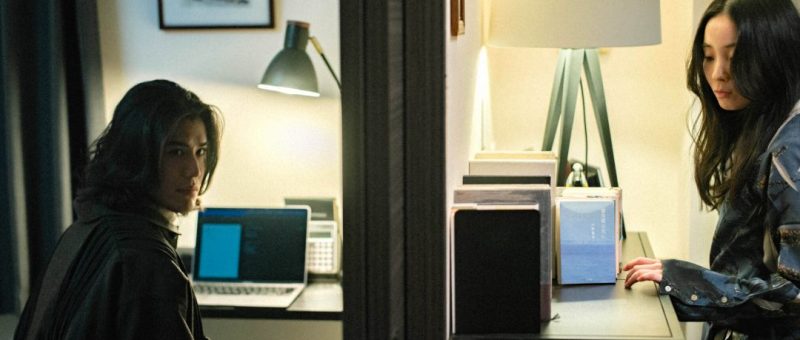
That’s one reason she bonds so easily with Takeru (Kanichiro), the lawyer who handled the probate for her estranged late mother’s estate which Kaori declined to inherit. Takeru tells her that he has something he wants to reject too, and it’s true enough that, to begin with, Kaori may be trying to reject her asexuality. She tries to initiate sex with Takeru in order to overcome it, but it isn’t something that either of them can go through with. Though he tells her that he has someone he can’t forget much as he’d like to, Takeru does not disclose that he is gay because of the intense shame he feels about his sexuality. Kaori evidently had a difficult childhood with a mother who was physically abusive towards her and thereafter raised in foster homes, while Takeru’s conservative mother (Mariko Tsutsui) seems to have instilled in him the same anxieties that plague Kaori in expecting him to marry and have children. Takeru’s former lover, Shingo (film director Ryutaro Nakagawa), has married a woman he doesn’t seem to like for convenience’s sake. Ten years after he and Takeru parted, Shingo is now a successful novelist writing populist fare that he secretly hates himself for knowing he’s writing for others and not himself. 

They all, in their way, attempt bury their true selves to achieve social success through heteronormative marriages, but Takeru and Kaori slowly discover that whatever joy they may have found in their mutual decision to overcome their self-loathing in a platonic union, it won’t work. They each at different times end up in the same hotel room with a hookup date staring a black mark on a wall that comes to represent an internal void. Realising that he will not be able to reject his homosexuality nor get over the grief and sense of loss he feels in Shingo’s rejection, Takeru eventually takes his own life. Struggling to understand why, Kaori ends up on a strange road trip with Shingo in which it’s never quite clear whether she fully realises he is Takeru’s former lover, or has already figured everything out and is trying to help him accept himself as a means of atoning for being unable to help Takeru do the same.

Her trip also strangely brings her into contact with a woman from her office who once claimed to hate her, but has now come to apologise while also looking, like Kaori, for some kind of acceptance and recognition. She says that she too hates herself, sure that men are only ever interested in sex and never in her. Eventually making a pass at Kaori, she admits that for some reason she is only able to be honest with her rather than her friends, family, or lovers. Nevertheless, though Kaori rejects her romantic advances, this simple act of unburdening and watching the sunrise together in silence seems to clear the air and grant both women a kind of peace.

Besides her sexual identity, Kaori seems to have a degree of trouble in dealing with people that suggests neurodivergence, but also longs for acceptance and companionship. While processing Takeru’s death and leading Shingo towards an acceptance of himself, she too learns to embrace her authentic identity and refuses to hide or run away from who she really is to please others rather than herself. Holding a mirror up to a repressed society, she achieves a kind of freedom in self-acceptance, which she then begins to extend to Shingo who once admitted that he ran away from love out of fear, and only now has the courage to face himself and the terrible delayed grief of having lost something precious that can never be reclaimed.


The Deepest Space in Us screened as part of this year’s BFI Flare.

Trailer (English subtitles)
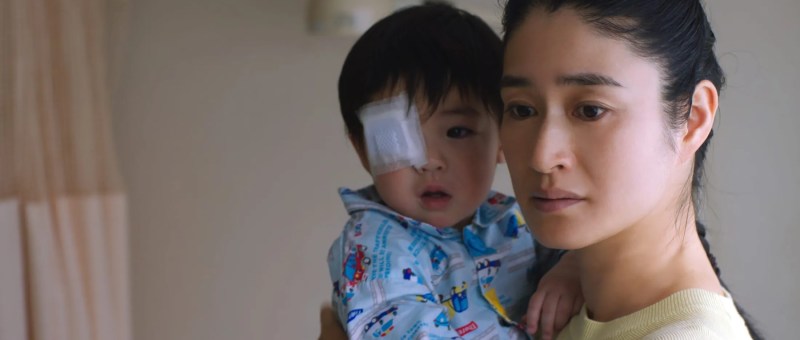
A Mother’s Touch (桜色の風が咲く, Junpei Matsumoto, 2022)

A young man begins to ponder the meaning of his life while losing both his sight and hearing in Junpei Matsumoto’s heartwarming biopic, A Mother’s Touch (桜色の風が咲く,Sakurairo no Kaze ga Saku). The English title aptly hints at the maternal devotion that kept Satoshi (Taketo Tanaka) part of the world even as he feared becoming isolated from it, though the Japanese “when the pink wind blooms” leans towards the poetic in echoing the ways in which he is able to open himself to a different kind of sensory experience. 

Satoshi Fujisawa would later go on to become the first deaf blind university professor in Japan though the films opens with a toddler Satoshi discovering that he has a rare condition that causes the pressure in his eyeball to increase endangering his vision. Though he undergoes various treatments, he eventually loses the sight in one eye and then the other several years later. While in high school he then discovers that he is also beginning to lose his hearing which, along with braille, had been his primary way of experiencing the world around him. 

Matsumoto’s film does not really go into the various ways in which Satoshi is inconvenienced by a largely ableist society aside from his having to leave home and go to Tokyo to attend a school for the blind. Satoshi does, however, experience bullying as a child particularly from an obnoxious gang of boys who egg him on to remove his glass eye in front of them while otherwise isolated by the constant need to rest his eyes with only rakugo to listen to on the radio. Introduced to braille, he is immediately fascinated remarking that the person who came up with it must have been a genius and explaining that he has not given up on his sight but it doesn’t hurt to learn. 

It’s braille that eventually becomes his lifeline as his mother figures out a way to communicate with him by pressing his fingers as she were typing on a braille keyboard while he replies vocally. Her adhoc solution has apparently gone on to provide an important means communication for other deaf blind people across the world and reminds Satoshi that though he may feel as if he as been marooned in deep space he is not alone and is able to interact with the world around him. While still trying to save his hearing, he had decided to try an alternative treatment method which emphasised heavy exercise and bland food designed to boost the immune system though he discovered that it only robbed him of an additional sensory input and a resultant longing to eat something sweet. Though he is unable to see or hear, he can still taste and smell the world around him welcoming the spring in unexpected ways while embracing his potential and independence.

That said, his major philosophy is that life is full of voids designed for other people to fill in the ways that we can all help each other. The film doesn’t shy away from exploring the strain placed on Satoshi’s family as they try to cope with his medical needs which leave his mother feeling guilty that she is often away from her other two children caring for him at the hospital, and his father lonely and overburdened while trying to balance the demands of his working life with that of taking over the domestic space. In any case, they resolve to get through it as a family doing what they can to support Satoshi without robbing him of the opportunity to lead as independent a life as possible. Satoshi comes to believe that his disabilities may be the price for his purpose, that there must be something he is uniquely supposed to do with his life along with places only he could discover. The film eventually finds him in a space of possibility, recalling happy times with his family as a child but also looking forward towards a new potential for pushing the boundaries and moving beyond the limitations others might have placed on him. 


A Mother’s Touch screened as part of this year’s Camera Japan.

International trailer (English subtitles)

Masked Ward (仮面病棟, Hisashi Kimura, 2020)

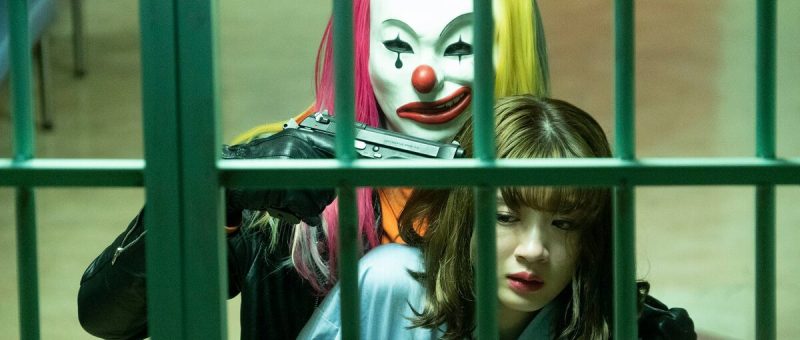
“This hospital is…abnormal” according to locum doctor Hayami (Kentaro Sakaguchi) as he begins to discover dark goings on while trapped in a former psychiatric home after being taken hostage by a man in a clown mask. Based on the medical mystery novel by Mikito Chinen, Masked Ward (仮面病棟, Kamen Byoto) is partly a meditation on guilt and grief and partly an attack on backroom eugenics in an often judgemental and potentially corrupt society, if wrapped up in a wilfully silly B-movie crime thriller. 

Still on a temporary sabbatical following a bereavement, Dr. Hayami is recruited by an old friend, Kosakai (Ryohei Ohtani), to cover a night shift at a long term care hospital mostly catering to patients living with dementia. It has to be said the hospital itself has an instantly creepy aura, the police who later arrive describing it as looking like a prison which is apt because no one ever thought to remove the bars from the interior intended to keep “dangerous” patients from escaping. Even so, Hayami is repeatedly assured that nothing ever happens here and most likely he won’t need to come out of his room. Unfortunately that proves to be bad advice because not long after he settles in, a man in a clown mask turns up with a young woman he apparently himself shot but now wants patched up thereafter taking everyone present hostage while hiding out from police who have instituted a manhunt after he robbed a convenience store at gunpoint. 

You’d have to admit it looks a bit suspicious that all of this happened the very night that Hayami is in charge, especially as it’s suggested he may bear a grudge towards head doctor Tadokoro (Masanobu Takashima) as he was the one who refused to admit Hayami’s late girlfriend Yoko (Izumi Fujimoto) who was killed in a car accident in which Hayami was driving. Then again, as Hayami says, what would be the point in that? Suffering frequent flashbacks he subconsciously links the young woman, Hitomi (Mei Nagano), with Yoko determined in a sense to save her instead while trying to figure out what exactly is going on in this very weird medical institution and what the clown is trying to achieve with his random siege. 

The creepiness of the hospital is already well established with its former psychiatric institution vibes, something only enhanced on the discovery of an apparently disused operating theatre which is no grimy basement filled with rusty equipment but appears to have been refurbished recently and is sparklingly clean. It doesn’t really take a genius to figure out what’s been going on in there or why evil head doctor Tadokoro doesn’t want to call the police, but it does call into question not just his own ethics but those of the wider medical profession as he advances a series of eugenicist justifications for his decisions insisting that some lives are not worth saving while those of the elite who “can’t bear to wait” obviously are. Many of those in their beds have no names, taking those only of the area in which they were found supposedly with no identification, and are receiving only basic care otherwise forgotten by an indifferent society while hypocritical politicians offer platitudes about equality, superficially insisting that every citizen should have the right to live, to be protected, and to have a future.  

Even so Kimura can’t quite decide how seriously he wants to treat the darkness at the film’s centre, embracing the outlandishness of the material through a series of B-movie cliches from eerie handheld photography in the creepiness of the of the empty hospital corridors to literal lightning effects and foreshadowing so heavy it almost feels ironic. Yet the tone is at the same time earnest and slightly naive, the police apparently minded to cover the whole thing up due to pressure from above while Hayami is otherwise free to blow the whistle by getting the media involved with a press conference beamed directly onto a big inner-city screen in the middle of a presidential campaign speech all of which seems faintly unlikely given how far they were prepared to go keep the conspiracy secret while one wonders if he’d really be able to get so much attention so quickly even having recovered the secret documents proving his claims are true. In any case, his speech is only really intended for an audience of one as he says pretty much the same thing as the duplicitous politician only he really means it while urging those who’ve been irreparably harmed to give up their hate and try to move on sharing feelings and hopes rather than anger and resentment which is a nice message but perhaps also not especially helpful in holding those who’ve misused their power to account. 


Masked Ward streams until 27th February in several territories as part of Japanese Film Festival Online 2022.

Original trailer (English sutbtitles)

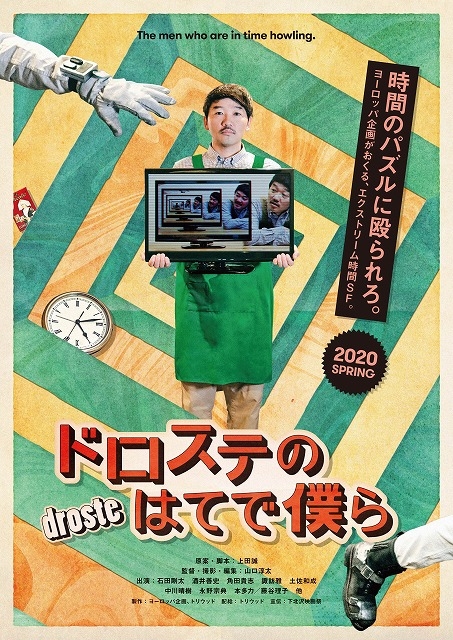
Beyond the Infinite Two Minutes (ドロステのはてで僕ら, Junta Yamaguchi, 2020)

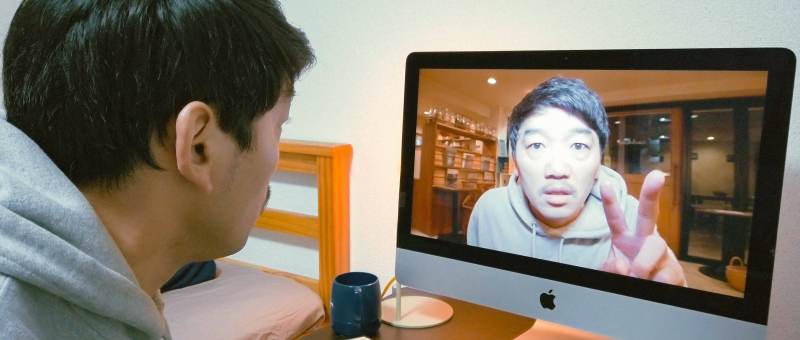
If you had the opportunity to talk to your future or past self, what would you want to say to them? There are many advantages to having some knowledge of things still to come, finding out next week’s winning lottery numbers for example or who’s going to win the Grand National, but on the other hand mightn’t you start to feel as if your life has no freedom or purpose if you find yourself compelled to do exactly as your future self advised? That’s something the future-hating hero of Junta Yamaguchi’s farcical time travel comedy Beyond the Infinite Two Minutes (ドロステのはてで僕ら, Droste no Hate de Bokura) can’t help feeling as he finds himself trapped in an infinite loop of communication with the him from two minutes previously. 

Granted, getting knowledge of what’s going to happen in two minutes is not actually that useful. Cafe assistant Aya (Riko Fujitani) makes a point of asking her future self what the next era is going to be after Reiwa ends forgetting that it is almost certainly still Reiwa in two minutes’ time. Then again, it could help with very short term decisions such as whether or not to confess your feelings to a crush or which spots to scratch on your scratch card to win the best prizes, but maybe knowing only the immediate consequences of your actions isn’t very helpful either. Let’s say your future self finds a bunch of money and tells you to go get it, only the money belonged to gangsters and now you have a big problem with a two-minute head start. And then, can you really trust your future self? Maybe they aren’t being completely honest with you for reasons you may well understand in two minutes’ time. In any case, maybe you have better things to do than be struck in an infinite dialogue loop parroting back what you’ve just been told by your future self to your past self. Maybe you should learn to live in the moment. 

That’s something cafe owner Kato (Kazunari Tosa) has had trouble doing, later confessing that he hates the idea of knowing what lies ahead largely because he over invested in conspiracy theories and prophesies about the end of the world and therefore failed to plan very much for his future. His friends, however, are childishly excited by the discovery that his upstairs TV is linked to the downstairs with a two-minute delay, realising they can extend its range through the “Droste” effect to send themselves messages from further into the future, but then again how long do they really want to keep all this up slavishly reenacting the same conversations afraid of deviating from the original path lest they create a time paradox or provoke some other kind of disaster. They find themselves trapped in the middle as if the present no longer existed and had become merely a conduit between an extremely near future and very recent past. 

Yamaguchi captures their farcical dilemma with an ironic immediacy, filming with an elaborate one shot conceit that adds to the sense of wonder as the gang find themselves continually running upstairs and down to talk to themselves from either side of the time divide. The uncanny absurdity is the film’s greatest asset, placing this extremely bizarre scientific anomaly in the centre of an ordinary hipster cafe run by a guy who really wants to be a musician and is too shy to ask out the girl who works in the hairdresser’s next-door (Aki Asakura). By the time a pair of strange-looking gentlemen turn up claiming to be from the time travel police insisting that the guys stop all this nonsense before they cause a serious problem in the space time continuum you might come to sympathise with Kato’s resentment in feeling as if the future is controlling him but then there are always unexpected ways to rebel against fate and who knows, maybe your romantic destiny will work out after all with a little old-fashioned conversation only tangentially assisted by sci-fi hijinks. A charmingly whimsical take on time travel shenanigans and their existential dilemmas, Yamaguchi’s meticulously plotted farce is an indie gem.  


Beyond the Infinite Two Minutes streams in Germany 1st to 6th June as part of this year’s Nippon Connection.

Original trailer (English subtitles)

The Tale of the Princess Kaguya (かぐや姫の物語, Isao Takahata, 2013)

no3_kaguya_nikonikoboard_outSo, Studio Ghibli is no more. For the moment anyway – both of the old masters have hung up their paint brushes for good, intent on indulging other pursuits, or so they say. Neither has yet found a suitable apprentice to succeed them and so all Ghibli’s revels are now ended, the staff is broken, the book is burned and it’s time we all went home. We’ve not quite set them free yet though, 2014 saw both the founders release their “final masterpiece” in a pattern that was intended to mimic their early success – the double header of the gently melancholic yet uplifting My Neighbour Totoro and the utterly devastating Grave of the Fireflies. Miyazaki’s The Wind Rises read like a deeply moving final poem – a artist’s apology for his failings as man. Takahata’s, in a pattern reminiscent of his career overall, feels in some ways harsher. He pushes deeper both artistically but also emotionally, less cynical but also perhaps less forgiving. Based on the classic Japanese folktale by the same title, often translated into English as The Tale of the Bamboo Cutter, The Tale of the Princess Kaguya is another late career masterwork from Takahata that cuts right to the quick of what it means to be human.

Bamboo cutter Okina makes his everyday journey up the mountain to cut bamboo, but this time finds a single stalk shining strangely. When he cuts into it, a tiny yet elegant lady is sleeping inside. Quickly realising she must be a princess sent from heaven, he carries her home to his wife in whose hands she suddenly morphs into a screaming human child. The couple embrace their miraculous gift heartily and raise the girl as if she were their own. “L’il Bamboo” as the other village kids call her, grows at an alarming rate, but enjoys an idyllic country childhood full of long hot summers, juicy, ripe melons pinched from a neighbour’s garden and fantastic adventures. However, another shining bamboo stalk has yet more presents for Okina in the form of gold and expensive kimonos. Believing his little princess is intended for the life of a noble woman, not that of the lowly daughter of a bamboo cutter, he buys a big house in the city filled with teachers and servants. However, one person’s idea of “best” can be quite different from another’s, and no matter how much you love someone, there are lines that cannot be crossed.

Li’l Bamboo is an elemental creature, meant for frolicking with frogs and dancing under cherry blossoms but Princess Kaguya, the name given to her by a nobleman as she comes of age, is forced into the constrained life of a court lady. Imprisoned inside her castle, separated from her childhood friends and confined to a life of sedately studying “the feminine arts” Kaguya’s once wild love of life seems to dissipate under the weight of adulthood. Even on a rare (and secret) journey outside to once again view the transient cherry blossoms, she decides to return almost immediately after encountering a mother and her children who rapidly kneel, apologise for their presence and leave. Feeling the ever present barrier between herself and “ordinary” people because of her fine clothes and appearance, Kaguya retreats despondently. However, as relative “new money” to the noble set, she doesn’t fit in there either.

The life that Okina envisages for his “princess” maybe one that society regards as better, but that isn’t to say it’s the best for everyone. Okina’s tragedy is that he never stops to consider his adopted daughter’s own feelings. The responsibility he takes is too great and he never sees that he’s stifling the gift nature has given him. Kaguya goes along with most of this because he’s her father and she doesn’t want to displease him, but she’s constantly setting free caged animals because she herself feels so imprisoned. Okina’s desire to ensure his daughter’s future happiness has only made her miserable and in the end will cost them both dearly. As common now as it’s ever been, this classic miscommunication between parent and child is made all the more tragic because it has love at its core.

Unfolding like an illustrated scroll, Princess Kaguya is full of beautiful and imaginative artistry. With its beguiling watercolour-like aesthetic, the film often breaks into breathtaking, impressionistic spectacle that can allow a girl to dissolve into the landscape or summon dragons from the clouds and waves. It’s a style that’s perfectly suited to the classic nature of the story which is only aided by the traditional, folk-tale narration and whimsical score from Joe Hisaishi (working with Takahata here for the first time despite his long association with Studio Ghibli as a whole).

A fitting end to a long and sometimes difficult career, Princess Kaguya is, in the end, a tale of sad yet inevitable partings. Still, though Kaguya was often unhappy on Earth, ultimately she doesn’t want to leave nor to forget her experiences be they of joy or sorrow. Perhaps better appreciated from a perspective of age, Princess Kaguya is a sorrowful tale in many ways, full of misunderstandings and missed opportunities yet there is great beauty in it too. All things must pass, and we must bid goodbye to Studio Ghibli (for now, at least) though painful as it may be, we ought to be grateful for having had something to grieve.

The Snow White Murder Case (白ゆき姫殺人事件, Yoshihiro Nakamura, 2014)

Review of The Snow White Murder Case (白ゆき姫殺人事件, Shiro Yuki Hime Satsujin Jiken) published on UK-anime.net


The sensationalisation of crime has been mainstay of the tabloid press ever since its inception and a much loved subject for gossips and curtain twitchers since time immemorial. When social media arrived, it brought with it hundreds more avenues for every interested reader to have their say and make their own hideously uniformed opinions public contributing to this ever growing sandstorm of misinformation. Occasionally, or perhaps more often than we’d like to admit, these unfounded rumours have the power to ruin lives or push the accused person to a place of unbearable despair. So when the shy and put upon office worker Miki Shirono (Mao Inoue) becomes the prime suspect in the brutal murder of a colleague thanks some fairly convincing circumstantial evidence and the work of one would-be microblogging detective, the resulting trial by Twitter has a profound effect on her already shaky sense of self worth.

The body of Miki Noriko (Nanao) has been found in a wood burned to a crisp after being viciously stabbed multiple times. Beautiful, intelligent and well connected, Noriko seems to have been well loved by her colleagues who are falling over themselves to praise her kind and generous nature, proclaiming disbelief that anyone would do such a thing to so good a person. One of these co-workers, Risako (Misako Renbutsu), happens to have gone to school with TV researcher, Akahoshi (Go Ayano) who’s a total twitter addict and can’t keep anything to himself, and decides to give him the lowdown on the goings on in her office. Apparently the offices of the popular beauty product Snow White Soap was a hotbed of office pilfering filled with interpersonal intrigue of boy friend stealing and complicated romantic entanglements. Working alongside Noriko and Risako was another ‘Miki’, Shirono (Mao Inoe), who tends to be overshadowed by the beautiful and confident Noriko who shares her surname. Shy and isolated, Shirono seems the archetypal office loner and the picture Risako paints of her suggests she’s the sort of repressed, bitter woman who would engage in a bit of revenge theft and possibly even unhinged enough to go on a stabbing spree. Of course, once you start to put something like that on the internet, every last little thing you’ve ever done becomes evidence against you and Shirono finds herself the subject of an internet wide manhunt.

In some ways, the actual truth of who killed Noriko and why is almost irrelevant. In truth, the solution to the mystery itself is a little obvious and many people will probably have encountered similar situations albeit with a less fatal outcome. Safe to say Noriko isn’t quite as white as she’s painted and the film is trying to wrong foot you from the start by providing a series of necessarily unreliable witnesses but in many ways that is the point. There are as many versions of ‘the truth’ as there are people and once an accusation has been made people start to temper their recollections to fit with the new narrative they’ve been given. People who once went to school with Shirono instantly start to recall how she was a little bit creepy and even using evidence of a childhood fire to imply she was some kind of witch obsessed with occult rituals to get revenge on school bullies. Only one university friend stands up for Shirono but, crucially, she is the first one to publicly name her and goes on to give a lot of embarrassing and unnecessary personal details which although they help her case are probably not very relevant. Even this act of seeming loyalty is exposed as a bid for Twitter fame as someone on the periphery of events tries to catapult themselves into the centre by saying “I knew her – I have the real story”.

Of course, things like this have always happened long before the internet and social media took their primary place in modern life. There have always been those things that ‘everybody knows’ that quickly become ‘evidence’ as soon as someone is accused of something. Some people (usually bad people) can cope with these accusations fairly well and carry on with their lives regardless. Other people, like Shirono, are brought down in many ways by their own goodness. What Risako paints as creepy isolation is really mostly crippling shyness. Shirono is one of those innately good people who often puts herself last and tries to look after others – like bringing a handmade bento everyday for a nutritionally troubled colleague or coming up with a way for a childhood friend to feel better about herself. These sorts of people are inherently more vulnerable to these kinds of attacks because they already have an underlying sense of inferiority. As so often happens, this whole thing started because Shirono tried to do something she already thought was wrong and of course it turned into a catastrophe which resulted in her being accused of a terrible crime. The person who manipulated her into this situation likely knew she would react this way and that’s why meek people like Shirono are the ultimate fall guy material.

Like Yoshihiro Nakamura’s previous films (Fish Story, The Foreign Duck, The Native Duck and God in a Coin Locker – both available from Third Window Films), The Snow White Murder Case is full of intersecting plot lines and quirky characters and manages to imbue a certain sense of cosmic irony and black humour into what could be quite a bleak situation. The Twitter antics are neatly displayed through some innovative on screen graphics and the twin themes of ‘the internet reveals the truth’ and ‘the internet accuses falsely’ are never far from the viewer’s mind. It’s testimony to the strength of the characterisation (and of the performances) that Shirono can still say despite everything she’s been through ‘good things will happen’ in attempt to cheer up someone who unbeknownst to her is the author of all her troubles, and have the audience believe it too. A skilful crime thriller in which the crime is the least important thing, The Snow White Murder Case might quite not have the emotional pull of some of the director’s other work but it’s certainly a timely examination of the power of rumour in the internet age.


Original trailer (English subtitles)