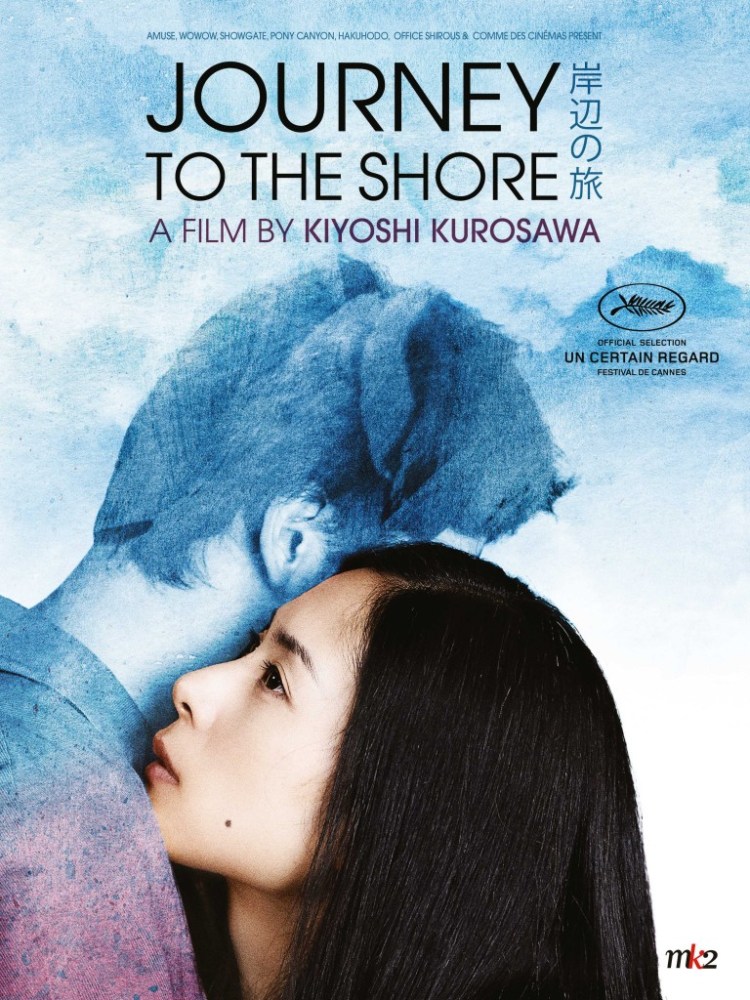
Journey to the Shore (岸辺の旅, Kiyoshi Kurosawa, 2015)

journey to the shoreTime is an ocean, but it ends at the shore. Kiyoshi Kurosawa neatly reverses Dylan’s poetic phrasing as his shoreline is less a place of endings but of beginnings or at least a representation of the idea that every beginning is born from the death of that which preceded it. Adapted from a novel by Kazumi Yumoto, Journey to the Shore (岸辺の旅, Kishibe no Tabi) takes its grief stricken, walking dead heroine on a long journey of the soul until she can finally put to rest a series of wandering ghosts and begin to live once again, albeit at her own tempo.

The film begins with three years widowed Mizuki (Eri Fukatsu) giving a piano lesson to a little girl whose mother goes on to enquire about her daughter’s progress. Wouldn’t it be better if she could learn something a little more cheerful once in a while? Reconsidering, the mother reflects that uptempo doesn’t quite suit Mizuki, and she’s right – it doesn’t. After impulse buying some flour and baking a few Japanese sweets at home, Mizuki receives an unexpected visit from her deceased husband, Yusuke (Tadanobu Asano), who drowned himself at sea.

Somehow unsurprised and pausing only to remind him to remove his shoes, Mizuki gives Yusuke some of the dumplings then retires to bed, only to wake up the next morning and wonder if she dreamt the strange events of the night before but, sure enough, Yusuke is still very much present. Promising to show her some of the beautiful places he discovered on his long odyssey home to her, Yusuke takes Mizuki on a reverse honeymoon in celebration and in mourning of all they once were to each other.

In each place they travel to, Mizuki and Yusuke help the people there deal with their own walking ghosts. Yusuke is not the only returnee as they discover with a lonely old newspaper seller who doesn’t appear to be aware that he died a long time ago. Walking dead in a realer sense than Mizuki or some of the other depressives they meet along the way who are still living but not exactly alive, Mr Shimakage is a spirit held in place by an inability to reconcile himself with the actions of his past and has brought his feelings of self loathing and regret with him into the afterlife.

Sometimes it’s the living that pin the dead, holding them close with guilt, regret, love or loneliness. If the film has a central tenet, it’s that the past has its place, and it’s not among the living. At one point Mizuki says that perhaps it’s better to leave some things unresolved. Yusuke asks her if she’s really OK with that, and she seems to reconsider but in the end that’s the way it has to be. There are no final solutions, the answers are not at the back of the book. In the end, the best you can do is try to understand and learn to be OK with everything you do and do not know about yourself and about those who are no longer here to tell their stories. Mizuki also says that she hated to practice piano as a child, but her teacher always told her to pay attention to her own rhythm. The music will always be lifeless, until you learn to hear your own song.

Kurosawa creates a beautifully ethereal world, held in a tension between the spirit realm and the everyday. Playing with lighting levels in extremely interesting ways, he allows the supernatural and natural to flow into each other, jostling and merging like waves and shore. Travelling from the grey, ordered and utilitarian city to the unruly nature of the countryside with its ancient, crashing waterfalls and beautiful, if lonely, coastlines we move from static and lifeless existence to a place of perpetual potential as we let go of one thing so that we might grasp another.

As much as Journey to the Shore is bound up with death, it necessarily speaks of life, too. During one of his strange lessons for the village folk, Yusuke delivers some meditations on science and philosophy to the effect that the world is built of nothingness but that nothingness does not lack meaning. He tells us that we are all dying, the universe was born billions of years ago and will end one day just as our species may end when the planet’s temperature exceeds that which we can endure or galaxies collide and take us down with them. For all of that, the universe is young, still growing, still expanding, and we are so lucky to have been born now when there is still so much ahead of us. This is a time of infinite beginnings. Starting again means letting go, but sooner or later you have to step off the shore of this self imposed purgatory and return to the great ocean which is life.


Journey to the Shore is availble on dual format DVD and blu-ray in the UK courtesty of Eureka Masters of Cinema.

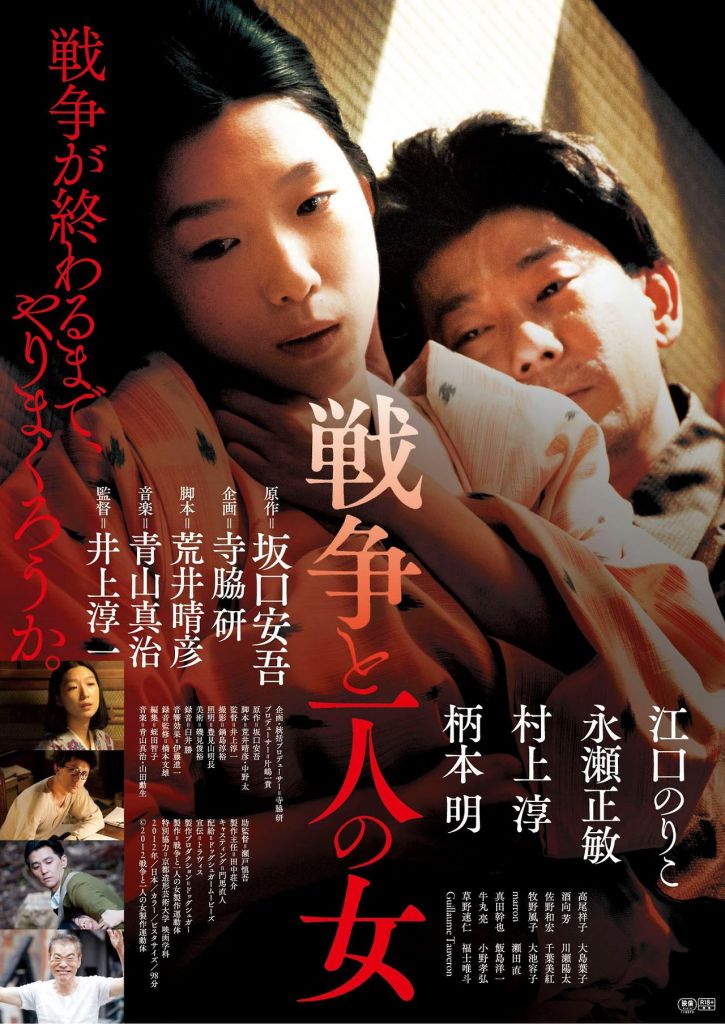
Dr. Akagi (カンゾー先生, Shohei Imamura, 1998)

Dr AkagiA late career entry from socially minded director Shohei Imamura, Dr. Akagi (カンゾー先生, Kanzo Sensei) takes him back to the war years but perhaps to a slightly more bourgeois milieu than his previous work had hitherto focussed on. Based on the book by Ango Sakaguchi, Dr. Akagi is the story of one ordinary “family doctor” in the dying days of World War II.

As Dr. Akagi (Akira Emoto) puts it, much of the the life of a family doctor involves running. If he breaks one leg, he’ll run on the other, if he breaks both legs, he’ll run on his hands, but he’ll do whatever it takes to get to his patients. Some of the villagers have branded him as a quack and nicknamed him “Doctor Liver” because his most frequent diagnosis is for hepatitis. Doctor Akagi is convinced that there really is an epidemic of contagious hepatitis plaguing the population and even has the evidence to back his theory up but with the war in crisis and so much else going on he’s having trouble getting anyone to listen to him. Nevertheless, Akagi fearlessly tries to find out what it is that’s causing this deadly disease to spread and hopefully put an end to it for good.

Imamura strikes an oddly comic tone here. Though the above synopsis may sound overly serious, for the vast majority of its running time Dr. Akagi is the story of a small fishing village going about its everyday life with the war just simply background. The town narrowly escapes being bombed by an American raid because it’s known that there’s prisoner of war camp nearby filled with allied soldiers and red cross personnel and there are certainly a lot of troops on the ground more or less running the show. However, despite the obvious hardships – lack of food being the biggest one, the townspeople are getting on with things in a fairly cheerful way.

Following a spot of pastoral care, Dr. Akagi ends up taking in a local girl as his assistant and housekeeper after her father has died leaving her to support her two younger siblings. Though a married woman with a husband away at the front, Sonoko (Kumiko Aso) has been making ends meet through prostitution with the rather unwelcome result that one of her regular customers wants to marry her (she does not reciprocate and after all already has a husband). Akagi doesn’t necessarily disapprove of the idea of prostitution or of openly expressed sexuality, but accepts that society does object to these ideas and takes Sonoko in so that she won’t have to sell herself (though she actually didn’t really mind very much and still finds herself called upon to provide her “services” even after she’s officially given up).

Akagi’s other supporters include a fellow doctor, Tomomi, who has become addicted to morphine after his wartime service and a drunken and lecherous buddhist monk who proves an essential ally when it comes to body snatching a recently buried corpse. Akagi gets himself into even more trouble when he takes in and treats an escaped Dutch POW who bears the scars of extreme torture by Japanese forces who are paranoid about possible spy action. Imamura is never afraid of raising the spectre of wartime brutality as his soldiers flit between righteous zealots committed to the letter of the law and bumbling idiots who can’t see that each of their actions is entirely counterproductive to their cause.

The most surprising moment comes when Akagi has a dream about his son who is an army doctor serving in Manchuria. After Akagi and his friend have conducted an autopsy to gain a fresh liver sample, Tomomi starts talking about his time in the army and a rumour about a group of doctors doing live dissections and possibly researching chemical weapons. Akagi is aghast and horrified but recounts his dream in which he stood before his son whose bloodied hands are extended towards him with a living patient writhing below. Akagi reminds him that he is a doctor and urges him to stop this barbaric practice but the nightmarish vision of this gloomy, blood-soaked room persists.

At the end of the film Sonoko and Akagi unwittingly end up viewing the giant mushroom cloud which arises after the atomic bomb blast in Hiroshima. Not knowing what it is, Akagi predictably sees it as a giant infected liver and wonders if the donor for his liver sample is angry with him but then thinks again and says the cloud is a representation of everybody’s anger towards this war. Akagi loses himself a little in the quest to solve the hepatitis question and after it leads him to neglect a patient he begins to question himself over his true motives and whether there’s really any point to what he’s trying to do. However, Dr. Akagi is a good and a kind man and eventually remembers what his true calling is – as a family doctor, running from one emergency to the next but always making sure his patients are well looked after. War or no war, life goes on – people get sick and they need to know there are men like Akagi out there that can always be relied upon to do the very best they can.


Dr. Akagi was originally released in the US by Kino Lorber but seems to be out of print. The good news is that the region free Korean disc comes with English subtitles.

Unsubbed trailer:

http://www.youtube.com/watch?v=g40YrQBAm3I

Capone Cries a Lot (カポネおおいになく, Seijun Suzuki, 1985)

1040003_lNever one to be accused of clarity, Seijun Suzuki’s Capone Cries a Lot (カポネおおいになく, Capone Ooni Naku) is one of his most cheerfully bizarre movies coming fairly late in his career yet and neatly slotting itself in right after Suzuki’s first two Taisho era movies, Zigeunerweisen and Kageroza. Though not part of the so called “Taisho trilogy” (this would be completed with Yumeji in 1991), Capone Cries a Lot begins its tale in the short lived period between the ages of Meiji and Showa when the world seemed open and foreign influence flooded into this once isolated nation. Could that influence also travel upstream? Naniwa-bushi, for example, could could a Naniwa-bushi singer on the run make something of himself in the New World?

Like most of Suzuki’s movies, plot is a secondary concern. However, loosely speaking, our protagonist is Jun – a man who wanted to learn the art of Naniwa-bushi from its accepted master but ultimately ran off with another man’s wife and ended up in 1920s America. Once there he hooks up the Japanese gangster Gun-tetsu who makes use of Jun’s sake making experience to assist in his bootlegging business during prohibition. This brings them in contact with the Capones, firstly with Frank and eventually with Al (who Jun amusingly mistakes for the president of the United States). Meanwhile, Jun’s girl, Kozome, has left him (to an extent) and become a prostitute. However well things seem to be going for Jun, he’s still a foreigner in a strange, and sometimes unkind, land. Is this the sort of place where dreams can survive?

Suzuki films the whole thing in Japan at an abandoned theme park which is 100% Americana – the Old West tricked out with cowboys, saloons and guns. Now it’s strange kind of new city populated by runaway Japanese criminals gambling and whoring their way through life. Jun wants to sing Naniwa-bushi in this odd place even if no one understands him. Originally he’s annoyed by the foreigners laying a hand on his shamisen or making attempts to join in with their jazz inflected modern music, but eventually he’s singing new Naniwa-bushi songs about the plight of the Native Americans and finally joining the jazz band for a full on musical fusion number. Suzuki does not shy away from the racial politics and problems inherent in his critique of American imperialism even up to an including the KKK and the Japanese internment camps.

In contrast to the previous two Taisho set films, Capone is much lighter in tone and obviously more playful even if it includes a similar level of oblique surrealism. Chaplin references and slapstick humour mix with absurdist dialogue and cosmic silliness to create a popcorn candy world that’s still somehow sad and strange. It’s a vision of America filtered through ‘20s gangster pics and B-movie westerns, equal parts bubblegum and tommy guns. It doesn’t make a great deal of literal sense but offers plenty of Suzuki’s psychedelic eye for colour, surprising editing choices and all round idiosyncratic approach to storytelling.

There may be ample reasons why Capone Cries a Lot has never found an overseas audience, it’s a little overlong for one and its comments on race are perhaps a little uncomfortable from several different angles. Nevertheless, it’s another characteristically zany effort from Suzuki and full of colourful pop aesthetics that are much more playful than the rather heavier Zigeunerweisen and Kageroza. Well worth the long strange ride, Capone Cries a Lot is a trip to 1920s candy land that few of the directors devotees will be able to resist.


(Unsubtitled) Scene from midway through the film

http://www.youtube.com/watch?v=r_ILc3zQ7nE


0.5mm (Momoko Ando, 2014)

0.5mm-poster-20.5mm is only Momoko Ando’s second film following on from her lesbian love story manga adaptation, Kakera: A Piece of Our Life. Starring her real life sister Sakura Ando in the lead role, 0.5mm is undeniably more complex and epic in scope than her previous film but retains some of its whimsical atmosphere and benign objectivity. Encompassing such disparate themes as Japan’s rapidly ageing population, entrenched sexism, archaic ideas about gender, and what it’s like to find yourself at the bottom of the heap thanks to a series of unfortunate incidents, 0.5mm is a hugely impressive sophomore effort from Ando and one of the best Japanese indie movies for quite some time.

Sawa is a home care nurse and her current assignment is caring for an elderly, bedridden gentleman who lives with his daughter and grandson. One day, the old man’s daughter makes an extremely odd and inappropriate request of Sawa which she eventually agrees to. However, things go just about as wrong as they could possibly go and Sawa finds herself out of a job and, as she lived in nurse’s accommodation, out of a home too. That’s not the end of her troubles as she manages to leave her coat, in the pocket of which is an envelope containing her life savings, on a train. At this point she’s pretty much down and out when she notices an elderly gentlemen confusedly trying to find out if it’s OK to sleep all night at a 24 hour karaoke box. Pretending to be the old man’s date she hires a room for two and bamboozles him into it for a night of singing and snoozing. In the morning it turns out the old man quite enjoyed the mad adventure as he’s temporarily run away from home because all his son seemed to care about was the inheritance so he thought he might as well spend it all himself. This strange encounter begins Sawa’s odyssey into a series of similar episodes where she blackmails an elderly gentleman into letting her stay with him for a while until one final meeting brings things full circle.

Sawa is definitely a very unusual woman. Good at her job, she’s a caring person in more ways than one. Her new found method of survival is certainly a novel one, and not entirely ethical, but then all she’s doing is exploiting circumstances in the same way circumstances have had a way of exploiting her. Though she weaselled her way into these men’s lives, she did, at least, care for them. Yes, she did the cooking and the cleaning and assisted with healthcare too but she also helped them to realise a few things about themselves and move on with their lives. Whether it’s saving them from yakuza backed pyramid scams or listening to their traumatic memories of the war, Sawa has a knack for seeing people’s hidden pain and another for knowing how to make it better.

Yet, her various encounters with the older generation speak of a number of different social problems that cannot be repaired by one person alone. The first man she meets feels unwanted by his family and is looking for escape, a reassertion of his independence and perhaps a little revenge. The second is really quite mad – obsessively counting the trees in the park, stealing bicycles and letting people’s tires down but he too is alone with no one looking after him. The third man has a bedridden wife and, apparently, a taste for erotic school girl magazines but no children of his own to take care of him. The fourth man discovered a teenage child he’d never met though is incapable of forming a relationship with him. Society is full of lonely, elderly people who either have no close family or have become estranged from them. Some of them have become vulnerable and half mad through extreme isolation and others have become embittered, violent or trapped in the past.

In the way that these men react to Sawa there’s also a complex system of ideas at play as each of Sawa’s employers seem incapable of defining exactly what sort of “services” they expect of her. Nurse, housekeeper, mother, courtesan? From the original, perhaps innocent though far from appropriate, request each of the men Sawa encounters can’t help but view her as a some kind of sex object and react with various degrees of embarrassment about it. To them she is many things though never quite a “person” until, perhaps, their relationship begins to near its end and each reaches some kind of epiphany brought about by her presence. However, Sawa herself is perfectly aware of each of these complexities and perfectly willing to exploit them with a sort of amused ruefulness.

The 0.5mm of the title refers to a metaphor offered on a farewell cassette tape from the second of Sawa’s old gentlemen that one person may be only be able to move a mountain by 0.5mm but if everyone got together the mountain would move and you could start a revolution. At once he bemoans Japan’s military past but also laments that something of the community spirit from those days has been lost. That if we all just stopped living in wilful isolation and embraced the fact that we’re all here together at the same time we could make things better for everyone. Much of the film is about the distance between people – young/old, male/female it isn’t the distinction that matters but the series of invisible walls that exist to keep people apart.

Warm, enigmatic and surprisingly funny (if in a kind of dark way) 0.5mm is is a complex and thought provoking film that is also often very beautiful and immensely enjoyable. At 196 minutes, it’s undeniably a long film with an episodic structure though it largely manages to sustain its lengthy running time without outstaying its welcome. Rich and strange, 0.5mm is all the better for its unresolved mysteries and offers an impressively nuanced cross section of modern society made all the more detailed thanks to its epic scope.

Wood Job! (Wood Job(ウッジョブ)神去なあなあ日常, Shinobu Yaguchi, 2014)

ff20140516a1aHe’s a lumberjack and he’s OK! Well, after a while anyway – climbing trees all day is not quite as much fun as it sounds in Shinobu Yaguchi’s latest comedy which sees a streetwise city kid randomly decide on a career on forestry. Not so much fish out of water as duck in a tree, Wood Job! is a heartwarming comedy drama which more than lives up to the puntastic comedy of its title.

Yuki Hirano is your typical slacker teenager. Like many guys his age, he’s run into something of a life crisis as he didn’t get into university and he hasn’t really thought about what to do. At first he thinks it’s no big deal, he’ll just take the tests again next year but after being abandoned by his girlfriend and seeing all his friends set off without him Yuki feels a little lost. That is until he notices a shiny magazine advertising a new life in the open air – “come and work with me!” it says next to a picture of a pretty girl. Yuki’s packed his bags and caught the next train before you can even say “Where’s the nearest combini”? but his new found occupation is a little more intensive than he was expecting and Yuki’s not sure he’s cut out for this no frills life. Then however he meets the girl from the advert herself – can Yuki really stick around long enough to convince her he’s not some city boy layabout but a real mountain man?

Wood Job! is that rare film that manages to mix a fair amount of slapstick comedy with the kind of naturalistic, everyday humour that can’t help but give it an endearingly warm quality. Taking the classic fish out of water approach as its basis, the film highlights the absurdity of country life (at least to eyes more accustomed to the city) but crucially never mocks it and seems to have a profound respect for the rural way of life and all that entails. Neither does it shy away from the fact forestry is hard work which is often dangerous and requires an extremely specific skill set – you can’t just rock up one day because you’ve seen a picture of a pretty girl on a poster and instantly become a man of the mountains over night. The villagers are all too used to people who turn up in the country with romantic ideas about getting back to the land or living a more simple life but go home after a week or so because they can’t adapt to this very different environment. Already pre-conditioned to expect disappointment, their approval is hard to win but worth all the more because of its rarity.

Yuki Hirano is something of a departure for Sometani who ranks as one of Japan’s most promising young actors. Having hitherto made a name for himself playing “intense” characters, Wood Job!’s laid back slacker couldn’t be more different than the tortured soul of Himizu though Sometani carries off this seeming 180 degree turn with aplomb further proving his versatility as an actor. He’s also surrounded by an equally talented cast including Hideaki Ito (most recently seen as the sociopathic teacher in Lesson of Evil, also alongside Sometani in a small role) as his hard tasking forestry mentor as well as Ken Mitsuishi and Akira Emoto in smaller roles and Masami Nagasaki as Yuki’s longed for poster girl for the world of forestry. Filled with realistically drawn characters near perfectly pitched by its well put together cast, Wood Job! manages to achieve just the right comedy-drama balance which makes some its more outlandish moments seem perfectly plausible.

It may be a very conventional film in many ways, but Wood Job! succeeds in doing what it set out to do incredibly well. Filled with warmth and good humour, director Shinobu Yaguchi manages to breath new life into this old idea to create a charming and engaging tale of the virtues of country life. Any film which manages to pack not one, but two distinct puns into its title alone has to be worth a look but Wood Job! more than lives up to the comedic promise of its name.


This is playing as part of the Japan Foundation Touring Film Programme so it’ll be a bunch of places between now and the end of March including:

  • MAC Birmingham (24th February)
  • Dundee Contemporary Arts (25 February)
  • Tyneside Cinema Newcastle (15th march)
  • Nottingham Broadway (25th March)
  • Brewery Arts Centre Cumbria (25th March).

So if you’re near any of these be sure to check it out! Also because people always say this – if the festival isn’t coming near you it’s most likely not Japan Foundation deliberately snubbing you, get in touch with your local indie cinema and try and convince them to book some of these films. If you don’t have a local indie cinema you’re probably out of luck though as the big chains often won’t take these kinds of special screenings :(. In short, support your local indie (or a not so local one if it’s your only option).

http://www.youtube.com/watch?v=ypQi69XGs6U

Review of the forestry themed comedy Wood Job! up at UK Anime Network. I love how many puns they managed to pack into the title of this film, it wins just for that.