Hong Kong 1941 (等待黎明, Leong Po-Chih, 1984)

“Britain has reassured the people that it will not give up Hong Kong,” according to a radio broadcast at the beginning of Leong Po-Chih’s Hong Kong 1941 (等待黎明). The words have a kind of irony to them and not only because Britain did abandon the people following the Japanese invasion, but because the film was released on the eve of the Sino-British Joint Declaration in which it said something quite similar. 

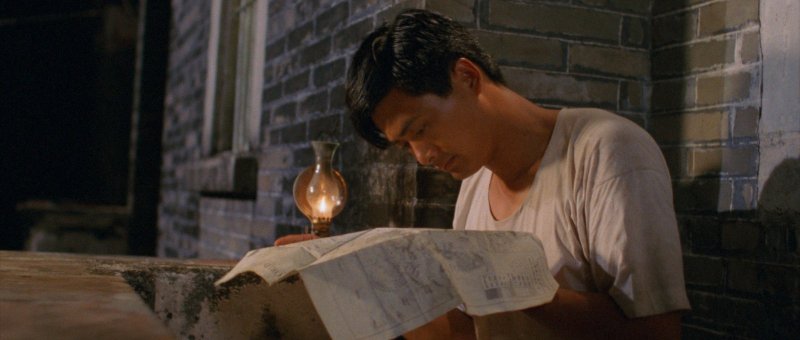
But then again, the opening scenes are themselves quite critical of British rule as they, on the one hand, insist they aren’t going anywhere and, on the other, start evacuating women and children to “safer” areas of the commonwealth such as Australia. Out of work actor Fei (Chow Yun-fat) fled the Japanese incursion on the Mainland and came to Hong Kong, but now tries to stowaway abroad a boat going to Australia. He’s caught by a little British girl who speaks fluent Cantonese yet refers to him as her “slave” and insists that he “kowtow to me, now.” But then the girl suddenly adopts the persona of the Empress Dowager Cixi and demands the same. Fei makes the first of his many jumps into the water around Hong Kong, as if only in this liminal space can he be free. Anticipating the wave of migration occurring before and after the Handover, and also that of the present day, he and his friends Keung (Alexander Man Chi-leung) and Nam (Cecilia Yip Tung) set their sights on leaving to find Gold Mountain in Australia or America.

But they’re one day too late because the date of their departure is that the Japanese arrive in Hong Kong. Their haste to leave was in part caused by the fact that Nam’s father, Ha Chung-sun (Shih Kien), was trying to force her to go through with an arranged marriage her prospective groom didn’t want either. Nam is never really free as, as she points out, even after her father relents and allows Keung to marry her after she is raped by a police officer emboldened by the chaos and therefore worthless to him as currency, Keung never actually asked her and she’s in effect forced into a marriage with him instead. In fact, she returns to the shrine Keung lives in two find the two men constructing her marital bed for her with the double helix symbol of happiness already placed above it in an ironic expression of patriarchal oppression.

Indeed, her position is more precarious than either of the men and we see other families roughly cutting their daughters’ long hair to make them look like boys in fear of a rapacious Japanese army. But it largely turns out that it wasn’t so much the Japanese they needed to be worried about as the local population, experiencing a temporary limbo in which the social order has been suspended. Police officer Fa Wing (Paul Chun) who had acted as a lackey for Ha Chung-sun while constantly eying up Nam leads a gang of looters to Ha’s house to take their own revenge against his capitalistic oppression of them. Ha had largely made his money through rice profiteering and exploiting the local workforce. Recent layoffs at the warehouse had led to a labour riot, while Keung and his friends had been running a sideline skimming sacks of rice to sell on the black market. 

Ha and his henchmen anxiously await the arrival of the Japanese hoping that they will protect them from retribution, but the Japanese do not arrive fast enough. When they do, Ha collaborates and attempts to ingratiate himself with the Japanese officer in charge of the colony who once again takes a liking to Nam. General Kanezawa (Stuart Ong) also uses their poverty to starve them into submission, promising rice to anyone who will come and sing with him. The song he chooses is “Shina no Yoru” by Li Hsiang-lan, whom he describes as “their very own”, yet was actually a Japanese woman, Yoshiko Yamaguchi, groomed for stardom in Manchuria and marketed a Chinese star in propaganda films. Another song of hers, Ieraishan, can be heard earlier on the soundtrack as if heralding Japanese arrival. 

Though Nam tries to resist, Fei raises the trio’s arms in a cry of “banzai” in a moment of ostensible collaboration designed to buy them temporary safety. His philosophy and that of many others is to take the rice and deal with the rest later, which Fei does by becoming an enforcement officer with the Japanese to get papers that will allow all of them leave. He uses his position to help a gang of Mainlanders who are resisting the Japanese, and are, in fact, the last ones to stay behind and defend the colony, as well as well as save Keung when his attempt to rescue two friends who have been sold out for forced labour on another Japanese-controlled island by a local gangster backfires and he’s captured himself. 

Ironically enough, Fei had been the first one to try to leave and described himself as “selfish” after jumping back into the water to return to Nam and Keung who didn’t make the boat on time because they were trying to save a local eccentric everyone calls “emperor” played by the director himself. Fei is quite obviously in love with Nam, and she gradually falls for him in return though symbolically wedded to Keung, if not in the legal sense. Again, she has no say over her romantic future which is sorted out between the two men with Fei abiding to a code of honour in continuing to protect the relationship between Keung and Nam. Perhaps this echoes the way in which the Hong Kong people of 1941 or 1984 have little say in their future either as their fate is decided by two distant powers. Nevertheless, it leaves Keung feeling awkward and inadequate, realising that Nam likely prefers the smart and dynamic Fei over his constant failures and inability to protect her, though he is never jealous or resentful towards him only knowing that he is continually indebted. Yet it’s Nam who eventually strikes back for Hong Kong and for her own freedom while Fei looks on as children in the street play at beheadings as if they were Japanese soldiers. She embodies the spirit of Hong and carries it with her, and as the Chinese title of the film suggests, waits for a new dawn while accepting that just like old memories it will be replaced by what is to come. She speaks from a perspective that is both historical and uncertain, mourning the past while fearful of the future, but all the while continuing to live as one new dawn replaces another.


Hong Kong 1941 screened as part of this year’s Focus Hong Kong.

Trailer
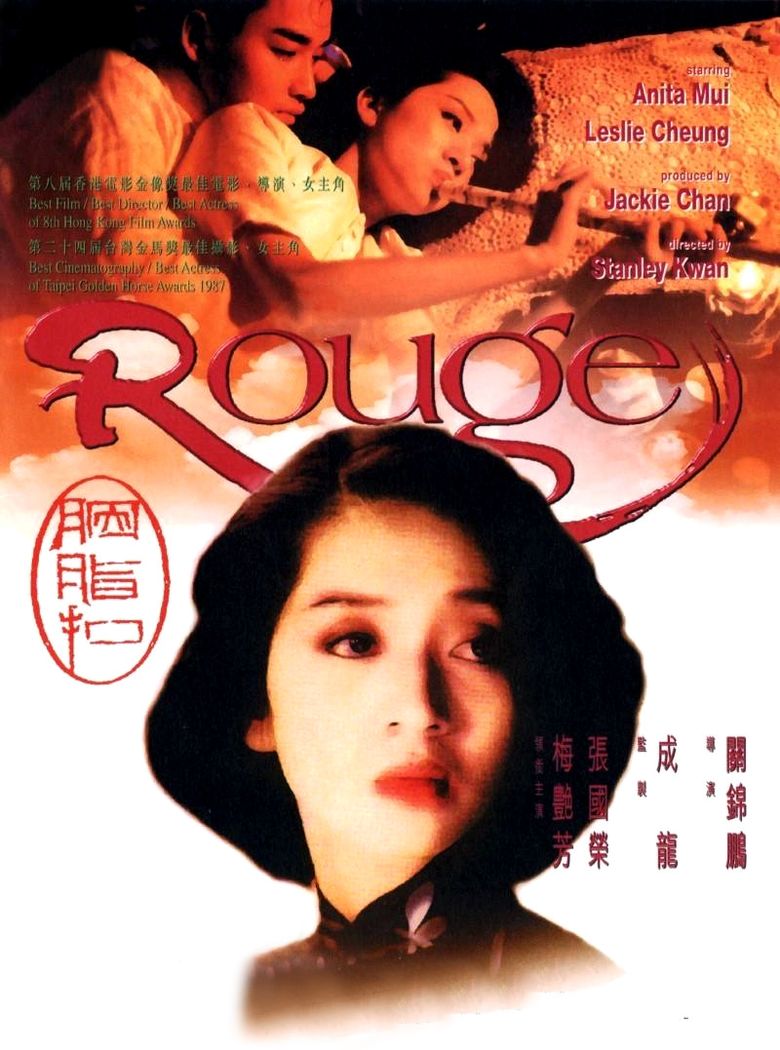
Rouge (胭脂扣, Stanley Kwan, 1988)

Rouge poster 2How long should you wait for love? They say every love story is a ghost story, and Stanley Kwan’s Rouge (胭脂扣) is a love story in more ways than one. A love letter to old Hong Kong, Rouge laments the passing of time and defeat of beauty by efficiency but then stops to wonder if perhaps that isn’t better and if we’re all secretly happier in world in which dying for love has gone out of fashion.

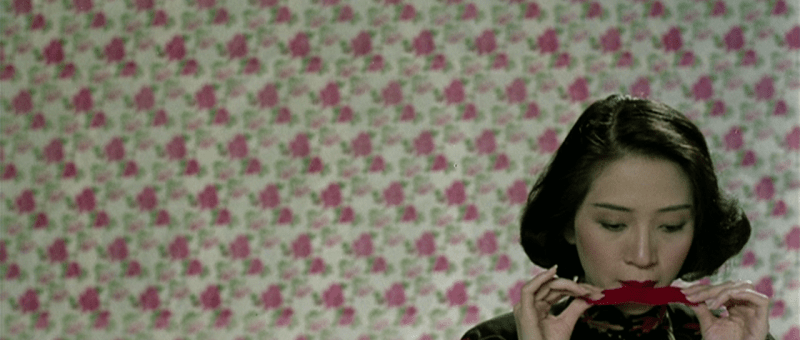
We begin in the early 1930s as courtesan Fleur (Anita Mui Yim-fong), dressed as a man and singing of doomed love, catches the eye of nobleman Master 12 Chan Chen-Pang (Leslie Cheung Kwok-wing). He lavishes gifts on her and the pair fall madly in love, but his family do not approve of the match and are set on Chen-pang marrying their chosen bride. Out of options, the pair decide on double suicide, but Fleur finds herself all alone in the afterlife and, after 50 years have passed, makes her way to the Hong Kong of the late 1980s in search of lost love.

Many things have changed in the Hong Kong of 1988, but luckily they still have classified ads which is how Fleur decides to find Chen-pang. Of course, ghosts don’t generally have need of money which means she’s still out of luck, but for some reason she finds herself attached to the kindly clerk, Yuen (Alex Man Chi-leung), who eventually agrees to “admit” her while he and his reporter girlfriend Chu (Irene Wan Bik-ha) help track down Chen-pang in the hope that Fleur can find him before the next memorial of her passing in two days’ time.

Kwan contrasts the opulence of the 1930s with the stark efficiency of the modern city in which pleasure palaces have been replaced with convenience stores. Fleur wanders through a world much changed, and sees its ghosts everywhere she goes. The Yi Hung teahouse is place of decadent delight filled with music, colour, and elegance but it’s also one built on misery in which young women are trapped and exploited as a direct result of generalised poverty. Hong Kong has moved on and is now one of the wealthiest cities in Asia, bustling with industry and ambition. The modern cityscape may be less aesthetically pleasing, but perhaps that’s not altogether a bad thing if that beauty had existed only to mask an unpalatable reality.

It is true enough that Fleur struggles to make herself understood to Yuen and Chu – her language is no longer current and her way of thinking arcane considering they are only two generations apart. Fleur wonders why the pair of them aren’t married, to which Yuen bemusedly replies that perhaps it’s that there’s no particular pressure urging them towards a more formal union. In any case their relationship seems solid enough in a pleasant, ordinary sort of way. Where Chen-pang gives Fleur the gift of an empty rouge case, Yuen notices Chu’s shoes are worn and thinks to buy her new ones seeing she’s always running about. They wonder if they’d commit suicide for love and come to the conclusion that they wouldn’t, but that doesn’t mean they don’t love each other only that life is precious and that kind of grand romanticism seems so absurd in the much more down to earth 1980s.

Still, Chu and Yuen can’t help but be captivated by the grandeur of Fleur’s romantic longing. They too want to see a happy ending to her tragic story that makes 50 years in limbo worth the wait, but what if Chen-pang was just a selfish coward who woke up from a romantic daydream and went back to his ordinary life of familial obligation and frustrated desire? Fleur died for love, but 50 years later it all seems so senseless and her return is, in a sense, an attempt to come to terms with disappointment – in love and in the world. The Hong Kong of 1988 may have been anxious too, if in a different way, as another uncertain dawn hovered on the horizon but Fleur’s parting gift is to accept that there’s no point waiting for someone who has no intention of coming. She says goodbye to the past, and walks into a new future with a lightness in her step while the past, suddenly burdened, can only look on with regret.


Rouge screens at the BFI on 4th May with director Stanley Kwan in attendance for a Q&A as part of the 2019 Chinese Visual Festival.

International trailer (dialogue free, English captions)

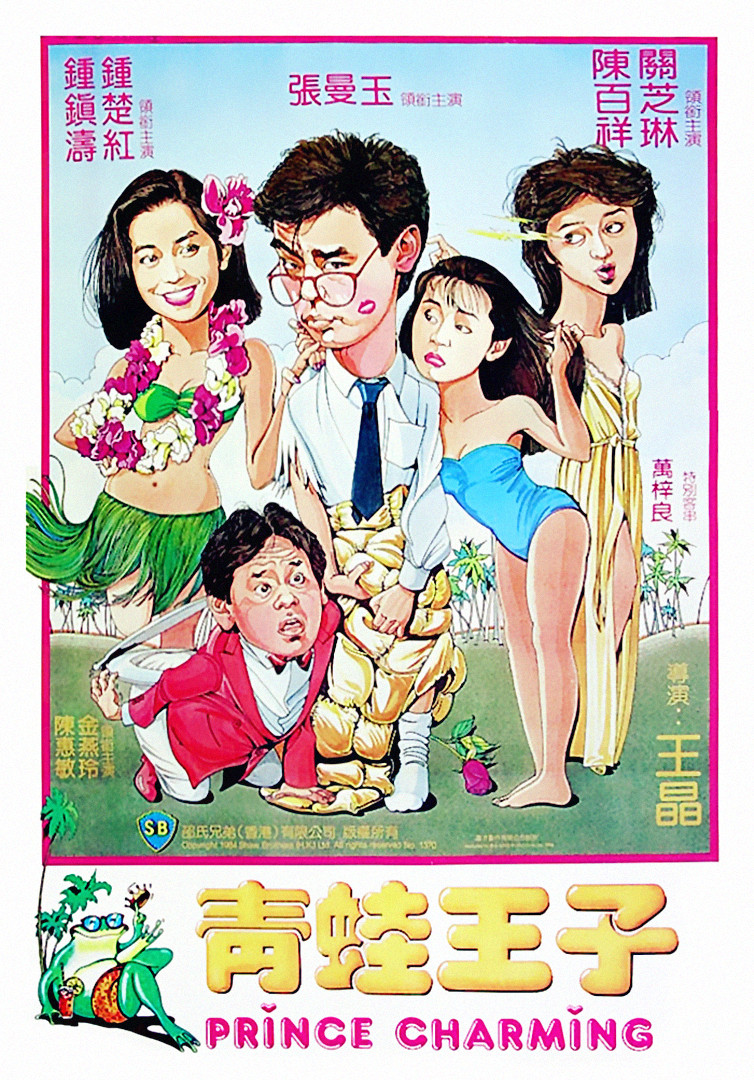
Prince Charming (青蛙王子, Wong Jing, 1984)

Prince charming 84 poster“This isn’t a film from the 1930s!” a confused sidekick exclaims part way through Wong Jing’s zany ‘80s comedy Prince Charming (青蛙王子). He’s right, it isn’t, but it might as well be for all the farcical goings on in Wong’s hugely populist, unabashedly zeitgeisty romp through a rapidly modernising society. Starring popstar Kenny Bee, Prince Charming also marks the feature film debut of the later legendary Maggie Cheung who would find herself making a fair few disposable comedies in the early part of her career. All the Wong trademarks are very much in evidence from the sometimes crude humour to the random narrative developments and deliberate theatricality but it has its charms, even if perhaps despite itself.

Signalling the “aspirational” atmosphere right away, Wong opens in “Hawaii” with Kenny Bee performing one of the many musical numbers which will be heard throughout the film (which is also a kind of idol movie as well as a populist Shaw Brothers Comedy). Chen Li Pen (Kenny Bee) is the son of an oil magnate and hotel chain manager but unlike his father, is a sensitive, nerdy young man who gets the hiccups around attractive women and has never had any luck with the opposite sex. Nevertheless, his mother wants to set him up with an arranged marriage – something which he vehemently opposes but understands will become harder for him fend off if he can’t find himself a love match in good time. Enter his old friend Lolanto (Nat Chan Pak-Cheung) who is a self-styled ladies man if a bit “common”. Lolanto has come to Hawaii on holiday and to hang out with Li Pen, but like any young guy he also wants to meet some girls.

The guys end up in a kind of sparring match with the two ladies staying in an adjacent room at the hotel, May (Cherie Chung Cho-Hung) and Kitty, (Maggie Cheung Man-Yuk) following a series of misunderstandings. When the girls drug them and then somehow leave them on a rock in the middle of the ocean, the boys are humiliated but don’t have too long to nurse their wounds because Li Pen’s dad sends them back to Hong Kong to investigate suspected embezzlement at head office. As luck would have it, both May and Kitty work for Li Pen’s family firm (which was perhaps why they were staying in the hotel). Another misunderstanding sees May assume Li Pen is a former triad looking for a new start, so she “bribes” the hiring department to get him a job as a chauffeur, while Lolanto ends up in the boss’ office posing as Li Pen. Hilarity ensues.

Aiming a squarely for the populist, Wong’s defiantly aspirational vision revolves around the fabulously wealthy and internationalised Li Pen who went to college in the US and lives most of his life in Hawaii, perhaps not quite understanding Hong Kong in the same way Lolanto does, both because of his outsider status and because of the freedom his wealth gives him. When the two swap roles they each get a kind of education, but their real quest (while halfheartedly investigating the embezzlement scandal) is winning over Kitty and May who think they’re dating a CEO and a chauffeur respectively. Despite their irritation when they realise their mistake, both May and Kitty perhaps come to realise that the deception is a part of what eventually drew them to the guys and they’re a better match than they might otherwise have imagined.

Meanwhile, Wong finally remembers the embezzlement plot and introduces a third woman, Puipui (Rosamund Kwan Chi-Lam), who is secretly a plant set up to seduce the pure hearted Li Pen and marry him because this will in some way prevent the embezzlement scam from coming to light. Puipui’s scheme eventually kicks off the ridiculous finale in which the gang find themselves chased by goons and having to play pool for their lives with hostages hooked up to electric chairs which will be triggered when a certain number of points are scored. Wong adds a host of cutesy touches from cartoon hearts around our lovelorn heroes and adorable doodles popping up as on screen graphics while Kenny Bee and Cherie Chung also get a completely bizarre musical number at the midway point where they pretend to be happy frogs marooned on a private lily pad. It doesn’t make any sense, but it really doesn’t matter. Completely throw away, but strangely fun.


Currently streaming on Netflix UK (and perhaps other territories)

Celestial Pictures trailer (English subtitles)