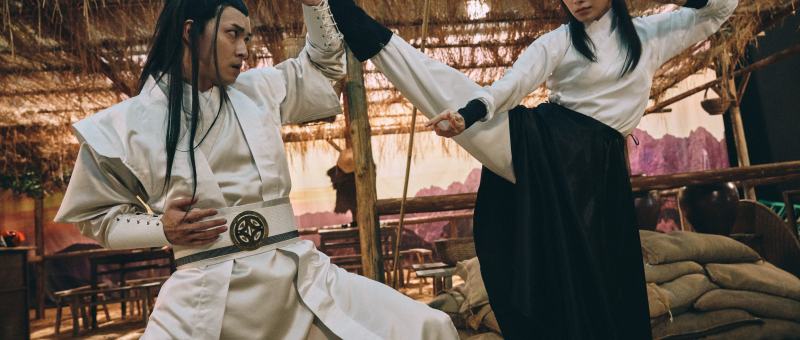
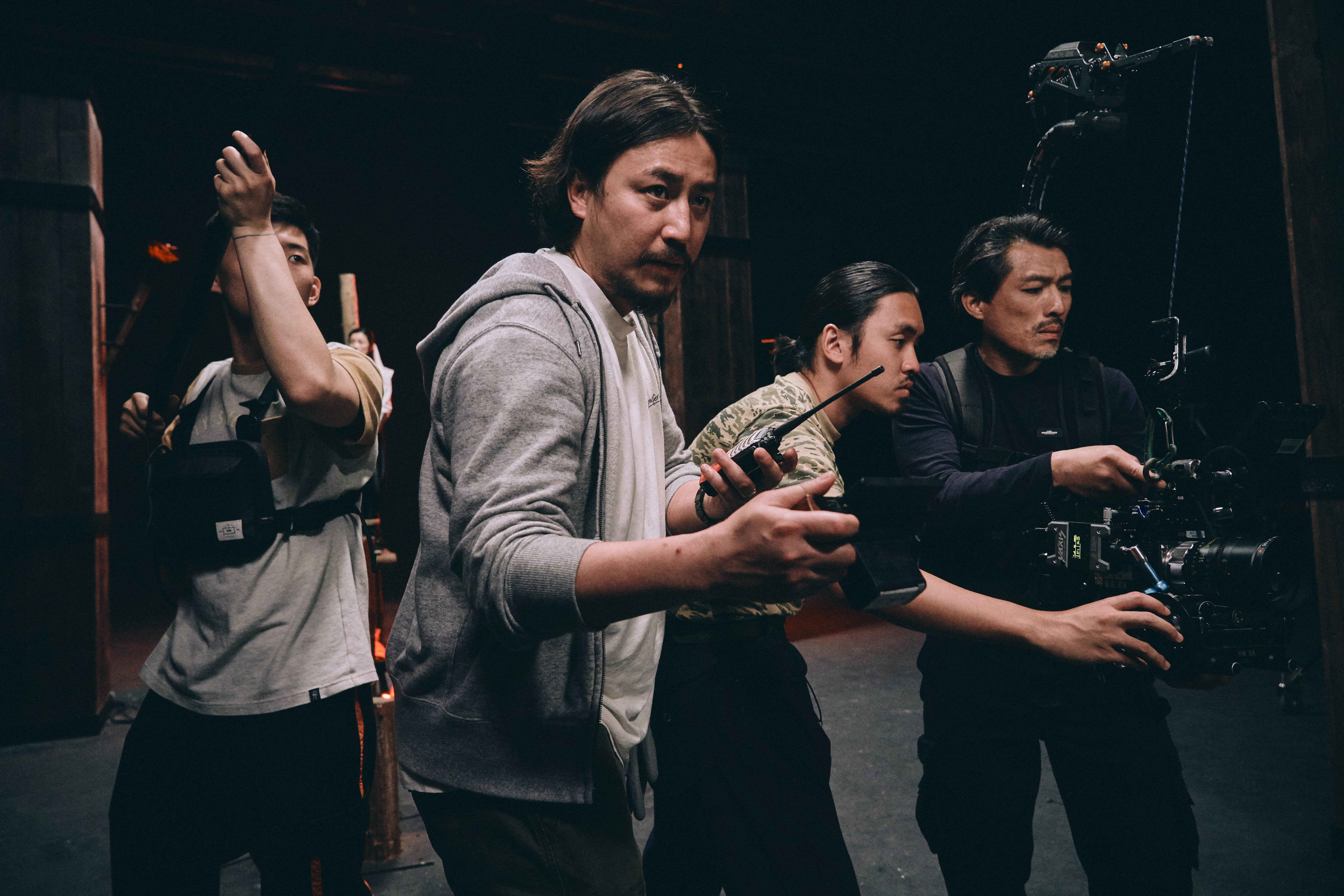
Legendary in Action! (大俠Action!, Justin Cheung & Li Ho, 2022)

An unsuccessful film director looks for new opportunities in gaining closure with the past in Justin Cheung and Li Ho’s behind the scenes comedy, Legendary in Action! (大俠Action!). Echoing classic wuxia, the film finds its heroes searching for themselves while on a quest to revitalise the Hong Kong film scene in which they must battle unscrupulous investors, idol stars with limited acting experience, divided loyalties, the changing nature of the industry, and the ghosts of wuxia’s past. 

40-ish Tiger (Bill “Tiger” Cheung) made a big splash in his earlier career but when his first feature flopped he discovered that second chances are hard to come by in the contemporary film industry. Since then, he’s been making a living shooting sleazy shorts for live streamers while privately dying inside. When a mysterious investor turns up wanting to make a retro wuxia, Tiger is the perfect fit. Shopping an old script he’d written to provide an ending to a serial he loved as a child which was abruptly cancelled, he sets about fulfilling his childhood dream even recruiting the original star to reprise his role but soon finds out that the past is not so easily resurrected. 

This fact is brought home to him by irascible former action star Master Dragon (Chen Kuan-tai) who constantly reminds him that it wasn’t like this in his day usually because they had no health and safety regulations or working rights. Yet Master Dragon is also in a sense in search of himself in that he has begun suffering with dementia and is no longer able to separate fantasy from reality. Far too into his role, he ignores the script and attacks the actors playing bad guys for real but cannot quite recall his signature move while insisting on completing dangerous stunts by himself. He’d also insisted on trying to find the original actress to play the romantic lead, but finally settles for a feisty young woman, Greta (Wiyona Yeung), who is mostly in it for the cash but gradually warms to Master Dragon happy to know that someone cared for her after he waded in on her behalf when she was bullied by lecherous customers at the bar where she was working. 

Tiger meanwhile finds himself failing in his responsibilities as a husband and soon-to-be father, pouring everything into the film while neglecting his long-suffering wife who asks him why he thought now was a good time for his one last chance. When the shoot enters a crisis, he signs up for even more “meaningless” shorts and onerous employment contracts to get the money together to finish while asking his cast and crew to do the same, each of them facing their various issues while coming together as a team squaring off against the vagaries of the independent cinema scene.

Then again, Tiger doesn’t seem to have learned much about work life balance. Nor is Master Dragon a particularly good influence instructing those around him that if film is not their lives’ work, they shouldn’t be doing it. Master Dragon is on his own journey trying to reclaim his former self while dealing with the past just as Tiger is himself trying to bring something full circle in giving his childhood favourite the ending it deserves. In a closing speech, he aligns his struggles with those of the Hong Kong film industry in general positing the wuxia serial as a symbol of faded glory while implying that the contemporary film industry has run out of steam. “At some point we lost faith in Hong Kong Cinema”, he laments, complaining about rubbish films with bad scripts and terrible production values while praising the efforts of the crazy people who give their all to make them. 

“I won’t accept fate” he goes on, like the hero of a classic wuxia fighting for justice in an unjust world while insisting that it is possible to turn things around and restore the glory of Hong Kong film. Then again, as much as his film seems to bring closure and present a place from which to move forward perhaps its unwise to look for new directions in attempting to recreate the past rather than finding new ways to bring it with you into a more positive future. 


Legendary in Action! screens at Lincoln Center 17th July as part of this year’s New York Asian Film Festival.

Original trailer (Traditional Chinese / English subtitles)

Images: © Marigold Project

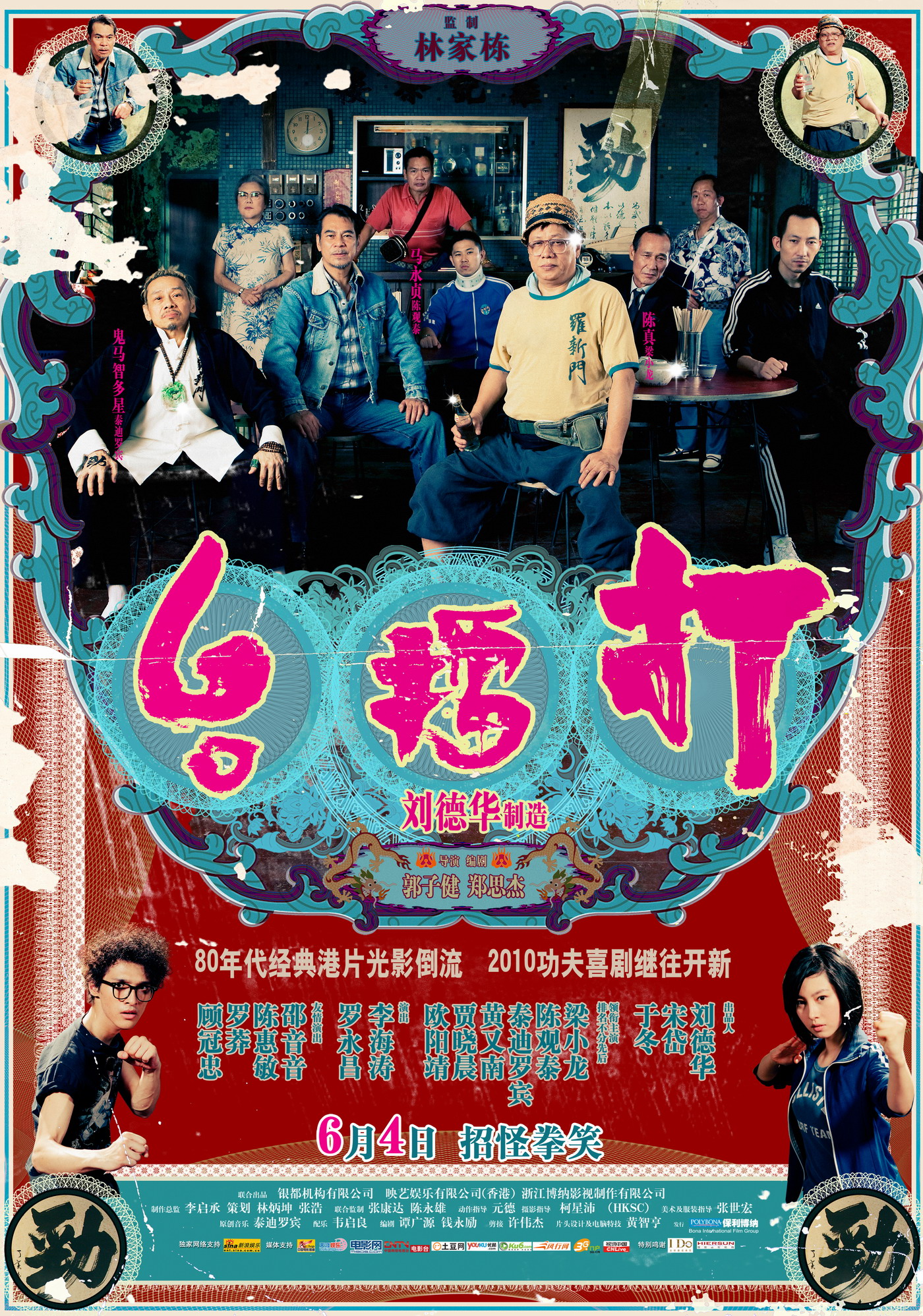
Gallants (打擂台, Derek Kwok & Clement Cheng, 2010)

Gallants PosterLike the master at the centre of Derek Kwok and Clement Cheng’s Gallants (打擂台), old school martial arts movies have been in a deep sleep since their Shaw Brothers heyday. Drawing inspiration from the kung fu films of old, Gallants is a tale of buried heroism suddenly reawakening and the risks of writing off veteran challengers just because of their age. It’s also a tribute to those perhaps more innocent times and, in contrast to a prevailing trend, a true Hong Kong film filled with typically Cantonese (sometimes untranslatable humour) and meta references to the area’s long cinematic history.

For a brief moment in his childhood, Cheung (Wong You-nam) was the unbeatable superhero who never lost a fight. These days, he’s a nerdy loser who sometimes hides under his desk to escape his angry boss. Despatched by the shady real estate company he works for, Cheung is sent back to his rural hometown entrusted with the mission of convincing the local population to surrender their homes so the developers can build a large scale complex. Whilst there he gets attacked by local punks only to be saved by an old guy who has immense kung fu skills.

The old guy turns out to be one of two living in a ramshackle tea house that used to be a martial arts studio. Tiger (Leung Siu-lung) and Dragon (Chen Kuan-tai) turned the Gate of Law into a teahouse to make ends meet while their legendary sifu, Master Law (Teddy Robin), has been in a coma for the last 30 years. When a fight breaks out and the old guys get to strut their stuff against a local kingpin, Cheung decides to petition them to take him on as a pupil. In a classic case of bad timing, Cheung is around when the teahouse is raided again and someone attacks Master Law causing him to wake up and act as if the last 30 years never happened. He thinks Cheung is both of his young pupils, Tiger and Dragon, in one and that the real 30 years older versions of Tiger and Dragon are some random old guys Cheung has agreed to train out of pity.

If you don’t fight, you won’t lose quips Law, but if you fight you have to win. Like any good martial movie, Gallants is more about the journey than the destination. Rather than focussing solely on Cheung who experiences several conflicts of the heart when he realises that his adversary is the childhood friend he used to bully and that he was technically on the wrong side to begin with, Kwok and Cheng broaden the canvas to allow Tiger, Dragon, and Law to take centre stage. Still skilled martial artists, the guys give it their all in the knowledge that they’ll have to work far harder now that they aren’t as agile as they once were. Still, they have the true spirit of kung fu and resolve to keep getting back up each time they’re knocked down.

This oddly defeatist attitude which presupposes humiliation but insists on perseverance gives the film much of its warmhearted, ironic tone as the hapless martial arts heroes repeatedly fail yet refuse to back down. The other source of comedy lies in the hilarious performance of the tiny Teddy Robin as the supposedly all powerful Law. Law, as it turns out, is a wisecracking lecher who sets about flirting with just about every young girl he lays eyes on before decamping to a hostess bar and asking for the ladies from 30 years ago. Former starlet Susan Shaw makes an amusing cameo as the long suffering, lovelorn doctor apparently in love with Law since their youth who has continued to care for him throughout his illness but is entirely forgotten when Law wakes up in full on sleaze mode.

Bizarre gags including one about a missing preserved duck, jostle with impressive action sequences performed by two veterans proving they’ve still got what it takes all these years later. The aesthetic is pure ‘70s Shaw Brothers complete with speedy zooms and whip pans accompanied by an overly dramatic score, lovingly echoing the classic kung fu era rather than trying to attack it through parody. As funny as it all is, and it is, Gallants is also surprisingly warmhearted as it finds space to value the skills of its elderly protagonists as well as the enduring bonds of friendship which connect them.


Screened at Creative Visions: Hong Kong Cinema 1997 – 2017

Original trailer (English subtitles)

The Teahouse (成記茶樓, Kuei Chih-Hung, 1974)

TheTeaHouse+1974-248-bWhere oh where are the put upon citizens of martial arts movies supposed to grab a quiet cup of tea and some dim sum? Definitely not at Boss Cheng’s teahouse as all hell is about to break loose in there when it becomes the centre of a turf war in gloomy director Kuei Chih-Hung’s social minded modern day kung-fu movie The Teahouse (成記茶樓, Cheng Ji Cha Lou).
Wang Cheng runs a small teahouse which prides itself on being the kind of progressive environment where everyone looks after each other as long as they play by the rules. Unfortunately, one of his young guys – Blackie, fresh off the boat from the mainland, has got himself into bad company and into trouble with the law. However, as he’s a minor, he gets off with barely any punishment at all. Cheng tells him he can stay at the teahouse only if he pays properly for his crime leading him to try and get himself arrested all over again so he can go to jail (which actually proves very difficult).

Another unfortunate side effect of Blackie’s adventure is that it brings some unwanted gangster attention and when two young thugs come looking for one of the waitresses, Boss Cheng is not going to stand for any nonsense. However, after his attempts to help the girl have failed, he finds himself in trouble with two different sets of gangsters and also a meddling police inspector who seems intent on using the teahouse to trap the triads.

Boss Cheng is a good and decent man but also someone with his own opinions on justice who is not afraid to take matters into his own hands. His rules for workers at the teahouse emphasise obeying the law and behaving like responsible citizens, but he’s not above carrying out a little corrective action of his own if the need arises.

The biggest theme of the film is the rising inequality and place of migrants from the mainland in contemporary Hong Kong society but the first target Kuei has his sights set on is out of control youth. Because of the lenient laws regarding child criminality, the young men of Hong Kong run rampant, safe in the knowledge that nothing is going to happen to them while they remain under the age of responsibility. The two gangsters accused of raping and attempting to force the teenage waitress at the teahouse into prostitution give their ages as 14 and 15 respectively to the trial judge and are released without charge to go back to their life of crime with impunity and no respect for the law or conventional morality. Sadly, this system just creates another child criminal but one who will receive a jail sentence even if a lighter one to be served in a reform school rather than a prison.

Blackie was seduced into crime by a lack of funds – having managed to make it over from the mainland he has nothing other than his job at the teahouse and the support of Boss Cheng. One day a ragged looking little boy leading his sister by the hand wanders into the teahouse to beg for food. It turns out his small family escaped from the mainland too but his father never made it to Hong Kong and his mother is ill, leaving the children to try and fend for themselves. Boss Cheng takes pity on them and gives the boy a job plus paying for his school fees but he still finds himself beaten up by thugs not much older than himself in the street.

All the while, corrupt fat cats are messing with the system to keep the poor in their place while the rich get richer. Cheng takes great pleasure in playing off a corrupt industrialist who tried to use him as a sacrificial pawn in his own war against the triads (well, the triads he doesn’t like, anyway). Amusingly, one of the triad bosses seems to think Cheng is also a brother forcing him to pretend to know all about triad rituals to attempt to make a truce with them. The teahouse is situated right between the territories of two rival gangs making it a prime spot for conflict. However, the real problem comes when the police start muscling in, giving off the impression that Cheng has turned traitor on the triads. Soon, Cheng becomes the single biggest threat to his own teahouse and the progressive environment he hoped it would foster.

The Teahouse is actually a little ahead of its time concentrating not on kung fu or street fighting but mixing in a little gun play and some bloody knife crime. The shooting style is impressive throughout with a realistic, gritty atmosphere which aims to put the real streets on screen. The film does, however, have a tendency to fall into an episodic rhythm and suffers from its abrupt and slightly odd, downbeat ending which finishes things on an unsatisfying note. That said, The Teahouse is a stylishly shot and socially engaged action extravaganza that makes up for its minor shortcomings with a degree of chutzpah which looks forward to the classic heroic bloodshed movies of the ‘80s.


Seen as part of HOME’s CRIME: Hong Kong Style touring season.

Unsubtitled trailer (Mandarin):


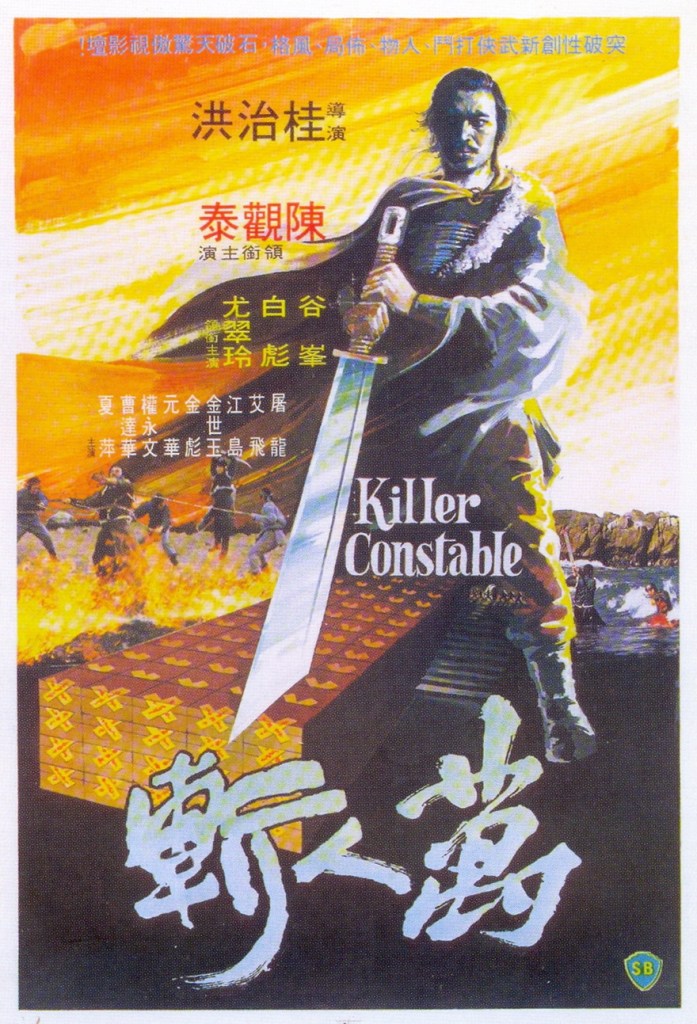
Killer Constable (萬人斬, Kuei Chih-Hung, 1980)

KillerConstable+1980-19-bEvery sovereign needs that one ultra reliable and supremely talented servant who can be called upon in desperate times. For the Dowager Empress of the Qing Empire, that man is Leng Tien-Ying – otherwise known as the Killer Constable. When a sizeable amount of gold goes missing from the Imperial Vaults, it’s Leng they call to try and get it back. However, what Leng doesn’t know is that there’s far more going on here than he could possibly have imagined and he’s about to wade into a trap so deep that you never even see the bottom.

At several points, the giant broadsword style weapon that Leng carries catches the light and appears to shine out with some kind of ethereal righteousness, yet if Leng wields the shining sword of justice he does so with a heart of ice. Early on one of his most trusted subordinates argues with him and says he intends to leave because he thinks Leng is more killer than policeman. He doesn’t take prisoners, where there’s reasonable proof of guilt he cuts the perpetrator down on the spot. At one point he tortures a suspect for information by mock drowning him in a lake while his wife and terrified children look on. When the wife complains, he hits her causing the husband to make the mistake of going for Leng which earns him the prize of getting his head cut off right in front of his family who are now left without any means of supporting themselves.

Leng cares only about the letter of the law. As the squad of policemen ride through the barren landscape, they pass through ruined towns filled with the starving and the desperate. One of the more compassionate men asks what’s happened here and if they, as policemen, shouldn’t be trying to help, but is reminded that these poor people are Hans and the policemen are Manchurians, so it’s just none of their business whether they live or die.

However, here is where Kuei’s film deviates from the accepted path. Leng’s generally bleak attitude to life is the one the film most closely identifies with. Any attempt at compassion is met with by betrayal, each act of kindness only earns retribution and being softhearted is almost another word for dying young. That is not to say the film is completely behind Leng as a hero or even as an anti-hero, he too will pay for the way he lives his life starting with realising that he alone is responsible for the deaths of the men that blindly followed him on a fruitless quest.

Killer Constable is more of a swordplay film than a kung-fu one and is filled with plenty of energetic and expertly choreographed fight sequences. The men fight in blazing heat (at one time literally), pouring rain and mud filled swamps against a suspiciously well trained gang of opponents who always seem to be lying in wait for them. The Killer Constable also seems to have something of a fetish for chopping off people’s legs which carries on right into the bloody finale with limbs flying off with oddly gleeful abandon.

As it turns out, the Killer Constable is not completely heartless, he’s just lived in this harsh world long enough to come to the opinion that the “bad” cannot be redeemed and need to be cut down like weeds so that the flowers can once again bloom. However, he, in his quest, has crossed the line and become that which he most hates. To nearly everyone else in the picture, Leng is a bad guy – the uncompromising face of the law and the knock at the door you most fear coming. In the film’s surprisingly downbeat ending he too will get what’s coming to him.

Bleak beyond measure, the only good and true thing in the cruel wold of Killer Constable is the blind daughter of one of the criminals. Kind and cheerful, she tries to help Leng as he lies wounded and is entrusted to him should her father die, yet she pays the heaviest price of all, left standing all alone in the rain waiting for the return of those who will never come home again. Far from heroic, Killer Constable is a critique of blind justice dealt out by self righteous egoists who will always discover the error of their ways far too late.


Seen as part of HOME’s CRIME: Hong Kong Style touring season.