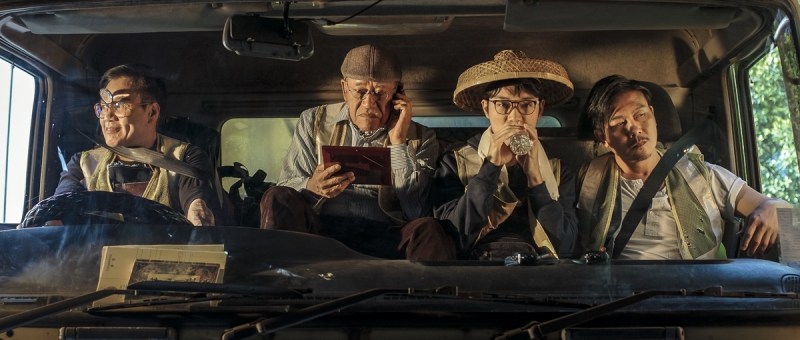

Vampire Cleanup Department (救殭清道夫, Chiu Sin-Hang & Yan Pak-Wing, 2017)

There are strange things going on all around you that you have no idea about. The life of the average man on the street can be far more mysterious than you could ever imagine. Or so the hero of Chiu Sin-Hang and Yan Pak-Wing’s nostalgic comedy Vampire Cleanup Department (救殭清道夫) realises on being co-opted into a top secret government anti-vampire squad after embarrassingly getting bitten on the bum by a creature of the night.

Tim (Babyjohn Choi) is a down-on-his-luck young man who was raised by his eccentric grandmother after his parents’ death and now assumes she has dementia because she continues to call him by his father’s name. All of his family members seem to have some association with rubbish, his grandmother collecting cardboard to alleviate their poverty, and Tim seems to have internalised a sense of himself being the same. Tim thinks his parents were regular street cleaners who were killed in an accident, only later finding out that they were part of the cleanup squad and everyone has been keeping this from him to keep him safe from vampires. Realising that he’s immune, however, after being bitten on the bum and feeling no ill effects beyond embarrassment, they decide he’s a prime candidate for injecting new blood into the team.

Though most obviously paying homage to classic hopping vampire movies such the Mr Vampire series several of the alumni of which are featured in the film, it also seems to have some spy movie influences with its small cell of operatives and Bond-esque vampire fighting gadgets while in some ways seeking to move on from the central Taoist mythology. Master Ginger (Yuen Cheung-yan) is apparently the only Maoshan Taoist left in Hong Kong. Part of Tim’s early training involves learning all of the various seals he uses to trap vampires but photoing them instead, while otherwise basically acting as a general dogsbody doing the team’s washing and other miscellaneous tasks.

Meanwhile, the gang is seemingly targeted by a shady rival organisation run within the local police force. Slimy policeman Chu (Jiro Lee Sheung-ching) is working with a foreign scientist who says that vampires are real, they’re just dead bodies infected with a virus that makes them move. He needs more samples to come up with a vaccine, and Chu seems willing to do whatever it takes to get them to him. A vaccine is eventually developed, but it is it seems homegrown in being taken from Tim’s blood which is immune to the toxin and developed through his parents’ sacrifice, which is perhaps a subversive hint of a grassroots organisation run by ordinary people like street cleaners standing up to an authoritarian external force that wants to stamp out their history and take away their power.

But at the same time, as all this has been kept from Tim, he has a hard time separating the “vampires” from the people they used to be, convinced that some of them can be rehabilitated and go back to being more like people. On his first case, he comes across a beautiful young woman (Lin Min Chen) who was apparently buried alive as a sacrifice to the landlord vampire, another hint at lingering feudalism and land profiteering in the contemporary era. Tim is moved by seeing what he thinks are tears, but turn out to be droplets leaking from the air conditioner. Nevertheless, he can’t bring himself to burn her as he’s been being taught to do so takes her home and starts looking after her until she eventually bonds with him and fights back against her former master.

Shedding his nerdy image by removing his glasses so he can see “properly”, the conclusion that Tim comes to is that vampires and human beings are much the same in that there’s good and bad everywhere. Sometimes it’s possible to turn an enemy into a friend and aim for peaceful co-existence, but at the same time a lot more youngsters have joined the apparently secret organisation to defend their streets from an evil external threat. Though a little more cute and cuddly than the films that inspired it, Vampire Cleanup Department does at least succeed in resurrecting the hopping vampire tradition for a new generation.


Trailer (Traditional Chinese / English subtitles)

Gallants (打擂台, Derek Kwok & Clement Cheng, 2010)

Gallants PosterLike the master at the centre of Derek Kwok and Clement Cheng’s Gallants (打擂台), old school martial arts movies have been in a deep sleep since their Shaw Brothers heyday. Drawing inspiration from the kung fu films of old, Gallants is a tale of buried heroism suddenly reawakening and the risks of writing off veteran challengers just because of their age. It’s also a tribute to those perhaps more innocent times and, in contrast to a prevailing trend, a true Hong Kong film filled with typically Cantonese (sometimes untranslatable humour) and meta references to the area’s long cinematic history.

For a brief moment in his childhood, Cheung (Wong You-nam) was the unbeatable superhero who never lost a fight. These days, he’s a nerdy loser who sometimes hides under his desk to escape his angry boss. Despatched by the shady real estate company he works for, Cheung is sent back to his rural hometown entrusted with the mission of convincing the local population to surrender their homes so the developers can build a large scale complex. Whilst there he gets attacked by local punks only to be saved by an old guy who has immense kung fu skills.

The old guy turns out to be one of two living in a ramshackle tea house that used to be a martial arts studio. Tiger (Leung Siu-lung) and Dragon (Chen Kuan-tai) turned the Gate of Law into a teahouse to make ends meet while their legendary sifu, Master Law (Teddy Robin), has been in a coma for the last 30 years. When a fight breaks out and the old guys get to strut their stuff against a local kingpin, Cheung decides to petition them to take him on as a pupil. In a classic case of bad timing, Cheung is around when the teahouse is raided again and someone attacks Master Law causing him to wake up and act as if the last 30 years never happened. He thinks Cheung is both of his young pupils, Tiger and Dragon, in one and that the real 30 years older versions of Tiger and Dragon are some random old guys Cheung has agreed to train out of pity.

If you don’t fight, you won’t lose quips Law, but if you fight you have to win. Like any good martial movie, Gallants is more about the journey than the destination. Rather than focussing solely on Cheung who experiences several conflicts of the heart when he realises that his adversary is the childhood friend he used to bully and that he was technically on the wrong side to begin with, Kwok and Cheng broaden the canvas to allow Tiger, Dragon, and Law to take centre stage. Still skilled martial artists, the guys give it their all in the knowledge that they’ll have to work far harder now that they aren’t as agile as they once were. Still, they have the true spirit of kung fu and resolve to keep getting back up each time they’re knocked down.

This oddly defeatist attitude which presupposes humiliation but insists on perseverance gives the film much of its warmhearted, ironic tone as the hapless martial arts heroes repeatedly fail yet refuse to back down. The other source of comedy lies in the hilarious performance of the tiny Teddy Robin as the supposedly all powerful Law. Law, as it turns out, is a wisecracking lecher who sets about flirting with just about every young girl he lays eyes on before decamping to a hostess bar and asking for the ladies from 30 years ago. Former starlet Susan Shaw makes an amusing cameo as the long suffering, lovelorn doctor apparently in love with Law since their youth who has continued to care for him throughout his illness but is entirely forgotten when Law wakes up in full on sleaze mode.

Bizarre gags including one about a missing preserved duck, jostle with impressive action sequences performed by two veterans proving they’ve still got what it takes all these years later. The aesthetic is pure ‘70s Shaw Brothers complete with speedy zooms and whip pans accompanied by an overly dramatic score, lovingly echoing the classic kung fu era rather than trying to attack it through parody. As funny as it all is, and it is, Gallants is also surprisingly warmhearted as it finds space to value the skills of its elderly protagonists as well as the enduring bonds of friendship which connect them.


Screened at Creative Visions: Hong Kong Cinema 1997 – 2017

Original trailer (English subtitles)