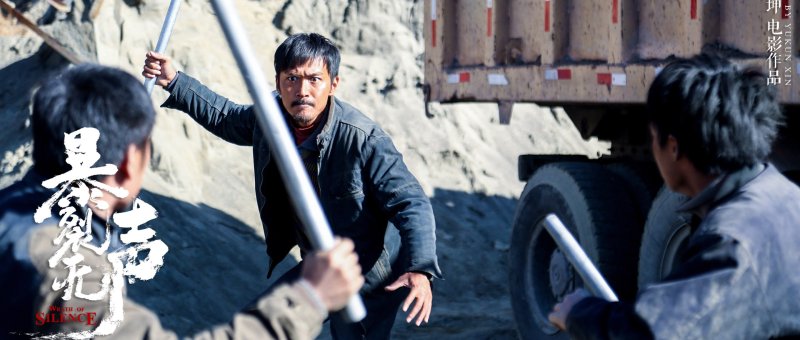
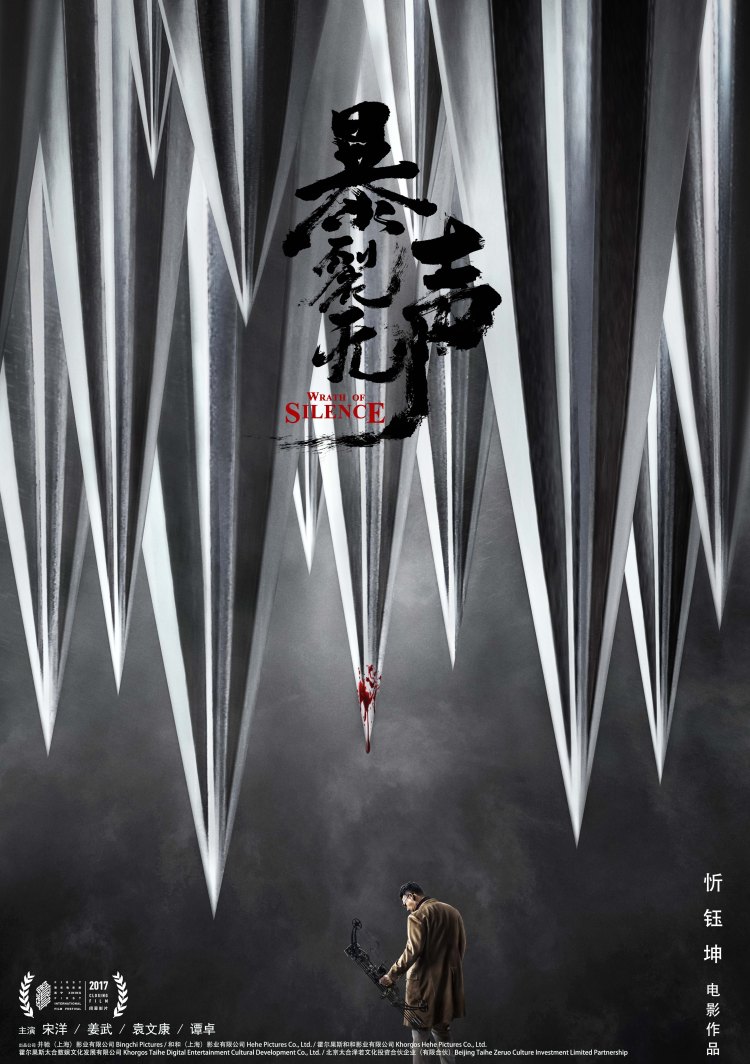
 Nature red in tooth and claw – life in the arid Northlands of modern China is surprisingly bloody in Xin Yukun’s The Coffin in the Mountain followup, Wrath of Silence (暴裂无声, Bào Liè Wúshēng). The film’s Chinese release has, apparently, been indefinitely delayed for unclear reasons but it’s easy to see what might have given the censors occasion for pause in this tale of missing children, corrupt businessmen, and the relentless lusty greed of the new middle classes. A voiceless everyman forced away from his family by a series of unfortunate events, returns to look for his missing son but finds only a malevolent darkness invading the corners of his once peaceful rural mountain town.
In the winter of 2004, a small boy watches his sheep whilst building a small rock tower and drinking from his Ultraman flask. A short while later, his dad, Baomin (Song Yang), is pulled away from a fistfight at the bottom of a coal mine by a phone call from his wife informing him that their son has gone missing. Baomin drops everything and goes home but he’s still persona non grata in the small mountain village after stabbing the local chef in the eye with a lamb bone during a fight over Baomin’s refusal to sign over his land to developers hoping to open a coal mine.
Baomin’s path crosses with that of two other men, gangster-like mining magnate Chang (Jiang Wu) who has recently been “acquitted” of running illegal operations, and Chang’s lawyer, Xu (Yuan Wenkang), a conflicted single parent. Baomin and Xu are at opposite ends of China’s recently born class system – one educated, successful, and inhabiting the new pristine cities, the other literally rendered voiceless by an act of violence, poor, and living an antiquated rural life in a desert wasteland. Chang exists in the no man’s land between them as an example of the new elite – his life is one of Westernised elegance in his smart study and wood panelled drawing room with its deer heads on the walls. Yet it’s not business acumen which underpins his success but thuggery and a thorough disrespect for conventional morality.
There is a double irony in Baomin’s life in that his original objection to the coal mine has sent him straight into one. Owing vast compensation to the chef whose eye he ruined as well as needing money to pay for his sickly wife’s medical treatment, Baomin has little choice but to leave his farm and travel to a distant city where he can earn the money he needs to pay for his various responsibilities. Not only are the coal mines ripping up the landscape, they’re destroying families firstly through forced absences and secondarily through disease born of industrial pollution.
This veniality is all too plain in Chang’s ostentatious display of needless slaughter as he sits at a large dining table entirely covered in plates of raw meat ready to be sizzled in Chang’s favourite hot pots while a finely tuned slicer runs in the background churning out an endless supply of repurposed flesh. Chang’s overwhelming need for consumption is less about hunger than conquest as his hunting hobby proves but the trophies on his walls are as fake as the hairpieces which cover his receding hairline. The force which drives him is not so much need as vanity, fear, and insecurity. Desperate to be hunter and not hunted, he has abandoned all morality and will stop at nothing to ensure his place at the table is secure.
Baomin will stop at nothing until he finds his son. The film’s title, ironically enough, includes a slight pun in its first two characters which are pronounced “Bao” and “Lie” (the name of Baomin’s son) but mean “violence” and “spilt” while the characters of Baomin’s name (保民) mean protect and citizenry. Baomin is a violent man. According to his wife he was always fond of a fight even before rendering himself mute, but it has to be said that violence is, in his voiceless state, his most efficient method of communication. Flashing pictures everywhere he goes, Baomin chases visions of his son, haunted by small boys in Ultraman masks, fighting monsters far more real than the tokusatsu hero’s usual foes.
Fable-like in execution, the final revelations are heavily foreshadowed though dual meanings are plentiful as in a small boy’s innocent assumption of a classic Ultraman pose which looks eerily like something else to those with a guilty conscience, planting the seed of doubt as to whether it really was quite that innocent after all. Xin shoots with Lynchian surrealism as darkness seems to creep idly into the frame and then hover there, threatening something terrible, like the manifestation of willingly unseen truths. The rapid pace of social change has brought with it a loss of morality that endangers the foundation of society itself, sacrificing the young on the altar of greed while the state turns a blind eye to systemic corruption and cowards save their own skins rather than ease the suffering of others. Filled with a quiet rage mediated through melancholy poetry, Wrath of Silence takes a long, hard look into that creeping darkness but finds the darkness looking back with accusing eyes.
Screened at BFI London Film Festival 2017.
Original trailer (dialogue free, no subtitles)





 As it stands, contemporary Chinese cinema is veering dangerously close to Monkey King fatigue. Stephen Chow brought his particular sensibilities to the classic Journey to the West before Donnie Yen put on a monkey suit for
 Like the rest of the world, China, or a given generation at least, may be finding itself at something of a crossroads. The past few years have seen a flurry of coming of age dramas in which the melancholy and middle-aged revisit lost love from their youth but Derek Tsang’s Soul Mate (七月与安生, Qīyuè yǔ Anshēng) seems to be speaking to an older kind of melodrama in its examination of passionate friendship pulled apart by time, tragedy, and unspoken emotion. The story is an old one, but Tsang tells it well as its twin heroines maintain their intense, elemental connection even whilst cruelly separated.
 Feng Xiaogang, often likened to the “Chinese Spielberg”, has spent much of his career creating giant box office hits and crowd pleasing pop culture phenomenons from World Without Thieves to Cell Phone and You Are the One. Looking at his later career which includes such “patriotic” fare as Aftershock, Assembly, and
  Youth looks ahead to age with eyes full of hope and expectation, but age looks back with pity and disappointment. Adapting her father’s novel, Liu Yulin joins the recent movement of disillusionment epics coming out of China with Someone to Talk to (一句頂一萬句, Yī Jù Dǐng Yīwàn Jù). Arriving at the same time as another adaptation of a Liu Zhenyun novel, I am Not Madame Bovary, Someone to Talk to takes a less comical look at the modern Chinese marriage with all of its attendant sorrows and ironies, a necessity and yet the force which both defines and ruins lives. Communism believes love is a bourgeois distraction and the enemy of the common good (it may have a point), but each of these lonely souls craves romantic fulfilment, a soulmate with whom they might not need to talk. The desire for someone they can connect with an elemental level becomes the one thing they cannot live without.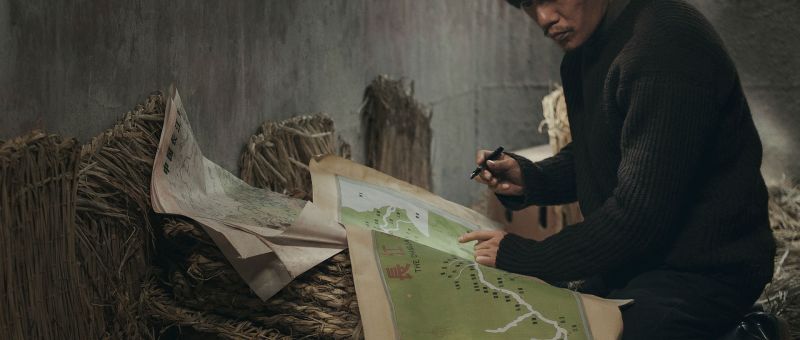
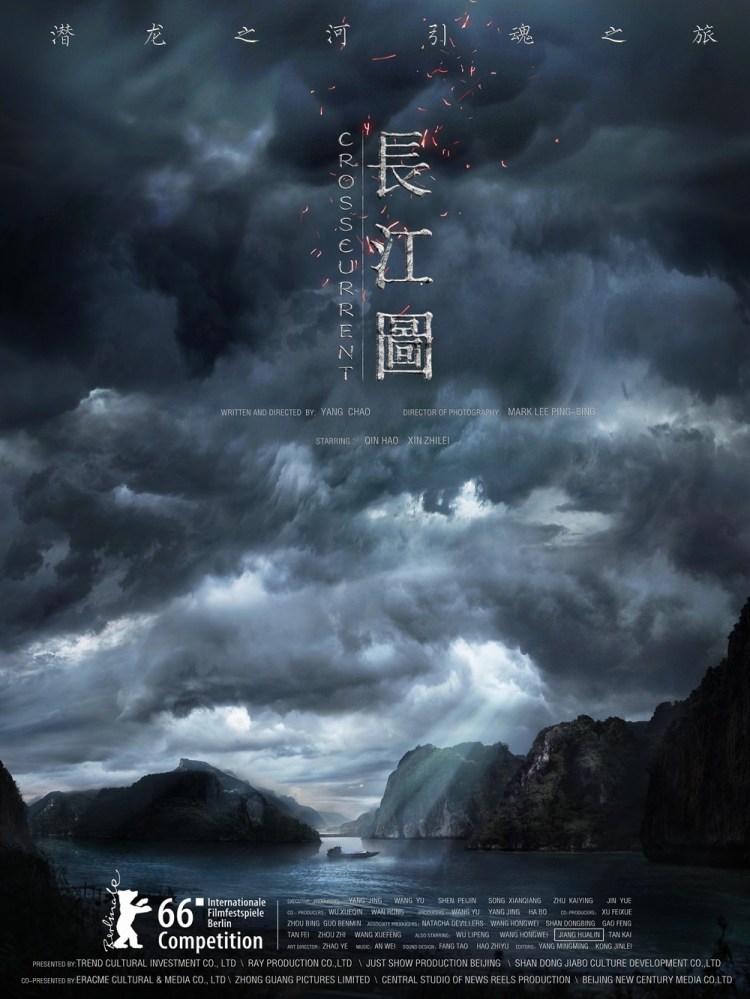 “Time, like a river, flows both day and night” as the narrator of Yang Chao’s poetical return to source Crosscurrent (長江圖, Chang Jiang Tu) tells us early on. Like the crosscurrent of the title, ship’s captain Chun sails forth yet also in retrograde as he chases a love he can never truly embrace. Truth be told, the philosophical poetry of a lonely sailor condemned to sail a predetermined course at the mercy of the winds and tides is often obscure and confused, like the half mad ramblings of one who’s spent too much time all alone at sea. Yet his melancholy passage is more metaphor than reality, or several interconnected metaphors as water yearns for shore but is pulled towards the ocean, a man yearns to free himself of his father’s spirit, and mankind yearns for the land yet disrupts and destroys it in its quest for mastery. Often frustrating in its obscurity, Crosscurrent’s breathtaking visuals are the key to unlocking its meditative sadness as they paint the beautiful landscape in its own conflicting colours.
 Raymond Yip Wai-man’s Cook up a Storm (决战食神, Juézhàn Shíshén) was scheduled to open at Chinese New Year but eventually found itself delayed and awkwardly repositioned as a Valentine’s Day date movie. Something of a rarity, there is no real romance in Cook up a Storm though it may inspire a post-movie visit to the nearest Chinese restaurant with its deeply felt tribute to classic Chinese cuisine and the raucous social gathering that often goes with it. Yip does his best to throw in as many themes as possible from the familiar tradition vs modernity to fathers and sons and the undue influence to China’s new ruling class who possess extreme wealth but (apparently) no taste. Most of these get somewhat lost in the meandering script which eventually falls into a conventional tournament narrative as two very different chefs face off in the kitchen before realising they have more in common than not.
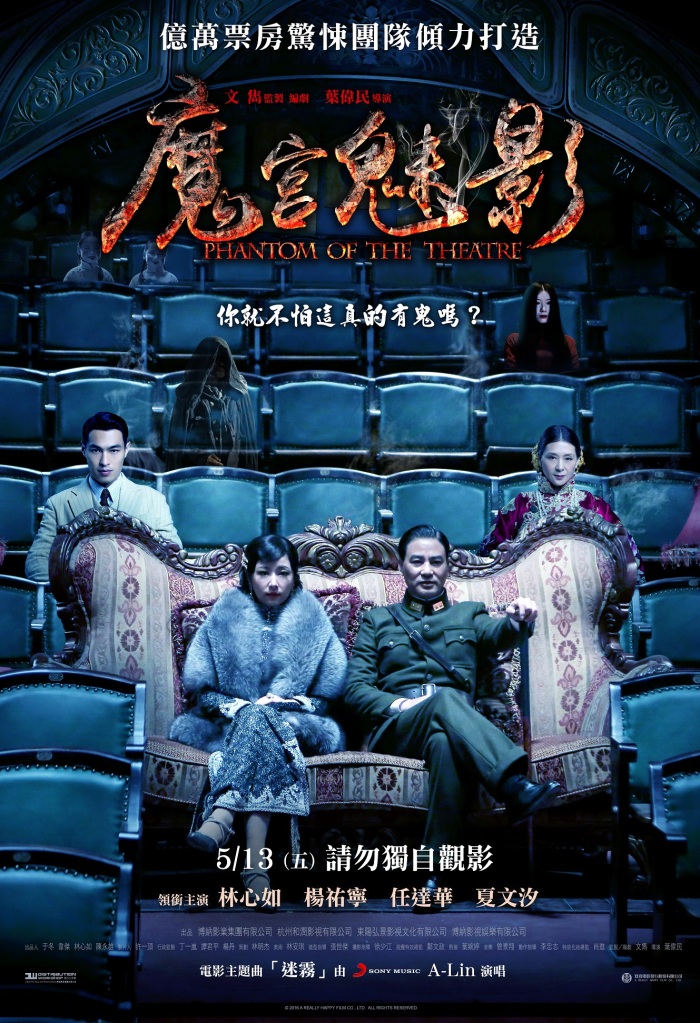 No ghosts! That’s one of the big rules when it comes to the Chinese censors, but then these “ghosts” are not quite what they seem and belong to the pre-communist era when the people were far less enlightened than they are now. One of the few directors brave enough to tackle horror in China, Raymond Yip Wai-man goes for the gothic in this Phantom of the Opera inspired tale of love and the supernatural set in bohemian ‘30s Shanghai, Phantom of the Theatre (魔宫魅影, Mó Gōng Mèi Yǐng). As expected, the thrills and chills remain mild as the ghostly threat edges closer to its true role as metaphor in a revenge tale that is in perfect keeping with the melodrama inherent in the genre, but the full force of its tragic inevitability gets lost in the miasma of awkward CGI and theatrical artifice.
 Windows on Worlds