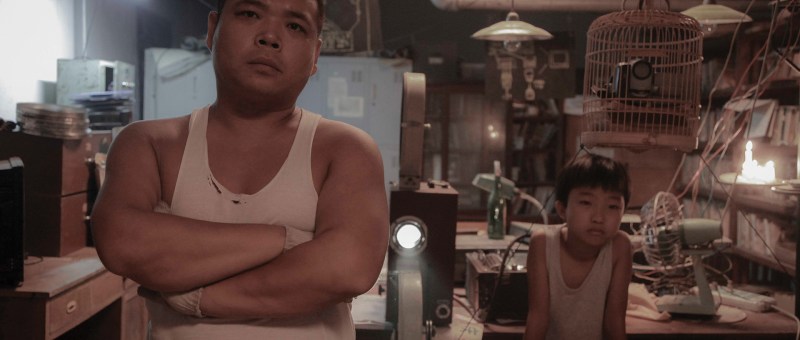
 Listen up, kids. Things were very different in the ‘90s when the internet didn’t really exist and people still queued round the block to get into giant single screen cinemas. Sam Voutas’ second film, King of Peking (京城之王, Jīngchéng Zhī Wáng), is an homage to these more innocent times taking place in a small corner of Beijing where a divorced father and his son are a charming double act of itinerant projectionists screening “Hollywood movies” for a dollar in the town square. Big Wong and Little Wong see themselves as “movie people” but their days are definitely numbered.
Big Wong (Jun Zhao) owns a Soviet era projector and a few reels of not quite recent but not yet classic movies. While Big Wong sets up a giant sheet and readies the reels, Little Wong runs round town “advertising” the event by shouting as loud as he can. The duo get a fair amount of customers but, as one loudmouth points out, this movie came out ages ago and he already has a copy on video at home – who wants to pay a dollar to watch it on a sheet in the square? This is also a question Wong’s ex-wife wants to know the answer to when she unceremoniously turns up and lays into Wong for “exploiting” their son. Wong’s wife left the boy behind claiming she couldn’t look after him but has since changed her mind. She wants an unfeasible amount of money or Little Wong. Little Wong wants to stay with his dad. Finding the money seemed a difficult prospect to begin with but when the projector catches fire and they have to give everyone their money back it seems all but impossible.
Voutas’ film is a father son drama in which the pair start off as firm friends – nicknaming each other Riggs and Murtaugh just like the Lethal Weapon heroes. Curiously enough, Lethal Weapon 4 is one of the films playing in the on screen cinema with a hand painted Chinese poster which places Rene Russo centre stage with Gibson and Glover on either side. Somewhat surprisingly, Jet Li does not feature. Sadly their father/son relationship is set to deteriorate ahead of schedule as Big Wong comes up with a plan which is intended to pay off his wife and get her to leave him and Little Wong alone. Taking note of the rude customer’s comments, Big Wong gets an idea, a set of DVD recorders, and a camcorder he can stuff into the penguin shaped bin in the cinema to rip off the latest releases, design covers, and sell them on DVD on street corners. Pretty soon, the Wongs are ruling the streets with dad’s innovative business model and son’s ruthless sales patter.
Of course, all of this is very morally dubious. Little Wong doesn’t quite like it, but is won over by his dad’s enthusiasm and, after all, aren’t they doing it because they love movies and want to share them with more people? Well, kind of, but it’s mostly for the money and Big Wong’s scheming soon works against him. Unlike his dad, Little Wong’s great love is for volcanoes, and Big Wong said he’d help him build one but he’s always too busy with the “business”. In becoming successful in his plan, Big Wong has forgotten why he started it in the first place and is too slow to see how his moral laxity is affecting the development of his son’s character.
Voutas avoids a neatly happy ending, going for something more realistic but also heartwarming in its own way as father and son end up understanding each other a little better but remain conscious of the growing distance between them. A tribute to ‘90s Chinese cinema with its oversaturated colour schemes, makeshift production budgets and essential red curtain opening, King of Peking is a warmhearted nostalgia trip filled with strange characters somehow left behind by China’s increasing modernisation such as the very young security guard at the cinema who talks about “work units” being a family and barks at his ushers as if they were a revolutionary cadre about to head off into battle. The security guard, officiously checking tickets, asks one customer for his “purpose of visit” to which he replies “for enjoyment and to forget all my poor life choices”. Big Wong has made a few poor life choices of his own and not all of them can be repaired through the magic of cinema, but as King of Peking proves the movie may soon be over but the memories last a lifetime.
Screened at the BFI London Film Festival 2017.
Original trailer (English subtitles)


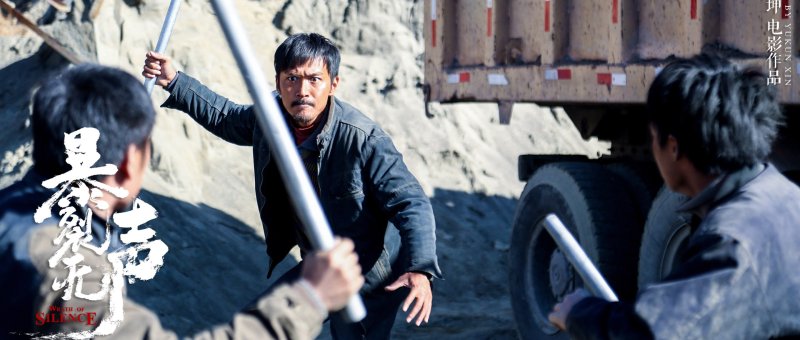
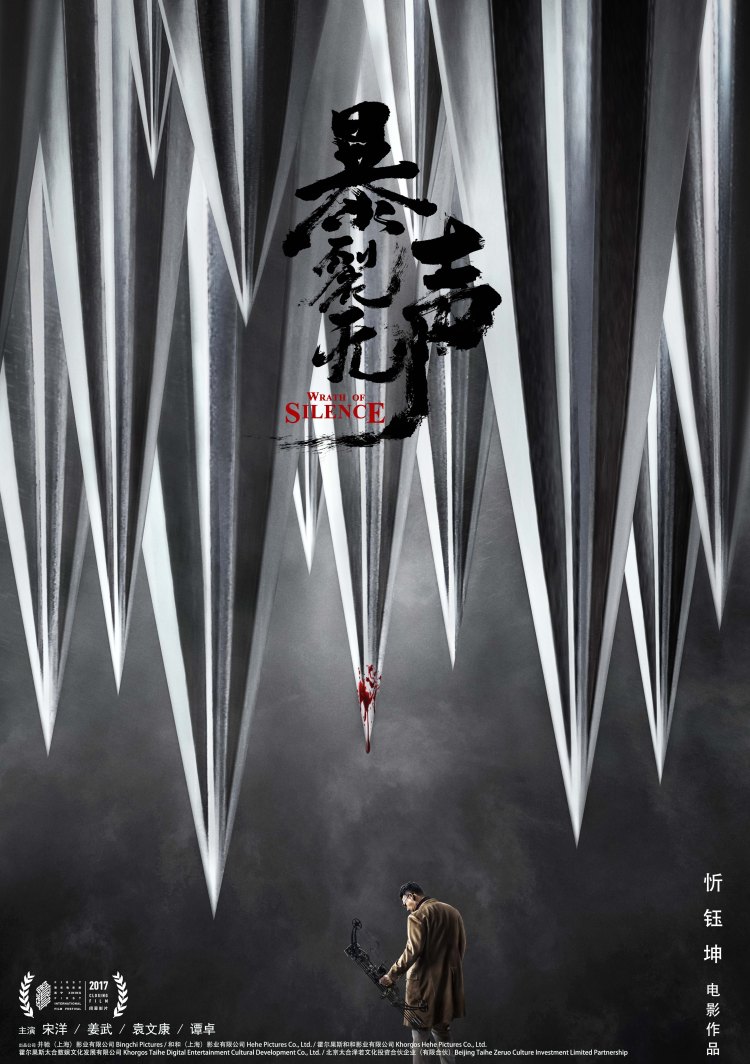





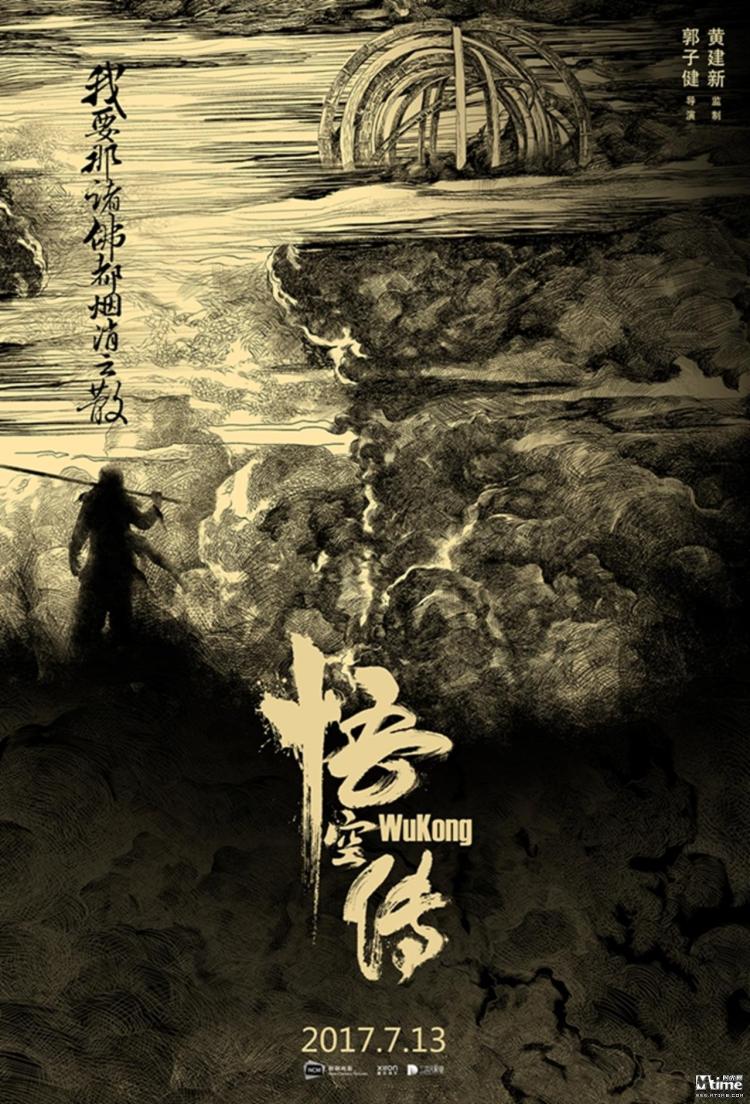 As it stands, contemporary Chinese cinema is veering dangerously close to Monkey King fatigue. Stephen Chow brought his particular sensibilities to the classic Journey to the West before Donnie Yen put on a monkey suit for
 Like the rest of the world, China, or a given generation at least, may be finding itself at something of a crossroads. The past few years have seen a flurry of coming of age dramas in which the melancholy and middle-aged revisit lost love from their youth but Derek Tsang’s Soul Mate (七月与安生, Qīyuè yǔ Anshēng) seems to be speaking to an older kind of melodrama in its examination of passionate friendship pulled apart by time, tragedy, and unspoken emotion. The story is an old one, but Tsang tells it well as its twin heroines maintain their intense, elemental connection even whilst cruelly separated.
 Feng Xiaogang, often likened to the “Chinese Spielberg”, has spent much of his career creating giant box office hits and crowd pleasing pop culture phenomenons from World Without Thieves to Cell Phone and You Are the One. Looking at his later career which includes such “patriotic” fare as Aftershock, Assembly, and
  Youth looks ahead to age with eyes full of hope and expectation, but age looks back with pity and disappointment. Adapting her father’s novel, Liu Yulin joins the recent movement of disillusionment epics coming out of China with Someone to Talk to (一句頂一萬句, Yī Jù Dǐng Yīwàn Jù). Arriving at the same time as another adaptation of a Liu Zhenyun novel, I am Not Madame Bovary, Someone to Talk to takes a less comical look at the modern Chinese marriage with all of its attendant sorrows and ironies, a necessity and yet the force which both defines and ruins lives. Communism believes love is a bourgeois distraction and the enemy of the common good (it may have a point), but each of these lonely souls craves romantic fulfilment, a soulmate with whom they might not need to talk. The desire for someone they can connect with an elemental level becomes the one thing they cannot live without.
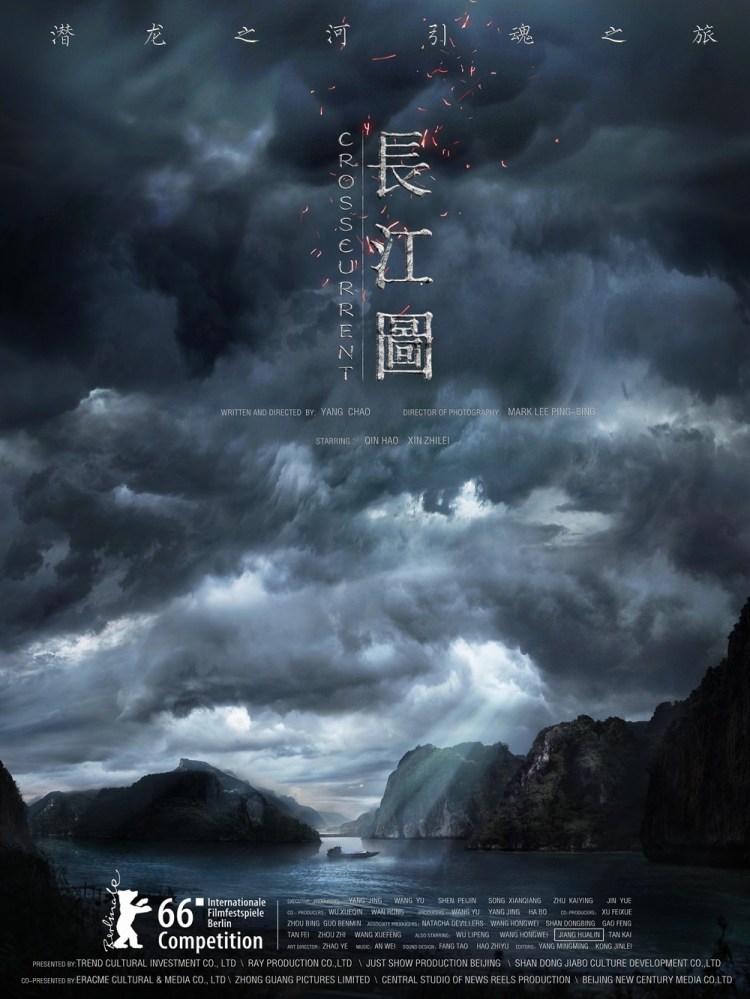 “Time, like a river, flows both day and night” as the narrator of Yang Chao’s poetical return to source Crosscurrent (長江圖, Chang Jiang Tu) tells us early on. Like the crosscurrent of the title, ship’s captain Chun sails forth yet also in retrograde as he chases a love he can never truly embrace. Truth be told, the philosophical poetry of a lonely sailor condemned to sail a predetermined course at the mercy of the winds and tides is often obscure and confused, like the half mad ramblings of one who’s spent too much time all alone at sea. Yet his melancholy passage is more metaphor than reality, or several interconnected metaphors as water yearns for shore but is pulled towards the ocean, a man yearns to free himself of his father’s spirit, and mankind yearns for the land yet disrupts and destroys it in its quest for mastery. Often frustrating in its obscurity, Crosscurrent’s breathtaking visuals are the key to unlocking its meditative sadness as they paint the beautiful landscape in its own conflicting colours.
