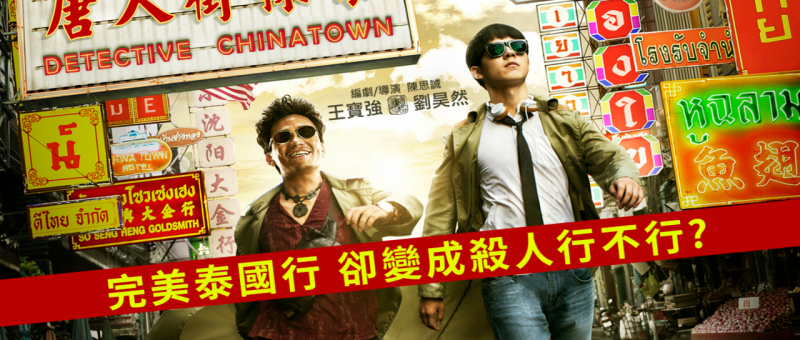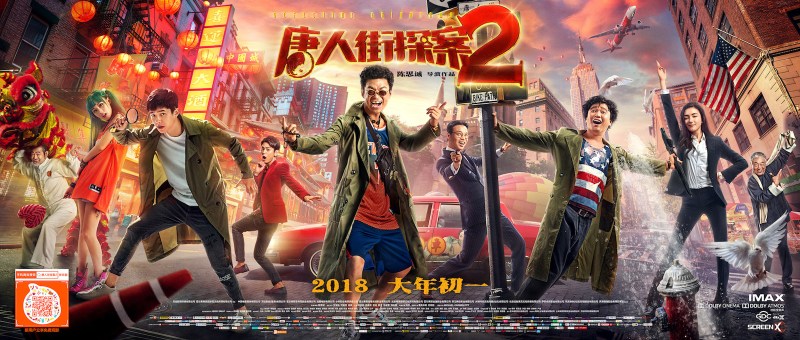
 Box office smash Detective Chinatown successfully pulled off the difficult feat of merging amusing buddy cop comedy with a holiday setting and intriguing cerebral mystery. Given the success of the first film it’s no surprise that the boys are back in town, or, as teased in the finale, in New York where another strange crime awaits their particular talents. Firmly a Chinese production taking place in an American city (though one using American crews), Detective Chinatown 2 (唐人街探案2, Tángrénjiē Tàn Àn 2) tries its best to maintain its unique character while shifting into American crime thriller territory, even if hampered by a stereotypical view of its target culture and some decidedly ropey English language dialogue.
Qin (Liu Haoran), now apparently a student at the police academy, has been tricked into coming to New York for Uncle Tang Ren’s (Wang Baoqiang) wedding to his love interest from the first film, Ah Xiang (Tong Liya). When he arrives, however, Qin quickly figures out that he’s in a room with some of the world’s best detectives – Ah Xiang left Tang Ren for someone with more money and so Tang Ren wants Qin to help him solve a mysterious New York murder for the reward promised by one of the victims’ grandfathers, a Chinatown gangster named Uncle Seven (Kenneth Tsang). Qin likes a good mystery so sticks around though the situation becomes decidedly more complicated after he finds and discounts the main suspect, Song Yi (Xiao Yang), leaving the trio on the run from the authorities, other detectives vying for the reward, and Uncle Seven’s guys some of whom have their own ulterior motives.
The most satisfying element of Detective Chinatown lay in the genuinely intricate nature of its locked room mystery and elegance of its resolution. Detective Chinatown 2 shifts away from the classical style of a European drawing room mystery for something altogether flashier and more American in keeping with its setting. It is, however, guilty of more than the faults of its genre in heavily signposting its solution from the midway point leaving any serious thriller fan twiddling their thumbs waiting for the penny to drop with ace detective Qin. Though a secondary twist offered after the killer has been unmasked helps to undercut the disappointment of such an anticlimax, it is not quite enough to compensate for the crushing obviousness of the central mystery.
Likewise, where Detective Chinatown existed firmly within a small Chinese enclave of Bangkok where everyone knew everyone, the move into the metropolis of Manhattan robs the film of its small-town charm. Despite the “Chinatown” tag, Chinatown itself is not a big player and as both of our guys are now full outsiders in another culture, we’re treated to a much less nuanced take on local stereotypes with several running gags likely to raise audience hackles with their tone-deaf approach to visualising the multicultural city. All of that aside, shooting in Central Manhattan with American crews also means much less creative freedom leaving the set pieces perhaps less impressive in terms of scale and ingenuity while the cinematography occasionally feels much more like standard American television than a big budget Chinese comedy.
Nevertheless the odd pairing of loudmouth Tang Ren and the comparatively subdued Qin, whose powers find even more impressive means of visualisation as he literally lifts buildings off a map and moves them round, remains the key selling point even though each half of the pair is also subjected to a bizarre round of sexual harassment from a biker boss with a tiny Chinaman fetish to a kung fu master with possible Alzheimer’s respectively. Though Chen generally relies on slapstick, the gags have a decidedly topical flavour – a police chief with terrible hair who makes off colour jokes and wants to build a wall to keep out all the annoying Chinese guys he can’t be bothered to deal with, for example, or the repeated references to immigration and the various dangers faced by those who’ve come from somewhere else and are trying to make a life for themselves. Yet the guys also keep running into people who unexpectedly speak Mandarin – perhaps a sign of the equally unexpected elevated status of Chinese visitors and their all important economic power. Detective Chinatown 2 is a mild disappointment after the duo’s impressive debut, but nevertheless does enough to spark interest in the teased Tokyo-set third instalment.
Currently on limited UK cinema release courtesy of Cine Asia. Screening details for UK, Germany, Australia, and New Zealand available via official website.
Original trailer (English subtitles)