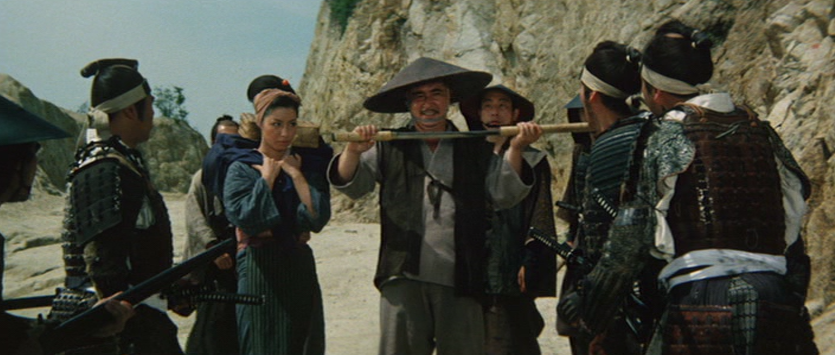
Killer’s Mission (賞金稼ぎ, Shigehiro Ozawa, 1969)

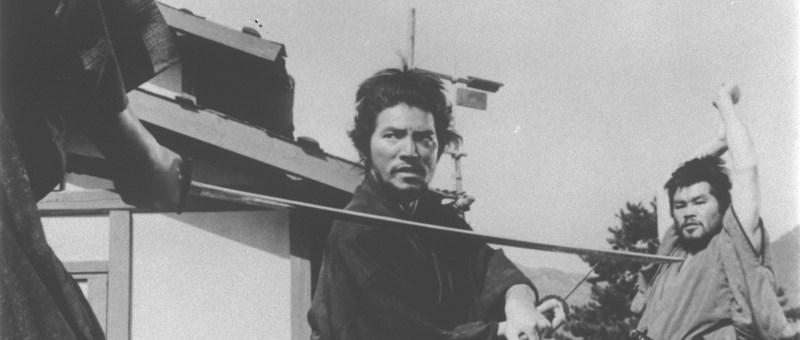
According to the title card at the beginning of Shigehiro Ozawa’s Killer’s Mission (賞金稼ぎ, Shokin Kasegi), none of the events it depicts have been recorded in history because the shogunate decided to erase them all in fear of the effect they may have on the nation’s geopolitical stability. Nevertheless, it gives some very concrete dates for its historical action, even if they may not make complete sense while foreshadowing the political turbulence of the following century. 

What it essentially attempts to do is tell a James Bond-style tale of political intrigue in a feudal Japan in which perpetual peace has begun to create its own problems. Here played in a cameo appearance from Koji Tsuruta, the Shogun Ieshige was weak in part because he was in poor health and had a speech impediment which led him to be rejected by his retainers. The problem here, however, is with Satsuma which has been on bad terms with the Tokugawa shogunate since the Battle of Sekigahara after which they took power. Satsuma will in fact be at the centre of the conspiracy to overthrow the government in the following century, but for the purposes of the film have fallen foul of a rumour that the plan to do an arms deal with some Dutch sailors who sailed South to Kyushu after being rebuffed in Edo. 

A civil war is feared and in the interests of maintaining peace, Ieshige sends his trusted spy Ichibei (Tomisaburo Wakayama) to protect Satsuma official Ijuin Ukiyo (Chiezo Kataoka) in the hope that he will be able to talk his young and naive lord out of doing the deal. Ostensibly a doctor by trade, Ichibei has a series of spy gadgets such as hidden blades and collapsible guns stored in a secret room at his surgery which he then carries in a black leather utility belt. He keeps the nature of his mission close to his chest, but often double bluffs by simply telling people he is a shogunate spy or otherwise adopting a disguise as he does in a moment of meta comedy impersonating the signature role of his brother Shintaro Katsu by posing as a Zatoichi-style blind masseur. 

As if to signal the cruelty of the feudal world, Ichibei comes across the corpses of suspected spies abandoned outside Satsuma territory while his enemies meditate on their ancient slight and consider taking the deal in the hope of avenging their defeat and overthrowing the Tokugawa. They are warned that creating unrest and sowing division may be exactly what foreign powers like the Dutch crave, but aren’t particularly bothered, preferring to take their chances with them rather than curry favour with the Shogun and possibly destabilising the entire society along with it. 

Of course, much of this is anachronistic with the Dutch sailors appearing in a distinctly 19th century fashion carrying weapons which are also too advanced for the era as are Ichibei’s folding pistols. Through his travels, he runs into a female Iga spy who too can do some nifty ninja tricks and has a gadget of her own in a comb which can shoot poison darts, though luckily it’s one of the poisons Ichibei has already developed an immunity to. Ichibei is fond of crying that you kill him he’ll simply come back to life, barrelling through the air with feats of improbable human agility and generally behaving like some kind of supernatural entity with a secondary talent for violent seduction. 

Though ironic and often darkly comic, there is an unavoidable poignancy in the inner conflict of Ijuin who knows his clan is about to do something very foolish but is torn between his duty to obey them and that to act in their best interests, eventually backed into a corner and left with no real way out of his predicament. As Ichibei points out, it’s difficult to keep the peace, especially when restless young samurai spot opportunities to cause chaos and the outside world knocks on the door of a closed community. Even so, Ozawa ends on a romantic image of a beach at sunset somehow undercutting the violence and tragedy with the restoration of an order that might itself be imperfect in its peacefulness.
Ninja’s Mark (忍びの卍, Norifumi Suzuki, 1968)

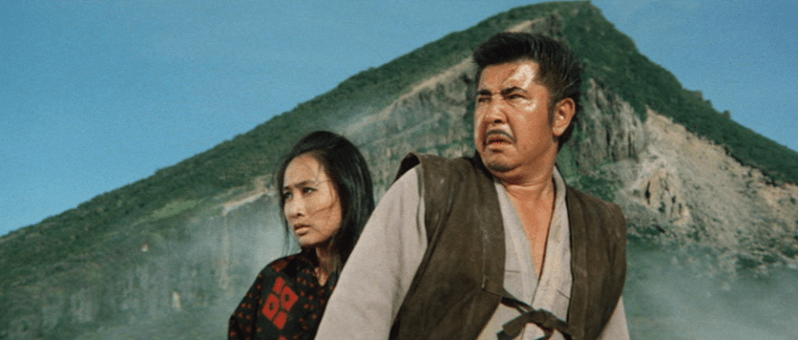
Many have tried to end the Tokugawa line. Few have done so by covering a courtesan’s legs in fish scales to put the Shogun off his stride. Based on a book by Futaro Yamada, Norifumi Suzuki’s Ninja’s Mark (忍びの卍, Shinobi no Manji) is at heart a romantic tale in which love is “part of the game” but also apparently the one trick a ninja can’t escape. Perhaps that’s why Shogun Iemitsu at the comparatively late age of 30 has failed to produce an heir with any of the beautiful yet emotionally distant courtesans of the inner palace many of whom also seem to be ninjas, therefore provoking a constitutional crisis.

Aside from that, it seems the ninja plot is a kind of revenge against the Tokugawa carried out by the last remnants of a house that was dissolved by the Toyotomi. There are in fact three ninja clans all clustering around the palace, Iga, Koga, and Negoro, each of whom have different kinds of skills. Technically, some of them are in the employ of the Shogun’s disinherited younger brother Tadanaga (Shingo Yamashiro), but others of them are working strictly for themselves and their revenge. In any case, their plan is to prevent Iemitsu from fathering an heir by putting him off sex essentially by making it freaky (in a bad way). Thus one of the ninjas uses his ability to transform objects so that the courtesan’s legs are covered in fish scales. Another plan sees a ninja body swap with one of the women so that Iemitsu’s sperm ends up inside him where it obviously has nowhere to go. Meanwhile others hatch a plan to steal some of Tadanaga’s seed to use on the women in the inner palace to cover up Iemitsu’s potential infertility seeing as it is after just as good being of the Tokugawa line. 

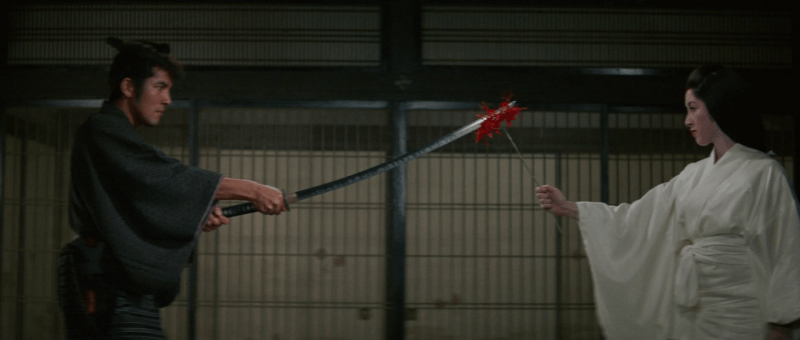
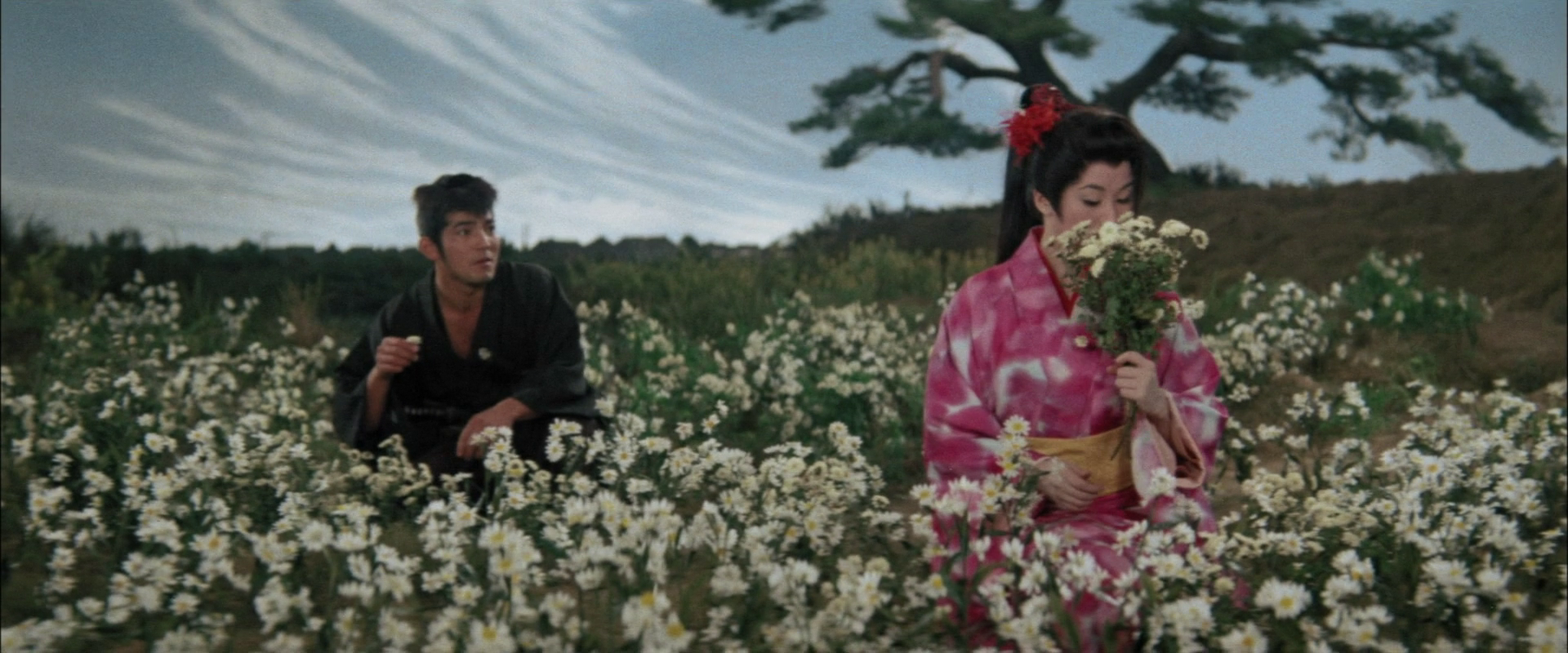
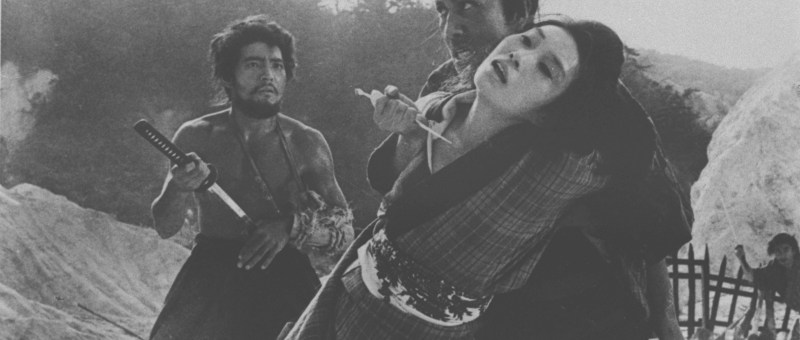
This particular ruse is suggested by Toma (Isao Natsuyagi), the disenfranchised former member of the Yagyu school turned ninja ronin they bring in to solve the problem. He quickly homes in on Kageroi (Hiroko Sakuramachi), a female ninja, as the villainess whose special power is poisoning men with love and desire by means of the spider lily plant. But as Toma points out to her, she is also a prisoner of her skill in that if she were to fall in love she would inevitably kill her lover. Of course, he survives her first attempt to kill him, leading her to fall in love with Toma and become conflicted in her mission while he plays on her emotions to escape but eventually realises they may be more genuine than he first realised. 

In this, Suzuki brings some of his trademark romanticism particularly in the colourful art nouveau aesthetics and frequent use of rose imagery. Though the film is clearly designed to lean into the erotic with frequent use of nudity and salacious scenes including a brief moment of lesbian seduction, it eventually heads towards romantic tragedy in which the debauched and nihilistic Toma and the wronged Kageroi discover a love made impossible by their ninja code and the times in which they live. Having been ordered to kill her, Toma declares that he will marry Kageroi in the next life and returns to her the Buddhist Manji that is the “ninja mark” of the title. 

Nevertheless, the dialogue is often suggestive as in Kageroi’s curse that Toma’s “sword” will rot, while it’s also Toma’s “sword” that alerts him to the danger she presents. Toma too claims to derive his ninja powers from his “sword” having apparently concentrated them by repressing his sexual desire and swearing off women. He says that he seals all his “distracting” thoughts into a virgin, closing off all her senses and placing her into a coma until he breaks the spell. Even so, he admits that without his “sword” he is just a man, and as a man claims to love Kageroi, but as long as he has his “sword”, and she her “lily”, their love is impossible. 

But this repressed love seems to pose less threat to the social order than the lack of it in Iemitsu who is bored with his courtesans and cannot conceive an heir. Constitutional crisis is averted only through a little ninja trickery and a convenient ruse to overcome Iemitsu’s infertility so that in time he produces five sons and a daughter, which honestly seems like it might just present another set of problems in about 30 years’ time. Like similarly themed ninja pictures, Suzuki makes good use of surrealist imagery and colour play alongside the kind of onscreen text later used in jitsuroku yakuza films to name each of the ninja’s key skills and which clan they belong to. What he always returns to, however, is the sense of romantic tragedy in a world seemingly poisoned by ambition in which love itself is rendered an impossibility. 


*Norifumi Suzuki’s name is actually “Noribumi” but he has become known as “Norifumi” to English-speaking audiences.

Samurai Wolf 2: Hell Cut (牙狼之介 地獄斬り, Hideo Gosha, 1967)

“We ronin must live without mercy” insists a fugitive on a quest for vengeance and riches only to meet his match in the justice-loving wanderer Kiba (Isao Natsuyagi) making his return for Samurai Wolf II: Hell Cut (牙狼之介 地獄斬り, Kiba Okaminosuke: Jigoku Giri). Like the second instalment in many series, Gosha’s avant-garde chambara largely follows the same formula picking up several familiar elements from the first film if giving them a new spin as Kiba once again finds himself caught up in intrigue provoked by the amoral venality of late Meiji society. 

In this case, he makes a rod for his own back by humiliating some swordsmen after catching them harassing a young woman, mocking them when they try to claim that their treatment of her is part of their “training”. Kiba saves the girl, Oteru (Rumiko Fuji), who has some kind of etherial quality and doesn’t quite seem to know what’s going on immediately throwing herself at Kiba who turns her down in gentlemanly fashion. Sometime later, he runs into a convoy of officials transporting criminals to the nearest judicial centre and stops to give the prisoners some of his own water explaining that that from the stream is polluted thanks to leaks from a nearby goldmine. In any case, Kiba is struck by the appearance of one of the men, Magobei (Ko Nishimura), who reminds him of the father who was killed by swordsmen he’d humiliated with his skill. 

Magobei is in chains for murdering the manager of the mine which previously belonged to the shogun but has now been shut down, its seam apparently exhausted. But like the toxins that poured into the river, the mine is a poison to society and in more ways than one. Magobei tells Kiba that he’s been set up. He was hired to kill the manager by a duplicitous gang leader named Jinroku (Bin Amatsu) who has found a new seam and has been operating the mine illegally taking all the gold for himself so obviously Magobei wants revenge. After seeing off an ambush, Kiba agrees to act as a bodyguard delivering both Magobei and the other prisoner, Kihachi (Out Yokoyama) who claims to be a big time bandit in trouble for robbing a samurai family, to the nearest city but secretly seems to sympathise with the injustice dealt to Magobei and the female prisoner who later joins them, Oren the Thistle (Yuko Kusunoki), who murdered a judge who killed her lover. 

Yet Kiba’s memories of his father cloud his judgment about Magobei who is definitely not a man worthy of his faith in him. “What good would pity do?’ Magobei asks, certain that compassion is a weakness and that if he were to give in to human feeling he would immediately be betrayed. The men misunderstand each other, assuming they are alike when in reality they are opposites. Kiba bets on Magobei’s humanity and loses, while Magobei assumes that Kiba will easily be won over by the riches to be found in the goldmine and help to wipe out Jinroku’s gang which is also a family of which Oteru is a member. “Life’s tough that’s how it is” he justifies, but Kiba cannot forgive him not least for his callous murder of a man who was only a frightened braggart and could not have harmed him and a woman who was otherwise blameless. Just as Sanai had in the first film, Magobei tells him that “one day you will be like me” a future that Kiba once again violently rejects. 

But then again he can never escape the world where goldmines pollute the rivers and money can buy anything, even the hearts of men. Just like his father, he’s pursued by the swordsmen he’s unwittingly insulted while discovering his desire to serve justice backfiring, eventually robbing him of the only thing he actually wanted just as it had at the end of the previous film. Even so, Kiba retains his sense of humanity and unlike so many jidaigeki (anti-)heroes refuses to give in to nihilism or despair. A little less avantgarde than the previous instalment, Gosha nevertheless conjures a world of dazzling violence in freeze-frame and silence while once again leaving Kiba the furious wolf to wander, a lonely figure in an unforgiving landscape.


Samurai Wolf 2: Hell Cut opens at New York’s Metrograph on Dec. 26 as part of Hideo Gosha x 3

Original trailer (English subtitles)

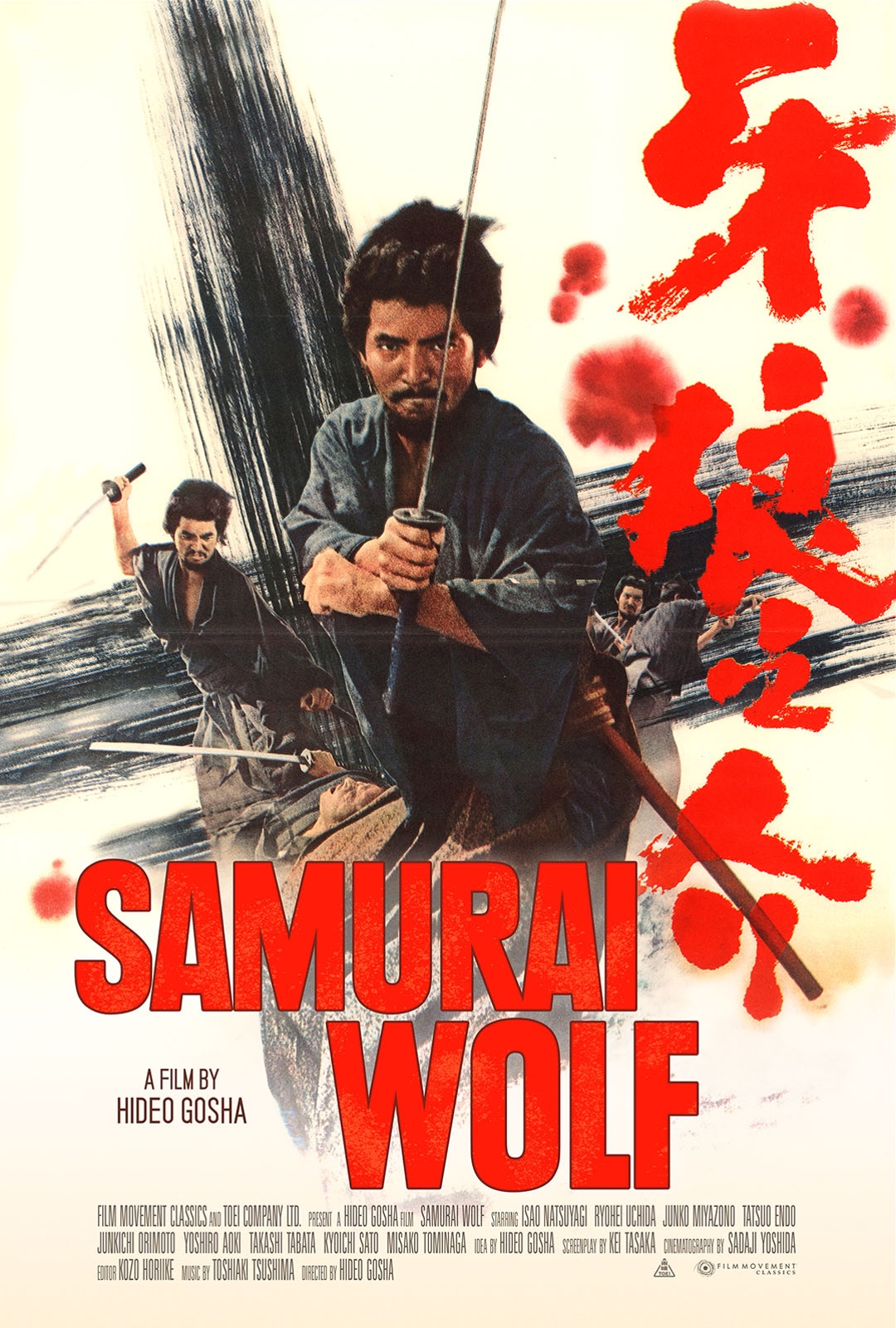
Samurai Wolf (牙狼之介, Hideo Gosha, 1966)

A cheerful ronin with strong moral fibre finds himself squaring off against a nihilistic assassin and a corrupt retainer/postmaster in Hideo Gosha’s new wave chambara Samurai Wolf (牙狼之介, Kiba Okaminosuke). Where many jidaigeki of the age would follow the antagonist Sanai (Ryohei Uchida), Gosha’s focusses on the figure of a man with wolfish appetites who is otherwise unaffected by the infinite corruption of the world around him and in that at least unwilling to submit himself to the dog-eat-dog mentality of late Edo-era society. 

Wandering samurai Kiba Okaminosuke (Isao Natsuyagi) explains that he got his name because often he bares his fangs and is known as the Furious Wolf, yet as much as the ferocity of the opening titles might bear that image out he is not cruel or avaricious but measured and honest. After wolfing down an exorbitant amount of food prepared by an old woman at a way station, he announces that he can’t pay. The old woman panics and we wonder if he might become violent or even kill her, but Kiba simply offers to pay in kind fixing the old lady’s leaky roof and chopping a supply of wood much to her surprise and gratitude. It seems, the wolf always pays his way. While there, he witnesses a trio of bandits attack a postal cart and kill the men who were pulling it. He retrieves the bodies along with a runaway horse and takes them back to the outpost they came from but the guard there is disinterested claiming that, as they died on the road and not in the town, it’s not his business. As Kiba soon discovers, the guard is in league with a corrupt lord, Nizaemon (Tatsuo Endo), who is an official messenger for the shogun but wants to take over the public postal service which is why he’s terrorising the postmistress, Chise (Hiroko Sakuramachi), with the intention of getting his hands on the relay outpost. 

There is something a little ironic in the fact that Ochise is blind while Nizaemon’s chief assassin is deaf and mute, both of them excluded from mainstream society and looking for support but finding it in opposing directions. Formerly a samurai woman, Ochise wants to hang on to the outpost because it has become her place to belong while resenting the incursion by corrupt lord Nizaemon who only wants it for the potential to control the cargo route along with raising the rates to use it to exorbitant heights. Shortly after Kiba tries to take out the assassins, a bunch of government inspectors turn up to complain about the missing merchandise while backing Chise into a corner by forcing her to accept the liability for transporting a large sum of gold coins. Kiba originally says he won’t help because he doesn’t want to risk his life for people he doesn’t even know, but of course later agrees in part on the promise of a significant return but also because he likes Chise and resents the kind of corruption men like Nizaemon represent.

On the other hand, his humanity is mirrored in his antagonist, hired gun Sanai who fetches up to help Nizaemon stop Kiba and take over the outpost. Sanai cynically tells him, that in five years’ time Kiba will be no better than he is, if he doesn’t kill him first. Kiba rejects the claim but it’s easy enough to see how someone could be corrupted by the realities of Edo-era society. Sanai later reveals that he fell in love with a samurai woman and eloped with her, a fierce taboo given the class difference between them, and later fell into his present state of nihilistic despair when she was taken from him quite literally betrayed by the social order. But Kiba seems different. He is not naive and has no expectations of human goodness yet remains cheerful and in his own way honest. When a young woman comes to him with her life savings and tells him that Sanai is the man whom she’s been waiting for to gain her revenge, he tells her to keep her money because he’s going to end up fighting him anyway. Likewise, when he realises someone he trusted has betrayed him, he tells them that he understands why they did it and bears them no ill will it’s simply the way things are only he suspects they will regret that others have died because of it. Even in his final confrontation with Sanai, he notices that his opponent is injured and ties one of his own hands to his belt to ensure it will be a fair fight. 

In any case, it seems that Sanai’s morally compromised existence is about to catch up to him with several other players intent on taking his life aside from the sex worker who longed to avenge the deaths of her family murdered during a massacre of peasants killed for standing up to a cruel landowner. A female gang leader also wants revenge for the death for her boss, while the cynical madam at the local brothel offers to team up with him to steal the gold from under Nizaemon’s nose. It seems that Sanai is a man already dead, having long abandoned the lovelorn boy he was for the nihilistic existence of a wandering assassin only to be confronted with the ghosts of the unattainable past. This world is indeed rotten, but Kiba has somehow managed to rise above it embracing his wolfish appetites in more positive ways while opposing injustice wherever he finds it. Much more avant-garde than much of his later work would be, Gosha makes great use of slow motion and silence broken only by the reverberating sound of clashing swords and hints at the meaninglessness of a life of violence in an agonisingly haunting death scene in which a bloodstained man turns and falls as if the air were suddenly leaving his body. In the end all Kiba can do is turn and walk away, on to the next crisis on the highways of a lawless society.


Samurai Wolf opens at New York’s Metrograph on Dec. 26 as part of Hideo Gosha x 3

Original trailer (English subtitles)

Actress vs. Greedy Sharks (小判鮫 お役者仁義, Tadashi Sawashima, 1966)

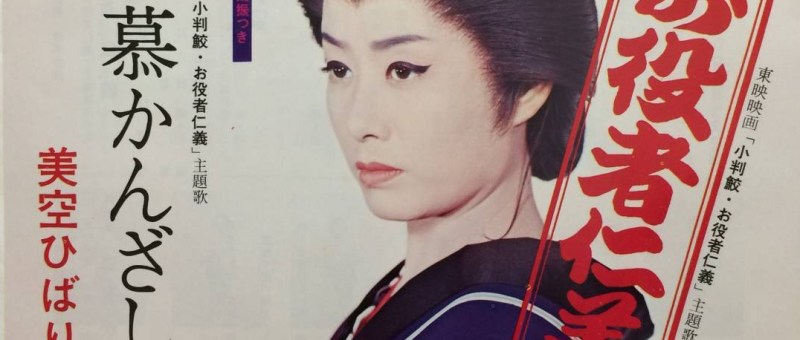
actress vs greedy sharks soundtrack albumA studio director at Toei, Tadashi Sawashima is best remembered for his work in the studio’s ninkyo eiga genre – prewar tales of noble gangsters, and samurai movies but he also made the occasional foray into the world of musical drama, teaming up with top name singing star Hibari Misora on a few of her historical action musicals. In 1966’s Actress vs. Greedy Sharks (小判鮫 お役者仁義, Kobanzame Oyakusha Jingi) Hibari once again plays a dual role though this time her casting is entirely arbitrary and the visual similarity of the legit actress and the acrobatic outlaw is never explicitly remarked upon.

The action opens with Shichi (Hibari Misora), an acrobat and member of a Robin Hood style band of outlaws (they don’t so much give to the poor as “share” with the less fortunate) interrupting the plot of Yamitaro (Yoichi Hayashi) – a nobleman in disguise to pursue revenge against corrupt lord Doi (Eitaro Shindo) who exiled his father to Convict Island when he began to raise questions about judicial corruption. Meanwhile, Yuki (also played by Hibari) is a top stage actress who is plotting against Doi for sending her father to Convict Island 20 years previously on a trumped up charge. Just as the “tomboyish” Shichi is beginning to fall for the mysterious Yamitaro, he teams up with Yuki to pursue their mutual quests for revenge which has Shichi feeling (needlessly, as it turns out) betrayed and vengeful.

Once again, the samurai order is shown to be corrupt beyond redemption. Doi, a greedy lord, is planning to sell off his only daughter, Ran (Yumiko Nogawa), as a concubine to the shogun. Meanwhile, he is also engaging in a rice profiteering scheme in order to bolster his financial resources. He is also still misusing his influence, just as he did when he had Yuki’s father sent to prison and got rid of Yamitaro’s so he couldn’t expose him.

As in her other movies, Hibari cannot allow this corruption to continue and becomes a thorn in the side of authority. However, the situation this time around is further complicated by her double casting in which she plays two visually identical characters who are, nevertheless, entirely unrelated and the resemblance between them entirely unremarked upon. The “tomboyish” Shichi, apparently falling in love for the first time much to the confusion of herself and others who regarded her lack of traditional femininity as a barrier to romance, becomes awkwardly resentful of the graceful Yuki whose charms she assumes will sway the handsome Yamitaro. Shichi does not seem to consider a class barrier between herself and Yamitaro as a problem but fears his natural affinity with a woman she perceives as superior to herself in her refinement, yet Yuki proves herself as staunch a fighter as Shichi and just as feisty. She appears to have little romantic interest in Yamitaro even if she resents Shichi’s rather blunt instructions to back off, and aside from concentrating on her revenge, spends the rest of the film dealing with the rescue of Doi’s daughter Ran who has drawn inspiration from her stage performances to rebel against her cruel fate and father.

Ran is just another symptom of her father’s corruption in his obvious disregard for her feelings as he prepares to send her off as a concubine to buy himself influence with only the mild justification that her ascendence to the imperial court is an honour even if she will never be a wife, only one of many mistresses. Unlike Ran, Yuki and Shichi have managed to seize their own agency, living more or less independently and as freely as possible within the society they inhabit. Experiencing differing kinds of bad luck and betrayal, they find themselves at odds with each other yet on parallel paths despite their obvious dualities.

With less space for song, Hibari’s dual casting does at least offer twice the fight potential as the outlaw and the actress finally find themselves on the same side to tackle the persistent injustice of Edo era society as manifested in the corrupt Doi and his slimy cronies gearing up for the mass brawl finale in which the wronged take their revenge on the wicked lord by proving him a villain in the public square and earning themselves not a little social kudos in the process. All of which makes the strangely melancholy ending exiling one aspect of Hibari to the outer reaches somewhat uncomfortable but then it does provide an excuse for another song.


Hibari’s musical numbers

The Yakuza Papers Vol. 3: Proxy War (仁義なき戦い: 代理戦争, Kinji Fukasaku, 1973)

3-Battles-Without-Honor-and-Humanity-3-Proxy-WarThree films into The Yakuza Papers or Battles Without Honour and Humanity series, Fukasaku slackens the place slightly and brings us a little more intrigue and behind the scenes machinations rather than the wholesale carnage of the first two films. In Proxy War we move on in terms of time period and region following Shozo Hirono into the ’60s where he’s still a petty yakuza, but his fortunes have improved slightly.

It’s now 1960 – almost 15 years since Hirono came home from the war. The young people who are just coming of age grew up in the turbulent post-war era but probably don’t remember much of the conflict itself. These days the problem is the ANPO treaty and the wider world’s pre-occupation with communism. Russia and America are engaged in various “proxy wars” across the world in what would come to be known as the cold war. This tactic of indirect warfare has also taken root in the yakuza world as gangs and gang members form covert alliances, hatch secret plots to take out rivals, or otherwise try to manipulate the situation to their advantage. When the head of the Muraoka crime syndicate is assassinated in broad daylight and his underling, Uchimoto, does nothing, it kickstarts a chain of petty vendettas as each of the ambitious crime bosses vie to fill the power vacuum with the snivelling Uchimoto not least among them.

Bunta Sugawara returns to centre stage again with Hirono at the forefront of the action. One of the few yakuza guys who’s pretty happy with his lot and not seeking a higher position he’s in the perfect spot to become a very important player when it comes to supporting other people’s bids for power. Having originally backed Uchimoto he’s at something of a disadvantage following Uchimoto’s cowardly flip-flopping. However, having found himself back under the aegis of former boss Yorimoto, it does afford Hirono the possibility of finally getting revenge against him. Gangs merge several times while fracturing on the inside as the lower bosses try to get their guys in line whlst picking sides as to whom they support in the leadership battles (some with more of an eye on their own futures) but this time the action is a little more cerebral than the audacious violence of the immediate post-war period.

Changing up his style slightly, Fukasaku keeps the overall documentary approach with the news reel voice over relating the salient political and historical details plus the initial captions explaining the names and allegiances of the major players but reduces the freeze frame death announcements. The action is still frenetic with ultra naturalistic handheld camera and occasional strange angles but this time he opts for a muted colour effect in the final shoot out which increases the shocking nature of the scene. Blow for blow there’s less overt violence here though there is a fairly graphic and unpleasant rape scene which feels a little out of place though it does add to Fukasaku’s argument about the nature of aggression.

Once again the ruined the dome looms large over everything, reminding us that this isn’t just a story of gang warfare but a critique of the senselessness of a violent life. As the film says, young men are the first to die when the battles begin but their deaths are never honoured. Like Hiroshima Death Match, Proxy War also leads to the death of a youngster in pointless gang violence – another young man who ended up in the criminal underworld through lack of other options. The futility of the cycle of violence is becoming wearing – as is perhaps the point. One gang boss falls, another rises – only the names have changed. There’s no rest for an honest yakuza like Hirono when the less scrupulous are willing switch allegiance without a second thought. The only victory is staying alive as long as you can.


Proxy War is available on blu-ray in the UK as part of Arrow Video’s Battles Without Honour and Humanity: The Complete Collection box set.