
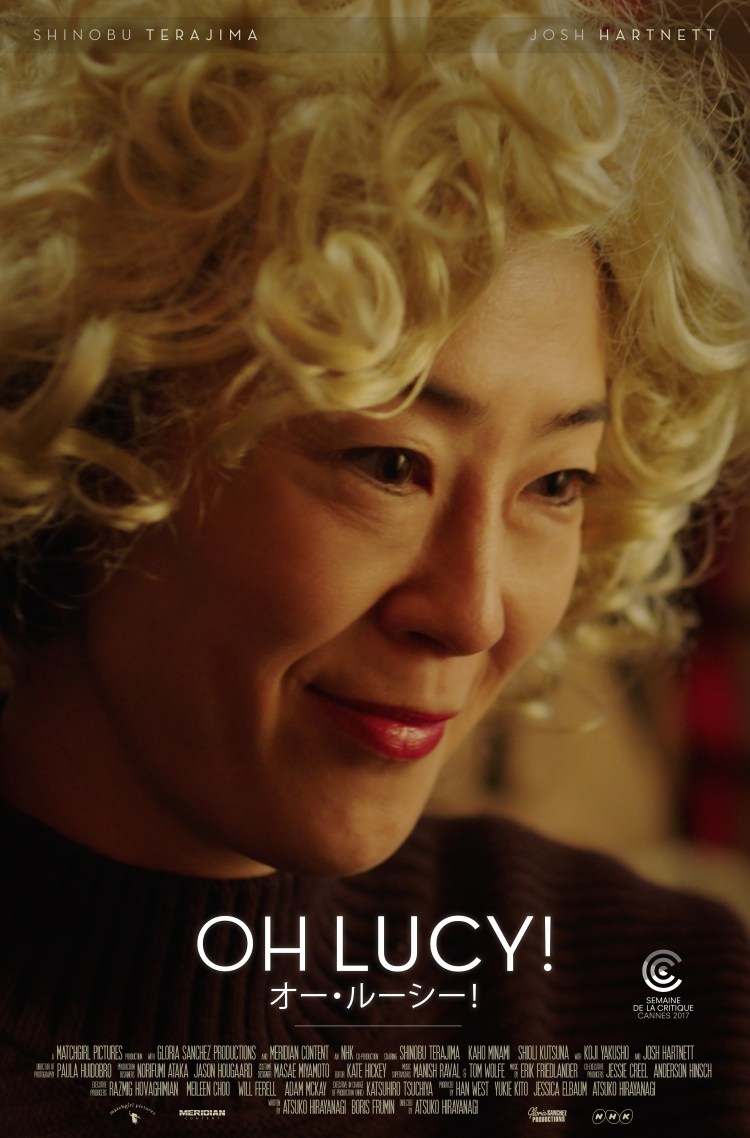
Oh Lucy! (オー・ルーシー!, Atsuko Hirayanagi, 2017)

Oh Lucy! posterDespite its rich dramatic seam, the fate of the lonely, long serving Japanese office lady approaching the end of the career she either sacrificed everything for or ended up with by default has mostly been relegated to a melancholy subplot – usually placing her as the unrequited love interest of her oblivious soon to be retiring bachelor/widower boss. Daihachi Yoshida’s Pale Moon was perhaps the best recent attempt to bring this story centre stage in its neat contrasting of the loyal employee about to be forcibly retired by her unforgiving bosses and the slightly younger woman who decides she’ll have her freedom even if she has to do something crazy to get it, but Atsuko Hirayanagi’s Oh Lucy! (オー・ルーシー!) is a more straightforward tale of living with disappointment and temporarily deluding oneself into thinking there might be an easier way out than simply facing yourself head on.

Middle-aged office lady Setsuko (Shinobu Terajima) is the office old bag. Unpopular, she keeps herself aloof from her colleagues, refusing the sweets a lovely older lady (herself somewhat unpopular but for the opposite reasons) regularly brings into the office, and bailing on after hours get togethers. Her life changes one day when the man behind her on a crowded station platform grabs Setsuko’s chest and says goodbye before hurling himself in front of the train. Such is life.

Taking some time off work she gets a call from her niece, Mika (Shioli Kutsuna) to meet her in the dodgy maid cafe in which she has been working. Mika has a proposition for her – having recently signed up for a year’s worth of non-refundable English classes, Mika would rather do something else with the money and wonders if she could “transfer” the remainder onto Setsuko. Despite her tough exterior Setsuko is something of a soft touch and agrees but is surprised to find the “English School” seems to be located in room 301 of a very specific brothel. John (Josh Hartnett), her new teacher, who has a strict English only policy, begins by giving Setsuko a large hug before issuing her a blonde wig and rechristening her “Lucy”. Through her English lesson, “Lucy” also meets another man in the same position “Tom” (Koji Yakusho) – a recently widowed, retired detective now working as a security consultant. Setsuko is quite taken with her strange new hobby, and is heartbroken to realise Mika and John are an item and they’ve both run off to America.

Setsuko’s journey takes her all the way to LA with her sister, Ayako (Kaho Minami), desperate to sort her wayward daughter out once and for all. As different as they are, Ayako and Setsuko share something of the same spikiness though Setsuko’s cruel streak is one she deeply regrets and only allows out in moments of extreme desperation whereas a prim sort of bossiness appears to be Ayako’s default. Setsuko’s Tokyo life is one of embittered repression, having been disappointed in love she keeps herself isolated, afraid of new connections and contemptuous of her colleagues with their superficial attitudes and insincere commitment to interoffice politeness. Suicide haunts her from that first train station shocker to the all too common “delays caused by an incident on the line” and the sudden impulsive decision caused by unkind words offered at the wrong moment.

“Lucy” the “relaxed” American blonde releases Setsuko’s better nature which had been only glimpsed in her softhearted agreeing to Mika’s proposal and decision to allow Ayako to share her foreign adventure. John’s hug kickstarted something of an addiction, a yearning for connection seemingly severed in Setsuko’s formative years but if “Lucy” sees John as a symbol of American freedoms – big, open, filled with possibilities, his homeland persona turns out to be a disappointment. Just like the maid’s outfit Setsuko finds in John’s wardrobe, John’s smartly bespectacled English teacher is just a persona adopted in a foreign land designed to part fools from their money. Still, Setsuko cannot let her delusion die and continues to see him as something of a saviour, enjoying her American adventure with girlish glee until it all gets a bit a nasty, desperate, and ultimately humiliating.

Having believed herself to have only two paths to the future – being “retired” like the office grandma, pitied by the younger women who swear they’ll never end up like her (much as Setsuko might have herself), or making a swift exit from a world which has no place for older single women, Setsuko thought she’d found a way out only to have all of her illusions shattered all at once. “Lucy” showed her who she really was, and it wasn’t very pretty. Still, even at this late stage Setsuko can appreciate the irony of her situation. That first hug that seemed so forced and awkward, an insincere barrier to true connection, suddenly finds its rightful destination and it looks like Setsuko’s train may finally have come in.


Screened at Raindance 2017

Expanded from Atsuko Hirayanagi’s 2014 short which starred Kaori Momoi.

Clip (English subtitles)

Latitude Zero (緯度0大作戦, Ishiro Honda, 1969)

latitude zero1969. Man lands on the moon, the cold war is in full swing, and Star Trek is cancelled prompting a mass write-in campaign from devoted sci-fi enthusiasts across America. The tide was also turning politically as the aforementioned TV series’ utopianism came to gain ground among liberal thinking people who rose up to oppose war, racial discrimination and sexism. It was in this year that Godzilla creators Ishiro Honda and Eiji Tsuburaya brought their talents to America with a very contemporary take on science fiction in Latitude Zero (緯度0大作戦, Ido Zero Daisakusen). Starring Hollywood legend Joseph Cotten, Latitude Zero gives Jules Verne a new look for the ‘60s filled with solid gold hotpants and bulletproof spray tan.
International scientists Dr. Ken Tashiro (Akira Takarada) and Dr. Jules Masson (Masumi Okada) are in the middle of a bathysphere alongside American reporter Perry Lawton (Richard Jaeckel) when a volcano suddenly erupts. Rescued by a passing sub, the team soon notice there’s something very strange about this serendipitous crew. To begin with, the doctor treating their injuries is a svelte young blonde woman in a skimpy outfit, and then there’s that plaque on the bridge which says the boat was launched in 1805, and why won’t Captain McKenzie (Joseph Cotten) tell them which country this very expensive looking rig belongs to?

All these questions will be answered in due course but the major revelation concerns the futuristic city of Latitude Zero – a secret underwater world where top scientists and other skilled people who have been “disappeared” from the surface conduct important research free of political constraints. Despite the peace and love atmosphere, Latitude Zero is not without its villains as proved by exile Malec (Cesar Romero), McKenzie’s arch nemesis who has set out to kidnap a prominent Japanese scientist before he can make his way to the city. Malec is hellbent on taking McKenzie down and has drifted over to the scientific dark side by conducting brain transplant experiments to create his own army of bizarre creatures to do his bidding.

There may be a cold war going on but Latitude Zero is more or less neutral when it comes to its position on science and scientists though when push comes to shove it leans towards negative. Malec, played by Batman’s Ceasar Romero, is a moustache twirling villain of the highest order who will even stoop to transplanting the brain of his own lieutenant into a lion as well as making other strange creatures like giant rats and weird bats to try and destroy McKenzie’s enterprises yet those enterprises are the entire reason for the existence of Latitude Zero. Towards the end of the adventure, Lawton points out to McKenzie that his world is essentially selfish, stealing all the best minds for his underwater paradise and secreting their discoveries away rather than sharing them with the the surface. McKenzie sympathises but deflects his criticism with the justification that mankind is currently too volatile and divided to take part in his project, though they do try to drip feed the essentials all in the name of making the world a better place.

Lawton further shows himself up by trying to loot Latitude Zero which has an abundant supply of diamonds it barely knows what to do with. What is does with them is experiment – jewels are worthless baubles here, the value of the diamonds is purely practical. Similarly, they have a taste for solid gold clothing which might explain the skimpiness of their outfits were it not for the fact the precious metal holds no other value than being stylish.

Unlike other subsequent US co-productions such as Fukasaku’s Virus, Latitude Zero was filmed in English with the Japanese cast providing their own English language dialogue (with various degrees of success). A second cut running fifteen minutes shorter was later prepared for the Japanese market with the entire cast dubbed back into Japanese and dropping McKenzie’s often unnecessary voice over. Given a relatively high budget, Honda and Tsuburaya once again bring their unique production design to life with intricate model shots and analogue effects complete with a selection of furry monsters even if they’re operating on a level that owes much more to Star Trek than Godzilla. It’s all very silly and extremely camp but good clean fun with a slight layer of political subversiveness which displays a noted ambivalence to the neutrality of utopia even whilst hoping for the day when the world will finally be mature enough to pursue its scientific destiny without polarised politics getting in the way.


Original trailer (English version)

Batang West Side (Lav Diaz, 2001)

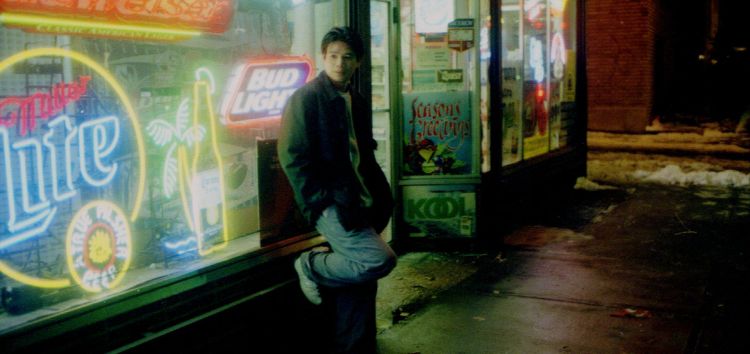
batang-west-sideLav Diaz’s auteurist break through, Batang West Side is among his more accessible efforts despite its daunting (if “concise” by later standards) five hour running time. Ostensibly moving away from the director’s beloved Philippines, this noir inflected tale apes a police procedural as New Jersey based Filipino cop Mijares (Joel Torre) investigates the murder of a young countryman but is forced to face his own darkness in the process. Diaspora, homeland and nationhood fight it out among those who’ve sought brighter futures overseas but for this collection of young Filipinos abroad all they’ve found is more of home, pursued by ghosts which can never be outrun. These young people muse on ways to save the Philippines even as they’ve seemingly abandoned it but for the central pair of lost souls at its centre, a young one and an old one, abandonment is the wound which can never be healed.

Lonely New Jersey police officier Mijares calls his ex-wife out of the blue after two years but has nothing in particular to say to her or the two children currently asleep in bed he no longer sees. His father abandoned the family when he was only seven years old leaving his mother bereft and searching, neglecting her child in her grief-like extremity. Mijares’s mother joined him in America, but has been in a vegetative state for the last few years meaning Mijares is more or less alone though surrounded by familiarity in an area dense with fellow Filipino exiles.

Called to a snow covered crime scene, Mijares discovers the body of a young Filipino boy he often saw around West Side Avenue and whose face, if not name, he knew. Hanzel Harana (Yul Servo) is just one of many young Filipinos trying to make a future away from home albeit one with a series of advantages and disadvantages which have brought him to this unhappy end. Hanzel rejoined the mother who abandoned him (also) at seven years old to provide a better life for the family by earning American wages. Now the wife of a wealthy old man to whom she is more carer than life partner, Hanzel’s mother Lolita reclaimed her oldest son in order to “save” him from the dangers of a Philippine adolescence. Nursing a broken heart, Hanzel came to the new world but brought his old habits with him. Despite a brief period of personal growth helped along by his grandfather’s sagacious council, Hanzel falls in with a bad crowd promising a glorious new Philippine future through the wonder drug, Shabu.

Mothers and motherland mingle in the imagination as Mijares is haunted by strange dreams of his broken hearted mother, desperately chasing the elusive ghost of her lost love at the expense of that of her very present son. His mother’s condition requires him to undergo frequent sessions with a strange psychologist who is primarily interested in his dream state believing that dreams are a kind of inner scream which need to be exorcised and laid to rest. Mijares dreams of his mother but also of his teeth falling out which, apparently, is code for the death of someone close but the only corpse so far is that of the young boy, Hanzel Harana, whom Mijares did not know yet felt some kind of invisible kinship with.

The two men mirror each other, one young and ruined by hope and the other older and defeated by its continuing failures. Delving deeper into Hanzel’s story Mijares finds much to echo his own as Hanzel remains preoccupied with the idea of family and restoring his long absent mother to his Philippine home. Having been brought to the States away from a life of dissipation, Hanzel struggles as a lone figure in an alien landscape, unexpectedly bonding with his paraplegic step-father but locking horns with his mother’s live in lover and fellow Filipino exile Bartolo (Arthur Acuña) – jealous, violent, and manipulative yet, perhaps, the embodiment of a certain kind of dangerous masculinity.

Hanzel is not a Bartolo and this kind of macho posturing is not in his more introspective nature. Despite professing that he doesn’t read books, Hanzel is eventually enlivened by his grandfather’s doctrine of continuing education even picking up a love for computers which could have led to a very successful career path in the rapidly developing tech world of the early 21st century but the honest way is hard and slow and Hanzel is in a hurry. Losing patience with his grandfather’s kindly ministrations and his mother’s steely rebuffing of his long held dream, Hanzel loses hope and allows himself to buy into the half-baked theories of the Avenue’s other Filipino kids with their Shabu based ideas of revolution and eventual descent into drug infused violence and confusion.

Hanzel’s grandfather has a few words of advice for the not quite young policeman. Like Hanzel the Philippines are directionless, all their heroes’ efforts have gone to waste. It’s up to the younger generation to heal it while there is still time. Yet it’s not only future of which Diaz is in search but truth found only through exposing lies. Mijares interviews the witnesses turning up differences and conflicting testimonies each time, leaving him with no concrete solution to the central mystery bar personal conviction. Mijares’ own convictions have been wavering, his “American” persona is a construct, like that of many exiles attempting to throw off past trauma with a new identity in a new land. Dreams do not lie even if they do not quite tell the truth and so Mijares’ increasingly violent visions in which Hanzel dies a thousand bloody deaths at his own hand eventually expose this long buried secret which lies at the core both of his own identity and that of his nation, still unwilling to meet his eye.

A man cannot outrun his central truths and carries his culture with him even as he claims to discard it. New identities only mask old wounds, eventually fracturing unable to bear the weight placed upon them by the expectation of place. Shooting this time in muted colour, capturing the low light neon glare of a New Jersey winter Diaz switches to black and white for his eerie dreamscape whilst presenting us with a final moment of truth and reconciliation offered via video. Bleak yet oddly hopeful, Batang West Side is a statement of intent from Diaz, a cinematic quest for essential truth, uncompromising in scope and unflinching in its gaze.


The Bacchus Lady (죽여주는 여자, E J-Yong, 2016)

bacchus-ladyRather than a Maenad in a divine frenzy driven by drunkenness, lust, and hedonistic fury, a “Bacchus Lady” is a humorous nickname used for the older women who solicit men in Korean parks by euphemistically offering to sell them a bottle of Bacchus energy drink. E J-yong reteams with veteran Korean actress Youn Yuh-jung to tell the tragic story of Youn So-young, hooker with a heart of gold and now a member of the older generation permitted to slip through the cracks in the absence of familial connections.

Youn So-young (Youn Yuh-jung) is going to have to close the shop for a few days, she has gonorrhoea thanks to a no good customer who (presumably) paid her extra for no protection. As if that weren’t bad news enough, So-young becomes a witness to a public domestic dispute as the doctor’s Filipina former lover and mother to his unacknowledged son tracks him down to his clinic. During the heated argument conducted in English the jilted lover stabs her no good former beau with a pair of scissors and is hauled off by security, instructing her young son, Min-ho, waiting downstairs, to make a run for it.

Not knowing quite why, So-young chases after the boy and ends up taking him home. With the help of her transgender landlady (An A-zu) and younger neighbour with a prosthetic leg (Yoon Kye-sang), So-young cares for the boy before trying to figure out what’s going on with his mother. So-young returns to work after her initial problems are cleared up which brings her into contact with three former clients who each have a very unusual favour to ask of her…

First and foremost, The Bacchus Lady (죽여주는 여자, Jug-yeo-ju-neun Yeo-ja) wants to ask a lot of questions about the status of the elderly in contemporary Korea. Korea has one of the highest rates of older people living in poverty among the developed nations with many forced to keep working to support themselves even as their health fails. Though many older people have extended family networks, the nature of modern society leaves them isolated as their children may have moved away or even to foreign countries and are not able, or simply not interested, in providing later life care for their relatives. Some, like So-young, are on their own. With no familial connections to rely on and only her neighbours to count as friends, she has few options and opportunities for women of her age are thin on the ground.

Speaking to a client who turned out to be a documentary filmmaker, So-young reveals that she chose prostitution out of pride – she couldn’t bring herself to take a street cleaning job and thinks this is better. In fact, her story is more complex and exposes a deep seem of historical social problems as So-young first became a prostitute at the American air base.

There are odd parallels to be found everywhere – So-young was seduced an abandoned by an American soldier just as Min-ho’s mother has been abandoned by her Korean doctor who returned home and married well, leaving her far behind. In fact, Min-ho has a picture of his happy family which is almost identical to one So-young has stashed away in a drawer (only she’s torn out the painful half of hers). Now the Koreans are making the same mistakes as the previously mentioned occupying forces, sowing their wild oats abroad and forgetting all about their foreign adventures when they come home to settle down.

Parents reject their children, and children reject their parents. When one of So-young’s former customers suffers a stroke, his son’s family come back from the States to visit him but the daughter-in-law coldly announces that they won’t visit again for another year (knowing full well he may not have that long). The grandchildren barely speak Korean and aren’t interested in hanging round the sickbed of a man they don’t quite know, grandfather or not. The son says nothing. The daughter-in-law even tries to stop So-young visiting her husband’s father assuming she’s some kind of granny gold digger (got to protect that inheritance after all). No wonder the poor man becomes the first of many asking So-young to help him to die. Loss of youth, loss of health, loss of relationships – the loneliness and the boredom alone are too much to bear, let alone pecuniary worries.

So-young is an impulsive sort of woman. When asked why she does some of the things she does, So-young replies that she doesn’t know, she must be mad. Yet there’s a kindness and a naivety belying her otherwise straightforward personality. Even if she can feel something is probably a bad idea but it might help, she feels compelled to do it anyway, eventually with disastrous consequences. So-young is a nice woman who’s been unlucky and society continues to make her pay for that. Always left feeling as if she needs to atone for an unforgivable sin, So-young lives an oddly ascetic life, taking few pleasures and giving away most of her rewards. Her story may be an extreme one, but hers is the fate of many older women who find themselves abandoned without pensions, savings, or family to help them survive.

An interesting look at life on the fringes of an affluent city, The Bacchus Lady is sad tale though one filled with compassion and good humour. E avoids outward melodrama or unwelcome sentimentality, approaching So-young’s ultimate destination with the necessary pathos. The gentle accordion based score lends the film a whimsical air which is only undercut by the abrupt tonal shift and suddenness of the coda finale, but E’s aim is a serious one. So-young is her own woman, but she also stands for a disadvantaged stratum of society who have been consistently denied the ability to fend for themselves and are suddenly expected to do so in their old age when they most need society’s help. Sympathy for Lady Bacchus? Society would do well to take note.


Reviewed at the 2016 BFI London Film Festival

Original trailer (English subtitles):

A Good Rain Knows (호우시절, Hur Jin-ho, 2009)

a-good-rain-knowsHur Jin-ho’s A Good Rain Knows (호우시절, Howoosijeol) was originally developed as a short intended to form part of the China/Korea collaborative omnibus film Chengdu, I Love You which was created as a tribute to the area following the devastating 2008 earthquake. However, Hur came to the conclusion that his tale of modern day cross cultural romance required more scope than the tripartite omnibus structure would allow and decided to go solo (Chengdu, I Love You was later released with just Fruit Chan and Cui Jian’s efforts alone). Very much Korean in terms of tone and structure, Hur uses his central love story to explore the effects time, memory, culture, and personal trauma on the lives of everyday people.
Smart suited businessman Park Dong-ha (Jung Woo-sung) has arrived in China as part of the Korean efforts to provide assistance in rebuilding after the 2008 earthquake which took thousands of lives and caused mass destruction. Met by a genial Korean ex-pat acting as his guide, Dong-ha takes in some sightseeing including a park dedicated to Tang dynasty poet Du Fu. As it turns out, an old university friend is also working at the park museum as a multilingual tour guide. There is more than a little unfinished business between Mei (Gao Yuanyuan) and Dong-ha though time has been passing all the while, throwing up obstacles every way you look to try and frustrate this serendipitous reunion.

Though the film is a collaborative effort between China and Korea, the bulk of the dialogue is spoken in English as Mei doesn’t speak Korean and Dong-ha doesn’t know any Mandarin (the pair apparently studied in the US and each returned to their home country separately, subsequently losing touch). Truth be told, the English is not always successful leaving both actors a little adrift – something which is not helped by conflicting Chinese and Korean acting styles. However, in someways this slight hesitance only adds to the restrained quality of their romance as each frequently adds tiny phrases of their own languages, becoming lost for words or trying to find exactly the right thing to say at the right moment.

The romance between Mei and Dong-ha never quite got going in their student days and seems to have taken on the status of a great lost opportunity. Time has moved on and they’re both different people. Student Dong-ha wanted to be a poet but now he’s a company man, even if a slightly conflicted, melancholy and romantic sort. Mei’s life has followed a more natural course though she too carries a deep seated sense of sadness caused by more recent personal tragedies. Both are left in a place of needing to relearn how be themselves – Dong-ha by getting back to writing and Mei by (literally) getting back on a bike but these are more natural, personal problems rather than the familial or social concerns which are the usual barriers to a successful melodrama romance.

Beautifully photographed, A Good Rain Knows takes its cues from Du Fu when it comes to the poetic, filling the screen with its vibrant green scenery. Of course, this contrasts strongly with the ruined buildings Dong-ha visits as well as the upscale hotels and restaurants, but the natural surroundings at least lend a healthy feeling of earthy wholesomeness to the proceedings. Hur has opted for a Korean orientated viewpoint, framing Chengdu as the slightly alien place it is to Dong-ha filled with bizarre foodstuffs and awkward conversations but nevertheless also an opportunity to reassess the current course of one’s life. A mature, realistic romance, A Good Rain Knows ends on a note of hopeful ambiguity – wisely avoiding the big romantic finale, Hur undercuts the inherent melodrama with wistful melancholy, the possibility of a happy ending is still in sight but there are no easy answers here, only a need for time and commitment.


Original trailer (English subtitles)

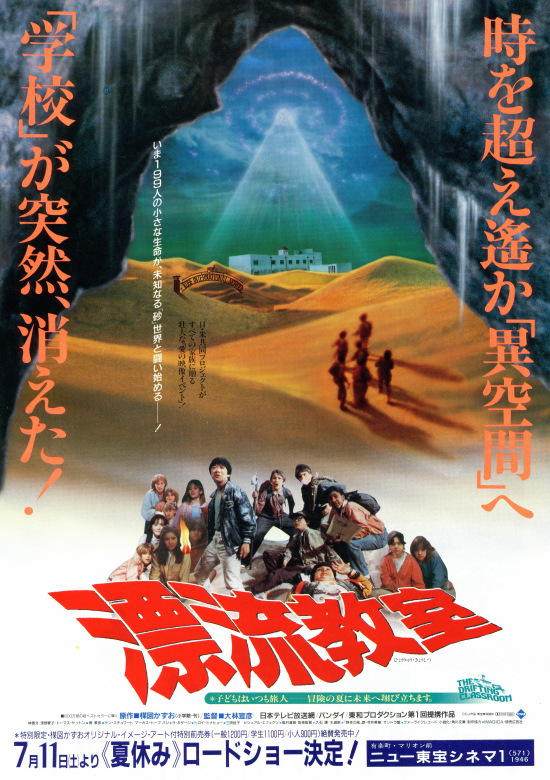
The Drifting Classroom (漂流教室, Nobuhiko Obayashi, 1987)

Drifting ClassroomNobuhiko Obayashi may have started out as an experimental filmmaker and progressed to a lengthy narrative film career but he remains best known for his “what the hell am I watching?” cult classic Hausu. Aside from his 1983 take on The Girl Who Leapt Through Time, very little of his other work has travelled outside of Japan. In the case of 1987’s The Drifting Classroom (漂流教室, Hyoryu Kyoshitsu), this is doubly surprising firstly because it’s based on a hugely popular manga by the godfather of horror comics Kazuo Umezu and secondly because it’s set in an international school so around 80% of the dialogue is in English.
Obayashi jettisons most of Umezu’s original plot which involves an ordinary Japanese school being suddenly and mysteriously uprooted from its city centre location leaving only a gaping hole to mark its place. This time our hero is Shou – a teenage boy who has recently returned from living in LA and is attending Kobe International School until his Japanese improves enough to get into a normal establishment. Having lived abroad for so long, Shou is a totally Americanised boy with a rebellious, individualistic streak and just wants to hang out with his cool American pals rather than study like his parents want him to do so he can get a foot on the all important ladder of the Japanese educational system. Consequently he argues with his mother and says some very harsh things which leads to her telling him to get out and not to bother coming back – sentiments which both are about to spend the rest of their lives regretting.

Right before taking the register some weird shit goes down and there’s an intense storm which fills most of the school building with sand. Looking out of the windows, everything seems to have become desert. The kids and the two remaining teachers think about what to do and settle on practical things like rationing the food and water left in the school canteen. Back in Kobe, there’s just a giant hole in the ground and a whole lot of confusion….

For some reason, Obayashi decided to set the story in an international school which means that most of the dialogue is in English (though judging by the accents and languages there are some Europeans and students from other parts of Asia around too). This is the single worst decision of the adaptation as the dialogue, which is overly silly to begin with, is offered in stilted, halting tones by its disappointing child actors with the native English speakers not doing very much better than the Japanese kids who are at least trying their best. Perhaps for these reasons (or just out of operational necessities) the film is entirely shot in non-sync sound and the dubbing never quite links up either.

It almost seems as if Obayashi is targeting an overseas audience as his tone is very much indebted to ‘80s kids’ movies with its cast of slightly plucky (sometimes irritatingly so) youngsters trying to solve the mystery of their own disappearance. However, it doesn’t seem as if the film was ever released outside of Japan (where it has never even been released on DVD) despite the presence of one time American star Troy Donohue leaving the strange Americanisms as a sort of exotic plot element with no real resolution.

Though the story seems to be aimed at older children with the usual themes of perseverance in times of adversity and the importance of teamwork and friendship, there are a few scary moments including a psycho style gag where a teacher’s head spins round before dissolving into sand. However, the majority of the special effects are extremely unconvincing resembling an ‘80s kids TV programme with a host of matte paintings, bad green screen, early digital effects and even some tokusatsu style people in rubber suits playing strange cockroach-like monsters. Arguably the best of these is the friendly creature who hangs round with the kids from school and most closely resembles a disgruntled potato with legs (but may actually be giving the most accomplished performance in the entire film).

All of this could have added to the film’s kitsch, “bad movie” vibe but Obabyashi opts to get serious every now and then and ruins everyone’s fun in the process. Weirdly, everyone just seems to accept the “timeslip” argument right away as if that’s a perfectly normal thing that happens every now and then like sinkholes or spontaneous human combustion – there’s even a geologist (?) being interviewed on the news who just says “yes – it is probably a timeslip” when asked to provide some “scientific commentary” on the disappearance of the school children. Completely bizarre but not in a very interesting way, The Drifting Classroom is a misfire on all levels neither making a good adaptation of its source material or an entertaining movie in its own right. Camp classics enthusiasts or Obayashi fanatics only.


The Drifting Classroom was also adapted into a TV drama in 2002 under the title of Long Love Letter which is much better than this movie.

A short scene from the film starring its best character whom I have decided to name “Spuddy” (English dialogue):

http://www.youtube.com/watch?v=g87XmnPjrNw

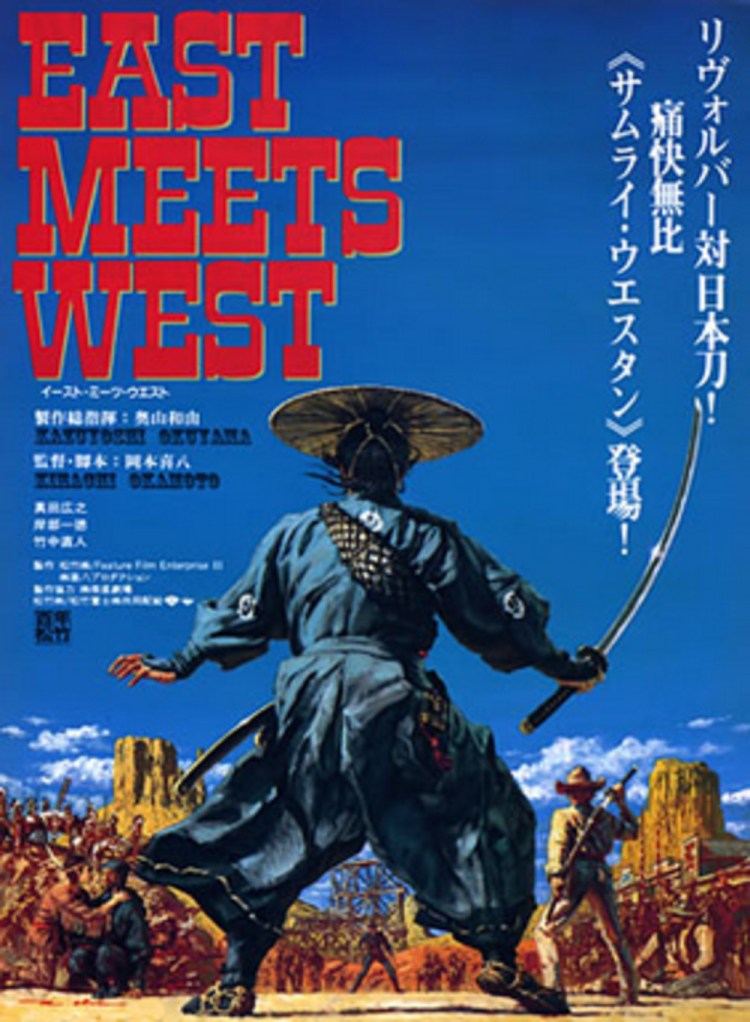
East Meets West (イースト・ミーツ・ウエスト, Kihachi Okamoto, 1995)

East_Meets_WestEast has been meeting West in the movies from time immemorial and though it’s often assumed that the traffic is only running in one direction, in reality the river runs both ways. Kihachi Okamoto was always fairly open about his love of Hollywood westerns, particularly those of John Ford, and even mixed a fair amount of wild west style action to his 1959 Manchurian war movie, Desperado Outpost. Returning to the theme almost 40 years later in East Meets West (イースト・ミーツ・ウエスト), Okamoto retains his wry, ironic eye but adopts a tone much more in keeping with the slightly silly exploitation cowboy movies of the ‘70s.

The tale begins with an American voiceover explaining the intricacies of the time period. It’s 1860 and America has been putting pressure on the recently opened Japan to agree to a trade deal. A delegation of two ships is shortly to arrive in San Fransisco which has also undergone many changes in the last few years after the influx of hopefuls during the 1848 goldrush transformed it from a peaceful fishing town to a dangerous prospector’s paradise. The situation in Japan is also turbulent and those who object to the recent foreign influences have a number of plots in motion. Once the boats leave a band of former samurai will assassinate the remaining official. The men on the boat will not hear of this until they return and the revolutionaries have also placed an assassin amongst those who will travel to America with the ultimate aim of assassinating the diplomat in charge of the delegation who was also responsible for the deaths of a number of “resistance” members in Japan.

However, everything gets derailed when a gang of bandits rob the bank just as the Japanese are about to deposit the money they’ve brought to seal the trade agreement. The group’s interpreter, Kamijo (Hiroyuki Sanada), takes advantage of his samurai training to cut down some of the bandits saving his own life but is unable to prevent them making off with the money. Taking to the road in the company of the young son of one of the bystanders who was killed, Kamijo becomes every inch the cowboy, standing apart ready to take his revenge. However, his mission is at times aided or hindered by an ace ninja working as a servant to the delegation, Tamejiro (Naoto Takenaka), who has accidentally ended up with a Native American wife.

East Meets West is a very silly film, it has very little in the way of serious intent but offers a fair amount of zany fun as its fish out of water samurai try to adapt to the ways of the Wild West. In many ways, it’s the classic cowboy movie as a bunch of strangers arrive and proceed to clean up the area which has become threatened by out of control bandit gangs. You have your mainstays like the lazy sheriff, meek vicar, and drunken doctor-cum-undertaker, the only difference is that the strangers are Japanese adventurers who fight with samurai swords and out of ideals of honour and justice rather than of survival or frontier values.

Indeed, it’s a little strange that East Meets West turned up in 1995 just a few years after Hollywood itself began to re-examine the western, re-injecting it with a little more realism and the grittiness and cruelty which filled frontier life but had been all but erased from the sanitised, romantic vision of the movie cowboy duelling pistols world. East Meets West references the classic western with its associated myths and tropes of clearly defined good guys taking down clearly defined bad guys to save the townspeople from moral and physical ruin. There are plenty of horse stunts and gunfights all offered with a kind of good natured (if sometimes black) humour that’s much more John Wayne than it is Clint Eastwood.

That said, there is a degree of cross cultural critique as the guys try to get used to their New World lives. Because English speakers have a problem with foreign names, Kamijo quickly becomes “Joe” and Tamejiro “Tommy” with Kamijo ending up with a little blond surrogate son and Tamejiro an enterprising Native American wife with whom he seems to develop quite a bond despite sharing no common language. Kamijo may have come to America with one singular mission in mind but once under the wide open skies he finds a kind of individual freedom that he hadn’t previously experienced and gradually loses his adherence to the rigid social codes of the samurai, exchanging them for the seemingly endless vistas of the ever expanding frontier.

Okamoto mines the dualities for all their worth – the chaos of the Meiji era contrasted with the organised lawlessness of the Wild West, yet East Meets West never quite transcends its western pastiche origins. With plenty of inventive and keenly observed comedy plus some nicely choreographed action scenes and excellent performances from the committed cast from both the English speaking American side and the Japanese actors, East Meets West proves an often entertaining experience but perhaps fails to offer the same level of social critique found in Okamoto’s previous work.


http://www.youtube.com/watch?v=EHpv6QA3UfU

Garm Wars: The Last Druid (Mamoru Oshii, 2014)

Snapshot-2016-03-02 at 02_43_18 PM-1532593162
Could get behind a god who looked like this.

Review of Mamoru Oshii’s latest attempt at live action filmmaking, Garm Wars: The Last Druid – First Published by UK Anime Network.


Mamoru Oshii is a giant of anime history – this is not in dispute. His work on the original Ghost in the Shell alone has made him something of a legend in the world of animation, however, his adventures in the live action realm have fared nowhere near as well. Garm Wars: The Last Druid attempts to mitigate this by blending the extremely beautiful animation techniques of Production I.G with a more conventional live action setting.

A sort of fantasy/cyber punk hybrid, Garm Wars takes place on a planet much like our own which was once cared for by a now departed god and has since descended into internecine warfare between the three remaining tribes of its original eight. We follow fighter pilot Khara who actually dies right away but is quickly “reborn” through downloading into a new clone body to become Khara 23. She links up with some kind of priest, Wydd (played by Lance Henrikson), who is travelling with a Druid (long thought to be extinct) and a holy deity, the Gula, who is (you guessed it) a basset hound. Later, this slightly less than merry band picks up the mercenary Stellig who ends up warming to Khara’s rebellious charms.

To be honest, you’ll get the most out of Garm Wars if you just ignore the entirety of the dialogue and listen to the visuals alone. Full of the most generic full on fantasy jargon, it’s extremely difficult to follow all of the different ideas and symbolic layers which attempt to construct Garm Wars’ post-apocalyptic landscape and all but those who particularly love over the top fantasy language will find themselves cringing at its lack of finesse. Oshii has been developing Garm Wars since the ‘90s and it may be the case that The Last Druid is simply one of its many chapters, just not the first, but the viewer is perpetually left feeling slightly lost with the wealth of disjointed information which is imparted mostly via straightforward exposition.

In essence, what Oshii has tried to do is to create a live action anime. It does beg the question as to why he thought this was necessary at all if he could have just made this more satisfactorily in animated form, but almost everything in the film that is not actually alive or attached to something alive is constructed through CG animation. Production I.G’s work here is often impressive even given their generally high level of quality but sits uncomfortably with the presence of the real live actors.

Oshii also opts for a highly stylised approach in which the actors are reciting their lines in a very deliberate manner. It would be easy to criticise their performances in this regard but, as all are adhering to the same style, it seems to be a deliberate choice perhaps meant to evoke a more classical, theatrical feeling. Unfortunately, this acts as another alienating technique which, along with the heavy CGI intrusion, makes it difficult to key in to either the characters or the story.

Garm Wars’ biggest weakness is that it plays like a string of video game cut scenes in which someone has inexplicably decided to skip the actual gameplay. Undoubtedly full of often beautiful and striking imagery, the central narrative never really kicks in offering a feast for the eyes but an unsatisfying smorgasbord of ideas for the mind. Garm Wars will most likely play best to longtime fans of Oshii who will be best placed to recognise his recurrent themes and the concerns which run through the entirety of his work, but for those less well versed in the director’s oeuvre, Garm Wars will most likely prove a frustrating, if intermittently entertaining, experience.


Garm Wars: The Last Druid is released on blu-ray and DVD in the UK by Manga Entertainment on 14th March 2016 and is available on DVD in the US from Arc Entertainment.

http://www.youtube.com/watch?v=LmqLB91siIo

Merry Christmas, Mr. Lawrence (戦場のメリークリスマス, Nagisa Oshima, 1983)

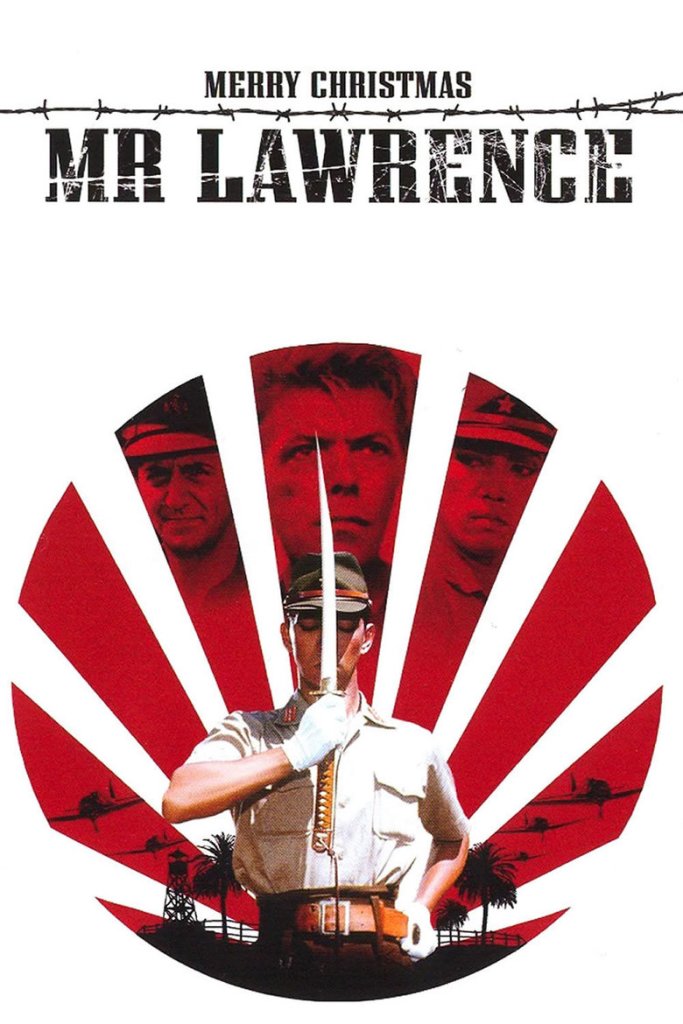
Merry-Christmas-Mr-Lawrence-images-832f3814-1564-403a-a98a-313c5bb99deOf all the post-war Japanese filmmakers, the one who liked to twist the knife the most was surely Oshima. No subject too taboo, no pain too raw – he liked to find the sore spot and poke at it a little, if only in the hope of encouraging an accelerated healing, albeit one which would leave a scar to remind you that once you suffered. With Merry Christmas, Mr. Lawrence (戦場のメリークリスマス, Senjou no Merry Christmas) he takes an unflinching look at the treatment of Japan’s prisoners of war and contrasts the Japanese forces with the different attitudes of the (mostly) British soldiers held within the walls of the camp.
Based on a semi-autobiographical novel by Laurens Van der Post, The Seed and the Sower, much of the action takes place in a prisoner of war camp run by the Japanese in Java in 1942. The titular Lawrence (Tom Conti) is one of the British prisoners here but unusually speaks fluent Japanese as he lived in Japan for a time before the war. The camp is run by Captain Yonoi (played by Ryuichi Sakamoto who also composes the music for the film) but largely ministered over by the more sadistic Sergeant Hara (played by Takeshi Kitano in an early straight acting role and billed here solely as “Takeshi”). Things kick off once Yonoi is called away to help preside over a military trial for a “difficult” prisoner who refuses to talk. However, Yonoi is somewhat taken aback by the upright soldier he discovers there. Celliers (played by David Bowie) is sentenced to death only to have the firing squad deliberately miss before he’s transferred to Yonoi’s camp.

As expected the conditions at the camp are not particularly pleasant. The first scene we’re treated to is Lawrence being called to witness an altercation where a Korean/Japanese soldier is accused of raping a Dutch internee. Hara taunts both of them with homosexual slurs and berates the Dutchman for not having resisted strongly enough. Kanemoto, the accused man, has obviously been badly beaten and is eventually ordered to commit seppuku which he eventually tries to do at that very moment by impaling himself on a bayonet. Seppuku is not something to be taken so lightly though so he’ll be patched up now for a ritual suicide later to be witnessed by the wronged parties (whether they wish to watch or not). Homosexuality, or more precisely, homosexual acts, are not to be tolerated among prisoners even if Hara later protests that samurai are not afraid of “queers” whilst insinuating that the majority of Englishman are gay anyway.

Latent homosexuality continues to be an ongoing theme throughout the film. The attraction between Yonoi and Celliers passes beyond simple admiration or even fascination. There don’t seem to be any other particular reasons for Yonoi to continue trying to protect Celliers as he does when he saves him from the firing squad and later allowing him a greater degree of freedom than other prisoners. Both men feel themselves prisoners of their respective social systems – Yonoi as the cold hearted samurai, efficient and unfeeling, yet with an intellectual core and a conflicted heart, and Celliers as a man desperately trying to atone for having once betrayed someone he deeply cared for in a misguided attempt to fit in. That said, both men are on opposite sides of a war and in any case that kind attraction stands against both of their countries’ current social customs. Again, a man is betrayed by a kiss and another man pays an extraordinarily high price leaving the other powerless to save him.

As Lawrence says there are no winners here, wars are just men doing what they thought was right at the time even if they really know that every one of them is wrong. The Japanese are rigid, repressed and anxious whereas the British are obsessed with honour in other ways and lean more towards the side of pragmatism when the going gets tough. A Japanese soldier may prefer to die, even going so far as to commit suicide, rather than subject themselves to the humiliation of having been captured alive. A British soldier will accept becoming a prisoner but largely because he believes he has a duty to live on and serve to the best of his capacity. Once captured, his duty is to try and escape to return to fight and die for King and country until the bitter end.

What both sides have in common is the dehumanisation of its troops. When it comes down to it one man is as good as another. If a radio has been smuggled into the camp someone must be punished for that action, the exact identity of the perpetrator becomes almost an irrelevance. Likewise, if a war has been lost, someone must pay for wrongful acts committed by the losing side even if his actions are no worse than those of any other soldier.

Merry Christmas, Mr. Lawrence proves a beautifully sad condemnation both of the rigidity of war, of men who think they’re acting in righteousness when the very idea is the one which causes them to act unjustly, and of repressive social systems in general. Lawrence acts as the voice of reason whilst all the while admitting that he himself is also “wrong” and forced into certain actions and modes of behaviour with which he does not necessarily agree. Both of these empires are on the verge of crumbling, all this death and cruelty will prove to have been for nothing. War is a fruitless tragedy in which there are no winners, only losers on every side. “There are times when victory is very hard to take”, victors too need to abide by their own sense of decency without being swayed by vengeance masquerading as righteousness.


Merry Christmas, Mr Lawrence is available with English subtitles on blu-ray as part of The Criterion Collection in the US (and was previously released on blu-ray in the UK from Optimum/Studiocanal but appears to be currently out of print).

(That final voice over is needlessy creepy, isn’t it?)


Yakuza Apocalypse (極道大戦争, Takashi Miike, 2015)

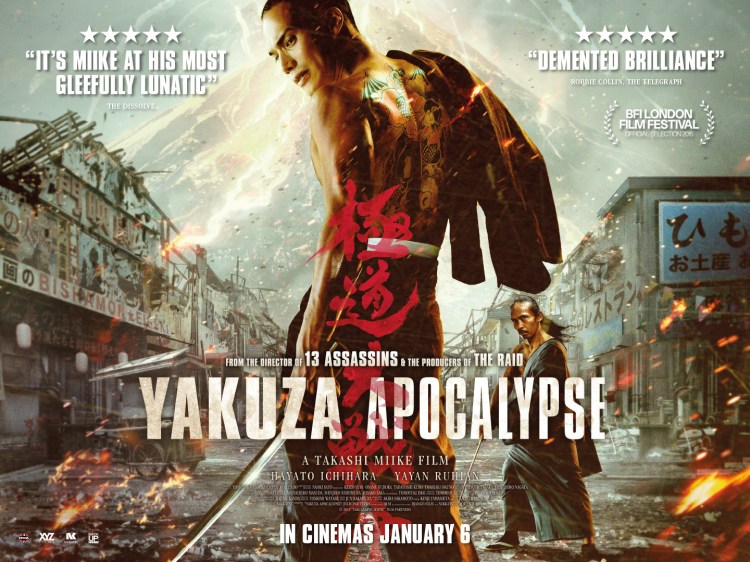
Yakuza-Apocalypse-Quad-HalfSize-NEWBelated review from the 2015 London Film Festival – Yakuza Apocalypse is released in UK cinemas for one day only on 6th January 2016 courtesy of Manga who will also be releasing on home video at a later date.


Takashi Miike shuffles back towards the yakuza plains in the western inspired horror comedy Yakuza Apocalypse (極道大戦争, Gokudo Daisenso) trailing ever more zany humour behind him. Yakuza gungslingers, bloodsucking, high school girls running away from things and, finally, a guy with a magic belly button wearing a frog suit who just happens to be “The World’s Toughest Terrorist”.

We open in media res as vampire yakuza boss Kamiura (Lily Franky) cuts up a storm in settling some local disputes. There’s a handy voice over from our soon to be protagonist, Kageyama (Hayato Ichihara), lamenting the old yakuza world of tough guys and honour codes but things don’t really take off until a very geeky looking guy and a Van Helsing type in 17th century attire suddenly turn up hoping to re-recruit the boss to “The Syndicate”. When he refuses, they fight and the geek twists Kamiura’s head right off. Using his last ounce of strength and in a touch right out of Hausu, Kamiura clamps onto Kageyama’s neck turning him into a vampire. However, in his just turned state, the honourable Kageyama turns a few more vampires of his own – and not only vampires, the bite also transmits yakuzaism too. This increase in bloodsucking gangsters is a bit of a problem for the regular guys as it does mean their pool of victims is being steadily depleted…

Not making much sense is not generally much of a problem in a Miike film. In fact, it’s a pretty much a given at this stage of the prolific director’s career. However, in the case of Yakuza Apocalypse it’s even more pointless than usual to pay any attention at all to any kind of narrative. Looking over Kageyama’s shoulder, we move from set to piece to set piece as, first of all, the non-vampire yakuza guys struggle for power between themselves and then with the vampire variety before the giant frog turns up to ruin everything.

There are some rules, Miike takes a while explaining to us how this yakuza business works with Kamiura as the “good” kind of yakuza committed to protecting his townspeople above all else – essentially, he’s the sherriff around these parts. He’s a vampire, yes, but he only feeds on yakuza who he’s “reforming” by means of an underground knitting circle held prisoner in his basement. Apparently yakuza blood tastes bad and isn’t very good for you but eating civilians is dishonourable and anyway, limited in supply, because when you turn someone they also become a foul mouthed yakuza fighting machine.

The world building is shaky at best, none of this really hangs together making for a fairly disappointing series of one note jokes. There is an attempt at a bit of more sophisticated satire with the regular gangsters suddenly lamenting that there will be no one left for them to prey on if everyone turns yakuza vampire but otherwise it’s crazy piled on crazy. Not a bad thing in itself but somewhat lacking in substance.

Despite that, the film offers some quality performances notably from its lead, Kageyama, played by Hayato Ichihara, as the yakuza who’s so sensitive his delicate skin won’t allow him to get a proper yakuza tattoo. That is, until he becomes a brooding, conflicted vampire mourning the loss of his boss and of those long held tough guy ideals. Lily Franky also offers a high impact though short lived appearance as the honourable vampire boss with a hinted at backstory, though the much publicised cameo of The Raid’s Yayan Ruhian feels a little wasted as he’s just generally hanging around for a handful of fight scenes. That said, the action scenes themselves are extremely impressive, both exciting and often funny too.

Yakuza Apocalypse is not one of Miike’s most well thought out efforts. Its collection of crazy ideas feels thrown together and there’s disappointingly little depth to its world building. Even its media res conclusion looks more like running out of ideas than a deliberate decision. However, that’s not to say it isn’t heaps of fun, which it often is. A crazy frog riding a bicycle who somehow wakes up the giant king of the crazy frog people after some kind of emergency plaster is ripped off his belly button – really, what could be more fun than that? That really is all there is though and those who prefer their absurdist action thrills with a little more substance had best look elsewhere.


Yakuza Apocalypse is in released in UK cinemas for one night only on 6th January 2016. Luckily the film is playing across the UK even if it’s only the one night and you can see if it’s on anywhere near you by checking out this handy link! If it’s not, don’t despair! It’ll also be available in all the normal ways from Manga later in the year.

Reviewed at the 2015 BFI London Film Festival.