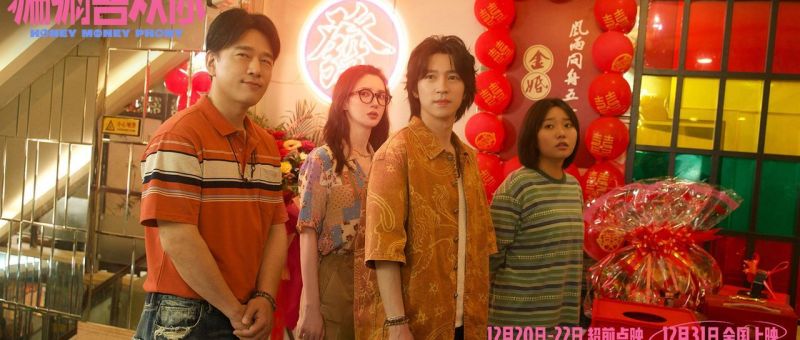

Honey Money Phony (“骗骗”喜欢你, Su Biao, 2024)

Can you really say a scammer who just takes people’s money without messing with their feelings is any better than one who just robs them? That’s a justification put forward by fraudster Ouyang (Sunny Sun) in Su Biao’s remake of Thai rom-com The Con-Heartist, but it’s a difficult one to swallow. After all, even if you just trick someone out of a small amount of cash,the psychological effects can be devastating though the pain may not be quite the same as getting your heart broken in a love scam.

Qinglang (Jin Chen) has indeed had her heart broken by the lothario Zijun (Wang Hao) whom she met at a tennis class she started going to after moving to the fictional city of Aoo Kang. Later it’s revealed that the cause of her move was getting fired from her company for reporting her boss for sexual harassment while she was also in a bit of debt from breaking a non-compete clause by getting another job, something which Zijun apparently sorted out for her. But not long after she took out a loan to give him money supposedly for his university tuition, Zijun ghosted her and she realised she’d been the victim of a romance scam. Now she’s on the hook for that too, working a series of part-time jobs in fast food restaurants and walking dogs as well as an unsuccessful gig as a vlogger in addition to her regular job in insurance. 

Experience is maybe why she suddenly thinks twice after being contacted by someone purporting to be from the vlogging site telling her she’s been suspended and needs to pay a fine. After getting Ouyang’s info from the bank she threatens to expose him but then makes a deal, if he helps her scam Zijun into giving back the money she gave him she won’t take this any further. Of course, there’s no guarantee Ouyang hasn’t just switched to a different con while Qinglang remains quite naive and despite herself trusting him. Then again, he’s the exact opposite of Zijun who took advantage of her despair and offered himself as a source of constant support. His aloofness and apparent honesty about what he is may in their way reassure her. 

There is something that might be comforting in Ouyan’s unflashiness. Though he drives a convertible, it’s not a particularly glamorous sort and has a busted taillight and in any case, he also lives in it. According to him, that’s so he can get away quickly if he needs to, but also suggests that it’s not really all about the money. Zijun, meanwhile, is greedy and materialistic, hopping from one wealthy woman to the next while hoping to join the social elite and live a high life of fast cars and wild parties. A justification for Ouyang’s scamming is given in a tragic backstory which may or may not be true suggesting that he was born out of wedlock and his mother died in childbirth. He was raised by his grandmother and uncle while his birth father entered his life at one point and tried to connect with him but it turned out it was all because his other son from a different relationship needed a bone marrow transplant. As soon as he found out Ouyang wasn’t a match, he disappeared from his life. 

The implication is that Ouyang scams as a kind of revenge because he doesn’t trust people and therefore is unable to live an ordinary, honest, life but through connecting with Qinglan and falling in love he develops the desire to live with more compassion and stability. Qinglang, meanwhile, gains confidence in herself and realises that her low self-esteem left her vulnerable to manipulation. Her friend, Xiaohui (Li Xueqin), who was also in massive debt and ended up posing as a blind person to carry out accident scams, also puts the skills she’s learned to good use to progress her acting career which might all be a very contradictory message even if there’s something satisfying about scamming a scammer and especially one as full of himself as Zijun. Released for Western New Year, the film has a zany wholesomeness despite its bleak subject matter and hints at a sense of despair in contemporary life in China but does indeed suggest that cheaters don’t necessarily need to prosper and you do have a degree of control over your life even if it’s just deciding to choose love and move on rather than wallow in a sense of futility. 


International trailer (English subtitles)

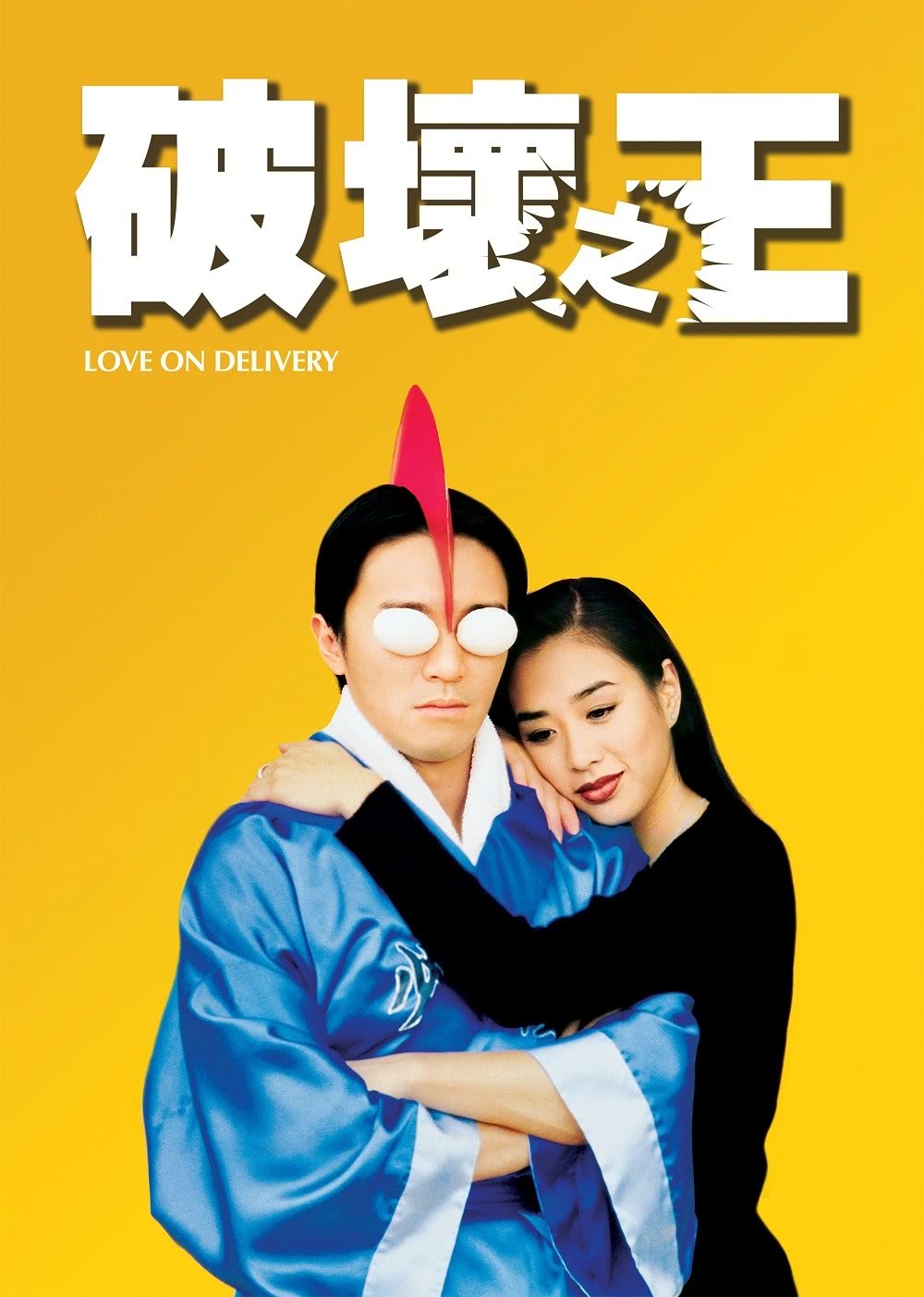
Love on Delivery (破壞之王, Stephen Chow & Lee Lik-Chi, 1994)

Love on Delivery posterBy the standards of ‘90s Hong Kong cinema, early Stephen Chow hit Love on Delivery (破壞之王) might seem refreshingly down to earth but make no mistake this under appreciated romantic comedy gem is as zany as you’d expect from the master of surrealist laugh a minute humour. A curious tale of cultural pollinations, Delivery once again stars Chow as an ineffectual loser trying to impress a girl but this time it’s a battle of wits he ends up winning when he unexpectedly finds himself standing up for “garbage” in the face of arrogant elitism.

The film opens not with its hero, but with judo champion Li (Christy Chung) who finds herself persistently sexually harassed by her slimy dojo leader who is apparently determined to win her because she’s the only woman capable of “throwing him over”. Seeing as his chat up lines are things like “my house is really big and my bed is really comfy come and see”, Li isn’t really interested which is why she ends up kissing in the right place at the right time delivery boy, He (not altogether against his will). He (Stephen Chow) is smitten, but Li has been looking for a “hero”, someone big, strong, and manly who can match her martial arts prowess but also respect her as a human being. Unfortunately, He is a weakling and a coward, as Li discovers when the boss of the dojo interrupts their first “date” and tries to thump He who activates his well honed coward skills and dodges the blow which lands squarely in the middle of Li’s face.

Fearing his romantic dreams have been well and truly shattered, He resolves to become stronger so he can fight back which is how he ends up meeting conman and stall owner “Devilish Muscle Man” (Ng Man Tat) who claims to be the last heir to “Ancient Chinese Boxing” as well as a close friend of Bruce Lee and Jackie Chan (only he doesn’t like to name drop). Devilish Muscle Man offers to “train” He in the ancient martial arts, for a “small” fee. Though all of Devilsh Muscle Man’s “training” is a sham, He starts to get quite good at it and eventually defeats the dojo boss whilst wearing a giant fluffy Garfield head. However, a new challenger soon enters the arena – a childhood friend of Li’s who went to Japan and has become an “elite” karate champion claims to be the mysterious Garfield head, stealing He’s thunder and Li’s heart along with it! 

Chow may be in a relatively restrained mood, but there are pop-culture references and in jokes galore which eventually culminate in a Hong-Kong vs Japan standoff in which Chow ends up inheriting Devilish Muscle Man’s kung fu persona which saw him fighting in a strange costume inspired by Ultraman (or possibly Chinese Ultraman rip off Inframan). Meanwhile, the big bad – Li’s ex Duan Shui Liu (Ben Lam Kwok-Bun), dresses in an old fashioned Japanese students’ uniform and rails about the “garbage” people of Hong Kong with their “garbage” kung fu which he plans to eradicate through affirming the primacy of karate as the best and only real martial art. He’s first problem is that he actually self identifies as “garbage” – he is only a poor delivery boy working for a tiny cafe which stoops to various scams to trick its customers out of their money and/or complaining and has no real prospects of being able to lift himself out of the gutter despite his new found fighting spirit and commitment to martial arts training. Nevertheless, He decides to own his “garbage” status to stand up for all the other “garbage” people resisting “Japanese imperialism” in the only way he knows how – by using his wits to trick Duan into allowing himself to be defeated.

He, a perpetually “nice guy” who gives away not only his entire wallet but all his clothes to a homeless father, eventually defeats the forces of “elitism” through an acknowledgement of his inferior fire power and an efficient use of the skills he does have to create a confusing atmosphere of chaos which ensures his final victory. A mildly subversive tale of fighting back against “the elite”, Love On Delivery is also a hilarious romantic comedy in which the nice guy gets the girl solely by demonstrating himself brave enough to face defeat with, well if not dignity, perhaps resolve.


Currently available to stream on Netflix in the UK (and possibly other territories)

Celestial Pictures trailer (Cantonese with English/Traditional Chinese subtitles)