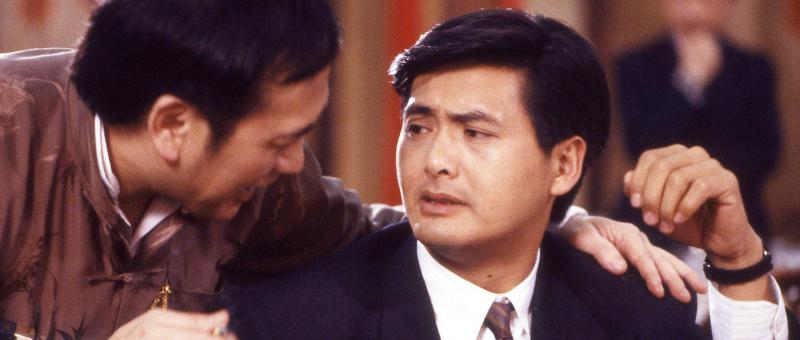
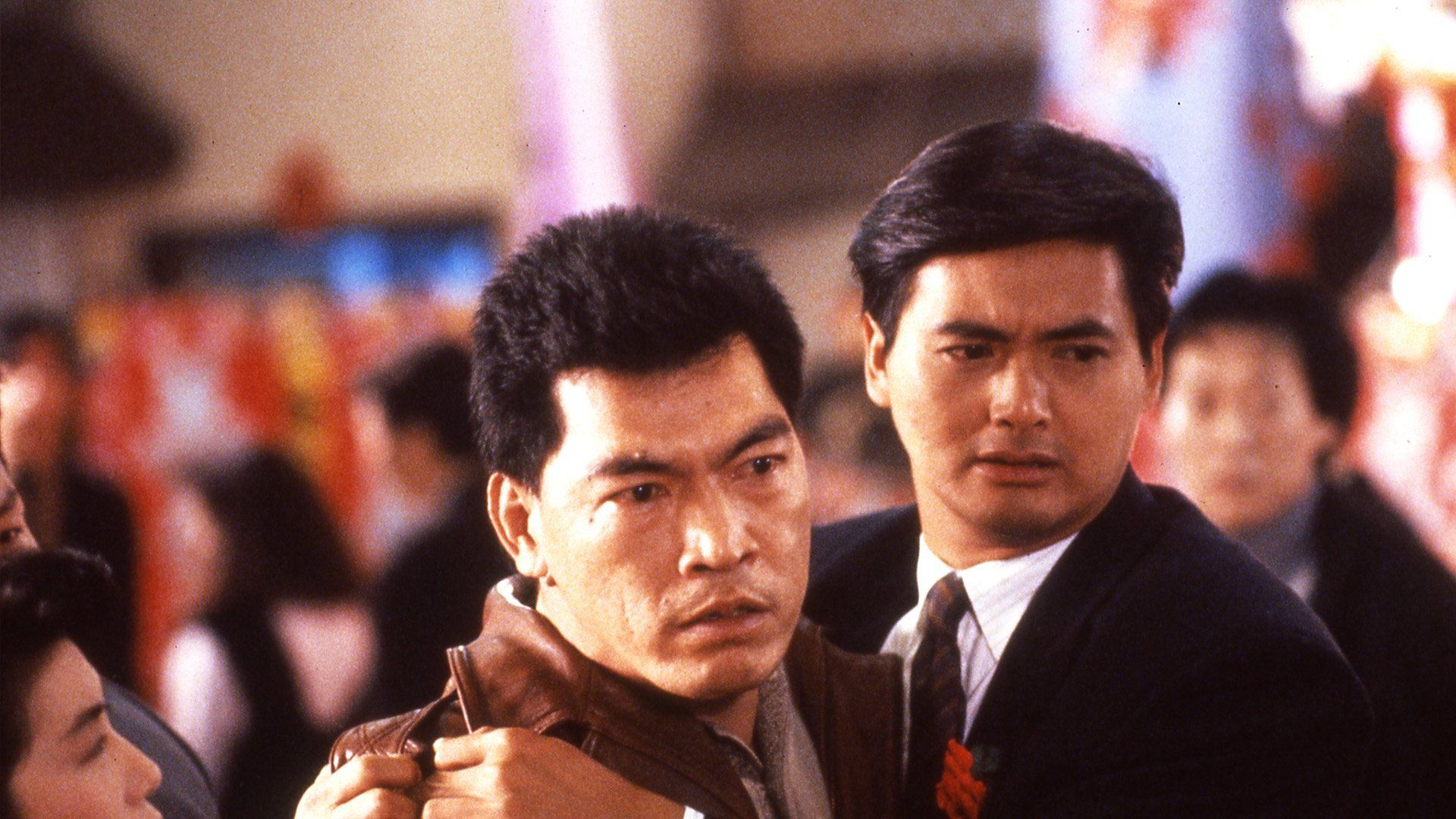
Triads: The Inside Story (我在黑社會的日子, Taylor Wong Tai-Loi, 1989)

“Brother Ho, you’re a kind leader, but not a good triad member,” a underling remarks of his rival, the biological son exiled from the world of crime now returned but struggling to accept his triad inheritance. Though Taylor Wong Tai-Loi’s Triads: The Inside Story (我在黑社會的日子) is said to have been intended to depict the life inside the triads in a more realistic way, the Chinese title, which translates as something more like “my time in organised crime,” more closely implies that this is a personal story of one man’s attempt to reconcile the two sides of himself.

Aging boss Uncle Kwan (Tien Feng) is challenged by a young upstart and killed during an ambush. With his dying breath, he instructs his right-hand men Shing (Michael Chan Wai-man) and Keung (Shing Fui-On) to tell his son, Ho (Chow Yun-fat), not to join their gang or seek revenge but to continue living his life in America. Kwan evidently sent Ho there with the intention of keeping him out of the world of organised crime, making sure he got an education and can live a nice, middle-class life. Ho indeed seems to have done quite well in the US. He has a large suburban house he lives in with his wife and young son, and has recently got into the real estate business. Nevertheless, he has a close relationship with his father even if he never approved of his triad activities.

Despite Kwan’s request, when Ho and his family return to hold the funeral, Shing and Keung press him to take over as head of the gang. Ho is understandably reluctant and insists he’ll be returning to America when all the formalities have been completed. Nevertheless, he ends up becoming somewhat involved in the gang’s business, using his corporate knowledge from America to suggest they simply sublet some of their territory to other gangs to stave off conflict and turf war, little realising that will lead to just that. Not knowing how the triad world works, he makes some catastrophic mistakes that lead to some of his father’s men being killed or injured.

In many ways Kong (Roy Cheung Yiu-Yeung), one of Kwan’s protégés, is his mirror image. Taken in by Uncle Ping (Lam Kau) and raised in triad society, he is in some ways Kwan’s natural heir but resents both still being treated as a petty foot soldier and that Ho has had all the opportunities not afforded to someone like him. Ho tells him that he’s still young, and could get a “proper job,” but Kong is illiterate and has been in triad society for most of his life. There are no other jobs he could go to, while Ho was sent abroad to study. Ho does not really belong in this society, but is respected as the biological son, while Kong, who cannot live anywhere else, is shunned and ignored.

Ho takes him to task for recruiting other young men to act as foot soldiers and scapegoats, but as Kong points out, this is how his father recruited him and triad society does at least provide a family for those who have no other. In going to America, Ho has lost touch with his culture and become somewhat exiled from his family, but also feels responsible for the empire his father built and the men who followed him. In some ways, his internal conflict may reflect a sense of anxiety that those who go abroad with the Handover looming will lose both their cultural identity and any possibility of influencing the future of the place they’ve left behind.

Yet, on the other hand, there is perhaps the idea that Ho survives abroad, while Kong sacrifices himself to save him in recognition of the fact that Ho has tried to do the same. In torching the Taoist altar along with his father’s photo, Ho sets fire to triad society itself along with the world his father left behind, asking for his father’s forgiveness while leaving to return to his new life in America without looking back. One of the first films to be awarded a Cat III certificate for its depiction of triad ritual which upset the colonial authorities, the film plays out more like a yakuza drama of fragmented paternal legacy and compromised brotherhood while exposing the inherent corruption of a gangster society before reaching a sense of catharsis as Ho prepares to burn it all down.


Trailer (Traditional Chinese / English subtitles)

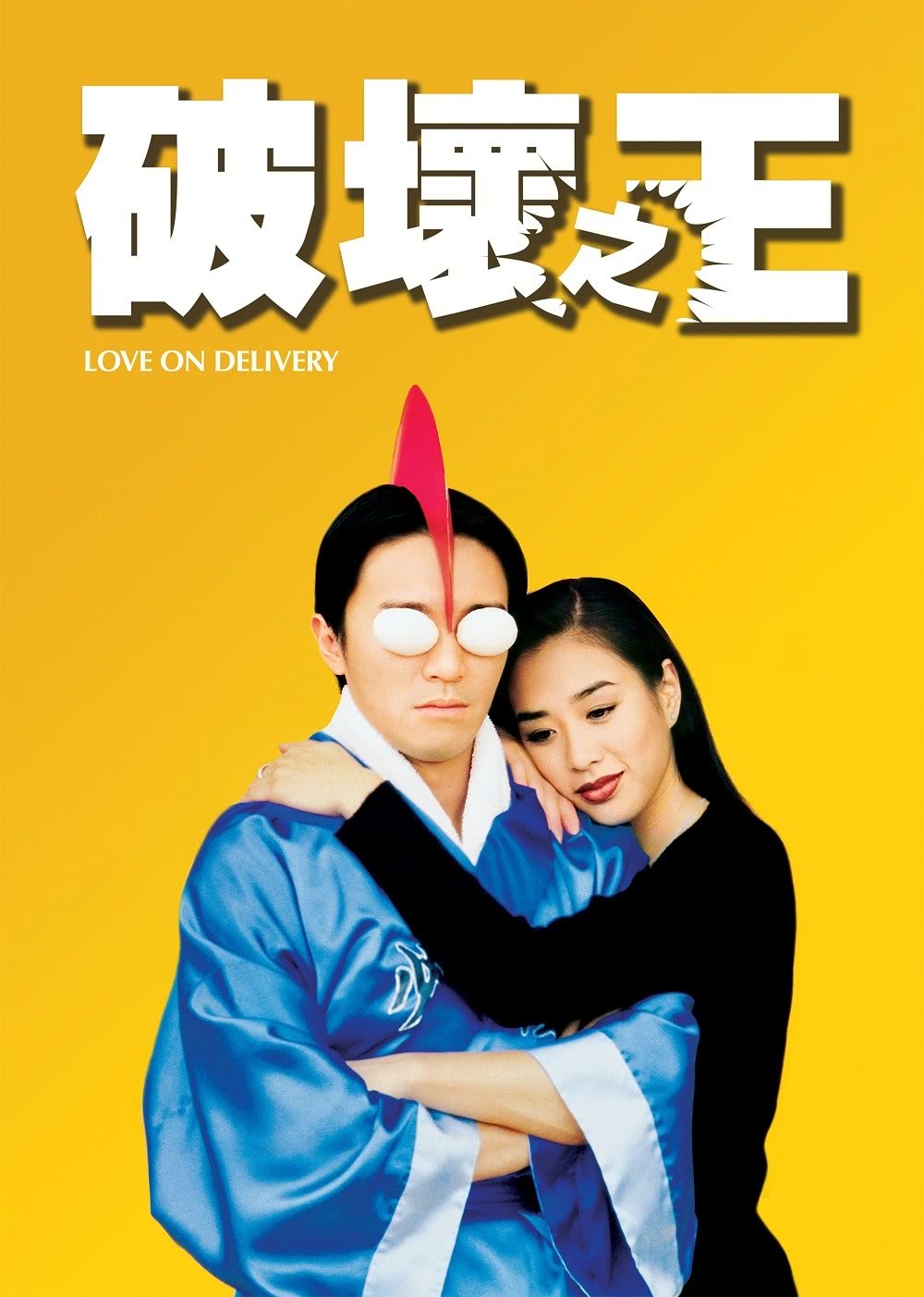
Love on Delivery (破壞之王, Stephen Chow & Lee Lik-Chi, 1994)

Love on Delivery posterBy the standards of ‘90s Hong Kong cinema, early Stephen Chow hit Love on Delivery (破壞之王) might seem refreshingly down to earth but make no mistake this under appreciated romantic comedy gem is as zany as you’d expect from the master of surrealist laugh a minute humour. A curious tale of cultural pollinations, Delivery once again stars Chow as an ineffectual loser trying to impress a girl but this time it’s a battle of wits he ends up winning when he unexpectedly finds himself standing up for “garbage” in the face of arrogant elitism.

The film opens not with its hero, but with judo champion Li (Christy Chung) who finds herself persistently sexually harassed by her slimy dojo leader who is apparently determined to win her because she’s the only woman capable of “throwing him over”. Seeing as his chat up lines are things like “my house is really big and my bed is really comfy come and see”, Li isn’t really interested which is why she ends up kissing in the right place at the right time delivery boy, He (not altogether against his will). He (Stephen Chow) is smitten, but Li has been looking for a “hero”, someone big, strong, and manly who can match her martial arts prowess but also respect her as a human being. Unfortunately, He is a weakling and a coward, as Li discovers when the boss of the dojo interrupts their first “date” and tries to thump He who activates his well honed coward skills and dodges the blow which lands squarely in the middle of Li’s face.

Fearing his romantic dreams have been well and truly shattered, He resolves to become stronger so he can fight back which is how he ends up meeting conman and stall owner “Devilish Muscle Man” (Ng Man Tat) who claims to be the last heir to “Ancient Chinese Boxing” as well as a close friend of Bruce Lee and Jackie Chan (only he doesn’t like to name drop). Devilish Muscle Man offers to “train” He in the ancient martial arts, for a “small” fee. Though all of Devilsh Muscle Man’s “training” is a sham, He starts to get quite good at it and eventually defeats the dojo boss whilst wearing a giant fluffy Garfield head. However, a new challenger soon enters the arena – a childhood friend of Li’s who went to Japan and has become an “elite” karate champion claims to be the mysterious Garfield head, stealing He’s thunder and Li’s heart along with it! 

Chow may be in a relatively restrained mood, but there are pop-culture references and in jokes galore which eventually culminate in a Hong-Kong vs Japan standoff in which Chow ends up inheriting Devilish Muscle Man’s kung fu persona which saw him fighting in a strange costume inspired by Ultraman (or possibly Chinese Ultraman rip off Inframan). Meanwhile, the big bad – Li’s ex Duan Shui Liu (Ben Lam Kwok-Bun), dresses in an old fashioned Japanese students’ uniform and rails about the “garbage” people of Hong Kong with their “garbage” kung fu which he plans to eradicate through affirming the primacy of karate as the best and only real martial art. He’s first problem is that he actually self identifies as “garbage” – he is only a poor delivery boy working for a tiny cafe which stoops to various scams to trick its customers out of their money and/or complaining and has no real prospects of being able to lift himself out of the gutter despite his new found fighting spirit and commitment to martial arts training. Nevertheless, He decides to own his “garbage” status to stand up for all the other “garbage” people resisting “Japanese imperialism” in the only way he knows how – by using his wits to trick Duan into allowing himself to be defeated.

He, a perpetually “nice guy” who gives away not only his entire wallet but all his clothes to a homeless father, eventually defeats the forces of “elitism” through an acknowledgement of his inferior fire power and an efficient use of the skills he does have to create a confusing atmosphere of chaos which ensures his final victory. A mildly subversive tale of fighting back against “the elite”, Love On Delivery is also a hilarious romantic comedy in which the nice guy gets the girl solely by demonstrating himself brave enough to face defeat with, well if not dignity, perhaps resolve.


Currently available to stream on Netflix in the UK (and possibly other territories)

Celestial Pictures trailer (Cantonese with English/Traditional Chinese subtitles)