Magic Cop (驅魔警察, Stephen Tung Wai, 1990)

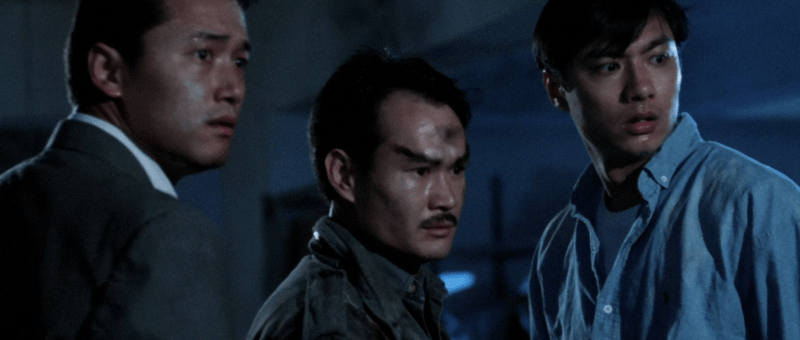
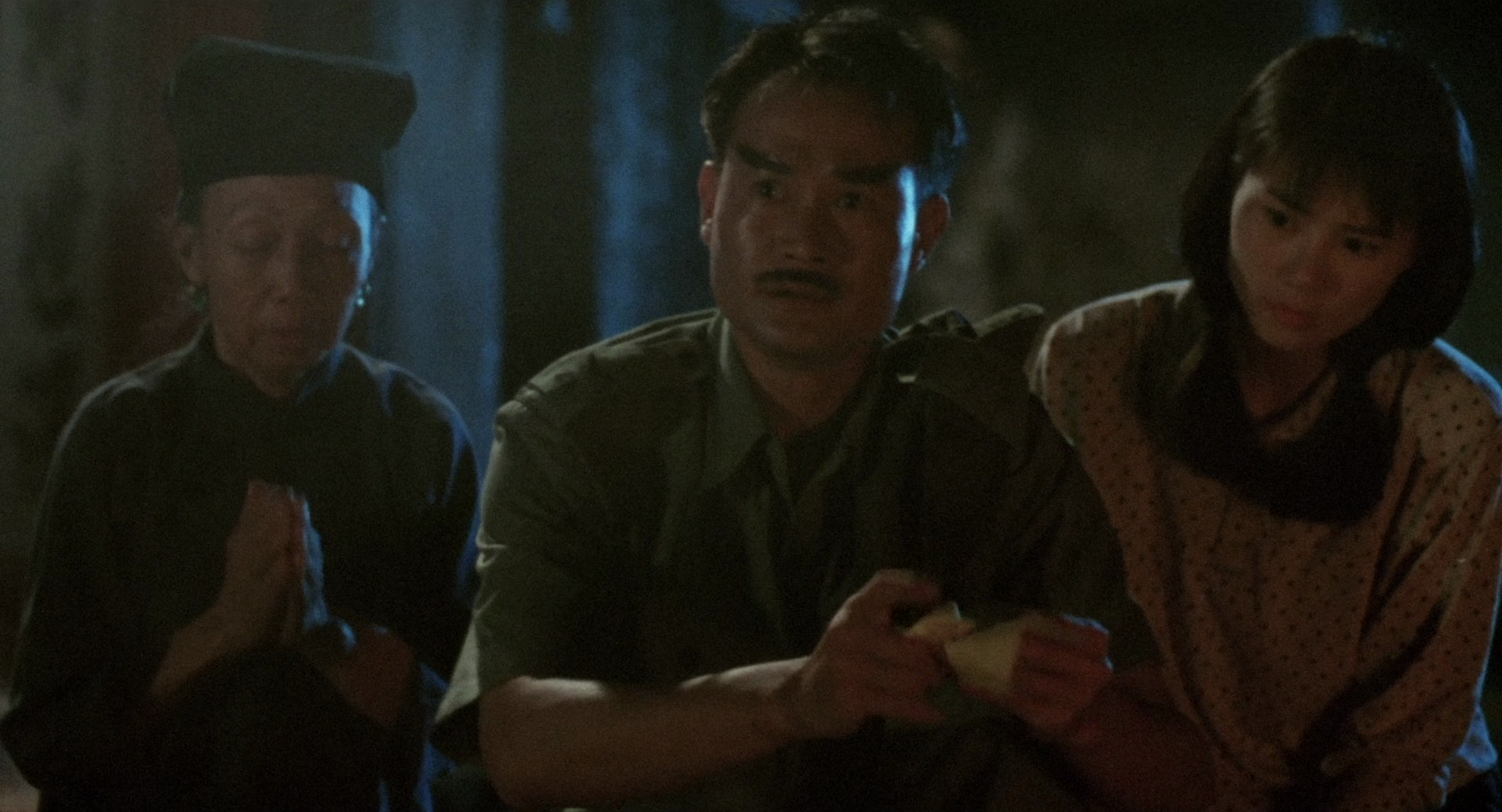
“Everything must be based on science,” a rather flippant young policeman insists when faced with the unusual investigative methods employed by Uncle Feng, rural cop skilled in Taoist magic. Though sometimes billed as Mr Vampire 5 and starring Lam Ching-Ying, Magic Cop (驅魔警察) in fact features no vampires but instead revolves around a demonic Japanese sect’s attempts to use Taoist zombies to traffic drugs. Uncle Feng is on the case after agreeing to travel into the city to identify the deceased granddaughter of a neighbour.

Much of the film is indeed about the contrast between rural Tung Ping Chau and the contemporary city. Slick policeman Lam (Wilson Lam) is not exactly thrilled to be saddled with Feng (Lam Ching-ying) as a parter, nor is he that keen on hosting him in his apartment. As he shows off to Feng, Lam’s place has a fancy electronic keypad rather than a key and is decorated in aggressively modern style. It has an unusual open-plan layout in which the toilet is housed in a pretend phonebox while the bath is in the middle of the room. As a modern policeman, Lam believes in things like forensics and harps on about the primacy of science. He doesn’t believe in the kind of Taoism that Feng represents and insists there must be a rational explanation for the fact the dead woman apparently died about a week before becoming the subject of Lam’s investigation. 

Even in the city, however, this kind of magic exists in this case wielded by a Japanese sorceress (Michiko Nishiwaki) running a demonic sect. She appears to be a good match for Feng, and otherwise uses a series of ninja techniques while trying to foil his investigation. In using zombies as drug mules, she has after all subverted the Taoist rituals to which Feng ascribes. His old partner on the force, Ma (Wu Ma), suggests that it was his superstitious nature that put paid to his career as an urban policeman. Though adept at solving crimes and catching wrongdoers he gained the reputation for being a “tornado”, creating chaos whoever he went. Lam too is put off by his chaotic nature and is slow to believe that Feng could be right about the black magic and zombies. He describes his investigative techniques as old-fashioned and resents the fact that he disobeys orders. Feng largely ignores him and his assistant Sergeant 2273 (Michael Miu) and acts impulsively, often using Sergeant 2273 as a vessel for his Taoist techniques. 

Nevertheless, Lam is slowly made to come around, admitting that Feng is a good policeman. Despite insisting Feng has no mind for science, Lam concedes that there is no science in this case and it cannot be solved scientifically. He is powerless to solve it alone and must reply on Feng’s Taoist knowledge. Though Sergeant 2273 much more readily accepts Feng as his superior and goes along with his suggestion that the case has a supernatural dimension, Feng favours Lam, while the two police officers bicker over their attempts to date Feng’s niece Arlene (Wong Mei-way) who is excited to be in the modern city having come from the rural backwater Tung Ping Chau.

Though juxtaposed with a British flag in Lam’s flat, Feng is in essence returning something of old Hong Kong to the island which is beginning to lose its identity amid its transformation into a financial centre and capitalist hotspot. That the villain is a Japanese woman heading a demonic sect of corrupted Chinese teachings also hints at a fear of cultural dominance and the threat external organisations pose to Hong Kong through capitalistic colonisation. Thus Feng must marshal all his skills to the defeat the demonic sect even while plunged into a more literal hell surrounded by flames. Only then is the city a safe space he can allow Arlene to explore alone while he returns to Tung Ping Chau in the company of his new disciple Sergeant 2273 making the same journey in reverse. Though filled with zany humour, the film never belittles the Taoism at its centre nor makes fun of Feng for his atypical policing methods so much as suggesting that the modern man Lam must open his mind to a world beyond reason and reintegrate these aspects of traditional culture that are in danger of erasure in a rapidly modernising city.


Original trailer (English subtitles)

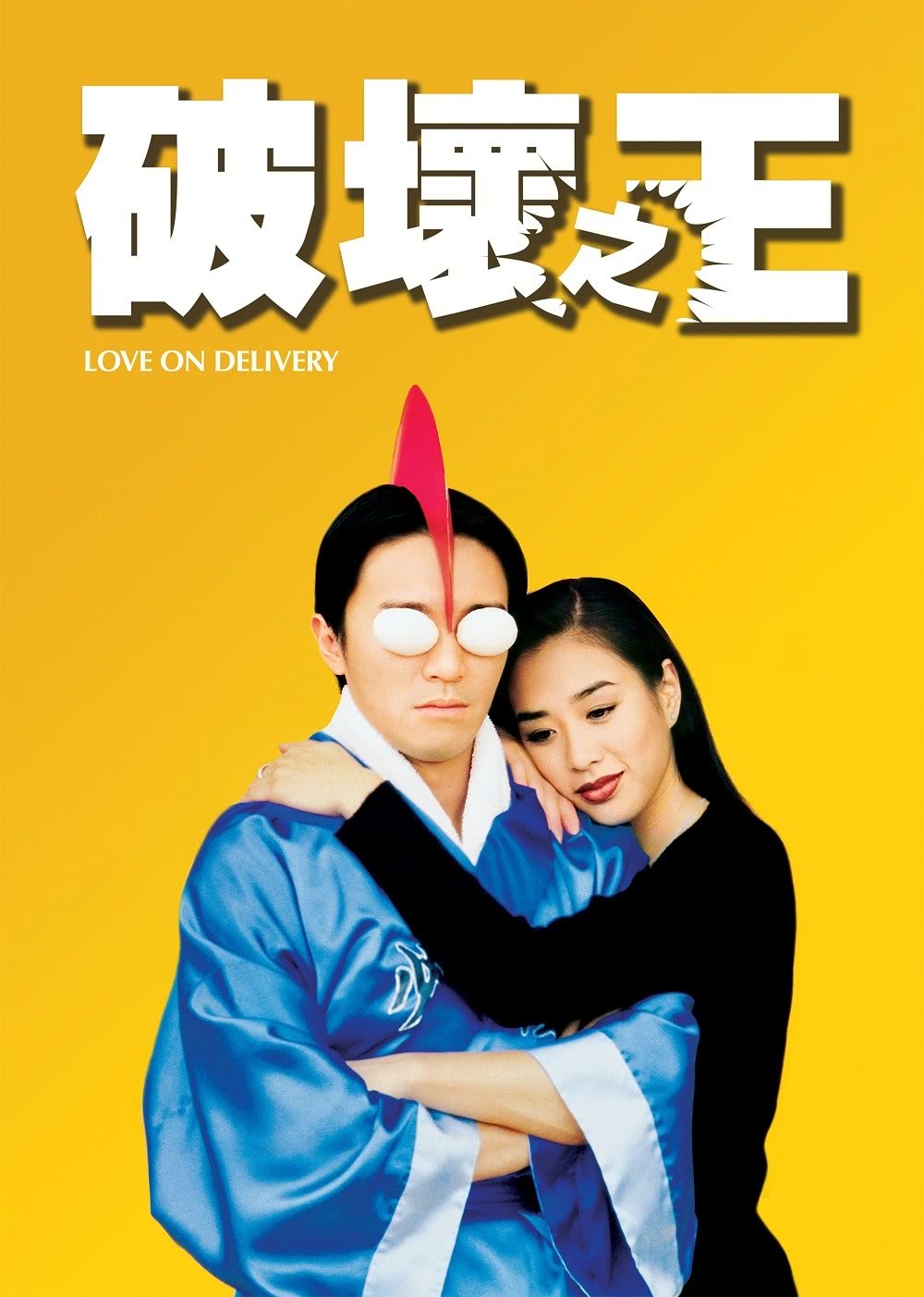
Love on Delivery (破壞之王, Stephen Chow & Lee Lik-Chi, 1994)

Love on Delivery posterBy the standards of ‘90s Hong Kong cinema, early Stephen Chow hit Love on Delivery (破壞之王) might seem refreshingly down to earth but make no mistake this under appreciated romantic comedy gem is as zany as you’d expect from the master of surrealist laugh a minute humour. A curious tale of cultural pollinations, Delivery once again stars Chow as an ineffectual loser trying to impress a girl but this time it’s a battle of wits he ends up winning when he unexpectedly finds himself standing up for “garbage” in the face of arrogant elitism.

The film opens not with its hero, but with judo champion Li (Christy Chung) who finds herself persistently sexually harassed by her slimy dojo leader who is apparently determined to win her because she’s the only woman capable of “throwing him over”. Seeing as his chat up lines are things like “my house is really big and my bed is really comfy come and see”, Li isn’t really interested which is why she ends up kissing in the right place at the right time delivery boy, He (not altogether against his will). He (Stephen Chow) is smitten, but Li has been looking for a “hero”, someone big, strong, and manly who can match her martial arts prowess but also respect her as a human being. Unfortunately, He is a weakling and a coward, as Li discovers when the boss of the dojo interrupts their first “date” and tries to thump He who activates his well honed coward skills and dodges the blow which lands squarely in the middle of Li’s face.

Fearing his romantic dreams have been well and truly shattered, He resolves to become stronger so he can fight back which is how he ends up meeting conman and stall owner “Devilish Muscle Man” (Ng Man Tat) who claims to be the last heir to “Ancient Chinese Boxing” as well as a close friend of Bruce Lee and Jackie Chan (only he doesn’t like to name drop). Devilish Muscle Man offers to “train” He in the ancient martial arts, for a “small” fee. Though all of Devilsh Muscle Man’s “training” is a sham, He starts to get quite good at it and eventually defeats the dojo boss whilst wearing a giant fluffy Garfield head. However, a new challenger soon enters the arena – a childhood friend of Li’s who went to Japan and has become an “elite” karate champion claims to be the mysterious Garfield head, stealing He’s thunder and Li’s heart along with it! 

Chow may be in a relatively restrained mood, but there are pop-culture references and in jokes galore which eventually culminate in a Hong-Kong vs Japan standoff in which Chow ends up inheriting Devilish Muscle Man’s kung fu persona which saw him fighting in a strange costume inspired by Ultraman (or possibly Chinese Ultraman rip off Inframan). Meanwhile, the big bad – Li’s ex Duan Shui Liu (Ben Lam Kwok-Bun), dresses in an old fashioned Japanese students’ uniform and rails about the “garbage” people of Hong Kong with their “garbage” kung fu which he plans to eradicate through affirming the primacy of karate as the best and only real martial art. He’s first problem is that he actually self identifies as “garbage” – he is only a poor delivery boy working for a tiny cafe which stoops to various scams to trick its customers out of their money and/or complaining and has no real prospects of being able to lift himself out of the gutter despite his new found fighting spirit and commitment to martial arts training. Nevertheless, He decides to own his “garbage” status to stand up for all the other “garbage” people resisting “Japanese imperialism” in the only way he knows how – by using his wits to trick Duan into allowing himself to be defeated.

He, a perpetually “nice guy” who gives away not only his entire wallet but all his clothes to a homeless father, eventually defeats the forces of “elitism” through an acknowledgement of his inferior fire power and an efficient use of the skills he does have to create a confusing atmosphere of chaos which ensures his final victory. A mildly subversive tale of fighting back against “the elite”, Love On Delivery is also a hilarious romantic comedy in which the nice guy gets the girl solely by demonstrating himself brave enough to face defeat with, well if not dignity, perhaps resolve.


Currently available to stream on Netflix in the UK (and possibly other territories)

Celestial Pictures trailer (Cantonese with English/Traditional Chinese subtitles)