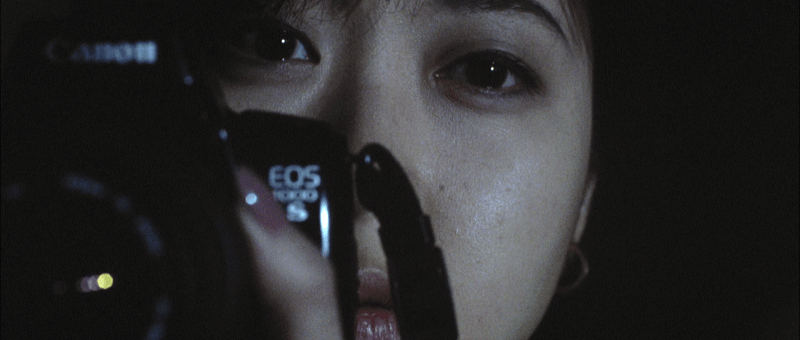
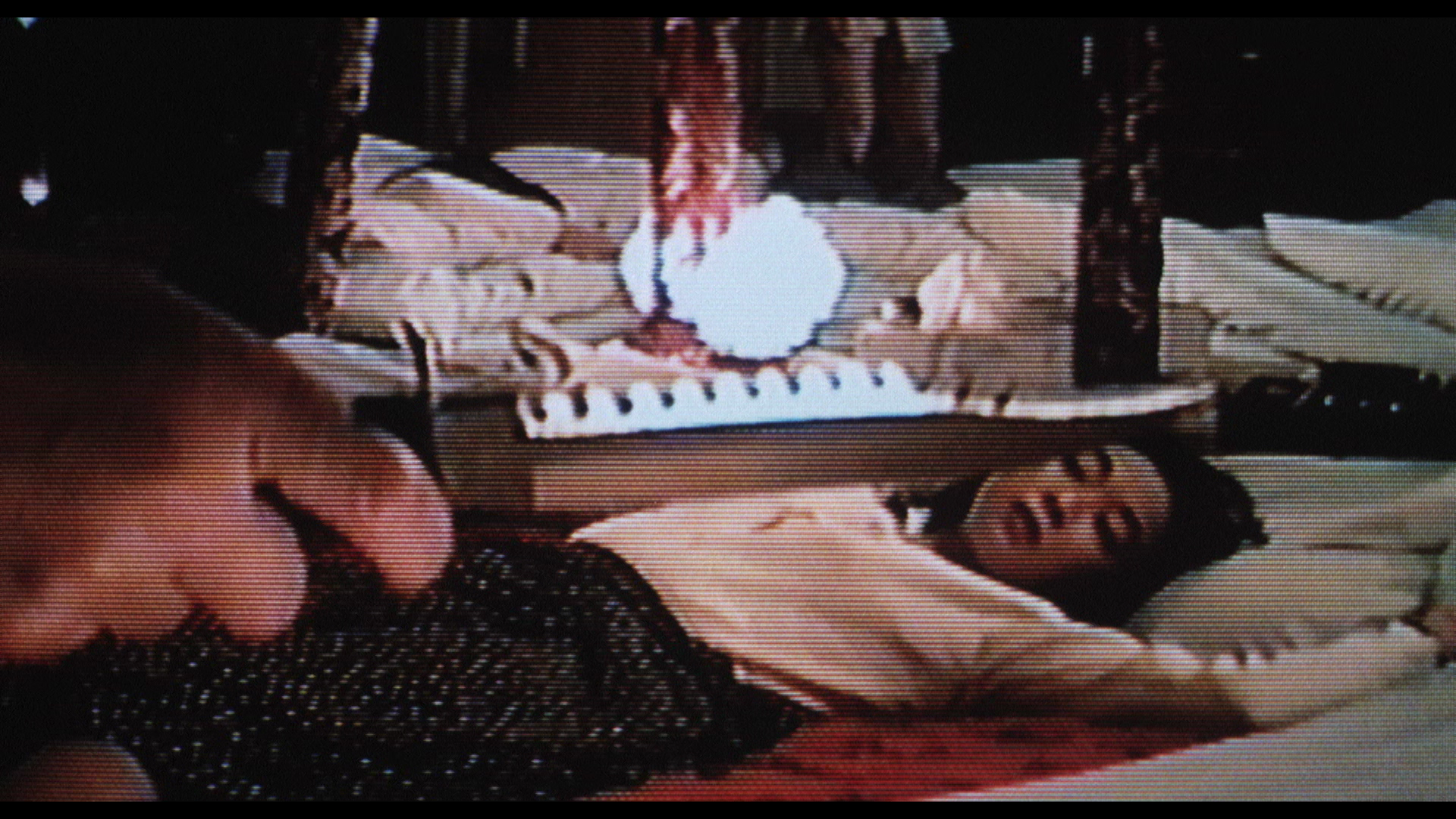
Sent to cover a pornographic movie shoot, a young woman finds herself confronted by the teenage trauma that continues to haunt her in the final instalment in the Angel Guts series, Red Flash (天使のはらわた 赤い閃光, Tenshi no harawata: Akai senko). Adapting his own manga, Ishii draws on giallo and classic noir as the heroine attempts to reclaim herself from the spectres that are haunting her even as Japan itself seems to be a land of predatory and dangerous men.
Nevertheless, as the film begins, Nami (Maiko Kawakami) seems to be holding her own aside from an apparent problem with alcohol that sees her drink far to much and end up in vulnerable, potentially dangerous situations. She has a job as an editor and ad hoc photographer where she’s regularly subjected to extreme imagery, while her sleazy boss is also sexually harassing her and in fact attempts to force himself on her in the lift. It’s being sent to take photos at a porno shoot featuring intense rape scenes that awakens her buried teenage trauma of having been abducted and raped on her way home from school.
Nami is haunted by the spectre of her attacker, though as her new ally Muraki (Jinpachi Nezu) tells her it’s only by killing this ghost that she might be able to “erase” the harmful memories of her rape and overcome the repulsion she feels towards sex with men. Perhaps problematically, the film then phrases Nami’s journey as one of repair in which the ultimate goal is being able to enjoy heterosexual sex which seems to be something Nami herself desires to the extent her inability to do so leaves her feeling as if there’s something wrong with her. Even so, it seems she is able to have successful and enthusiastic sex with bar owner Chihiro (Noriko Hayami) who seduces, or perhaps takes advantage of, Nami after bringing her home because she’d had too much to drink at the bar.
On another drunken occasion, Nami is ushered into a love hotel where she wakes up naked several hours later with no recollection of how she got there. Looking around, she spots not only a bloody knife in the sink, but the body of a middle-aged man hidden under the duvet, and camera which has apparently been filming the whole thing. The act of watching her assault, of which she has no memory, echoes the out of body experience of her rape in which she sees another version of herself save her by killing the attacker. What Nami is essentially trying to do is kill the attacker in her mind through discovering what really happened in the hotel room. As Nami has developed a fear of sex of men, she has a tendency to kick and punch violently in self-defence which, coupled with her drunkeness, lead her to fear that she killed this man after waking up during the assault. In another kind of haunting, Nami begins receiving unpleasant phone calls from someone using a voice disguiser who knows she was at the hotel and attempts to blackmail her in exchange for sexual favours.
Her first suspect is Muraki, which makes sense because he was at the bar and saw her leave with the other customer so could easily have followed her and either observed her entering the hotel and put two and two together after seeing the crime on the news, or actually committed the murder himself while she was unconscious. She’s also been given a negative impression of Muraki by her jealous boss who tells her that his wife killed herself because his constant infidelities. But Muraki is also carrying traumas of his own in his guilt over his wife’s death which he acknowledges was influenced by his behaviour even if because of a misunderstanding or irrational jealousy rather than sexual or emotional betrayal. Thus, Nami becomes to him a means of atonement in the form of a woman he could save in place of the wife he could not.
Which is to say, Nami is pulled towards trusting the improbable presence of a “good” man even as Chihiro insists that they don’t exist. After they made love, Chihiro deepened the intimacy between them by revealing that she had been abused by her stepfather, though it does not prompt Nami to reveal her own traumatic memories of her rape and abduction. She is reluctant to go to the police not because she fears she is guilty of the crime and wants to avoid punishment, but feels ashamed and can’t bear the idea of the police watching the tape which would amount to a kind of second rape. She does eventually allow Muraki to watch it, but on realising that it may exonerate her is still reluctant to let the police see it while torn by her civic duty in knowing that she has evidence that may help catch the “real” killer. She and Chihiro wonder why it is men like to watch the rape videos she was sent photograph, but can’t come up with much of an answer though it hints and an ingrained misogyny, a desire for control and dominance of a woman and her sexuality. The fact that she was sent to photograph it all by this otherwise mainstream company again hints at a kind of desensitisation amid an overly sexualised atmosphere even as her boss tells her the UN has been critical of Japanese attitudes to sex. Nevertheless it seems that Nami is able to overcome her trauma, to an extent, through reclaiming her identity even if she still has the occasional red flashes of violent fantasy.
Angel Guts: Red Flash is available as part of Third Window Films’ Takashi Ishii: 4 Tales of Nami boxset.

 Windows on Worlds