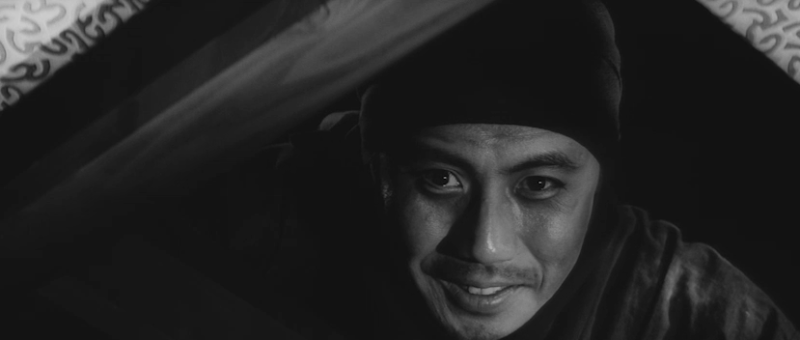
Shinobi No Mono 5: Return of Mist Saizo (忍びの者 続・霧隠才蔵, Kazuo Ikehiro, 1964)

At the end of the previous instalment, Saizo (Raizo Ichikawa) had escaped from the fall of Osaka Castle spiriting away Sanada Yukimura (Tomisaburo Wakayama) who, in contrast to what the history books say, did not die. The pair make their way towards Shimazu, where they are also not well disposed to Ieyasu (Eitaro Ozawa), but as Saizo is informed the Tokugawa clan will never die. Knocking off Nobunaga put an end to the Oda clan, getting rid of Hideyori took the Toyotomi out of the running, but killing Ieyasu will make little difference because another retainer will swiftly take his place.

As a reminder, that’s bad for Saizo because what he wanted was the chaos of the Warring States era back to restore the ninja to their previous status. Nevertheless, at the end of the previous film he claimed to have rediscovered a human heart in his devotion to Yukimura though it may of course be simply another ruse to meet an end. In any case, Ieyasu seems to be putting his ninjas to good use and is once again waiting it out apparently aware that Yukimura is alive and well in Shimazu.

Meanwhile, times are changing. Yukimura is convinced the future of warfare lies in firearms and whoever controls Tanegashima where the weapons are made will prove victorious. They think they can gain it by figuring out how they get access to high-quality iron when trading with anyone outside of Portugal is illegal and the Portuguese don’t have any. It’s access to foreign trade which is becoming a crunch issue as Ieyasu tries to solidify his power, later giving a deathbed order to ban Christianity to stop European merchants taking over the country. Saizo travels to Tanegashima to investigate and figures out that the secret is they’re trading with China, which is pretty good blackmail material, but also encounters two sisters who turn out to be the orphaned daughters of a Tokugawa ninja with vengeance on their mind.

In a surprising turn of events, it turns out that his main adversary is Hanzo Hattori (Saburo Date) but the fact he keeps outsmarting him eventually convinces Ieyasu that the ninja have outlived their usefulness. Hanzo becomes determined to kill Saizo to restore his honour, filling the palace with various ninja traps though unlike Goemon Saizo seems to be one step ahead of them. This lengthy final sequence is played in near total silence, and ironically finds Goemon just waiting, after dispatching several of Hanzo’s men, to see if his poison dart has taken effect and Ieyasu is on his way out. Only in the end Ieyasu just laughs at him. He’s 75. Saizo’s gone to too much effort when he could have just waited it out. Ieyasu has already achieved everything he wanted to. His control over Japan is secured given he’s just been appointed chancellor. He can quite literally die happy because nothing matters to him anymore. A title card informs us that when Ieyasu did in fact die, no one really cared. The Tokugawa peace continued. 

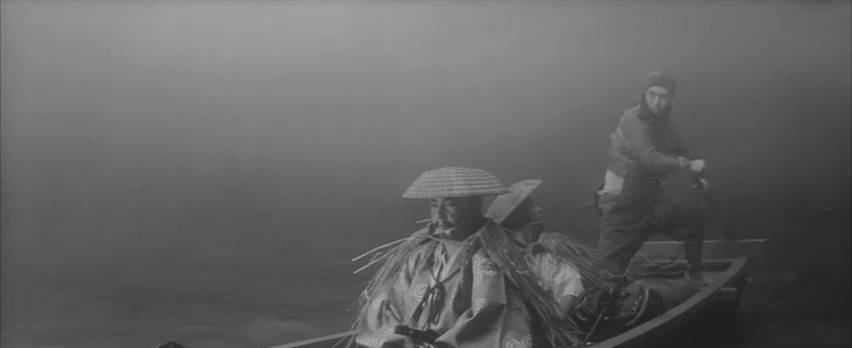
Here, once again, the Ninja too are powerless victims of fate despite their constant machinations. Yukimura tells Saizo to live and be human, advice he gives to the sisters in Tanegashima but does not take for himself staking everything on his revenge against Ieyasu which is, as he points out, pointless for Ieyasu was at death’s door anyway and his demise changed nothing. In his first of two entries in the series, Kazuo Ikehiro crafts some impressive set pieces beginning with a mist-bound underwater battle as Saizo and Yukimura make their escape by water to an epic flaming shuriken battle, though this time around the deaths are noticeably visceral. Men are drowned, stabbed, or caught on wooden spikes. Those who do not obey the ninja code are stabbed and pushed off cliffs while once again emotion is a weakness that brings about nothing more than death. Ikehiro’s frequent use of slow dissolves adds to the dreamlike feel of Saizo’s shadow existence even as the ninja themselves seem to be on the point of eclipse for what lies ahead for them in a world of peace in which there is no longer any need for stealth?


Blood End (天狗党, Satsuo Yamamoto, 1969)

When the black ships appeared off the coast of Japan in 1853, it provoked a moment of crisis which eventually led to the fall of the Tokugawa Shogunate and the Meiji Restoration. Between those two events however lay a period of intense confusion as several groups and movements attempted to lay claim to the future direction of the nation. Many, such as the legendary figure Sakamoto Ryoma, held that above all else Japan needed to Westernise as quickly as possible in order to defend itself against foreign powers now far more technologically advanced than the Japan which had attempted to hold back time for over 200 years. Others felt quite the opposite, that what was needed was an end to the corrupt rule of the Shogunate and the restoration of power to the emperor while expelling foreign influence and going back into isolation. 

Satsuo Yamamoto’s Blood End (天狗党, Teng-to) dramatises this debate through the melancholy tale of the Mito Rebellion as a brutalised peasant farmer is sucked in by the idea of revolution but eventually betrayed by it in discovering that the samurai, even revolutionary samurai, will never change. They may claim they want an end to the feudal caste system and to live in a world where all men are equal, but continue to feel themselves entitled to more equality than others and insist on deference from those they still believe to be inferior. 

The action begins with a scene familiar from many a jidaigeki in that a small farming community is being pressed to provide the usual amount of rice despite the failure of the harvest. Revolutionary yakuza Jingoza (Kanemon Nakamura) and egalitarian samurai Kada (Go Gato) stumble on the scene of a “stubborn” peasant being subjected to 100 blows as punishment for the village’s raising the unfairness of their situation with the local lord. Surviving his ordeal, Sentaro (Tatsuya Nakadai) asks only for water but is denied by his cruel samurai tormentor. Jingoza intervenes and offers him his flask along with some money by way of an apology on behalf of these savage nobles, a gesture for which Sentaro remains grateful. While many of his friends are exiled and lose their lands, Sentaro disappears from the village and becomes a yakuza himself, learning the art of the sword in preparation for his mission of revenge. 

Meeting Jingoza by chance, he takes the opportunity to thank him and agrees to transport some money back to his family in a nearby village while he engages in urgent business in the mountains. While there, Sentaro ends up defending Jingoza’s steely daughter Tae (Yukiyo Toake) who is running something like an orphanage for children rendered fatherless by the ongoing chaos. It’s at Tae’s that he ends up running into Kada, who is a member of revolutionary movement “Tengu-to”, named for the mythical ogres with long noses and bright red faces. Sentaro ends up joining the movement, but gradually discovers that Tengo-to is not all he thought it to be. In the modern parlance, many of their actions are terrorist, they care little for human life and have no issue with looting wealthy houses as they prove after helping Sentaro assassinate the man who beat him, killing the man’s wife and servants and making off with his money as “military funds”. Sentaro is shocked, but only manages to get some of the money for himself to take back to Tae as a way of making amends. He continues to associate with Tengu-to despite his growing disillusionment with their philosophy. 

The Mito clan were perhaps outliers in the great Bakumatsu culture war, running under the “Sonno Joi” banner but doing so alone and forcefully advocating that the emperor’s instruction to expel all foreigners with immediate effect be enforced. At least as far as Yamamoto’s revolutionaries go, they advocate for this not so much because they reject foreign influence but because they resent the country’s elites maintaining a stranglehold on the riches to be gained by foreign trade. Kada, however, claims to have a more revolutionary spirit in that he wants to improve conditions for farmers like Sentaro, protecting them from the “corrupt system” but he’s still a product of his society and finds the programming increasingly hard to break. Having recruited vast numbers of peasants to their cause and witnessing the failure of their campaign, the other leaders want to go to Kyoto to talk to the emperor but are embarrassed to go there in the company of so many men who are not samurai. The solution is that they simply kill them, because peasants aren’t really people anyway. 

Sentaro thought they were “doing something good for peasants and the poor”, but samurai will always be “samurai” and eventually they will betray him. He wavers when Kada and the others ask him to assassinate Jingoza because he’s gone over to the Westernising cause, and is half talked round by his insistence that he’s acting blindly without thinking far enough ahead but himself finds it hard to break with the idea that samurai are honest and know what they’re doing. 

Yamamoto is perhaps making a direct allusion to the imminent failure of the student movement in Japan which finds itself in much the same place as the Tengu-to, torn apart by infighting and increasingly corrupted by duplicitous dogma. Kada has a lot of fine ideas but he doesn’t act on them, doubling down on ruthlessness in complaining that Sentaro is too sentimental, insisting that emotion is the enemy. Sentaro, however, has figured out that the enemy is the sword and everything it represents. Jingoza’s “Restoration” is the one he should have been fighting for if he wanted to see a classless Japan, but the Tengu-to have misused his idealism for their own ends and turned him into a defender of his own oppression. Still, the Tengu-to are the ones who pay the price, their entreaties to the emperor falling on deaf ears with 353 retainers beheaded as punishment. Sentaro lives on, vowing he will never die, as he walks towards the “Restoration” of the future and away from the Blood End of an inherently corrupt insurrection.