The Man Without a Map (燃えつきた地図, Hiroshi Teshigahara, 1968)

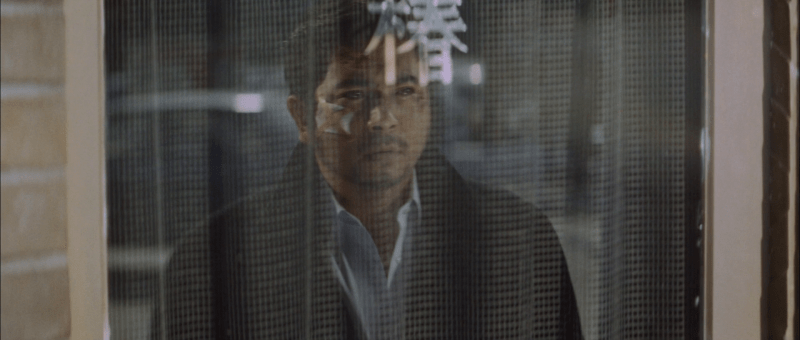
Hired to find a missing person no one really wants found, a detective begins to chase his own tail amid the impersonal vistas of the contemporary city in Hiroshi Teshigahara’s The Man Without a Map (燃えつきた地図, Moetsukita chizu). The fourth and final in his series of Kobo Abe adaptations and the only one in colour, the film’s Japanese title “burned-up map” may also, in its way, refer to the city of Tokyo which appears blurred out and indistinct in the sepia-tinted opening and is thereafter frequently shot from above as a depersonalised space where anonymous cars shuttle along highways like so many ants moving in rhythm with the momentum of the metropolis.

We follow a nameless detective (Shintaro Katsu) as he’s charged with investigating the disappearance of a 43-year-old salaryman, Hiroshi Nemuro, who turns out to have myriad other personalities and hasn’t been seen for six months. The man’s wife, Mrs Nemuro (Etsuko Ichihara), is not terribly helpful and the detective comes to wonder if the investigation itself is intended to further disguise the man’s whereabouts and prove that he really is a “missing person”. Yet this Tokyo is full of “missing people” including the detective who, we later learn, is a kind of fugitive himself. He apparently walked out on his wife (Tamao Nakamura), the owner of a successful boutique, because he couldn’t find his place there any more. He was once a salaryman too, and became a detective because it was the furthest thing he could think of from a regular job. 

It confuses him that no one really seems to be interested in where Nemuro is or if he’s alright, only in the reason behind his disappearance. The more he chases him, the more he begins to take on Nemuro’s characteristics as if he were intended to slide into the space Nemuro has vacated. Toru Takemitsu’s eerie harpsichord score only seems to add to the hauntingly gothic quality of this quest. The question is whether such a thing as identity even exists any more. The detective puts on Nemuro’’s jacket, though it’s too small, and is mistaken for him, while a colleague of Nemuro’s insists that he’s seen him in the street and is sure it was Nemuro simply because of the unusual colour of his suit without ever seeing his face. Tashiro (Kiyoshi Atsumi) tells the detective that Nemuro had a secret hobby taking nude photos at a specialist club that caters to such things. The two of them are confident they’ve identified the woman in the picture based on her haircut, but the girl they speaks laughs and takes off her wig explaining that she was merely asked to wear it, so the woman in the photo could be anyone, including Nemuro’s own wife.

Nemuro apparently had a series of hobbies for which he’d obtained certificates because he said that having them helped him to feel anchored in his life, though he’s apparently unmoored now. Like the detective, he may have been trying on different personalities from car mechanic to school teacher looking for the right fit and a place he felt he belonged in rebellion against the depersonalisation of the salaryman society in which one man in a suit is as good as another. The detective finds an opposite number in the missing man’s brother-in-law (Osamu Okawa), a very modern, apparently gay gangster connected with a network of male sex workers sold on to influential elites, and a commune of similarly displaced people working as casual labourers that is overcome with corporate thugs and eventually trashed.

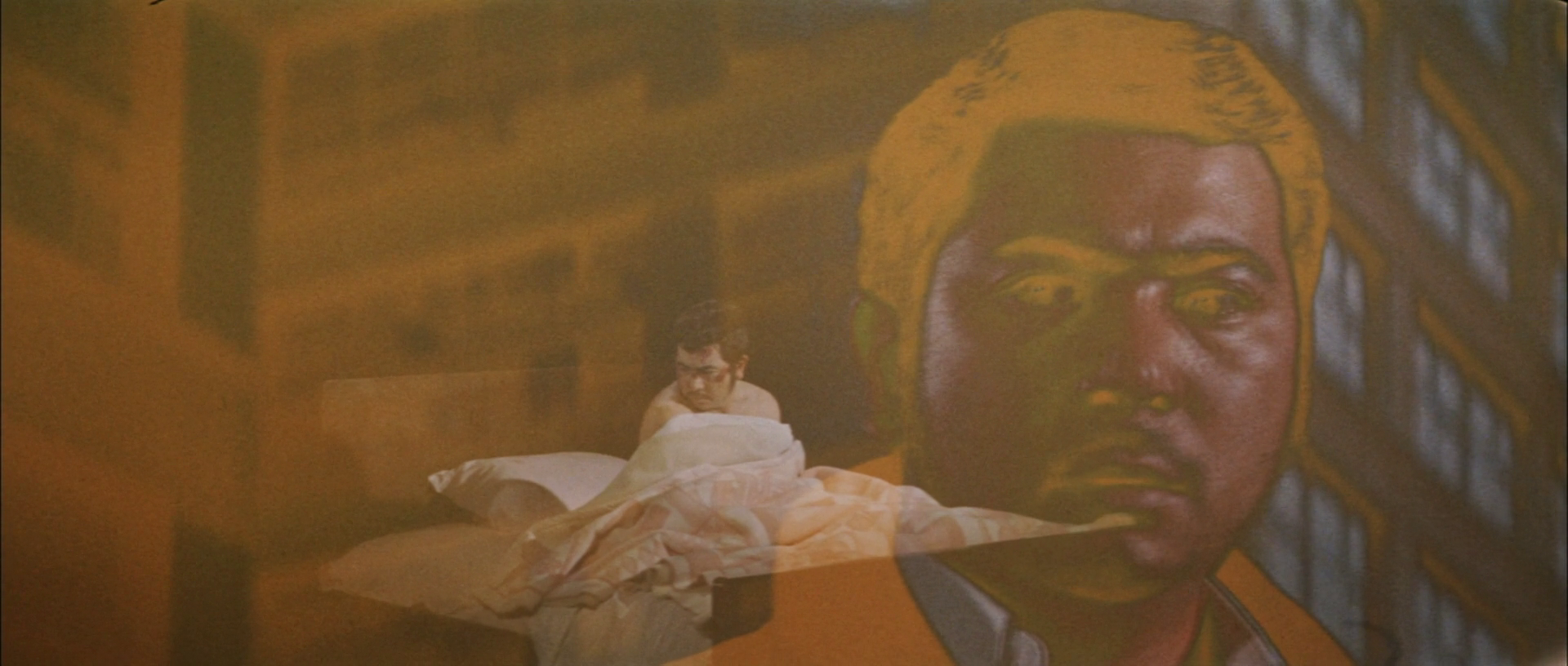
The trashing of the commune may have something to do with a man named Maeda who is a councillor in a town no one’s heard of, but was possibly involved in some shady business over which Nemuro may have been intending to blackmail him or blow a whistle with the assistance of his brother-in-law who helped him land a big contract at work. The more the detective investigates, the more confused he becomes. It’s impossible to follow the case as we might expect in a conventional noir thriller, but we’re not supposed to be looking at Nemuro’s disappearance so much as the detective’s gradually fracturing sense of self as he becomes lost in the anonymous city. He sees himself bury Mrs Nemuro in leaves only for her body somehow reduce itself to its component parts and sink into the street. Later her face is superimposed on the buildings as if she were looking down on him while he is lost and alone. Nemuro’s face also appears on buildings, though more as a metaphor as if the salaryman and the office building were one and the same and the reason the detective can’t find him is because he doesn’t really exist as a concrete identity. The detective spots a dead cat in the road and laments that he never thought to ask its name, but will try to think up a good one later. He might as well be talking about himself, now displaced, unmoored, and pursued among the city streets, a man without a map lost amid the simulacrum of an imaginary city.
The Twilight Years (恍惚の人, Shiro Toyoda, 1973)

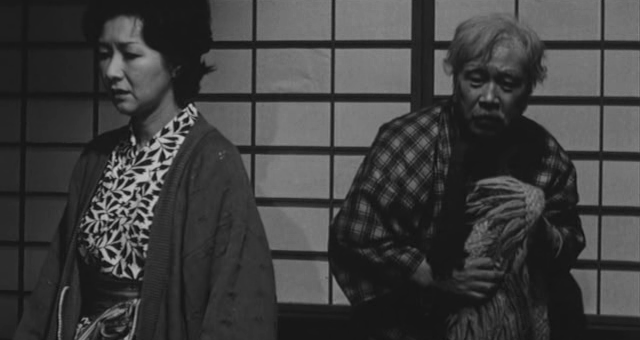
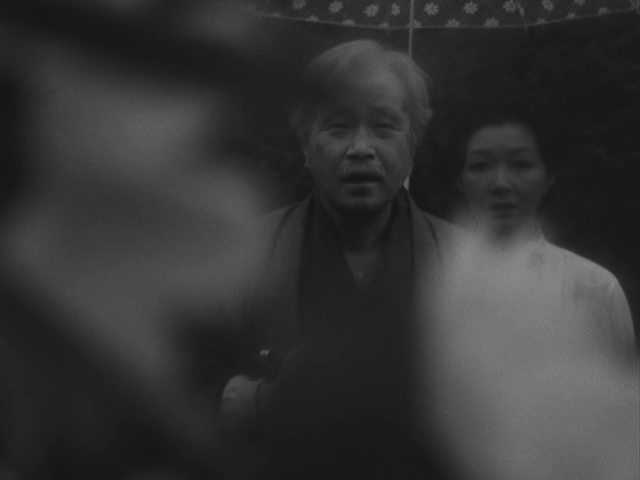
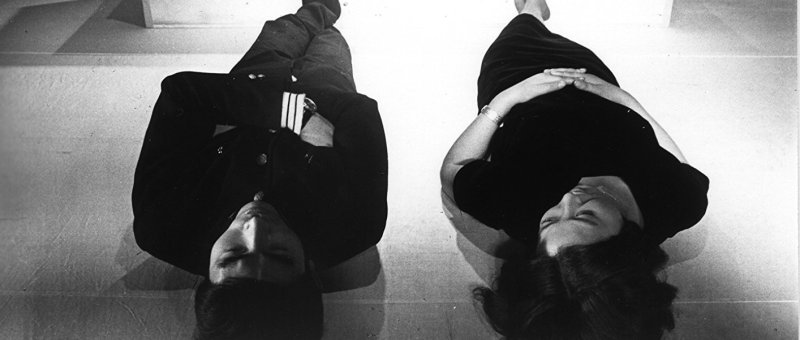
In the early 1970s Japanese society was not as concerned with population slowdown as it would come to be, but Shiro Toyoda’s sympathetic ageing drama The Twilight Years (恍惚の人, Kokotsu no Hito) is evidence of a growing consciousness that traditional ideas about how one cares for the elderly may now be becoming incompatible with the functioning of modern society. Based on a best-selling novel by Sawako Ariyoshi, the film has profound empathy both for the ageing patriarch once apparently a tyrant but now a meek and frightened child, and the daughter-in-law to whom his care largely falls.

In fact, it’s caring for Shigezo (Hisaya Morishige) that some believed shortened the lifespan of his late wife who passes away in the film’s opening scenes. Already somewhat detached from reality, Shigezo simply reports that his wife won’t wake up no matter how much he tries to wake her, much like a child who’s discovered someone no longer living. While his daughter-in-law Akiko (Hideko Takamine) rushes to her room with a sense of foreboding, Shigezo merely stays in the kitchen eating boiled potatoes straight out of the pan. It’s the odd behaviour that seems to irk his son Nobuyoshi (Takahiro Tamura) but it’s only now that the couple seem to be realising that there’s something wrong especially as Shigezo does not appear to understand that his wife has died. Pitiably, he chides her for lounging around so late in the day when she’s already been laid out for her funeral.

When his daughter, Kyoko (Nobuko Otowa), arrives having actually missed the funeral itself due to transport issues and a conflicting responsibility to act as a matchmaker at a wedding, Shigezo doesn’t recognise her. He continues to ask for Akiko and gradually forgets most of the other people in his life, screaming when encountering Nobuyoshi and instructing Akiko to call the police to report a burglar in their home. According to both women, Shigeyoshi had treated Akiko poorly ever since she joined their family, which makes caring for him so much harder. The reason he becomes so attached to Akiko is likely simply that she is the person who is always around him so he has less time to forget her. He may realise on some level that she may not wish to care for him given his previous behaviour which may be why he becomes preoccupied with the idea she may “disappear” and cries out in the night when he can no longer see her.

But Akiko also has other responsibilities including a job outside the home and a teenage son studying for his exams. Nobuyoshi expresses regret that he hasn’t been more help and voluntarily tries to pitch in, but lets himself off the hook given that his father doesn’t recognise him and becomes anxious in his presence. Satoshi (Izumi Ichikawa) meanwhile does try to do his bit but is young and a little resentful of the responsibility. As his dementia becomes more severe, Shigezo begins calling Satoshi “Dad” as if he were a child again. Which is all to say, Shigezo becomes Akiko’s responsibility and the strain of caring for him begins to affect her own mental and physical health leading her to fear that she too may die younger than she otherwise might have. 

Yet in exploring her options, Akiko finds little by way of support. Most nursing homes won’t accept patients with complex needs like Shigezo and conditions such dementia are often regarded as mental illnesses meaning her only option might be to put him in an asylum. Shigezo was attending an old person’s daycare centre, but later says he doesn’t want to go anymore because it’s full of old people and therefore no fun. While the film is sympathetic towards Akiko and the difficulties she is facing in caring for her father-in-law it also has profound empathy for Shigezo for though he has so many people who are doing their best to look after him, his increasing mental confusion quite obviously leaves him isolated and he must be incredibly lonely while trapped within his own reality. He develops a habit of saying “hello, hello,” as if he were answering the telephone which may be his attempt to communicate while he is also fascinated with a caged bird which may reflect his own sense of being constrained by his condition.

Later, the bird seems to symbolise Akiko too, trapped as she is within the domestic environment where all responsibility seemingly falls to her. Even so a young student couple she rents the annex to for a lower price in exchange for keeping an eye on Shigezo during the day remark that he may be in the ideal state for a human being having returned to early childhood in which there are no concerns or responsibilities and he is therefore unburdened by the weight of what is to live. Toyoda often uses handheld camera to symbolise the desperation and destabilisation of Shigezo’s existence in which Akiko has become his only fixed point. One of Nobuyoshi’s friends remarks that perhaps it was better when the average life expectancy was 50 and Nobuyoshi’s mother might have been lucky passing away peacefully while otherwise in good health. Still, as Nobuyoshi says, it comes for us all in the end and we should all try to be kinder to each other while we’re here.


Sing a Song of Sex (日本春歌考, Nagisa Oshima, 1967)

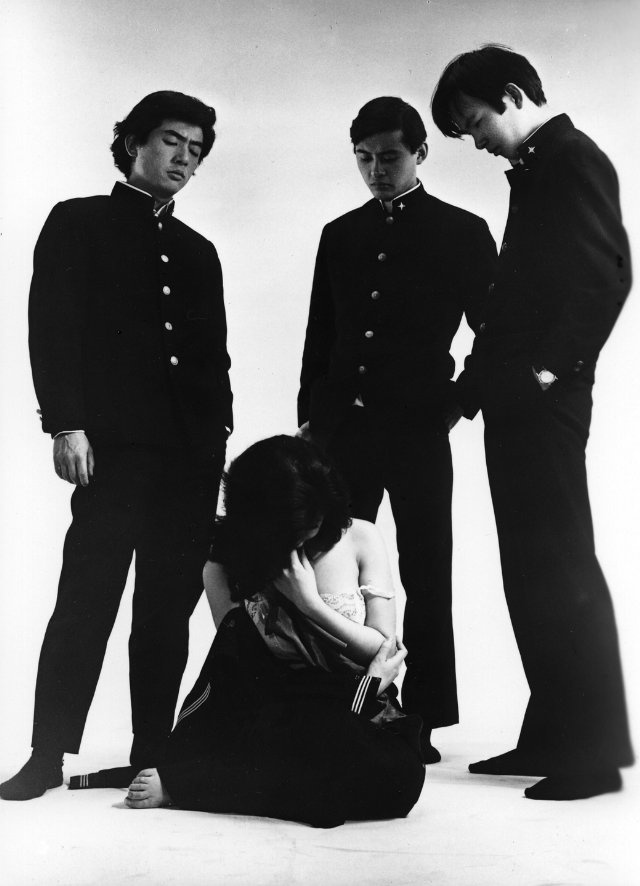
20120910022716257Aimless youth wastes its potency on repressed desires in Oshima’s avant-garde treatise on power dynamics and political fallacies. Sing a Song of Sex (日本春歌考, Nihon shunka-ko), less the bawdy romp the title promises than an irony tinged journey through music as a weapon against oppression, is the first of three films Oshima would make in the late ‘60s examining Japan’s complicated relationship with Korea. Its “heroes” however are about as depoliticised as it’s possible to get – they interrupt protests they don’t understand and obsess over a single pretty girl they fantasise about raping in an elaborate classroom based piece of erotic wish-fulfilment. All that matters to them is their craving for physical satisfaction which knows no morality or greater purpose save satiation, conquest, and implied humiliation.

Japan, spring, 1967. Four boys sit their university entrance exams with (externally at least) less seriousness than might be expected. Huddling together away from the snow they smoke cigarettes and gossip about miss 469 whose name they don’t know but caught their eye in the exam hall. The boys, along with three girls, are nominally under the care of their teacher, Mr. Otake (Juzo Itami), who takes them to a pub to “celebrate” before getting extremely drunk and kicking off on an inappropriate lecture about bawdy folk songs and their lasting legacy as the voice of the poor and the oppressed who have no other way of expressing their needs and desires. Lamenting that the young people of today lack the capacity for real feeling, Otake offers to put the kids up in a local inn, perhaps hoping to provoke some kind of awakening among his teenage charges but the loss of innocence he inspires in them is of a very different nature. Still extremely drunk, Otake falls asleep next to a faulty gas heater and dies of carbon monoxide poisoning.

One of the boys, Nakamura (Ichiro Araki), went to see Otake during the night and saw him keeled over in a room that smelt of gas but did nothing. The girls, wailing and distraught, attempt to make their way home while the boys joke about having murdered their teacher and continue to exchange increasingly lewd and disturbing banter about their female classmates including collective rape fantasies (but only of the pretty one). The “other” girl that they collectively decide they don’t fancy, Kaneda (Hideko Yoshida), is disturbed enough by the boys’ murderous joke that she comes back to make sure it isn’t true, accidentally finding out about their dreamscape rape of no. 469 and pushing Nakamura towards paying a visit to Otake’s girlfriend, whom the boys have also been fantasising about, to apologise to her about his possible contribution to Otake’s death.

While Kaneda and the other three set off to track down 469, Nakamura splits off for Otake’s wake where he finds himself alone among a collection of former student protestors with differing views about Otake’s legacy and relation to the cause. The protestors break into a traditional Japanese leftwing anthem, but Nakamura isn’t having any of it. That’s not the Otake he knew. He resists their politicisation of his mentor’s funeral by loudly singing the bawdy drinking song Otake taught them at the pub. The song becomes something like an anthem for Nakamura and his friends who sing it at every conceivable opportunity, delighting in its inappropriateness and ironic similarity to the acts they frequently discuss but seemingly do not directly engage in. Like the peasants Otake idolised, Nakamura takes up the song as a weapon against his own oppression and the unwilling repression of his physical desires.

The battle becomes one of audience and agency. Nakamura sings his song over the hymn of protest being offered by the defeated left while Kaneda later attempts to counter with a female tale of exploitation, snatching a microphone away from some Americanised hippies singing Woody Guthrie and protesting the Vietnam war while dancing round the stars and stripes. Kaneda eventually gets her moment in the spotlight but she pays a heavy and ironic price for it, partly at the hands of miss 469 who re-enters the boys’ rape fantasy after it is directly revealed to her and she dares them to realise their baser desires. Suddenly back in an empty classroom presided over by Otake’s girlfriend, Miss Tanigawa (Akiko Koyama), and the silent spectre of Kaneda now dressed in a sparkly white hanbok, the boys get an intense lesson in Japanese history and more specifically the origins of the Japanese state in the royal courts of Korea.

The songs of the youthful protestors, some Japanese some co-opted from abroad, have lost their meaning and their fire. Their protest is affected and purposeless, as solipsistic as the boys’ destructive desires. On the one hand, youth embraces the pop culture of rebellion – joining the flower power revolution and adopting the Americanised protests against a foreign war and (perhaps tangentially) their nation’s complicity in it, while age fixes its sights on a recently revived imperial holiday and a rejection of the fascist past (though not a rejection of the imperial past or a recognition of its lingering legacy). Painted in tones of red and white, the rising sun occasionally replaced with the blackened flag of protest, Sing a Song of Sex is a paradoxically nihilistic condemnation of post-war youth who allow their oppression to push them into senseless acts of violence rather towards the noble causes of revolution and social change which might finally set them free.


Original trailer (no subtitles)

Keiho (39 刑法第三十九条, Yoshimitsu Morita, 1999)

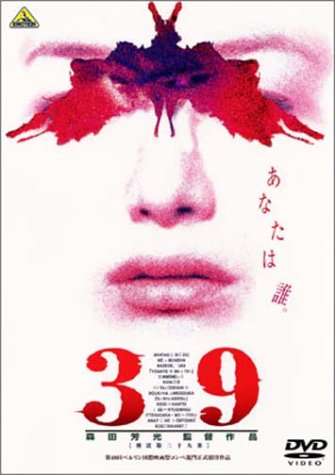
keihoArticle 39 of Japan’s Penal Code states that a person cannot be held responsible for a crime if they are found to be “insane” though a person who commits a crime during a period of “diminished responsibility” can be held accountable and will receive a reduced sentence. Yoshimitsu Morita’s 1999 courtroom drama/psychological thriller Keiho (39 刑法第三十九条, 39 Keiho Dai Sanjukyu Jo) puts this very aspect of the law on trial. During this period (and still in 2016) Japan does nominally have the death penalty (though rarely practiced) and it is only right in a fair and humane society that those people whom the state deems as incapable of understanding the law should receive its protection and, if necessary, assistance. However, the law itself is also open to abuse and as it’s largely left to the discretion of the psychologists and lawyers, the judgement of sane or insane might be a matter of interpretation.

The case at the centre of the film centres around a young actor, Masaki Shibata, who has confessed to the murder of a pregnant woman and her husband after he argued with the woman at her place of work. Shibata acts strangely and makes a point of asking for the death penalty before spouting off about angels and demons and later displays evidence of a split personality. Everyone seems convinced he’s suffering from MPD and committed the murders during a dissociative episode but the assistant psychologist is convinced he’s faking. At the same time, one of the lead policemen on the case also thinks there’s more to this. On investigating further, he discovers the strange irony that the murdered man himself escaped prosecution by reason of insanity after committing a horrifying crime that lead to the death of a six year old girl.

The film may be about a murder but what’s really on trial here is the law itself. The murdered man, Hatada, committed a heinous crime but was a child himself at the time so received only a brief sentence served in a hospital. He was released, went to university, got a good job and got married – a normal life. The family of the little girl he killed, by contrast, will never be able to return to normality and will continue to live in torment for the rest of their lives knowing the man who so brutally took their child from them is still out there living just like one of us. The film does not go into why Hatada committed the original crime or the reasons he was later declared fit to return to society, but the film wants to question the idea of releasing back into the world someone who has done something as horrifying as the rape, murder and dismemberment of a child.

The case at hand is a complicated one which has so many layers coupled with twists and turns that it becomes unavoidably confusing. Playing with several literary allusions from the frequent quotations from the “mad prince” Hamlet to naming the assistant psychologist “Kafuka”, Keiho also wants to delve deep into human psychology with its questions of identity and self realisation. Both the accused and the psychologist have deeply buried memories of trauma the suppression of which has cast a shadow through the rest of their lives. Both of them are, in a sense (even if not quite in the way it originally appears), haunted by a shadow of themselves.

When it comes to the procedural aspects, the final “twist” is a step too far and perhaps undermines the groundwork which has gone before it. Something which is presented as an elaborate revenge plot against both the state and the original instigator of a crime also appears to originate with a clumsy motion of self preservation. The state’s failure to properly deal with the criminal in the first case has resulted the death of another innocent bystander, all of which might have been avoided if Article 39 had not come into play.

Kafka-esque is, in fact, a good way to describe the circularity of the narrative as the notion of an insanity plea becomes a recurrent plot device. Backstories are constructed and discarded, identities are shed and adopted at will and the past becomes a thorn in the side of the future that has to be removed so everyone can comfortably move on. Morita relies heavily on dissolves to create a floating, dreamlike atmosphere as memories (imaginary or otherwise) segue in and out like tides but he also shows us images reflected in other surfaces such as the Strangers on a Train inspired sequence which literally shows us events through someone else’s eyes as we’re watching them reflected doubly on the lenses of a pair of sunglasses.

Difficult, complicated and ultimately flawed Keiho proves an elusive and intriguing piece that is put together with some truly beautiful cinematography and interesting editing choices. Fascinating and frustrating in equal points Keiho is another characteristically probing effort from the wry pen of Morita which continues to echo in the mind long after the credits have rolled.


Keiho is available with English subtitles via HK R3 DVD as part of Panorama’s 100 Years of Japanese Cinema Collection.

http://www.youtube.com/watch?v=PrgZp2Bhizo