Danger Point: The Road to Hell (Danger Point: 地獄への道, Yasuharu Hasebe, 1991)

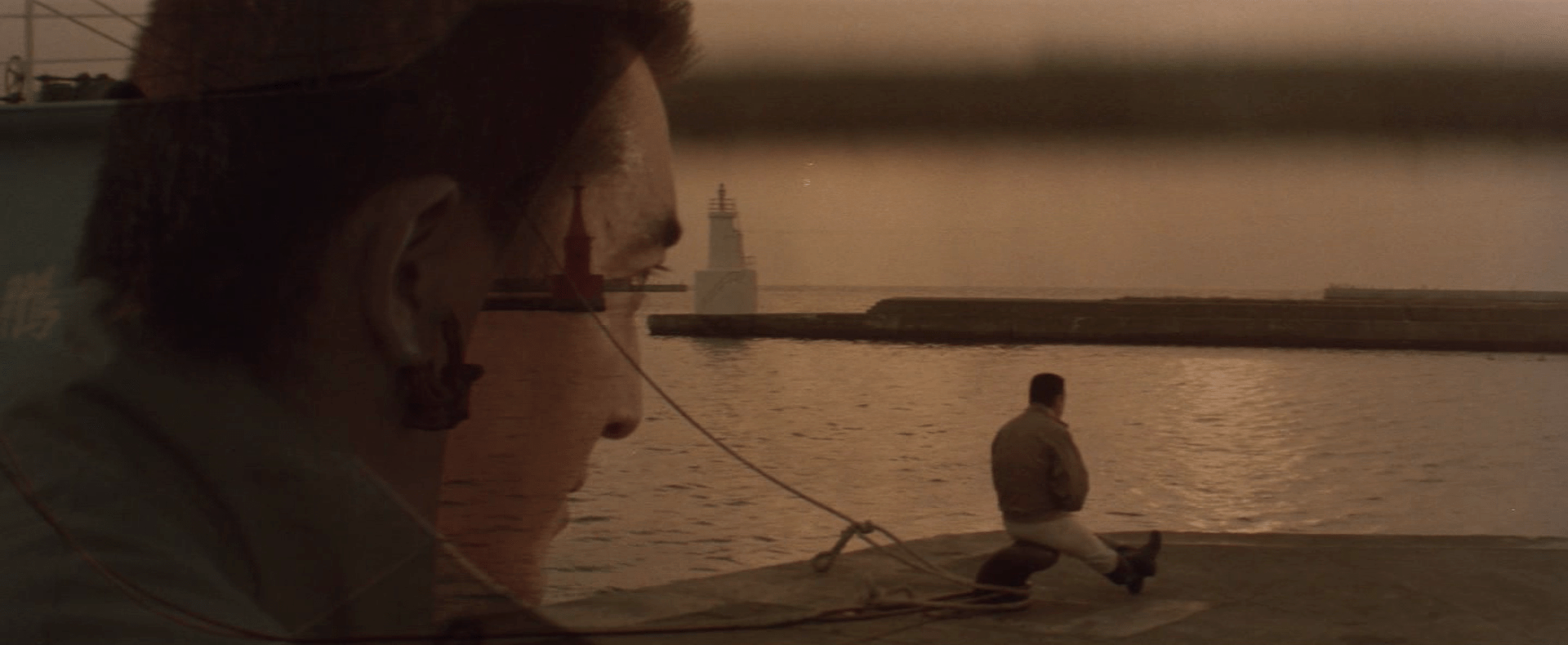
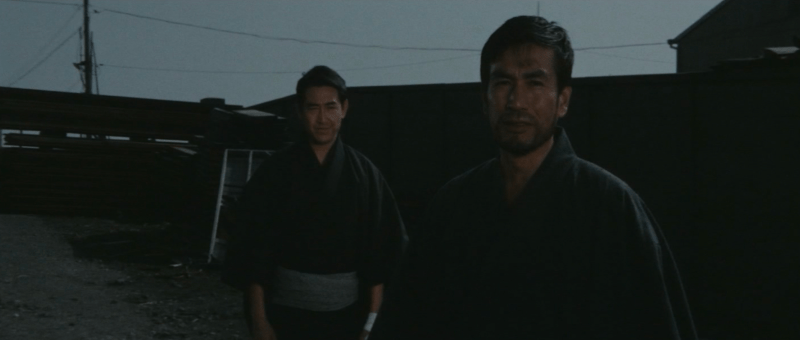
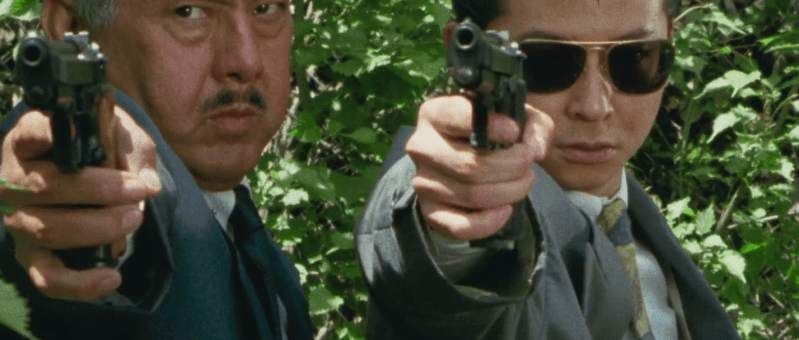
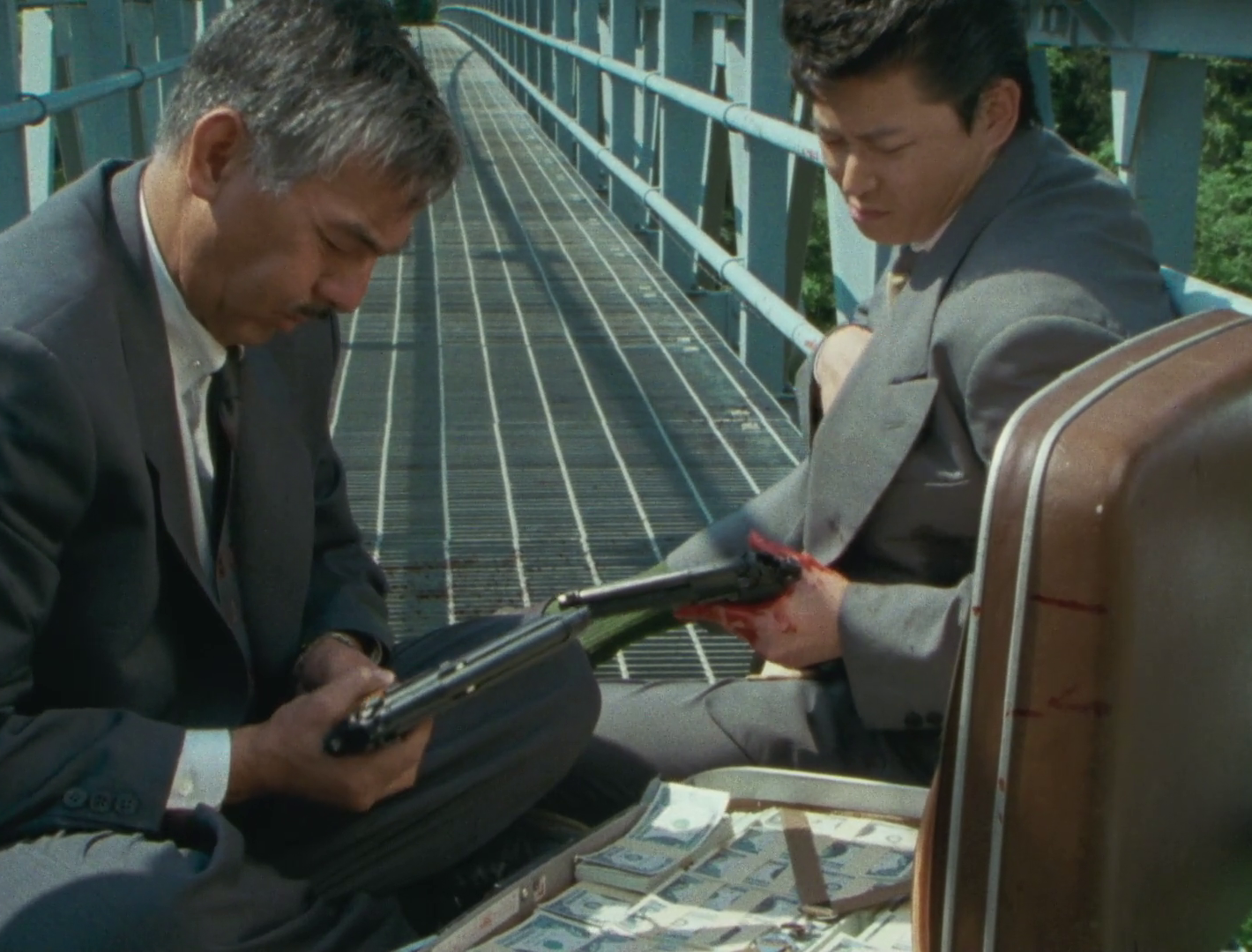
A pair of hitmen find themselves conflicted when their latest target dies gripping the photo of an innocent-looking nurse. Who was this man, what’s his relationship to the woman in the photo, and why did he have to die? Asking questions is taboo when you’re a hired killer, and you’re probably better off not knowing anyway, but there’s something that’s bugging veteran executioner Joji (Jo Shishido) and it’s not just the missing 20 million dollars.

Nikkatsu veteran Yasuharu Hasebe’s V-Cinema noir Danger Point (Danger Point: 地獄への道, Jigoku e no Michi) is a classic tale of nihilistic fatalism in which the bond between the two assassins is tested by the intervention of greed and mystery. Shishido’s Joji is the more old-fashioned of the pair yet fascinated by the mystery behind Sakai’s death, not necessarily wondering if he bears any culpability but confused about why he had to die despite not actually having the missing money. This puts Joji partially at odds with the younger Ken, a more dynamic and less morally ambivalent figure played by the contemporary star Show Aikawa who’d come to represent for V-Cinema what Shishido once had for Nikkatsu action. Together, the chase the various clues they’ve been given looking for the person behind the job and, of course, the missing money.

But the money presents a problem too. Ken begins to wonder if Joji will abandon him and take the prize for himself, though that doesn’t seem to be something that Joji is actively considering. The relationship between the two men is more brotherly than paternal, though Joji does scold Ken for his treatment of Yumi (Nana Okada), the nurse from the hospital and their key witness. He beats and sexually assaults her, though it’s less his lack of chivalry that Joji criticises than the wisdom of bringing a woman into their business. He’s suspicious of Yumi in a way Ken does not seem to be, though they both agree that eventually she’ll have to go before she does them any harm because now she knows too much.

Ultimately, the money turns out to be from a bank job in the Philippines that the American criminals were hoping to convert to US dollars in Japan, though predictably everyone wants the whole amount for themselves, not least Joji and Ken along with the kingpin’s horse-loving girlfriend Saeko (Miyuki Ono) who is playing her own side of the game. Neither Saeko nor Yumi do very well out of this particular affair and are each constrained by the men around them. While Yumi was apparently seduced and abandoned by corrupt cop Sakai, Saeko is hemmed in by her gangster boyfriend Takamura (Hideo Murota) and seeks escape through stealing the money with the help of Sakai, one way or another, at least. Though this world doesn’t seem to want to let either of them have it while the  men fight over the spoils in a desperate struggle to assert dominance over the situation.

As the ironic “Dead End” sign at the film’s conclusion implies, however, that chasing money is a fool’s errand and leads only to hell. A chase past the no entry signs into an industrial complex suggests that this world is not quite fully formed or in the process of falling apart. The ironic and strangely obvious product placement for Perrier sparkling mineral water might hint at a more sophisticated world the hitmen are on one level trying to inhabit, but in other ways their presence is incongruous. They belong to an earlier time as does this hidden world of bank robberies, smuggled cash, criminal gangs and fixers that seem out of place amid the tail end of the Bubble era. Or in that sense at least, perhaps it’s Japan heading for a crash desperately chasing the riches that seem only slightly out of reach. Nevertheless, there’s a genuine sense of mystery that leads Ken and Joji to their final destination in which they discover that it might not be greed that does for them after all, but in an odd way, love. Their desire for togetherness and fear of separation in the end can have only one conclusion and as much as it is the money that leads them to their doom, it’s loneliness and brotherhood that eventually seal their fate.
Sister Street Fighter: Hanging by a Thread (女必殺拳 危機一, Kazuhiko Yamaguchi, 1974)

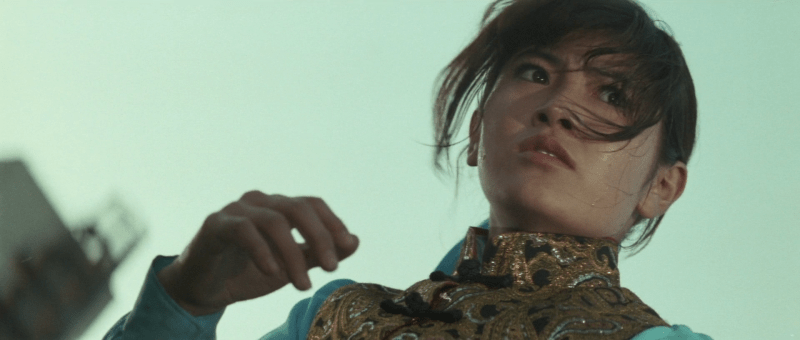
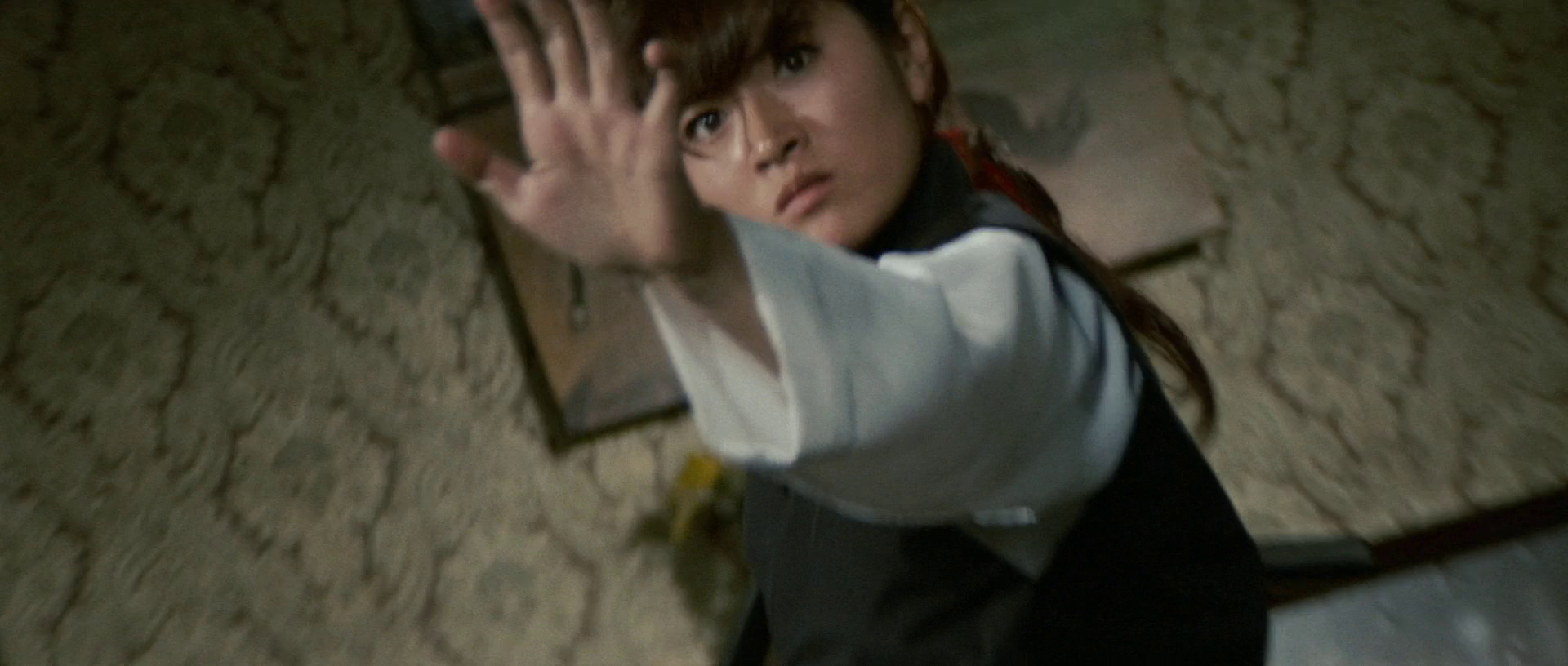
Li Koryu (Etsuko Shihomi) returns to fight crime in Japan in the second in the Sister Street Fighter series, Hanging by a Thread (女必殺拳 危機一, Onna hissatsu ken: Kiki ippatsu). The first film apparently tested so well so that studio execs ordered a second one right away to fill a big New Year slot. That might in one sense explain why the film is pretty much the same in terms of narrative, yet this one does go a little further while swapping the drugs subplot for diamonds.

Koryu comes to the aid of a man being attacked by thugs in a Hong Kong marketplace and is somehow completely unfazed when he plucks out his false eye with instructions to give it to Professor Enmei (Hideaki Nagai) who is also known to Koryu because he’s the father of her old school friend, Birei (Hisako Tanaka). Unfortunately, the false eye contains microfilm that suggests Birei has been kidnapped by vicious Japanese gangsters. The professor therefore sends her to Tokyo on a rescue mission and we discover that she also has an older sister, Byakuren (Kanya Tsukasa), who was never mentioned in the earlier film, who is living in Japan having chased her dream of becoming a jewellery designer.

This time around, it’s diamonds not drugs, but the gangsters still haven’t cracked this smuggling business and have come up with the very weird idea of hiding them in the bum cheeks of attractive young women. Meanwhile, they also force the women into sex work. Osone’s (Hideo Murota) female business partner Mayumi, played by Madam Joy, a drag queen who starred in several Toei films in the mid-70s, films them from a distant window to get material for blackmail. Nevertheless, she only cares about the diamonds, unlike the boss and several of the gang which once again includes a rival martial arts outfit who have in it for the Shorinji temple. 

Shinichi Chiba does not appear in the film, but Koryu does gain a kind of sidekick in the form of Tsubaki (Yasuaki Kurata), a sleazy-looking guy whose intentions are permanently unclear. The film goes a little bit further with its awkward orientalism opening in a Hong Kong marketplace with some offensively stereotypical music and a bunch of fire crackers, even if once again in trends in the opposite direction from most films of the time in that the crooks are all Japanese and it’s a half-Chinese woman who’s coming to sort them all out. The gangsters have apparently been trafficking the women abroad for sex work, then bringing them back with the diamonds in their bums which seems like a plan with a lot of potential problems even if they hadn’t made the huge mistake of kidnapping a friend of Koryu and then later her sister. 

But then again, Koryu’s cases seem to be fairly isolated. Once she takes out these bad guys, that’s it. There’s no wider conspiracy save a general sense that the world itself is corrupt and indifferent to human suffering. Osone has a strange love of taking people’s eyes, which might be a way to stop them seeing who he really is. He has, after all, already taken the stars from Byakuren’s along with her dreams of a new life in Japan finally becoming the jewellery designer she always dreamed of being. Despite her determination to save her sister, Byakuren soon realises that Osone is most definitely not a man of his word. His curiously old-fashioned outfits and demeanour suggest he’s seeking a place with the elites of an earlier time while indulging in some fairly odd behaviour. 

Once again, Koryu squares off against his equally weird henchmen who start attacking her the moment she lands in Japan, and eventually ends up stabbing someone with the severed arm of another enemy still holding his knife. Still, the tone is generally cheerful and upbeat despite the strangeness of the tale and series of losses Koryu experiences including a challenge to her pride when she’s bested by one of the martial arts goons. In this continually uncertain and increasingly surreal world, Koryu’s fists, it seems, are one of the few things that can absolutely be relied upon along with evil smugglers and their bizarre new plans for circumventing the law of the land out of nothing other than lust and greed.


Original trailer (English subtitles)

The Killing Machine (少林寺拳法, Norifumi Suzuki, 1975)

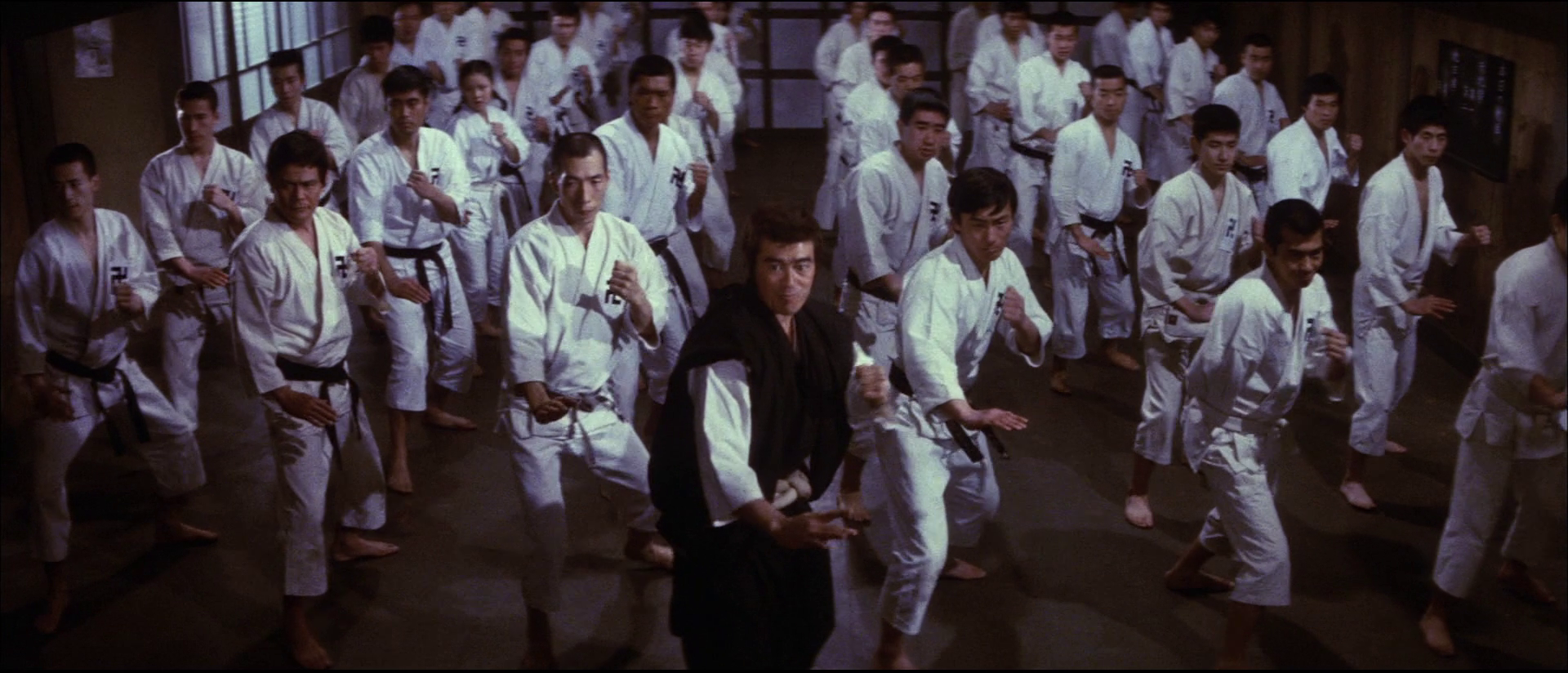
“As long as somebody like you is around, there’s hope for Japan,” an oddly sympathetic prison warden says to the last patriot standing in post-war Osaka. The title of Norifumi Suzuki’s Sonny Chiba vehicle The Killing Machine (少林寺拳法, Shorinji Kempo) maybe somewhat inappropriate or at least potentially misleading as the film is deliberately constructed as a martial arts parable emphasising the spiritual philosophy of self-improvement and compassion that is inextricable from its practice.

To that extent, the hero, Soh Doushin (Shinichi Chiba), is trying to fight his way out of the miasmas of the immediate post-war era. As may be apparent, Soh has taken a Chinese name, though Soh was apparently his along and belonged to a former samurai family whose nobility has been crushed by militarism. As the film opens, however, he’s a Japanese secret service operative in Manchuria blindsided by the news of Japan’s surrender. Soh is it seems a nationalist and a patriot, but a fairly revisionist one who stands up to the abuses of the Japanese army. He later says that he protested the way that the local Chinese population were often treated and he does indeed raise a fist toward an officer who wants to sell a young Japanese woman to a Chinese soldier in return for a guarantee of their safe passage to a boat heading out of the country. The young woman’s mother protests that she is an innocent virgin, a fact that has some later relevance. Soh refuses to let the officers take her, though evidently separated from her later.

When he meets the young woman again in the bomb-damaged backstreets of Occupation Osaka, she is dressed in Western clothing as opposed to the smart kimono she wore in Manchuria and is about to become a “pan pan” or streetwalking sex worker catering to American servicemen. Of course, Soh can’t let this happen either, but as she later tells him, she was raped by Russian soldiers during the retreat and now feels herself to be despoiled. She never wears kimono again and becomes a kind of symbol for a despoiled nation that Soh is reluctantly forced to accept he cannot save in part because his philosophy, which is still uncomfortably rooted in the philosophy of militarism, only valued strength when it should have valued love. The kind of love that Kiku (Yutaka Nakajima) had for her brother that made her willing to sacrifice herself for his wellbeing. 

Even so, Soh is doing his best to issue a course correction by caring for a small group of war orphans and helping them support themselves by running a rice soup stall so they won’t end up becoming dependent on the yakuza or the black market. It’s the yakuza and their increasingly corporatising nature that become Soh’s chief enemies, though standing right behind them are the Occupation Forces. They are, of course, just the biggest gang, as we can see when one of the kids steals a few tins from the gangster’s crate which is marked with text making it clear it came from the mess hall at the American base. The backstreets are full of sleazy soldiers and pan pans or otherwise the starving and dejected, sometimes violent demobbed soldiers filled with despair. It’s these men that Soh wants to buck up, telling them to rediscover their fighting spirit and giving them the opportunity to do so through learning Shaolin martial arts.

Of course there are those who don’t want to learn Chinese kung fu in the midst of their defeat, but what Soh is advocating is something that has a greater spiritual application even than karate can also have. It’s a kind of humanitarian riposte to the futility of the post-war society that might sometimes fail to recognise the depths of the impossibility faced by many in insisting they can be faced by discipline and moral fortitude but at the same time is not really judgemental except toward those who have deliberately abandoned their humanity, such as the trio of goons who rape a school for amusement (the girl is later seen among the students at Soh’s school along with the children from Osaka). The girl’s father reports it to the police, but the police and the gangsters are in cahoots, so nothing gets done. Soh cuts the guy’s bits off so he won’t be doing that again. Strength without justice is violence, he realises. But justice without strength is inability. Strength and love like body and mind should never be separated. The closing shots show an entire mountain covered in white-clad figures practising Shaolin kung fu and joining the humanitarian revolution rather than the cruel and selfish one represented by the gangsters with their red-light districts and black markets. It may be a simplistic solution, but it is in its way satisfying and at least a rejection both of the militarist past and the capitalistic future.


*Norifumi Suzuki’s name is actually “Noribumi” but he has become known as “Norifumi” to English-speaking audiences.

Festival Champ (お祭り野郎 魚河岸の兄弟分, Norifumi Suzuki, 1976)

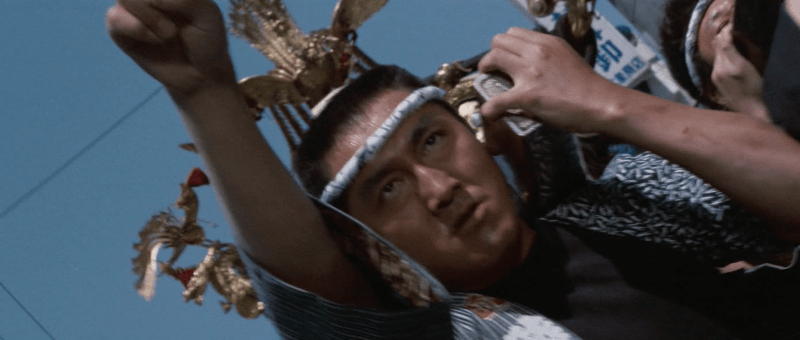
Who doesn’t love a festival? The hero of Norifumi Suzuki’s Festival Champ (お祭り野郎 魚河岸の兄弟分, Omatsuri yaro: Uogashi no Kyodai-bun) loves them so much that he travels all over Japan to help out in places where young men have become thin on the ground thanks to increasing urbanisation and rural depopulation. Following the success of Suzuki’s entries in the Truck Yaro series in 1975 and 1976, the film was part of a new line of comedies and sports movies launched by Toei as well as a vehicle for Hiroki Matsukata who was trying to move on from yakuza movies.

Katsuo (Hiroki Matsukata) is however something of a goodhearted bruiser who is always getting into manly scraps and especially at the festivals he travels to which is a pretty good hook for an ongoing series. But it’s not all that great for his employer who runs a family fishmonger’s at the Uogashi fish market and complains that Katsuo’s always running off and causing trouble. The fish market itself takes on an exoticised quality in the opening sequence which features a voice over from karate queen Etsuko Shihomi, here in a purely dramatic role, who is the daughter of a well-to-do traditional Japanese restaurant and travels there daily by speedboat to pick up the best fresh fish available. Suzuki throws in some documentary-style stock footage and statistics about the market that lend a strangely corporate feel, but then homes in on its capacity as a community hub. Kiyoko says it’s her favourite place precisely because there’s nothing formal about it. Deals are done through body language and you don’t need any kind of resume to work there, everyone’s welcome. 

That may be the implied contrast between Kiyoko’s father, who owns an upscale place and cultivates genuine relationships with local fishermen and brokers, and local boy made good Kurosaki who has supposedly become the CEO of a restaurant chain, itself a symbol of the soulless corporation of ‘70s Japan. Kurosaki rocks up dressed like a yakuza, but everyone treats him as a successful businessman and in part thanks to Katsuo’s boss Zenjiro’s recommendation is eager to make deals with him but predictably he’s running a huge scam that could destroy the local economy. Zenjiro is later faced with the difficult decision of selling his family business to repay all the other fishermen and brokers that have fallen foul of him. 

It’s this societal sense of unfairness that stripper Kumi (Terumi Azuma) hints at when she says she feels “frustrated” and that her long-lost brother Eiji (Toru Emori) probably feels even more frustrated than she does after he slaps her having found out that she’s become a burlesque dancer. As she points out to him, he ran away from home and left her behind with the aunt that was cruel to them so what exactly he expected her to do is a mystery. In the end, it’s his own fault for abandoning her, so he has no leg to stand on in criticising her for the way she’s lived her life. Kumi is well accepted in the local community and walks around in very elegant attire which gives her the air of an “ojosan” or upperclass lady to much greater extent that Kiyoko has in her love of the earthy world of the fish market. The fact that she turns out to be suffering from a tragic terminal illness perhaps only reinforces this sense of unfairness, that the modern world has essentially poisoned her and she can no longer survive in it.

The only things that give her solace are Katsuo and the idea of joining in carrying a shrine festival which would seem to be ways of reconnecting with a more essential Japaneseness. Despite his rowdiness, Katsuo is as she describes him the kindest person she’s ever met and a more positive vision of a still traditional masculinity that looks to protect the community and those around him. He gets into a fight with Eiji, but after exchanging a few blows the men become firm friends, while it’s trying to hook his wimpy friend Kinichi up with a date that brings him to Kumi in the first place. Meanwhile, it seems like Ayuko (Junko Natsu) has a crush on him and despite Zenjiro’s exasperation with Katsuo, everyone expects that he will eventually marry her and take over the family business. 

And so, it’s only a violent, but also quite funny, intervention from Katsuo that can eventually overcome the disruption Kurosaki threatens. Suzuki throws in a lot of his trademark weirdness including all of Zenjiro’s other daughters having fishy names, and a local sex worker who is insatiably aroused by octopuses followed by a gag in which Katsuo is trolled with a suggestive-looking shellfish, but mostly rests on a sense of qualified wholesomeness and community all carried on Katsuo’s broad shoulders as the lone guardian of a more essential Japaneseness otherwise uncorrupted by venal post-war capitalism.


*Norifumi Suzuki’s name is actually “Noribumi” but he has become known as “Norifumi” to English-speaking audiences.

Jeans Blues: No Future (ジーンズブルース 明日なき無頼派, Sadao Nakajima, 1974)

Nihilistic lovers on the run make a break for the sea only to find their pathway blocked in Sadao Nakajima’s anarchic love tragedy, Jeans Blues: No Future (ジーンズブルース 明日なき無頼派, Jeans Blues: Asu naki Buraiha). As the title suggests, the heroes find themselves devoid of hope, pressing the accelerator as far it’ll go with no clear destination in sight and nothing really left to lose while discovering a twisted kind of salvation in their unlikely connection.

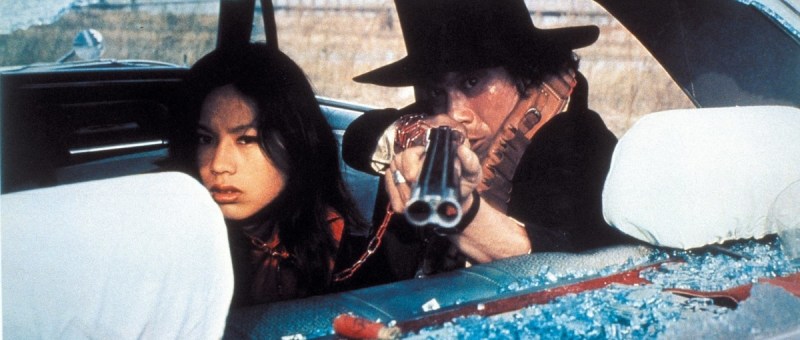
Sensing danger in the air, grave-digging drifter Jiro (Tsunehiko Watase) decides to run off with all the money after his gangster friends off a moneylender on the orders of a businessman. Meanwhile, across town, bar lady Hijiriko (Meiko Kaji) decides to walk out on her unsatisfying life taking some money from the till and her boyfriend’s car for good measure. The pair quite literally collide, but realise that they are much the same in their growing sense of emptiness and impossibility. Nothing really really interests Hijiriko anymore, and watching the car burn after Jiro tossed a cigarette is the only thing that’s made her feel alive in eons. Running through his many and various jobs, Jiro reflects that work is “no fun” either and that the reason he wanted the money was for his sister who he says has run up huge debts paying for medical treatment for a close friend and is now facing the threat of being forced into sex work. 

His sense of impotence is palpable in his desperation and the knowledge that there is no good way to come by large amounts of money especially for a young man from the country with limited prospects. At one point he is beaten by a man with a golf club, a symbol of the class privilege and middle class success that will always elude him. The money, much more than he needs for his sister, gives him a new sense of confidence and possibility even if he remains somewhat frugal, picking up an old banger from a second hand car salesman that immediately blows a tire and apparently belonged to “Koji the murderer” which explains the huge dent in the bonnet. Yet he does at least pay his way, even leaving a collection of notes next to the body of a man he ran over intended to pay for medical treatment which casts him as something of a naive innocent cast adrift in a corrupt society and driven into criminality by desperation.

Trapped inside a shipping container and fearing he may be about to die, Jiro comes to see his fate as karmic retribution for having taken the money that was earned by killing others. Inside the container, the pair are in a sense already dead but also undergo a kind of rebirth if only one fuelled by desperation and the connection that has arisen between them. Hijiriko appears to be suffering from some kind of trauma, experiencing a flashback to the orgy going on at the bar which she had been invited to join but declined much to her customer’s disappointment. He remarks that she always did before, a comment which seems to annoy her though perhaps not as much as the arrival of an older woman a male voice tells her on the phone is a actually quite wealthy and doesn’t need the money but does sex work as a kind of hobby. 

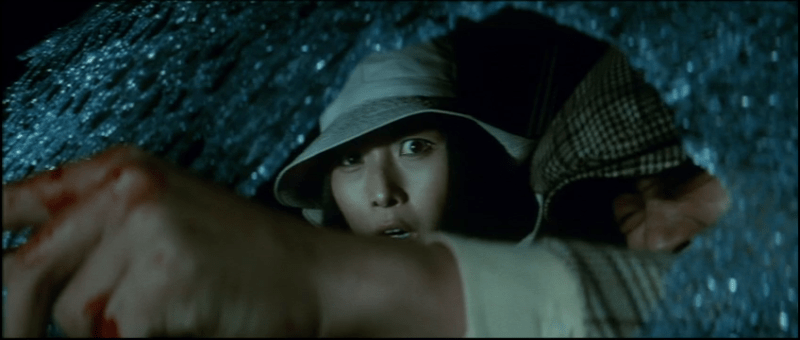
It’s Hijiriko who begins to fight back against the world, dressed in the stylish black leather suit Jiro buys her while he struts around in a cap and three-piece tartan suit. Jiro does not actually kill anyone, but Hijiriko does without a second thought perhaps because she herself is already dead. Using her sexuality as a weapon, she asks a hunter if she can hold his gun and trying his luck he lets her only to end up getting shot when he tries to fight back. The pair rob a petrol station for money but come up with only a few notes and coins while the attendant reveals they’ve already made their daily deposit at the bank signalling just how out of luck these lovers really are. They’re bound for the sea, but travel to the mountains and find there only danger and disappointment. Nakajima lends their flight from a dissatisfying existence a kind of desperation in its breakneck pace and frenetic camera work but equally injects a sense of cosmic irony in the many coincidences and reversals that frustrate the lovers’ escape and in the end leave them only one way out from the society which constrains them.


Original trailer (no subtitles)

Dissolution Rites (解散式, Kinji Fukasaku, 1967)

“We’re all legitimate businessmen now” as a former yakuza explains to a recently released foot soldier stepping out into a very different Japan in Kinji Fukasaku’s Dissolution Rites (解散式, Kaisan Shiki, AKA Ceremony of Disbanding). The funereal opening scenes feature the first in a series of dissolution rites as a man dressed in black reads from a scroll and explains that all the local yakuza clans will be disbanding because despite “working day and night for the benefit of the world and humanity in the spirit of democracy” times have changed and they find themselves unnecessary.

There at the beginning of that change, Sawaki (Koji Tsuruta) served eight years in prison for the murder of a rival gang boss to ensure his gang got hold of a local landfill site where they later built an oil complex. While he was inside, his boss died and his clan disbanded leaving him with nowhere to go but thankfully looked out for by an old friend, Shimamura, who has since become a construction magnate. On his arrival at Shimamura’s office, however, he’s ambushed in a suspected case of mistaken identity while the man driving him is killed. 

Shimamura (Fumio Watanabe) tells him he’s gone straight, but it soon becomes clear that even as yakuza forsake the streets for more organised crime they still behave like thugs using the same old tactics to get what they want. Shimamura is in cahoots with a corrupt local politician, Kawashima (Asao Uchida), and is determined to get access to another stretch of bombed out wasteland owned by an egalitarian doctor, Omachi, who refuses to sell because he’s set up a community there of marginalised people, including Sawaki’s former girlfriend Mie (Misako Watanabe), who work on his chicken farm. Meanwhile, Shimamura is targeted by rival “legitimate businessman”, Sakurada (Hosei Komatsu), who pulls a few dirty tricks of his own in an effort to cut Shimamura out of the picture.

Once again Tsuruta plays a man who is out of step with his times, partly because he’s been in prison but also in his fierce commitment to a now outdated code of gangsterdom. “The chivalry that we were taught was just a way for bosses to use their soldiers” Shimumura insists, “you’ll look foolish if you don’t get rid of it”, disingenuously casting his transformation into a legitimate businessman as a way of freeing himself from yakuza oppression. Sawaki turns down his offer to join the business because it seems a bit dodgy while intensely disappointed to discover another former colleague, Kubo (Kyosuke Machida), running a trafficking ring masquerading as a management studio for cabaret singers and strippers by tricking women with the offer of good jobs then getting the hooked on drugs and shipping to them to Okinawa to do sex work near the US bases.  

On his return, Sawaki is also stalked by the man whose arm he severed in killing the rival boss who turn out to be, like him, an old school gangster which is why he insists on his revenge only to find an unexpected kindred spirit as the two men find themselves each adrift in a world in which no one really cares about humanity and honour. Sakai (Tetsuro Tanba) chooses to walk a different path, conducting his disbandment ceremony in protest of yakuza corruption. Like many Tsuruta heroes, Sawaki also has the possibility of walking away and living a conventional family life as a husband and father having been forgiven by Mei but inevitably is pulled in a darker direction by the necessities of his code. The oil complex he helped to create is only a symbol of the duplicities of the post-war society allowing men like Shimamura to get rich while literally choking the life out of those like Mei whom they now want to kick out of her home to add insult to injury. 

There’s no one more tragic than a yakuza Sawaki admits, knowing there is no longer any place for him in an amoral gangster society while unable to simply leave it and enjoy a quiet life with the woman he loves. An indictment both of corporatised yakuza and the equally duplicitous practices of “legitimate” businesses and corrupt authorities, the film ends in another righteous assault filmed handheld with Fukasaku’s characteristically canted angles amid the chaos and confusion of a rapidly changing society. 

Curse of the Dog God (犬神の悪霊, Shunya Ito, 1977)

By the late 1970s, Japan was a very prosperous place and the cutting edge of modernity yet old beliefs die hard and those who run afoul of a natural order they assumed had long been forgotten will pay a heavy price for their arrogance. After a four-year hiatus following the third of the Female Prisoner Scorpion films, Shunya Ito returned with a strange slice of folk horror The Curse of the Dog God (犬神の悪霊, Inugami no Tatari) in which it is indeed the city invaders who have transgressed these ancient boundaries in their wilful indifference to the natural world.

The conflict between these two Japans is clear in the opening sequence in which three men pass through a tunnel in a truck bearing the logo of a nuclear power company and emerge into a village where a group of boys jump out from behind a row of tiny haystacks wearing masks made of leaves. The boys crowd around the van asking the strangers why they’re here and they jokingly tell them that they’ve come to look for “treasure,” which turns out to be a quest to find uranium in the local mountains. Otherwise uninterested in the village or the landscape, the men back their truck into a dilapidated roadside shrine which then collapses, and subsequently run over a little boy’s dog which had attempted to stop their car by barking fiercely at them. Rather than stop to apologise or comfort the boy who is cradling his dead dog in his arms, the men sheepishly drive off as if embarrassed. 

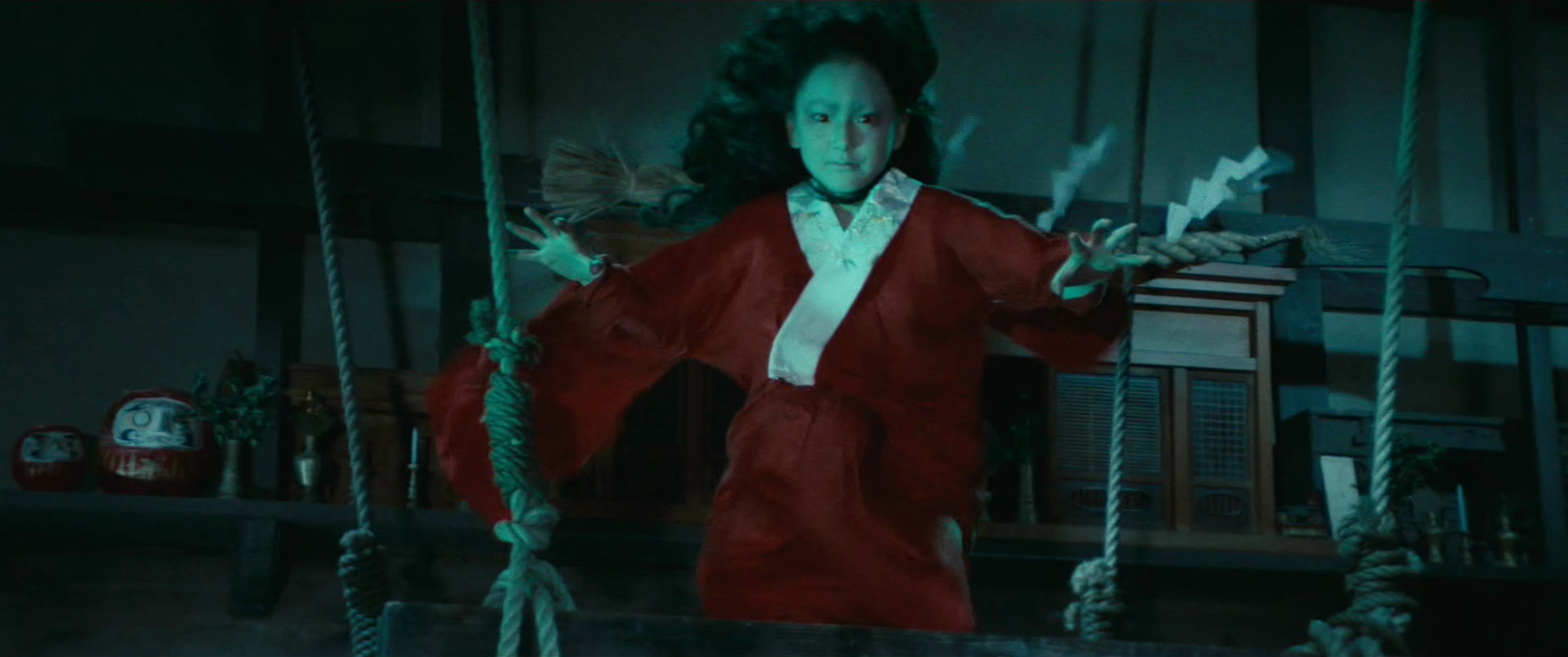
Of course, the shrine turns out to belong to the Dog God who is guardian deity of these mountains and now incredibly annoyed not just by the destruction of the shrine and killing of the dog, but by the men’s intention to tear the natural world apart looking for something which could prove very destructive even if they claim they want to use it responsibly to fuel the economic rocket which is Japan in the 70s. The Kenmochi family, the head of which, Kozo, is the local mayor are very receptive to the firm’s entreaties and immediately grant them access to their land while arranging a marriage which at least in part dynastic between Kozo’s daughter, Reiko (Jun Izumi), and the head of the expeditionary group Ryuji (Shinya Owada). But once they return to the city, the other two men die in mysterious circumstances, one entering a kind of trance and walking off the roof of the hotel after the couple’s formal wedding reception and the other attacked by a pack of wild German Shepherds in the middle of Tokyo. 

Reiko is quick to exclaim that it’s all the fault of the Dog God, though it’s never quite clear whether or not she is aware that her family is the subject of an ancestral curse because they themselves offended the deities by getting their hands on the land cheaply when it was used as collateral for a loan. In contrast to the Tarumis, the family of Reiko’s best friend Kaori (Emiko Yamauchi) and her little brother Isamu (Junya Kato) who is the boy whose dog they killed, the Kenmochis put on heirs and graces and as if they were the ancestral aristocracy of this area rather than having made a speedy class transition thanks to someone else’s misfortune and the vagaries of the post-war era. The Tarumis, meanwhile, live in a much more humble home and dress in a much more traditional mountain village manner. Patriarch Kosaku (Hideo Murota) point-blank refuses to sell his land and will have little truck with Ryuji or the mine once it opens, leaving the family regarded as outcasts within the village. 

But then there is a definite and literal pollution signalled by the arrival of the prospectors. At a meeting, it’s suggested that the sulphuric acid they’re using to flush out the uranium in inaccessible areas of the mine could contaminate the local groundwater which is a problem when many families are still taking their water from wells but they all laugh it off. Sometime later Ryuji is horrified to see dead fish floating in the river, while his own in-laws, the older generation of the Kenmochi family, are also killed by ingesting contaminated water. A rumour arises that the culprit is the Tarumis who have poisoned the wells out of spite, and when Ryuji tries to raise the alarm after getting a positive result for sulphuric acid in the water supply the company tell him to pin it on them instead. 

The intrusion of modernity has interrupted the careful, if woefully feudal, balance of the village with terrifying and tragic consequences. Yet Kosaku is also surprised, asking how a city man like Ryuji could really believe in something like a “curse”. The shamans they bring in to do a ritual also blame everything on the Terumis, adding the suggestion that the ill will is motivated by Kaori’s sexual jealousy over Ryuji giving rise to yet another interpretation of the curse’s origin besides the Kenmochi’s class transgression and the unintentional offence caused by the destruction of the shrine. Then again, perhaps it really is all because of the Dog God in a great confluence of coincidences that have led to this incredibly strange and unfortunate situation. In the end, even the film’s purest character, the Kenmochi’s small daughter Mako (Masami Hasegawa), is possessed by the evil spirit and made to take her revenge with a remorseful Ryuji desperately trying to repair what he himself broke in the acceptance that he should not have come here and was the catalyst for this confrontation with fate. Weird and haunting even in its bizarre obscurity the film nevertheless makes a case for the protection of the dark heart beating at the centre of the contemporary society which speaks of something older that cannot be crossed and most specially by those hellbent on a hubristic path to prosperity that has little respect for the land.


Zero Woman: Red Handcuffs (0課の女 赤い手錠, Yukio Noda, 1974)

“Your sense of duty is too strong! The world isn’t a pretty place,” barks an irate policeman, scolding a female officer with a tendency to take things, in his view at least, too far. Yukio Noda’s kidnap drama Zero Woman: Red Handcuffs (0課の女 赤い手錠, Zeroka no onna: Akai Tejo) is on the extreme end of pinky violence and soaked in the political concerns of the 1970s along with all their concurrent paranoia but nevertheless positions its fearless avenger as a lone arbiter of justice in an incredibly unjust world. 

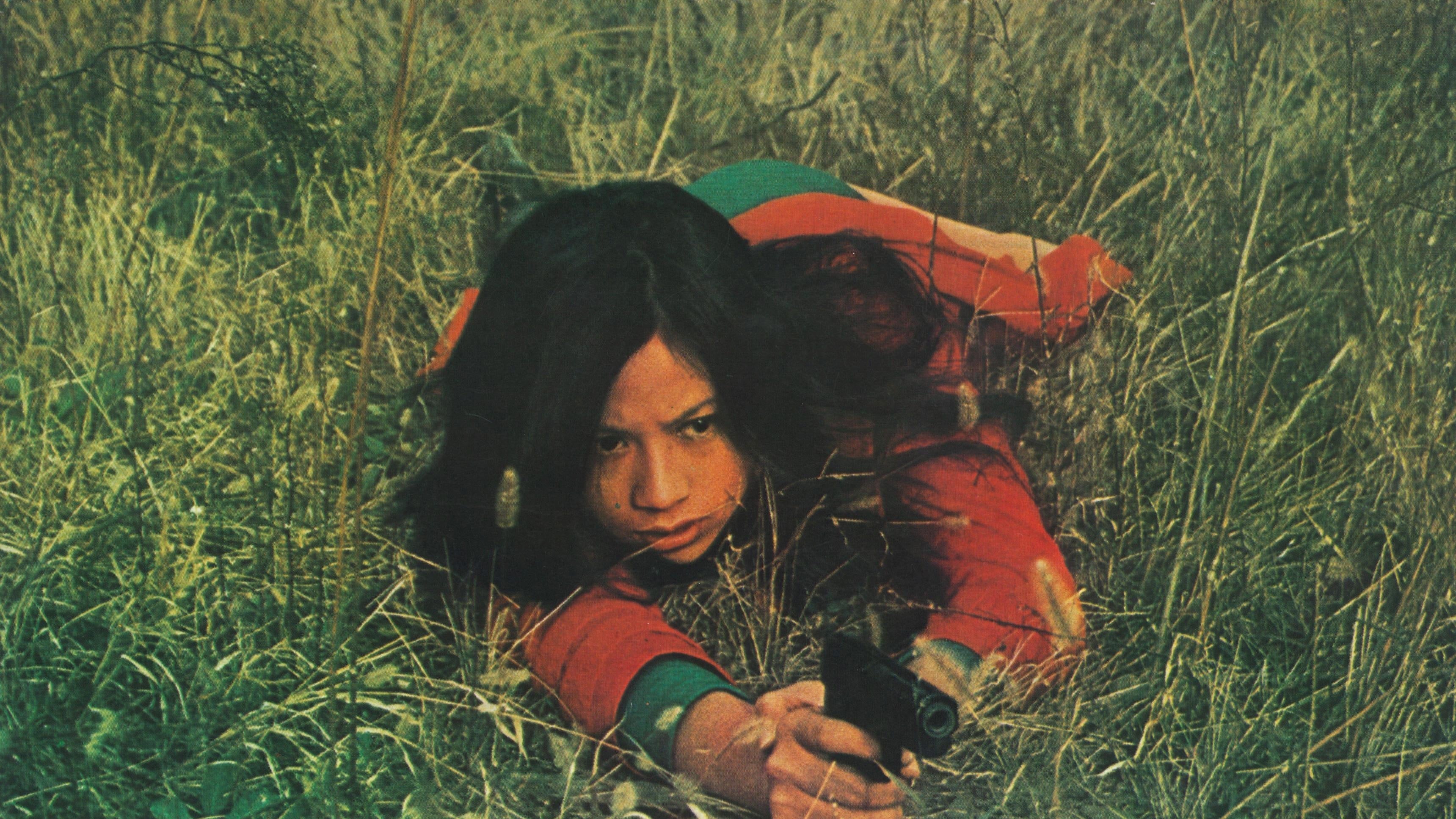
We know this from the start as we see Zero (Miki Sugimoto) almost date raped by an apparent serial killer who has his own torture suitcase and apparently killed her friend. Knowing that he is a diplomat and therefore has diplomatic immunity, she simply shoots him in the balls in the film’s extraordinary opening sequence. But even though it could be argued what she did was self-defence, Zero is kicked off the force and thrown into a woman’s prison for an indefinite period of detention to keep the lid on any possible scandal. Zero is only reprieved when the daughter of a politician is kidnapped by thugs and, wanting to keep things quiet, they need someone to rescue her and also wipe out all of the kidnappers to ensure no one ever finds out.

Kyoko (Hiromi Kishi), the politician’s daughter, claims that her father will do “anything” to ingratiate himself with the prime minister and has in fact already arranged her marriage to his son. Kyoko, however, already has a boyfriend who, inconveniently, is quite obviously a student protestor given his yellow construction hat and other paraphernalia. The pair are accosted while sitting in a car near an old American base, and as Kyoko is gang raped, firstly by the gang leader Nakahara (Eiji Go) who is wearing a hoodie with the words US Navy printed on the back, US planes fly over her as if she were being raped by America in an obvious metaphor for the legacy of the occupation. 

Indeed, the flashbacks later experienced by Nakahara are of his mother whom he describes as a sex worker who worked at the base suggesting a very literal allusion to the corrupting influence of American servicemen. The gang operate out of a bar called “Manhattan” which is surrounded by other similar bars with Western names in a neon-lit area, while they constantly run across various signs written in English in fact peeing directly on a no peeing sign outside a largely disused residential area on the edge of the base where they later take hostage some kind of amateur dramatics / English-language class currently in the middle of a production of Romeo and Juliet. 

Yet the big bad turns out to be essentially homegrown in the form of the corrupt lackey policeman Osaka, and the politician Nagumo (Tetsuro Tanba), who is more concerned with his political capital than his daughter’s safety keen that the police keep everything out of the papers otherwise the wedding will be called off and he’ll have a problem with the prime minister. Seeing a very pale Kyoko, her clothes torn, barely conscious having been drugged by the gang, he says he no longer cares to think of her as his daughter and perhaps it would be better if she simply passed away in an “accident”, instructing Osaka to care of loose ends like Zero too. 

It’s very clear that women’s lives have little currency in this very patriarchal world, something Zero seems to know all too well even if at the beginning of the film she was content to work for the oppressive organisation of the police force though she later tears up her warrant card in disgust. The fact that division zero, operating like a secret police force on the behalf of an authoritarian government, exists at all is a clear indication that this is already a police state though one subverted by Zero who uses her red handcuffs to deliver ironic justice to all those who deserve it. Then again, unlike other pinky violence films there’s precious little solidarity that arises between herself and Kyoko whom she later describes as nothing more her mission objective seemingly caring little for her as a fellow human being. Noda cuts back between the Diet building and police HQ as if actively critiquing the latent authoritarianism of the early 70s society but even if Nagumo gets a kind of comeuppance it’s abundantly clear that nothing really will change and Zero stands alone wilfully freeing herself of the handcuffs of a controlling society. 


The Tattooed Hitman (山口組外伝 九州進攻作戦, Kosaku Yamashita, 1974)

The close brotherhood between two men is disrupted by changing times in a more contemporary gangster drama from Kosaku Yamashita, Tattooed Hitman (山口組外伝 九州進攻作戦, Yamaguchi-gumi gaiden: Kyushu shinko-sakusen). As many are fond of saying, times have changed and the yakuza must try to change with them or else meet a melancholy end. But as the hero admits, change is something he has no intention of doing even as his old school gangsterism leaves him increasingly at odds with the corporatising ways of the contemporary yakuza. 

The change in the times is obvious from the film’s opening sequence set in 1957 in which an attempt is made on the life of petty boss Ishino (Tatsuo Umemiya) by a gunman who shouts “die, for the good of the world” before firing a pistol and running away. Ishino has been targeted in a dispute over construction rights connected with the regeneration of hot springs resort, Beppu. The hit seems to have been ordered by rival gang, Sakaguchi (Eizo Kitamura), the leader of which is also a prominent local politician who is content to abuse his power for his own financial gain. So confident is he in his safety, that Sakaguchi even gets the police involved rather than deal with it himself. 

Ginji (Bunta Sugawara) has been Ishino’s sworn brother since their teenage delinquent days and determines to get revenge by raiding the Sakaguchi offices and killing one of their high ranking officers. Seeing as he’s already wanted by the police for a previous murder, Ishino sends Ginji to Osaka to lay low while working for an associate, Daito, mainly as a debt collector. It’s this act of separation which introduces a rift between the two men. While Ginji waits patiently to be recalled, Ishino climbs the ranks of corporatised gangsterism by learning to play by the new rules. 

To fill the void, Ginji takes on a new “brother” or perhaps surrogate son in the wayward Ken (Tsunehiko Watase) whom he first meets cheating at pachinko at a parlour where his pregnant wife Fusako (Mayumi Nagisa) is working. It’s Ken who first drags him into a brewing turf war as Korean gang Soryu threaten to disrupt the local equilibrium not least by selling drugs of which Ginji does not approve. Ginji “saves” Ken from joining Soryu by essentially making him his one of his guys though he doesn’t really have much of a position in Daito’s gang, offering him a sense of grown-up responsibility by handing him a pistol with the only the instruction to make sure he shoots with two hands. Unfortunately, Ken will follow his advice but otherwise ends up almost causing an incident with another gang by shooting a man who disrespected him in the street. Ginji marches straight down there to sort things out, but on arrival discovers an arrangement has already been made with his boss which further strains his sense of pride and confidence in his position as a yakuza.

Ginji feels something similar on being invited to a party to celebrate Ishino’s promotion only to be seated with the lowly footsoldiers and ignored by Ishino all night. Ishino rejects him still further in agreeing to plan to send him back to Kyushu out of the way hoping that his old school hotheadedness can finally be tempered. Others meanwhile voice concern that Ginji may have forged a relationship with rival Kobe gangs during the 18 months he abruptly disappeared from Osaka and has only come back to cause trouble. Ginji perhaps knows that he has no more future in the contemporary society, others remarking that seems like someone who is in a sense already dead for having accepted that he will die and most likely in Hakata, the town he had wanted to conquer with Ishino who had crushed his dreams in his newfound pragmatism by calmly explaining that they would never have the power to take it. 

Koji Takada’s screenplay positions Ginji’s gradual decline as an allegory for the yakuza himself while citing the new legislation that this particular series of incidents made necessary creating the new offence of assembly with dangerous weapons as a decisive moment in weakening the yakuza as an institution. Ginji remains a man displaced by his times unable to move forward into a new society in the way that Ishino has but stuck in a permanently post-war mentality despite the constant reminders that “times have changed”. Yamashita adopts the trappings of the jisturoku drama with frequent references to real life events and narrative voiceover but otherwise maintains his classicist formalism while ending on a note of ambivalence that tells us a certain kind of justice may have been served but the cycle of violence may not yet be completed.


Original trailer (no subtitles)

The Kamikaze Guy (カミカゼ野郎 真昼の決斗, Kinji Fukasaku, 1966)

The hero of Kinji Fukasaku’s Kamikaze Guy (カミカゼ野郎 真昼の決斗, Kamikaze Yaro: Mahiru no Ketto) is described as cheerful and with a spirited personality though unfortunately not very bright. A vehicle for rising star Chiba, the film was intended as the first in a series starring its bumbling hero, Ken Mitarai, though no other instalments were ever produced. In any case, it seems to echo the lighter side of Nikkatsu’s borderless action line along with Toho’s spy spoofs in its wrong man tale of wartime legacy and corporate duplicity. 

Often called “Mr. Toilet” because of the way his name is pronounced, Ken (Sonny Chiba) is a slightly sleazy private plane pilot who has pinups on the roof of the cockpit. According to the voiceover, there is no bottom to the depths of his crassness which is a sentiment later borne out by his attempt to pick up a woman on a ski slope by uttering the immortal lines “please don’t think I’m a creep, just hear me out.” However, events take a turn for the strange when the pair of them are witness to a murder. Ken valiantly tries to help, but is later brought in as a suspect himself, partly as the police are annoyed by his smugness. The woman, Koran (Bai Lan), turns out to be from Taiwan which is where Ken ends up flying only to discover that his cargo is the body of an old man he also encountered at the slopes. 

In keeping wth the growing internationalism of mid-1960s Japanese cinema, the film travels to Taiwan but does so in a rather complicated way as Ken is drawn into a plot concerning three men responsible for the death of a Japanese official shortly after the war killed because he wanted to return 200 billion yen’s worth of diamonds stolen from the local population. While on his travels, Ken runs into a woman who was trafficked to the island at the age of 15 and later cheated out of the money she’s saved to return. The film almost flirts with the awkward relationship between the two nations and Japan’s imperialist past but in the end does not quite engage with it save for the brief appearance of the indigenous community which seems to stand in for layers of historical and contemporary colonialism.

In any case, the murdered man was Japanese as were the two of the three currently being targeted in the assassination plot Ken is being framed for. Ken’s defining characteristic is his bumbling earnestness in which his determination to get to the bottom of the mystery only lands him in further trouble. At one point he even tries to stop the villain escaping by standing in front of the plane with his arms wide open as if it hadn’t really occurred to him that a man who has already killed a number of people is unlikely to be deterred by the thought of killing one more. Nevertheless, it provides the film with one of its more memorable and quite incredible sequences as Ken grabs on to the wing support as the plane is taking off and eventually climbs his way inside.

Chiba reportedly designed the action sequences himself and his martial arts skills are very definitely on display in the unusually well accomplished fight scenes while the film also contains a lengthy and expertly choreographed car chase albeit one occasionally interrupted by random bison and an indigenous parade. Perhaps because of this manly tone, there is an unfortunate strain of semi-ironic misogyny that runs through the film with frequent exclamations that women are too quick to jump to conclusions while Ken later seems slightly put out that Koran is “using her feminine wiles” to combat the bad guys. 

By the same token, there is something a little ironic and subversive in the film’s use of the term kamikaze, self-adopted by Ken to emblematise his devil may care nature while otherwise setting the action in a nation once colonised by Japan that holds a celebratory gala in Ken’s honour for his assistance in retrieving the gold and returning it to the Taiwanese people. Perhaps in another sense, it echoes a new willingness to make restitution with the past even if Ken bumbles his way into it and does so by accident taking on both the new and destructive capitalism of the post-war society and the toxic wartime legacy and freeing himself from them, literally a body flying in midair with no direction but his own.

Original trailer (no subtitles)