Murder on the Last Train (終電車の死美人, Tsuneo Kobayashi, 1955)

Rather than the hard-boiled tale the title may suggest, Murder on the Last Train (終電車の死美人, Shudensha no Shi Bijin) seems to be one of a number of films made in the early post-war era designed to improve the reputation of the police force. Just as in Bullet Hole Underground, we’re shown several scenes showcasing police technology and depicting detectives as men of science rather than an authoritarian force extracting confessions and pressuring suspects. The film went on to inspire a long-running series of police procedurals, and is shot in the style of a documentary lending an air of realism to its tale of murder, desperation, and spiralling debt.

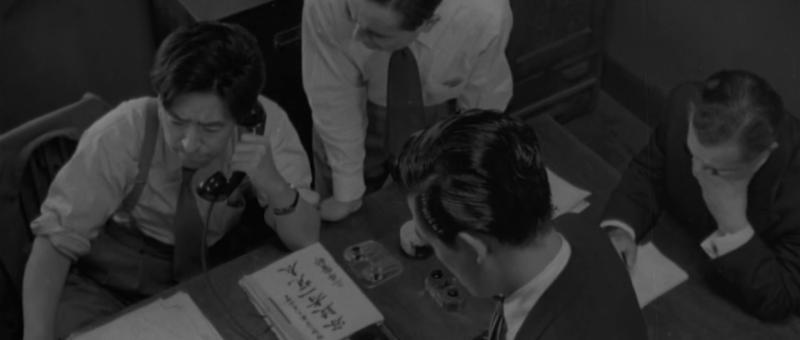
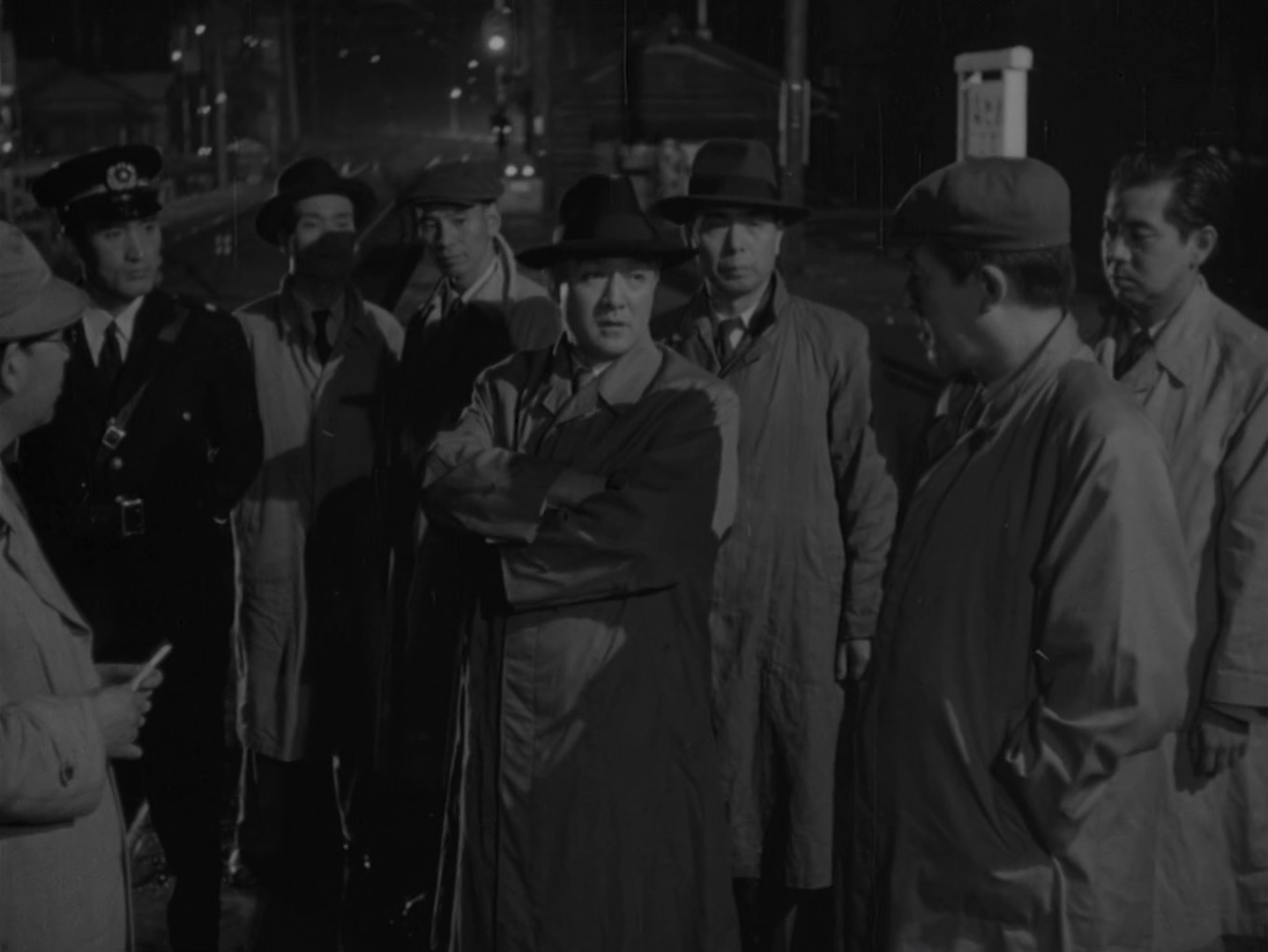
Yet all the police know in the beginning is that a young woman has been found dead on the last train out of the city at its final stop of Mitaka. Times being what they are, they don’t even know who she is, and have only slim leads to go on such as the possible sighting of a middle-aged man running away across the tracks, though it was dark and raining so no one can be quite sure. Nevertheless, we quickly see the law enforcement machine spring into action. The call centre is alerted and arranges for detectives from the top murder squad to attend the scene. The narrator tells us that they are ready to respond at any time of day or night, and that, like a pack of wolves after their prey, they will not rest until they’ve apprehended the guilty party. The way this and the closing statement are phrased makes it sound a little like the squad is sort of eager for a murder to occur to have something to do, which probably isn’t the intention but does make them seem a little blood thirsty. Especially as one of the policemen we’re introduced to is said to care about nothing other than murder. 

Nevertheless, the narrator introduces us to all of the squad members who each have their quirks from the henpecked husband to the former monk. There’s a running gag that they can’t get anything done at their office because of constant noise outside from advertisements, festivals, and children singing. Despite all of their technological advances, all they can really do to begin with is wander round Mitaka with photos of the victim along with one of a man found inside a locket she was carrying, asking local people if they know them. They can only assume the woman must have lived in Mitaka because she was presumably killed between the previous stop and the train’s final destination, but there are other reasons she may not have alighted earlier. 

The trail eventually leads them to a land broker, Hayakawa (Eijiro Tono), who has a solid alibi but is acting in an incredibly suspicious way. He also turns out to be in mountains of debt, and may have been acting recklessly trying to right himself financially, while a young man he’s acquainted with, Saburo, may have equally been hooked on the idea of living the high life on stolen money. Another man has been embezzling from his company with no real explanation given as to why save possibly trying to get himself into a financial position appropriate for marriage. The implication that this economy is still a crime factory filled with desperate people who do anything they can either to escape their straitened circumstances or protect what they have.

That might be one reason the police, who all seem very nice and, in general, treat suspects and witnesses kindly and with respect, are keen to get away from the idea the murder may have been a random crime perpetrated by someone trying to ease their frustration or strike back against society. People can feel reassured that this young woman’s death can be explained because it means they are in less danger from a threatening world. The policemen are also there to provide that reassurance, suggesting that any crime that occurs will be swept away neatly, without really dwelling on the other implications of a super-powered police force. The narrator explains that most crimes are committed simply, and for simple reasons, which is comforting, in a way, but also not. In any case, the central message is that modern law enforcement is scientific and compassionate, and the police force a well-oiled machine designed to protect all citizens from the threat of crime wherever and whenever it may arise.

The Eleventh Hour (どたんば, Tomu Uchida, 1957)

The problematic working practices of a post-war coal mine are thrown into stark relief when five men are trapped underground during a collapse in Tomu Uchida’s tense rescue drama, The Eleventh Hour (どたんば, Dotanba). Based on a TV play which was itself inspired by real events, the title alone tells us that we can expect a happy ending even if it’s somewhat undercut by the cynical quality of the fanfare with which it is greeted. Nevertheless, it’s clear that the mine itself reflects a dark side of the contemporary society even as it rocketed towards an economic miracle at least on one level fuelled by coal. 

The Towa mine is a small concern run by the owner, Sunaga (Yoshi Kato), who was a miner himself in his younger days, and the chief engineer Kusaka (Shin Tonomura). In the opening scenes it becomes apparent that they are having difficulty running the business effectively while chasing lucrative large-scale contracts. Kusaka pulls Sunaga aside and attempts to warn him that recent attempts to fit a replacement support beam have caused the structure to shift with the effect that it has begun leaking water. The implication is that Sunaga has attempted to cut corners and endangered the miners’ safety. He barely listens to Kusaka’s complaint before barking at him that it’s his responsibility to take care of, and he must be aware of the cost implications involved seeing as he more than anyone knows how hard it is to run this kind of business. 

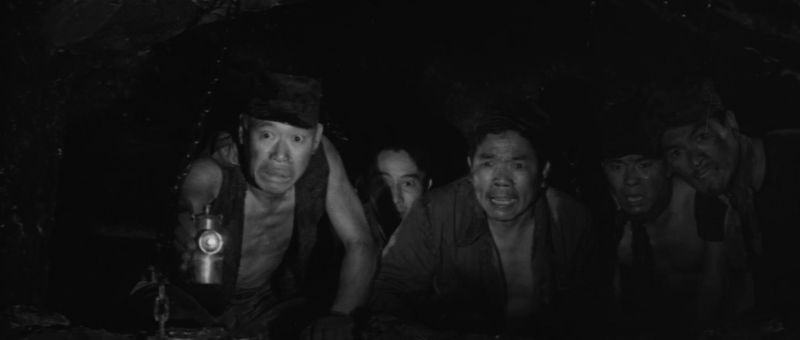
Unfortunately for him, a sudden rainstorm spells disaster when the mine begins to flood. Some workers still underground are able to escape thorough a support tunnel that connects to another mine, but five are trapped at the other end having managed to climb to a higher shelf above the water. In the rain-soaked soil, some of the above ground structure also begins to collapse, while to his credit a distraught Sunaga calls in the police and miners’ union as soon as possible rather than trying to cover up the disaster to hide his mismanagement. 

For all that, Sunaga is not a stereotypically exploitative mine owner so much as a bad businessman possibly in over his head though as a former miner he should have known better. On the one hand, he had only just found out about the unstable support arch and could not have fixed it before the disaster but as he himself agrees he bears the ultimately responsibility for the way the mine was run which includes skimping on repairs and inspections. More than anyone else, he wants the men to be rescued alive and later tearfully tells his wife that he has considered suicide but is now resolved to sell the mine and his own home to compensate the families should the worst happen. Kusaka later does try to take his own life after witnessing the rescue effort flounder, a Buddhist priest later suggesting that his act may have been intended as a kind of human sacrifice as if he could save the men’s lives by offering up his own. 

Then again, the way some of the men put it it seems like some mine owners view the compensation money for workers killed on the job as a kind of fine they’re prepared to pay to maximise profits. The film briefly introduces the circumstances of the some of the men and their families, one a husband and father who asks for an advance on his pay because his wife and daughter are ill with something that could turn out to be measles. The amount of the compensation money isn’t clear, but may not be enough for a widow to raise a five-year-old daughter to adulthood. If these men die, their families may die with them. Other relatives waiting for news include an elderly man anxious for his only son, and a grandmother waiting for her grandson who only went to the mine to have a look around before potentially starting to work there. 

In the case of the young Yamaguchi (Shinjiro Ebara), the film hints at the way the industrialisation presented by the mine has disrupted local communities as farmers’ sons leave the land for the promise of better pay for working underground. Yamaguchi is taking the job because his father is ill with some kind of neurological complaint, possibly caused by industrial pollution, and he has argued with his brother presumably about money and the responsibility of earning his keep. While underground, he runs into a friend of his father’s, Banno (Takashi Shimura), who tells him that mining is not a job you can do for life and he himself seems far too old to be doing such physically strenuous work though he is the only one almost able to stand when the men are eventually lifted from the mine. 

A veteran miner, Banno too is perhaps complacent. He smokes underground and blows the cigarette out after every puff but only to avoid carbon monoxide rather than a potential explosion. Trapped underground twice before, he does his best to comfort the other men while reassuring them that their colleagues are working to rescue them as they speak. Most of the mine workers from the surrounding area have indeed come to help, along with a specialist rescue team from Tokyo, though they make little progress with the tools available to them. As a journalist puts it, small enterprises don’t have access to the same resources as large corporations and cannot simply order in larger pumps or better diggers. Many of the workers want want to give up with the main support coming from the korean miners from a neighbouring town though they get little thanks for the efforts. After overhearing a frustrated member of the rescue team employ a racist stereotype to describe them as lazy drunks only after money, they withdraw their labour. 

Sunaga is later forced to go back to the Koreans cap in hand with a personal apology, but though some of them are personally sympathetic they remark on the level of discrimination they’ve faced for the entirety of their careers and aren’t sure why they should help Sunaga now considering the way they’ve been treated. On a side note, standard workers protections would not apply if they were killed or injured during a rescue attempt meaning they’d be risking their families’ lives as well as their own for men who are almost certainly already dead. It’s not surprising that they overwhelmingly vote not to help leaving a dejected Sunaga devoid of all hope. 

Nevertheless, they eventually reconsider reflecting that if they were trapped underground they’d want to believe someone was coming and if they don’t come now then they won’t have any right to expect them to. It is workers’ solidarity that eventually saves the miners, from winch operator Michi (Masako Nakamura) who refuses to leave her post so that the men won’t feel “abandoned” to those who arrive to rejoin the rescue effort just when it seems the most hopeless. The solution to cracking the mine is found only by listening to a former employee who hints at its dark history in reminding them of a secret support tunnel sealed up after the war once military equipment had removed.

It might be tempting to read an allegorical message into the solution being the need to blast through the buried wartime past to rescue the men trapped on the other side though it may be a bit of a stretch. In any case the action outside is also somewhat ironic. As the mine collapse becomes national news and attracts rubbernecking crowds, a man turns up to sell ice cream, while journalists also report on the event from the close by. They seem broadly hopeful, but are also looking for a good story and all too quick to report on Kusaka’s suicide attempt. When the men are eventually rescued, they order a helicopter to drop confetti over the surrounding area (possibly unhelpful to local farmers) along with a bouquet for each of the men. Uchida had some experience of working in a mine during his time in Manchuria which had permanently ruined his health and had first hand knowledge of how a mine works and what happens when something goes wrong which explains the otherwise naturalistic opening sequence laying out the conveyor belt design of the complex as the coal is picked and transferred into pick up trucks that will take it to its new owners. It is however “dark and wet like hell” underground, a place that ideally no one should have to go and that all should eventually be rescued from.