Devil’s Nursery Rhyme (悪魔の手毬唄, Kunio Watanabe, 1961)

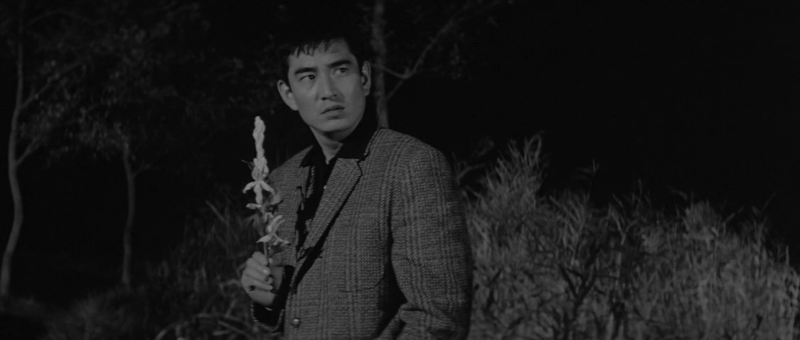
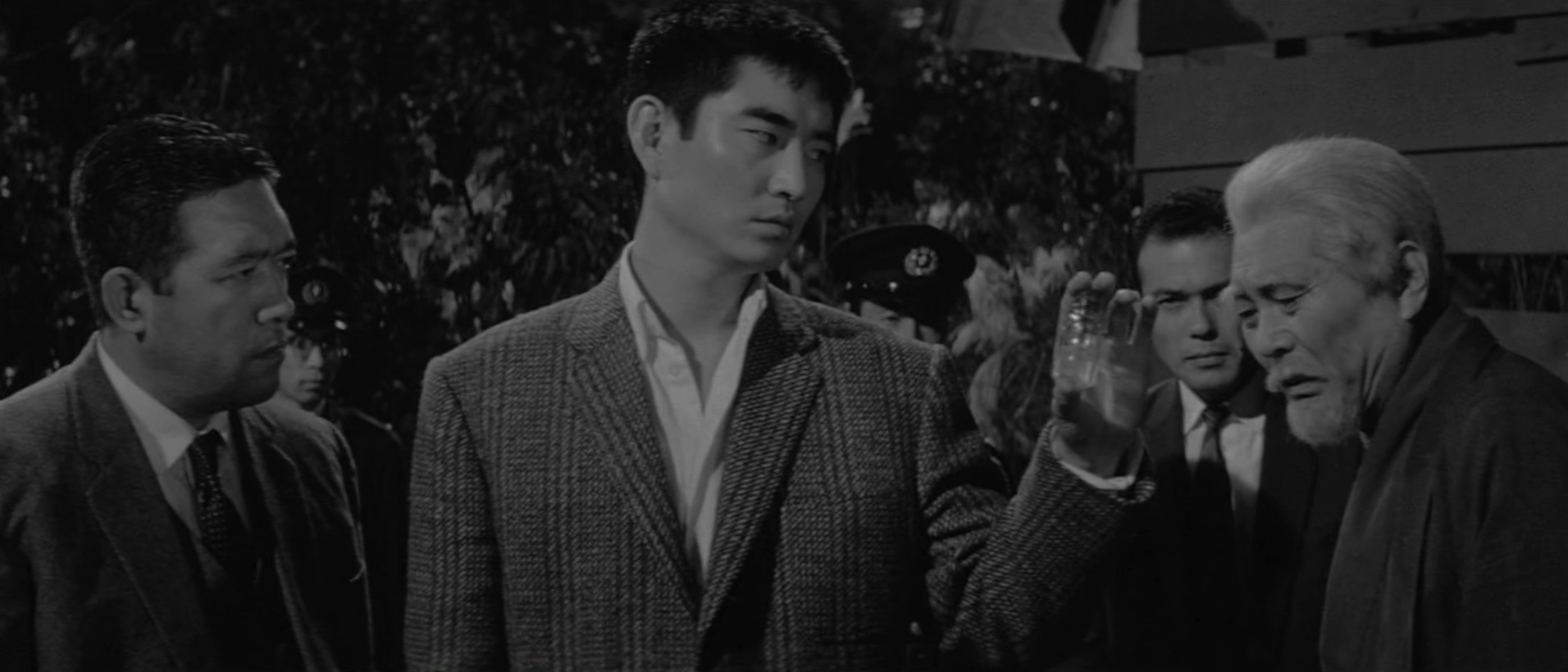
Ken Takakura might seem like a slightly odd fit for Seishi Yokomizo’s iconic detective Kosuke Kindaichi who is known for his dishevelled appearance and general eccentricity. This 1961 adaptation of The Little Sparrow Murders, Devil’s Nursery Rhyme (悪魔の手毬唄, Akuma no Temari Uta), however, follows the path laid down by the Chiezo Kataoka-led series of Kindaichi movies in making Kindaichi a more conventional private detective who is also a consultant to the police force. As such, Takakura plays him as a dapper young man, first seen wearing a cravat and sunglasses while driving a distinctive sports car. In terms of his detecting style, however, he’s much Sherlock Holmes, relying on his observational skills to spot small details that help him to solve the mystery.

As for the mystery itself, it bears very little relation to Yokomizo’s novel. Director Watanabe was apparently unhappy with the script he was handed and had it entirely rewritten by Shinji Kessoku. Kessoku later recalled that he was only handed the original script to rewrite and wrote his version without ever reading the book, coming up with what is basically an entirely new, much simpler story that only keeps the feudalistic tensions of Yokomizo’s original in revolving around a family whose prosperity was effectively stolen through underhanded means.

Oldest daughter of the Nire family Sumako (Machiko Yashiro) has become a popular singer and is returning to her hometown for the first time in a while after receiving a threatening letter. Unfortunately, she is murdered on the way while her new single featuring her singing a local folksong plays on the radio. It soon transpires that her father, Gozo (Yasushi Nagata), has also been receiving threatening letters and is urged to go to the police by his son, Genichiro (Fumitake Omura), though Gozo insists the two things are not related. Meanwhile, he is perturbed by the return of local man Tatsuzo (Zeko Nakamura) after 18 years, fearing he means to poke into the death of his former boss Aoike whose land Gozo ended up acquiring less than ethically.

Kindaichi is in town after being contacted by Sumako and soon sets about investigating with the help of Kazuo (Tou Ono), the university boyfriend of Sumako’s younger sister Satoko (Kiwako Taichi). Kessoku and Watanabe don’t stick too closely to the classic Yokomizo formula and only include a little of the supernatural strangeness his work is known for such as the appearance of a weird old woman who seems to be a local shamaness, warning of the cursed plants near the lake and mentioning her frequent communications from the gods foretelling danger and disaster for everyone. Similarly, Gozo is apparently tormented by the Temari Uta song Sumako has just released, though unlike the novel it doesn’t have very much to do with the murders which don’t follow any particular pattern.

Though set in the present day rather than the slightly earlier setting of the novel, the “curse” does in fact relate to village dynamics and the unfair rise of the Nires who destroyed the Aoike family to become the village leaders. Not everyone who lives in a big house is a good person, Tatsuzo point out as if in one sense kicking back against the idea of feudal privilege but at the same time remaining loyal to the Aoikes and only resenting Gozo because he manipulated the system to claim a privilege he wasn’t really entitled to. The Nires have a bad reputation locally and this is likely why. People don’t like it that they usurped their position and expect the upper classes to be a little more morally upright, rather than objecting to their existence in the first place or rejecting the kind of power they still wield over them locally even in the democratic era.

Nevertheless, Satoko eventually decides to make amends by dissolving the family estate and giving the money to social causes while returning to university with Kazuo to lead a more modern life. Kindaichi, by contrast, already seems to have more cases lined up and will return to Tokyo with his secretary. He’s played a more obvious role, in some ways, than is usual in the series in which he sometimes just appears as a background character who reveals the solution to the mystery at the conclusion. Perhaps for these reasons, the film did not really fit the Kindaichi series and was not particularly successful, which might explain why Takakura never played him again, though it does perhaps say something of how Toei envisioned of the character in the early 1960s.

The Eleventh Hour (どたんば, Tomu Uchida, 1957)

The problematic working practices of a post-war coal mine are thrown into stark relief when five men are trapped underground during a collapse in Tomu Uchida’s tense rescue drama, The Eleventh Hour (どたんば, Dotanba). Based on a TV play which was itself inspired by real events, the title alone tells us that we can expect a happy ending even if it’s somewhat undercut by the cynical quality of the fanfare with which it is greeted. Nevertheless, it’s clear that the mine itself reflects a dark side of the contemporary society even as it rocketed towards an economic miracle at least on one level fuelled by coal. 

The Towa mine is a small concern run by the owner, Sunaga (Yoshi Kato), who was a miner himself in his younger days, and the chief engineer Kusaka (Shin Tonomura). In the opening scenes it becomes apparent that they are having difficulty running the business effectively while chasing lucrative large-scale contracts. Kusaka pulls Sunaga aside and attempts to warn him that recent attempts to fit a replacement support beam have caused the structure to shift with the effect that it has begun leaking water. The implication is that Sunaga has attempted to cut corners and endangered the miners’ safety. He barely listens to Kusaka’s complaint before barking at him that it’s his responsibility to take care of, and he must be aware of the cost implications involved seeing as he more than anyone knows how hard it is to run this kind of business. 

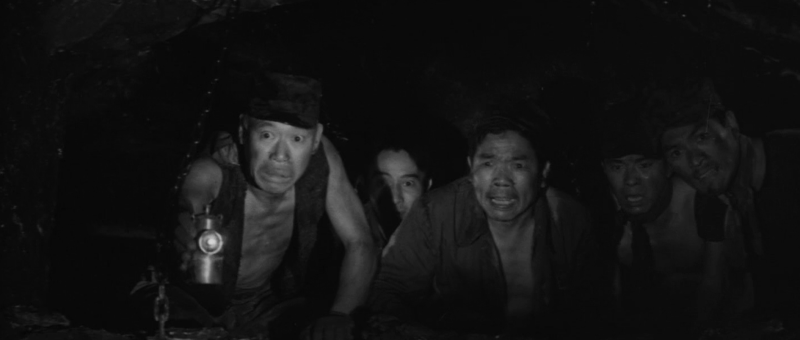
Unfortunately for him, a sudden rainstorm spells disaster when the mine begins to flood. Some workers still underground are able to escape thorough a support tunnel that connects to another mine, but five are trapped at the other end having managed to climb to a higher shelf above the water. In the rain-soaked soil, some of the above ground structure also begins to collapse, while to his credit a distraught Sunaga calls in the police and miners’ union as soon as possible rather than trying to cover up the disaster to hide his mismanagement. 

For all that, Sunaga is not a stereotypically exploitative mine owner so much as a bad businessman possibly in over his head though as a former miner he should have known better. On the one hand, he had only just found out about the unstable support arch and could not have fixed it before the disaster but as he himself agrees he bears the ultimately responsibility for the way the mine was run which includes skimping on repairs and inspections. More than anyone else, he wants the men to be rescued alive and later tearfully tells his wife that he has considered suicide but is now resolved to sell the mine and his own home to compensate the families should the worst happen. Kusaka later does try to take his own life after witnessing the rescue effort flounder, a Buddhist priest later suggesting that his act may have been intended as a kind of human sacrifice as if he could save the men’s lives by offering up his own. 

Then again, the way some of the men put it it seems like some mine owners view the compensation money for workers killed on the job as a kind of fine they’re prepared to pay to maximise profits. The film briefly introduces the circumstances of the some of the men and their families, one a husband and father who asks for an advance on his pay because his wife and daughter are ill with something that could turn out to be measles. The amount of the compensation money isn’t clear, but may not be enough for a widow to raise a five-year-old daughter to adulthood. If these men die, their families may die with them. Other relatives waiting for news include an elderly man anxious for his only son, and a grandmother waiting for her grandson who only went to the mine to have a look around before potentially starting to work there. 

In the case of the young Yamaguchi (Shinjiro Ebara), the film hints at the way the industrialisation presented by the mine has disrupted local communities as farmers’ sons leave the land for the promise of better pay for working underground. Yamaguchi is taking the job because his father is ill with some kind of neurological complaint, possibly caused by industrial pollution, and he has argued with his brother presumably about money and the responsibility of earning his keep. While underground, he runs into a friend of his father’s, Banno (Takashi Shimura), who tells him that mining is not a job you can do for life and he himself seems far too old to be doing such physically strenuous work though he is the only one almost able to stand when the men are eventually lifted from the mine. 

A veteran miner, Banno too is perhaps complacent. He smokes underground and blows the cigarette out after every puff but only to avoid carbon monoxide rather than a potential explosion. Trapped underground twice before, he does his best to comfort the other men while reassuring them that their colleagues are working to rescue them as they speak. Most of the mine workers from the surrounding area have indeed come to help, along with a specialist rescue team from Tokyo, though they make little progress with the tools available to them. As a journalist puts it, small enterprises don’t have access to the same resources as large corporations and cannot simply order in larger pumps or better diggers. Many of the workers want want to give up with the main support coming from the korean miners from a neighbouring town though they get little thanks for the efforts. After overhearing a frustrated member of the rescue team employ a racist stereotype to describe them as lazy drunks only after money, they withdraw their labour. 

Sunaga is later forced to go back to the Koreans cap in hand with a personal apology, but though some of them are personally sympathetic they remark on the level of discrimination they’ve faced for the entirety of their careers and aren’t sure why they should help Sunaga now considering the way they’ve been treated. On a side note, standard workers protections would not apply if they were killed or injured during a rescue attempt meaning they’d be risking their families’ lives as well as their own for men who are almost certainly already dead. It’s not surprising that they overwhelmingly vote not to help leaving a dejected Sunaga devoid of all hope. 

Nevertheless, they eventually reconsider reflecting that if they were trapped underground they’d want to believe someone was coming and if they don’t come now then they won’t have any right to expect them to. It is workers’ solidarity that eventually saves the miners, from winch operator Michi (Masako Nakamura) who refuses to leave her post so that the men won’t feel “abandoned” to those who arrive to rejoin the rescue effort just when it seems the most hopeless. The solution to cracking the mine is found only by listening to a former employee who hints at its dark history in reminding them of a secret support tunnel sealed up after the war once military equipment had removed.

It might be tempting to read an allegorical message into the solution being the need to blast through the buried wartime past to rescue the men trapped on the other side though it may be a bit of a stretch. In any case the action outside is also somewhat ironic. As the mine collapse becomes national news and attracts rubbernecking crowds, a man turns up to sell ice cream, while journalists also report on the event from the close by. They seem broadly hopeful, but are also looking for a good story and all too quick to report on Kusaka’s suicide attempt. When the men are eventually rescued, they order a helicopter to drop confetti over the surrounding area (possibly unhelpful to local farmers) along with a bouquet for each of the men. Uchida had some experience of working in a mine during his time in Manchuria which had permanently ruined his health and had first hand knowledge of how a mine works and what happens when something goes wrong which explains the otherwise naturalistic opening sequence laying out the conveyor belt design of the complex as the coal is picked and transferred into pick up trucks that will take it to its new owners. It is however “dark and wet like hell” underground, a place that ideally no one should have to go and that all should eventually be rescued from.