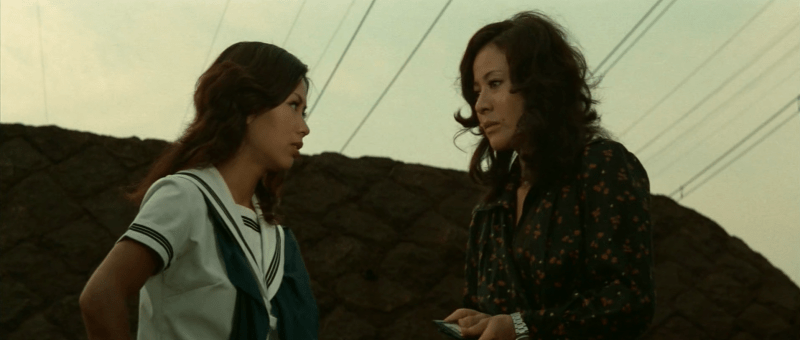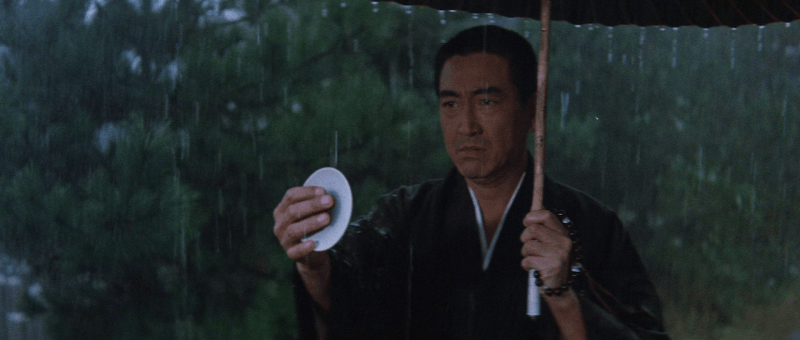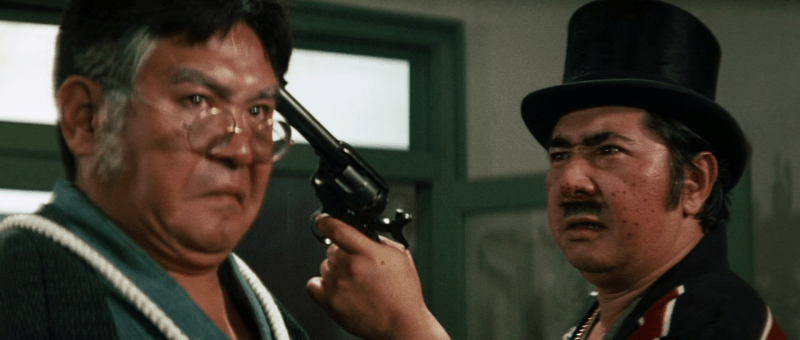
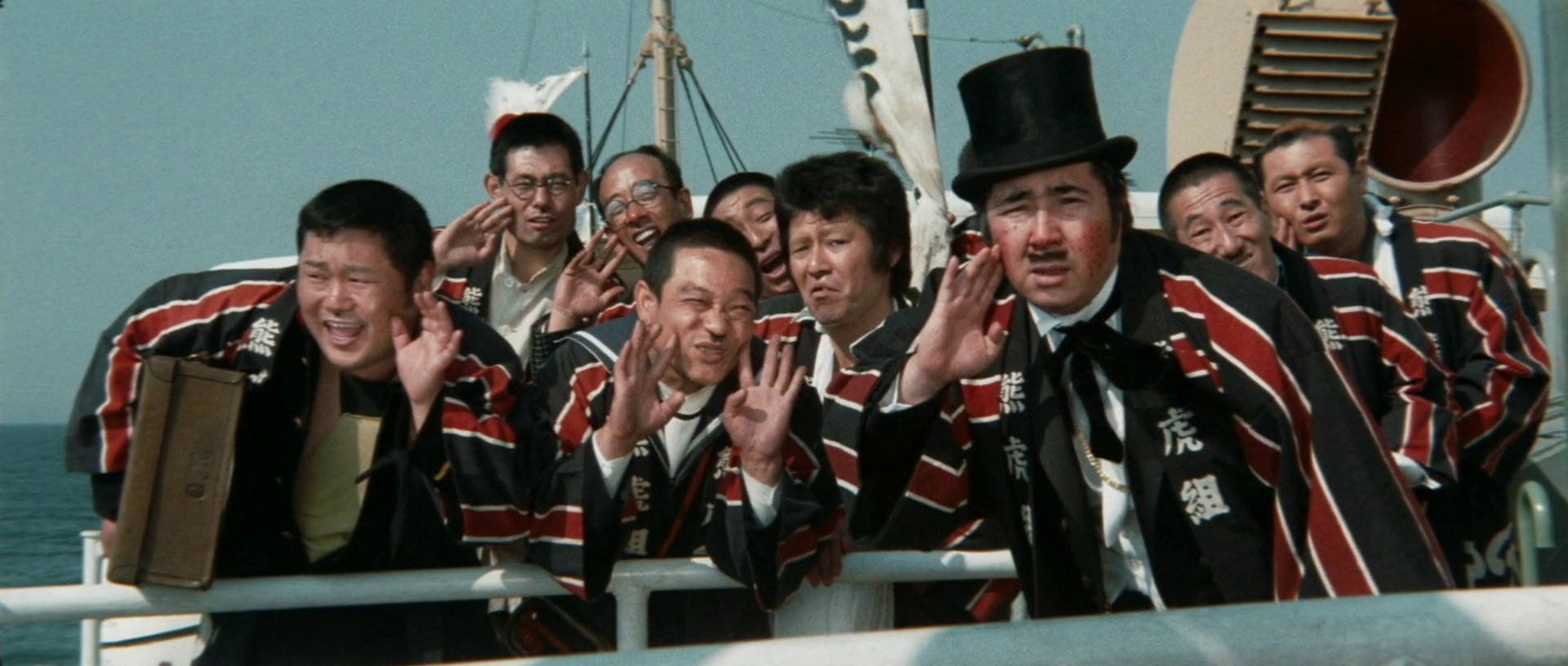
The Killing Machine (少林寺拳法, Norifumi Suzuki, 1975)

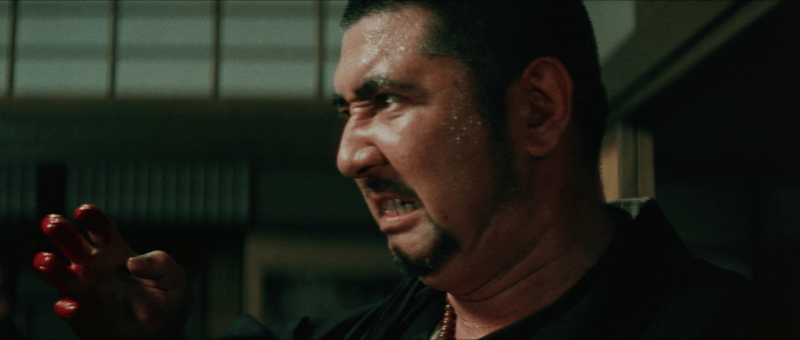
“As long as somebody like you is around, there’s hope for Japan,” an oddly sympathetic prison warden says to the last patriot standing in post-war Osaka. The title of Norifumi Suzuki’s Sonny Chiba vehicle The Killing Machine (少林寺拳法, Shorinji Kempo) maybe somewhat inappropriate or at least potentially misleading as the film is deliberately constructed as a martial arts parable emphasising the spiritual philosophy of self-improvement and compassion that is inextricable from its practice.

To that extent, the hero, Soh Doushin (Shinichi Chiba), is trying to fight his way out of the miasmas of the immediate post-war era. As may be apparent, Soh has taken a Chinese name, though Soh was apparently his along and belonged to a former samurai family whose nobility has been crushed by militarism. As the film opens, however, he’s a Japanese secret service operative in Manchuria blindsided by the news of Japan’s surrender. Soh is it seems a nationalist and a patriot, but a fairly revisionist one who stands up to the abuses of the Japanese army. He later says that he protested the way that the local Chinese population were often treated and he does indeed raise a fist toward an officer who wants to sell a young Japanese woman to a Chinese soldier in return for a guarantee of their safe passage to a boat heading out of the country. The young woman’s mother protests that she is an innocent virgin, a fact that has some later relevance. Soh refuses to let the officers take her, though evidently separated from her later.

When he meets the young woman again in the bomb-damaged backstreets of Occupation Osaka, she is dressed in Western clothing as opposed to the smart kimono she wore in Manchuria and is about to become a “pan pan” or streetwalking sex worker catering to American servicemen. Of course, Soh can’t let this happen either, but as she later tells him, she was raped by Russian soldiers during the retreat and now feels herself to be despoiled. She never wears kimono again and becomes a kind of symbol for a despoiled nation that Soh is reluctantly forced to accept he cannot save in part because his philosophy, which is still uncomfortably rooted in the philosophy of militarism, only valued strength when it should have valued love. The kind of love that Kiku (Yutaka Nakajima) had for her brother that made her willing to sacrifice herself for his wellbeing. 

Even so, Soh is doing his best to issue a course correction by caring for a small group of war orphans and helping them support themselves by running a rice soup stall so they won’t end up becoming dependent on the yakuza or the black market. It’s the yakuza and their increasingly corporatising nature that become Soh’s chief enemies, though standing right behind them are the Occupation Forces. They are, of course, just the biggest gang, as we can see when one of the kids steals a few tins from the gangster’s crate which is marked with text making it clear it came from the mess hall at the American base. The backstreets are full of sleazy soldiers and pan pans or otherwise the starving and dejected, sometimes violent demobbed soldiers filled with despair. It’s these men that Soh wants to buck up, telling them to rediscover their fighting spirit and giving them the opportunity to do so through learning Shaolin martial arts.

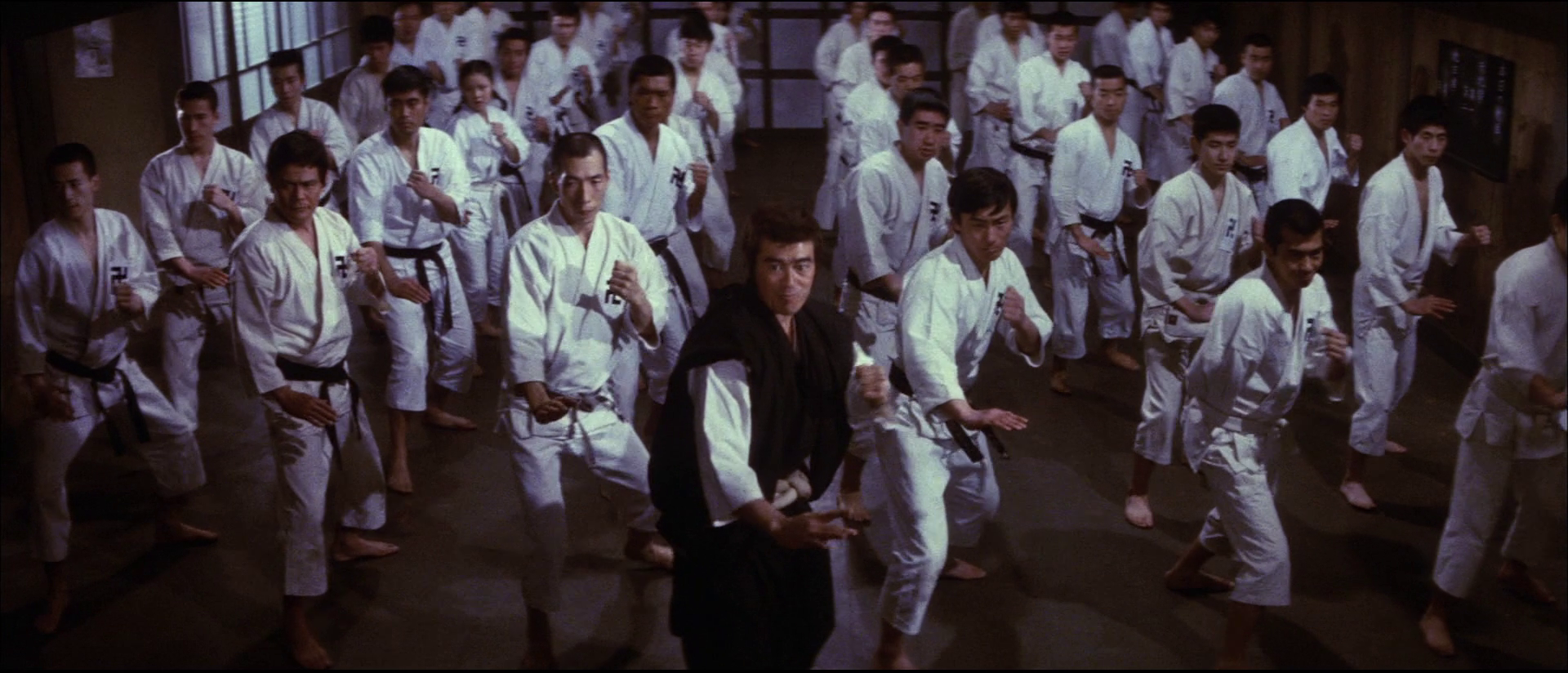
Of course there are those who don’t want to learn Chinese kung fu in the midst of their defeat, but what Soh is advocating is something that has a greater spiritual application even than karate can also have. It’s a kind of humanitarian riposte to the futility of the post-war society that might sometimes fail to recognise the depths of the impossibility faced by many in insisting they can be faced by discipline and moral fortitude but at the same time is not really judgemental except toward those who have deliberately abandoned their humanity, such as the trio of goons who rape a school for amusement (the girl is later seen among the students at Soh’s school along with the children from Osaka). The girl’s father reports it to the police, but the police and the gangsters are in cahoots, so nothing gets done. Soh cuts the guy’s bits off so he won’t be doing that again. Strength without justice is violence, he realises. But justice without strength is inability. Strength and love like body and mind should never be separated. The closing shots show an entire mountain covered in white-clad figures practising Shaolin kung fu and joining the humanitarian revolution rather than the cruel and selfish one represented by the gangsters with their red-light districts and black markets. It may be a simplistic solution, but it is in its way satisfying and at least a rejection both of the militarist past and the capitalistic future.


*Norifumi Suzuki’s name is actually “Noribumi” but he has become known as “Norifumi” to English-speaking audiences.

Big Time Gambling Boss (博奕打ち 総長賭博, Kosaku Yamashita, 1968)

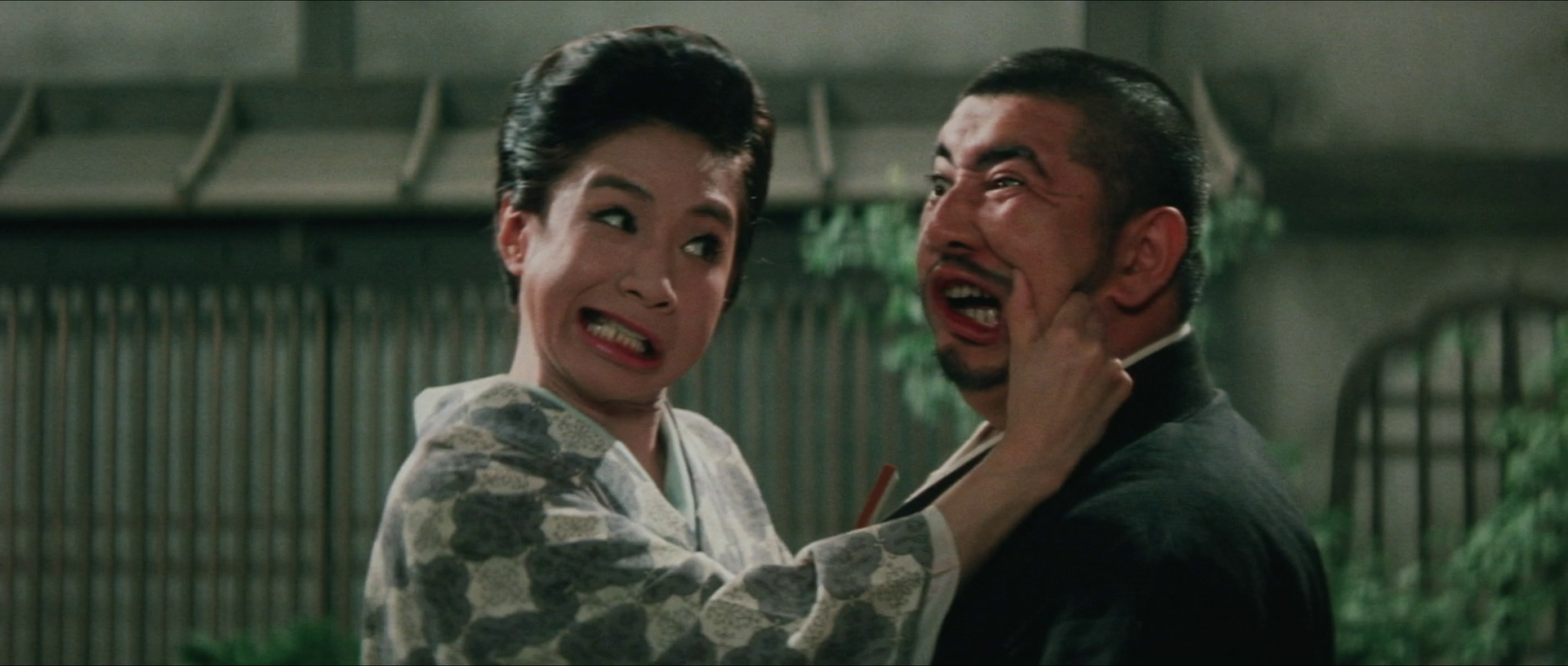
A Shakespearean tragedy of blood and honour, Kosaku Yamashita’s Big Time Gambling Boss (博奕打ち 総長賭博, Bakuchiuci: Socho Tobaku) discovers only fatalism and futility in the nobility of the yakuza code. The tragedy is that at any moment anyone could make a free choice to walk away, to abandon these arbitrary notions that convince them they must kill their friends and let their enemies go free, but they don’t because spiritually they cannot. Abandoning the yakuza code would in its own way a kind of death and mentally unsurvivable. 

There is however a greater tragedy in play. The film opens in the spring of 1934 with a villain remarking that it’s absurd to restrict oneself to one’s home terrified while a sword and the Japanese flag appear behind him. The catalyst for all this drama is Japan’s imperialist expansion. Yakuza fixer Senba (Nobuo Kaneko) and the shady Kawashima have hatched a plan to get all the yakuza clans to unite in a “patriotic” mission to traffic drugs to the frontlines looting as they go. Noble boss of the Tenryu Awakawa refuses, reminding them he’s just a simple gambling man and has no desire to get involved with politics before collapsing with a stroke. With Awakara alive but bedridden and no longer able to communicate effectively, the Tenryu decide to nominate a successor. The ideal candidate, Nakai (Koji Tsuruta), declines the offer on the grounds that he is a transplant from another gang in Osaka and thinks it would be inappropriate for an outsider to lead the clan. He proposes that his sworn brother, Matsuda (Tomisaburo Wakayama), should be appointed, though he is currently surviving a prison sentence so a caretaker should serve in his stead until his release. Most think this sensible though the proposed caretaker, Ishido (Hiroshi Nawa), also declines given the rules of seniority despite the fact that he is Awakawa’s son-in-law and so dynastic succession would also seem permissible. 

It’s during all of this finagling that Senba begins manipulating events to his advantage, gently manoeuvring the other lieutenants towards accepting Ishido as the new boss while he has no idea he’s being used as a pawn in Senba’s nefarious nationalist plotting. When Matsuda is released early, the entire situation kicks into overdrive in his outrage that the codes of rank have not been respected and that a man who is his inferior now sits at the head of the clan in a place he think’s rightfully Nakai’s but in light of his honourable refusal no one’s but his own. Even Matsuda later recognises his hot-headed recklessness in directly challenging Ishido over his decision to accept, insisting that the proper thing to do in his position would have been to persuade Nakai to take the job. Meanwhile, his own righthand man who’d been slumming it as a mere labourer in his absence, is dragged into intrigue in foolishly defending his honour by recklessly attacking Ishido’s men incorrectly believing they had provoked another gang’s attack on Matsuda little knowing it was all part of Senba’s plot. 

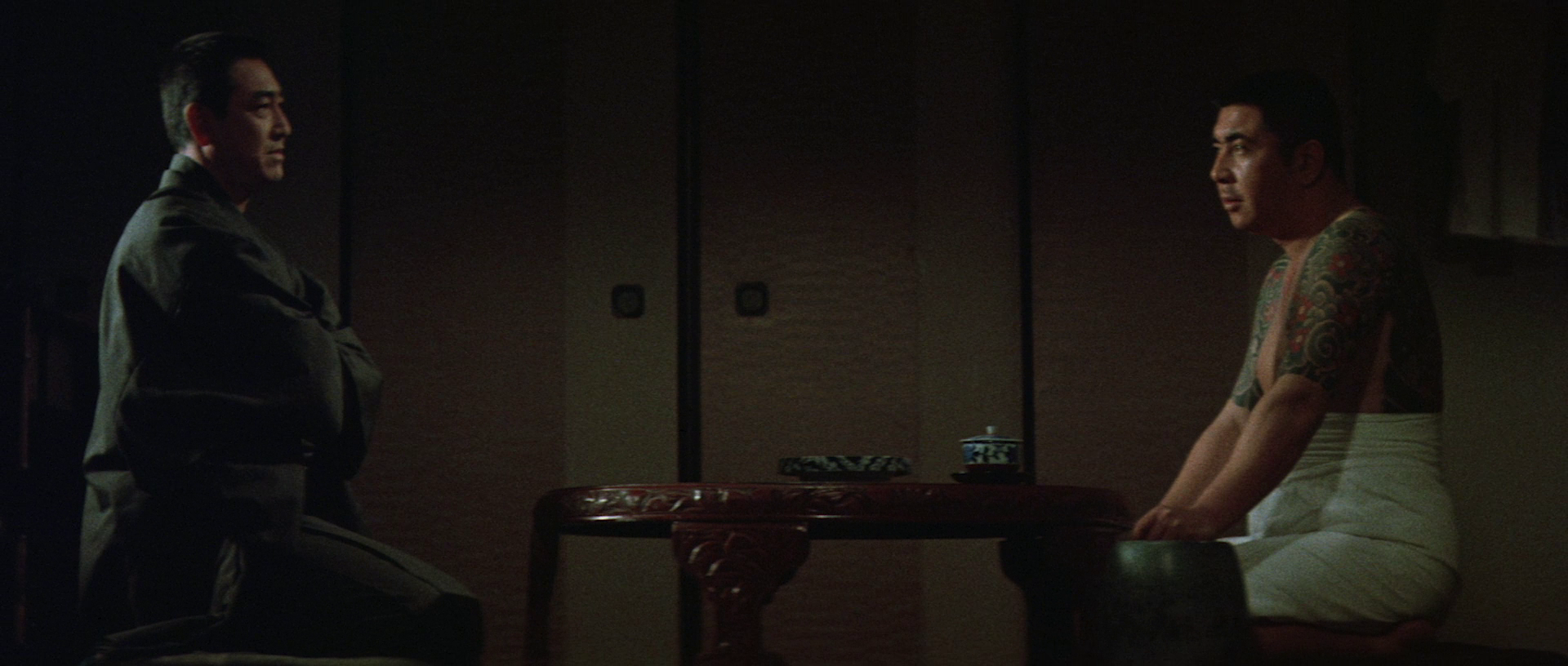
Nationalist trappings aside, Senba’s villainy is obvious from the moment he tells Nakai he thinks Matsuda was foolish for going to prison on the clan’s behalf and that he should have just found a scapegoat and put the blame on them, signalling himself a member of the new amoral yakuza who does not believe in giri and has no ninjo. Nakai rather is the opposite, as his old boss confirms in praising him for his correct decision to turn down the succession as it would not be right for him to accept as one who did not originate in their gang. Matsuda meanwhile pays too much attention to the letter of the code and not its spirit, obsessed with Ishido’s transgression and unable to let the matter drop to live a quiet life even as Nakai tries to convince him that the decision has been ratified by the lieutenants and the boss and so he must obey it. In a poignant moment, Nakai brings out the cup they used to seal their friendship and tells him that he will choose the clan, breaking the cup if Matsuda does not agree to accept a minimal degree of humiliation in returning with the intention of lying low and subtly reminding him that if he does not Matsuda will be placing a heavy burden on him that he may be forced to inflict lethal violence on his best friend and in fact brother-in-law. Realising the gravity of the situation, Matsuda immediately backs down, but events are now in motion that neither of them are capable of stopping. 

Of course, they could walk away but they don’t. Nakai offers the opportunity to Matsuda’s remorseful foot soldier Oto, telling him to leave the clan and take the woman he loves far away to live a peaceful life but of course he can’t because of his debt of loyalty to Matsuda. They are all trapped by the code which they follow and the villains ignore, laughing at them all the way. Then again, that’s what men like Nakai are for, born to set things right even if it comes at great personal cost. Even he finally snarls that he’s merely a murderer, rejecting any sense of honour in his actions while throwing a sword at the symbol of the system which has defined his life and submitting himself to the automatic operation of law of the state as a kind of martyr for system in which he may no longer believe. 


Trailer (English subtitles)

Wicked Priest (極悪坊主, Kiyoshi Saeki, 1968)

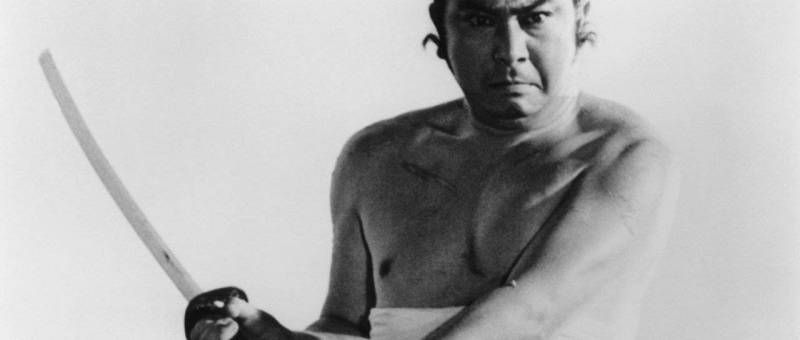
A bunch of corrupt monks get a lesson in business ethics from one of their own in the aptly titled Wicked Priest (極悪坊主, Gokuaku Bozu). The first in a series of five films starring Tomisaburo Wakayama as a rogue Buddhist monk who enjoys fighting, drinking, and women but deep down has a powerful sense of moral righteousness, Wicked Priest is in its own way another take on classic ninkyo only this time it’s temples acting like yakuza clans rather than actual gangsters with “wicked priest” Shinkai the ironic symbol of nobility. 

Set in early Taisho, the film opens with a prologue set five years before the main action in which Shinkai breaks up a fight between another violent monk, Ryotatsu (an incredibly gaunt Bunta Sugawara), and some yakuza he challenged while they were hassling a young man for supposedly messing with the wrong girl. Predictably, it’s Shinkai who ends up in trouble. Relieved of his duties, he’s exiled to another temple and sentenced to spend a whole year in isolation thinking about what he’s done. Five years later we can see that the conclusion he’s mostly come to is that the religious world is full of hypocrisy anyway and he might as well live his life to the full while he can.

Indeed, the opening scene sees him ironically reciting a sutra with his head between a woman’s legs and preparing to drink holy water from her belly button. The problem here seems to be one of inter-temple politics that sees Shinkai hassled by officious monk Gyotoku (Hosei Komatsu) who objects to Shinkai’s behaviour and to the leniency which is shown to him by head priest Donen (Kenjiro Ishiyama). Of course Gyotoku is later discovered to be the source of corruption, wanting to depose Donen and take control of the temple in part to facilitate a sex ring he’s running that involves live peep shows literally on temple grounds. Shinkai, meanwhile, has a particular dislike for abusers of women and especially for pimps eventually rescuing some of the women indentured by a local brothel and unfairly kept on after redeeming their contracts with bogus loans, and starting a women’s refuge in the temple where they can find “honest” work and eventually lead “normal lives” as farmers or waitresses free of the abuse and oppression they faced in the “hell” of indentured sex work.

Wandering around the town, he saves one young woman newly arrived in Tokyo from falling victim to a scam and being forced into sex work by getting her a waitressing job at a local restaurant. To keep her safe, he jokes with the cafe owner that he’s already slept with her which in the bro codes of the time makes her his woman and owing to his famously violent nature no one else is going to bother her. For what it’s worth, women young and old come to admire him greatly for his gallantry though he never abuses his position. All of his sex partners are at least of his own age and fully consenting even if he is not exactly faithful in love. 

Meanwhile there’s some minor commentary more familiar from post-war gangster films that sees the temple as a refuge for orphaned men. The fatherless Shinkai finds a beneficent paternal authority in Donen and is, he says, “reformed”, if living to a code that seems to be mostly his own but informed by a kind of moral righteousness not found in others at the temple. Having discovered that a wayward young man Shinkai is attempting to save from his life of petty crime exploiting women for his own gain is a son he never knew existed, Donen would have left the temple to fulfil his familial role but is prevented from doing so by the intrusion of temple politics. Unless undertaking specific vows, Buddhist priests are not necessarily expected to practice celibacy and are permitted to marry yet Donen’s father objected to his choice of bride and she left not wanting to disrupt his temple career. Shinkai entrusts the boy to Donen, talking him into accepting a new paternal authority as a means of returning him to the “proper” path while himself swearing that he will leave the temple in order to ensure justice is served against the true “wicked priest” Gyotoku. Directed by ninkyo specialist Kiyoshi Saeki, the film ends in an outburst of bloody violence as Shinkai takes revenge on institutional corruption but once again leaves its hero a lonely wanderer in an unjust world.


Original trailer (no subtitles)

Female Yakuza Tale (やさぐれ姐御伝 総括リンチ, Teruo Ishii, 1973)

Having completed her quest for revenge, Ocho (Reiko Ike) returns in Female Yakuza Tale (やさぐれ姐御伝 総括リンチ, Yasagure anego den: Sokatsu Lynch) once again swept up in intrigue after being framed for a bizarre series of murders. With Teruo Ishii taking up the reins from Norifumi Suzuki, the film has a slightly more realistic aesthetic making frequent use of handheld particularly in the narrow backstreets of the late Meiji Society while eventually taking a bizarre detour into the cruel world of an early 20th century mental health institution. 

In any case, Ocho’s troubles start when she’s met at Kobe harbour by a woman who says she’s come to fetch her. On arrival at her destination, Ocho is chloroformed and sexually assaulted by three men who evidently think she’s think she’s someone else and decide to get rid of her after realising their mistake. She wakes up next to the dead body of another woman and is in danger of becoming the prime suspect in a series of murders the subtitles don the “crotch-gauge” killings. After managing to escape, she sets about trying to find out who set her up and what’s going on while getting involved in a succession crisis in the Ogi in which the old boss who was once good to her has been killed. 

Though with much less political subtext, the film nevertheless indulges in the Sinophobia common in many similarly themed dramas in revealing a Mr Lee of Yokohama to be a major player in a drug trafficking scam in which women are forced to smuggle drugs in their vaginas after the gang gets them hooked to manipulate them. Besides Ocho, another woman dressed eerily like Sasori in a black wide brimmed hat and loose dress known as “Yoshimi of Christ” is also on their tail and seeking revenge while echoing some of the religious themes of the first film. She later teams up with recently released yakuza Jyoji who is looking for the daughter of the old boss who has gone mysteriously missing while he is also convinced that present boss Gondo had something to do with it along with the old man’s death. 

This is however mainly a tale of female revenge, Ocho’s being on the yakuza who cut off the Old Boss’ finger after he stood up for her as a teeanger whens she was caught cheating at a gambling den. Nevertheless, what eventually emerges is a sense of female socildairy as Ocho, Yoshimi, and the other women abused by the gang come together to free themselves from its grasp in a strange orgy of violence utilising eerie green lighting to lend it an almost supernatural dimension even if in the end the final blow is struck by a man and not without a little irony. 

This sense of unreality otherwise out of keeping with the immediacy of Ishii’s handheld camera is also seen in the mental institution to which the film eventually travels, a foggy gothic building echoing the Western mansion in the first film but similarly filed with oppressed and abused women sent mad by a patriarchal society or perhaps merely sent there to become so by men who wanted them out of the way. Gondo himself seems to be a regular visitor bringing along his own electroshock machine but finally resorting to using his bare hands in order to tie up a loose end and preserve his own position as head of the clan. 

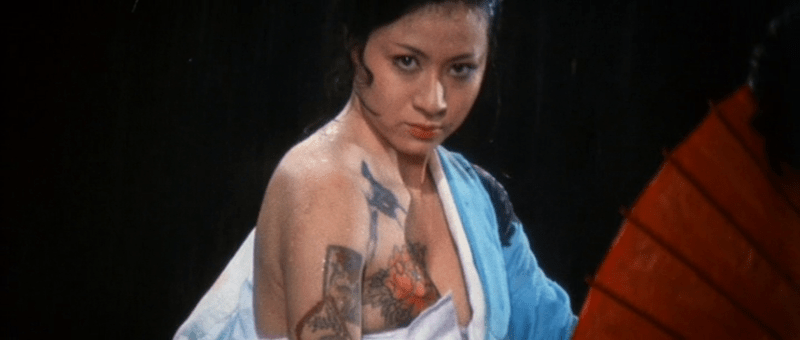
Ocho is not above using her sexuality to manipulate him, while Ishii maintains the naked sword fights from the first film both from the balletic opening of Ocho and her parasol to the chaos of the final sequence as the women come together to take their revenge as one. Perhaps strangely there isn’t an awful lot of gambling in the film, but Ocho nevertheless makes good use of her trademark hanafuda cards while in a moment of symmetry it’s the wife of her target who eventually settles the matter in a more diplomatic fashion by subjecting herself to the same humiliation to which Ocho had been subjected to bring the circle to a close. Having once again stood up against corrupt crooks and greedy men, Ocho later takes her sisters with her as she walks off this time into the sunset rather than the dark. 


Original trailer (no subtitles)

Sex and Fury (不良姐御伝 猪の鹿お蝶, Norifumi Suzuki,1973)

An orphaned daughter takes revenge against the corruptions of the late Meiji society in Norifumi Suzuki’s pinky violence classic Sex and Fury (不良姐御伝 猪の鹿お蝶, Furyo anego den: Inoshika Ocho). As the opening voiceover explains, the Japan of the early 1900s is already stoking imperial ambitions closely linked with the ideas of “modernisation” and “civility” it is seeking though in reality it is very much a gangster society as the three villains the heroine searches for have come to dominate the new Japan. 

This moment of schism is depicted in the opening sequence set in 1886 in which the little girl who will later take the name Ocho witnesses the murder of her policeman father by three unseen assassins who steal from him evidence of a scandal they then use for their own gain. The murder takes place in a shrine, the young Ocho rolling her paper ball onto a discarded charm that reads “misfortune”, while the film then jumps on to 1905 through a series of historical images prominently featuring the emperor Meiji along with a host of patriotic symbols that seem to signal the wrong path that is being taken. 

As for Ocho (Reiko Ike), she has survived by living on her wits as an excellent pickpocket and gambler but is otherwise uncorrupted continuing to dress in kimono and giving off an air of refined elegance that belies her toughness. In the course of her revenge, she is met by her opposite number, Shunosuke (Masataka Naruse), whose father was also killed by the same three duplicitous yakuza and is dragged into geopolitical intrigue by means of plot by the British to turn Japan into the site of the second opium wars using a spy disguised as a dancer played by Swedish starlet Christina Lindberg who is really in Japan for Shunosuke with whom she fell in love abroad only to be cruelly abandoned. 

Somewhat contradictorily, it’s these Western intrusions that are being resisted with Ocho the representative of an older Japan, and the gangsters that of a newer, largely amoral society of burgeoning militarism. Arch villain Kurokawa (Seizaburo Kawazu) lives in a huge Western-style mansion and is preparing to transition into national politics in the post-feudal society insisting that he and his organisation will soon control “everything”. His underling Iwakura (Hiroshi Nawa), who travels by motorcar, will also be handling the construction of Tokyo Harbour. When the girls from Ocho’s adopted family are kidnapped, they are taken to dance hall Panorama which is bedecked both with Christmassy tinsel and signs celebrating the victory in the Russo-Japanese conflict, while in an anachronistic touch scenes of the war are projected inside. Just to ram the point home, the man who throws a knife at Ocho is wearing stereotypical Chinese dress, while Kurokawa is later seen to have at his disposal a secret attack squad of nuns armed with switchblades and has Ocho whipped, by British spy Christina, in front of a large mural of Christ in some kind of underground chapel. 

In taking her revenge, Ocho is also in a sense attempting to right a historical wrong in removing these usurping men and their accomplice from power while fighting their perversion with her sexuality over which only she is master going so far as to kill one with poison rubbed on her own skin. In accidentally having exposed the equally duplicitous practices in a gambling hall, she is attacked while in the bath but instantly leaps into action entirely in the nude in a strangely beautiful sequence of elegant violence and poetic bloodletting that echoes the film’s conclusion in finally moving out into the snow. Eventually captured, she is bound tightly with rope and tortured but manages to cut herself free using only one of her trademark hanafuda cards which also symbolise her skill as a gambler even if her climactic game with Christina is played with Western cards for casino chips over a dining table. 

Suzuki signals the chaotic nature of this early 20th century world in his riotous use of colour and frequent anachronisms along with canted angles and a spinning top shot that seems to echo the world spinning out of control as Iwakura breaks a sacred promise between gamblers and rapes a young woman he had agreed to spare if Ocho was victorious in her bout with Christina. He saves his most expressionistic technique for the film’s closing moments in which Ocho singlehandedly puts a stop to Kurokawa’s corruption, another picture of Emperor Meiji looking down at her as she launches her final attack, and then stops to purify herself in the snow before wandering off into a storm of hanafuda cards with only darkness ahead of her.


Original trailer (English subtitles)

*Norifumi Suzuki’s name is actually “Noribumi” but he has become known as “Norifumi” to English-speaking audiences.

Father of the Kamikaze (ゝ決戦航空隊, Kosaku Yamashita, 1974)

By the mid-1970s, Japanese cinema at least had become much more comfortable with critiquing the wartime past, considering it from a greater distance than the often raw depictions of war in the films from the previous two decades. 1974’s Father of the Kamikaze (ゝ決戦航空隊, A Kessen Kokutai), however, is among the few to skew towards the nationalist rather than the ambivalence or simple anti-war messages of other similarly themed films of its era. 

Starring ninkyo icon Koji Tsuruta who served in the air force himself, the film is a kind of biopic dedicated to Admiral Onishi who oversaw the kamikaze operations at the end of the war. As is pointed out, Onishi had been against the war in general terms even before its inception and is originally against the philosophy behind the kamikaze squadrons but as Japan’s fortunes continue to decline he becomes its biggest advocate citing a kind of sunk cost fallacy that it would be in someway unfair to the men that have already died to surrender while insisting that suicide missions are the only feasible way to turn the tide because one kamikaze could take out a hundred men by destroying battleships singlehandedly. 

The film in part attributes this extreme solution to the prevailing with your shield or on it philosophy of the contemporary society which placed extreme shame on the act of being taken prisoner. In the prologue that opens the film, a squadron of downed pilots whose heroic deaths have already been recorded is discovered alive in an American prisoner of war camp but as being a prisoner of war is so shameful and would reflect badly on the military, the decision is taken to fix the books by sending the men on a mission from which they are not intended to return. Onishi is opposed to the plan, he asks why they can’t find a way for the men to live, but the decision is already made. In any case, he describes the action of a suicide mission as a “beautiful ideal” even when insisting that a war cannot be fought in that way not least for purely practical reasons in that they do not have the resources to be wilfully sacrificing skilled pilots and their planes. 

Having come round to the idea, however, Onishi is a crazed zealot who cannot accept the idea of surrender and even goes so far as to barge into a cabinet meeting to urge ministers against a truce even though the war is clearly lost. To his mind, the only way to honour the sacrifices of those who’ve died is to fight to the last man. Kozono (Bunta Sugawara), another officer opposed to the kamikaze, eventually meets a similar fate in refusing to obey the order to lay down his arms and ending up in a psychiatric hospital. His objection had partly been that it’s wrong to turn men into ammunition, but also that the kamikaze project is itself defeatist and self-defeating when there are men such as himself who are committed to fighting on.  

In this the film leans into the image of militarism as a death cult in which dying for the emperor is the only noble goal of the whole imperial expansion. In its eventual lionising of Onishi’s image, his bloody suicide atop a white cloth resembling the flag of Japan while his parting words scroll across the screen in text, it does not shy away from his more problematic aspects in which he fails to object to a request from a junior officer that soldiers should be allowed to test their swords on American prisoners of war, roundly telling a subordinate who breaks protocol to insist that such a thing is not only morally wrong but will ruin their international reputation that he has no need to think of consequences because Japan will win this war. He claims to want to find a way of defeat that will satisfy the living and the dead, but in reality cannot accept it not least in that it would entail admitting that he sent 2600 young men to their deaths for nothing. 

Tsuruta brings the same level of pathos to his performance as he did in playing conflicted yakuza stoically committed to a destructive code, but there’s no getting away from the fact that the film focuses mainly on Onishi’s personal suffering as a man who sent other men to die for a mistaken ideal and then could not admit his mistake offering an apology only in his death in which he urged the young people of Japan to work to rebuild the nation in the name of peace. In switching to the present day and showing us Onishi’s dilapidated former residence and in fact the room in which he died with its tattered shoji and peeling paintwork, he veers towards the nationalistic in uncomfortably reinforcing the nobility of his death rather than the folly of war or absurdist tragedy of the kamikaze programme. Adopting a quasi-jitsuroku approach with frequent use of onscreen text, a narratorial voiceover, and stock footage of kamikaze in action Yamashita may portray war as madness in Onishi’s crazed devotion but cannot help depicting it as a “beautiful ideal” even in the undignified violence of Onishi’s ritual suicide. 


Boxer (ボクサー, Shuji Terayama, 1977)

Boxer posterArtistic polymath Shuji Terayama was fond of claiming that more could be learned about life from boxing rings and race courses than from conventional study. Immersing himself in the countercultural epicentre of mid-century Shinjuku, he became known for iconoclastic street theatre before shifting to film, instantly recognisable for his striking use of colour filter and theatrical, avant-garde aesthetic. 1977’s Boxer (ボクサー) is, however, his most conventional experiment, a generic tale of a struggling boxer yearning to be a champion and battling himself, along with his society, in the claustrophobic arena of the ring, but for all the expected triumph it’s futility which marks his life and the ropes which restrain rather than liberate.

Former boxing champion Hayato (Bunta Sugawara) now lives a lonely existence alone with his beloved dog in a rundown boarding house. His brother is about to be married and wanted him to be in the engagement photos, but he told the young couple to go ahead without him. He may come to regret that because his brother quickly becomes the victim of an accident that may not have been quite that at the construction site where he and his fiancée worked. It seems that another employee, Tenma (Kentaro Shimizu) – an aspiring boxer with a limp, had taken a liking to the same girl and, either distracted by the news she intended to marry someone else, or not thinking clearly, he allowed his digger to hit Hayato’s brother and kill him. Of course, Hayato is not happy about that and determines to track Tenma down, looking for him at a neighbourhood bar where a small boy guides him to the gym, which he is eventually expelled from by the other boxers. Nevertheless, Tenma, having heard about Hayato’s past and been dismissed by his trainers because of his disability, is determined to overcome the debt that exists between them and become Hayato’s mentee hoping to go on to boxing glory.

Like many a Shinjuku tale, this is one of scrappy chancers longing to escape the vice-like grip of an underworld that refuses to release them. In the land of broken dreams, the hopeless man is king, and Hayato is nothing if not hopeless. Years ago, we’re told, he was a champion, yet he suddenly quit boxing mid-way through a bout that he was clearly winning. He had a wife and daughter, but now lives alone (except for the dog), making a living by pasting up flyers. In response to Tenma’s request, Hayato recounts to him the histories of boxing champions in Japan all of whom met a sticky end: dying of typhus in Manchuria, drowning after demobilisation, dying under a bridge, hit by a train, suicide after revenge on a yakuza who’d killed his brother, killed when a runaway truck hit his home, car accidents etc. The boxing match which opens the film is preceded by a minute of silence for a champion who died just a few days previously. So what, Hayato seems to say, we fight but we all die in the ring anyway. What’s the point?

Still, for all the meaningless of his success, he too finds a kind of purpose in Tenma’s quest even if he knows it’s futile and that it is perhaps perverse to commit to saving the man who killed his brother either by accident, as he claims, or out of romantic jealousy. Tenma tells him that he wants to be a champion to appear on TV and be famous. He has, it seems, something to prove. Hayato tells him that boxing’s not for everyone, cruelly echoing the words of the president of the boxing society in his letter explaining to Tenma that there is no place for him in the boxing world because of his disability. His reasoning is however different. He asks him if he is able to hate, to which which he replies that yes, he hates his mother, father, brother, and in fact “the whole damn world” which makes him a perfect mirror for his defeated mentor.

Terayama opens the film with a melancholy black and white sequence in which a boxer walks down a long corridor towards a door filled with light while other contenders pass him from the opposite direction, some badly beaten and others unable to walk. This is the price, he seems to say, a literal manifestation of life’s battery. Even the denizens of the strangely colourful, warm and cheerful little neighbourhood bar with its Taisho intellectual, former actress turned streetwalker, smoking child, and bookmakers who don’t pay their bills, are fighting a heavy battle, crushed under the weight of their broken dreams. Hayato tries to offer encouragement from the sidelines, “Get up if you refuse to be a loser”, he yells to a barely conscious Tenma struggling raise himself from the mat, but even if he does what will he gain? Suitcase in hand the women leave looking for better lives, while Tenma struggles to escape from the ring, chasing hollow victories of illusionary manhood but finding salvation only in the struggle.


Opening sequence (no subtitles)

Hanzo the Razor: Who’s Got the Gold? (御用牙 鬼の半蔵やわ肌小判, Yoshio Inoue, 1974)

Hanzo the razor who's got the gold posterAll things must come to an end, and so the third instalment in the Hanzo the Razor series, Who’s Got the Gold? (御用牙 鬼の半蔵やわ肌小判, Goyokiba: Oni no Hanzo yawahada koban) is the last. To be frank the central tenet is wearing a bit thin (not least because Hanzo’s been bashing away at it with a mallet for the last two movies), and though scripted by the previous film’s director, Yasuzo Masumura, direction has been handed to the less experienced studio director Yoshio Inoue. Consequently, Who’s Got the Gold? is the most obviously parodic entry in the series, camping it up in grand style as Hanzo (Shintaro Katsu) goes after a more obvious kind of vice in the form of greedy, entitled lords, corrupt priesthood, and a nation too obsessed with its past to survive in a rapidly modernising era.

Inoue opts for a purely theatrical opening as Hanzo’s two ex-con underlings, Devil and Viper, enjoy a spot of night fishing whilst dreaming about having enough money to head to the red light district. They get the fright of their lives when they think they see a creepy ghost woman emerging from the lake. Being Devil and Viper they panic and run home screaming to report this terrifying incident to their brave protector Hanzo. Hanzo is in the middle of his usual “tool polishing” routine but fancies paying a visit this mysterious lake because, well, it might be fun to try having sex with a ghost for once. Devil and Viper are very confused by this idea, but it’s par for the course with Hanzo and so off they go.

Of course, the ghost lady is not a real ghost so only part of Hanzo’s lusts are satisfied as he performs his normal sort of “special torture” on her and finds out that she’s part of an ongoing scam in which treasury officials have been skimming off some of the gold they’re supposed to be protecting. Sadly, Hanzo’s investigations hit a snag when the woman’s husband turns up and kills her for having been raped by Hanzo before promptly getting killed himself.

Hanzo does not approve of any of these goings on and fully intended to arrest the treasury officers if only they hadn’t gone and died first. Accordingly he reports all of this to his superiors but advises against prosecutions because he sympathises with the difficult position these men found themselves in. Being a samurai is not cheap and these lowly jobs are very badly paid – how are you supposed to maintain your house to the manner required without resorting to extreme measures when your lord is snaffling all the money and not paying his retainers what they’re owed. It will not come as a surprise that the lord didn’t want to hear this, and so Hanzo marks his card. It didn’t really help that Hanzo’s walk into the castle involved running a gauntlet of unfortunate samurai forced to kneel along the path all day just hoping that the lord would show them some favour. Among them was a old friend of Hanzo’s who receives a tactless offer of fixed employment if only he will give up a family heirloom that the lord has been admiring.

The gold smuggling subplot runs in parallel with another problem – a doctor whom the lord has ordered Hanzo to arrest because he was advocating the adoption of Western technologies, fearing that the nation was leaving itself dangerously vulnerable if it refused to modernise. The doctor, like the girl’s father in the first film, is dying of a terminal illness and so Hanzo thinks the sentence can wait. Hiding the doctor in his house he listens to his ideas and then comes to the same conclusion, allowing him to finish building a cannon to prove to the lord just how destructive these new weapons really are and just how dangerous it would be to fight them with only katanas and samurai spirit. Hanzo lives in interesting times, but this dilemma says something both about the precarious position of the samurai order in the face of increasing modernisation and about the 1970s background in which a small war was currently being waged against American imperialism.

As usual Hanzo refuses to bow. He will not give in to bullies or those who abuse their authority to add additional oppression onto an already oppressed populace which he has pledged his life to protecting. The contradiction of being a rapist so well endowed that afterwards no one seems to mind has still not been solved, but by this third instalment in the series the “joke” is so well worn as to receive little attention. Who’s Got the Gold? is weakest of the three adventures for Hanzo and his well conditioned razor but it has its charms, if only in the troublingly easy way that its central conceit has become so essentially normalised as to be barely noticed.


Original trailer (no subtitles)

https://www.youtube.com/watch?v=S4lQYgAAEr8

The Most Dangerous Game (最も危険な遊戯, Toru Murakawa, 1978)

the most dangerousThe late Yusaku Matsuda remains an ultra cool pop culture icon thirty years after his death and forty after his reign as the action king of Japanese cinema. Though there were several other contenders for the crown – Sonny Chiba, or the tough guy yakuza stars Ken Takakura and Bunta Sugawara, to name but a few, it’s Matsuda’s intense screen presence which continues to endure as an example of mid-1970s extreme masculinity. This image was in large part created through his work with director Toru Murakawa in roles inspired by hardboiled novelist Haruhiko Oyabu in Resurrection of the Golden Wolf and The Beast Must Die, but before that it was the “Game” trilogy which helped to make his name.

The first of these, The Most Dangerous Game (最も危険な遊戯, Mottomo Kikenna Yuugi), introduces us to Narumi (Yusaku Matsuda) – a sleazy hitman with a gambling problem who is capable of pulling off the most daring and precise of hits but remains a disaster outside of his working life. After losing a mahjong game and getting roughed up by gangsters, Narumi gets a job offer from an arms company currently vying for a large government contract to develop a Star Wars-style air defence system. As reported in the news, a number of top CEOs are being kidnapped for ransom thanks to a plot by the Godai Conglomerate. The Tonichi Corporation want Narumi to rescue their kidnapped employee, Nanjo (Masanori Irie), who also happens to be the son-in-law of CEO Kohinata (Asao Uchida).

Unlike the later Resurrection of the Golden Wolf or The Beast Must Die, the corporate conspiracy and shady government military project are merely background and never really dealt with in any further detail. Nevertheless, it appears Narumi has got himself involved in a much darker world than even he is used to. Kohinata claimed to want to save Nanjo because of their familial connection, but as it turns out he doesn’t really care so much about his daughter’s husband as he does about wiping out the Godai and getting the lucrative government contract all to himself. He’s even willing to pay Narumi twice for doing the same job, but then perhaps he’s not really looking to pay at all. Conspiracy may extend further than just the corporate realm.

Narumi makes for a strange “hero”. His very 1970s bachelor pad is a monument to sleaze with its prominent topless pinups displayed like precious artwork in his living room and his well stocked personal bar – a strange thing to have when it’s clear he does not entertain many visitors. Dancing around with his gun and posing topless in front of the mirror Taxi Driver-style implies perhaps he’s not so confident with his chosen profession yet he’s clearly well known enough to get a phone call out of the blue from the Tonichi Corp. Despite his rather pathetic attitude at the mahjong game and equally pathetic exit after falling asleep during a lap dance at a sex parlour, Narumi’s professional exterior is one of infinite capability and powerful masculinity.

Yet, like many films of the era Narumi’s masculinity is also intensely misogynistic. Gangster’s moll Kyoko (Keiko Tasaka) becomes an unlikely (and inconvenient) love interest after Narumi tries to use her to bait her boyfriend. Lying in wait in Kyoko’s apartment, he surprises her coming out of the shower while she is half naked and vulnerable. She tries to escape, he stops her, phone’s the boyfriend, and begins raping her so that the gangsters can hear her distress over the phone. Kyoko stops struggling and apparently gets into the groove, falling instantly in love with Narumi’s awesome love making skills and following him back to his apartment where she stays for the rest of the film.

Nevertheless Matsuda is presented as the epitome of cool, unshaken by danger and always coming out on top with enough time to strike a pose as he takes down a target with automatic precision. Murakawa’s approach is of its time but leaning towards arthouse rather than Toei’s unusual brand of action cinema. Its vistas are noirish but filled with 70s paranoid claustrophobia while the hopeless, melancholy jazz score by Yuji Ohno adds to the moody hardboiled aesthetic. An exercise in style, The Most Dangerous Game is as cynical as they come but its wry commentary and occasional fits of gleeful comedy lift it above both the B-movie silliness of other contemporary action movies and the dour seriousness of later Matsuda/Murakawa collaborations.


Original trailer (no subtitles)

https://www.youtube.com/watch?v=0arB-GItuvw

Wolf Guy (ウルフガイ 燃えよ狼男, Kazuhiko Yamaguchi, 1975)

Wolf Guy posterUniversal’s Monster series might have a lot to answer for in creating a cinematic canon of ambiguous “heroes” who are by turns both worthy of pity and the embodiment of somehow unnatural evil. Despite the enduring popularity of Dracula, Frankenstein (dropping his “monster” monicker and acceding to his master’s name even if not quite his identity), and even The Mummy, the Wolf Man has, appropriately enough, remained a shadowy figure relegated to a substratum of second-rate classics. Kazuhiko Yamaguchi’s Wolf Guy (ウルフガイ 燃えよ狼男, Wolf Guy: Moero Okami Otoko, AKA Wolfguy: Enraged Lycanthrope) is no exception to this rule and in any case pays little more than lip service to werewolf lore. An adaptation of a popular manga, Wolf Guy is one among dozens of disposable B-movies starring action hero Sonny Chiba which have languished in obscurity save for the attentions of dedicated superfans, but sure as a full moon its time has come again.

Chiba plays Inugami (literally “dog god”, in Japanese folklore an Inugami is a vengeful dog spirit which can possess people in times of emotional extremity), a melancholy reporter with a reputation for getting himself into trouble who comes across a strange scene in the street in which a white suited man begins raving about a tiger before being gored to death by invisible forces. The police, dragging in Inugami for questioning, can’t come up with anything better than demons to explain such strange events but Inugami’s interest is piqued – more so when he runs into a shady paparazzo who tips him off to similar crimes all targeting a rock band run by a prominent talent agency.

Wolf Guy is not the most coherent of films, it explains itself piecemeal as it goes along and mostly through Inugami’s own world-weary voiceover. Despite this immediate access to Inugami’s psyche, he remains aloof, brooding, and distant. Literally a lone wolf, Inugami is the last of his kind – the little boy saved from a massacre in the black and white still frames of the opening sequence. Yamaguchi chooses not to engage with this theme on much more than a surface level though he maintains a low-level anger towards corrupt authority and those who attempt to wield power from the shadows, targeting the different or the weak.

Through this deeply held feeling of alienated otherness, Inugami comes to feel an intense kinship with the wronged woman at the centre of the curse. Miki (Etsuko Nami) is even more a victim of this intense authoritarianism than Inugami himself. A working class nightclub singer in love with a politician’s son, Miki becomes a problem for her potential father-in-law, one which he solves with gang rape and infection with syphilis. Dumped, alone, infected, and also hooked on drugs, Miki’s mental state is understandably volatile but her troubles are not yet over. The mysterious tiger and Inugami’s wolf man attributes bring the pair to the attentions of a shady group intent on harnessing these unique supernatural powers for themselves with no regard for the “human” cost involved.

Inugami sympathises with Miki out of a shared hatred for “humans” who can treat each other in such inhumane ways. Humans massacred his family and when he tries to go home, the sons of the men who did it seem to know who he is and want to finish the job. Lonely and afraid, Inugami starts to wonder if humans and his own kind will ever be able to live together in harmony. Though he does begin to form brief romantic relationships, none of them end well. It’s almost a running joke that he’s irresistible to every woman in the film, but as much as they run to him they run to death – his love is toxic and even the invulnerability conferred by the moon is unable to save the women in his life from the violence of mortal men. Yet for all his sadness and internalised rage, the Wolf Guy is a hippy hero, the kind who throws away his gun and chooses to retreat in peace rather than fight on in a pointless and internecine quest for vengeance.

Rather than a story of humanity overturned by overwhelming, irrational emotional forces, Wolf Guy presents a hero perfectly in tune with his emotional life even if imbued with Chiba’s iconic coolness. This is not a “werewolf” story, Chiba never transforms nor does he lose himself at the sight of a full moon – rather it strengthens, sustains, and protects him. This almost new age idea gels well with the generally psychedelic approach filled with groovy ‘70s guitar, whip pans, zooms and crazy action though the film certainly goes to some dark places including an extremely unsettling surgery scene followed by an equally disturbing one of healing body horror in which exposed intestines rearrange themselves neatly inside the stomach cavity which then begins to knit itself together again. An eccentric, essentially disposable offering, Wolf Guy makes no real attempt at coherence but is willing to embrace just about every kind of madcap idea which presents itself. Strange, absurd, and all the better for it Wolf Guy is one wild ride but also has its heart in the right place as its melancholy hero heads out into the mountains, a self-exile from a cruel and unforgiving world.


Wolf Guy is released on Dual Format DVD & Blu-ray in the US and UK on 22nd/23rd May 2017 courtesy of Arrow Video.

Arrow release EPK video