The Monster Chronicles: Tiktik (Erik Matti, 2012)

Tik tik posterReview of Erik Matti’s Philippine folklore/comic book inspired horror movie The Monster Chronicles: Tiktik (also known as Tiktik: The Aswang Chronicles) up at UK Anime Network.


An “aswang” is a supernatural monster from Philippine folklore which is basically a vampire, zombie and were-creature all rolled into one. Appearing just like everyone else in everyday life, the aswangs can disguise themselves as various animals in order to trick unsuspecting people into letting their guard down so they can feast on their hearts and livers. Aswangs are particularly fond of the flesh of unborn babies and will even attempt to sneak into the homes of unsuspecting expectant mothers to suck the child from their very wombs as they lie peacefully asleep.

All of this is very bad news for metropolitan city slicker Makoy who’s managed to trek all the way out to a remote village backwater hoping to win back his heavily pregnant girlfriend who has left him after finally becoming fed up with his total uselessness. However, his efforts seem to have been in vain as Sonia, the possibly ex-girlfriend, doesn’t even want to see him and her domineering mother Feley is dead against this dead beat city boy who’s got her daughter pregnant coming anywhere near her family ever again. Luckily, Sonia’s father, Nestor, is a little more open to the idea of a reconciliation with his grandchild’s father and eventually invites him to stay for Sonia’s birthday celebrations.

At this point Makoy decides to make himself useful by haggling down the price of a pig for roasting at the party, only after managing to pay a whole lot less he ends up with a whole lot more than he bargained for. The local villagers all turn out to be a colony of aswang and now they know about Sonia’s unborn baby it’s not long before all hell breaks out at the prospective parents-in-law of the previously feckless Makoy!

Director Erik Matti (perhaps best known for his urban crime thriller On the Job) opts for a comic book inspired aesthetic by emphasising the artificiality of his studio bound film through noticeably fake CGI backgrounds. Playing out like a Philippine From Dusk Till Dawn, the film has an ironic, pop-culture filled humorous tone and further brings out its comic book trappings through the frequent use of split screens which divide the frame almost like panels do a comic book page. The slightly old fashioned appearance of the split screens coupled with the heightened colour scheme and CGI graphics also add a retro appeal which helps to create the crazy, almost cartoon-like universe in which the film takes place.

However, even if Tiktik has a Saturday morning toon aesthetic, it’s very much an adult affair filled with blood, guts and viscera. An old lady sitting next to Makoy on the cart into town ominously seems to be carrying a large bag of intestines which only seems to foreshadow events to come which will see Makoy wielding a large pitchfork with the guts of an aswang coiled around it like the messiest spaghetti you’ve ever seen.

The aswang might be known for their transforming powers but the real transformation we’re being asked to witness of that of Makoy himself as he plays the classic “stranger in town” role whose arrival is the catalyst for everything going to hell. In the beginning Makoy is an arrogant townie who can’t quite believe the backwardness of this tiny village with no cellphone signal or transport options. He arrogantly assumes he can haggle and barter with the locals by treating them with a superior attitude and the distain of a recent visitor from “civilisation”. This only earns him the additional ire of the aswang who are now, quite literally, out for blood. Sonia may have left him because of his laid back, slacker ways but if he wants to save her and their baby from being devoured by slavering, ugly monsters that no one quite believes in anymore, he’ll finally have to man up.

Makoy manages a little better than Sonia’s father, Nestor – a mild mannered and kind man who loves his fierce wife very much but still can’t quite find the necessary strength within himself to protect his family. If Makoy is to succeed he’ll have to jump into the shoes of a father with both feet, taking charge of a situation which he is not fully equipped to understand.

The film neatly divides itself into two halves with the set-up economically established early on giving way to the aswang assault. Though the action scenes are often exciting and inventive with a fair bit of humour thrown in, Tiktik loses momentum when it switches from the CGI enhanced actors to the completely CGI creatures which are never quite convincing. A genre affair throughout, Tiktik will undoubtedly play better to the Midnight Movie crowd (as it is intended to do) but uninitiated viewers may find themselves tiring of the gore tinged action long before the last aswang is split in twain.


The Monster Chronicles: Tiktik is out now in the UK from Terracotta Distribution following its appearance at the Terracotta Festival in 2014.


The Snake Girl and the Silver-Haired Witch (蛇娘と白髪魔, Noriaki Yuasa, 1968)

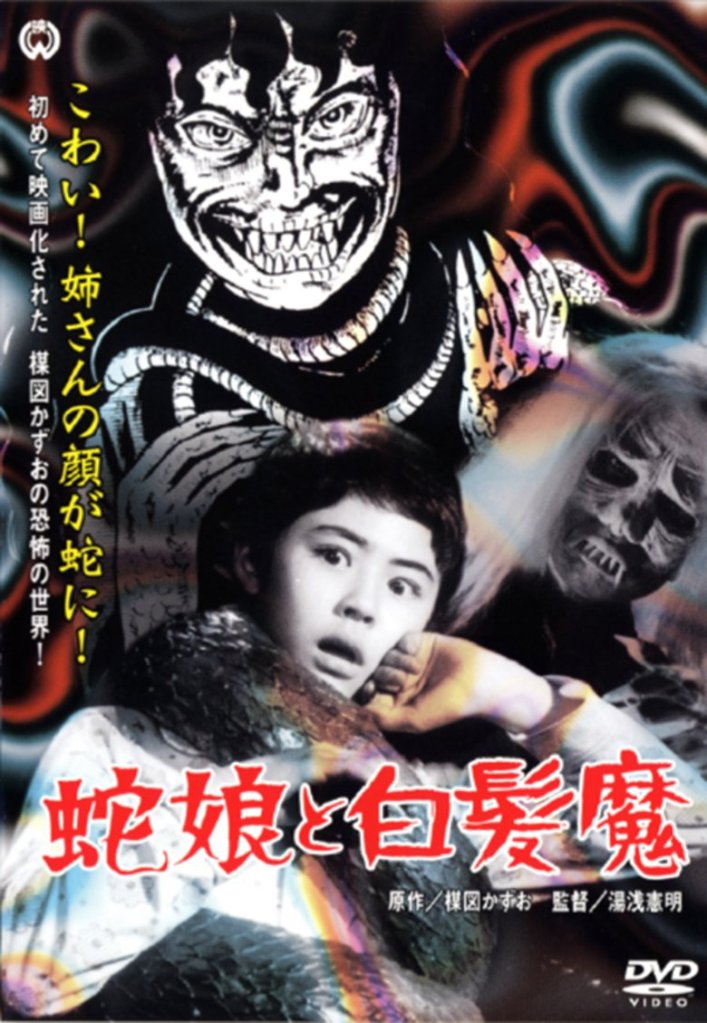
snake girl and the white haired witchLittle Sayuri has had it pretty tough up to now growing up in an orphanage run by Catholic nuns, but her long lost father has finally managed to track her down and she’s going to able to live with her birth family at last! However, on the car ride to her new home her father explains a few things to her to the effect that her mother was involved in some kind of accident and isn’t quite right in the head. Things get weirder when they arrive at the house only to be greated by the guys from the morgue who’ve just arrived to take charge of a maid who’s apparently dropped dead!
If that weren’t enough her “mother” calls her by the wrong name and then dad gets a sudden telegram about needing to go to Africa for “several weeks” to study a new kind of snake! On her tour of the house, Sayuri finds a room full of snakes, reptiles and insects (and also for some reason a large vat of acid?!) as well as a room with a buddhist altar where the food seems to disappear just as if Buddha himself were really eating it. Eventually, Sayuri is introduced to her secret sister, Tamami, who has slight facial disfigurement and a wicked disposition which has seen her locked away from view for quite some time…..

Based on the manga by Kazuo Umezu, Snake Girl and the Silver-Haired Witch (蛇娘と白髪魔, Hebi Musume to Hakuhatsuma) is, apparently, aimed at a younger audience which explains its child’s eye view of events but the film makes no concessions to the supposed softness of little minds. With a host of surreal imagery including dream sequences full of creepy, hypnotic spirals, and moments of shocking violence such as a large frog being suddenly ripped in half right in front of Sayuri’s eyes the film certainly doesn’t stint on blood, horror and general freakiness.

Sayuri herself seems largely unperturbed by these strange goings on outside of her nightmarish serpentine visions. She seems to have been well cared for at the orphanage and is happy to have found her family rather than just to be escaping the institution. On getting “home” she does her best to fit in right away, acting politely and trying to bond with her mother even in her confused state. She even tries to get on well with her mysterious sister despite the ominous warning to keep her very existence a secret from her father. Tamami, however, is a nightmare child with homicidal tendencies who isn’t interested in playing happy families with the girl who’s come to usurp her place in the household.

There’s a little more to the set up than just snake based horror (the clue being the Silver-Haired Witch of the title) but the secondary message seems to be one of remembering that the true beauty of a person lies not in their external appearance but in the goodness of their soul. The previously deformed Tamami is later said to be looking sweeter after having “redeemed” herself and Sayuri pledges to honour Tamami’s sisterly sacrifice by always remembering to hold fast and true to the beautiful things in her own soul without being swayed by worldly charms.

Snake Girl and the Silver-Haired Witch is more of a psychological horror tale than some of the effects laden efforts of the period. However, there are a fair few practical effects on show most notably during the dream sequences – one of which sees Sayuri actually fighting a giant snake with a sword, as well as the creepy spirals and the appearance of weird vampire-like snake women, dancing oni masks and the Silver-Haired Witch herself.

A children’s film that no one in their right mind would actually show to a child, Snake Girl and the Silver-Haired Witch is a freakishly psychological horror show seen through the eyes of a little girl. Part dreamscape and part terrifying reality, the film mixes the real and the imagined with a fiendish intensity and it just goes to show that sometimes you really do need to pay attention to the strange fancies of intrepid young ladies.


This trailer doesn’t have any subtitles but it is actually quite scary…..

Blind Beast (盲獣, Yasuzo Masumura, 1969)

81dGenRMu-L._SL1500_Never one to take his foot off the accelerator, Yazuso Masumura hurtles headlong into the realms of surreal horror with 1969’s Blind Beast (盲獣, Moju). Based on a 1930s serialised novel by Japan’s master of eerie horror, Edogawa Rampo, the film has much more in common with the wilfully overwrought, post gothic European arthouse “horror” movies of period than with the Japanese. Dark, surreal and disturbing, Blind Beast is ultimately much more than the sum of its parts.
This dark tale is narrated by its “victim” Aki, a photographer’s model and the subject of a currently running exhibition. On paying a visit to the show herself, she finds a strange man caressing a statue of her built by one of the photographer’s students. Somewhat uncomfortable, she leaves the gallery in hurry and once home calls up a massage company help her relax. Once her masseuse arrives, he proceeds to caress her in a strange manner despite Aki’s protestations that she needs it “harder”. Eventually the ruse is uncovered and Aki realises he’s the blind man from the gallery at which point he chloroforms her and drags her back to his evil lair and mysterious studio in the middle of nowhere where he lives with his accommodating mother. The pair keep Aki prisoner until she consents to modelling for blind artist Michio’s latest sculpture project. After trying and failing to escape, Aki gradually falls into a kind of Stockholm syndrome where she finds herself in thrall to Michio and the pair’s sexual adventure enters a path towards the ultimate debasement and depravity…

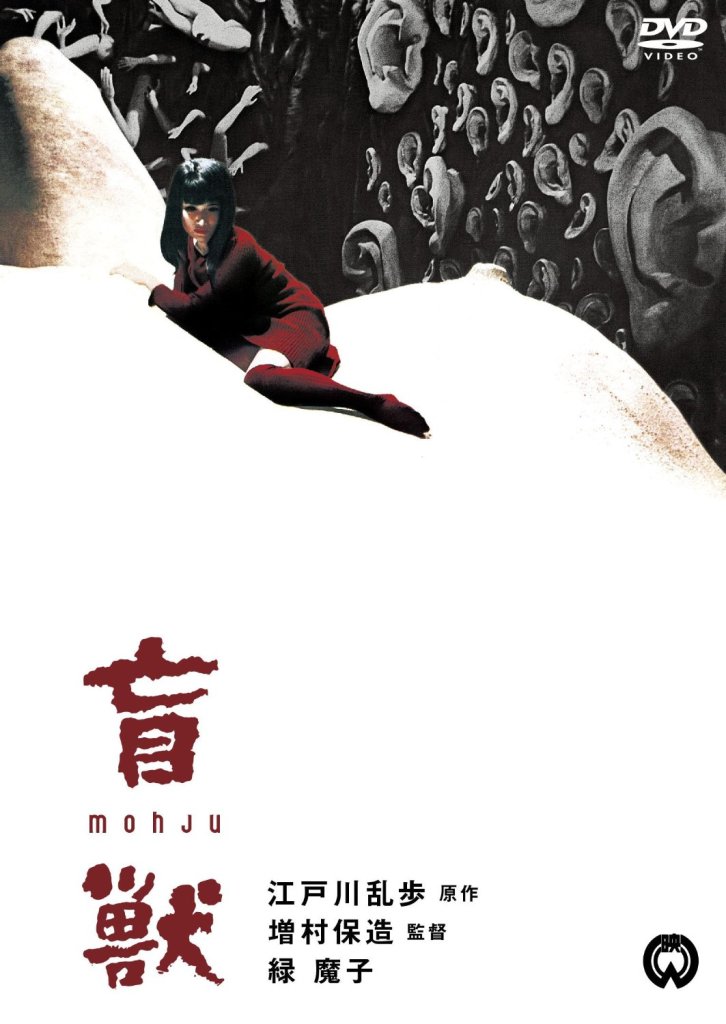
The opening sequence of Blind Beast is the most surreal in this eerie, bizarre film. As Aki awakens in Michio’s lair she explores her darkened environment only to find the walls are each covered in sculptured motifs of various women’s body parts. First an entire wall of noses followed by mouths, arms, legs and breasts each apparently created from memory by the aspiring sculptor who, in his blindness, has decided that touch is the ultimate, neglected sensation. If that weren’t strange enough, the floor of the studio is taken up by a colossal statue of a woman lying on her back, as Aki finds out trying to escape the room by crawling over its perfectly sculpted breasts.

Micho himself is an unsettling though somewhat weakened figure, supported still by his caring mother who is prepared to do “anything” to indulge his “one pleasure in life”. Neither of the pair seems to appreciate the perfectly natural reaction of Aki to being held prisoner or her desire to escape and both are entirely focussed on making use of her in Michio’s new artistic movement which will place touch at the forefront of expression. Aki attempts to manipulate the situation in order to escape, firstly pretending to go along with their plans and then by attempting to place a wedge between Michio and his mother by emphasising Michio’s lack of autonomy and particularly his lack of sexual experience. Eventually she seduces him as a way of building his trust so he’ll let his guard down. However, after an event most would regard as traumatic, she comes to build a grudging affection for the blind sculptor and no longer wishes to leave.

Losing her sight herself, Aki grows ever more obsessed with the sculptor’s touch. As the pair’s relationship becomes increasingly intense they seek out even more vibrant sensations, new paths to ecstasy. Turning to sado masochism firstly through animalistic biting, clawing, and tearing they eventually resort to whips and knives before coming to a conclusion about where their new life of dissipation is leading them. Aki wonders if she had masochistic tendencies all along which the sculptor has “unlocked” with his magic touch.

Literally blinded, the two have entered a realm of sensations which are purely physical. Sexually naive, Michio has mentally dismembered the concept “woman” into a series of neatly separated components which can be assembled to form the physical shape without needing to think about anything which lies beyond the skin. Blind Beast is a romance, in some sense, even if an extremely disturbing one. Michio and Aki don’t fall in love in the conventional sense so much as become obsessed with the physical sensation of mutual touch. Pain and pleasure become interchangeable as the pair’s desire for physical satisfaction exceeds all limits.

Strange and surreal, Blind Beast carries one of the most disturbing final sequences ever committed to celluloid. With its European chamber music soundtrack it feels much more like an arty ‘60s giallo than anything else though in terms of what is actually visible on the screen is actually fairly light on gore or violence. This level of restraint only makes the film more disturbing as does its claustrophobic atmosphere and deadpan voice over. Another characteristically probing effort from Masumura, Blind Beast is among his strangest and most original efforts and is likely to linger in the memory long after its traumatic finale fades from the screen.


Blind Beast is available with English subtitles on R2 DVD from Yume Pictures.


Kwaidan (怪談, Masaki Kobayashi, 1964)

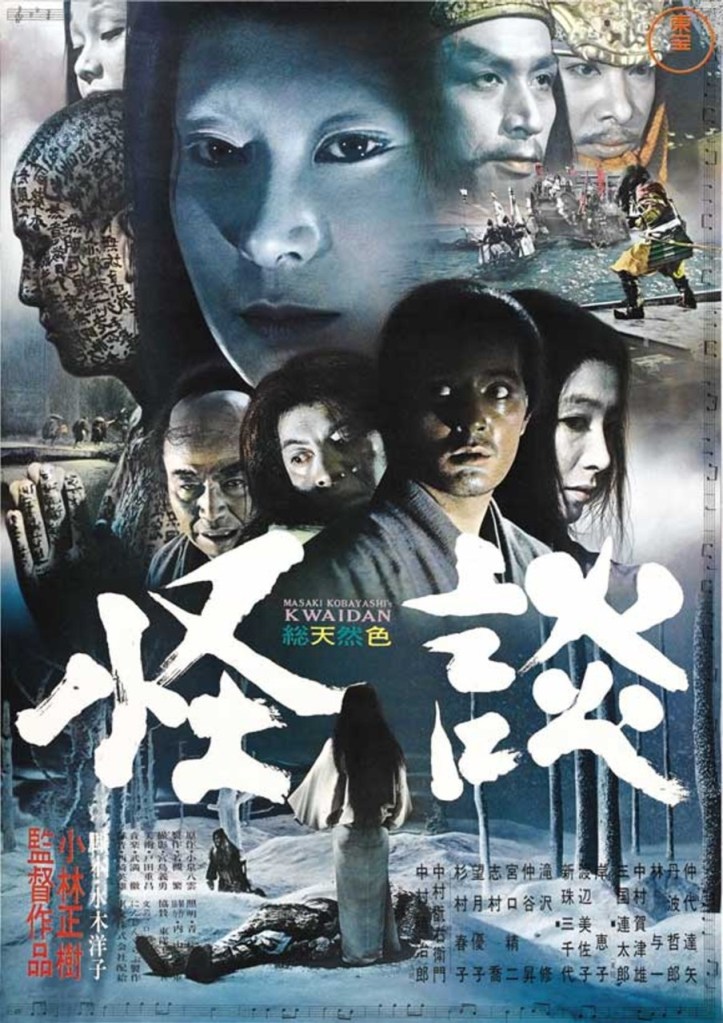
tumblr_ly5zbgdNH61rn3yrmo1_1280Kwaidan (怪談) is something of an anomaly in the career of the humanist director Masaki Kobayashi, best known for his wartime trilogy The Human Condition. Moving away from the naturalistic concerns that had formed the basis of his earlier career, Kwaidan takes a series of ghost stories collected by the foreigner Lafcadio Hearn and gives them a surreal, painterly approach that’s somewhere between theatre and folktale.
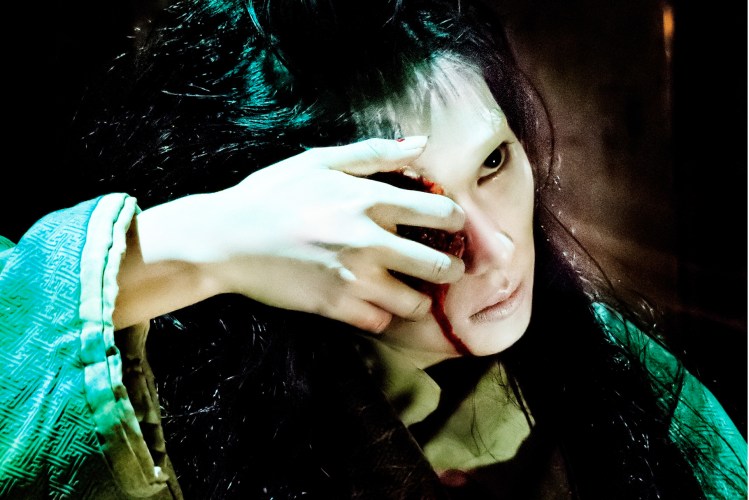
The first tale, Black Hair, is the story of an ambitious young samurai (Rentaro Mikuni) who abandons his one true love to marry a wealthy woman and advance his career. However, his second marriage is far from happy and he begins to appreciate just what it is he’s cast aside. Eventually returning home he meets his former wife again and harbours the desire to start afresh. However, when the sun comes up all is not as it seems.

Tale two, The Woman of the Snow, begins when two woodsmen are caught in a blizzard and a mysterious woman appears to suck one of them dry of blood. She spares the other, Minokichi (Tatsuya Nakadai), because she’s moved by his youth but she instructs him never to reveal the events of that evening or she will return to finish what she started. Minokichi returns home and meets another mysterious woman who later becomes his wife and bears him three children but will he remember to keep his secret even from the love of his life?

The third tale is perhaps the most famous, Hoichi the Earless, and features the sad tale of a blind biwa player (Katsuo Nakamura) whose storytelling ability is so great that the dead themselves petition him nightly to recount their story. Eventually the head monk finds out and disapproves of Hoichi’s dealings with the supernatural so the monks paint sutras all over his body to protect him from the malevolent spirits. However, like achilles and his vulnerable heel, they forget to paint Hoichi’s ears…

The fourth tale, A Cup of Tea, is a little more whimsical and opens with a framing sequence lamenting the fact that some ancient tales were never finished for one reason or another. The tale within the tale features a samurai who keeps seeing a face appear in his tea. Obviously this is quite disturbing, but eventually he just decides to drink it anyway only for the owner of the face to suddenly appear and complain about soul having been stolen.

Like all good fables the stories each have a moral to offer but also, crucially, paint the protagonists as victims of circumstance more than rash or unwise people. The samurai feared poverty so he abandoned his love in search of riches only to discover he’d been chasing the wrong kind of dreams. Minokichi momentarily forgot himself, perhaps entrapped by the Snow Woman’s final trick, Hoichi just wanted to play his biwa but his desires were frustrated by the powers at be who further mess things up for him by botching the sutra application. The protagonist of A Cup of Tea does choose to drink the tea himself but the resultant madness is not something that could ever have been reasonably expected. These are worlds of spirits where the doorway to the supernatural is always ajar, waiting for some ordinary person to tumble through accidentally.

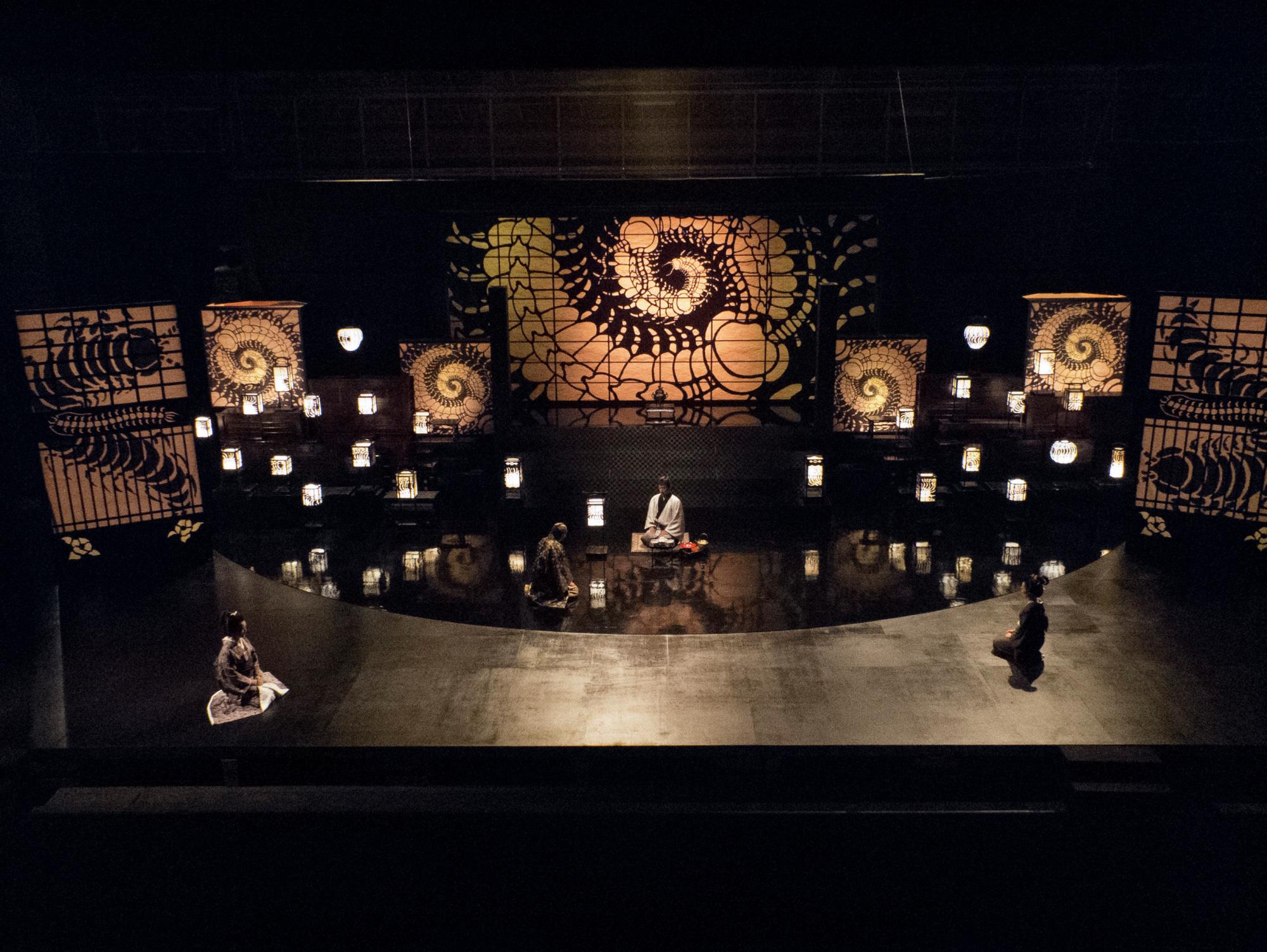
Though employing slightly different styles for each of the four segments, Kobayashi sets his stage with a deliberately theatrical, almost hyperreal set design. Obviously shot on a soundstage, the tales take on the feeling of stories which have been told and retold, replayed countless times across the great theatre of life. Black Hair steers closest to a traditional kabuki play, an effect aided by Toru Takemitsu’s more traditional score but The Woman of the Snow gives way to intense color play full of cold blue ice vistas mixed with impressionistic, passionate red skies. Hoichi’s tale begins with an overlay of a scroll painting recounting the famous The of the Heike of which Hoichi sings his song. Full of epic battle scenes, ghostly apparitions and a whole load of biwa music, this segment is the lengthiest but also the meatiest when it comes to subtext. The final tale by contrast is much more straightforward and brings a little chanbara exuberance to the otherwise heavy atmosphere though it does leave us with one of the most haunting images in the entire film.

Kwaidan may look like an exercise in style for Kobayashi – it was also his first colour picture and he makes full use of that aspect of the film. However, that isn’t to say he’s abandoned his recurrent concerns. The people in the stories are all ordinary, they’re flawed but they aren’t evil. The samurai comes closest to bringing his fate on himself when he makes the selfish decision to abandon his loving wife for money and status though he pays a heavy price when he finally realises his foolishness. Minokichi’s crime is a loss of faith of perhaps of having doubted the truth of his tale in itself. In the end, he simply forgot his promise rather than making a conscious decision break it like the samurai. Hoichi is something of a passive player here as his blindness renders him unable to understand his plight – he is unable to keep his promise to the fallen samurai firstly because of the physical toll it’s taking on him and secondly as he’s prevented by his superiors. The protagonist of the final tale simply gives in to temptation and then to madness perfectly symbolising human weakness. Kobayashi maybe more artful here than acerbic but his bleak view of human nature still wins out. However, what Kobayashi crafted in Kwaidan is a beautiful, dreamlike canvas of supernatural visions which continue to dazzle in their artistry long after the screen has gone dark.


Kwaidan is available on blu-ray in the US from Citerion and on DVD in the UK from Eureka Masters of Cinema.


Over Your Dead Body (喰女 クイメ, Takashi Miike, 2014)

003_b
Oh! I think there’s something in your eye…

Review of Miike’s latest (well, not really latest…maybe recent? Does recent still work? This is Miike after all) classy horror shocker Over Your Dead Body up at UK Anime Network. It’s OK but it’s not very scary, gets a bit too clever for its own good and shows you a film you’d much rather be watching than the one that you came for. It’s fine though, really. And quite pretty to look at.

over-your-dead-body-(2014)-large-picture 4
see what I mean?

Nobody could ever accuse Takashi Miike of being a slouch and his breakneck pace of film production continues here with a more classically subdued take on the horror genre than his casual fans may expect. It’s not the first time the director has dipped a toe into the world of kabuki theatre – indeed he’s no stranger to the stage and his most recent outing made sure to inject a little of his characteristic craziness including space aliens and references to Star Wars. Over Your Dead Body is much more in the vein of Harakiri than of Audition or Ichi the Killer and despite its often grotesque overtones and suggestions of supernatural machinations its chief merit is in the beauty of its stagecraft rather than in its infrequent thrills.

Miyuki (Ko Shibasaki) is a successful kabuki actress and has landed a plum leading role in the classic play Yotsuya Kaidan. Using her status and connections, she’s been able to wangle the central male role in the piece for her boyfriend, Kosuke (real life kabuki superstar and previous Miike collaborator in Harakiri Ichikawa Ebizou XI), with whom she’d like to settle down and have a family. Kosuke, however, has a wandering eye and may not be quite as committed to the relationship as Miyuki. Before long, onstage and offstage events begin to blur as supernatural forces, mental illness and distorted realities begin to take their toll on this unlucky troupe of actors.

Yotsuya Kaidan is a true classic of kabuki theatre. Filmed countless times, it’s the story of down on his luck samurai Iemon who’s in love with a young woman but denied by her father thanks to his lowly status. Eventually, Iemon murders him and hides the body so he can marry his one true love after an appropriate amount of time has passed. However, Iemon’s crimes begin to weigh heavily on his conscience and having got what he wanted he finds himself haunted and unable to live the happy life he’d dreamed of. His dreams of becoming a high ranking, respected samurai consume him and when he’s offered the opportunity to marry into a more impressive family he makes a shocking and bloody decision.

The darkness of this stygian tale doesn’t take long to seep into the “real” world and it quickly becomes near impossible to distinguish between several different layers of reality. Wronged heroine Miyuki’s behaviour becomes increasing erratic as her rather cold and calculating boyfriend Kosuke gradually takes on the cruel persona inherited from Yotsuya Kaidan’s Iemon. Her elaborate revenge plot seems to go around in circles, culminating in an extremely bloody and completely insane set piece before heading off into the realms of the supernatural.

However, the real success of the film lies in the kabuki scenes themselves and some viewers may even windup wishing they were watching Yotsuya Kaidan instead. Built with an unfeasibly beautiful theatrical set utilising a modern, fully revolving stage Miike blurs us seamlessly from the theatricality of the stage set into the world of the play. Always beautifully filmed, the world of Yotsuya Kaidan comes to life before our eyes whereas the regular “reality”, our world with its everyday demands, feels cold, sterile and emotionless. One actor even remarks that he wishes the world of the play were real – quite an odd thing to say considering it’s a morality play about the wages of sin which is soaked in blood including that of a young infant.

Despite the committed performances of the cast, the off stage antics which ought to be the focus of the film end up feeling superfluous. Ultimately, despite its relatively short running time Over Your Dead Body feels like a short story unwisely expanded into a novella which might have benefitted from stronger editorial control. The overall tone is one of unexplained mystery but its refusal to explain itself is more likely to frustrate rather than delight and something about its plot machinations just never manages to come together in a satisfying way.

Something of a mixed bag, Over Your Dead Body is not without its merits – it looks beautiful for one thing, yet never manages to engage. It lives and breathes in its kabuki scenes and perhaps a filmed kabuki production of Yotsuya Kaidan may ultimately have proved more satisfying. Gore fans and lovers of the bizarre who stay with the slow burn approach will find a lot to like in Over Your Dead Body but die hard horror aficionados  maybe advised to look elsewhere for their supernatural thrills.


Here be a trailer:

If you’re a Miike fan don’t forget that another of his more “recent” efforts will also be screening at the London Film Festival before being released on DVD & blu-ray by Manga in November – Yakuza Apocalypse, which sounds like a very boring film about a weird frog or something? Yeah, you probably wouldn’t like it anyway. *buys all the tickets*

Wanna read more about Miike?

Phew – that was actually a lot of work. Someone remind me I’ve already done it so I don’t have to do it next time. Takashi Miike probably made ten more movies while I was writing that list!

Greatful Dead (グレイトフルデッド, Eiji Uchida, 2013)

OEO9ONpIf there’s one thing Third Window Films have proved themselves adept at, it’s finding those smaller, off kilter and cultish films that often fall through the cracks. Greatful Dead, the deliberate misspelling the title of which is only the first sign of its oddness, is the latest find in what might be thought of as “weird cinema”. Evoking comparisons with Sion Sono’s Love Exposure thanks to its christianising themes, wry tone and sheer craziness, Greatful Dead is not all together as successful but is likely to find its own fans through its undeniably cultish appeal.

Nami, like many movie heroines, starts by recounting her childhood as a lonely, neglected child. The younger of two sisters, she desperately tries to get the attention of her mother who is only interested in saving disadvantaged children in other countries whilst ignoring the needs of her own two daughters, or her father who is so entirely wrapped up in their mother that he’s barely noticed the two girls either. Eventually after her mother leaves and her father slowly disintegrates, Nami becomes increasingly isolated. After inheriting a sizeable fortune, grown-up Nami wastes her time in idle pursuits before hitting on her favourite hobby – an amateur anthropological study of the “Solitarian” or those who have driven themselves completely mad through loneliness. Her favourite kind of Solitarian is randy old men whom she likes to watch as they spiral deeper into depravity before eventually reaching their end game. Old Mr. Shiomi, who was once something of a big shot but is now an embittered old man, is her perfect specimen but after he receives a visit from a pretty Korean Christian missionary and becomes “reborn” her observational project is ruined! Mr Shiomi’s been stolen by God, what lengths will Nami go to to get him back?

Of course, the irony is Nami is the biggest Solitarian of them all and the one she’ll never be able to identify. In the accompanying DVD interviews, the director states his intention to highlight the increasing numbers of lonely, older people in Japan thanks to the declining birth rate and fracturing of traditional community bonds but in actual fact many of the Solitarians Nami identifies are younger people and some of them even appear to have quite serious mental issues which require more serious intervention. Taking frequent field trips and noting down rare specimens in a little notebook like some deranged “twitcher”, Nami joyfully enjoys the darker side of her hobby as her favourite part seems to be watching lonely people die at the zenith of their craziness. Though in fact both she and Mr. Shiomi have both in some senses chosen their lonely lives as both have rejected the interest of family members – Nami the insistences of her sister that the normal is best and to be strived for and Mr Shiomi those of his son (who may or may not be mainly interested in his money).

There is then, obviously, a veneer of social commentary, though it feels fairly thin at best. The main appeal is in the degree of tonal shifts that occur throughout the film. Starting out in a similar way to many a quirky comedy as young Nami goes to extreme lengths just to get some kind of attention from her indifferent parents, to her carefree adult life the film plunges off a cliff face about two thirds of the way through thanks to Mr. Shiomi’s “betrayal”. Where another film would end with Nami meeting another lonely person and becoming slightly less unhinged, Greatful Dead veers into some seriously dark alleyways filled with blood, murder and pensioner rape among other perversions. The wildest thing is the resurgence of Mr. Shiomi as he decides he’s mad as hell and isn’t going to take this anymore! Fighting back in an equally strange way (why does no one ever just call the police? No, sharpening a mop into a spear seems like a more rational solution), the furious battle between subject and observer is quite literally in the lap of the gods.

Greatful Dead is an undeniably enjoyable, wild ride that escalates in a gently expert manner from its black comedy beginnings to exploitation ending but never quite coalesces into something more. Its views on the place of religion in this lonely world seem a little ambiguous – would Mr. Shiomi have opened his door to the male missionary quite as readily as he opened it to a pretty Korean girl and how long would his quite radical conversion really have lasted? Is the church actually helping some of these elderly people who might just want company or exploiting them? The film doesn’t seem sure, not that it’s that much of a problem. In the end, Grateful Dead is a wild ride through crazy town and destined to become another cult classic entry in to the world of wacky Japanese horror.


Review of Greatful Dead up at UK Anime Network – released courtesy of Third Window Films this coming Monday 26th January 2015.

Tod Browning’s Freaks

SPOILER WARNING!!!

Tod Browning’s Freaks is notoriously the film that fell so foul with the studio and audiences of the time that even after cutting around a third of its running time the degree of revulsion it produced pretty much ended the director’s career. Having run away to join the circus as a teenager, Browning had spent spent much of his life around circus performers and felt them much maligned by society. Although he’d touched on similar themes before, Browning had always used professional actors made up to appear as if they were in someway different but this time he was determined to use genuine sideshow performers – a decision that would prove too radical for the society of the time.

Although it’s often placed into the horror genre, Freaks is really a tale of revenge and poetic mob justice in which the surrogate family of the carnival people punish the ‘normal’ couple who have tried to harm one of their own by the only method of justice that’s open to them – absorbing the miscreants into their own group. Hans is engaged to Frieda who like him is a midget but has become infatuated with the beautiful trapeze artist Cleopatra. Cleopatra, however, has recently stolen the boyfriend of another performer, the strongman Hercules, and together they mock Hans’ courteous courting whilst accepting his generous gifts and loans of money. When Frieda confronts Cleopatra about her treatment of Hans and lets slip that Hans has recently come into an inheritance, Cleopatra and Herman decide to trick Hans into a marriage and then do away with him for the money.

Hans is overjoyed to have married the most beautiful woman he’s ever seen but things turn sour at the wedding banquet when, in show of friendliness and inclusivity, the the carnival folk each drink from a large glass whilst chanting before offering it to Cleopatra who recoils in horror and screams ‘Freaks’ repeatedly. Prior to this she’s already been seen in an embrace with Hercules and has been drugging Hans’ champagne with some sort of poison. In a final humiliation, she makes several allusions to Hans’ childlike stature and manhood (or lack thereof) before putting him on her back as if he were a toddler.

Cleopatra then continues to slow poison Hans but unbeknownst to her he knows what’s up and he and the others plan their revenge. An opportune storm hits the convoy in which Hercules attempts to rape or kill his former girlfriend whilst Cleopatra runs off intro the storm pursued by the mob with knives in their teeth. In the extant version of the film this is all we see – we cut back to the sideshow proprietor who provided the opening of a framing sequence who shows us Cleopatra now disfigured and stuffed into some kind of chicken suit – a freak, like those she despised. In the full version we would have seen her legs be hit by a falling tree and her lover Hercules castrated – now emasculated he also joins their group as a member of the deformed.

We are told in the lengthy prose prologue about the code of the carnival freaks (a title they embrace for themselves), of how they stick together and a wrong done against one is done against all. Looked down upon by society and often cast out by their natural families, or even sold on to goodness knows what kind of horror in virtualised slavery who else do they have to turn to other than each other? Lacking any other recourse to justice or protection isn’t their turning on Cleopatra and Hercules who have, after all, attempted to murder and rob their friend, just natural manifest justice?

Some will argue that Freaks is exploitative, aren’t we being expected to flock toward this title to gawp at the oddities? Yes, and then again no. Browning knows we will do this, it’s part of the point of his film after all. We come as voyeurs – allured by the title and the film’s reputation but our expectations are subverted. The carnival folk are good, honest people who are kind and fiercely loyal to their friends. They are willing to welcome Cleopatra into their group yet she cruelly rejects their friendship and pays them back with scorn. The real freaks are the two ‘normal’ people who are prepared to dupe an unsuspecting man in love, exploiting his emotions for their own personal gain before dispatching him completely without a second thought.

In this way Freaks does what all horror should do, it reflects the part of yourself that is ugly, that you’d rather keep hidden. It isn’t ‘otherness’ that’s frightening, it’s your own greed and hate and prejudice. It’s just a shame that it took us so long to be able to face what we so loathe in ourselves that we can finally see Tod Browning’s Freaks for what we are.

Seen at the Prince Charles Cinema, 9th October 2012. 35mm

The Skin I Live In – Summer Screen at Somerset House

Wednesday night saw the opening of the Film4 Summer Screen at Somerset House which launched with the UK premiere of Pedro Almodóvar’s latest film The Skin I Live In (La piel que habito). This marks the first reunion of Almodóvar and Banderas since 1990’s Tie Me Up, Tie Me Down!. It’s also the first time Almodóvar has stepped into the horror genre, so expectations were running fairly high.

They were not disappointed.  This is quite simply a brilliant film, dark, disturbing, but also displaying that trademark Almodóvar humour. Unfortunately it’s almost impossible to review as it’s best to know absolutely nothing at all about the plot before going in. It’s a real return to form for Almodóvar after the slightly disappointing Broken Embraces, this is a film with plenty to say that’s also wickedly entertaining. Highly recommended, do not miss this!

On Psycho and Star Power

I often wonder, how much of its impact does Psycho lose given that a modern audience, even if they somehow have managed to avoid knowing anything about the plot, does not relate to Janet Leigh in the same way the audience of 1960 would have. If you don’t know Janet Leigh is supposed to be the ‘star’ of the movie, is her early exit all that shocking? and if it’s not all that shocking, does the film feel unbalanced? does the viewer feel they’ve missed something, are they confused they’ve spent so long with this character that’s just disappeared and the focus has moved on entirely?

I feel as if I should be able to answer some of these questions, after all it’s not as if I saw this in a cinema myself in 1960, but I honestly don’t remember the first time I saw it. I must have been quite young, probably too young and like most other people I must have seen it on the television. I’m almost certain I would have watched it with my mother, who probably explained to me who Janet Leigh was and that she was the ‘star’ of the film and that it was odd, therefore, that she was only in the first third or so. I think I probably did think Marion was going to reappear at some point, or be not really dead, just because this started out as her story so it didn’t really make sense that it quickly became someone else’s. I wonder if everyone else felt this way too, or if ‘this’ followed by ‘that’ just felt a natural progression to them?

Les Diaboliques

This article will discuss the plot of Les Diaboliques in full and therefore contain major plot spoilers


Now that Les Diaboliques has been been released on Blu Ray, twice, once by Criterion (Region A) and once by Arrow (Region Free, UK) it seems like an appropriate time to revisit one of cinema’s most enduring thrillers. It might be thought that the film would seem dated or that the constant imitations and ought right theft of the central plot twist in every prime time mystery show of the last fifty years would leave a modern audience unimpressed, feeling they’ve seen all of this before. However, on seeing the recently restored print at the BFI a few months ago, it was most reassuring (and completely wonderful) to hear several disbelieving gasps as Nicole and Michel congratulate themselves on the successful completion of their plot, followed by amused discussion of the young boy’s curious reacquisition of his slingshot at the very end. Les Diaboliques remains a perfectly plotted crime thriller, complete with some of the most disturbing imagery ever captured on celluloid.

So then, the plot. As the film opens, we meet Christina (Vera Clouzot) – The Wife, and Nicole (Simone Signoret) – The Mistress, who is wearing dark glasses after, it seems,  receiving a black eye from the film’s apparent villain, Michel (Paul Meurisse) – The Husband. Oddly, Christina seems very concerned about Nicole’s injury and seeks to comfort her, and this strange camaraderie between wife and mistress is remarked upon by two of the other teachers of the boarding school at which the central trio live and work. Later on we see the women discussing a plan to get rid of Michel, who has obviously been causing both of them not a little pain. The plan goes off without too much trouble, but then, the body disappears and Michel’s presence begins to make itself felt in unexpected ways….

of course this is only the beginning of the plot we think we see throughout the film (and you might want to look away now if you ignored the spoiler warning and blatant mention in the first paragraph) as it transpires that Michel really is the villain of this piece and along with Nicole has concocted a diabolical plot involving his wife’s fragile heart, her religious mentality, and his own faked death. The scene where he rises out of the bath tub, with those strange (and painful looking) dead man contact lenses is one of the most iconic in cinema history – truly chilling. However, Michel and Nicole have not counted on the perspicacity of the retired policeman Fichet who is there to rob them of their final triumph. Not content with this masterful plot twist, Clouzot seeks to tease us again, although we see Christina die, we are presented with the mystery of the small boy and his slingshot, which he says was just returned to him by the headmistress, who we know to be dead. This is the same small boy who was accused of lying about seeing the ‘deceased’ Michel earlier in the film, whom we now know to have been telling the truth. So, is Christine really dead? is her ghostly presence inhabiting the school? or did Fichet manage to save her life after all? or is the boy lying this time? We’ll never know, Clouzot just wanted to leave us with that one last note of uncertainty to completely mess with our heads once and for all.

It is Christina, whose apparent death we finally witness, that we’ve sympathised with all the way through. We can see right from the beginning that she’s terrorised by her cruel husband Michel – carrying on with another woman right in front of her, forcing her to eat rotten fish, forcing her off screen where it’s implied he will beat and rape her. We are right behind her desire to kill Michel, we can see that this is the only way out of an unbearable situation for her, and we are eager to release from that torment. She can’t divorce him as she’s a strict Catholic, and he likely wouldn’t consent to a divorce because he’s dependent on her money. She owns the school but he controls it. We also sympathise with Nicole who it seems is under some sort thrall to Michel although he also beats her and she isn’t tied to him in any way, perhaps we buy into her desire to eliminate Michel in revenge for the humiliation she has suffered. Nicole is the driving force behind the initial plan convincing Christina to go through with it, forcing her hand when she wavers. However, it is Nicole who ‘appears’ to crumble as things start to go wrong, for a brief period Christina becomes the dominant woman and Nicole ‘panics’ as the relationship between the two women becomes fraught and they both goad each other to go the police. Though of course Nicole’s actions here are completely calculated to place further stress on Christina, she obviously is fully aware of what’s really going on. In fact the character of Nicole is one of the most intriguing aspects of the film, she must be the most diabolical of all the characters – appearing to comfort and console Christina whilst leading her to her death so that she can have the loathsome Michel and all of Christina’s money. Why she thinks Michel will be any more well disposed to her than he’s been to Christina is anyone’s guess, but then perhaps she really is in that much thrall to him.

Indeed the relationship between the two women both one of the most central aspects of the film and one of the most ambiguous. In the novel which served as the source material for the screenplay (Celle Qui N’Etait Plus by Boileau & Narcejac who also wrote the inspiration for Hitchcock’s Vertigo) the plot twist is reversed. A man and his mistress plot to kill his wife, but haunted by the crime he eventually kills himself and it turns out that the two women are lovers and have plotted together to get rid of the husband, and in the novel they get away with it. Clouzot, probably rightly, assuming such a scandalous affair would never get through the censors, and probably wouldn’t be accepted by the audience even if it did altered the original plot to a slightly more conventional situation. However, throughout the film, the two women appear very close, they’re very tactile and are often posed like a couple, see the way Nicole holds Christina’s arms when persuading her to call Michel in Niort and at several other points in the film. They are seen to share a bed on more than one occasion and at least once they get back to the school there’s no logistical reason for them to do so. The scene where Nicole decides to leave also resembles a typical thwarted lovers parting scene, Nicole’s ‘Do You Hate Me?’ is particularly potent. Is Christina telling her to go because she’s going to confess, or because she doesn’t trust her anymore? Were the two women lovers, is this another motive for the murder of Michel? and of course, this is looking even worse for the already pretty awful looking Nicole, was she sleeping with both of them? Did she like Christina at all, did she have some remorse for what was about to happen? Who can say, but she does seem fairly ecstatic afterwards.

Clouzot’s typically bleak world view is very much in evidence here. Christina aside (and even she’s a murderess, albeit an unwilling one) no one comes out of this film looking particularly good. Does the policeman really let Christina die as punishment for her part in the hypothetical crime? Perhaps he has a plan in place to save her afterwards and whip her out as a sensational witness at the trial but even so it’s quite an ordeal he leaves her to suffer. You also have to wonder why no one is investigating standards at this school, did none of the children complain about the rotten fish, how much are their parents paying for this sort of thing? but I digress. Clouzot succeeds in piling up the tension until it becomes almost unbearable by the end, this has to be one of the most successful suspense films ever made. Even if the twist appears obvious to the modern viewer the final scenes still succeed in being genuinely thrilling!

As for the Blu Rays, as far as picture quality goes Criterion is the winner as the Arrow is slightly cropped and although both releases look occasionally soft the higher bit rate on the Criterion really pays off. As for extras both offer very interesting supplements, I would probably advocate the Arrow as the video introduction from Ginette Vincendeau is indispensable (and much longer than expected!) and the full length commentary by Susan Heywood more informative than the selected scene commentary provided by Criterion. Though the introduction provided by Criterion is also very good and the short piece by Kim Newman is very interesting as well. Fans of the film who have the ability to play A coded discs would benefit from double dipping on both editions, but as always your choice is pretty much decided for you by your region of residence and both have their merits. Les Diaboliques remains a prime example of the thriller genre and a must see for anyone interested in psychological horror.