Clothes of Deception (偽れる盛装, Kozaburo Yoshimura, 1951)

「偽れる盛装」(C)KADOKAWA1951

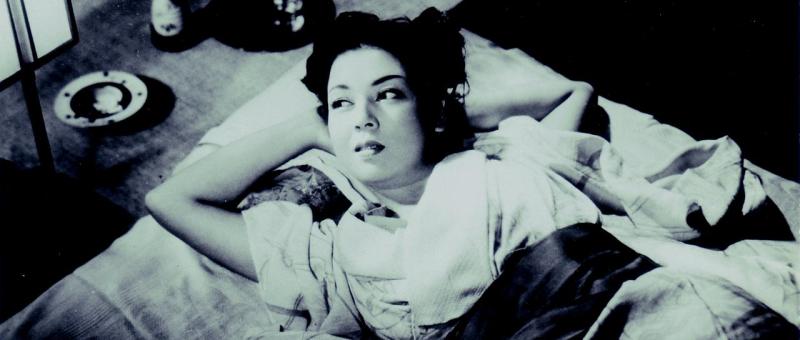
「偽れる盛装」(C)KADOKAWA1951Japan at a crossroads. East/West, past/future becomes a conflict between Kyoto and Tokyo in Yoshimura’s exploration of two women pulled in surprisingly contradictory directions in the new post-war world, Clothes of Deception (偽れる盛装, Itsuwareru Seiso). Working from a script by Kaneto Shindo, Yoshimura frames his tale as one of progress and resistance but the divisions are not as simple as they first seem. Machiko Kyo turns in another wonderfully nuanced performance as a Kyoto geisha trapped by the unchanging nature of her city yet yearning for an end to its slavish devotion to tradition.

Kumicho (Machiko Kyo) is the daughter of a longstanding geisha house currently operated by her mother. Though working as a geisha, Kumicho is not universally popular with the older generation thanks to her money first attitude which sees her prioritise earnings potential through having an unlimited number of clients rather than relying on a single patron. Kumicho is tough where geishas are generally soft and accommodating. She doesn’t take orders or nonsense from anyone, not least her push over of a mother.

Kumicho’s sister, Taeko (Yasuko Fujita), is not involved in the geisha trade and has a regular office job in the local tourist office. Unlike Kumicho, Taeko is mild mannered and reserved, dressing in regular Western fashions and travelling everywhere by bicycle. Taeko is engaged to a colleague, Koji (Keiju Kobayashi), who just happens to be the adopted son of another geisha house run by a woman with a long standing grudge against her mother.

Kyoto, a former capital, is famous for its historical qualities – a living museum to old-time Japan, but as a friend visiting from Tokyo points out perhaps that’s not altogether a good thing. Unlike Tokyo, Kyoto escaped much of the wartime destruction allowing it to be seen as a symbol of cultural resilience but lack of destruction also robs of it the chance for rebirth. History has survived, but so have lots of “tired old ideas”, according to Taeko’s friend Yukiko who urges her to forget the stagnant city and head for pastures new in Tokyo where the exciting post-war future is already underway.

Those old fashioned ideas are embodied within the rigid codes of the geisha world which Kumicho, on the surface the more traditional of the sisters but in actuality less so, has been breaking. Kumicho cares about money and she cares about survival which has made her unsentimental. Despite being involved in the “traditional” Kyoto occupation with all of its elegance and complicated ritual, Kumicho is a modernist who secretly hates the trade and holds each of her customers in deep contempt. Thus she thinks her mother, Kiku (Hisako Takihana), is a soft touch for continuing to bankroll the feckless son of her former lover, but is as heartbroken as anyone when one of the geishas becomes gravely ill. Kumicho’s manner maybe brash and brassy but her heart is as warm as her mother’s who continues to visit the widow of her former patron and makes sure the sickly geisha is cared for properly without resenting either the costs involved or the loss of earnings.

Taeko’s engagement to Koji opens up old wounds and exposes the less genial side of geishadom in the grudge bearing rivalry of Kiku and Koji’s mother Chiyo (Chieko Murata). Chiyo tries to put the kibosh on Taeko’s marriage as a way of getting back at Kiku, claiming that Taeko simply isn’t good enough for her son, but her authority is also dependent on those tired old ideas of hierarchy and filial piety. Koji, an adopted child, feels himself beholden to his mother’s needs in having been raised exclusively to fulfil them and vacillates in indecision regarding his marriage. Spineless and cowardly, Koji cannot find the strength to tell his mother no but also refuses to definitively break things off with Taeko.

Younger than Kumicho and a part of the “modern” world thanks to her regular office job in the tourist office, Taeko is comparatively more socially conservative reacting with horror when the increasingly strained Koji makes desperate, aggressive advances towards her whilst refusing to confirm his intention to marry against his mother’s wishes. Taeko and Koji have imprisoned themselves within Kyoto’s oppressive system of social codes in refusing to seize their chance of individual happiness and stride forward into the bright future being offered everywhere else except in the unchanging city.

Kumicho’s machinations eventually land her in hot water when an obsessed client ruins himself and then turns violent, demonstrating the less publicised dangerous side of life in the geisha trade. Kyoto, with all of its elegant refinement, can still be a place of rancour and regret where decades old grudges and more recent resentments threaten to disturb the peace. Kumicho’s innovations have shown up the geisha trade for what it is through her thoroughly unsentimental seduce and discard philosophy but she is, if nothing else, essentially truthful in her “modern” desire to call a spade a spade. The old ways are changing, though perhaps not fast enough. Kyoto, with its rigidity and stagnation is eventually rejected as Kumicho, unable to extricate herself, makes sure that her sister is first in line for all the opportunities the new world has to offer – by sending her to Tokyo, the capital of the future.


Screened at BFI as part of the Women in Japanese Melodrama season.

Vestige (面影, Heinosuke Gosho, 1948)

vlcsnap-2017-06-25-03h44m26s663Master of the shomingeki, Heinosuke Gosho goes upscale for the post-war romantic melodrama, Vestige (面影, omokage), even if he goes out of his way to add a layer of expressionistic imagery. Inspired by Gosho’s own experiences, Vestige has an air of melancholy and of frustrated dreams but also of resignation as the two not quite lovers at the centre agree to quell their romantic yearnings and preserve their conventional, bourgeois lives at the expense of greater happiness.
When Kawasaki goes to stay at the seaside retreat of his former professor and mentor Inagaki, he is immediately struck by the professor’s much younger wife, Sachiko, who is the spitting image of his own whom he lost in the war three years previously. Inagaki more or less lives at his spacious seaside villa along with Sachiko, her older sister Fukuko, and Fukuko’s two children. Having married late, Inagaki is a happy man and his home life seems settled and pleasant if conventional.

The couple quickly realise that there’s something deeply sad about Kawasaki, but they attribute it to having lost his wife in such an abrupt manner. Kawasaki is indeed in mourning and nursing feelings of guilt over not having appreciated his wife enough while she was alive – the marriage was an arranged one with a grain of resentment at its core, but still Kawasaki came to be fond of his wife even if his feelings only cemented themselves after she died. Kawasaki keeps his growing feelings for Sachiko to himself though their growing intensity eventually begins to pain him.

Sachiko mainly remains unaware of Kawasaki’s emotional turmoil and she and the professor are secretly hatching a plan to suggest a semi-arranged marriage between Kawasaki and the couple’s niece, Kaoru. Not only insensitive in the extreme, the idea leaves Kawasaki feeling hoodwinked and confused. Kaoru may be approaching marriageable age by the standards of the time but she’s very much a little girl, running around in shorts and pigtails with girlish glee. Even if they don’t intend the marriage right away, Sachiko and Inagaki have almost tried to foist a child bride on a man still eaten up by guilt at not having been a good husband to a woman he only realised he loved after she died. Unsurprisingly, Kawasaki feels even more awkward and begins to make noises about going home.

Like many romantic melodrama players, the relationship between Sachiko and Kawasaki is prefigured by a musical bonding in which Sachiko sings the lyrics to the only song Kawasaki can play on the piano which was taught to him by his pianist wife. Though Sachiko had been happy enough in her marriage, her surfacing feelings for Kawasaki who is, to put it bluntly a more age appropriate partner, are a surprise and a problem. As in Brief Encounter, Sachiko may not have known such violent emotions could happen to ordinary people and now they have arrived there is little she can do about them.

Keeping her true feelings well under-wraps, Sachiko only breaks briefly after Kawasaki has opened the floodgates by confessing his love when she finds the photo of his late wife  and realises that she looks just like her. Hurt and confused, Sachiko is upset by an odd kind of jealousy as she is forced to wonder how much of Kawasaki’s feelings for her are really those for his late wife. Kawasaki seems uncertain, dreaming of Akiko but seeing Sachiko, unable to separate the two women in his mind.

Inagaki, a magnanimous if wounded husband, begins to see a side of his much younger wife that he had not seen before. Fukuko is the first to spot the innocent bond developing between Kawasaki and her sister but trusts Sachiko to do the right thing whilst feeling sorry for lonely piano playing widower. Inagaki truly loves his wife. Proclaiming that if she isn’t happy than he can’t be either, he comforts and protects Sachiko rather than trying to keep her through violence or anger. Despite his original happiness there’s a part of him which feels guilt towards Sachiko for marrying her at such a late age, as if he’s robbed her of her youth. An odd conversation with Kaoru in which he delicately tries to talk to her about the idea of Kawasaki as a husband backfires when he’s forced to realise she’s far too young to talk about this and also that Kawasaki is a much better fit for his wife than his niece. His solution is a painful but pragmatic one, asking Kawasaki to leave he hopes that all of these unwelcome, destabilising feelings can be put back in the box and forgotten about once the intrusive presence of the outsider has been eliminated.

This is, indeed, the conventional wisdom but as in many of his later films Gosho undercuts it through suggesting that it’s never just as simple as sealing off one’s feelings and living happily in the way society dictates. Inagaki might have made the point that “happy” marriages are not always happy – his own was one of ordinary pleasantness which might have grown into a deep love rather than a great romance, but Sachiko’s heart has been opened and being forced to close it so definitively cannot have any other result than breaking it permanently. Resentfully snapping at the menfolk as they agree to shake hands and forget all about all of this love stuff, Sachiko turns her back on her husband weeping at her sister’s confirmation that Kawasaki will never return, only later returning to his side to light his cigarette as he picks up the book titled “A Theory of Happiness” which now seems like a very ironic gift from the sensitive Kawasaki.

Carried along by the lush romantic theme of the folk song which brings together Kawasaki, Akiko, and Sachiko, Vestige is a romantic melodrama of the highest order but Gosho attempts to elevate it by frequent use of expressionist imagery from super imposition and cuts to crashing waves on silent beaches. The war is barely mentioned and little seen – it does not seem to have touched Inagaki’s upperclass life in his idyllic beachside paradise, but the spectre is always there as it haunts Kawasaki with the cruel randomness of his wife’s death mixed with his guilt both about being unable to save her and not having treated her well enough when she was alive. The conventional life wins out, sanctioned bonds are maintained, holding strong against the forces of “irrational” emotion but Gosho imbues the final scenes with a heavier sadness than just that of people sacrificing themselves in service of a social code. These are people already trying to live life along a “theory” of happiness and failing, pretending to find fulfilment in embracing conventionalty but finding only pain and suffering in being unable to acknowledge their true feelings.


Night Drum (夜の鼓, Tadashi Imai, 1958)

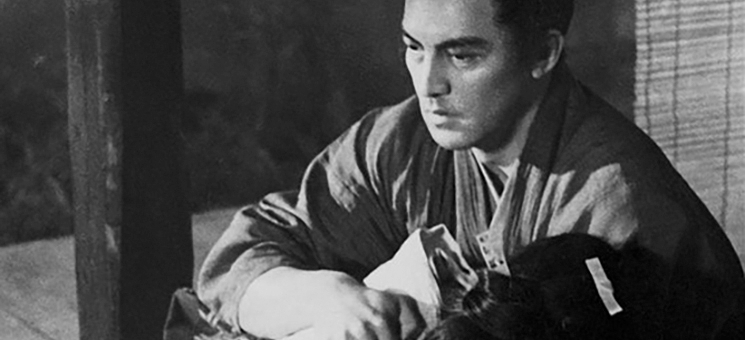
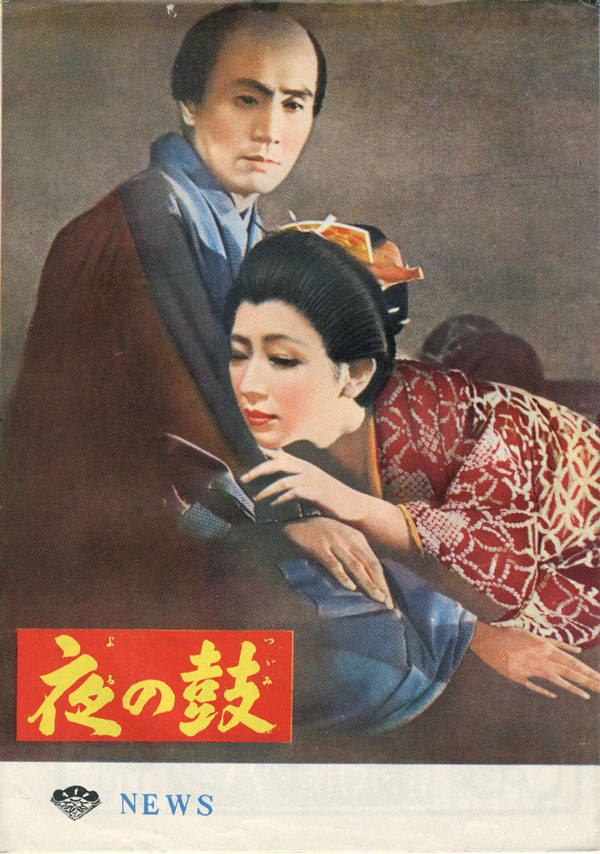
night-drum

The works of Chikamatsu Monzaemon continue to have a large influence over Japanese drama even if not as frequently and directly adapted as they were in the immediate post-war period. Famous for tales of tragic love suicides and romantic heroes who risk all in the service of deep emotion, Chikamatsu’s works perhaps found even greater resonance in the turbulent years in which individual freedom and adherence to tradition found themselves in even greater conflict than ever before. Tadashi Imai makes the most of Chikamatsu’s melancholy fatalism to take a sword to the samurai order itself with all of its arcane rules and the essential hypocrisy which underlines its cruelty.

Hikokuro Ogura (Rentaro Mikuni) has been in Edo for a year with the shogun and is now on his way home. Stopping at an inn, he has a low level argument with his brother-in-law who warns him the men are getting restless and need to blow off some steam preferably with some sake. Hikokuro is in charge of the purse strings and knows all of this pageantry costs money the clan do not quite have hence he’s reluctant to fritter it away on alcohol no matter how much the men might resent him for it.

That’s not to say Hikokuro is a particularly officious person, he’s kind and cheerful by nature but also tired and eager to get home after such a long time away. His wife, Otane (Ineko Arima), is very happy to see him but something seems different about her and there’s a tension in the air among some of the other women. It seems, there are rumours about Otane and a travelling musician (Masayuki Mori) who frequented the house during the summer while Hikokuro was away. Rumours are often just that, especially in these petty circles of nobility, but female adultery is punishable by death and so is not something to be gossiped about idly.

Night Drum (夜の鼓, Yoru no Tsuzumi) begins with the ominous sound of the drum itself, beating out the inevitably tragic fate of all concerned with a melancholy fatality. The tale proceeds in a procedural fashion as the authorities become involved, hearing witness testimonies and trying to discover if there could be any truth at all in these unpleasant rumours. Matters are further complicated by the pecuniary difficulties the clan currently finds itself in – the elders are half hoping it is true because it would be a good excuse to expel the Ogura household and thereby save the money which goes on its upkeep. They are aware, however, that they’re talking about the life of a previously unblemished woman as well as the ruin of her extended family.

The life of a retainer is not as easy as it sounds and we’re constantly reminded of just how much money is necessary to keep up appearances. The clan authorities are dismayed when they hear of Otane earning money on the side through needlework though other retainers are quick to confess their wives also help out, they just can’t survive on such meagre stipends. Each lord is required to hire servants as befits their status but they aren’t given the money to do so. Hikokuro is also required to serve the shogun in Edo every other year for at least twelve months meaning Otane is left alone at home with almost nothing other than her needlework to do except wait patiently for her husband’s return.

Given these circumstances, it’s easy to understand how such pernicious rumours might begin. The sole basis of the evidence seems to rest on a tip off that Otane is thought to have been alone in a room with a man who is not her husband. That she may be put to death solely for the crime of sharing the same space as someone of the opposite sex seems extreme, but this is the feudal world where rules and propriety are all. The men can cavort with geishas to their heart’s content, but Caesar’s wife must be above suspicion.

The action unfolds piecemeal as each of the various witnesses offers their testimony of events. Given the gravity of the situation, few are eager to recount their suspicions – especially the other women who fear the rumour may be true but are also unwilling to believe it. Hikokuro does not want to believe it either but faced with such convincing, if circumstantial, evidence doubt creeps into his mind and finds an anchor in Otane’s guilt ridden behaviour. Ironically, this entire situation developed only because of Otane’s attempts to avoid it – remaining at an inn rather than travelling with a man on the road only for one of her husband’s friends to attempt to rape and blackmail her. Having had far too much to drink in an attempt to steel her nerves and cover up the embarrassing assault, Otane finds herself at the mercy of man who should have known better than to take advantage of another man’s wife in such a moment of weakness.

One stupid mistake born of alcohol, loneliness, and a series of male betrayals is enough to bring down the social order all on its own. Rentaro Mikuni plays the part of the previously affable wounded spouse with an exceptional level of nuance as he accepts his part in his wife’s downfall thanks to the the circumstances of their lives which have kept them apart and left her at the mercy of untrustworthy lords. There is anger here, and shame, but there is still love too which only makes the inevitable outcome all the more painful for everyone concerned. Hikokuro plays the part he’s expected to play, but it pains him and you can’t wipe a slate clean with blood. Imai has his eyes firmly on the civilised society with all of its rigid yet often cruel and unfair rules for living. Shot with a kind of hypnotic dreaminess in which each of our unfortunate players is swept along by events they are powerless to influence, Night Drum beats out the death knell of those who allow their individual desires to overwhelm their “civilised” conformity but it does so with a rhythm that is filled with anger rather than sorrow, for those who are forced to leave half their lives unlived in maintenance of the very system which oppresses them.


Odd Obsession (鍵, Kon Ichikawa, 1959)

odd-obsessionJunichiro Tanizaki is widely regarded as one of the major Japanese literary figures of the twentieth century with his work frequently adapted for the cinema screen. Those most familiar with Kon Ichikawa’s art house leaning pictures such as war films The Burmese Harp or Fires on the Plain might find it quite an odd proposition but in many ways, there could be no finer match for Tanizaki’s subversive, darkly comic critiques of the baser elements of human nature than the otherwise wry director. Odd Obsession (鍵, Kagi) may be a strange title for this adaptation of Tanizaki’s well known later work The Key, but then again “odd obsessions” is good way of describing the majority of Tanizaki’s career. A tale of destructive sexuality, the odd obsession here is not so much pleasure or even dominance but a misplaced hope of sexuality as salvation, that the sheer force of stimulation arising from desire can in some way be harnessed to stave off the inevitable even if it entails a kind of personal abstinence.
Our narrator for this sardonic tale is an ambitious young doctor, Kimura (Tatsuya Nakadai), who opens the film in an unusually meta fashion with a direct to camera address taking the form of a brief lecture on the decline of the human body (which begins at age ten and then gets progressively worse). Kimura reminds us that we too will grow old, but his warning is intended less to engender sympathy for the elderly patriarch who will become our secondary protagonist than it is to raise a grim spectre of the inescapability of death.

The story Kimura wants to tell us of a man who fought against senility centres on antiques expert and respected cultural critic Kenmochi (Ganjiro Nakamura). Advanced in years, Kenmochi is beginning to feel the darkness encroaching along with the desire to resist it through restored virility. For this reason, he’s been making regular appointments at Kimura’s clinic which he keeps secret from his wife who would be unhappy to know he’s been getting mysterious injections to help with his sex drive but which also come with a number of side effects including dangerously raising his blood pressure.

Eventually Ikuko (Machiko Kyo), Kenmochi’s slightly younger wife and mother of his grown up daughter Toshiko (Junko Kano), does indeed find out though what she does not appear to know is that Kenmochi has also been drugging her so that he can take photos of her naked body and enjoy his rights as her husband without her needing to be 100% present at the time. Kenmochi’s plan is to lure Kimura into having an affair with his wife so that the resultant jealousy will stimulate his system, staving off senility and other unwelcome effects of ageing. This would be strange enough on its own were it not that Kenmochi has also been trying to set up a marriage between Toshiko and Kimura who are already engaged in a discreet affair.

In contrast with the source material which takes the form of a number of diary entries providing differing perspectives on events, the film takes the point of view of the cynical and morally bankrupt doctor Kimura who feels himself above this “pathetic” old man with his sexual preoccupations and diminished prospects. As the narrator, Kimura evidently believes himself in control but Ichikawa is keen to play with our sense of the rules of storytelling to show him just how wrong he could be. Intrigue is everywhere. Kenmochi may think he’s using all around him in a clever game to prolong his own life but he’s entirely blind to a series of counter games which may be taking place behind his back.

Sex is quite literally a weapon – aimed at the heart of death. Kimura recounts a dream he sometimes has in which he is shot through the heart in an arid desert, only for this same scene to invade the mind of a paralysed Kenmochi on gazing at the naked body of his wife. The marriage of Kenmochi and Ikuko has apparently been a cold (and perhaps unhappy) one with Kenmochi berating his wife for remaining “priest’s daughter” all these years later, prudish and conventional. Nevertheless, Ikuko – the kimonoed figure of the traditional Japanese wife, subservient yet mysterious and melancholy, becomes the central pivot around which all the men turn, eclipsing her own daughter – a Westernised, sexually liberated young woman rendered undesirable in her very availability. Kimura is not quite the destructive interloper of Pasolini’s Theorem so much as he is a “key” used by Kenmochi to “unlock” a hidden capacity within himself but one which, as it turns out, opens many doors not all of them leading to intended, or expected, destinations.

Ichikawa continues with a more experimental approach than was his norm following the bold opening scene in which Kimura directly addresses the audience with a straight to camera monologue. A pointed symbolic sequence of a train coupling, freeze frames, dissolves and montages add to his alienated perspective as he adopts Kimura’s arch commentary on the ongoing disaster which is the extremely dysfunctional Kenmochi family home. Middle class and well to do, the Kenmochis’ lives are nevertheless empty – the house is mortgaged and the beautiful statues which taunt Kenmochi with their physical perfection have all already been sold though Kenmochi refuses to let the buyer take them home. Old age should burn and rave at close of day, but as the beautifully ironic ending makes plain it will be of little use, death is in the house wearing an all too familiar face which you will always fail to recognise.


Screened as part of the Japan Foundation Touring Film Programme 2017.

Opening scene (no subtitles)

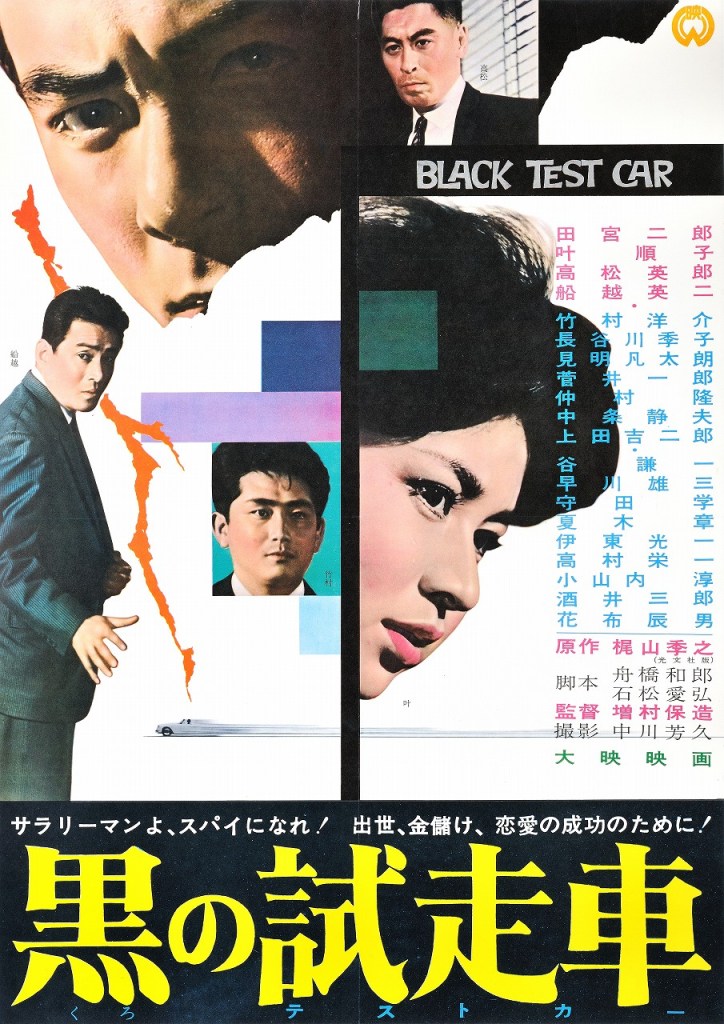
Black Test Car (黒の試走車, Yasuzo Masumura, 1962)

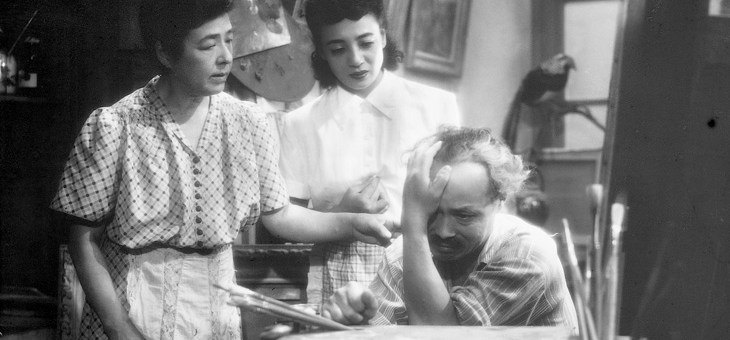
tumblr_n2w2l2mX1a1tvmqcgo1_1280The automobile business is a high stakes game. Do you want to play faster, shinier and sleeker, or safer, family friendly and reliable? Family cars are the best sellers – everyone one wants something that’s reliable for getting to work every morning, getting the grocery shopping done and that you won’t worry about taking your kids to the park in. However, it’s the 1960s and lifestyles are shifting, men (in particular) are marrying later and they want to have fun before they do – hence having quite a lot of disposable income they can blow on a flashy two-seater sports car with no wife to complain about it. Tiger have just finished a new prototype called the Pioneer they plan to launch as a revolution in commercial sports cars which is super speedy but with the convenience of an everyday sedan. However, the Yamato company are also set to launch a new car and it keeps looking suspiciously like the Pioneer – does Tiger have a mole?

Black Test Car (黒の試走車, Kuro no Test Car) begins with the prototype model of the Pioneer bursting into flames during a test run. Not the best start, but it’s early days and at least the driver wasn’t hurt. The guys at Tiger suspect sabotage as they can’t find anything wrong with car’s design. Onoda, the man who’s in charge of the project, has summoned some of his best employees to become the “industrial spying” department to flush out the mole. However, their first few plans fail and Yamato always seems to get there ahead of them. Yamato’s “chief of spying” is a slightly sleazy older man by the name of Mawatari who lost his wife and daughter during the Manchurian campaign (where he also may have been a more official kind of spy). Luckily (for some more than others), Onoda’s protege, Asahina, is dating a girl who works in the hostess industry and it’s suggested to him that he get his girlfriend to spy on Mawatari as he has a particular fondness for a certain hostess bar. The shady dealings only get worse from here on in, blackmail, bribery, pimping and prostitution – is this the yakuza or the automobile industry?

Yasuzo Masumura turns his cynical eye to big business and finds just as must drama as in your cold war spy epic. Onoda is a fanatical company man whose primary reason for living is his work. He barely comes home, rarely sees his children and views his precious Pioneer as his legacy. As such, he’s determined to find the man who’s betraying all his secrets and has become something of a petty dictator in the process. “We’re industrial spies!” he keeps declaiming, as if those words had any kind of authority. He’s not a policeman, he’s not a warrior for justice, he’s just a guy at a car firm who’s poured altogether too much of himself into a few scraps of metal.

His assistant, the up and coming Asahina, seems set to follow in Onoda’s footsteps. He’s young and ambitious, he wants to get the head of department job so he can marry his girlfriend who is still working as a bar hostess (which he doesn’t actually seem to mind about if she doesn’t mind about it either). The girlfriend, Masako, worries that work is changing him. When Asahina asks her to spy on Mawatari she refuses, but when he half jokes that he might not want to marry her she if won’t do as he says, she eventually agrees. Later he asks her for more than that which might just be enough to nip this young love story well and truly in the bud.

Having lost out several times already, the Tiger guys think they’ve got an angle and decide to launch the Pioneer way ahead of schedule to undercut Yamato’s price and release date. However, right away there is a scandalous accident which ends up all over the papers as the driver of the car (who survived unscathed, there were no serious injuries involved) drags the wreck all over town with a loud speaker to announce just how dangerous he believes the car to be. Of course, he’s a stooge, set up by Yamato and aided by another undiscovered mole in the Tiger camp. This incident is the last straw for those who still have a moral backbone at Tiger – culminating in violence and suicide, it leaves the fresh faced executives wondering whether they’re on the career ladder at a respectable firm or among the ranks of thuggish gangsters prepared to lie, cheat and extort to get along.

Shot in a noirish black and white with a moody jazz score, Black Test Car has its film noir overtones with the immorality of big business at its centre. At the beginning of the film everything is for the company – no one thinks of themselves or their own soul, they just want in and to climb the ladder while its there. Or so it seems because everyone is also taking kickbacks whilst blackmailing other people for doing exactly the same thing. There are spy cams interpreted by lip readers, undercover prostitutes masquerading as nurses and men in bushes with microphones – not a dignified way of doing business. At one point Onoda scoffs “you can’t get hung up on  morals. You’ll just have remorse” – this is the choice that presents itself, would you rather have the flashy sports car or retain your humanity?


Black Test Car is available on R1 DVD with English subtitles courtesy of Fantoma.

(unsubbed trailer)

http://www.youtube.com/watch?v=31_7Ve8SPJU


The Crucified Lovers (近松物語, Chikamatsu Monogatari, Kenji Mizoguchi, 1954)

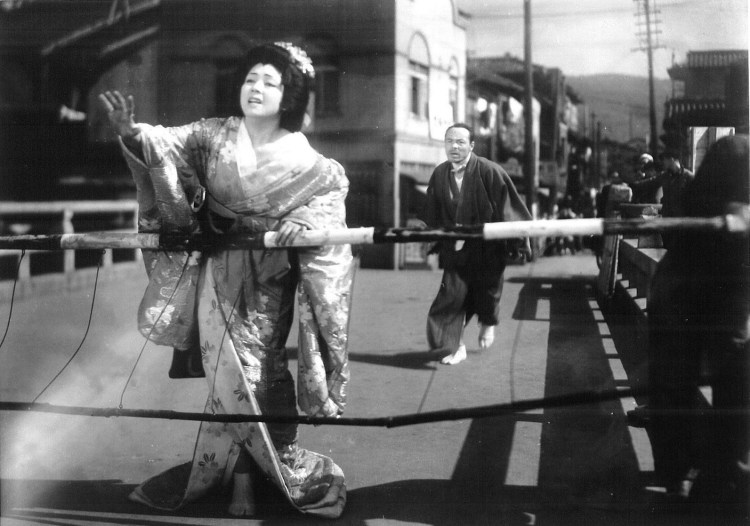
E8BF91E69DBEE789A9E8AA9EB2Bunraku playwright Chikamatsu Monzaemon had a bit of a thing about double suicides which feature in a number of his plays. Though these legends of lovers driven into the arms of death by a cruel and unforgiving society are common across the world, they seem to have taken a particularly romantic route in Japanese drama. Brought to the screen by the great (if sometimes conflicted) champion of women’s cinema Kenji Mizoguchi, The Crucified Lovers (近松物語, Chikamatsu Monogatari) takes its queue from  one such bunraku play and tells the sorry tale of Osan and Mohei who find themselves thrown together by a set of huge misunderstandings and subsequently falling headlong into a forbidden romance.

Set in 17th century Kyoto, the story begins with a reminder that adultery is currently illegal and that the penalty is crucifixion of both parties. A samurai woman and a man servant are being paraded through the streets for having committed the double transgression of an extra-martial affair which also crosses class borders. We set our tale at the top printing house in the city where the most promising employee, Mohei, is being pulled from his sickbed to complete a particularly important order. At the same time, mistress of the house Osan receives an unwelcome visit from her brother who is once again in pecuniary difficulty. He wants her to ask her wealthy husband, Ishun, to lend him some more money to meet the latest mortgage payment on their family home. However, Ishun is a stingy old man and outright refuses. Mohei overhears the brother’s visit and offers to help but his idea to temporarily embezzle some of the money backfires when he’s caught.

To make matters worse, Ishun now has it in for Mohei as Ishun has been after the servant girl Otama who has been refusing his advances and finally lied to him by claiming that she and Mohei are secretly engaged. After Otama reveals Ishun’s true nature to Osan, they hatch a plan to confront him by swapping rooms so that when Ishun makes his nightly visit to Otama he’ll find his wife waiting for him instead and have to backdown for awhile. This backfires too when Mohei decides to escape and stops by Otama’s room to say goodbye only for another servant to find Mohei and Osan together there. Mohei flees but a rumour starts about his friendship with Osan and it’s not long before she’s stormed out too. Accidentally running in to each other the pair find themselves on the run and eventually falling in love, but this isn’t the sort of place where two people can just move to another town and disappear. The police and Ishun’s men are hot on their tail determined to try and prevent the impending scandal…

Life was pretty harsh in feudal Japan. In some ways Osan might be thought lucky – married off at a young age to a well connected and prosperous husband. Indeed, at the beginning of the film she doesn’t seem too unhappy though is obviously nervous to talk to her husband about her brother’s predicament. Ishun is not a good man though he is perhaps sadly typical of his petty samurai merchant class. He swaggers around complaining about having to pay for everything and won’t even lend any of his vast wealth to his own sister let alone his wife’s family. Though outwardly miserly he’s no problem promising fancy kimonos and even a house to Otama if she’d only consent to becoming his mistress. Something of a double standard then when his wife is accused of having affair with a servant merely by having been found in a compromising position alone in a room with another man.

Mohei, by contrast, is the archetypal loyal retainer. When ever a problem comes up he reminds himself that one needs to be a “good servant” – a sentiment he utters to Otama when she asks for his help to fend off Ishun. He doesn’t approve of the idea of her simply giving in, but thinks she ought to grin and bear it. Similarly when some of the female members of staff are sympathising with the samurai lady about to be crucified for love, Mohei agrees that he feels sorry for her but also that she’s broken a law and what is happening is simply a natural consequence. He’s the last sort of person you would expect this sort of thing to happen to, and yet, it does.

The irony is that nothing existed between the pair other than the loose friendship and loyalty of a mistress and a member of staff before this whole thing started. Their union is quite literally unthinkable, not only a relationship between a married woman and another man, but love across the class divides. Even if Osan were free, a marriage with Mohei would be considered a disgrace. When the pair face the hopelessness of their situation and decide on suicide, Mohei confesses his love which immediately changes Osan’s mind about dying. She’s fallen in love with him too, and now she wants to live. For her now there can be no life without Mohei. Though Mohei entertains the noble idea of handing himself in to the police and sending Osan back to Ishun who would doubtless be glad to cover up the affair and avoid a bigger scandal, he later finds himself unable to give her up. The pair cannot, and will not, deny their love even if it costs their lives. In this unforgiving world of harsh social justice, the only freedom left to Osan and Mohei is to ride proudly to their agonising deaths hand in hand and with beatific smiles on their faces.

In the end, two grand houses fall because of a series of coincidental misunderstandings and lapses of protocol. Envious of his position, another petty samurai is perfectly happy to manipulate the situation to take down Ishun fully knowing that it will mean the deaths of two people. In ordinary circumstances this passionate, romantic love would never be permitted to exist (or at least among this social class). Its blossoming is an impossible miracle that threatens the very foundation of the extraordinarily regimented society of the two people at its centre. Parents betray their children to protect these archaic laws and preserve their family “honour” but what honour could their possibly be in the denial of love and society that places standing above basic compassion?

Though not perhaps Mizoguchi’s most impressive effort, The Crucified Lovers is an impassioned attack on needlessly repressive social systems and the self centred shenanigans which perpetuate them. Unashamedly melodramatic and filled with a melancholy though passionate resilience, The Crucified Lovers is a tragic tale of true love torn asunder by a cruel and unforgiving world. It would be so easy to say this would never happen today, and yet…


The Crucified Lovers is available on blu-ray in the UK as part of Eureka’s Late Mizoguchi box set.

No trailer but here is a particularly beautiful scene from the film

http://www.youtube.com/watch?v=rG59RIaz3VM

And an introduction from Tony Rayns