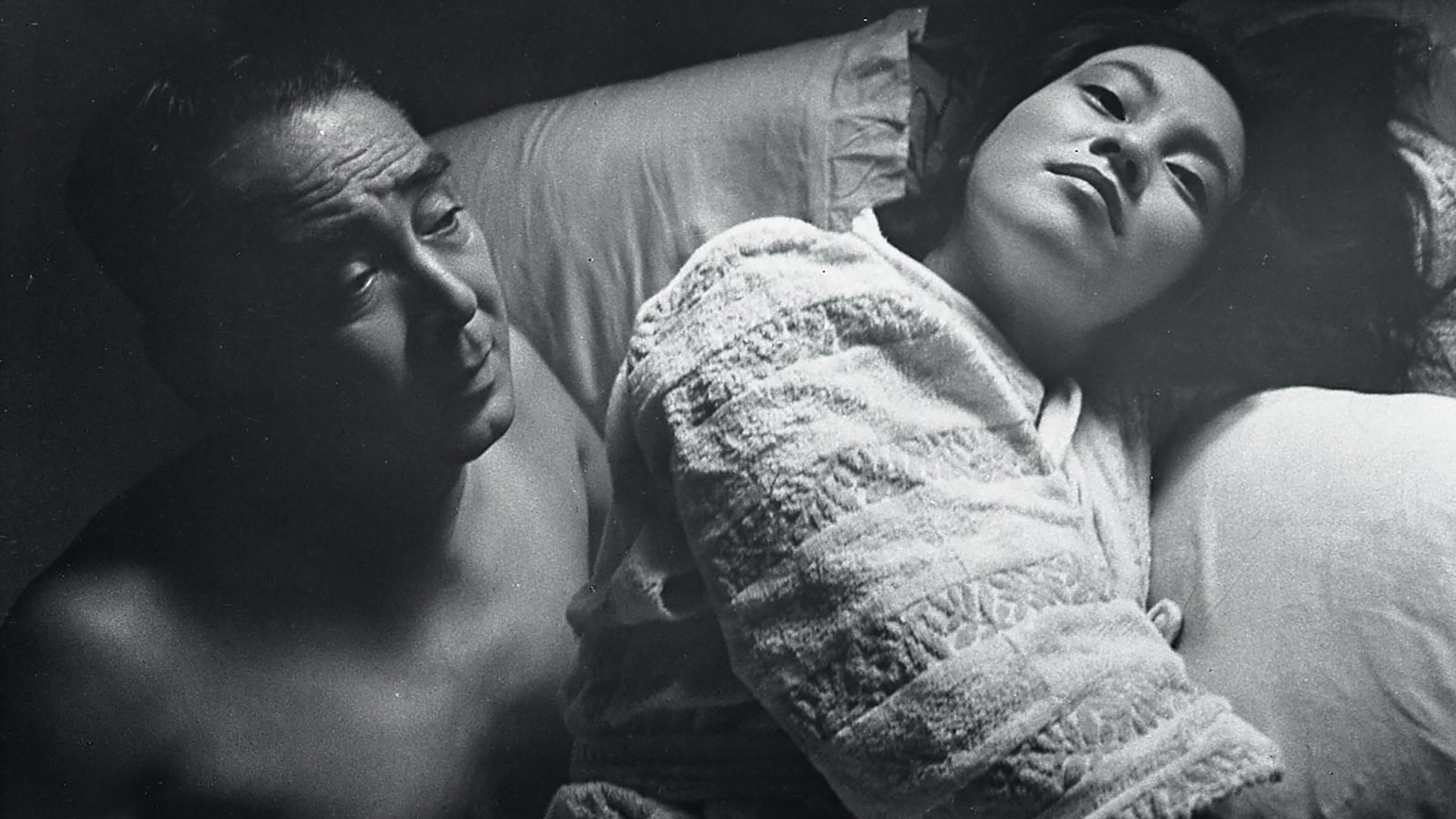
The Insect Woman (にっぽん昆虫記, Shohei Imamura, 1963)

“What other way is there?” a young woman says to her mother, little understanding that what she so casually tells her quietly crushes her mother’s view of herself as if her long years of suffering had all been for nothing while exposing her justification that everything she had done was to save her daughter from her own fate as not strictly true. The opening scenes of Shohei Imamura’s The Insect Woman (にっぽん昆虫記, Nippon Konchuki) follow a bug stubbornly traversing rough terrain, slipping, pushing onward, overcoming obstacles, yet not really getting anywhere.

The bug’s journey is echoed in Tome’s (Sachiko Hidari) return to the village at the end of the film, now an ageing woman struggling with mountain roads after long years spent in the city and finally snapping her geta leaving her barefoot on rocky ground. Like that of the bug, Tome’s life seems to be a flat circle in which history repeats itself inexorably. The film opens in 1918 as Tome is born out of wedlock to a promiscuous woman who has entered a common law union with a man who appears to have learning difficulties. Chuji (Kazuo Kitamura) may or may not be her biological father, but has an attachment to Tome. As a child, she had asked him whether they are “married” seeing as they sleep together, and he had said that they were. There is definitely more than humouring a little girl’s silly question in his reply, while he flies into jealous rages when there is talk of marrying off the older Tome to the local landlord’s son. 

Just as her mother had, Tome also has a child out of wedlock, though the father can only be Shuzo, the man her family intended her to marry in part in settlement of a longstanding debt. Tome’s early life is defined by the lingering feudalism of the rural society in which her family are serfs beholden to the whims of the landlord. The older women in the village call her away from her factory job which she says she is doing for the war effort to help on the landlord’s farm. Though she is assured she is only required to do farm work, she is raped by Shuzo who urges her to submit to him and serve her country in another way by letting him have his way with her as he will soon be going off to die for the emperor. Tome then becomes his woman, but not actually his legal wife while this justification wears a little thin when it is revealed that Shuzo has another woman and child already and thus will likely not marry her. When she becomes pregnant and Chuji beats Shuzo up, Tome is sent back to her family to have the baby. It turns out to be a girl and the older women have a brief conversation about whether to let it die as female babies are worthless and resources are scarce. This seems to run contrary to rural wisdom seen in other films such as Imamura’s later The Ballad of Narayama in which, grim as it is, male children are often exposed as girls at least can be sold, though possibly not any longer in the new democratic society.

Nevertheless, Tome insists on keeping her baby though feels out of place among her family and returns to the factory where he she has an affair with the married foreman who gets her into trade unionism and then complains that she’s too militant about the labour movement when he gets promoted to assistant manager. Tome bristles at his hypocrisy, but later abandons her ideals herself and becomes an exploiter of women after moving to the city. After visiting a shady cult to overcome her sense of guilt after a child she was looking after who reminded her of her own faraway daughter died in accident, Tome meets a devotee who complains that all of the contemporary society’s ills are caused by a lack of religious rigour, yet is actually running a brothel staffed by “amateur” sex workers to which she forcibly recruits Tome by locking her in a room with a customer. 

Just as Tome schemes by dobbing her new boss in to the police so she can start up her own business using the women as call girls posing as one half of a regular couple to avoid police detection, so she is later betrayed by her own prodigy. Tome’s travel from her rural hometown to Tokyo mimics the nation’s transition from an agrarian to an urban society mired in post-war corruption as seen in the cynical and exploitive conditions at the brothel in which the madam takes almost all the money for herself, deducting large amounts for things like kimonos and room and board, while the “amateur” sex workers prepare blood vials to convince the customers they are virgins. Tome always states that her goal is to earn enough money so that she, Chuji, and her daughter Nobuko who have been shunned by the family, could live together but though she becomes quite wealthy and sends large amounts of money home she makes no real attempt to bring them with her or to go back to the village. 

A grown-up Nobuko (Jitsuko Yoshimura) later comes to her and asks for money because some of the local youngsters are trying to start a collective farm in the wake of land reforms that redistributed landlords’ lands and ended serfdom. Tome is distressed to know that Nobuko has dropped out of school though Tome has been sending her money for the fees, realising that Nobuko will not escape the village through education nor through marrying a nice professional husband and moving to the city. In fact, Nobuko follows in the footsteps of her mother and grandmother by conceiving a child of uncertain lineage out of wedlock after being coaxed into a sexual relationship with her mother’s former lover, Karasawa (Seizaburo Kawazu), a once-prominent businessman who has fallen on hard times. He agrees to lend her the money for the farm on the condition that she make herself sexually available to him twice a week. He eventually asks her to stay and run a shop he owns instead. Nobuko agrees, but actually runs off with the money for the farm and returns to her boyfriend Yoshiji. Like Chuji, he also questions the paternity of her child, but seems to have accepted the fact it may not be his while agreeing to raise it. Tome, meanwhile, returns to the village on Karasawa’s behalf planning to tell Yoshiji about Nobuko’s life in the city in an attempt to force her to return to him.

In blowing Karasawa off and taking the money to invest in the farm, Nobuko may have broken the cycle in another way in shaking off male authority and rejecting the consumerism of the urban society, though her farm is also envisioned as a money-making business that will make them rich rather than purely self-sufficient. Another passenger on the train Tome is travelling on remarks that the rice tastes better because they have had good harvests, bearing out Nobuko’s optimism for the future. Yet in other ways, Tome is merely a passive everywoman largely oblivious to the history happening all around her. She misses the emperor’s speech announcing the end of the war while sick from malnutrition and canoodling with her lover. A former union organiser she ironically gets caught up in the Matsukawa train derailment that was blamed on the Communist Party and Japan National Railway Union which the authorities desperately wanted to crush. As an older woman, she runs into the 1960 Anpo protests, but is irritated because they disrupt her cab journey costing her time and money. She may have been corrupted by the urban, amoral capitalism of the post-war society, but is neither good nor bad, just herself and someone doing what they can to survive. 

Imamura had said that he wanted to challenge the image of suffering womanhood seen in golden age cinema. Self-sacrificing heroines such as those in Naruse’s Floating Clouds or Mizoguchi’s Life of Oharu don’t really exist, he explained. His heroines were strong and outlived men, just like Tome who tries to carve out a kind of independence for herself, but eventually finds it taken from her by other women trying to do the same. Imamura had been prevented from making another film for three years after going over budget on Pigs and Battleships, but returns with a bold new stylistic experiment using freeze fames and ironic composition to depict the “messiness” of Tome’s life in all of its moral ambiguities, victories, and defeats.
Yellow Crow (黄色いからす, Heinosuke Gosho, 1957)

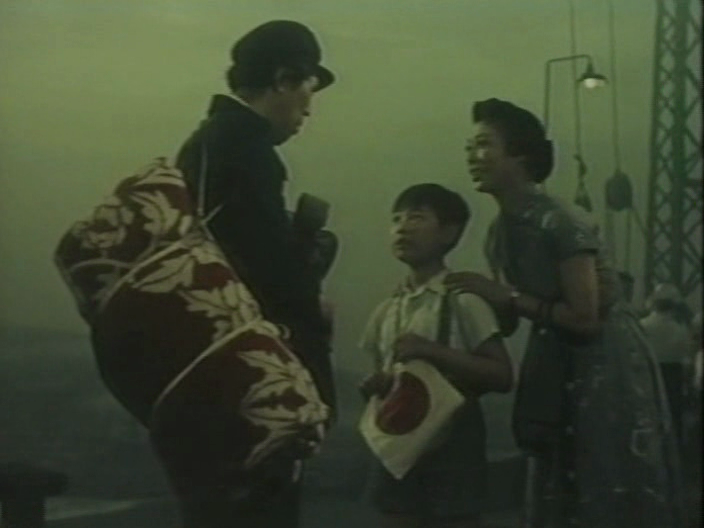
A small family struggles to repair itself after eight years of wartime separation in Heinosuke Gosho’s post-war melodrama, The Yellow Crow (黄色いからす, Kiiroi Karasu). Rather than focus directly on the legacy of the traumatic past, Gosho takes aim at war itself in making plain that the family’s problem is the time that was stolen from them each in a way forced to address the gulf between the idealised family life they may otherwise have had and the post-war reality. 

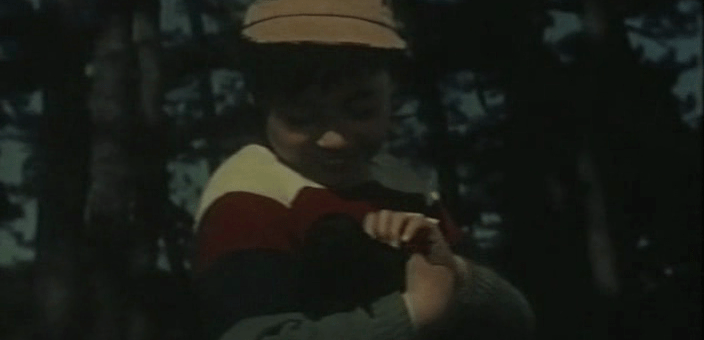
As the film opens, nine-year-old Kiyoshi (Koji Shitara) is sketching with his class at a temple. His teacher Miss Ashiwara (Yoshiko Kuga) is a little worried about the strange picture he’s drawing, noting that where once he had been a happy child painting cheerful pictures in vibrant colours now he only uses black and yellow and there’s unsettling quality in his composition. Still, trying to comfort him she tells Kiyoshi not to worry and that he’s free to draw whatever he likes, only later showing the paintings to a child psychologist who advises that these colours are often used by children who are anxious and lonely usually because they’ve lost a parent in the war. Only, Kiyoshi is lucky because he has both a mother and a father, his dad having been recently repatriated from China after being interned as a prisoner of war. 

In a sense it’s Miss Ashiwara’s misconception that the family must be happy because they’ve been so fortunate that lies at the centre of the conflict. Mother Machiko (Chikage Awashima) and father Ichiro (Yunosuke Ito) are so keen to get back to “normal” that no one really tries to address the obvious problems of their situation merely to reassume the lives they led before the war. For little Kiyoshi who wasn’t even born when his father left that sense of normality is very different and necessarily disrupted by his father’s return in what can only seem like an intrusion into closeness he had previously shared with his mother. 

Where another director or screenwriter may have told the entirety of the story from Kiyoshi’s point of view, Gosho pulls back to show us the way the adults struggle and suffer in their confusion and disappointment. On the surface, it does not seem that Ichiro has been particularly affected by his wartime service, rather the problem is in his frustrated attempts to reintegrate into a society which is entirely different from the one he left. He himself is older, and is perhaps acutely aware that he is a stranger to his son at first hurt by his shyness and reluctance to acknowledge him but then consumed by a sense of failure in a working life that leaves him little time to bond with his son leaving Kiyoshi with yet another sense of rejection. Meanwhile though his job was kept open for him, the nature of the business has changed. His boss is much younger than he is and has no interest in training an old timer he thinks is only really there as a goodwill gesture. As his friend points out, had it not been for the war he’d be a manager by now but as the boss puts it he’s returned to Japan “too late”. 

All of this adds to his sense of displacement and contributes to his increasingly harsh treatment of Kiyoshi, constantly discouraging all of his interests such as his fascination with animals and talent for drawing telling him only that he should be studying useful things like maths and science. His parenting style is evidently much more authoritarian than Machiko’s had been, often taking the view that Kiyoshi has been spoiled and needs some discipline instilling in him. But Kiyoshi reads his father’s treatment of him only as rejection, that must think he’s a bad boy and not want him. The resentment he feels only grows when the parents have another child, Mitsuko. It’s obviously much easier for Ichiro to bond with her than the already grown Kiyoshi while Machiko is both weak from the birth and mindful of a new responsibility all of which leaves Kiyoshi feeling pushed out and unwanted. He often takes refuge at the home of the kindly woman next-door, Yukiko (Kinuyo Tanaka), and her adopted daughter Haruko with whom he rescues animals, including a wounded crow, much to his father’s consternation. 

Always the wise observer, it’s Yukiko who finally tries to coax Machiko towards a resolution to challenge her husband’s authoritarianism. After his father accuses him of being a threat to Mitsuko and tries to shut him in the shed overnight, finally releasing his pet crow, Kiyoshi tries to run away and later returns to Yukiko’s house where he asks her to adopt him. Listening in secret, Machiko is heartbroken realising that they’ve been going about this all wrong, too busy trying blindly reassume the lives they had before when they should have met each other with more compassion and understanding trying to listen to Kiyoshi, who can admittedly at times be difficult and unreasonable unwilling to recognise when he is in the wrong, rather than instantly scolding him. Machiko’s story perhaps fades into the background, but she too is struggling having realised that her hopes that everything would finally be alright now that Ichiro has returned were misplaced while caught between her husband and her son with a baby daughter to care for trying to keep the peace if nothing else.   

Gosho apparently chose yellow after consulting with child psychologists* and filmed in full colour to make the most of Kiyoshi’s attempts at artistic expression while capturing his youthful sense of loneliness and displacement, but equally treats his parents with a degree of sympathy for their own confusion and disappointment. Ichiro is not a bad man and often trying his best but frustrated, admitting that he would have liked to simply forgive Kiyoshi and get closer to him as his father but for whatever reason found himself lashing out in misplaced anger. The message for the post-war society is then one of generalised compassion, that there’s no point blindly trying to reassume one’s life as if nothing had happened and patience and mutual understanding will be necessary to repair the bonds that war has corrupted. Thus it is Ichiro who has to change, dropping his authoritarian distance in deciding to be kinder to his son finally going out to look for him when he tries to run away in the middle of a storm returning the colours to Kiyoshi’s world as he begins to feel more secure in his familial connections in the knowledge that he is loved and wanted as a child of the new post-war generation. 


*Arthur Nolletti Jr., The Cinema of Heinosuke Gosho: Laughter Through Tears, pg. 185

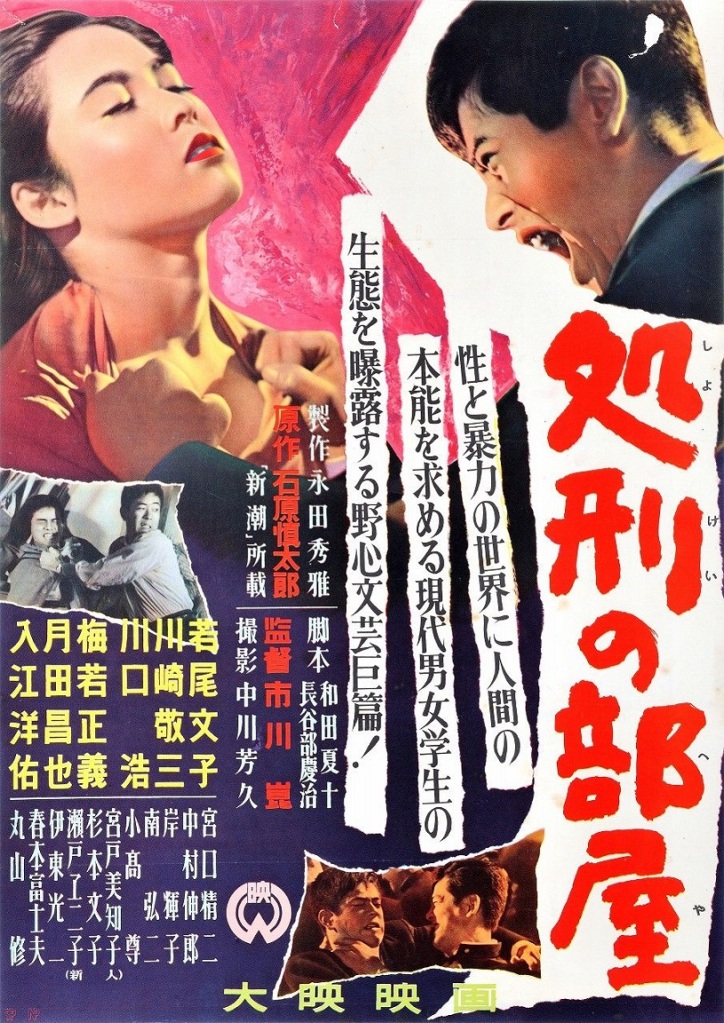
Punishment Room (処刑の部屋, Kon Ichikawa, 1956)

In the mid-1950s, Nikkatsu released a series of incendiary youth films which gave rise to a small moral panic in the older generation. The “Sun Tribe” movies proved so controversial that Nikkatsu could only release three of them before bowing to public pressure while Toho and Daiei both managed to release one each, bringing the total up to five. Produced by Daiei, Kon Ichikawa’s contribution to the Sun Tribe phenomenon, Punishment Room (処刑の部屋, Shokei no Heya), adapted another novel by Crazed Fruit’s Shintaro Ishihara who had, it seems, managed to capture something of the nihilistic spirit of the age.

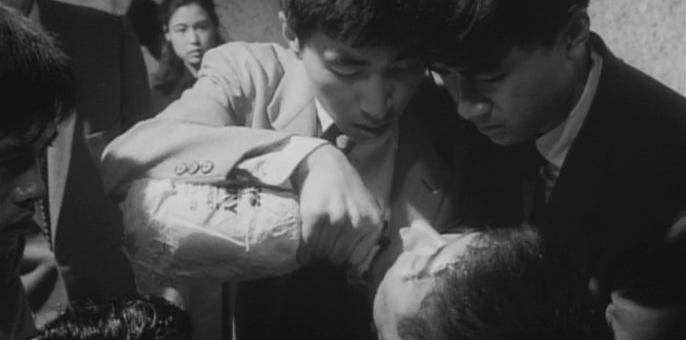
Among the darkest of the Sun Tribe tales, Punishment Room follows near sociopathic university student Katsumi (Hiroshi Kawaguchi) as he works out his frustration with his hangdog father Hanya (Seiji Miyaguchi) by kicking back against societal rigidity. Hanya is a bank clerk with some kind of stress-related stomach complaint for which he is forever taking medicine. One particular day, Katsumi and his friend Hideo (Shoji Umewaka) turn up to run some kind of scam on him, insisting that Hideo’s family are in dire straits because his dad’s working abroad and they don’t have money to make a payment on a loan. The boys want Hanya to buy the note of debt as security and lend them 30,000 yen, something which isn’t really allowed but he ends up taking out half of his own life savings to avoid embarrassing or being embarrassed by his own son in the workplace. The boys, however, were just trying to extort him and planning to use the money to host a college dance while making a little extra on the side. 

At this point, most still seem to feel that Katsumi is a “nice kid”, while Hideo is a bad influence. His middle school best friend Ryoji more or less says as much, but no one really knows the extent to which Katsumi is already becoming a black hole of nihilistic fury. His ire is provoked during a college debate session at which he’s outtalked by smart female student Akiko (Ayako Wakao) and abruptly cut off by the bored professor (Nobuo Nakamura). Despite knowing that one of his buddies has a crush on her, Katsumi makes a point of picking Akiko up during the chaos of celebration after a sports game. Along with Hideo and another, more innocent student they nickname “Sonny”, Katsumi takes Akiko and her friend to a nearby drinking house, popping out to buy sleeping pills and eventually spiking their drinks while they use the bathroom, knocking Sonny out for good measure to stop him getting in the way. After dragging the barely conscious girls back to Hideo’s family home, they take one each and rape them. On waking Akiko is defiant, threatening to call the police but an unrepentant Katsumi insists that she won’t be believed. Not content with their humiliations, the guys even insist on taking the girls home by cab only to run out and leave them with the bill. 

Katsumi is is equally unrepentant when someone sends his family a letter informing them of his conduct, admitting that the allegations are true but insisting that the women are complicit because they did not report him to the police. He even refers to Akiko, who has after a fashion fallen in love with him, as “sort of my girlfriend”. Hanya ironically blames his wife whom he has treated with nothing but contempt, giving his son a crash course in a inherited misogyny, but she turns the same logic of toxic masculinity back on him in pointing out that his own passivity is the major cause of his son’s resentful rebelliousness. If Katsumi is rebelling against something rather than just a sociopathic little punk, it is indeed the spinelessness he sees in his father, obliged to scrape and bow for a mere pittance as a “wage slave” of a cruelly conformist society. 

An angry young man, Katsumi preemptively rejects the salaryman straightjacket by rebelling against conventional morality. “I do what I want” he insists, as if proving that he’s a free agent acting under force of will alone and beholden to no one. His efforts are however, futile. His amoral violence buys him nothing but the same in return. Denied a mechanism for dealing with emotion, contemptuous of hollow authority figures, and infinitely bored by a society they believe has nothing to offer them bar empty consumerism, post-war youth seeks escape but finds only nihilistic self-destruction, trapped in a perpetual Punishment Room with no exit in sight. 


Opening Scene (no subtitles)

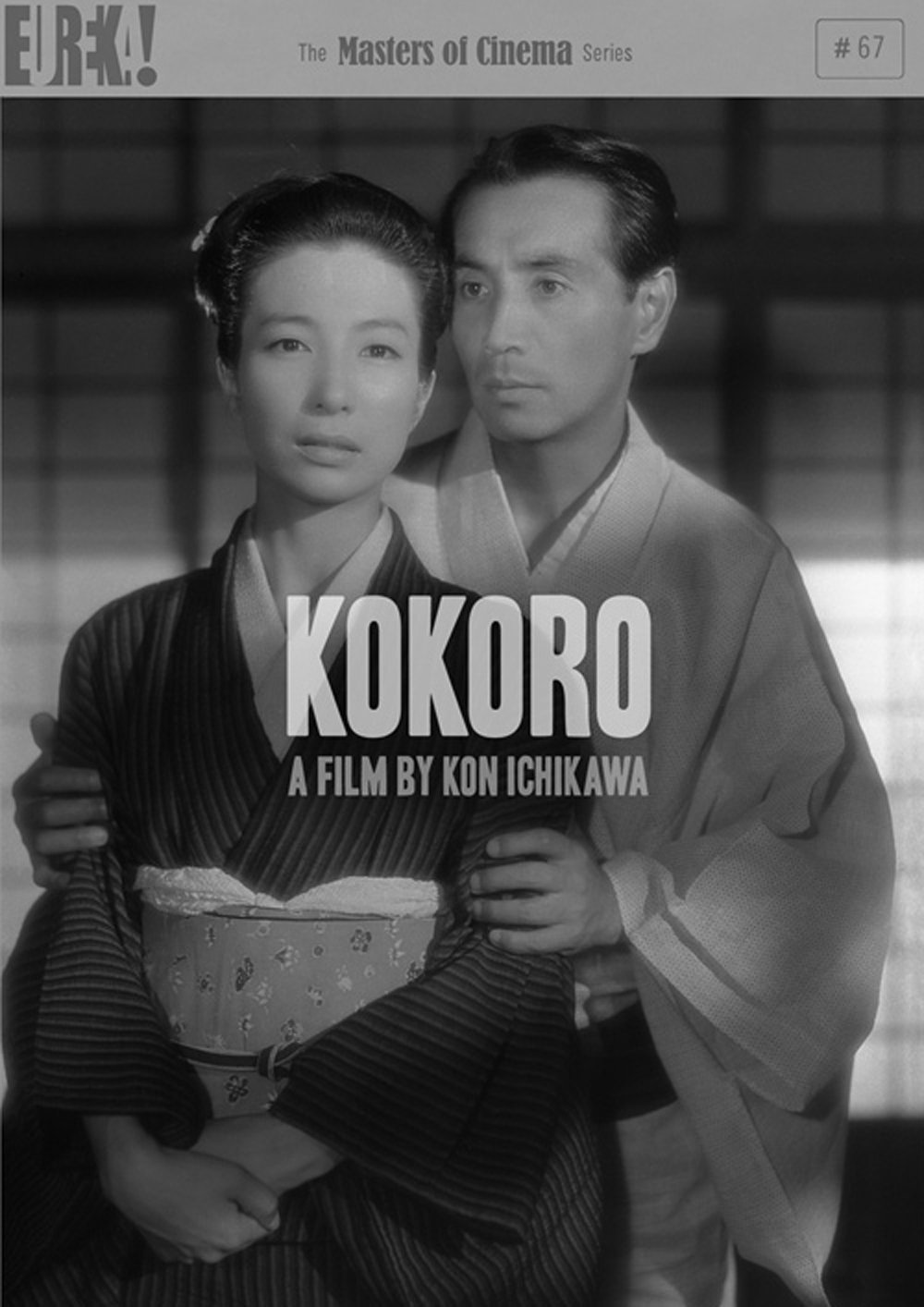
Kokoro (こころ, Kon Ichikawa, 1955)

kokoro coverAmong the most well-regarded of his works, Natsume Soseki’s Kokoro (こころ) is a deeply felt mediation on guilt, repression, atonement, and despair as well as an examination of life on a temporal threshold. Kon Ichikawa’s long career would be marked by literary adaptations both of classics and genre fiction but even among these Kokoro is something of an exception, marshalling all of his skills bar his trademark irony in a melancholy tale of loneliness, self loathing, and the destructive effects self-destruction on those caught in the cross fire.

Ichikawa opens in media res as Nobuchi (Masayuki Mori) and his wife, Shizu (Michiyo Aratama), appear to have had an argument. She darns angrily while he paces and eventually seems to relent on his decision not to let her accompany him to the grave of a mutual friend, Kaji (Tatsuya Mihashi), who died when Nobuchi was still a student. Eventually Nobuchi goes alone but is disturbed in the graveyard by the approach of an enthusiastic young university student, Hioki (Shoji Yasui), who has been redirected by Shizu after turning up to ask to borrow some books. Nobuchi is not really in the mood to talk but the two men chat, eventually sharing a drink together in the local bar before Nobuchi abruptly returns home, pausing only to invite Hioki to visit another time for the books he wanted to borrow.

Though the marriage of Nobuchi and Shizu may seem to be a model one, their lives together are mostly performance. Nobuchi is a melancholy, gloomy man who does not work and lives the life of a scholar, living off family money. The household is not wealthy but they are able to afford one maid and live in reasonable comfort. They have no children and, it seems, the marriage may be one of companionship rather than passion.

On their first meeting Nobuchi refuses to tell Hioki the reason why he is the way he is, but decides he must explain and that Hioki is the only person he can unburden himself to. Badly let down by those who should have had his best interests at heart at a young age, Nobuchi has learned not to trust, believes that love is a “sin”, and that he is unworthy of any kind of personal happiness or fulfilment. As a young man, Nobuchi did something completely unforgivable for the most selfish (and fiendishly complicated) of reasons and his best friend, Kaji, later died as a direct result.

Where Nobuchi is cynical, Kaji is ascetic and closed off but sincere in his Buddhist practice. Nobuchi’s actions are not only hurtful in their deliberate betrayal, but amount to a slow implosion of Kaji’s entire spiritual universe. Having been tempted away from his religious beliefs by irrepressible desire, Kaji’s path to spiritual fulfilment has been severed and his path to other kinds of happiness blocked by Nobuchi’s own panicked act of personal betrayal. Unable to reconcile his cowardly, cruel actions which have, in a sense, broken Kaji’s “heart”, Nobuchi resolves to deny himself the life he stole from his friend, committing himself to a living death defined by the absence of physical love, desire, or success.

Hioki first meets Nobuchi when he sees him attempt to walk into the sea and saves him from drowning. Immediately drawn to him, Hioki believes he and the man he calls “sensei” share the same kind of existential loneliness. His eagerness to forge a friendship with the older, aloof scholar may seem strange but Ichikawa is keen to build on a much disputed subtext of the original novel in Nobuchi’s possible repressed homosexuality. Hioki steps into the space vacated by Kaji which has been empty the last 15 years as the sort of man who might understand Nobuchi’s “heart”.

Shizu attempts to ask the question directly, both about Nobuchi’s relationship with Kaji whose name she is forbidden to mention and to new friend Hioki whom she fears maybe taking Kaji’s place in her husband’s affections. Pleading that she just wants to understand his “heart”, Shizu tries to get some clarification on the empty hell that is her married life, but Nobuchi’s heart is firmly closed to her and she’s shut out once again.

On hearing of the death of the Emperor Meiji, Nobuchi’s gloom descends still further as he feels himself to be a man who’s outlived his age. At one point, long before, he pushes Kaji on his spiritual weaknesses prompting him to admit he doesn’t know whether to go forward or back. Nobuchi, cynical and perceptive, points out that there likely is no back even if you wanted to go there. Taking the teacher/student relationship to its natural conclusion, Nobuchi’s final testament in which he confesses the circumstances which have led to his spiritual death is intended only for Hioki in the hope that the younger man can learn from his mistakes and prepare himself to step forward into the bright new age where Nobuchi fears to tread. Once again his actions are selfish in the extreme, but there is something universally understood in Nobuchi’s particular pain and the steps he takes to ease it.


Previously available on DVD from Eureka, now sadly OOP.

Scene from midway through the film

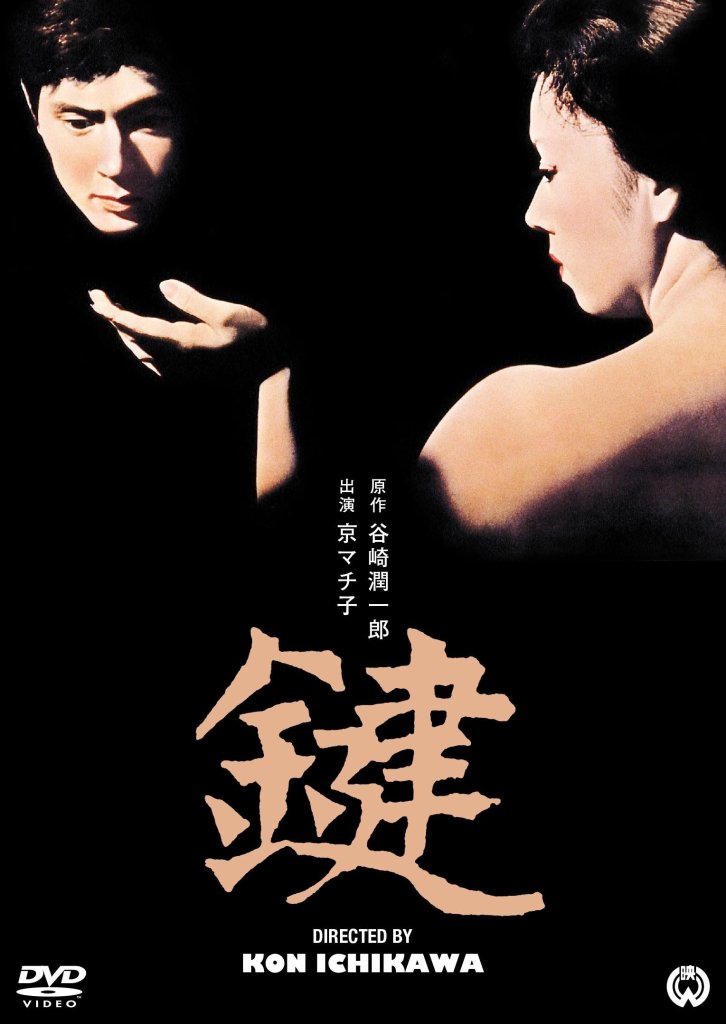
Odd Obsession (鍵, Kon Ichikawa, 1959)

odd-obsessionJunichiro Tanizaki is widely regarded as one of the major Japanese literary figures of the twentieth century with his work frequently adapted for the cinema screen. Those most familiar with Kon Ichikawa’s art house leaning pictures such as war films The Burmese Harp or Fires on the Plain might find it quite an odd proposition but in many ways, there could be no finer match for Tanizaki’s subversive, darkly comic critiques of the baser elements of human nature than the otherwise wry director. Odd Obsession (鍵, Kagi) may be a strange title for this adaptation of Tanizaki’s well known later work The Key, but then again “odd obsessions” is good way of describing the majority of Tanizaki’s career. A tale of destructive sexuality, the odd obsession here is not so much pleasure or even dominance but a misplaced hope of sexuality as salvation, that the sheer force of stimulation arising from desire can in some way be harnessed to stave off the inevitable even if it entails a kind of personal abstinence.

Our narrator for this sardonic tale is an ambitious young doctor, Kimura (Tatsuya Nakadai), who opens the film in an unusually meta fashion with a direct to camera address taking the form of a brief lecture on the decline of the human body (which begins at age ten and then gets progressively worse). Kimura reminds us that we too will grow old, but his warning is intended less to engender sympathy for the elderly patriarch who will become our secondary protagonist than it is to raise a grim spectre of the inescapability of death.

The story Kimura wants to tell us of a man who fought against senility centres on antiques expert and respected cultural critic Kenmochi (Ganjiro Nakamura). Advanced in years, Kenmochi is beginning to feel the darkness encroaching along with the desire to resist it through restored virility. For this reason, he’s been making regular appointments at Kimura’s clinic which he keeps secret from his wife who would be unhappy to know he’s been getting mysterious injections to help with his sex drive but which also come with a number of side effects including dangerously raising his blood pressure.

Eventually Ikuko (Machiko Kyo), Kenmochi’s slightly younger wife and mother of his grown up daughter Toshiko (Junko Kano), does indeed find out though what she does not appear to know is that Kenmochi has also been drugging her so that he can take photos of her naked body and enjoy his rights as her husband without her needing to be 100% present at the time. Kenmochi’s plan is to lure Kimura into having an affair with his wife so that the resultant jealousy will stimulate his system, staving off senility and other unwelcome effects of ageing. This would be strange enough on its own were it not that Kenmochi has also been trying to set up a marriage between Toshiko and Kimura who are already engaged in a discreet affair.

In contrast with the source material which takes the form of a number of diary entries providing differing perspectives on events, the film takes the point of view of the cynical and morally bankrupt doctor Kimura who feels himself above this “pathetic” old man with his sexual preoccupations and diminished prospects. As the narrator, Kimura evidently believes himself in control but Ichikawa is keen to play with our sense of the rules of storytelling to show him just how wrong he could be. Intrigue is everywhere. Kenmochi may think he’s using all around him in a clever game to prolong his own life but he’s entirely blind to a series of counter games which may be taking place behind his back.

Sex is quite literally a weapon – aimed at the heart of death. Kimura recounts a dream he sometimes has in which he is shot through the heart in an arid desert, only for this same scene to invade the mind of a paralysed Kenmochi on gazing at the naked body of his wife. The marriage of Kenmochi and Ikuko has apparently been a cold (and perhaps unhappy) one with Kenmochi berating his wife for remaining “priest’s daughter” all these years later, prudish and conventional. Nevertheless, Ikuko – the kimonoed figure of the traditional Japanese wife, subservient yet mysterious and melancholy, becomes the central pivot around which all the men turn, eclipsing her own daughter – a Westernised, sexually liberated young woman rendered undesirable in her very availability. Kimura is not quite the destructive interloper of Pasolini’s Theorem so much as he is a “key” used by Kenmochi to “unlock” a hidden capacity within himself but one which, as it turns out, opens many doors not all of them leading to intended, or expected, destinations.

Ichikawa continues with a more experimental approach than was his norm following the bold opening scene in which Kimura directly addresses the audience with a straight to camera monologue. A pointed symbolic sequence of a train coupling, freeze frames, dissolves and montages add to his alienated perspective as he adopts Kimura’s arch commentary on the ongoing disaster which is the extremely dysfunctional Kenmochi family home. Middle class and well to do, the Kenmochis’ lives are nevertheless empty – the house is mortgaged and the beautiful statues which taunt Kenmochi with their physical perfection have all already been sold though Kenmochi refuses to let the buyer take them home. Old age should burn and rave at close of day, but as the beautifully ironic ending makes plain it will be of little use, death is in the house wearing an all too familiar face which you will always fail to recognise.


Screened as part of the Japan Foundation Touring Film Programme 2017.

Opening scene (no subtitles)