Otakus in Love (恋の門, Suzuki Matsuo, 2004)

koi no monReview of Suzuki Matsuo’s Otaku’s in Love (恋の門, Koi no Mon) first published on UK Anime Network in February 2014.


The word “otaku” is a difficult one to pin down. In the West, it’s often come to be a badge of pride and respect, a label that many fans of what most people would perceive as a niche subculture actively identify with and eagerly apply to themselves. However, the roots of the term are much darker and in its native Japanese, “otaku” can be far from a nice thing to call another person. Of the central couple in this film perhaps only one can be thought of as a traditional “otaku” the other being more of a “tortured artist” whose eccentric behaviour makes it difficult for him to survive in the real world. Well, to be honest finding a base line for “normal behaviour” in this film is a pretty tall order, we run into bizarre anime conventions, cosplay obsessives, broken hearted ex-mangaka (manga) bar owners and a bizarre cult like office environment where the only rule is you must be “happy!” all the time. Otakus In Love is an endearingly odd film that is jam packed full of in jokes and meta references that knows its audience very well and never fails in the humour stakes as a result.

Mon is a down on his luck, in fact totally broke, manga artist. Well, he calls himself a “manga artist” but his work isn’t exactly what most people would expect. In a touch of the avant garde, Mon makes his manga out of rocks. Mon’s “manga” are, in fact, a collection of rocks painted with a single kanji character and arranged inside a custom made wooden box. Needless to say each of Mon’s works is a one off piece and his sales record is not exactly going to get him on the best seller list. He can’t seem to hold down a part time job either due to his extreme reactions to people not taking his art seriously and his strange appearance which is something like a seventies guru come glam rock god whose ragged clothes have an oddly deliberate look to them. One fateful day he has an interview for Tsugino Happy Inc which turns out to be a cult-like office environment which seems to advocate happiness through total subjugation. He lasts about an hour at this job before punching his new boss in the face for failing to appreciate his artistic qualities.

However, on the way there about to pick up a particularly fine looking rock, he meets Koino who turns out to be a colleague of his at Happy Inc. The two go out for drinks which ends up at Koino’s apartment where upon Mon wakes up the next morning to find out he’s been a victim of forced cosplay! Unwittingly dressed up as Koino’s favourite character from Soul Caliber II, he’s quickly posed by Koino for her cosplay wall and dragged into a world of doujinshi, comiket, cosplay and all things geeky. Koino is an amateur manga artist who claims to have made a small fortune selling her home made manga at conventions and is well and truly an otaku. Can two such different people really find love? There’s only one way to find out!

Otakus in Love is based on Jun Hanyunyuu’s manga Koi no Mon (also the original Japanese title of the film) and as such carries over various extremely clever meta visual references. Directed by well known actor Suzuki Matsuo (Ichi the Killer) the film is often about as close as you could get to being a live action manga as Matsuo manages to make standard manga tropes like reaction shots and surreal action scenes work in a totally believable way. In the course of the film we’re treated to full on musical sections and ridiculous comic motifs that resurface at fairly predictable moments which could all end up just being far too much, but under Matsuo’s steady hand the film comes out on the right side of crazy and is never anything less than totally zany fun.

The film isn’t afraid to wear its otaku badge on its sleeve, either. Jam packed with references from video games, anime, and manga, Otakus in Love gets its audience completely and trusts it to understand all of its allusions and homages without needing to repeatedly bash the viewer over the head with tie-ins. It also takes an affectionate side swipe at fan culture with some bizarre interactions with cosplay, conventions and ani-singers which any anime fan can probably relate to. The film also has a fair few cameos from such well known personages as Hideaki Anno, Shinya Tsukamoto and Takashi Miike to name but a few.

At a 114 minutes it does run a little long and occasionally feels like it’s going to run out of steam but for the vast majority of its running time Otakus in Love is a genuinely hilarious, truly bizarre, romantic comedy. Full of warmth and exuberance, it’s difficult to image anyone not being swept away by its surreal humour and though it’s certainly on the broader side of comedy it never feels particularly over the top (or at least not in a bad way). Otakus in Love is a romanic comedy that no self confessed otaku should miss out on seeing.


Reviewed at the Japan Foundation Touring Film Programme 2014.

Japan Foundation Touring Film Programme Announces 2016 Line-up!

Farewell letter to jinu

The Japan Foundation London’s annual festival of Japanese film is back for 2016 and boasts its biggest programme yet. There are 14 films in total which will play at London’s ICA from 5th February 2016 before some of them head off around the country.

The Cowards Who Looked to the Sky

(ふがいない僕は空を見た, Fugainai Boku wa Sora wo Mita)

This 2011 film from Yuki Tanada (One Million Yen and the Nigamushi Woman) stars Tomoko Tabata (Moving) as a bored housewife obsessed with cosplay who embarks on an unwise affair with a high school boy.

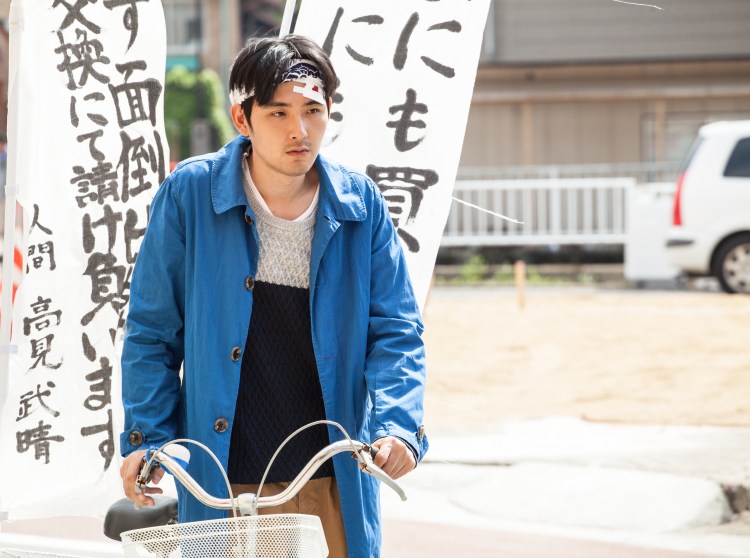
A Farewell to Jinu

(ジヌよさらば ~かむろば村へ~, Jinuyo Saraba ~ Kamuroba Mura e)

The latest film from Otakus in Love director Suzuki Matsuo, A Farewell to Jinu is the familiar story of a burned out salaryman (played by Ryuhei Matsuda) who decides to upsticks to the country for a simpler life. “Simpler” isn’t isn’t always simple though as he finds out in this zany comedy based on the manga, Kamuroba Mura e, by Mikio Igarashi.

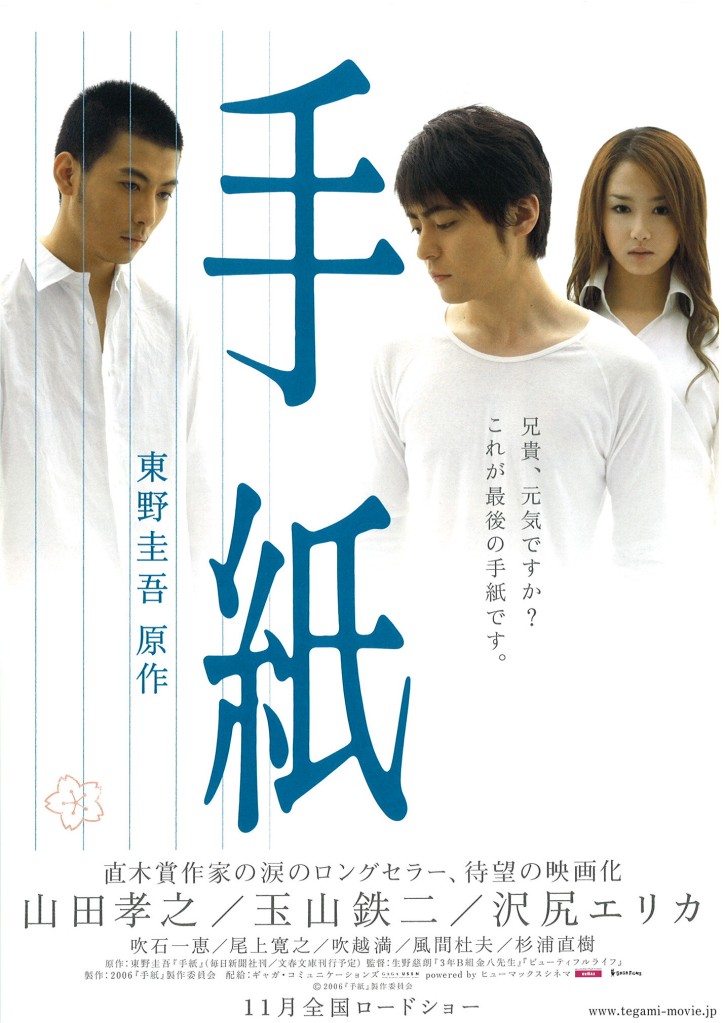
The Letter

(手紙, Tegami)

The Letter is a social drama circling the lives of two brothers one of whom has gone to drastic measures to protect the other but now finds himself resentfully languishing in prison. Directed by Jiro Shono and stars Takayuki Yamada, Tetsuji Tamayama and Erika Sawajiri.

This is based on a novel by Keigo Higashino (The Devotion of Suspect X) who, to be frank, I don’t get on with as he’s so rigidly “moral”. His mysteries are often good but I end up thinking the detective should just shut up at the end because he just ends up making a tragic situation even more pointless and stupid than it needs to be. I’m from the Poirot school of just letting everyone go and hoping they won’t do it again, I guess. That said, he also wrote the book Himitsu is based on and tends to be a bit weird so you never know. [/rant]

http://www.youtube.com/watch?v=6Ibsv_ZJ0d4

Pecoross’ Mother and Her Days

(ペコロスの母に会いに行く, Pekorosu no Haha ni Ai ni Iku)

This social drama focuses on the growing problem of elder care in an aging society. Directed by Azuma Morisaki, the film follows the daily life of a manga artist as he tries to care for his elderly mother who has alzheimer’s. Topped the Kinema Junpo best of list back in 2013.

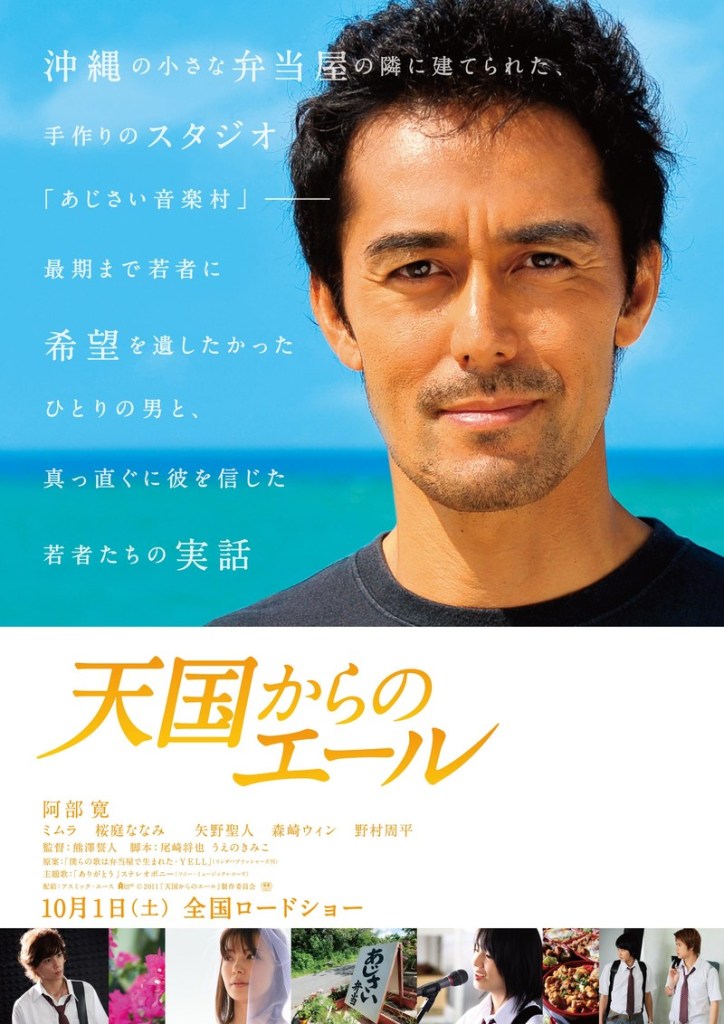
Cheers from Heaven

(天国からのエール, Tengoku Kara no Yell)

This one sounds like a weepy. Hiroshi Abe plays a man with an undisclosed terminal illness who decides to open his shop up to a group of youngsters who have nowhere to practice their music. Directed by Makoto Kumazawa.

http://www.youtube.com/watch?v=LSYWW2W4U24

Noriben – The Recipe for Fortune

(のんちゃんのり弁, Nonchan noriben)

Directed by Akira Ogata, this 2009 food focussed feature tells the story of Komaki – a woman who decides to leave her husband and move back to her hometown with her little daughter, Non-chan, in tow. When the “Noriben” (a bento with nori on top of rice) she makes for Non-chan becomes a hit at school Komaki decides to try her hand at running a bento store.

Uzumasa Limelight

(太秦ライムライト)

Loosely based on Charlie Chaplin’s Limelight, this gentle tale of a dying industry tells the story of Seiichi, a now elderly “kirareyaku” whose sole job is repeatedly dying in samurai movies. However, these days period films are not as popular as they once were and even those that are made don’t require his particular skillset. Feeling the sun setting, Seiichi is given another chance to make an impact in the form of an unlikely young girl who hopes to become his pupil.

I have already reviewed this one! Spoiler – quite good! It’s also getting a release from Third Window Films at some point.

I’ll Give it My All…Tomorrow

(俺はまだ本気出してないだけ, Ore wa Mada Honki Dashite nai Dake)

Sounds familiar…this one’s a comedy about a 41 year old who quits his job to become a “full time slacker” playing video games and working part time at a fast food restaurant before realising his true dream is manga! Adapted from the manga by Shunju Aono and directed by Yuichi Fukuda the film has a starry cast including Shinichi Tsutsumi, Ai Hashimoto, Takayuki Yamada, and Gaku Hamada.

http://www.youtube.com/watch?v=eC7i9s_xgso

Being Good

(きみはいい子, Kimi wa iiko)

Latest movie from Mipo O (The Light Shines Only There), Being Good starts Kengo Kora as an idealistic teacher who fears one of his students is being abused at home meanwhile Machiko Ono plays a mother who was abused herself as a child and finds herself lashing out at her own infant daughter. This is the big ticket, folks!

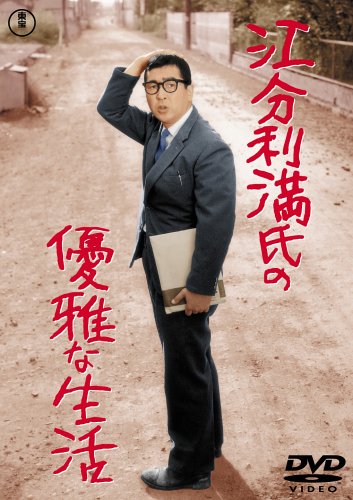
The Elegant Life of Mr Everyman

(江分利満氏の優雅な生活, Eburi Man Shi no Yugana Seikatsu)

Now here’s an unexpected gem! A 1963 salarayman comedy from Kihachi Okamoto (The Human Bullet) The Elegant Life of Mr Everyman is the story of a drunken salaryman who pitches articles to two different magazines and ends up deciding to write a novella about himself and his middle class life. Excited about this one!

Predictably no trailer but here’s the DVD cover which features Keiju Kobayashi looking confused!

51Z6SANMA2L

A Japanese Tragedy

(日本の悲劇, Nihon no Higeki)

Rare outing for this 1953 classic from Keisuke Kinoshita. A bleak picture of a mother’s sacrifice for her ungrateful children, A Japanese Tragedy is a portrait of maternal love and social indifference in post-war Japan.

If you’re looking forward to this one you could read up on some of my other Kinoshita reviews

(sorry).

(This trailer has no subtitles but there is no dialogue either)

Tale of a Butcher Shop

(ある精肉店のはなし, Aru Seinikuten no Hanashi)

This is apparently exactly what it sounds like as it’s the story of a family run butcher shop which also farms and slaughters its own produce. Contains actual footage of real animal slaughter.

(I don’t think this one is for me, also not including a trailer.)

Anthem of the Heart

(心が叫びたがってるんだ, Kokoro ga Sakebitagatterunda)

Recent anime from Tatsuyuki Nagai. From the same team as Anohana: The Flower We Saw That Day, this is the story of Jun Naruse, a young girl who feels she she always seems to say the wrong thing and hurts people’s feelings. She then meets an “Egg Fairy” (!) who says he can help by casting a spell on her so she’ll never speak again. The years go by and eventually Jun is cast in a high school musical where she enounters music and friendship.

Might start paying more attention to eggs in future…especially if they’re wearing hats…

Miss Hokusai

(百日紅~Miss HOKUSAI~, Sarusuberi: Miss Hokusai)

Based on the manga Sarusuberi by Hinako Sugiura, Miss Hokusai is the story of the daughter of the famous woodblock artist of the Edo era. Directed by Keiichi Hara whose film Colorful was also featured in a previous Touring Film Programme, Miss Hokusai has been receiving mixed reviews but has also won a few international animation awards. Will also be released by All the Anime at some point.

The festival begins at the ICA from February 5th before heading to: Aberystwyth, Birmingham, Bristol, Cumbria, Derby, Dundee, Endinburgh, Exeter, Leicester, Manchester, Nottingham and Sheffield. Dates are as yet unconfirmed, as is which films will play which venues but you can keep up with all the latest news on the Japan Foundation Touring Film Programme website (which is also updated with Japanese film related content throughout the year).

Wood Job! (Wood Job(ウッジョブ)神去なあなあ日常, Shinobu Yaguchi, 2014)

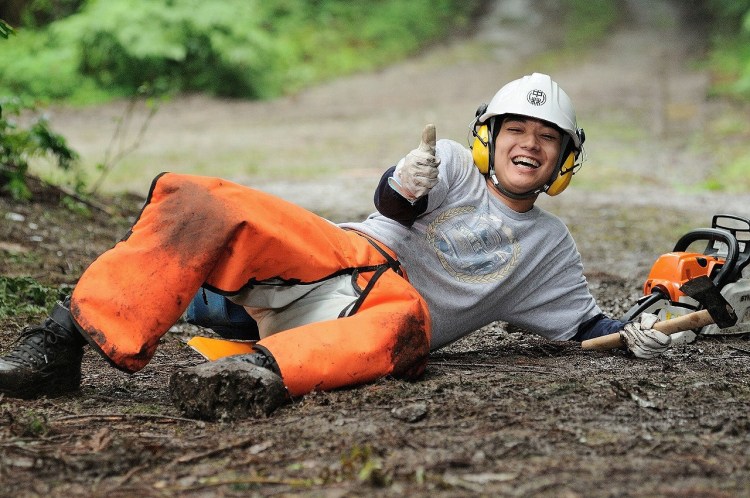
ff20140516a1aHe’s a lumberjack and he’s OK! Well, after a while anyway – climbing trees all day is not quite as much fun as it sounds in Shinobu Yaguchi’s latest comedy which sees a streetwise city kid randomly decide on a career on forestry. Not so much fish out of water as duck in a tree, Wood Job! is a heartwarming comedy drama which more than lives up to the puntastic comedy of its title.

Yuki Hirano is your typical slacker teenager. Like many guys his age, he’s run into something of a life crisis as he didn’t get into university and he hasn’t really thought about what to do. At first he thinks it’s no big deal, he’ll just take the tests again next year but after being abandoned by his girlfriend and seeing all his friends set off without him Yuki feels a little lost. That is until he notices a shiny magazine advertising a new life in the open air – “come and work with me!” it says next to a picture of a pretty girl. Yuki’s packed his bags and caught the next train before you can even say “Where’s the nearest combini”? but his new found occupation is a little more intensive than he was expecting and Yuki’s not sure he’s cut out for this no frills life. Then however he meets the girl from the advert herself – can Yuki really stick around long enough to convince her he’s not some city boy layabout but a real mountain man?

Wood Job! is that rare film that manages to mix a fair amount of slapstick comedy with the kind of naturalistic, everyday humour that can’t help but give it an endearingly warm quality. Taking the classic fish out of water approach as its basis, the film highlights the absurdity of country life (at least to eyes more accustomed to the city) but crucially never mocks it and seems to have a profound respect for the rural way of life and all that entails. Neither does it shy away from the fact forestry is hard work which is often dangerous and requires an extremely specific skill set – you can’t just rock up one day because you’ve seen a picture of a pretty girl on a poster and instantly become a man of the mountains over night. The villagers are all too used to people who turn up in the country with romantic ideas about getting back to the land or living a more simple life but go home after a week or so because they can’t adapt to this very different environment. Already pre-conditioned to expect disappointment, their approval is hard to win but worth all the more because of its rarity.

Yuki Hirano is something of a departure for Sometani who ranks as one of Japan’s most promising young actors. Having hitherto made a name for himself playing “intense” characters, Wood Job!’s laid back slacker couldn’t be more different than the tortured soul of Himizu though Sometani carries off this seeming 180 degree turn with aplomb further proving his versatility as an actor. He’s also surrounded by an equally talented cast including Hideaki Ito (most recently seen as the sociopathic teacher in Lesson of Evil, also alongside Sometani in a small role) as his hard tasking forestry mentor as well as Ken Mitsuishi and Akira Emoto in smaller roles and Masami Nagasaki as Yuki’s longed for poster girl for the world of forestry. Filled with realistically drawn characters near perfectly pitched by its well put together cast, Wood Job! manages to achieve just the right comedy-drama balance which makes some its more outlandish moments seem perfectly plausible.

It may be a very conventional film in many ways, but Wood Job! succeeds in doing what it set out to do incredibly well. Filled with warmth and good humour, director Shinobu Yaguchi manages to breath new life into this old idea to create a charming and engaging tale of the virtues of country life. Any film which manages to pack not one, but two distinct puns into its title alone has to be worth a look but Wood Job! more than lives up to the comedic promise of its name.


This is playing as part of the Japan Foundation Touring Film Programme so it’ll be a bunch of places between now and the end of March including:

  • MAC Birmingham (24th February)
  • Dundee Contemporary Arts (25 February)
  • Tyneside Cinema Newcastle (15th march)
  • Nottingham Broadway (25th March)
  • Brewery Arts Centre Cumbria (25th March).

So if you’re near any of these be sure to check it out! Also because people always say this – if the festival isn’t coming near you it’s most likely not Japan Foundation deliberately snubbing you, get in touch with your local indie cinema and try and convince them to book some of these films. If you don’t have a local indie cinema you’re probably out of luck though as the big chains often won’t take these kinds of special screenings :(. In short, support your local indie (or a not so local one if it’s your only option).

http://www.youtube.com/watch?v=ypQi69XGs6U

Review of the forestry themed comedy Wood Job! up at UK Anime Network. I love how many puns they managed to pack into the title of this film, it wins just for that.

Rebirth (Youkame no semi) 八日目の蝉

高解像度寒霞渓First of the Japan Foundation Touring Film Programme for this year up on UK-Anime.net. I’m going to do a general round-up later in the week but this was the best of the (impressive) bunch.


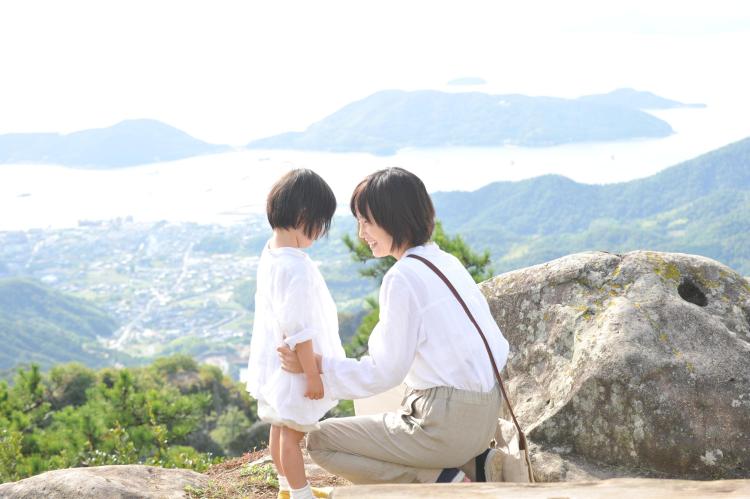
Kiwako has been having an affair with a married man who swears he’s going to leave his wife (just not right now) but now things have come to a head as she finds out she’s carrying his child. Despite her being desperately happy and excited about it – planning to call the child Kaoru and designing visions of the a domestic bliss, Kiwako’s married lover is decidedly less enthusiastic and persuades her to opt for a termination. However, complications from the procedure leave her unable to have any more children and she also begins being harassed by her lover’s wife who finally turns up on her doorstep one day, heavily pregnant, to taunt her – going so far as to remark that her ‘barren womb’ is a direct result of her immoral relations with her husband. One day Kiwako just snaps and in an act of madness abducts her lover’s newborn baby and raises the child as her own for four years until she is finally caught.

In the present day, Erina – who was Kaoru, raised by Kiwako for the first four years of her life, has grown up and is in college. She is deeply scarred by the traumatic events of her early childhood and seems to have difficulty with forming relationships with people, not that she seems to want to make any. After being returned to her birth parents she struggled to adapt to her new life and her birth parents struggled to come terms with everything that had happened. Now, as a young woman, Erina finds history begin to repeat itself in more ways than one and she’s forced to consider who she really is and what she wants out of life. In order to do that, she’ll finally have to confront her traumatic past and all of the complex questions and emotions that will inevitably arise.

In a Chalk Circle-esque way, Rebirth wants to ask a lot of questions about motherhood. Who is the mother of this child really? The woman who gave birth to it or the one who has cared for it all its life and who the child regards as its parent? It is obviously a terrible situation for all involved – the birth parents have lost their child, something truly awful, but the child now believes her abductor to be her mother and ‘returning’ her to a pair of ‘strangers’ she has no recollection of is beyond cruel. Being cruelly ripped away from everything she knew would be traumatic enough, let alone being dragged away from her ‘mother’ in a car park late at night and bundled into car by a harsh woman who tells her she’s being taken to her ‘mummy’ when her total understanding of that word is being handcuffed and taken away.

At only four years old you might think she’d be young enough to gradually ease back into her birth family, and you might be right had her natural parents been better equipt themselves to cope with the situation. Erina’s mother is very definitely of the ‘carry on as if nothing happened’ school so any allusion to the first four years of the girl’s life provokes a hysterical fit that only further exacerbates the confusion already ripping apart the poor child’s soul. So jealous is she that she’s effectively projecting all her resentment and bitterness towards Kiwako’s actions onto the child itself – as if she can’t forgive her for the crime of growing older or having spent so much time with the other woman. The child is a reminder of the trauma of its disappearance, of her husband’s infidelity, and subsequently of her own fear of not measuring up as a mother.

Izuru Narushima has crafted an intense and deeply layered character study that neatly sidesteps the risk of becoming as overblown or melodramatic as the plot description might sound. He approaches the subject matter with great sensitivity and with as even a hand as is humanly possible. His camera is incredibly non-judgemental and treats each of the characters with the same level of sympathy and understanding. Surprisingly, it is the birth parents that become the most difficult to sympathise with but even they are presented with a great deal of compassion.

Rebirth is certainly a very complex film that raises all sorts of uncomfortable moral questions from the nature of motherhood to the treatment of the women of society. If I had one criticism it would be that the male characters don’t come out of this well at all – which may be slightly unfair given the deliberate similarity between the two prominent male characters, but certainly the portrait it paints of masculinity is far from flattering. The performances are astounding, particularly those of Mao Inoue (probably still best known for Hana Yori Dango) as the damaged Erina and Hiromi Nagasaku as the desperately maternal Kiwako. Excellently shot and fantastically well conceived Rebirth is one of the best Japanese films of recent times.