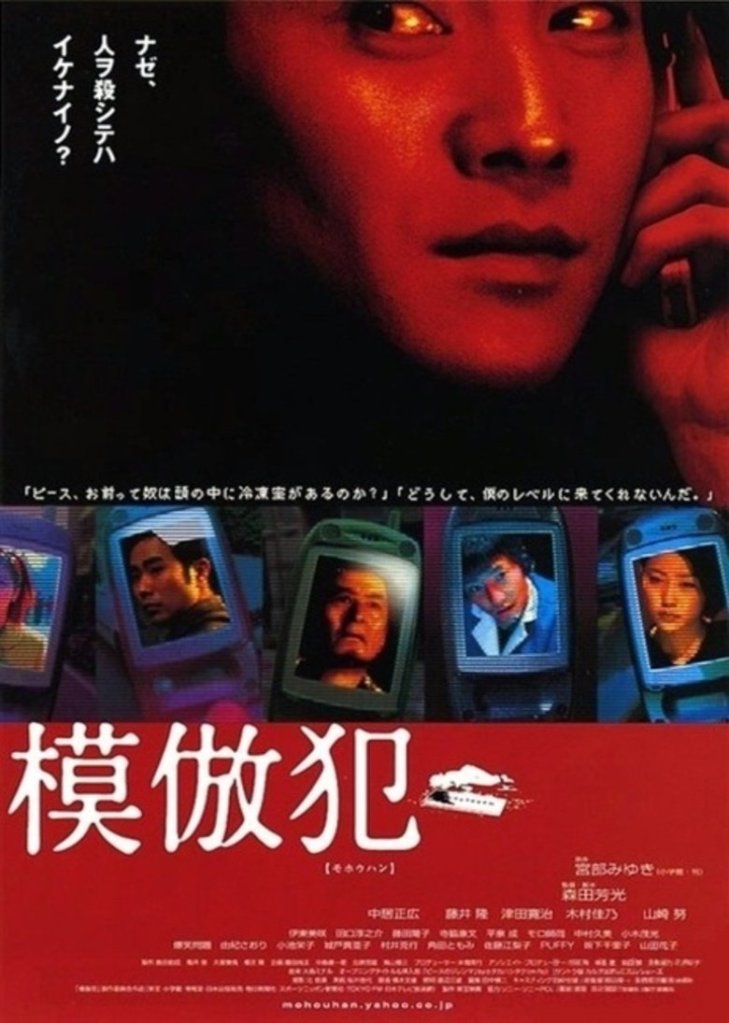
 Yoshimitsu Morita had a long standing commitment to creating “populist” mainstream cinema but, perversely, he liked to spice it with a layer of arthouse inspired style. 2002’s Copycat Killer(模倣犯, Mohouhan) finds him back in the realm of literary adaptations with a crime thriller inspired by Miyuki Miyabe’s book in which the media becomes an accessory in the crazed culprit’s elaborate bid for eternal fame through fear driven notoriety.
Following a non-linear structure, the film first introduces us to an old man who runs a tofu shop where he lives with his middle aged daughter who is in the middle of a breakdown following the end of her marriage, and his grown up granddaughter who has become the woman of the house during her mother’s illness. Though not without its difficulties his life was happy enough but after granddaughter Mariko goes out one evening and never comes home, nothing will ever be the same again.
A severed arm and a handbag are discovered in a flower bed by a teenage boy whilst walking a dog, though a mysterious distorted voice later contacts the media to inform them that the arm and the handbag do not belong to the same woman. The boy, oddly enough, is the sole survivor of his family who were all murdered some years previously. He was interviewed at the time by press reporter Yumiko whose soba shop owning brother may have a connection to the crimes. The cold blooded killer knows all of this and is engineering coincidences into a grand plan in which he will harness the power of mass media to earn himself a kind of national respect as an “expert” on the crimes which he has himself been committing.
Hitting a style somewhere between The Black House and Keiho, Morita opts for a dreamlike atmosphere filled with dissolves, soft split screens and hacker inspired graphical touches. Not only is the killer interested in appearing on TV either in voice or in person but can also manipulate mass media by hacking commercials and billboards to proclaim his own messages. As well as the early computer inspired effects, photo zooms, and contemporary methods of evidence presentation, Morita wrong foots the audience by zigzagging through the chronology of crime beginning with the central murder then switching back to the killers as they are now, then their childhoods, and cutting back to each of the other protagonists – the grandfather, teenage boy, and reporter.
Possibly inspired by the Leopold and Loeb case, the killers are a duo of psychotic young men who think they can achieve everlasting fame and personal satisfaction by committing the kind of murders which have never been committed before. The true motivator of the crimes even tells one of his victims that she ought to be grateful. That she was leading a “pointless” life and now she’s being given the opportunity to “serve” in something greater as a component in his master plan. Before, he explains, she’d just have gone on living until she died and been forgotten but now she’ll be a star – everyone will remember her name as a victim in the crime of the century and the world will mourn her death.
At another juncture, the killer also remarks that absolute faith in the family unit is the reason a relative of a suspect or victim of crime is routinely targeted by the press and a source of recrimination even though they themselves had nothing to do with it. Family issues are also a factor as rejection and abandonment by parental figures is offered as a reason for why a person may eventually become deranged. Thus, the killer’s intention to harness mass media for worldwide fame through committing heinous, terrible crimes is painted as a quest for the attention and recognition he never received from his parents. The family is both nothing and everything, but as we reach the conclusion it’s family that engenders hope as we’re presented with a potential new family committing to proving that nurture can trump nature with happy childhoods building mentally balanced adults.
The grief stricken grandfather tells the killer that his selfish actions are cowardly and pointless. That if he really wanted to cause a sensation in this cruel world, he should have become a hero and taught people how to love instead of hate – that would be the true radical action. Morita’s essential world view is once again resolutely bleak but offered with a wry and cynical sense of humour. The final messages are of acceptance and moving on no matter how hard it may be, and of trying to create something good out of even the very worst occurrences. The film’s extremely strange, oddly explosive expressionist finale takes things a step too far and the youthful, contemporary electronic score with its link to the stereotypical hacking iconography occasionally calls attention to itself but Copycat Killer still proves an entertaining, multilayered crime thriller filmed with Morita’s characteristically experimental approach and necessary dose of oddness.
Unsubtitled trailer:
 1973 is the year the ninkyo eiga died. Or that is to say, staggered off into an alleyway clutching its stomach and vowing revenge whilst simultaneously seeking forgiveness from its beloved oyabun after being cruelly betrayed by the changing times! You might think it was Kinji Fukasaku who turned traitor and hammered the final nail into the coffin of Toei’s most popular genre, but Sadao Nakajima helped ram it home with the riotous explosion of proto-punk youth movie and jitsuroku-style naturalistic look at the pettiness and squalor inherent in the yakuza life – Aesthetics of a Bullet (鉄砲玉の美学, Teppodama no Bigaku). This tale of a small time loser playing the supercool big shot with no clue that he’s a sacrificial pawn in a much larger power struggle is one that has universal resonance despite the unpleasantness of its “hero”.
 Yusuke Iseya is a rather unusual presence in the Japanese movie scene. After studying filmmaking in New York and finishing a Master’s in Fine Arts in Tokyo, he first worked as model before breaking into the acting world with several high profile roles for internationally renowned auteur Hirokazu Koreeda. Since then he’s gone on to work with many of Japan’s most prominent directors before making his own directorial debut with 2002’s Kakuto. Fish on Land (セイジ -陸の魚-, Seiji – Riku no Sakana), his second feature, is a more wistful effort which belongs to the cinema of memory as an older man looks back on a youthful summer which he claimed to have forgotten yet obviously left quite a deep mark on his still adolescent soul.
 Being stood up is a painful experience at the best of times, but when you’ve been in prison for three whole years and no one comes to meet you, it is more than usually upsetting. Sixth generation Oyabun of the Ona clan, Daisaku, has made a new friend whilst inside – Taro is a younger man, slightly geeky and obsessed with bombs. Actually, he’s a bit wimpy and was in for public urination (he also threw a firecracker at the policeman who took issue with his call of nature) but will do as a henchman in a pinch. Daisaku wanted him to see all of his yakuza guys showering him with praise but only his son actually turns up and even that might have been an accident.
 The somewhat salaciously titled Black Kiss (ブラックキス) comes appropriately steeped in giallo-esque nastiness but its ambitions lean towards the classic Hollywood crime thriller as much as they do to gothic European horror. Directed by the son of the legendary father of manga Osamu Tezuka (not immune to a little strange violence of his own) Macoto Tezuka, Black Kiss is a noir inspired tale of Tokyo after dark where a series of bizarre staged murders are continuing to puzzle the police.
 Hiroshi Shimizu is well known as one of the best directors of children in the history of Japanese cinema, equalled only by the contemporary director Hirokazu Koreeda. The Shiinomi School (しいのみ学園, Shiinomi Gakuen) is one of the primary examples of his genius as it takes on the controversial themes of the place of the disabled in society and especially how children and their parents can come to terms with the many difficulties they now face.
 No names, no strings. That’s the idea at the centre of Daisuke Miura’s adaptation of his own stage play, Love’s Whirlpool (愛の渦, Koi no Uzu). Love is an odd word here as it’s the one thing that isn’t allowed to exist in this purpose built safe space where like minded people can come together to experience the one thing they all crave – anonymous sex. From midnight to 5am this group of four guys and four girls have total freedom to indulge themselves with total discretion guaranteed.
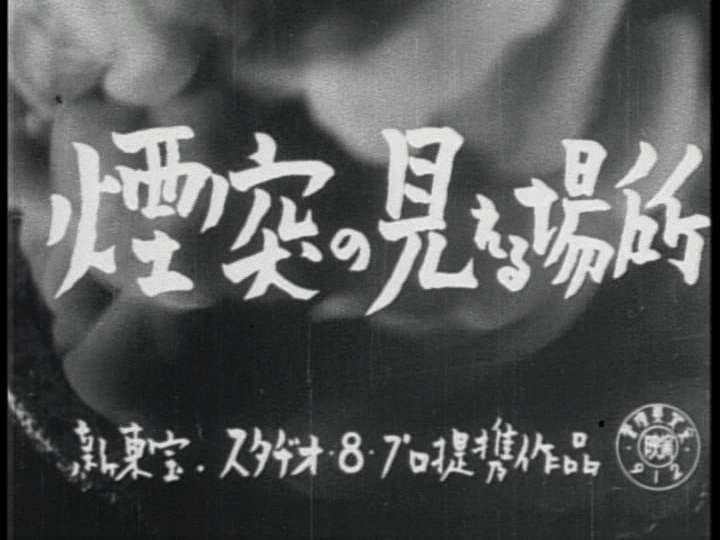 Where Chimneys are Seen (煙突の見える場所, Entotsu no Mieru Basho) is widely regarded as on of the most important films of the immediate post-war era, yet it remains little seen outside of Japan and very little of the work of its director, Heinosuke Gosho, has ever been released in English speaking territories. Like much of Gosho’s filmography, Where Chimneys are Seen devotes itself to exploring the everyday lives of ordinary people, in this case a married couple and their two upstairs lodgers each trying to survive in precarious economic circumstances whilst also coming to terms with the traumatic recent past.
 Making a coming of age film when you’re only 14 is, in many ways, quite a strange idea but this debut feature from Ryugo Nakamura was indeed directed by a 14 year old boy. Focussing on a protagonist not much younger than himself and set in his native Okinawa, Catcher on the Shore (やぎの冒険, Yagi no Boken) is the familiar tale of a city boy at odds with his rural roots and the somewhat cosy, romantic relationship people from the town often have with matters of the countryside.
 Windows on Worlds