Hard-Core (ハード・コア, Nobuhiro Yamashita, 2018)

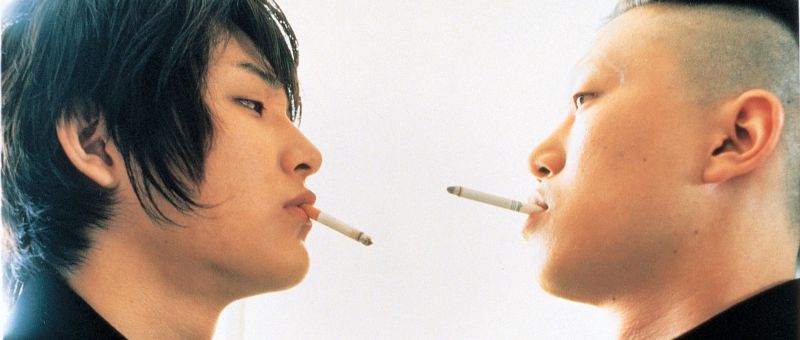
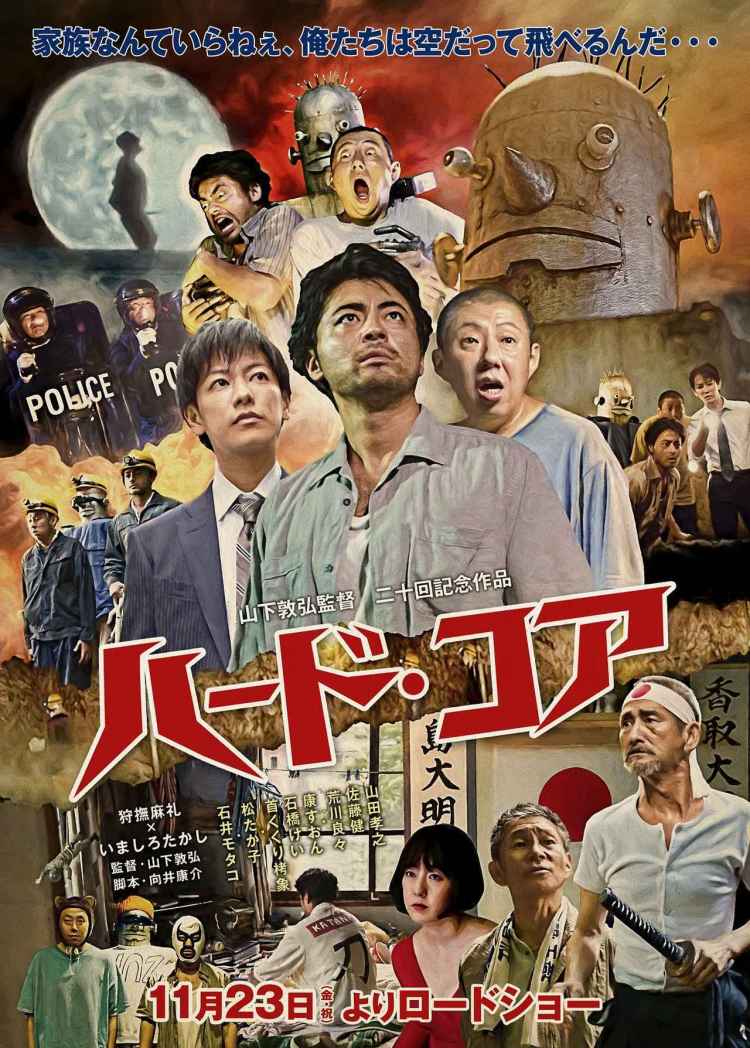
Hard-Core retro poster“The world will always be corrupt”, the cynical brother of the angry young man at the centre of Nobuhiro Yamashita’s Hard-Core (ハード・コア) advises him, “you just have to work around it”. Unfortunately, Ukon (Takayuki Yamada) just wants to do “the right thing”, but it is constantly unsure of the best way to do it while remaining resentful and conflicted in his conviction that the world has already rejected him. Yamashita has made a career out of chronicling the struggles of disenfranchised young men but Ukon and his pals are less genial slackers than potentially dangerous idealists looking for a way back to a simpler time in which the world was not quite so rotten.

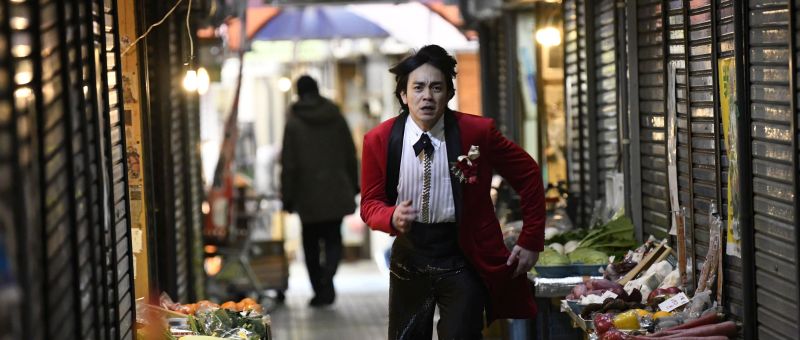
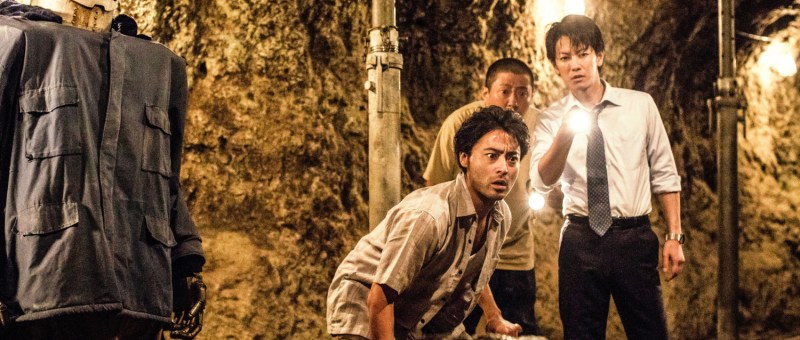
An opening bar scene in which Ukon gets slowly drunk and then lays into a rowdy bunch of guys bothering a middle-aged woman (Takako Matsu) just trying to enjoy a drink showcases his propensity to abruptly lose his temper and fall into a self destructive cycle while also subtly pointing out his entitlement issues in his taking the guy to task by praising himself for leaving the lady alone while he presumably had exactly the same desire not to. In any case, after getting banned from the bar, he ends up joining an ultranationalist political cell, the Crimson Hearts, which aims to teach the youth of Japan to re-embrace its traditional culture. In order to facilitate his goals, the elderly and eccentric leader, Kaneshiro (Kubikukuri Takuzo), has enlisted Ukon, along with a friend, Ushiyama (Yoshiyoshi Arakawa) who is almost entirely mute, to dig out a mysterious cavern where he is convinced there is buried Edo-era treasure.

It’s easy to see why Ukon might fall for the rather insane ramblings of Kaneshiro. They reinforce his sense of moral decline while giving him a banner to follow and a place to belong. His loyalty to Kaneshiro is as absolute as a retainer’s to his lord, though he is perhaps conflicted in his commitment to the core ideology even as he sees obvious merit in wanting to reclaim something of the old Japan. Meanwhile, his relationship with his family appears strained. His younger brother Sakon (Takeru Satoh) has become a cynical salaryman out for nothing other than greed and self interest, staring into his own empty eyes in the reflection of the full glass panelling of his high rise office as he has meaningless sex with anonymous office ladies. Ukon just wants to do the right thing, but Sakon wants to make the smart choice and doesn’t particularly care about the wider implications of his choices.

Meanwhile, Ukon is fiercely loyal to his friends and fellow outsiders in solidarity with all those who feel the world will never be willing to accept them. Ushiyama, a man laid low by familial expectation and societal pressure, lives in an abandoned factory where he has made “friends” with a broken robot that Ukon manages to repair and names “Robo-o”. Believing that Robo-o is just like them in that he would be ostracised if people discovered his true nature, Ukon and Ushiyama set about disguising him and even get him in on their gold hunting gig (where he gets paid!) at which he proves adept considering his considerable technical superiority. Ukon’s first instinct is to protect his friend, while Sakon’s is how best to exploit him.

Nevertheless, events at the Crimson Hearts begin to escalate as unpleasant underling Mizunuma (Suon Kan) considers taking the battle to the next stage to “overthrow the corrupt totalitarianism masquerading as democracy” through actions others will regard as terrorist. Meanwhile, Ukon has also begun to fall for Mizunuma’s damaged daughter Taeko (Kei Ishibashi) whom he met by chance after being inappropriately charged with spying on Mizunuma’s new girlfriend to make sure she wasn’t sleeping around (as women do, according to Mizunuma). Ukon, as the first scene implied, is not in favour of all this obvious misogyny but can only find the strength for passive resistance. What he chooses, in the end, is his friends and his precious group of outsiders, albeit with his hopes pinned on his cynical brother and the illusionary lustre of historical treasure. The power of friendship eventually enables even Robo-o to break his programming, though it’s Sakon’s cynicism that, in one sense at least, seems to triumph. Yamashita takes his troubled young heroes on a rocky, noirish path through the “rotten” world which they are increasingly convinced holds no place for them but finally finds hope in human compassion even if that compassion may be the long buried treasure of an archaic civilisation.


Hard-Core was screened as part of the 2019 Udine Far East Film Festival. It will also be screened at the 2019 Nippon Connection Film Festival on 31st May at 22.30pm and 1st June, 22.45pm.

Original trailer (English subtitles)
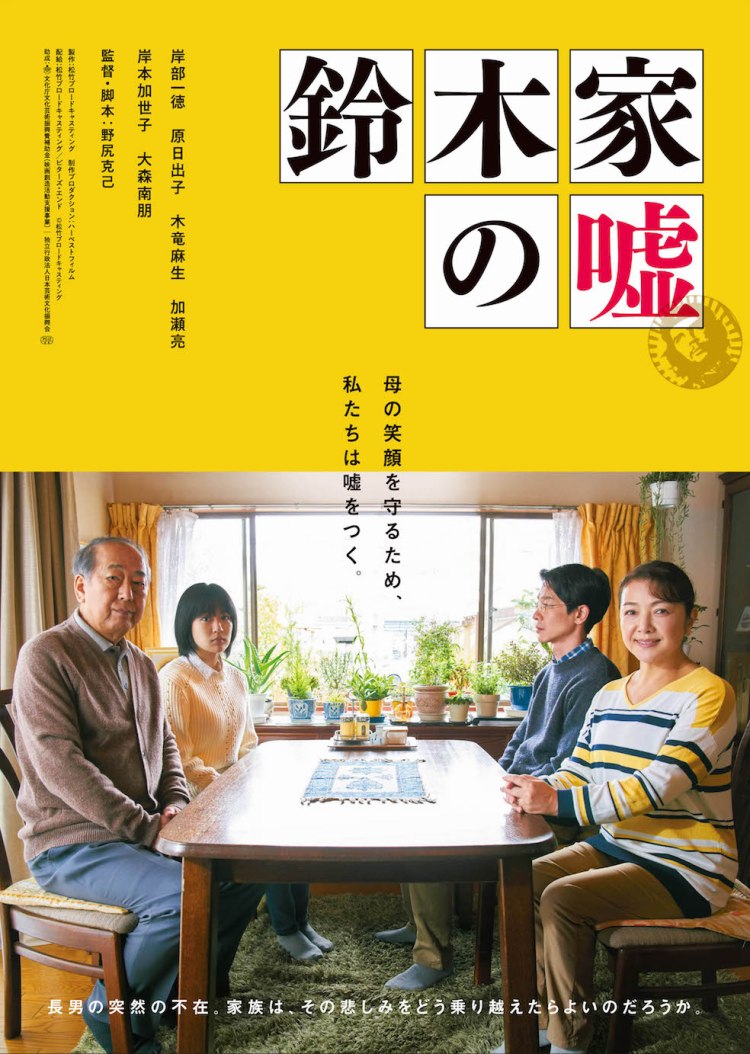
Lying to Mom (鈴木家の嘘, Katsumi Nojiri, 2018)

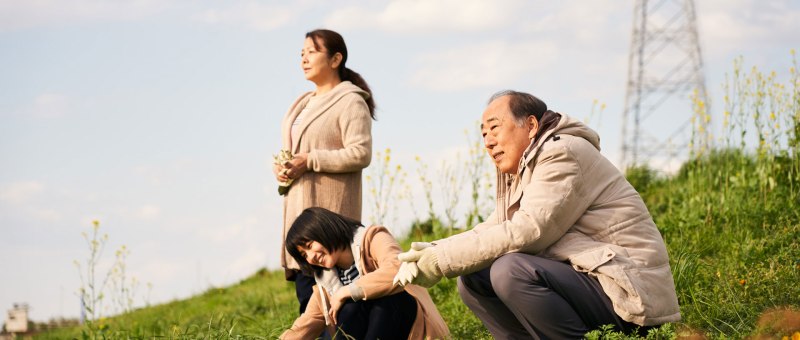
Lying to Mom posterLearning to live with loss is difficult for any family, but when the loss was caused by suicide the pain is even more acute as those left behind try to understand why it is their loved one had to die and if there was anything else they could have done to prevent it. The family at the centre of Lying to Mom (鈴木家の嘘, Suzukike no Uso) choose, initially at least, to avoid dealing with it at all. Each taking their individual paths through grief, they keep the past painfully alive by pretending that oldest son Koichi (Ryo Kase) is only temporarily absent and will eventually return.

Koichi, who has been a hikikomori for many years, takes one last look at the peaceful suburban scene outside his window and hangs himself from a storage closet in his room. His mother Yuko (Hideko Hara), out at the time, only discovers the body when trying to get him to come down to lunch. Panicked, she injures herself and ends up in a coma in hospital while nothing could be done for Koichi. When she wakes up some time later, she’s lost all her memories of the incident and the family don’t have the heart to tell her that her son is gone so they pretend he went to work for his uncle in Argentina.

This is of course very comforting to Yuko who now believes that as a result of her illness Koichi has finally been able to leave his room for a more productive life, but it places a strain on the other family members – father Yukio (Ittoku Kishibe) and daughter Fumi (Mai Kiryu), who remain conflicted about keeping up the pretence while dealing with their own grief in secret. Fumi, whose idea it was to lie in the first place, types out beautiful letters supposedly from Koichi to be handwritten in his handwriting by an associate in Argentina which detail his new life full of freedom and promise overseas.

Meanwhile, Yukio ponders on his relationship with his son with whom he admits he never quite bonded. He sets about trying to find a mysterious woman named on Koichi’s life insurance policy less for practical reasons than to ascertain some sort of evidence that his son lived, even if he lived the last years of his life alone in a room. The reasons for Koichi’s isolation are never exactly explained with Yuko blaming high school bullying and the stagnant economy, but it is clear that he never managed to find himself in Japan and perhaps if he really had gone to Argentina things might have been different.

Wracked with guilt, Fumi finds herself trying out a support group for relatives of those who died by suicide but struggles to put her own thoughts in order. Though people try their best, insensitivity reigns when they try to offer words of condolence. Only love can save people, Fumi’s colleague smugly tells her with a random story about coaxing a shy high school student out their room, little realising he’s tacitly accusing her of not trying hard enough to save her brother. People can’t be saved, Fumi retorts, and she might well have a point. Even the leader of the support group shows himself up when he considers banning a grief-stricken woman with a loud personality because her problems are “smaller” seeing as she’s wealthy. As another attendee tells him, people grieve in different ways and having money or not is unlikely to affect the degree of your emotional pain even if it might in some sense reduce the burden. Besides, his assumptions about her are mostly wrong because he’s not been paying attention to the things that really matter only to his own surface level prejudices.

Despite the prevalence of suicide, the Suzukis still find themselves embarrassed by Koichi’s passing. They tell people it was an illness or avoid mentioning it all. Meanwhile they keep the secret from Yuko and avoid talking about it amongst themselves until finally forced to deal with all of their anger, guilt, pain and confusion. A comforting lie may serve its purpose, but only an emotional reckoning can clear the air. There may be no real answer to why Koichi did what he did, but the Suzukis will have to make their peace with it, finding fresh hope in the process as they begin to repair their emotional wounds together as a family.


Lying to Mom was screened as part of the 2019 Udine Far East Film Festival. It will also be screened at the 2019 Nippon Connection Film Festival on 30th May at 7.30pm.

International trailer (English subtitles)

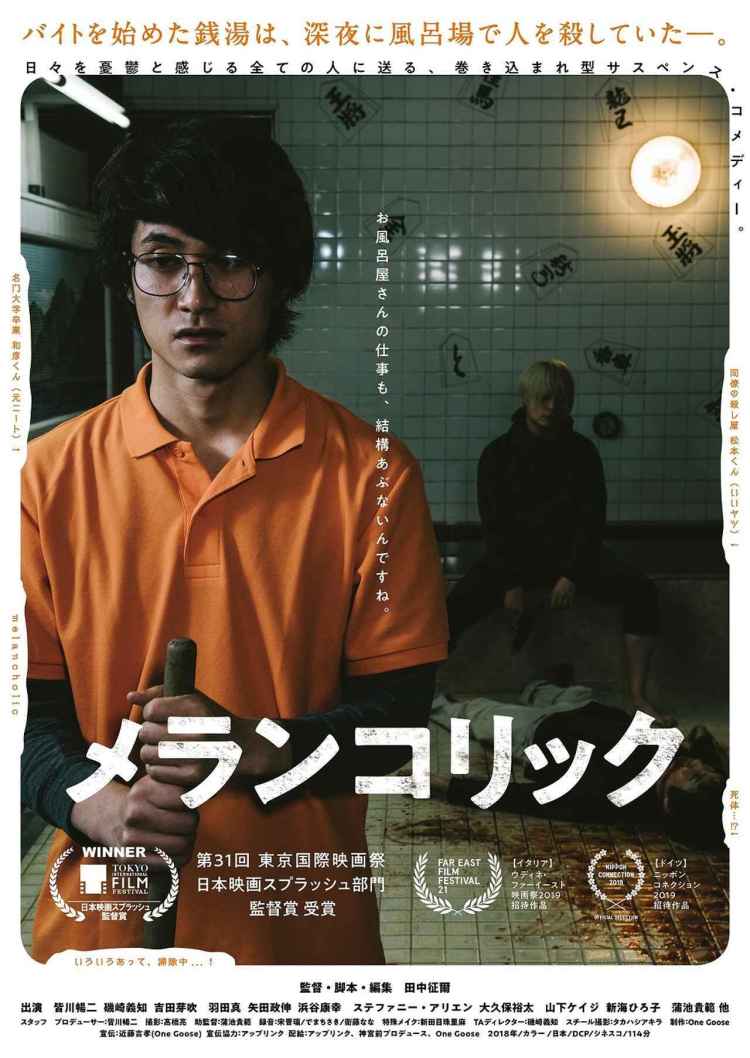
Melancholic (メランコリック, Seiji Tanaka, 2018)

Melancholic posterJust because you’re smart and graduated from a top university, does that necessarily mean you have to put on the salaryman straitjacket in order to become “a success”? The dejected hero of Seiji Tanaka’s Melancholic (メランコリック) isn’t quite so sure, but then he’s always been the type to amble through life going wherever the wind blows him. The time is about to come, however, when decisions must be made and priorities decided lest someone else decide them for you.

Kazuhiko (Yoji Minagawa) graduated from Tokyo University but he’s never been in full time employment and has no definite career plans. Still living at home with his parents, he floats between part-time jobs with little sense of forward motion while his mum and dad are content to let him find his way, if a little exasperated. On a rare visit to a public bathhouse he ends up running into an old high school classmate, Yuri (Mebuki Yoshida), who half-jokingly advises he apply for the open job at the baths seeing as it’s bound to be less stressful than your average salaryman gig. Smitten but too awkward to do much about it, Kazuhiko applies for the job and consents to go to a school reunion as a means of seeing Yuri again. Much to his surprise, however, the bathhouse has a second life as a yakuza kill room with on site body disposal facilities.

Asking questions about what goes on at the bathhouse after dark, Kazuhiko’s boss Azuma (Makoto Hada) tells him that it’s dangerous to know things you aren’t supposed to know, but Kazuhiko is not good with hints and his natural curiosity won’t it let it rest. After he finds out about the secret yakuza backroom deal, Kazuhiko has a “difficult” choice to make – elect to help out with the “night shift”, or die. Kazuhiko chooses to help out (he likes being helpful) and discovers that he actually doesn’t mind it all that much, especially considering the “bonus” package Azuma gave him for being a good boy.

The extra money made Kazuhiko feel as if he could grasp that swanky salaryman life without having to submit himself to the rat race. He uses the money to take Yuri to a fancy French restaurant where he’s flummoxed by the wine list and she’s uncomfortable, but still it goes well even if they both resolve to go somewhere more casual next time. Kazuhiko’s inferiority complex is only enflamed by the lingering presence of Tamura (Yuta Okubo), another old classmate made good, who is also interested in Yuri and is everything Kazuhiko feels himself not to be – handsome, successful, filthy rich, cultured, and confident.

Being allowed in on the after hours business made Kazuhiko feel as if he’d been promoted, that Azuma obviously trusted him and that there might be more overtime coming if he played his cards right. His confidence receives a further knock, however, when he realises that a punkish colleague who joined at the same time as him, Matsumoto (Yoshitomo Isozaki), is technically in a more senior position despite being a barely literate drop out with bleach blond hair. In way over his head, Kazuhiko still desperately wants to regain some of that status and approval he felt was his when the cleanup business was their little secret.

An awkward, naive, but sincere man, Kazuhiko marvels on realising how many yakuza seem to be “around” before Azuma and Matsumoto remind him that not everyone involved with crime is a bona fide yakuza. The bathhouse outfit is, more or less, run by freelancers but still at the mercy of mob boss Tanaka (Masanobu Yada) who has an iron hold over Azuma because of outstanding debts. Azuma would like to put a stop to the night shift, but can’t – or so he claims. As is later pointed out, for those getting on in years an unsatisfying status quo is often preferable to a turbulent new. Though Kazuhiko has no real objection to working the night shift as far as the clean up goes, he is not completely comfortable with its wider implications, often asking why it was someone had to die only for Matsumoto and Azuma to shrug and say it doesn’t matter. They had orders and carried them out, anything else is an irrelevance they don’t need to worry about.

Kazuhiko, however, does worry if in a fairly minor way until his gradual descent into the world of crime drags him into a vicious quagmire in which he must accept the seriousness of his situation along with its potential costs. Despite the original animosity and natural sense of distrust, what wins out is a sense of fellow feeling between unlikely allies Matsumoto and Kazuhiko who begin to see a way out of their mutual malaise through seizing their own futures and daring to pin their hopes on things they assumed unattainable, like love and friendship. Rather than chasing the salaryman dream, or climbing to the top of the yakuza tree, they pick an ordinary kind of “good enough” success in which moments of warmth and togetherness become the only things which give life meaning. A surreal ode to just muddling through and learning to be happy in the moment, Melancholic more than lives up to its name but despite all the darkness eventually finds real joy in the easy pleasures of mediocrity and mutual acceptance.


Melancholic was screened as part of the 2019 Udine Far East Film Festival. It will also be screened at the 2019 Nippon Connection Film Festival where director Seiji Tanaka and actor Yoshitomo Isozaki will be present for a Q&A.

Original trailer (English subtitles)
Blue Spring (青い春, Toshiaki Toyoda, 2001)

Blue Spring posterJapan is a hierarchical society, but that doesn’t mean there is only one hierarchy. Every sector of life seemingly has its own way of ordering itself, including high school. Back in the ‘80s, high schools became known as violent places in which angry young men took out their adolescent frustrations on each other, each hoping to be accounted the toughest guy in town. Toshiaki Toyoda, chronicler of millennial malaise, made his one and only “youth movie” in adapting Taiyo Matsumoto’s delinquent manga Blue Spring (青い春, Aoi haru), bringing to it all the nihilistic hopelessness of his earlier work tempered with sympathetic melancholy.

The action begins with a photograph of group of boys entering their final year of high school before embarking on a dare to decide who will be the new king of the school which involves hanging off a high balcony and seeing how many times you can clap before needing to catch hold of the railing or fall to your death. Cool and apathetic Kujo (Ryuhei Matsuda) wins easily with a new record, but seems indifferent to his increased status while his best friend and underling, Aoki (Hirofumi Arai), basks in the vicarious glow of suddenly being top dog. Meanwhile, Yukio (Sousuke Takaoka) – a silent and troubled young man, keeps his minion on the hook with promises of making him a fully fledged member of the gang while squaring off against Ota (Yuta Yamazaki) who is keen to talk up his growing friendship with a local mobster.

Despite a reputation for order and discipline, Asa High School is a lawless place where ineffective authority figures run scared of the hotblooded teens. Set in entirely within the school, there is little hint of the boys’ home lives but none of them truly believe there’s very much for them out in the world and know that the last year of high school is a final opportunity to be uncivilised with relatively few repercussions. The teachers, sadly, mainly agree with them, tiredly reading out the same dull text books while letting the kids do as they please because they lack the inclination to help them. Even those who do take an interest fail to get through, trotting out tired platitudes which do little to convince the kids in their care that their time at school matters or that they should want to work on their interpersonal skills and anger issues.

“People who know what they want scare me”, Kujo explains to a strangely sympathetic teacher (Mame Yamada) whose job it is to make the flowers bloom. He’s top dog now, but being made king has only made him feel powerless and uncertain. Suddenly, being the strongest seems like an irrelevance and this pointless violence an absurd waste of time. The problem is, none of these kids have any direction or hope for the future. They don’t believe education can be a way out, and being trapped in a stagnant economy makes them inherently distrustful of the salaryman dream that might have distracted their fathers. All they have are their fists and angry, adolescent hearts.

One by one their dreams are crushed – the baseball star doesn’t make it to Koshien, the sickly kid doesn’t show up for school, the yakuza goon is betrayed by a friend, the bullied underling moves up to bullying others, and a cross word between Aoki and Kujo threatens to ruin a childhood friendship. Asked for his hopes and dreams for the future, all Yukio can offer is a dedication to world peace and the Ultraman pose. Kujo, staring confused at the flowers, wonders if some are destined to wither without ever blooming only for his teacher to console him, melancholically, that he chooses to believe that flowers are born to bloom and so bloom they will.

Meanwhile, yakuza circle the fences like baseball scouts at a championship game, knowing organised crime is the traditional next step for handy boys who won’t graduate high school. Yet the tragedies here aren’t so much ruined futures and the futility of life as the failure of friendship. The boys fight and they hurt each other in ways other than the physical but lack the maturity to deal with their pain. Violence, self inflicted and not, is their only outlet and their only means of attracting attention from the authority figures so intent on ignoring their existence. Toyoda builds on the relentless sense of hopelessness seen in Pornostar but leaves with the weary resignation of one no longer young who knows that youth is dream destined to disappoint.


Blue Spring is released on blu-ray courtesy of Third Window Films on 13th May. The set also includes a very frank and often humorous commentary from Toyoda (in Japanese with English subtitles) as well as a “making of” from the time of the film’s release.

Original trailer (English subtitles)

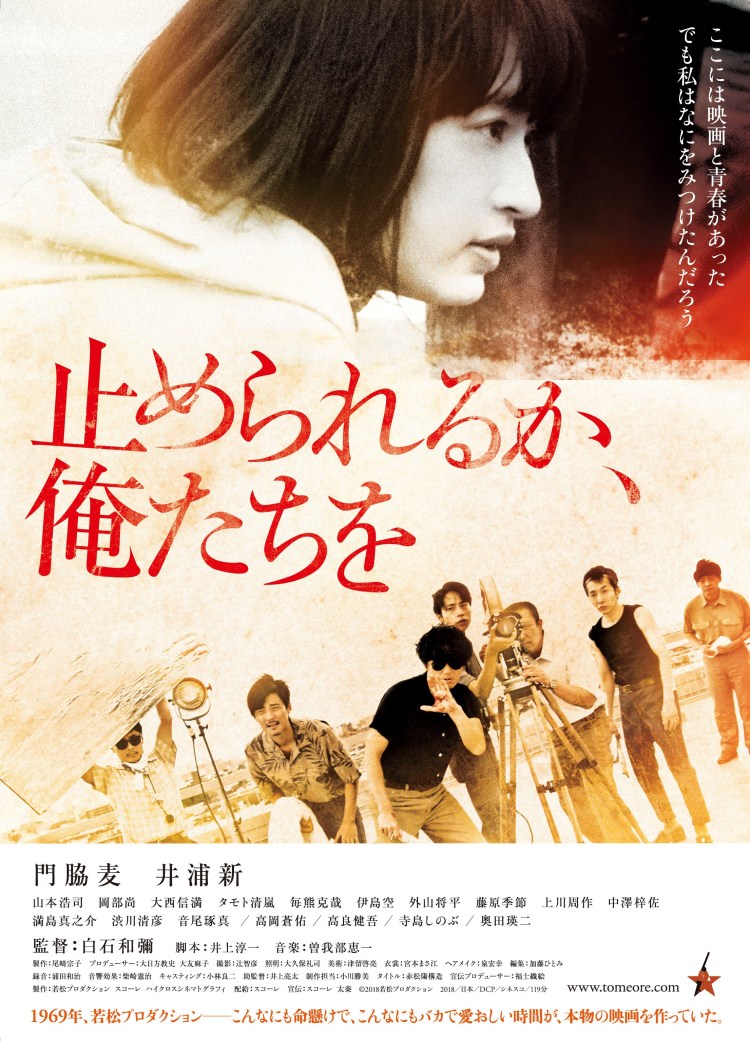
Dare to Stop Us (止められるか、俺たちを, Kazuya Shiraishi, 2018)

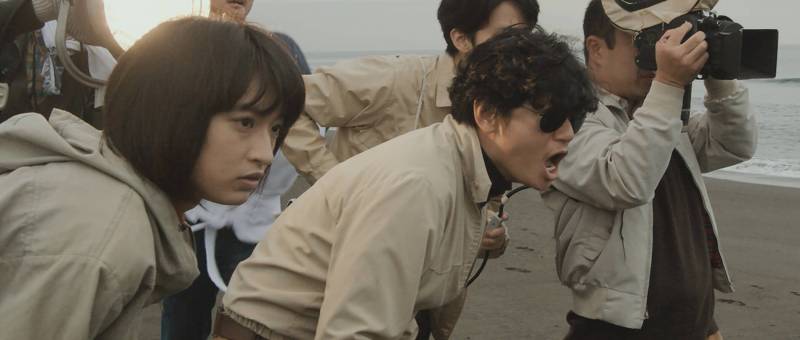
Dare to stop us posterUntil his untimely death in a road traffic accident in 2012, Koji Wakamatsu had been the enfant terrible of Japanese cinema. An irascible but somehow much loved figure, Wakamatsu is most closely associated with a series of provocative sex films which mixed politically radical avant-garde aesthetics with pink film exploitation. Kazuya Shiraishi, himself a former Wakamatsu apprentice, takes a look back at the heady years of Japanese indie cinema in the aptly titled Dare to Stop Us (止められるか、俺たちを, Tomerareruka, Oretachi wo) which explores the backstage environment at Wakamatsu Production from 1969 to 1972 (or, right before everything changed with the death of the student movement in Japan following the Asama-sanso incident).

Rather than follow Wakamatsu (Arata Iura) directly, Shiraishi frames his tale around aspiring director Megumi Yoshizumi (Mugi Kadowaki) – the only female presence (besides the actresses) at the otherwise extremely masculine studio which focusses mainly on artistic soft-core pornography. A Shinjuku hippie and self-confessed fan of Wakamatsu, Megumi finds herself joining the team after being recruited to scout potential starlets who could pass for high schoolers. On arrival at the studio, Megumi is quickly mistaken for an actress or mistress but finally manages to win the guys round and is taken on as an assistant director with the possibility of stepping up to the director’s chair if she lasts three years working under Wakamatsu.

As the gruff director warns her, most don’t even last the month. Megumi is however determined, despite Wakamatsu’s continued show of forgetting her name and harsh on-set demeanour. Commiserating with her, another veteran affirms that the big studios wilfully exploit their ADs, at least with Wakamatsu his heart is in the right place even if he’s only a different sort of difficult. He also, however, hands her a bottle of hooch which serves an unfortunate harbinger of things to come as Megumi finds herself playing along with the hard drinking boys club but becoming ever more confused about her role in the organisation and the further direction of her life.

Wakamatsu and his partner Masao Adachi (Hiroshi Yamamoto) vow to make films to shake the world, but are not above commercial concerns which is why they find themselves making pure sex films under pseudonyms to balance the books, much to the chagrin of some of the studio’s more politically engaged members. These are particularly politically engaged times in which the student movement is at its zenith, protesting not only the renewal of the ANPO treaty, but the Vietnam War, and the fiercely contested building of Narita airport. Mostly thanks to Adachi, Wakamatsu Production gradually shifts from indie film company to activist organisation in which political concerns are beginning to take precedence over the business of filmmaking.

The shift leaves those like Megumi who were not so interested in the political dimension floundering along behind and increasingly disillusioned with the world of Wakamatsu Pro. Megumi may admit that she had other problems that probably should have been better addressed, but remains conflicted as to her involvement with the studio. Feeling as if she has nothing in particular to say, she questions her desire to make films at all while clinging fiercely to the surrogate family that has grown up around the strangely fatherly director and continuing to feel insecure in her atypical femininity in a world which more or less requires her to act like a man but doesn’t quite accept her for doing so.

Wakamatsu said he wanted to hold the masses at knifepoint and create a film to blow up the world, but Megumi increasingly feels as if it’s she who will eventually face Wakamatsu with only one of them surviving. Megumi is, in a sense, a victim and encapsulation of her age in which she wanted a little more than it had to give her and found herself increasingly disillusioned with its various betrayals and disappointments. Given the chance to direct a 30-minute short for love hotels, Megumi spins a tale of Urashima Taro which is, as Adachi puts it, all about how she can’t go back to being a hippie after getting mixed up with Wakamatsu and has lost sight of her true self in her quest for acceptance. Both nostalgic look back to a heady era and a tragic tale of that era’s costs, Dare to Stop Us is a fitting tribute to the Wakamatsu legacy which portrays the irascible director as neither saint nor demon but painfully human and infinitely flawed.


Dare to Stop Us was screened as part of the 2019 Udine Far East Film Festival.

Original trailer (no subtitles)

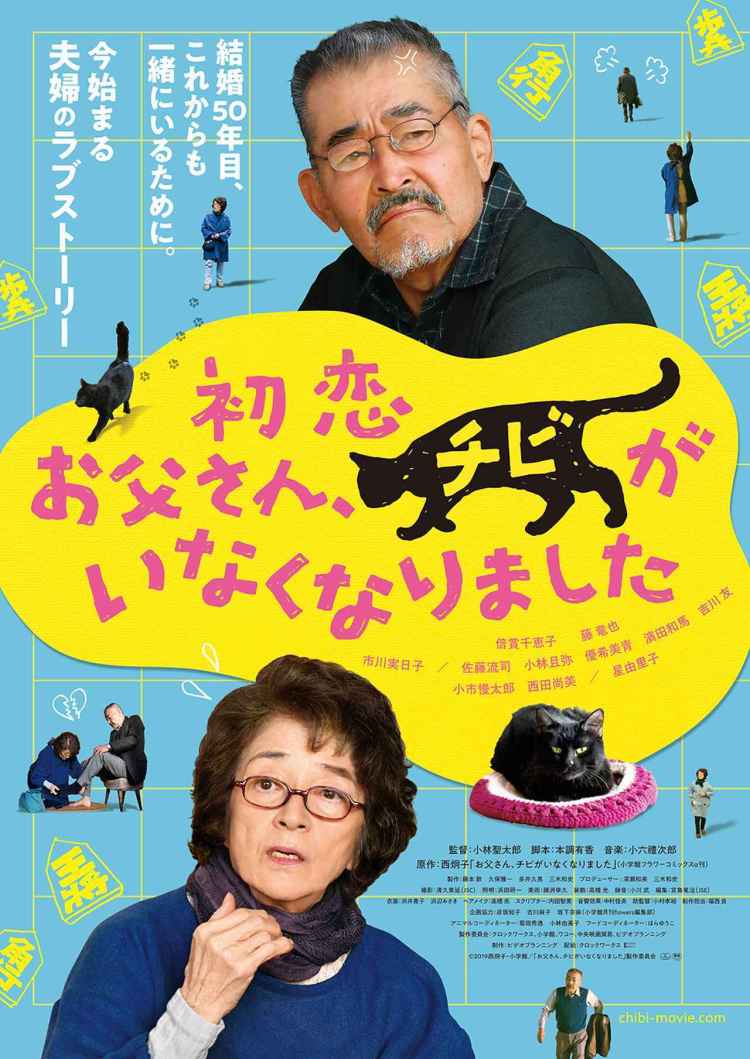
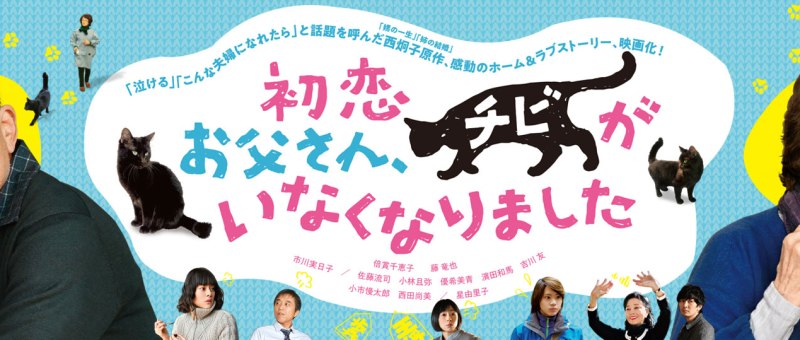
Only the Cat Knows (初恋 お父さん、チビがいなくなりました, Shotaro Kobayashi, 2019)

Only the cat knows poaterThe disappearance of a beloved cat has sparked many a crisis in Japanese cinema. In Shotaro Kobayashi’s* Only the Cat Knows (初恋 お父さん、チビがいなくなりました, Hatsukoi: Otosan, Chibi ga Inaku Narimashita), the disappearance is as metaphorical as it is literal in that this particular cat has come to symbolise the faded love of a couple married for fifty years whose relationship has begun to disintegrate if in a very ordinary way.

Chibi had been a constant companion to Yukiko (Chieko Baisho) who often feels neglected by her salaryman husband of 50 years, Masaru (Tatsuya Fuji). Now that he’s (semi-)retired, she hoped they might be able reconnect, perhaps even travel, but he is just as disinterested in domestic life as ever and mostly spends his days popping back into the office or playing shogi in a nearby club. An awkward, conservative man, Masaru aggressively ignores his wife, even irritatedly blanking her when she spots him out and about, while she dutifully waits for him at home to take his socks off for him in the hall and pick up the jacket he so casually throws to the floor for her to deal with. Chibi’s disappearance is then another blow to her already lonely world and Masaru’s extremely unsympathetic reaction to her fears eventually provokes her into wondering if she should leave him.

Masaru, it has to be said, is not an easy man and it’s easy to imagine that much of Yukiko’s married life may have been difficult or even unhappy. This is perhaps why though youngest daughter Naoko (Mikako Ichikawa) is originally panicked by her mother’s mention of divorce, all three of the couple’s grown-up children are eventually on her side and claim they can completely understand why she might feel that way. As if trying to fill a very real void in her life, Yukiko has taken to watching romantic Korean dramas dubbed into Japanese while reminiscing on her own romantic past which led her to marry Masaru all those years ago.

Nevertheless, despite her own dissatisfaction, she remains perturbed by Naoko’s disinclination to marry even at the comparatively late age of 37. Avowing that she doesn’t think a woman needs a career, Yukiko tries to push her daughter towards the socially conservative choices of home and family. Yukiko may worry that Naoko will end up all alone in her old age, but then as Naoko points out, Yukiko did everything “right” and feels alone anyway. Tellingly, Naoko was once engaged to man who jilted her right before the wedding because he was insecure about her career success which had exceeded his own and apparently needed to be master in his own home. Unfortunately, the world has not quite moved on enough and it seems many men still only want women who will take their socks off for them at the end of a busy day.

Naoko doesn’t want to get married just for the sake of it which, ironically, seems to be the same way Yukiko felt when she was young though as it turned out her courtship with Masaru was an awkward mix of arranged and not. Having fallen for him at her job on the milk counter at the station, she was slightly stunned to spot his picture in an omiai book and agreed to the meeting only for Masaru to tersely tell her he’d decided to take the first offer and didn’t even open the envelope to peek inside. In true Masaru fashion, this may turn out to be a lie of awkwardness but it’s left a note of anxiety running right through their decades long marriage which only is now bubbling the surface. Yukiko worries she “stole” Masaru from her friend on the counter who liked him first and whom she spots him secretly meeting all these years later. A lack of emotional honesty has created a widening gulf between husband and wife with Yukiko left wondering if her husband ever really loved her at all.

The search for the missing cat becomes a quest to rediscover the smouldering love of a longterm couple that a lack of communication has all but smothered. Yukiko tries everything she can to find Chibi, even hiring a pet detective, while Masaru irritatedly tells her to give up – that Chibi has most likely gone off to die and wanted to spare Yukiko the pain of watching him suffer. Masaru may be somewhat casting himself as the wandering cat, the strong and silent type who thinks he’s protecting his wife by making her miserable, but deep down he too wants to save their love even if it means he will finally have to find the wherewithal to talk about his feelings without embarrassment. A charming late life love story, Only the Cat Knows is careful not to sugarcoat the the destructive social codes of a bygone era but allows its pair of former lovers to rediscover what it was they once had while allowing them to move forward into a happier future.


Only the Cat Knows was screened as part of the 2019 Udine Far East Film Festival.

*Director Shotaro Kobayashi’s name is also romanised as Syoutarou Kobayasi

Original trailer (no subtitles)

Every Day a Good Day (日日是好日, Tatsushi Omori, 2018)

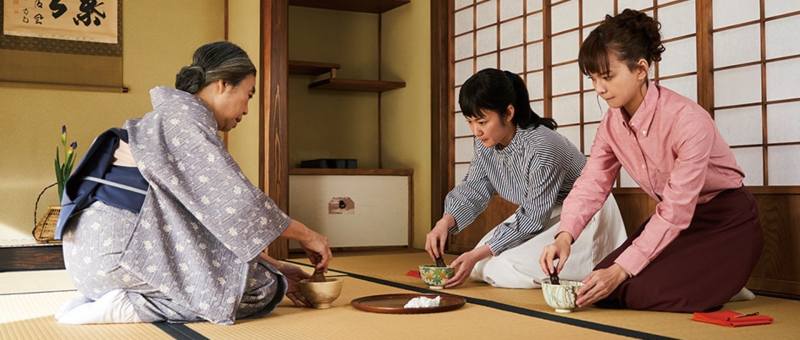
Everyday a good day posterTatsushi Omori burst onto the scene in 2005 with the extremely hard-hitting and infinitely controversial The Whispering of the Gods before going on to build a career on chronicling the unpalatable facets of human nature. He does have his lighter sides as the delightfully whimsical Seto and Utsumi proves, but even so he might be thought an odd fit for directing an adaptation of a series of autobiographical essays detailing one woman’s personal growth over a 20 year period spent perfecting the art of the Japanese tea ceremony. Every Day a Good Day (日日是好日, Nichinichi Kore Kojitsu) is, however, like much of his previous work, a story of youthful ennui and existential despair only one in which it turns out that the world is basically good once you agree to embrace it for what it is.

The film opens in 1993 with the heroine, Noriko (Haru Kuroki), a confused college student unsure of the forward direction of her life. Often ridiculed by her family for being clumsy and neurotic, Noriko compares herself unfavourably with her glamorous cousin Michiko (Mikako Tabe) who has come to the city from the country to study and appears to have her whole life already mapped out with a confidence Noriko could only dream of. A turning point arrives when she’s talked into accompanying Michiko to learn tea ceremony from a kindly old lady, Mrs. Takeda (Kirin Kiki), who lives nearby. Despite regarding tea ceremony as something fussy and old fashioned that only conservative housewives aspire to learn, Noriko begins to develop a fondness for its formalist rigour and continues dutifully attending classes for the next 24 years.

“Carry light things as if they were heavy, and heavy things as if they were light” Noriko is told as she clumsily tries to carry an urn from one room to another, though like much of Takeda-sensei’s advice it serves as a general lesson on life itself. Mystified by the entire process, Noriko and Michiko make the mistake of trying to ask practical questions about why something must be done in a particular way only for Takeda-sensei to admit she doesn’t know, it simply is and must be so. To look for that kind of literal meaning would be a waste of time.

Of course, she doesn’t quite put it that way. As Noriko later realises, some things are easy to understand and need only be done once. Other things take longer and can only be understood through a weight of experience. Just as she was bored out her mind by La Strada at 10 but moved to tears at 20, the discrete pleasures of the tea ceremony are something only fully comprehended when the right moment arrives. What was once empty formalism becomes a framework for appreciating the world in all its complexity, embracing each of the seasons as they pass and learning to live exactly in the moment in the knowledge that a moment is both eternal and transient.

Noriko continues to feel herself out of place as she witnesses those around her progress in their careers, get married, or go abroad while she remains stuck, unable to find a direction in which to move. Even tea ceremony occasionally betrays her as new pupils arrive, depart, and sometimes wound her newfound sense of confidence by quickly eclipsing her. Nevertheless, the calm and serenity of ritualised motion become a place of refuge from the confusing outside world while also offering a warmth and friendship perhaps unexpected in such an otherwise ordered existence.

Over almost a quarter of a century, Noriko’s life goes through a series of changes from career worries to romantic heartbreak, learning to love again, and bereavement, while tea ceremony remains her only constant. She may not yet have discovered the path to happiness, but perhaps has begun to reach an understanding of it and believe that it might exist in some future moment – as Takeda-sensei says, there are flowers which bloom only in winter. In any case, what she’s learned is that sometimes it’s better not to overthink things and simply experience them to the best of your ability while you’re both still around. Every day really is a good day when you learn to slow down and truly appreciate it, living in the moment while the moment lasts in acknowledgement that it will never come again.


Every Day a Good Day was screened as part of the 2019 Udine Far East Film Festival.

Original trailer (English subtitles)
Jam (SABU, 2018)

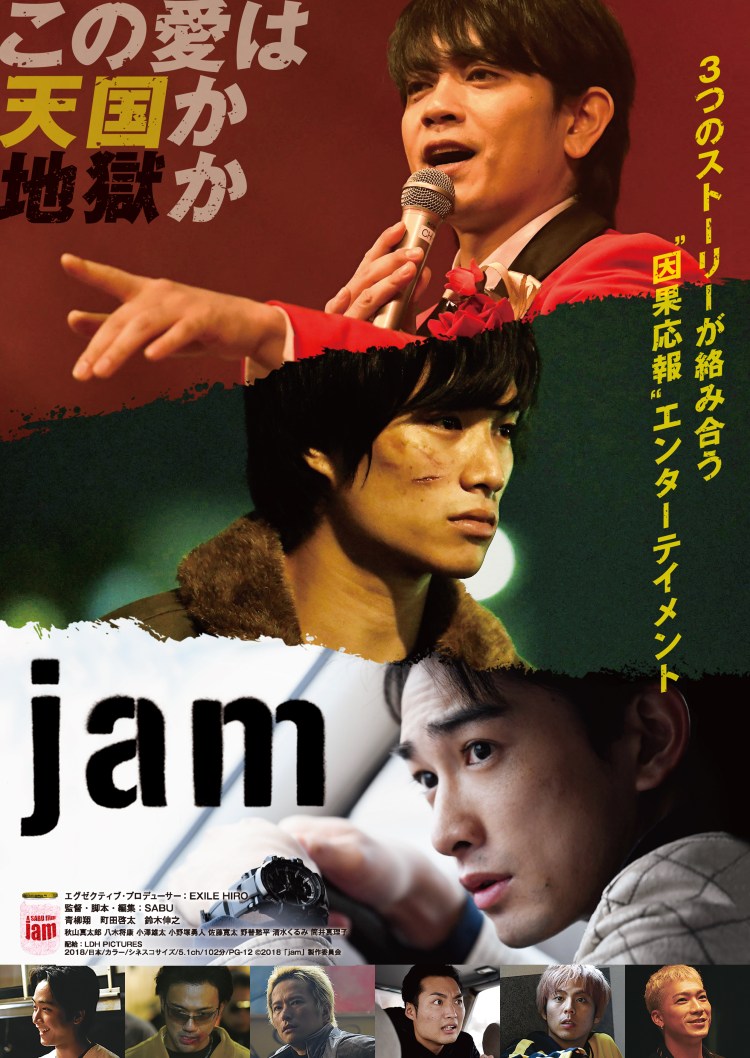
PrintSABU began his directorial career with a reputation for shooting on the run. Time may have caught up with him, in that relaxed contemplation has begun to replace frenetic action in the more recent stages of his career, but it’s to his first feature, Dangan Runner, that he (after a fashion) returns in the similarly structured Jam. Random circumstance conspires once again to send three fugitive guys on a zany collision course, but this time the crash offers each of them something a little more positive (to a point, at least) than a grudging acceptance of life’s impossibilities.

The first of our three heroes, Hiroshi (Sho Aoyagi), is a cheesy enka singer with an army of middle-aged female fans whom he is perfectly aware of exploiting. Despite his “star status” with the ladies who crowd out his meet and greets, Hiroshi’s big concert is at the Civic Centre in Kitakyushu which is not exactly the Budokan, but it’ll do for the minute. Trouble brews when the wealthiest of his fans, Mrs. Sakata, suggests a change to the setlist only for a backbencher to leap to Hiroshi’s defence with slightly embarrassing fervour. Masako’s (Mariko Tsutsui) crazed fan aesthetic is later brought to its zenith when she gets Hiroshi to chug down some home made soup which is laced with some kind of knock out drug.

Meanwhile, all round good guy Takeru (Keita Machida) is driving around in a not quite classic car and looking for people to help because a Buddha appeared to him and told him if he did three good deeds a day his girlfriend would wake up from her coma, and ex-con Tetsuo (Nobuyuki Suzuki) is patiently pushing his grandma round town in a wheelchair and taking revenge on the gangsters who have betrayed him every time her back is turned.

“Pay back is scary as hell” one of the gangsters affirms as he laments potentially mixing up a thoroughly good guy like Takeru in their nasty yakuza business. As the other had earlier outlined, this is a world very much defined by karma – you do good and good comes back to you, but do something bad and you’re in for more of the same. The logic is sound, and yet it doesn’t quite work the way you’d expect it to. Takeru is nothing but good, too good as it turns out, but constantly suffers precisely because of his goodness. Not only is his girlfriend gunned down in front of him during an act of random street violence, but he eventually finds himself tricked into helping the exact same thugs commit further crime only to attempt heroics and see that massively backfire too. Even so, he keeps on trying to be good and perhaps it really will pay off in the end.

Meanwhile, Hiroshi seems to be leading something of a charmed life though perhaps through a prism of self-loathing. He knows he is a cheesy lounge singer and one step up from gigalo in the way he accommodates himself to these older ladies in whom his only interest is their money. This is perhaps why he finds himself desperately playing along when kidnapped by Masako in the hope he will write a song just for her (that’ll show the snooty Mrs. Sakata), but finally betraying her in the final moment as if attempting to reassert his artistic autonomy. Masako eventually makes a sacrifice of her own which sends Hiroshi running for the hills only to finally acknowledge a sense of responsibility for his willing misuse of her loneliness and disappointment in selling her an impossible dream of connection.

As for Tetsuo, pushing granny round the city by night, the yakuza lurk round every corner proving the past really is impossible to escape. As expected, the paths of the three men eventually intersect in strange and various ways though each is bound for a different destination and an individual epiphany. Another boy band odyssey from SABU, this time in collaboration with studio LDH and the members of EXILE, Jam takes a fairly ironic view of the idol business if thinly disguised in Hiroshi’s depressing business plan of self-debasement and fansploitation while simultaneously asking if you really do reap what you sow when it comes to cosmic karma in an increasingly surreal existence.


Jam was screened as part of the 2019 Udine Far East Film Festival.

International trailer (English subtitles)
Law in Ghost Island (幽霊島の掟, Yasushi Sasaki, 1961)

The post-war world was one of increasing globalisation which brought with it anxiety as well as hope as Japan readied itself to step back onto the world stage. The populist cinema of the early ‘60s is marked by ambivalent attitudes to international influences, not just towards creeping Americanisation and its perceived costs but perhaps somewhat uncomfortably towards the wider world and Asia in particular with the same old prejudices which had marked the previous 20 years rearing their heads once again. Voice of the post-war era, the films of Hibari Misora are, by contrast, about as forward looking and progressive as it was possible to be but Law in Ghost Island (幽霊島の掟, Yurei-jima no Okite) in which she plays a noticeably smaller part, is a bizarre exception in which a “lawless” melting pot outpost must be “civilised” by Japanese influences else the creeping rule of thuggish Asian gangs finally reach Japan “proper”.

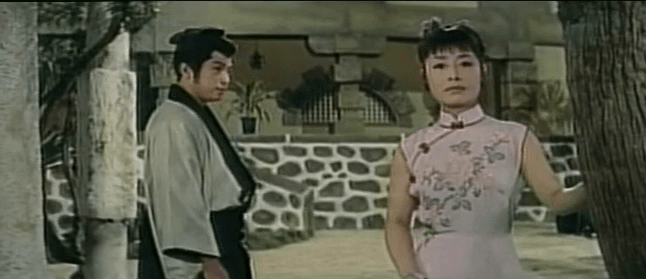
We’re deep in the Bakumatsu. The Black Ships have already arrived and there is considerable political trouble brewing back in Japan. That’s not our immediate concern however because we’re on a creepy boat with slovenly ronin Yagi Hanzo (Hashizo Okawa) and a mysterious woman wearing a cheongsam (Hibari Misora). Fellow petty gangster and slave trafficker Bunji (Chiyonosuke Azuma) is suspicious of Hanzo, but decides he’s probably just an unlucky retainer on the run from something or other and might prove useful. Therefore, on arrival at Dragon Island, Bunji starts on trying to recruit Hanzo for his boss Chou Yang Po (Isao Yamagata), but Hanzo’s his own man and he hasn’t come here looking for a job. Fearing Hanzo is a government official here to bring the law down on all their heads, Chou tries to force him to harm a man they have in custody and believe to be working for the state. Hanzo gets round this by breaking a chair over the man’s back but leaving him otherwise unharmed, keeping his cover (if that’s what it is) firmly intact.

During his stay on Dragon Island, Hanzo will meet several other shady characters, many of them dressed in outfits more usually associated with the Chinese, Indians, nondescript “islanders”, and strange movie pirates, but what must be assumed is that though Japan “owns” this distant island it is unable to police it and as such it has become a den of scum and villainy in which various tribal gangs vie for hegemony and control over the lucrative smuggling hub which has unwittingly formed in direct response to Japan’s unwise policy of internal isolation which is itself at breaking point thanks to Perry’s Black Ships which we later hear are also on their way to Dragon Island.

Our key into this conflict is the crazed child of the leading gangster, Isakichi (Hiroki Matsukata), who dresses like a cowboy and likes to showoff his hard-won saloon credentials as sharpshooting libertine and all round party animal. Hanzo is not as impressed by this as Isakichi was hoping though an awkward sort of camaraderie eventually arises between them. Meanwhile, Isakichi has fallen in innocent love with the sister of his childhood best friend who is deep into a putative resistance movement hoping to end the stranglehold the smugglers have placed over the previously peaceful island.

Misora’s Madame Song, for some reason posing as a Chinese sex worker, hints at the various ways nothing is quite as it seems in her astute observations of the world around her, sensing that Hanzo is hiding something but also assuming that he is on the “right” side. There is conspiracy everywhere – the putative revolution at home is sending its shockwaves all the way out here as our unscrupulous gangsters try to procure guns to send to various sides on the mainland, while Madame Song ironically laments that what Dragon Island needs is to be more like Japan which is to say ruled less by law itself than an internalised acceptance of the proper order of things. Uncomfortably, it also probably means sending the people who aren’t wearing kimono somewhere else and trying to stop them tricking nice women from Kyushu into coming to tropical islands where they discover they’ve been trafficked into sex work and are unable to leave.

Among Toei’s lower budgeted efforts, Law in Ghost Island bills itself as a supernatural tale and does indeed open with a creepy scene of a misty boat but Hanzo doesn’t end up anywhere like the isle of the dead only a fantasy tropical “paradise” filled with zany movie pirates. Somewhere between pirate fantasy and western, Law in Ghost Island is closer to the kind of spy spoofs Toho would start producing in a few years’ time and even ends with a strangely comic scene in which just about everyone reveals themselves as spy for the same side during the climactic final shootout having been too busy playing spy games to figure any of it out before.

The final messages too are uncomfortable and ambivalent as Hanzo affirms that if there were more “good samurai” Japan would not become lawless like it is here while also claiming Dragon Island for the mainland in fear external forces may use it as a base to attack Japan. The smugglers pay heavily for their “treachery” in contributing to internal mainland chaos while the revolutionary islanders declare their intentions to make the island a better place, which mainly seems to mean making it more “Japanese” which is a fairly ambivalent message whichever way you look at it. Misora only sings two songs and is relegated to a minor mystery in the strange goings on of Ghost Island which features absolutely no ghosts or supernatural intrigue. It does however perhaps shine a light on a strange moment of cultural flux however how unflattering that mirror may turn out to be.


Brief clip of some of Hibari’s songs (no subtitles)

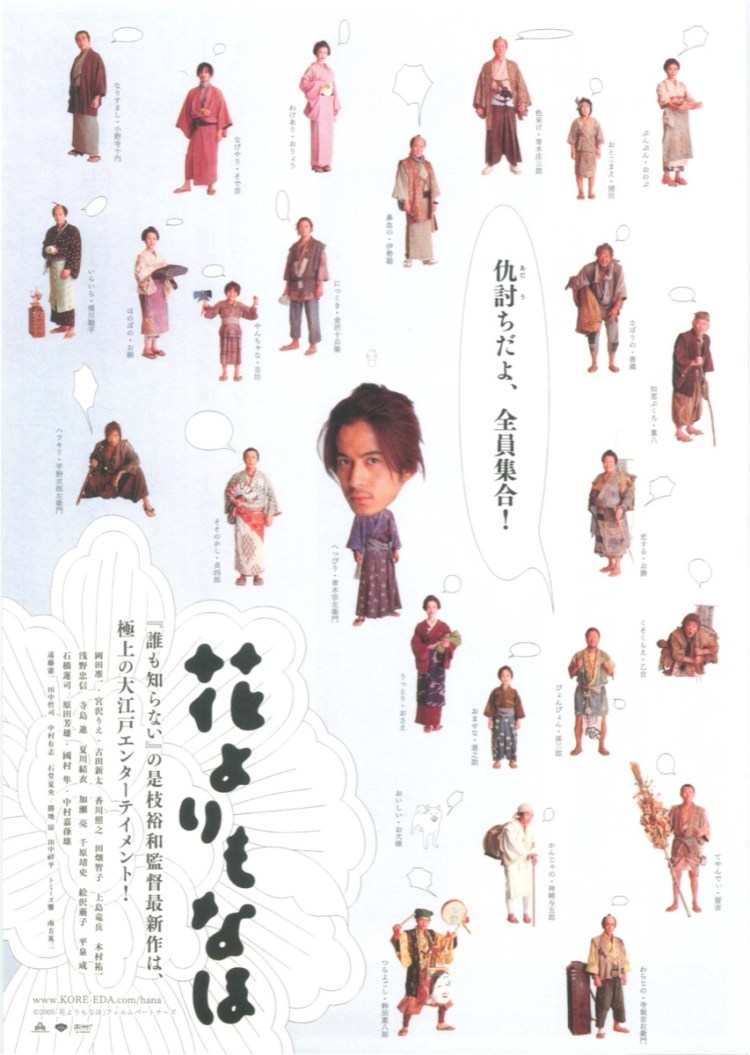
Hana (花よりもなほ, Hirokazu Koreeda, 2006)

Hana poster 1The heart of the samurai movie lies in the conflict between human feeling and duty to one’s code, unexpectedly the code usually wins but its victory is often tragic. Following a series of bleak modern dramas, Hirokazu Koreeda took his first (and so far only) foray into the jidaigeki with Hana (花よりもなほ, Hana yori mo Naho), stopping to ask if the entirety of the samurai ethos was founded more on pride and a sense of entitlement than a supposedly high ideal of honour of justice, and if perhaps the negative legacy of the samurai era is one that continues to be passed on through toxic masculinity and the patriarchal primacy of problematic fathers.

Set in 1702, the action revolves around noble hearted samurai Soza (Junichi Okada) who has been living in a rundown tenement ally for the last three years looking for the man who killed his father in a pointless quarrel over a game of Go in order to avenge his death. Despite being a fine samurai and heir to a dojo, Soza’s big secret is that he’s not much of a swordsman and is also tenderhearted which leaves him doubly conflicted in his mission. Unwilling to admit he has simply come to like living among these “ordinary” people, and most particularly alongside the widow Osae (Rie Miyazawa) and her young son Shinbo, Soza has perhaps begun to slack off and no is longer looking very hard for his quarry, willingly allowing himself to be conned into buying meals for the cheeky Sado (Arata Furuta) who already has tabs running all over town.

Unlike the majority of samurai tales, Koreeda deliberately shifts the focus to the poor – routinely oppressed by an unscrupulous landlord who has even taken to selling their excrement for extra money just to make sure they are as thoroughly exploited as possible. These people exist so far out of the samurai world that it might as well not exist for them and its rules are nothing more than a ridiculous affectation when your primary concerns are how to keep yourself fed for the day and make sure your house doesn’t suddenly fall down while you’re out. These facts are well and truly brought home to Soza when, knowing he has little chance of winning anyway, he is challenged to a fight by jaded street punk Sode (Ryo Kase) who is keen to prove to little Shinbo that dojo skills mean nothing in the real world. Soza gets a pounding, but somehow wins people’s hearts anyway if only for being so easily humiliated and bearing it with good grace.

Lessons to little Shinbo, who has figured out his father is probably dead but worries that maybe his mother still doesn’t know, becomes a persistent motif as Koreeda embraces his favourite theme – good fathers and bad. Soza’s samurai code pushes him towards martial rigour and the necessity of obeying his father’s wishes which in this case would be hating the man who killed him and avenging his death. Hate is, however, something the fair-minded Soza finds difficult even if he seems to have a fair amount of inner conflict towards his father whom even his cheerful uncle describes as a joyless prude. Osae, sensing Soza’s inner pain, points him in the right direction in remarking that if all his father left behind for him was hate then that legacy would be too sad. Eventually, Soza remembers that there were other things, better things, that his father taught him and that he could pass on to Shinbo which aren’t about pointless cycles of revenge killing and century old grudges. He can honour the spirit of his duty without having to obey it to the letter.

Meanwhile, Koreeda deliberately contrasts Soza’s gradual confidence in his humanitarianism with the stubborn pride of the 47 ronin who are also hiding out in the tenement ally while they bide their time waiting to strike. Soza manages to effect his “revenge” with some theatrical subterfuge, whereas the 47 (well, in the end 46) ronin take theirs for real but not altogether honourably and end up becoming legend overnight, earning the tenement a brief reprieve after the landlord threatens to close it down through becoming a tourist spot. The title, apparently inspired by the death poem of Lord Asano whose seppuku triggered the series of incidents later retold as the legend of the Chushingura, alludes to the nihilistic pointlessness of the samurai ideal of a death as elegant as falling cherry blossoms, later imbuing it with earthier, warmer wisdom as an unexpected fount of profundity affirms that the reason cherry blossoms fall so beautifully is that they know they will soon bloom again.


Hana was screened as part of an ongoing Koreeda retrospective playing at the BFI Southbank in April and May 2019.

Original trailer (no subtitles)