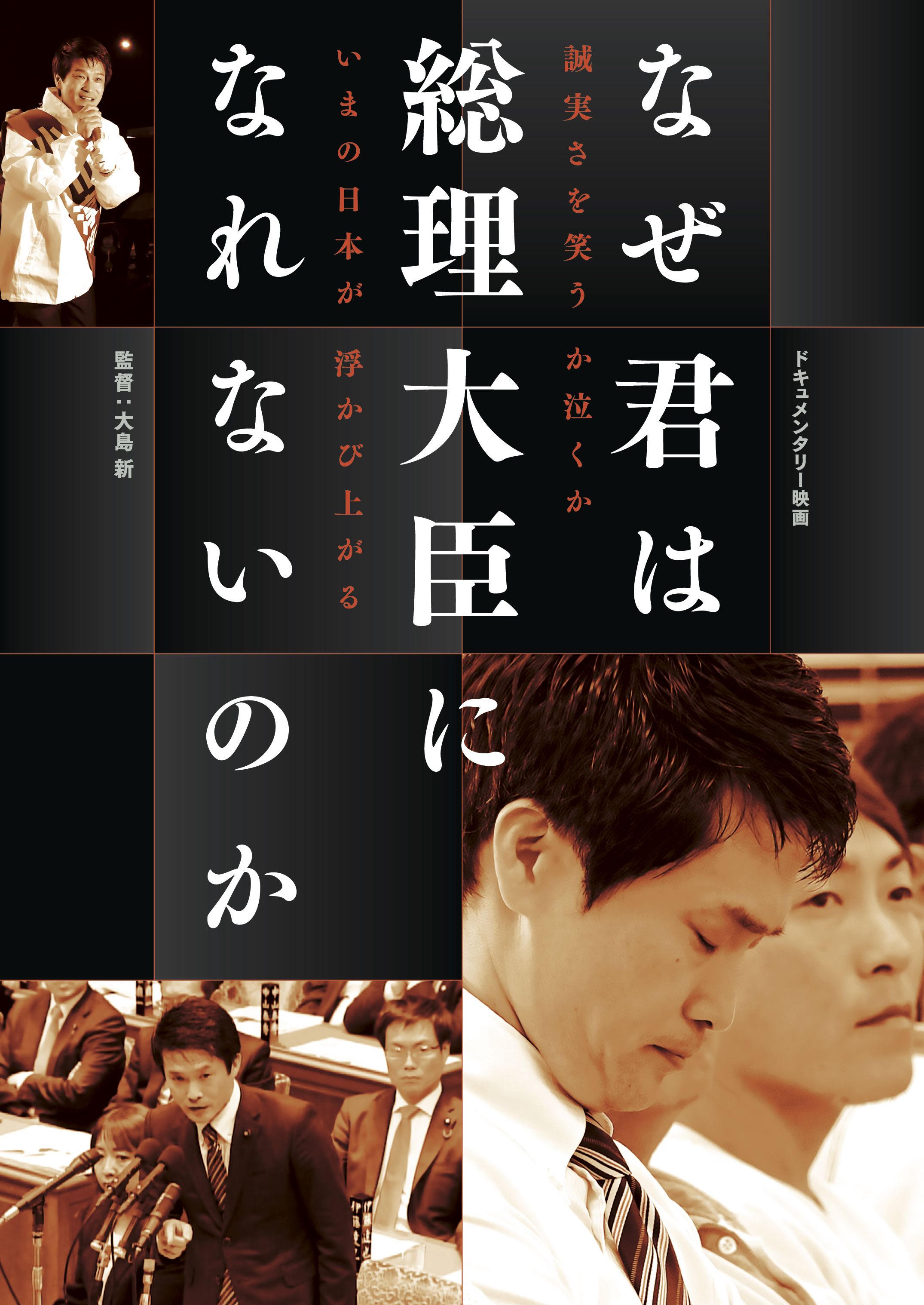
Why You Can’t Be Prime Minister (なぜ君は総理大臣になれないのか, Arata Oshima, 2020)

When Shinzo Abe stepped down in September 2020 citing a recurrence of the chronic illness which had caused him to resign from the same position in 2007 he did so as Japan’s longest serving prime minster having held the post since 2012. The centre-right Liberal Democratic Party has rarely been out of power since its foundation in 1955 though the opposition Democratic Party of Japan did achieve a minor breakthrough in the 2009 election only to lose out again in 2012, its reputation tarnished by a perception that it had not done enough during the 2011 earthquake and tsunami crisis. 

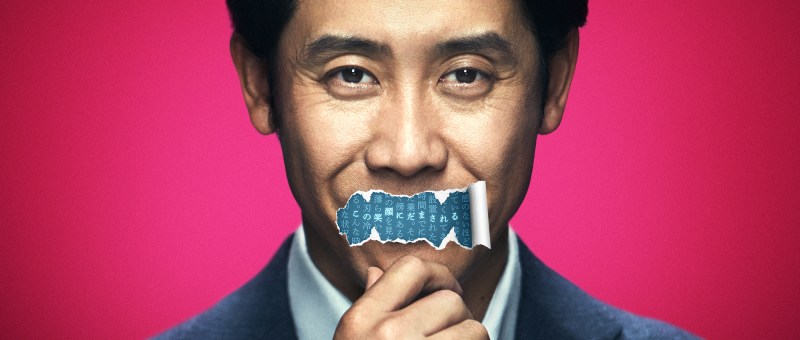
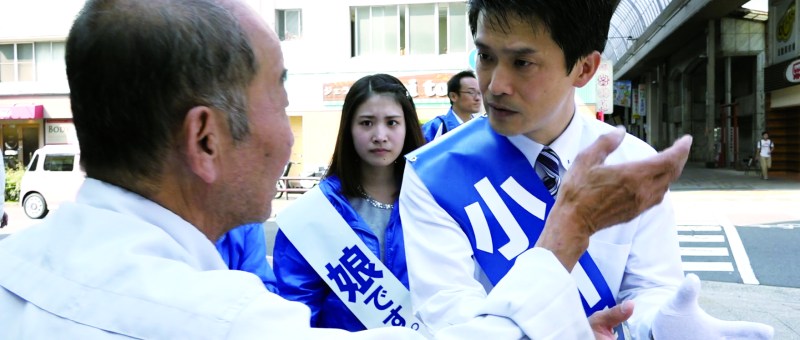
This is the background which informs Arata Oshima’s probing documentary Why You Can’t Be Prime Minster (なぜ君は総理大臣になれないのか, Naze Kimi wa Soridaijin ni Narenai no ka) which follows idealistic politician Junya Ogawa over 17 years from his beginnings as a 32-year-old former bureaucrat standing on a platform of integrity in politics, to a no less idealistic yet perhaps weary middle-aged man now sitting as an “independent” representative. Oshima perhaps partly answers the central question in a lengthy series of opening titles attempting to explain Japan’s rather complicated electoral system which operates both first past the post and proportional representation components. Although mitigated by the additional proportional representation list seats, just as in the UK Japan’s political system remains biased towards the centre-right by virtue of the fact that the leftwing vote is split between a number of different parties. As Oshima also points out, Ogawa’s rival for a first past the post seat is a dynastic candidate whose family is prominent in the local area. 

The other problem, if you want to call it that, is Ogawa’s essential personality and (near) unshakeable idealism. He stands on a platform of integrity in politics in which politicians should be accountable to the people they serve believing that the government has become overly complacent and forgotten about the lives of everyday citizens, the Abe regime famously focussing on their key concerns such as constitutional reform and the military. As such he watches as his more ruthless colleagues surge ahead of him, local rival Tamaki always managing to secure a first past the post seat by playing the political game while he scrapes through on the reserve list. Yet later he makes a fatal mistake, allowing himself to be persuaded to join Yuriko Koike’s Party of Hope after the proposed merger with the DP during the 2017 election. Current governor of Tokyo, Koike is a prominent figure on the conservative scene and member of the ultra-nationalist Nippon Kaigi. It’s not surprising that many of Ogawa’s supporters felt disappointed and betrayed on his decision to follow his mentor Maehara, on the right of the DP, and join the new party which could not credibly claim to reflect the values he’d hitherto espoused while even those accepting his logic that he was simply lending his voice to a unified anti-Abe coalition were put off by Koike’s duplicity in immediately walking back on earlier promises by announcing she would not accept all DP members into the Party of Hope.

“Your face is pretty but your heart is black” is just one of the many comments he receives from disappointed voters while out canvassing, another actively distancing herself from him before angrily remarking that he should have joined the CDP, a rival leftwing party set up by a former DP member Edano which promised to accept anyone who wanted to join. Yet the problem might not be so much the party as Ogawa’s inner conflict, wrestling with himself that he should have stood as an independent even if acknowledging he would have had a much harder time campaigning with no party backing him. His decision obviously conflicts with his pledge of integrity, a broken promise it will prove extremely hard to overcome while his secondary battle is and always will be legacy of the DP’s failure in government leaving many to assume only the LDP is qualified to govern. Following the party’s electoral defeat he does indeed sit as an independent but obviously acknowledges that he has far less influence even than he had as a less powerful list seat representative. 

Ogawa himself attributes his inability to become prime minster by an arbitrary date he’d thrown out after the 2009 opposition win engendered a false sense of hope for long lasting political change to his lack of personal ambition unwilling to do whatever it takes to climb the ladder, preferring to pursue his political goals ahead of his own position. He describes himself as an “otaku of making Japan a better place” and brands himself a centrist while advocating for socialist policies such as a welfare state modelled on that seen in Scandinavia. His parents who along with his wife and children are very much involved in his campaigning wonder if he’s too “pure” for politics, that his inability to compromise is the reason he can’t gain a foothold in the political establishment yet he refuses to give up, later telling Oshima in an otherwise unnecessary Covid-themed coda that if he didn’t think he could be PM he’d stand down right away. Politics needs men like Ogawa, Oshima seems to say, but the electorate isn’t so sure.


Why You Can’t Be Prime Minister streams in the US until Sept. 2 as part of this year’s Japan Cuts.

Original trailer (English subtitles)
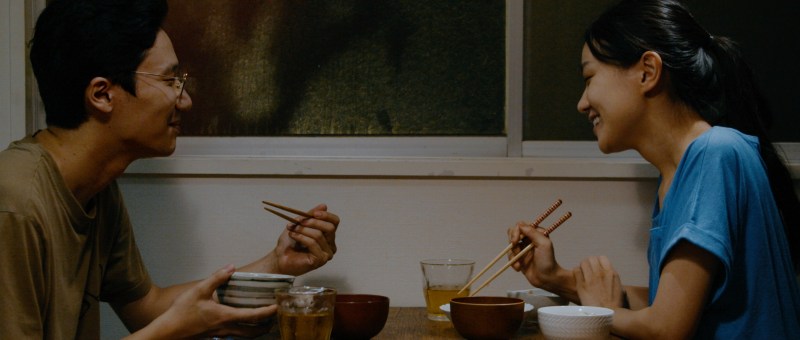
Mari and Mari (彼女来来, Tatsuya Yamanishi, 2021)

How well do you really know your significant other, and is it possible that even you can be lulled into a false sense of security by the performative qualities of your relationship? The befuddled hero of Tatsuya Yamanishi’s Mari and Mari (彼女来来, Kanojo Rairai) is forced to reckon with the superficialities of his romantic life when he arrives home one day to discover that his girlfriend is nowhere to be found and in her place is another woman with the same name who seems intent on occupying the space she has just vacated. 

Casting agent Norio (Kou Maehara) is in a longterm, actually rather nauseating in its sweetness, romantic relationship with girlfriend Mari (Nao). Despite being a well established, not yet married but might as well be cohabiting couple, they have their own little song they like to sing about how great their lives are with each other while taking romantic walking dates along the river where they look lovingly into each other’s eyes. “You’ve been together for ages, but you act like it’s a first date” one of Norio’s colleagues unironically remarks, seemingly a little envious. After moaning about a workplace setback, Norio suggests taking a trip while Mari points out that he’s always too busy for holidays but seems pleased just with the thought. 

For all these reasons, Norio is especially confused when he arrives home after a tough day and finds Mari gone, understandably mistaking the figure of a woman sleeping on their sofa for his girlfriend only to realise his error when she gets up and turns around, the low evening light finally hitting her face. The woman, who is apparently also named “Mari” (Hana Amano) claims to have no memory of her life before waking up on the sofa, and declaring herself homeless announces that she’s moving in. Extremely confused, Norio embarks on a quest to try and out what’s happened to Mari but discovers few leads. Even her sister seems relatively unconcerned, certain that she’s just blowing off steam bringing up a childhood incident in which she “ran away” to stay with a friend whose family ran a sweetshop because she had a sweet tooth and they weren’t allowed sweets at home. 

This relatively innocent story perhaps highlights the possibility of cracks in Norio’s “perfect” relationship, that “Mari 1” might have been feeling the lack of something and has gone off to find it. Though we’re told that Norio and Mari had been happily coupled for some years, a surprise visit from Norio’s parents reveals they’d never met his longterm girlfriend which does indeed seem odd if the relationship is as serious and loved up as it seemed to be. The plot thickens further when he visits the bookstore where Mari was working and is told she quit her job a few days previously having said nothing to him. You have to wonder if Mari 2 is actually real or a merely a manifestation of his inability to accept the fact that his relationship has failed and his girlfriend has moved on. 

Could Norio be guilty of treating his romantic life like one of his auditions, simply slotting in a woman who looks the part to play the role of “girlfriend”? Maybe Mari 1 was so wrapped up in her relationship that she didn’t have any friends, but Norio doesn’t contact any outside of her sister and appears not to know very much about her interior life. He also appears oblivious to a sweet intern at the office, his work life beginning to suffer while he remains preoccupied with Mari 1’s disappearance, who seems to have a crush on him until becoming unexpectedly jealous on spotting her in a clinch with another coworker in the darkened break room. Missing Mari 1 he repeatedly rebuffs Mari 2, attempting to throw her out of his apartment and rejecting each of her attempts to get close to him but eventually warms to her presence and finally allows her to take Mari 1’s place as his live-in girlfriend. 

Are Mari 1 and Mari 2 interchangeable to him? His brief comment that Mari 1 looked like another person under different light hints at a slight fluidity in the nature of her identity, as does the repeated motif of the sunlight climbing towards her face in their darkened bedroom. Then again, could the memory of Mari 1 merely be the intrusive ghost of failed love that disrupts his subsequent relationships, suggesting that his relationship with Mari 2 is doomed to failure because of his obsession with the one who literally got away. Or are Mari 1 & Mari 2 actually the same and a reflection of the way people can sometimes change or you learn something new about them and they seem like a completely different person? Perhaps “Mari” is just a signifier for romantic partner, otherwise devoid of an individual identity. What seems clear at least is that Norio does not “see” the woman in his life because he only sees “Mari”, as the slightly melancholy, intensely lonely look on the face of the woman next to him at the film’s conclusion may seem to suggest. 


Mari and Mari streams in the US until Sept. 2 as part of this year’s Japan Cuts.

International trailer (English subtitles)

Caution, Hazardous Wife: The Movie (奥様は、取り扱い注意, Toya Sato, 2021) [Fantasia 2021]

Perhaps in some ways out of step with the times, the 2017 Nippon TV drama Caution, Hazardous Wife (奥様は、取り扱い注意, Okusama wa, Toriatsukai Chui), like the earlier Secret Agent Erika, saw top assassin Nami (Haruka Ayase) fake her own death in order to live a “normal” life as an “ordinary housewife” married to “boring salaryman” Yuki (Hidetoshi Nishijima). Nami could not however resist using her skills for good and bravely took on a local yakuza gang who’d been running a suburban prostitution ring through employing handsome gigolos to seduce emotionally neglected housewives and thereafter blackmailing them into sex work. The series ended on a cliffhanger in which, spoiler alert, Nami was confronted by her husband who turned out to be a Public Security Bureau officer originally tasked with monitoring her before genuinely falling in love.

This brief background recap is useful but not strictly necessary in approaching the series’ big screen incarnation, Caution, Hazardous Wife: The Movie, which ironically assumes the audience knows Nami’s secret backstory but also obfuscates it in picking up 18 months after the cliffhanger to find her now living as “Kumi” in a tranquil seaside town having apparently lost her memory. The town will not remain tranquil for long, however, as a mayoral race is about to bring tensions to the fore in the polarising issue of a prospective methane hydrate plant the authorities insist is necessary to revive the area’s moribund economy while others worry about industrial pollution and its effects on the local sea life. Unsurprisingly, the events will turn out to have a connection to Nami’s past while she struggles to regain her lost memories and preserve the peaceful, ordinary life with her husband which is all she’s ever really wanted. 

Though some might find it somewhat conservative that what Nami wants is to become a conventional housewife, what she’s looking for is the stability of the “normal” life she’s never known. As such, she may not actually want to regain her memories, preferring to go on living as Kumi who has perfected the housewife skills which so eluded Nami including becoming a top cook, for as long as possible. Yuki, meanwhile, now living as high school teacher Yuji, feels something similar having been ordered to “deal with” his wife if she remembers who she is but refuses to become a PSB asset. 

Upping production values from the TV drama, Sato keeps Nami in the dark for as long as possible though her sense of social responsibility remains just as strong as she bravely intervenes when coming across a gang of teens taunting a boy with homophobic slurs for having a pink coin curse, later becoming concerned on witnessing the leader of the opposition to the plant being attacked by thugs in an attempt to intimidate him out of his decision to stand as a rival candidate to the incumbent mayor. Nevertheless, he allows space for plenty of dramatic action scenes including flashbacks to Nami’s career as an international assassin while the final set piece also throws in some bickering marital comedy before turning unexpectedly dark.  

Regaining her memories, Nami’s inner conflict is in her complicated relationship with Yuki wondering if he ever really loved the “real” her or if he perhaps preferred Kumi the docile Stepford wife, which is ironically the cover identity she’d longed to construct. Conflicted and suspecting his wife may have remembered who she really is, Yuki tells her to forget about the past but also that his feelings won’t change and she should be free to be herself but as Nami later realises the past won’t let her go and the peaceful life she’d dreamed of might be harder to preserve than she’d previously thought even as she commits herself to embracing the life she has now because her relationship with Yuki is the most important thing to her despite her lingering doubt. 

Touching on a few hot button issues from industrial pollution and environmental concerns to economic decline and rural depopulation, Sato nevertheless returns to the outlandish absurdity of the TV drama as Nami finds herself facing off against Russian gangsters while exposing a plot by shady conglomerates to exploit a small-town desire for better access to jobs and infrastructure, along with judicial corruption and electoral interference. Nevertheless, the hometown spirit eventually wins out even if Nami finds herself on the run once again though having gained a little more emotional clarity. 


Caution, Hazardous Wife: The Movie streamed as part of this year’s Fantasia International Film Festival. The original TV series is also available to stream with English subtitles (along with those in several other languages) in many territories via Viki.

International trailer (English subtitles)

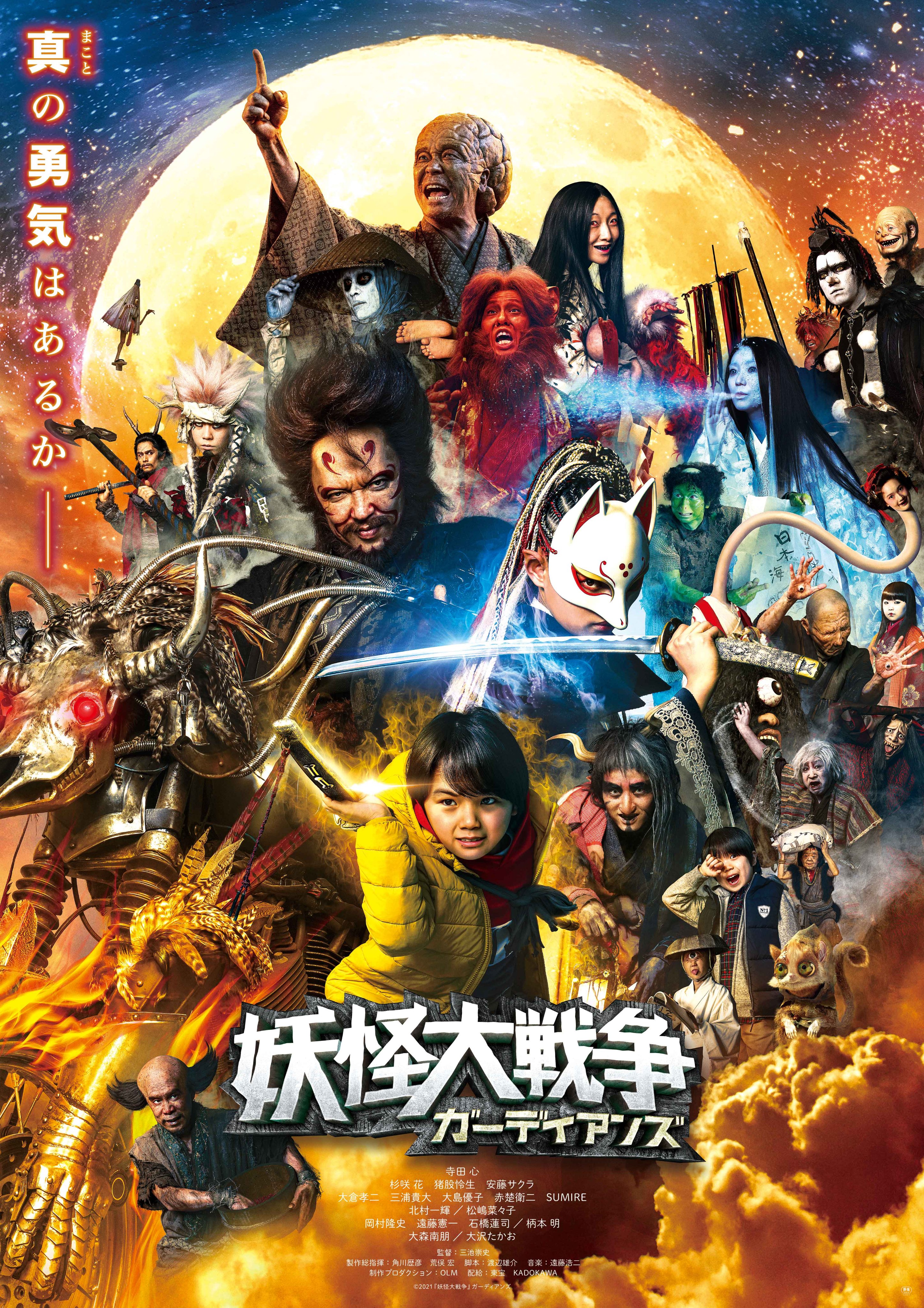
The Great Yokai War: Guardians (妖怪大戦争 ガーディアンズ, Takashi Miike, 2021)

An anxious little boy struggling with his growing responsibility finds himself charged with saving the world in Takashi Miike’s return to the realms of folklore, Great Yokai War: Guardians (妖怪大戦争 ガーディアンズ, Yokai Daisenso Guardians). Not quite a sequel to the 2005 supernatural drama, Guardians once stars a child hero trying to come to terms with his place in the world, but this time takes on another dimension as the pint-sized hero determines to embrace his “humanity” through the very qualities the yokai fear are largely absent among those who “kill and cheat their own kind”. 

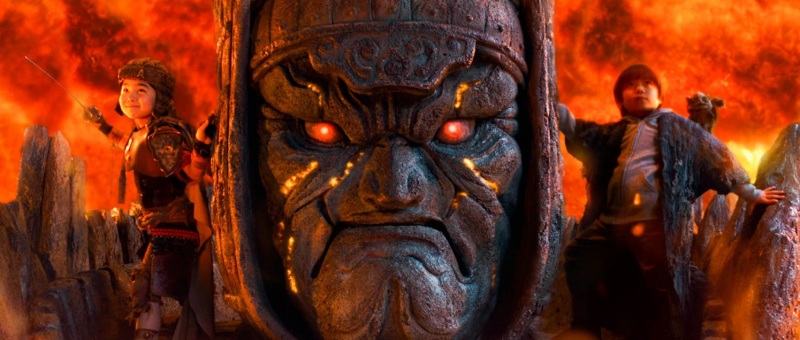
Young Kei (Kokoro Terada) has recently lost his father and as the oldest child has gained an additional responsibility especially towards his younger brother, Dai (Rei Inomata). The other children meanwhile think of him as a scaredy-cat, a small gang of them exploring a disused shrine from which they each pick a fortune from a small box, Kei’s being an ominous red sheet otherwise blank. While Kei had hesitated to enter, Dai did as he was told and waited outside but longed to be included, excited rather than frightened by the creepy old buildings. Later that night, Kei is woken up by a scary yokai leaning over him in bed, covering up one eye so he can see him. Running away in fright the boy finds himself in another world, surrounded by dozens more scary yokai who tell him he’s the descendent of a legendary Edo-era yokai hunter and it’s time for him to accept his destiny by helping the yokai avoid disaster. It just so happens that a bunch of sea creatures trapped underneath a fault line have banded together in a huge ball of resentment that is currently barreling towards Tokyo. The yokai are particularly worried that the monster which they’ve named “Yokaiju” (see what they did there?) will break the seal over the city and release a nameless evil. 

The yokai first tried asking for help among themselves at the “Yammit” or Yokai Summit recently held in Beijing at which supernatural monsters from across the world including vampires, mermaids, and even Bigfoot meet, but were roundly rebuffed. Japanese yokai rarely carry weapons, and they’ve already tried asking Yokaiju nicely not to destroy Tokyo, so they need some help. The yokai that that Kei encounters are mostly of the harmless kind like the guy who just stands around holding tofu or the one who creepily washes azuki beans at inappropriate moments, what they want Kei to do is help them wake up General Bujin, the god war, though others fear the cure may be worse than the disease. Some yokai are even of the opinion that letting Yokaiju run riot is no big deal because humans are generally awful anyway and so deserve little sympathy. 

Little Kei, however, is a counter to their argument. They constantly ask him if he really has the courage to carry his mission through, even at one point taking his brother Dai instead, while Kei struggles with himself understandably afraid of his new destiny. Back in the “real” world, he is of course entirely anxious about his responsibilities as a “big brother” now that his father’s no longer around and especially as his mother is a nurse meaning she often has to work late helping other people. He is however determined to keep his promise to look after Dai, mustering all his courage to push through the scary world of monsters to save him from being sacrificed to General Bujin. He also acts with kindness and generosity of spirit, even on being betrayed by a yokai expressing only sympathy that he’s glad the lonely monster turned out to have more friends than he thought, while also making a point of stopping to save even the bad demons who were trying to kill him after they’re trapped by rockfall because “you can’t just leave a suffering person”. 

Kei’s solution is, ultimately, love not war. Faced with the giant resentment monster he chooses to soothe its pain, teaching the yokai a thing or two about themselves as they rediscover their ancient capacity for compassion and forgiveness. It’s the brothers’ love for each other which eventually saves the world, leading even the most cynical of yokai to hope that the spirit of kindness in this generation might be enough to bring about a human revolution. A good old-fashioned family adventure, Guardians’ charmingly grotesque production design and childlike view of the twilight world of spirits and demons carries genuine magic while its wholesome messages of kindness, acceptance, and personal responsibility can’t help but warm the hardest of hearts. 


The Great Yokai War: Guardians screens on Aug. 28 and Sept. 1 as part of this year’s Japan Cuts.

Original trailer (no subtitles)

Wife of a Spy (スパイの妻, Kiyoshi Kurosawa, 2020)

“If the times have changed you, couldn’t you have changed the times?” the spy’s wife not unreasonably asks of a man she knew to be good and kind yet has done terrible things, perhaps, as has she, out of a misplaced love. Travelling from death is eternal loneliness to love is our salvation, Kiyoshi Kurosawa’s Wife of a Spy (スパイの妻, Spy no Tsuma), co-scripted by Ryusuke Hamaguchi and Tadashi Nohara, picks up a thread from Before We Vanish TV companion Yocho (Foreboding) to suggest that love can in fact be as destructive as hate in its all encompassing single-mindedness as an ordinary housewife uninterested in politics is caught between her progressive, compassionate and aristocratic husband and a childhood friend with an unrequited crush who has since become an ardent militarist. 

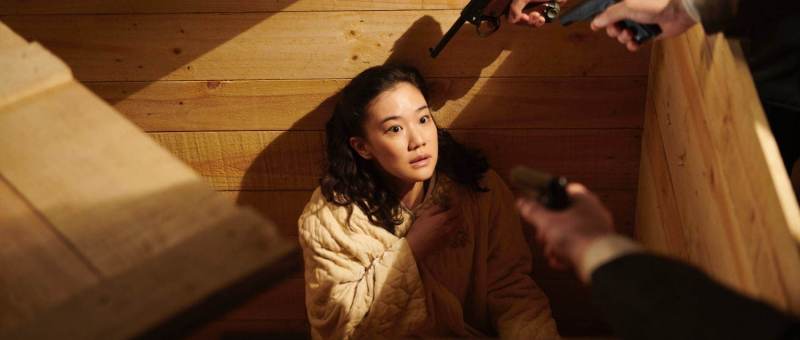
Set in Kobe in 1940, the film opens with a portly British textile merchant, Drummond, dragged from a silk inspection centre by the military police on the suspicion of being a foreign spy. This is appears not to be the case, but as in much of the narrative little is as it seems. The British merchant is a friend and associate of Yusaku Fukuhara (Issey Takahashi), the chairman of a family-owned textile company whose main objection to the idea that Drummond is a spy seems to be that a man of such copious proportions hardly fits his mental image of the word. Yusaku is nevertheless questioned by the local squad leader, Taiji (Masahiro Higashide), who happens to be a childhood friend of his wife Satoko (Yu Aoi), and later risks implication by paying Drummond’s bail. Satoko approves of this decision even if it may be politically unwise, confessing that she thought it “heartless” that Yusaku was messing about making a silent movie in which she starred as a femme fatale spy eventually killed by her lover/rival while his friend was in custody. “You’re always looking so far ahead of me, I feel like a fool” she reflects though as we’ll see she’ll soon be taking him on at his own game, the couple dancing around each other in a deadly waltz of love and betrayal. 

When Yusaku declares that he’s planning to visit Manchuria, partly for adventure and partly on behalf of a doctor friend, Satoko’s main concern is his impending absence though his return brings her little peace. After a woman he and his nephew Fumio (Ryota Bando) had apparently befriended and then brought home is found dead, Satoko makes a dark discovery driven at once by jealousy in Taiji’s vague hints that Yusaku may have been romantically involved with the dead woman, and resentment in realising he is keeping something from her. That something turns out to be his intention to expose the atrocities he witnessed in Manchuria committed by doctors connected to the Kwantung Army. 

Yusaku’s motives for this are rather naive, believing that it will bring the Americans into the war and hasten a Japanese defeat bringing an end to the militarist folly. Nevertheless, the discovery forces the couple into an ideological confrontation, Yusaku insisting that he is a “cosmopolitan” whose allegiance lies in “universal justice” rather to than any nation. To him happiness founded on injustice is an impossibility, while Satoko declares herself able to unsee the inconvenient truth in order to preserve the status quo reasonably pointing out that Yusaku’s “justice” will necessarily result in the deaths of thousands of innocent people. It’s at this point, however, that the tables turn, Satoko setting in motion a series of machinations which at first appear naive and counterproductive but are in fact infinitely ruthless. 

“I’m not afraid of capture or death, I’m only afraid of being separated from you” Satoko insists, willing to burn the world to save her love if also later moved on “seeing” for herself the reality of Japanese abuses in Manchuria. Taking on the role she had played in their silent movie, Satoko becomes the spy revelling in her ruthlessness yet this spy game revolves around the ability to correctly read the emotional lives of others. Having been “warned” by the austere Taiji that she and her husband were too Westernised for the times with their expensive foreign whiskey and international fashions, Satoko puts on kimono in order to curry favour with him hoping to leverage his unrequited love for her. Yusaku meanwhile perhaps banks on something similar, each of them ironically manipulating the apparently conflicted militarist in the conviction that his love is pure and he will therefore continue to protect Satoko, and by extension her husband, as a means of protecting himself. 

Early on, Taiji had confessed to Yusaku that he disliked arresting people which may have been a thinly veiled threat, but also bears out Satoko’s conviction that he is at heart a gentle person though we’ve not long seen him rip out one man’s fingernails in order to present them to another as a warning. Unrequited love has perhaps thrown him into the arms of militarist austerity, hardening his heart while his ardour is sublimated into a misplaced love of country that allows him to justify such heinous acts of inhumanity.  “Hard choices must be made to achieve greet deeds” Satoko herself had said in order to excuse her own act of injustice in sacrificing another man on Yusaku’s behalf, only to later face the same fate in an ironic turn of events either vengeful betrayal or protective act of love depending on how you read the emotional intentions behind them. 

Just as in the silent movie, incongruously scored with a poignant Japanese cover of Jerome Kern & Oscar Hammerstein II’s Make Believe, everyone is playing a role, engaging in an act of deception if only self-directed, yet their act perhaps exposes the truth they were attempting to hide, the spy’s wife becoming the spy but beaten at her own game unable to see the entirety of the board. Commissioned as an 8K feature for a Japanese TV channel, the incongruity of the hyperreal digital photography deepens the sense of the uncanny in the unexpected naturalism of the period setting, a world of constant anxiety with soldiers on the streets and the feeling of being forever watched in the oppressive atmosphere of authoritarian militarism, while standing in strong contrast with the unreality presented by the films within the film both that made by the couple and the brief yet ironic inclusion of Sadao Yamanaka’s Priest of Darkness, another tale of infinite duplicities, given that the director had himself become a casualty of war on the Manchurian front two years previously. Ironically titled, Wife of a Spy situates itself in a state of permanent paranoia in which nothing and no-one is as it seems and love may in its own way be the most destructive force of all while containing within itself the only possible source of salvation no matter its veracity.  


Wife of a Spy  screens on Aug. 27 as part of this year’s Japan Cuts.

International trailer (English subtitles)

Karisome no Koi (“fleeting love”) – Chiyoko Kobayashi (1936)

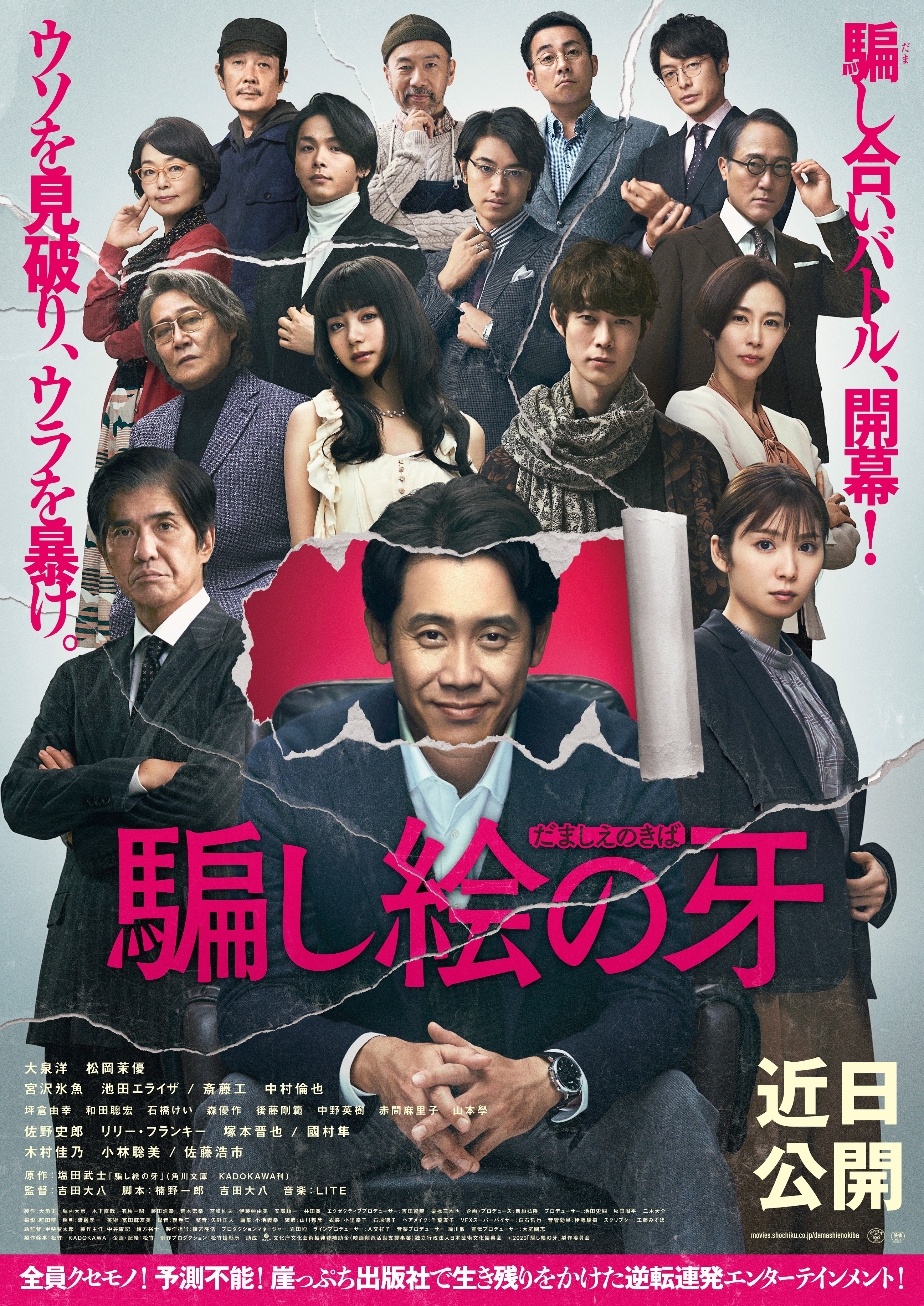
Kiba: The Fangs of Fiction (騙し絵の牙, Daihachi Yoshida, 2020)

“Landscapes don’t stay the same” laments a young woman in Daihachi Yoshida’s slick corporate drama, Kiba: The Fangs of Fiction (騙し絵の牙, Damashie No Kiba), though the more things change the more they stay the same and the push and pull of traditionalists and modernisers seems set to be an unending battle. If someone were brave enough to think of it, there may be a third way, but one thing is clear – it’s adapt or die for the printed word and the real war is over who makes it onto the page and how they do it. 

When the CEO of a major family-owned publishing house dies of a heart attack while walking his dog, it throws the entire industry into disarray and even makes it onto the national news where pundits discuss who might be most likely to succeed while pointing out that publishing is already in crisis seeing as most novels are serialised in literary journals and magazine readership is on its way out. Earnest editor Megumi (Mayu Matsuoka) is forever told that old and new is a false dichotomy and in some ways it may be, but century-old literary journal Kunpu Review is quite clearly mired in a traditionalist past woefully out of touch with contemporary society. 

This Megumi learns to her cost when pulled straight from the CEO’s funeral to a 40th anniversary event marking the debut of their best-selling author Daisaku Nikaido (Jun Kunimura). Encouraged by rival editor Hayami (Yo Oizumi), she gives her honest opinion on Nikaido’s work pulling him up on the latent sexism in his novels by suggesting his sexual politics are at best old-fashioned. This is of course a huge faux pas and a moment of minor embarrassment for all concerned, though it will also become a repeated motif Megumi again trying to bring up a younger author on his subpar portrayal of women but finding her concerns falling on deaf ears. 

Part of the problem is that authors, and particularly well-established ones, rarely undergo a rigorous editing process such as they might outside of Japan. Kunpu is so desperate to keep Nikaido on side that they treat him as a mini god, wasting vast amounts of their budget expensing him for “research” holidays and a healthy interest in fine wines. They simply wouldn’t have the courage to tell him that his drafts are improvable or that elements of his writing may cause offence. 

Hayami, the tricky editor of rival culture mag Trinity, is by contrast deliberately looking for the modern but in other ways is not so different from Kunpu. Poaching an up and coming author Megumi had pitched but was rejected, Hayami embarks on an elaborate PR campaign casting the young and handsome Yajiro (Hio Miyazawa) as a literary idol star. But Yajiro seems to be uncomfortable with the attention, unprepared to deal with demands of being a prominent writer and resenting Hayami’s attempts to manipulate his image by forcing him into photoshoots dressed in outfits he would never wear. Hayami also engineers a publicity stunt implying Yajiro is in a relationship with his other protege, a young model and unexpected firearms enthusiast (Elaiza Ikeda) who is later arrested after shooting a stalker with a homemade pistol. 

What happens to Saki Jojima is either an unintended consequence or direct result of Hayami’s inability to fully control the situation, but it also creates both crisis and opportunity for Trininty when Hayami breaks protocol and decides to run Saki’s issue rather than pulling it entirely with an apology as is usual in Japan when a celebrity is the subject of scandal. This places him in direct opposition to the traditionalist Kunpu, horrified and insistent that his decision stains the integrity of the publishing house. Like Hayami, however, new CEO Tomatsu (Koichi Sato) is determined to do things differently and prepared to take a gamble, secretly working on his own plan to streamline the business and build their own production/distribution facility in Yokohama. 

Everyone is so absorbed in their own plotting that they fail to notice others plotting around them. Megumi, meanwhile, is preoccupied with the survival of her father’s old-fashioned book shop which itself badly needs another literary hit because half the customers are kids who come in to browse the manga and then download the good ones when they get home. One young woman looking for a particular novel even explains that she only wants to read it because there’s no movie or drama adaptation. With all this finagling, it’s easy to think everyone’s forgotten about the books while Megumi desperately tries to get someone to let her do some actual editing because they’re all too busy mollycoddling their authors. Nevertheless there’s more to the Kunpu vs Trinity battle than it first seems as they vie for the future of Japan’s publishing industry little suspecting that there may be another contender with a less acrimonious solution. “If something could be updated it should be” Megumi insists, a sentiment which apparently goes both for dinosaur writers unwilling to reckon with their latent misogyny and the book business itself. 

Once again adapting a literary source, Yoshida’s gentle farce quietly builds the tension with courtly intrigue as the wider society remains rapt over the succession crisis at a publishing firm while its ambitious courtiers plot amongst themselves in order to steal the throne. Casting Yo Oizumi in the role he apparently inspired in the book is another masterstroke of meta commentary as his thrill-seeking manipulator plays the long game but even if the prognosis for Japan’s publishing industry may be bleak there is unexpected glee to be had in the eventual triumph of a righteous underdog over a thoroughbred plotter. 


Kiba: The Fangs of Fiction screens on Aug. 26 and 28 as part of this year’s Japan Cuts.

Original trailer (English subtitles)
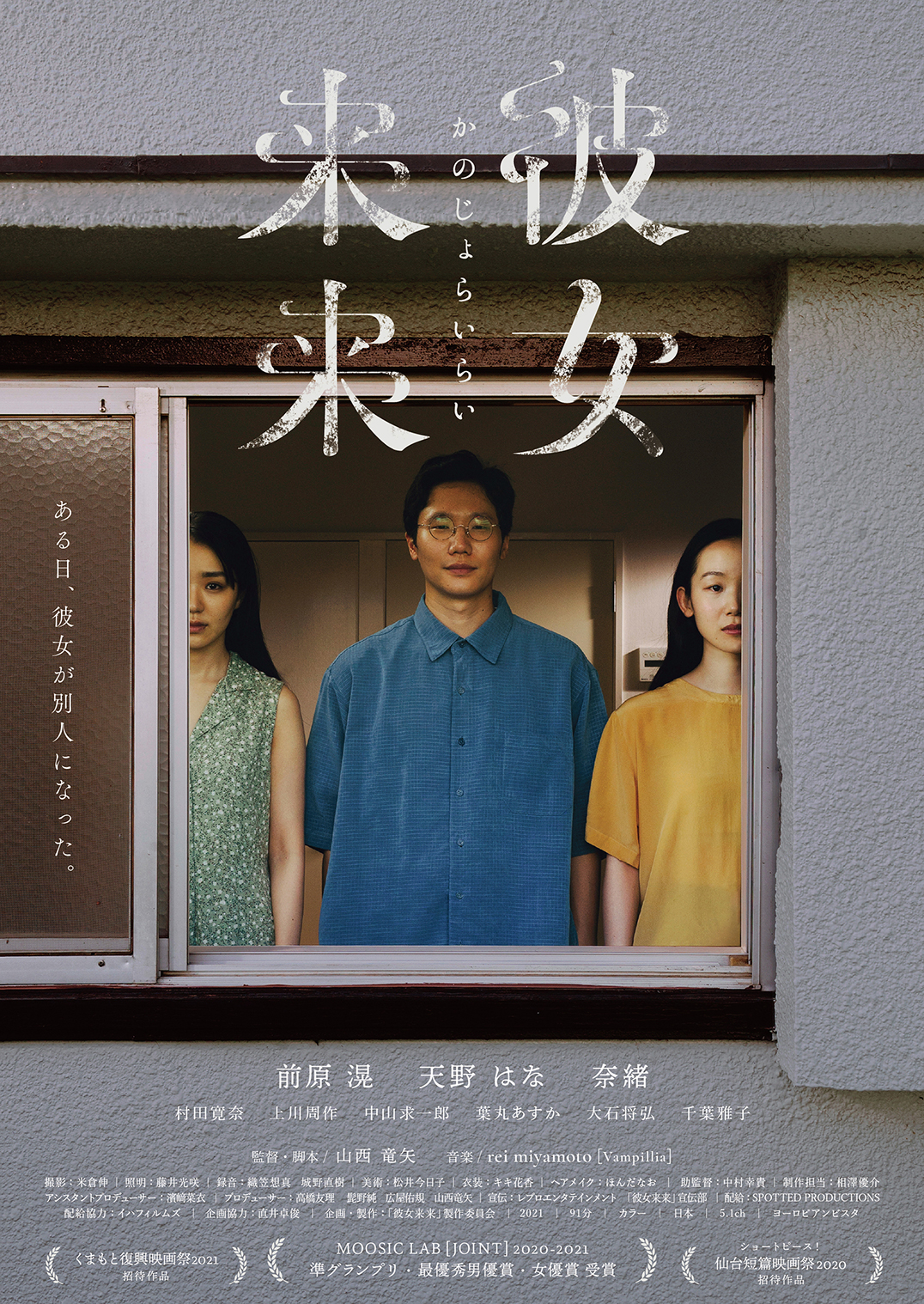
The Pass: Last Days of the Samurai (峠 最後のサムライ, Takashi Koizumi, 2021)

“Even with 100 plans and 100 ideas, we cannot defeat the march of progress” a progressive samurai admits, well aware that he’s witnessing the end of his era while knowing that the “thrilling future” that lies ahead will have no place for him. Adapted from the novel by Ryotaro Shiba, The Pass: Last Days of the Samurai (峠 最後のサムライ, Toge: Saigo no Samurai) is inspired by the life of Kawai Tsugunosuke, known as the “Last Samurai” for his steadfast embodiment of the samurai ideal during the chaos of the Bakumatsu and subsequent Boshin War

As the opening voiceover from Tsugunosuke’s wife Osuga (Takako Matsu) explains, the Tokugawa Shogunate had ruled Japan for close to 300 years after bringing the warring states era to an end following the Battle of Sekigahara, placing the nation into a period of enforced isolation which by the 1850s was beginning to crack while resentment towards the Tokugawa continued to grow over their handling of access to foreign trade. In 1867, Tokugawa Yoshinobu (Masahiro Higashide) effectively relinquished his monopoly on power and restored ultimate authority to the emperor (the “Meiji Restoration”). Yet if he hoped his decision would both restore peace and allow the Tokugawa to maintain political influence he was quite mistaken. In the immediate wake of this political earthquake the nation became polarised between those in favour of imperial rule and those who remained loyal to the Shogunate. 

The chief retainer in Nagaoka, Tsugunosuke (Koji Yakusho) finds himself in an impossible position caught between the forces of East and West and essentially unable to pick a side because of the demands of samurai loyalty. Fearing another war would prove disastrous, he chooses neutrality certain that the present conflict cannot be resolved militarily and requires a political solution. To this effect he attempts to petition a delegation from the Western, pro-emperor, pro-modernisation army but his pleas fall on deaf ears and lead only to a rebuke that he is a coward and a traitor. Like any good leader, however, Tsugunosuke has also been preparing for the worst, buying a gatling gun from foreign dealers in order to boost his meagre man power eventually realising they have no other option than to go war 

The irony is that Tsugunosuke tacitly supports imperial rule but cannot say so because his clan is closely affiliated with the Tokugawa. He is well aware that his era has come to a close and that he will not live to see the new Japan, knowing that he is man of the old world and cannot progress into the classless society he is certain is coming. For all that he seems to be excited by the promises of revolution, encouraging the son of a friend to take advantage of the freedoms of a new era while dreaming of foreign travel and advocating for “liberty and rights” along with universal education in the hope of building of a better society. 

Yet for himself he cannot let go of samurai ideals, knowing he must fight a pointless war in which he does not believe because honour dictates it. “If it shows future generations what we samurai truly stood for then this battle will have been worthwhile” he tells a friend, fearful of a future dominated by the clans of Satsuma and Choshu. “Your samurai spirit will encourage countless others” another retainer tells him, “you are our ideal”, touched by his stoicism and grace even in defeat as he takes sole responsibility for the failure of their military campaign caused in part by the betrayal of a defecting ally. “This warriors’ way shall die with me” he cheerfully tells a servant, advising him to become a merchant and travel abroad to seize the “thrilling future” which lies ahead of him. 

A martyr to his age, Tsugunosuke is the last of the samurai stoically defending a lofty ideal in an acknowledgement that he does not belong in the new society and must sacrifice himself in order to bring it about. An homage to classic samurai cinema from former Akira Kurosawa AD Takashi Koizumi, who even throws in the odd screen wipe, featuring cameos from golden age stars Tatsuya Nakadai and Kyoko Kagawa, The Pass is about the passage from one era to the next taking as its hero a closet revolutionary and walking embodiment of the idealised samurai who chooses unity and shared vision over conflict in the creation of a better world he does not intend to live to see.


The Pass: Last Days of the Samurai screens on Aug. 21 and Sept. 1 as part of this year’s Japan Cuts.

Original trailer (English subtitles)
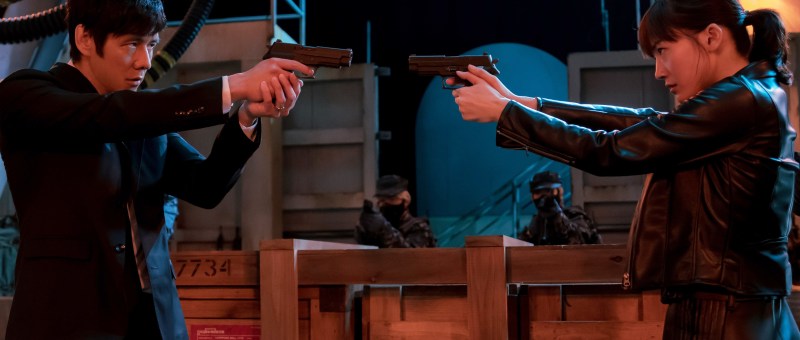
Remain In Twilight (くれなずめ, Daigo Matsui, 2021) [Fantasia 2021]

“So what? We just live on.” remarks a bereaved young man learning to let go of his grief in Daigo Matsui’s melancholy ensemble drama Remain in Twilight (くれなずめ, Kurenazume). Matsui sets the scene at a wedding which is also in some ways a funeral during which the ghost at the feast will eventually be laid to rest but his study in loss is also a reflection of its eternal arrest as a group of high school friends learn to accept a sense of absence where their friend used to stand while processing the various ways their lives have and will continue to diverge where as his obviously will not. 

As the film opens a group of six men is surveying a wedding hall where they intend to recreate a dance they first performed at a high school culture festival. The wedding co-ordinator comes out to confirm that everything is in order and seating has been arranged for the five of them only to be reminded that actually they are six. Factory worker Nej (Rikki Metsugi) wants to hang out longer, but most of the other guys have other commitments from work to family but at a rambunctious karaoke session the next day during which they regress to their high school selves it becomes clear that one of their number, Yoshio (Ryo Narita), passed away five years previously but is quite literally there in spirit. 

In addition to Yoshio’s absence, it’s clear that the group has become distant since their high school days the wedding reunion highlighting the class differences between them with some going on to regular salaryman jobs, others working in fringe theatre, and Nej at the factory the uniform of which he is ubiquitously wearing at every occasion other than the wedding during which the guys’ black suits are identical to those they wore for the funeral save the substitution of a jauntier bow tie. The previously nicknamed “Sauce” is now Mr. Sogawa (Kenta Hamano) and a married father of one. They aren’t 17 anymore. 

Nevertheless, the guys can’t let go of the memory of Yoshio who remains among them as if he were still alive. Triggered by a seemingly trivial act such as eating a biscuit or hearing a particular turn of phrase each of the men is called back into the past towards a private memory of Yoshio some directly related to the performance at the cultural festival which seems to have marked their lives and others from later. They collectively meditate on the last time they saw each other, reliving the event, trying to prevent Yoshio from leaving but of course failing. Actor Akashi (Ryuya Wakaba) regrets not picking up his phone, little knowing it would be the last time he would see his friend because you can’t get away from the fact every time might be the last you just can’t know. 

“You’re only dead when it’s convenient” Yoshio’s high school crush Mikie (Atsuko Maeda) barks, seemingly unperturbed to see him in the flesh but also angry and resentful asking him to finally cancel his social media accounts so she won’t keep getting birthday reminders or see something about him popup on her feed, remember, and be sad. But softening she shows him a picture of her daughter, signalling that she’s moved on while he obviously cannot though he wishes her only happiness glad perhaps to have shared something he lacked the courage to confess while alive. 

So corporeal does Yoshio seem to be that he even receives a goodie bag from the wedding, again signalling his absence as the guys find themselves literally carrying extra baggage which they eventually decide to try burying leading to a rather surreal incident which confronts them directly with Yoshio’s liminal status and survival in their hearts. Travelling to the other side they begin to learn to let him go, poignantly once again considering calling a taxi though this time for five. Adapting stage play, Matsui’s sweeping handheld camera shifts effortlessly from one time period to another and finally into another realm with a giddy ethereality as the men, now approaching middle-age, meditate on the sense of loss in grieving teenage friendship along with its unlived future. It’s less the ghost than those who are left behind who must finally learn to “move on”, rewriting the past as they see fit in order to walk into a freer future. 


Remain In Twilight streams in Canada until Aug. 25 as part of this year’s Fantasia International Film Festival.

International trailer (English subtitles)

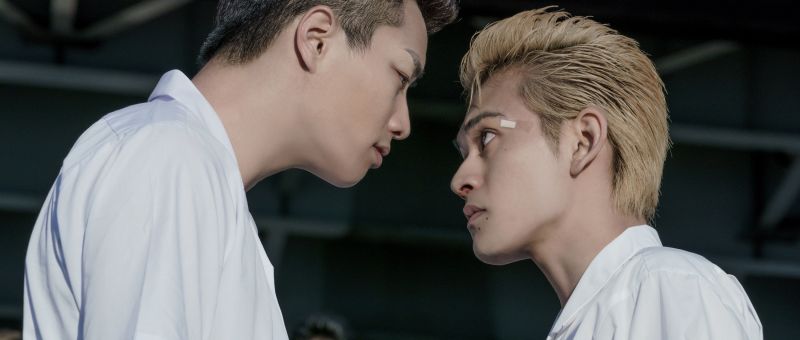
Tokyo Revengers (東京リベンジャーズ, Tsutomu Hanabusa, 2021) [Fantasia 2021]

“You don’t deserve to change my life” the hero of Tsutomu Hanabusa’s adaptation of Ken Wakui’s manga Tokyo Revengers (東京リベンジャーズ) eventually affirms in finally facing his fears while trying to change destiny not least his own. In contrast to its original meaning in English, the wasei eigo “Revenge” usually means not payback but “rematch” or at least a second chance to prove oneself or make up for a past mistake. Through his time travel shenanigans, this is perhaps what young Takemichi (Takumi Kitamura) is attempting to do in revisiting the events which he feels ruined his life and left him a useless coward too cowed to offer much resistance to his continual degradation. 

Now 27, Takemichi lives in a rundown, untidy apartment and works part-time in a bookstore where his boss inappropriately mocks for him for still being a virgin, the kind of guy who peaked in high school and can’t move on from adolescent bravado. He might have a point in a sense in that Takemichi is indeed arrested but hearing on the news one day that his first love Hinata (Mio Imada) has been killed in a car accident supposedly caused by the Tokyo Manji gang alongside her brother Naoto (Yosuke Sugino), he finds himself thinking back to his school days. It’s at this point that someone shoves him off a train platform and, facing certain death, he suddenly finds himself in the body of his 17-year-old, bleach blond delinquent self. Takemichi assumes it’s a near death flashback, but later wakes up back in the present and realises that his actions in the past have consequences in the future. 

Quite clearly taking its cues from classic high school delinquent manga in which moody high school boys vie for the top spot through relentless violence, Tokyo Revengers nevertheless undercuts the genre’s macho posturing in firstly having Takemichi broken by his first defeat and then allowing him to reclaim his space as a hero through his determination to care for and protect others even if his final victory is in facing the man he held responsible for shattering his sense of self. Sent back into the past to prevent the Tokyo Manji Gang from ever forming, Takemichi refuses the obvious early solution but remains conflicted in realising that at its inception “Toman” saw itself as a compassionate force for good, a far cry from the nihilistic violence it now brings to the city. Rather than more violence, he finds a solution in its reverse, safeguarding relationships and preventing heartbreak in order to ensure no one else’s soul is corrupted by grief or loneliness. 

Takemichi feels himself powerless but is valued by his friends for his determination to protect others no matter the cost to himself, as he unwittingly proves through his time travel adventures attempting to save himself as much as Hinata by restoring his sense of self apparently shattered by his subjugation at the hands of a rival gang back back in high school. At 27 he’s a meek and broken man, forever apologising for his existence and living an unfulfilling life always running away from challenge or difficulty. Given an improbable second chance, he begins to find the courage to do it all differently with the benefit of hindsight and the stability of age, finally facing his teenage trauma as a fully adult man.  

Like any good delinquent movie, Hanabusa makes space for more than a few mass brawls along with intensely personal one-on-one battles drawing a direct line between high school violence and street war thuggery. “Thugs aren’t cool anymore” Toman leader Mikey (Ryo Yoshizawa) had explained, his compassionate second in command Kenchin (Yuki Yamada) reminding him to “have a heart” in keeping gang violence within the confines of their society and refraining from injuring innocent people. Toman aren’t yakuza, but they are perhaps the inheritors of jingi, or at least would be if left untouched by trauma and betrayal. In beating his own trauma, Takemichi undoes his destiny saving his friends and himself by learning to embrace his inner strength and refusing to back down in the face of intimidation. Part high school delinquent manga, part time travel adventure, Hanabusa’s sci-fi-inflected drama swaps macho posturing for a more contemplative take on the weight of past mistakes while giving its hero a second chance to be the kind of man he always thought himself to be.


Tokyo Revengers screened as part of this year’s Fantasia International Film Festival.

Original trailer (English subtitles)

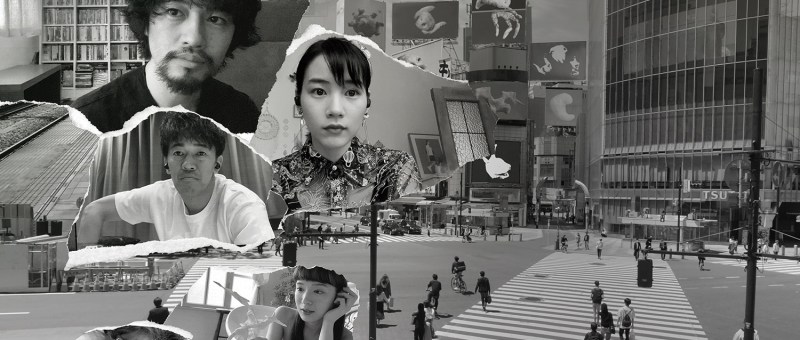
The 12 Day Tale of the Monster that Died in 8 (8日で死んだ怪獣の12日の物語, Shunji Iwai, 2020) [Fantasia 2021]

“We, all of us, can be heroes! Let’s support each other to beat this monster.” the hero of Shunji Iwai’s pandemic dramedy, The 12 Day Tale of the Monster that Died in 8 (8日で死んだ怪獣の12日の物語, Yoka de Shinda Kaiju no Juninichi no Monogatari) affirms. Inspired by Shinji Higuchi’s Kaiju Defeat Covid project and originally streamed as a web series, Iwai’s surreal screen drama is replete with the atmosphere of the pandemic’s early days, a mix of boredom and intense anxiety coupled with a determination to protect and support each other through this difficult time. Yet it’s also a tale of uncanny irony taking place in world in which Ultraseven is a documentary while the Earth has apparently been subject to waves of monster aggression, alien visitors, and even apparently an epidemic of ghosts. 

All of this the hero, Takumi Sato (Takumi Saitoh playing a version of himself) finds out from director Shinji Higuchi after contacting him on Zoom for advice about how to raise the “Capsule Kaiju” he bought on the internet in order to do something to help battle corona virus. Sato’s single “egg” soon becomes three, later back down to one again causing him to worry if the other two managed to escape or perhaps were eaten by the sole remaining monster. In any case, while they are three he names each of them after various Covid-fighting drugs and is informed by Higuchi that they currently resemble three kaiju from classic tokusatsu series Ultraseven. 

Nevertheless, Takumi is continually confused and disappointed by the slow progress of his project, confessing to one of his friends online that they were rated only one star on the store he bought them from but he’s sure that’s just because they’re a new product. His friend Non, (also playing a version of herself), meanwhile, has invested in an alien though the alien is, conveniently enough, entirely invisible and inaudible via camera. Non’s alien seems to be making much better progress to the extent that it eventually becomes disillusioned with selfish, apathetic human society and decides to return to outer space. Challenged, Takumi has to admit he hasn’t really done anything to make the world a better place except for raising his capsule kaiju and even that hasn’t gone particularly well. 

Then again, perhaps just getting through is enough to be going along with in the middle of a global pandemic. Takumi’s friend So (So Takei) is separated from his family in Bangkok and is struggling to find work as a chef while all the restaurants are closed only to later confess that he actually has a second family he, understandably, had not mentioned before in Japan that he also needs to support financially. Even so, Takumi is bemused watching the YouTube channel of a young woman (Moeka Hoshi) who broadcasts from her bathtub dressed in a nightgown and has managed to raise a recognisably dragon-like kaiju while his keep shapeshifting without progressing into a final form. He starts to worry, what if his kaiju are actually evil and intend to destroy the world rather than save it? The fact that it eventually takes on the form of a giant coronavirus might suggest he has a point, but kaiju work in mysterious ways and perhaps they are trying to help in their own small ways even if it might not seem like it in the beginning. 

In many ways that might be the primary lesson of the pandemic, everyone is doing their best even if they’re only doing something small like staying at home and wearing their mask. Shot entirely in black and white and mostly as direct to camera YouTube-style monologues or split-screen Zoom calls complete with occasional lag and echoing, Iwai adds in eerie pillow shots from a camera positioned high above the streets of a strangely quiet but not entirely empty Tokyo along with fragmentary dance sequences of young women dressed in black with CGI kaiju heads. A whimsical slice of pandemic life, 12 Day Tale ends as it began, with Takumi once again reminding us that we are all heroes and should support each other to beat the “virus monster” but adds a much needed note of hope as he assures his audience that the the day we beat the virus will certainly come, “let’s do our best together”. 


The 12 Day Tale of the Monster that Died in 8 streams in Canada until Aug. 25 as part of this year’s Fantasia International Film Festival.

Original trailer (English subtitles)