So Close (夕陽天使, Corey Yuen Kwai, 2002)

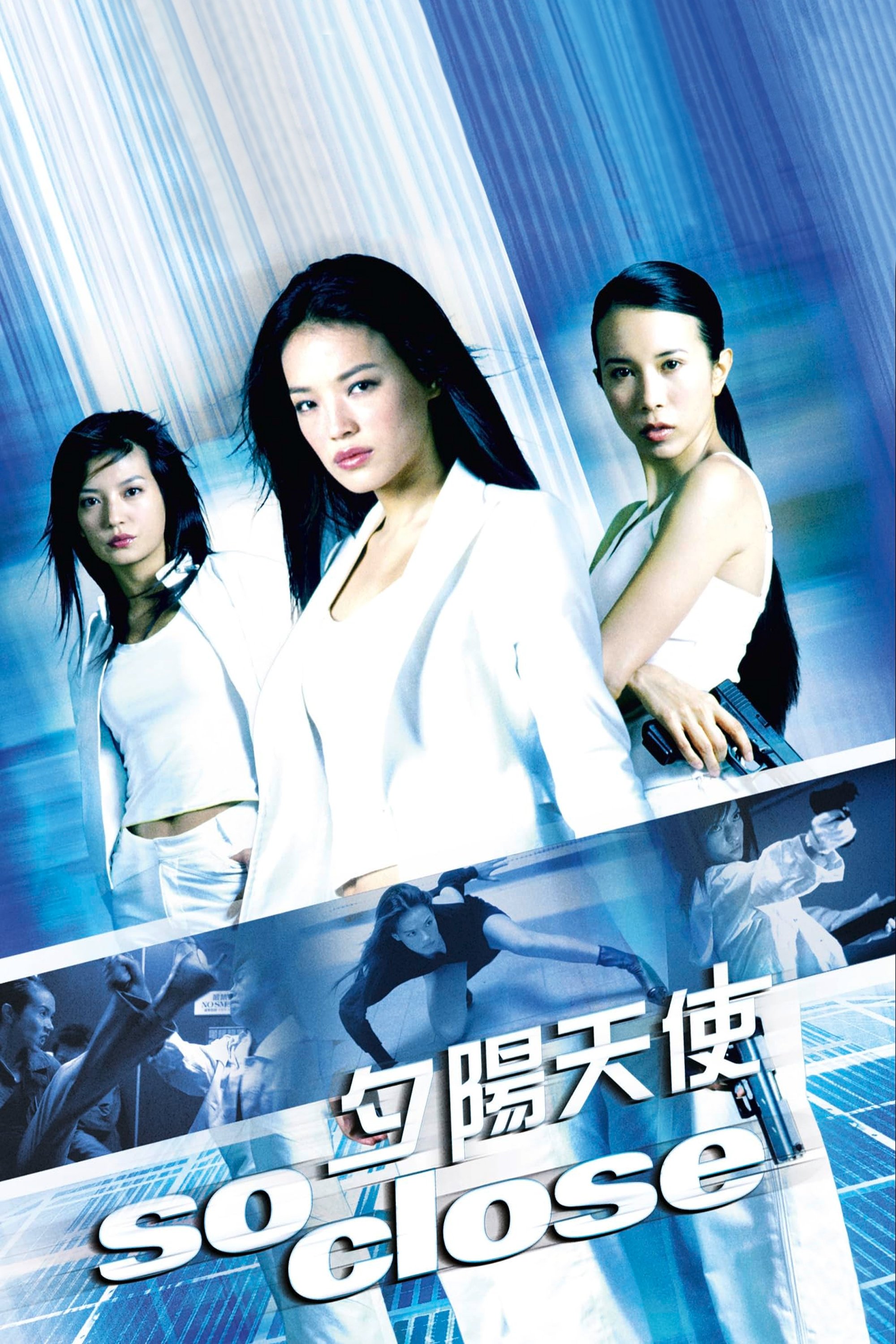
A latish entry in post-millennial cyber thrillers, Corey Yuen’s So Close (夕陽天使) finds two hit women sisters safeguarding next generation technology in keeping it out of the hands of corrupt businessmen who in fact murdered their father to get it. They claim he always intended to gift his all-powerful mass surveillance tool to the police, which either seems politically uncomfortable or incredibly naive, but have been using it themselves to earn their keep as killers for hire albeit justifying themselves in insisting on the moral bankruptcy of their targets.

In this case, that would be Chow Lui (Shek Sau) who according to “Computer Angel” made his “evil fortune” through drug smuggling. Infinitely smug, Chow thinks he has better technology but is soon proved wrong as Computer Angel admits she also sent the virus, or more accurately manifested it, to teach Chow a lesson. Yuen fills the film with 90s cyberpunk motifs, even having Computer Angel, later identified as Lynn (Shu Qi), jump off a building in a shot that is a clear homage to Ghost in the Shell while otherwise employing electronic imagery of cables and wires though the “World Panorama” system largely works through satellite.

In the opening sequence, Chow’s company is also revealed to be a global enterprise connected around a large table via the internet while futuristic systems allow him to have video calls with associates speaking Japanese and English. He suggests they simply pay the hackers to save their reputation which is apparently built on their world-class security systems though he himself perhaps remains sceptical abruptly shutting down his younger brother’s attempt to broker a deal investing in a company called Dragon. His office meanwhile has a bonsai tree in the background and his brother Nunn seems to have very close ties with a Japanese gangster hinting at a possible economic anxiety.

This fraternal conflict is eventually reflected in the fracturing relationship between the two sisters as field agent Lynn informs her sister Sue (Zhao Wei) that she wants to give up the killing trade after reuniting with an old boyfriend and deciding to get married. Techno wiz Sue has no other means of supporting herself and is resentful that Lynn always takes charge and won’t let her participate in missions, though Lynn is later vindicated when Sue’s hasty decision to take on a solo job goes just about as wrong as it can go. Meanwhile, their relationship is also strained by the presence of Hung (Karen Mok), a policewoman investigating Chow’s death who, as she later says, is strangely drawn to Sue who rollerblades around her at a record store with thinly concealed desire. 

There might be something in the fact that the actresses playing Sue and Lynn are from the Mainland and Taiwan respectively each performing their scenes in Mandarin but dubbed into Cantonese for the local release. They are indeed outsiders, firstly because of their unusual profession and secondly because of their all-powerful surveillance tool that allows them to carry out their missions yet also acting as a moral authority even if as Lynn later says they kill for money not conviction. World Panorama allows them to edit surveillance footage, placing fake avatars of themselves in the digital space and allowing them to otherwise recreate reality in a way that seems in keeping with the film’s otherwise low-key special effects which have an almost tongue-in-cheek quality parodying other more serious cyber thrillers from the mid-90s. 

The film’s English title comes from Yuen’s use of the Carpenters’ track (They Long to Be) Close to You, yet the Chinese is the more melancholy Sunset Angel which is most obviously refers to the film’s final scene if also perhaps calling time on the sisters’ roles of guardians of next-gen tech and avenging ghosts of the machine working out the bugs of corrupt gangster businessmen. In any case, they move through the “real” world like digital avatars performing incredible feats of human agility and not least in the high impact action scenes culminating in a lengthy katana fight in a tatami mat room which both echoes the cyberpunk aesthetics and reinforces an idea of corporatising colonialism finally blown away by the forces of female solidarity and an unlikely loves story between a soldier and a bandit. 


Trailer (English subtitles)

Dream Home (維多利亞壹號, Pang Ho-cheung, 2010)

“In a crazy city, if one is to survive, he’s got to be more crazy.” according to the opening titles of Pang Ho-cheung’s surprisingly poignant slasher satire Dream Home (維多利亞壹號). In the 10 years since the handover, the average wage has increased by a measly 1% while house prices have risen by 15% in 2007 alone. Sheung’s (Josie Ho) one overriding mission in life is to buy a flat for her family to live in, but it’s clear that her struggles to become a homeowner aren’t the only pressure points in her life in an increasingly capitalistic society. 

As we later discover, Sheung is set on one particular flat because the building it’s in stands on the spot where she once lived as a child before her family was pushed out by rampant gentrification. In essence, she’s just trying to take back what’s hers and restore her family’s sense of dignity and security. A flashback to her childhood reveals her father’s own insecurity in having been unable to secure a larger living space in which she and her brother could have their own rooms while her grandfather, a sailor, longed for a sea view and the sense of an expanding horizon otherwise denied to the family in a cramped Hong Kong council flat. In a touch of irony, Sheung’s father himself worked in construction building apartment blocks he couldn’t afford to live in and in the end it killed it him through exposure to asbestos and other dangerous fibres. 

Sheung works at a bank but is conflicted about her job cold calling account holders to try to get them to buy into dodgy loans neatly echoing the film’s closing moments which hint at a coming economic crash precipitated by the subprime mortgage crisis which will threaten Sheung’s homeowning dream. Her friends think she’s crazy to buy a flat at all, but she’s completely fixated on repairing her broken childhood by taking back her family home and ending her displacement. Meanwhile, she’s in a dissatisfying dead end relationship with a married man which largely takes place in love hotels he sticks her with the bill for and turns up late to only to immediately fall asleep. When Sheung asks him for a loan to help pay for her father’s medical care after the insurance she got for him is voided because he never told her he’d been diagnosed with a lung complaint before she took it out, he tells her to use her deposit fund instead and give up on homeownership because only fools like her would buy in such a volatile market. 

Disappointment in both her personal and professional lives continues to place a strain on Sheung’s fragile mental state that eventually tips her over the edge. Hoping to bring the apartment’s price down, she goes on a murder spree in the building killing it seems partly out of resentment and otherwise pure practicality. There is irony here too, in that she kills her victims with the weapons of their privilege. A cheating husband who comes home unexpectedly after lying to his wife that he’s gone golfing but was actually with his mistress is whacked on the head with a golf club while an obnoxious stoner kid is stabbed in the neck with his bong. Sheung murders a Filipina helper, but also the snooty middle-class woman who employed her by using the vacuum pack machine the helper had been using on her behalf. One might ask if she really needed to kill the helper or the pair of Mainland sex workers in the next apartment, but when it comes to devaluing property prices “massacre” sounds much better than “killing” and so it’s the more the merrier. 

In the end, it’s this city that’s driven her out of her mind with its status-obsessed consumerism and constant sense of impossibility. After her killing spree, she doesn’t even seem very conflicted about selling dodgy loans to vulnerable people not so different from herself while she was so desperately trying to get approval on a mortgage there was no way she could afford despite working a series of other part-time jobs including one selling designer handbags to the kind of wealthy women she resents. Her dream apartment has a view quite literally to kill for, though there’s a sense that Sheung’s dream will always be futile with the same motivations that brought her here leading to the mortgage crisis and economic shock that could eventually take it from her. Bloody, gory, and at times sickeningly violent Pang’s satirical horror show paints contemporary capitalism as the real villain and even in its dark humour reserves its sympathies for the wounded Sheung pushed to breaking point by a pressure cooker society. 


Dream Home available to stream in the UK until 30th June as part of this year’s Odyssey: A Chinese Cinema Season.

International trailer (English subtitles)

Full Strike (全力扣殺, Derek Kwok & Henri Wong, 2015)

A former badminton champ begins to rediscover herself after being permanently banned for bullying behaviour when charged with coaching a bunch of former bank robbers in Derek Kwok & Henri Wong’s zany sports comedy Full Strike (全力扣殺). Dedicated to “all the beautiful losers”, the film is less about literal winning as it is about learning to turn one’s life around in moments of profound despair and draw strength from even non-literal victories in simply refusing to be looked down or belittled.

It’s ironic in a sense that Dan (Ekin Cheng Yee-Kin), Kun (Wilfred Lau Ho-Lung), and Chiu (Edmond Leung Hon-Man) became bank robbers because they didn’t want to be bullied having grown up as friendless orphans. Former badminton champ Kau Sau (Josie Ho Chiu-Yee), meanwhile, was such as tyrannical diva that she gained the nickname “The Beast” before being banned because of her unsportsmanlike behaviour and treatment of her long-suffering assistant. But cast out of the sports world, she’s become a dejected layabout not quite working in her brother’s restaurant and otherwise hiding out from the world. Her life changes when she’s publicly mocked after running into her former assistant who has since gone to take her position as a reigning champion. Running out into the night, she spots a shuttle-cock-shaped meteor and is chased to a badminton club by what she assumes is an “alien” but might have just been a frightened homeless man.

In any case, she takes it as a sign she should pick up a racket once again which as Dan later points out she probably wanted to do anyway and was just waiting for an excuse. He can’t explain why he chose the unlikely path of becoming a badminton player to help him turn over a new leaf after leaving prison but reflects that perhaps you don’t really need a reason only the desire to change. Dan, Kun, and Chiu all developed disabilities as a result of their life of crime but slowly discover that they can actually help them on the court in a literal process of making the most of their life experiences no matter how negative they might have assumed them to be while Kau Sau similarly regains her self esteem while acknowledging the destructive patterns of her previous behaviour careful never to bully her new teammates as they all square off against her bullying cousin “nipple sucking Cheung” (Ronald Cheng Chung-Kei) who tries to use his newfound wealth to cover up a lack of skill by hiring Kau Sau’s old teammate. 

Cheung is also trying to overcome low self-esteem and is later forced to realise that becoming a champion won’t really change that much about how he sees himself, though apparently still relying on an ever capable middle-aged woman to fight (literally) his battles for him. Meanwhile, the gang are coopted by a media mogul hoping to make an inspirational documentary about them but also manipulating their lives and hyper fixating on their criminal pasts to the point of staging a fake arrest as they enter the stadium for a competition. Doubting the chances of success in setting up new lives for themselves as badminton players, Chiu is drawn back towards a life of crime while feeling somewhat distanced from the team as a tentative romance between Kau Sau and Dan seems to fall otherwise flat.

A throwback to classic mou lei tau nonsense comedy, the zany gags come thick and fast but are at times over reliant on low humour while the central premise of staking everything on an “unexciting” game like badminton perhaps wears a little thin by the time it gets to the high stakes finale with the heroes fighting twin battles squaring off against their traumatic pasts rather than the literal opponents in front of them. Winning becomes a kind of irrelevance when the contest was within the self. Each rediscovering the spark of life, the players rediscover the will to live while bonding as a team and sticking to their training in pursuit of their goal. Kwok and Wong lay it on a little thick with the martial arts parody in the uphill battle to master badminton but otherwise lend a poignant sense of warmth and genuine goodwill in sympathy with the underdogs’ quest if not quite to win then to own their loserdom on their on terms in reclaiming their self-respect and dignity. 


Full Strike is available to stream in the UK until 30th June as part of this year’s Odyssey: A Chinese Cinema Season.

Original trailer (Traditional Chinese / English subtitles)

Dead or Alive: Final (Takashi Miike, 2002)

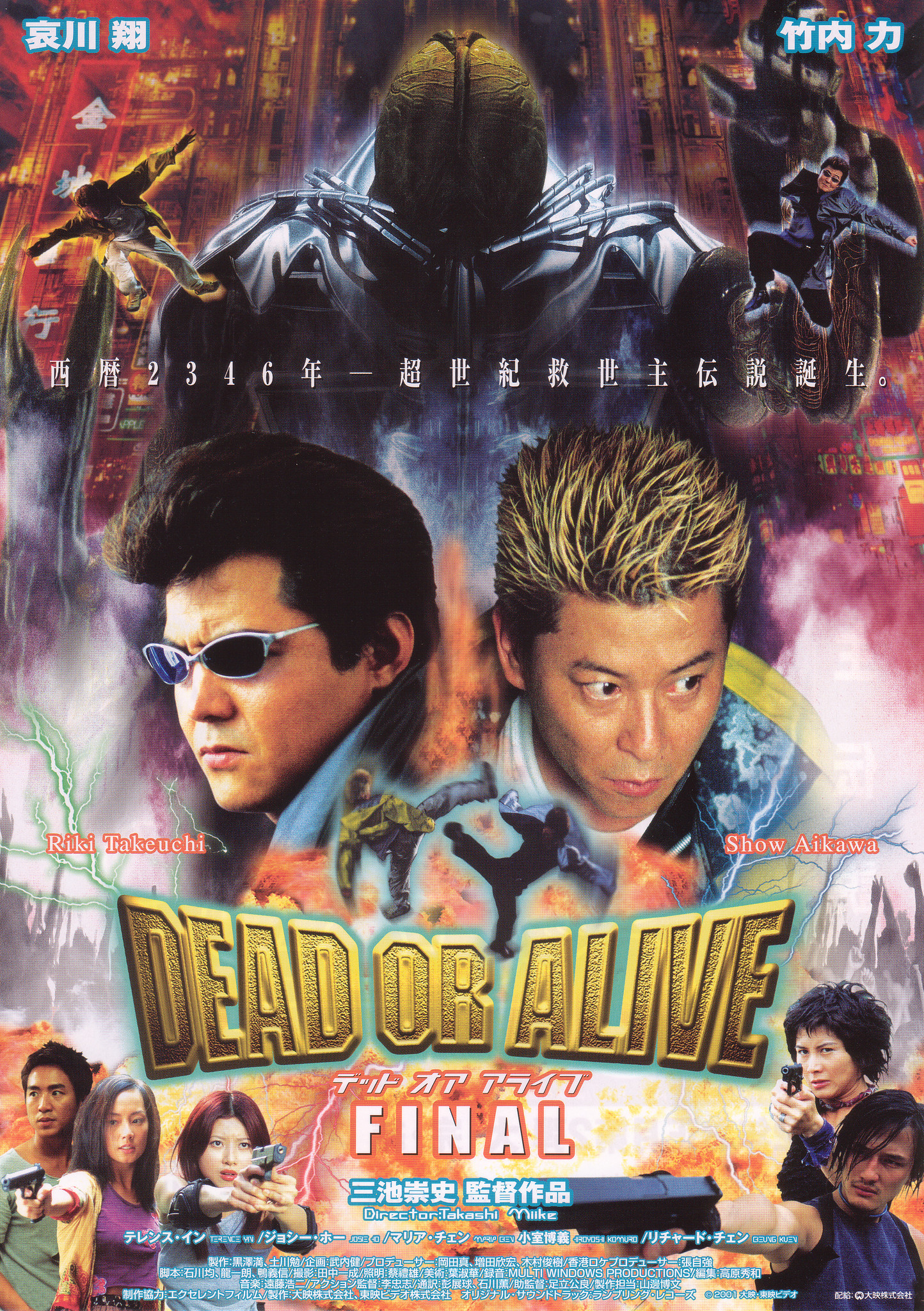
dead_or_alive_final_jap_chirashiThe Dead or Alive Trilogy began in a furious, drug fuelled hymn to violence in which a petty vendetta between the opposing forces of good and evil (mingled and bloody) eventually destroyed the entire world. Dead or Alive 2: Birds was an altogether more contemplative affair in which two orphaned boys rediscover each other as jaded hitmen and decide to put their talents to “good” use by donating the hit money to pay for medicinal drugs for impoverished children around the world. Strange and surreal, Birds moved beyond the first film’s absurd ending for an altogether more abstract approach to universe building but Final pushes the idea to its limit in a cyberpunk infused far future tale of rogue robots and sexual dictatorship.

Yokohama, 2346. A new society is being forged, a new social order has been created. All powerful Mayor Wu (Richard Chen) has decreed that the only true love is gay love and made heterosexuality taboo. Births are strictly controlled to maintain population numbers with contraception ruled mandatory. The heterosexual resistance has gone into hiding in a ruined part of the city, living in a free love commune in which the birth of children is a primary goal. Lead by Fong and his first lady Jun, the resistance aims to liberate the people from the yoke of the crazed dictator and create a better, freer world for the as yet unborn children of the future. Teaming up with a rogue “Replicant”, Ryo, (Sho Aikawa) the gang attempt to further their cause by kidnapping the young son of Wu’s chief of police, Honda (Riki Takeuchi), who later discovers some uncomfortable truths about his own existence.

The use of the world “Replicant” is a pointed one and an overt reference to Final’s key text – Blade Runner, though its intentions amount much more to a pastiche than an examination of the existential questions so central to the seminal cyberpunk classic. Online captions state the action is taking place in Yokohama – an industrial harbour town close to Tokyo, but is in reality a thinly disguised Hong Kong with a green tint. Nevertheless, Miike makes the most of rundown industrial complexes now overrun by nature and the symbols of historical hubris. Aside from the flying cars and other CGI touches, the dystopianism is all too real in its sense of economic and social failures which have allowed a man like Wu to run a strange fascist police state even in the absence of the necessary infrastructure.

In keeping with the Hong Kong setting the Yokohama of 2346 is largely Chinese with broad mix of intermingled languages. Once again the nature of family is called into question but this time more through a large scale change in the social order which sees birth strictly controlled through medical and cultural enforcement. The largely Cantonese speaking resistance movement want to create a world where children can be born and then grow up freely, neatly echoing the previous films’ preoccupation with the fates of children as considered by orphans. Aside from their idealism, the Resistance turns out not to be so far removed from the petty gangsters of the previous instalments as they ultimately turn on each other with deadly consequences.

Sho Aikawa and Riki Takeuchi face off once again with Aikawa playing a Rutger Hauer-esque android who proves his “humanity” through his affiliation with children. A “Replicant” from a long forgotten war, Ryo has superpowers which allow him to stop bullets in mid-air or send out sparks of energy but is also at home playing the clown as he brushes his teeth nonchalantly in the middle a fist fight or plays dead to entertain a little boy. Takeuchi’s Honda, by contrast, is the stereotypical gestapo inspired secret police chief whose family life is a hollow one devoid of genuine feeling and maintained solely for professional expectation.

If Miike has been playing Blade Runner all along, his finale jumps ship for Tetsuo: The Iron Man as the trilogy’s leading men relive the totality of their experiences across three different plains of existence before merging into one as a kind of angel of destruction. The cycle of violence has reached its apotheosis as the twin angels are sent to wreak revenge on those who have misused their authority. Shot on high grade video, Final makes the most of its more modest production values but can’t help suffering in comparison to its predecessors. The B-movie opening is a helpful clue to Miike’s intentions as he creates his own kind of sci-fi dystopia inspired by pop culture memories, but even if the overarching themes lack integrity, Final provides the perfect ending for this often frustratingly absurd series, defying rational explanations until the end of time.


Available now in UK from Arrow Video!

Original trailer (English subtitles)