The Little Girl Who Conquered Time (時をかける少女, Nobuhiko Obayashi, 1983)

Little Girl Who Conquered TImeThe Girl Who Leapt Through Time is a perennial favourite in its native Japan. Yasutaka Tsutsui’s original novel was first published back in 1967 giving rise to a host of multimedia incarnations right up to the present day with Mamoru Hosoda’s 2006 animated film of the same name which is actually a kind of sequel to Tsutsui’s story. Arguably among the best known, or at least the best loved to a generation of fans, is Hausu director Nobuhiko Obayashi’s 1983 movie The Little Girl Who Conquered Time (時をかける少女, Toki wo Kakeru Shoujo) which is, once again, a Kadokawa teen idol flick complete with a music video end credits sequence.

As in the novel, the story centres around regular high school girl Kazuko Yoshiyama (Tomoyo Harada). She has two extremely close male friends (generally a recipe for disaster, or at least for melodrama but this is not that kind of story) – Horikawa and Fukamachi, and one Saturday while all three are charged with cleaning up the schoolroom, Kazuko ventures into the science lab where she sees a beaker on the floor emitting thick white smoke which smells strongly of lavender causing her to pass out. Everyone seems to think it’s either hunger, anaemia, or that old favourite “woman’s troubles” but from this day on Kazuko’s life begins to change. The same day repeats itself over and over again with minor differences and Kazuko also begins to experience multilayered dreams in which her friends are in some kind of peril.

Tsutsui’s original novel was a Kadokawa Shoten property (though first published 15 years previously) which made it a natural fit for the Kadokawa effect so when legendary idol master Haruki Kadokawa found an idol he was particularly taken with in Tomoyo Harada the stars aligned. Obayashi set the story in his own hometown, the pleasantly old fashioned port village of Onomichi, which adds a nicely personal feel to his take on the original story. Although The Little Girl Who Conquered Time is an adaptation of a classic novel, many of Obayashi’s regular concerns are present from the wistful tone to the transience of emotion and the importance of memory.

Kazuko is another of Obayashi’s young women at a crossroads as she finds herself wondering what to do with the rest of her life. The original timeline seems to point to a romance and possibly a life of pleasant, if dull, domesticity with one of her best friends but with this time travelling intrusion everything diverges. Though assured that she will not remember most of the strange events that have been happening to her, something of her adventures seems to have stuck in Kazuko’s mind even if she couldn’t quite say why. Much to the consternation of her mother, Kazuko’s purpose in life begins to lean to towards the scientific rather than the romantic, almost as if she’s waiting for the return of someone whom she has no recollection of having met.

Obayashi once again uses conflicting colour schemes to anchor his story. Beginning with black and white as Kazuko has her first encounter with someone she’s known all her life under the brightly shining stars, he gradually re-introduces us to the “real” world through sporadically adding colour during her bus ride home to her small town which does have a noticeably more old fashioned aesthetic when compared to Tokyo set features of the era. The effects are highly stylised and very much of their time including the celebrated time travel sequence which has Kazuko framed by a neon blue halo. The most touching sequence occurs near the end of the film in which Kazuko crosses paths with a familiar face that she doesn’t quite recognise, the camera perspective actively changes physically pulling us away from the encounter until Kazuko turns around and walks away in the opposite direction and into yet another empty corridor.

Tomoyo Harada developed into a fine actress with a long standing and successful career in both television and feature films as well as releasing a number of full length albums. As is usual with this kind of film she also sings the theme tune which has the same title as the movie though in an unusual movie Obayashi includes a music video retelling of the events of the film over the end credits featuring all of the cast helping Harada to perform the song with silly grins on their faces all the way through. Harada proves herself much more adept at convincingly carrying a feature length movie than some of her fellow idols but the same cannot be said for many of her co-stars though she is well backed up by established adult cast members including Ittoku Kishibe as Kazuko’s romantically distressed teacher.

The Little Girl Who Conquered Time is first and foremost a Kadokawa idol movie and has all the hallmarks of this short lived though extremely successful genre. Necessarily very much of its time, the film has taken on an additional layer of nostalgic charm on top of that which has been deliberated injected into it. Nevertheless, in keeping with Obayashi’s other work The Little Girl Who Conquered Time has a melancholic, wistful tone which is sentimental at times but, crucially, always sincere.


Original trailer (no subtitles)

And here’s the famous music video for the title song (which is of course sung by Tomoyo Harada herself). English Subtitles!
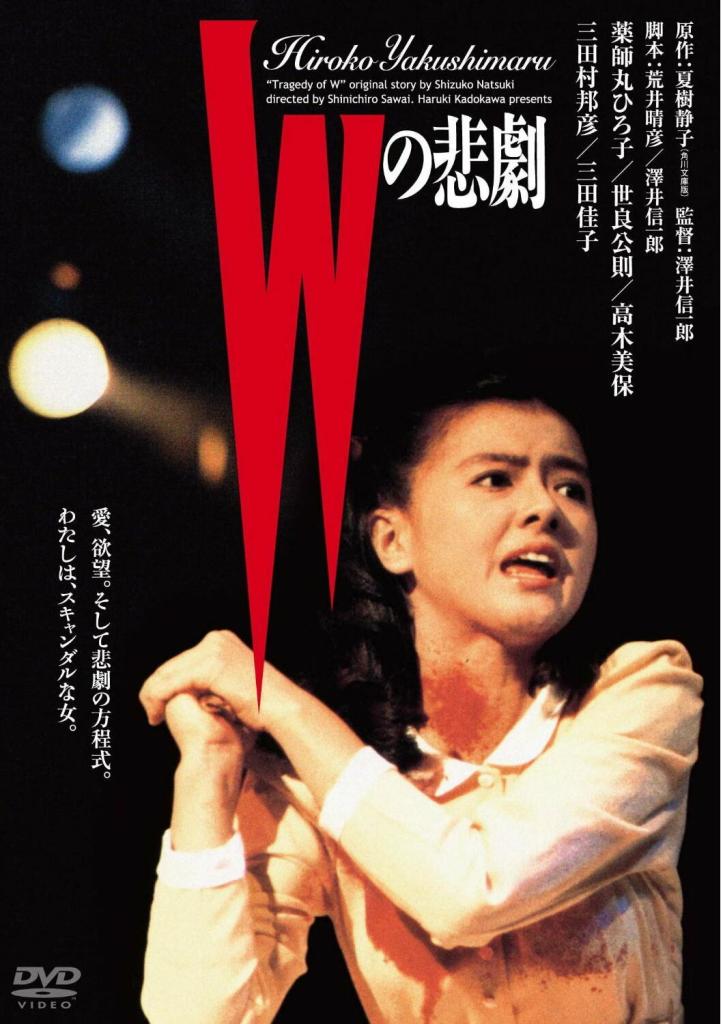
W’s Tragedy (Wの悲劇, Shinichiro Sawai, 1984)

W's TragedyHiroko Yakushimaru was one of the biggest idols of the 1980s. After starring in Shinji Somai’s Sailor Suit and Machine Gun, she went on to become one of Kadokawa’s tentpole stars in vehicles such as Detective Story and Main Theme but she hit her artistic stride in 1984’s W’s Tragedy (Wの悲劇, W no Higeki) which earned her her first Blue Ribbon award for Best Actress. Inspired by the 1982 novel of the same name by Shizuko Natsuki (translated into English under the title Murder at Mt. Fuji), Sawai’s film radically diverges from its source material as the central murder mystery takes place on stage but eerily begins to mirror real life events.
Shizuka Mita (Hiroko Yakushimaru) is an aspiring young actress desperate to find her place in the spotlight. After spending the night with her teacher, she wanders home through a park and begins monologuing her life on the stage of an outdoor amphitheatre. Unbeknownst to her, a young man was sleeping on one of the rear benches and wakes up to applaud her performance. Despite her hostility towards him, Akio perseveres in getting Shizuka’s attention and the two eventually develop a tentative relationship.

Shizuka’s acting school offers its pupils the opportunity to star in a full scale production with established stars of the stage as part of their training and this year’s play is based on the recent novel, W’s Tragedy, which centres around a murder in an aristocratic family. Shikuza is desperate to win the leading role of Mako who claims to have murdered her grandfather after he tried to assault her. Losing out in the original auditions process but winning a small role which also comes with some backstage craft experience, Shizuka begins to lose heart. However, after building up a relationship with the star actress in the show, Shizuka is offered the opportunity to displace her rival through underhanded means but just how far is she willing to go for stardom and what will it all mean if and when she gets it?

Taking its cues from All About Eve, W’s Tragedy, reconfigured as a vehicle for Yakushimaru, becomes more about dualities as Shizuka effectively splits into two different “selves” – the young and innocent girl dreaming of a life on the stage, and the insecure, ambitious student willing to sacrifice anything to get there. Though clearly conflicted, Shizuka easily gives in to dubious suggestions that will earn her what she wants though not perhaps in the way that she wanted it. Her rival is shown to be a very competent actress who has also sacrificed parts of herself to attain the position that Shizuka so covets though it’s the older actress, Sho, who is the first to lament the fate of the displaced former leading lady even if she adopts a casualty of war ethos about the whole entrprise.

Shizuka gives the best performance of her life at a press conference held when she replaces the other actress in the show as she lies through her teeth to reinforce the fake story she and Sho have concocted together to their mutual benefit. Taking the brunt of a scandal just as Mako tries to take responsibility for a crime in the play, Shizuka becomes rather than performs an entirely different persona as she gives a heartfelt account of a passionate love affair with a married man that belongs to someone else entirely. Taken to task by Akio who doesn’t know the story is fake but has come to despise this manipulative side of the acting profession, Shizuka begins to wonder who she really is underneath all of the lies, scheming, and performance.

Though the directing style is generally straightforward and in keeping with Kadokawa’s mainstream idol movies of the time, Sawai adds in a few interesting flourishes which often pay homage to similarly themed Western movies such as an overtly All About Eve moment with Shizuoka taking to the stage and reciting the lead role when she thinks no one’s looking. A strange shot near the end takes place during the play but has been constructed entirely for our benefit as Shizuka looks at her reflection on a pane of glass. The audience would not be able to pick up on this ghostly effect of the two Shizukas – the stage persona and the shade of the innocent girl dreaming of the spotlight, but the effect itself is a perfect evocation of the ever present theme of duality.

Very much of its time and bearing most of the hallmarks of the classic Kadokawa idol movie, W’s Tragedy is, in many ways, the evocation of another era. However, it does provide a plum leading role for its star and an interesting meditation on the nature of acting as a profession as well as the double standards and hypocritical judgements inherent to the running of the entertainment industry.  Though less explosive than the later Perfect Blue with which it shares a few common themes, W’s Tragedy provides another set of mirrors into the nature of stardom, identity, and the price of success.


Unsubbed trailer (look out for a brief cameo from the late Yukio Ninagawa):

And here’s a clip of Hiroko Yakushimaru singing the title song at her 30 year anniversary concert back in 2013:

https://www.youtube.com/watch?v=955x2TFXcgw

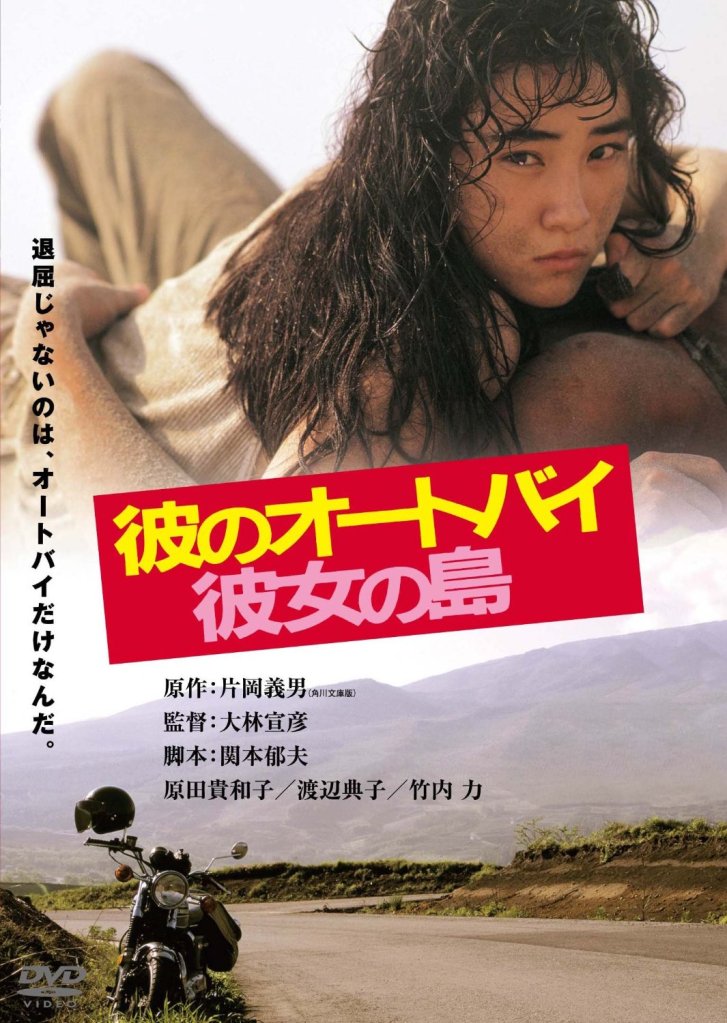
His Motorbike, Her Island (彼のオートバイ彼女の島, Nobuhiko Obayashi, 1986)

His Motorcycle Her IslandLike many directors during the 1980s, Nobuhiko Obayashi was unable to resist the lure of a Kadokawa teen movie but His Motorbike, Her Island (彼のオートバイ彼女の島, Kare no Ootobai, Kanojo no Shima) is a typically strange 1950s throwback with its tale of motorcycle loving youngsters and their ennui filled days. Switching between black and white and colour, Obayashi paints a picture of a young man trapped in an eternal summer from which he has no desire to escape.

Ko (Riki Takeuchi) tells us that he’s an unusual guy because most people dream in colour but all of his dreams are in monochrome. He’s a student and dispatch rider overly attached to his admittedly very handsome Kawasaki motorbike. After getting beaten up by his boss due to deflowering the guy’s sister and then breaking her heart, Ko skips town for the open road, just him and his bike. However, he repeatedly runs into the same mysterious girl who lives on an equally mysterious island and develops a deep seated need for her, secondary only to that for his bike. Miyo (Kiwako Harada) has also taken a liking to the Kawasaki and is intent on getting her full motorcycle license. Her growing obsession with the bike threatens to become an all consuming need driving a wedge between the two young lovers.

Obayashi begins in a black and white sequence window boxed in the centre of the screen before expanding to 4:3 when Ko has his fight with his boss and only hits 16:9 for the first colour scene which sees Ko taking off on his beloved bike. He told us that his dreams are in black and white but the film seems to disagree with him, segueing into various gradated colour schemes as Ko narrates his melancholy tale of tragic lost love. Ko is not necessarily a very reliable narrator in any case, but in each instance the on screen action is always coloured by the recollections of the older man who offers his voice over commentary.

Like many Obayashi films, the overriding feeling is one of melancholy mixed with a youthful apathy.  This is a story about modern young people, but refracted through rebellious ‘50s movies from Rebel Without a Cause to The Wild One and a hundred others inbetween. Ko is a university student (of what we don’t know) but seems to have no great ambitions. He takes things as he finds them and his only passion is the bike itself. When he first meets Miyo and she asks him where he’s going, he simply replies that he’s “looking for the wind” – a motif which recurs throughout the film.

Later on when he arrives at Miyo’s island, it takes on an opposing symbolism to his bike. Just as Miyo can’t get enough of the Kawasaki, Ko is originally attracted to the island much more than to the girl. It’s not quite a coincidence that each time he visits there it’s the Bon festival where the dead are temporarily allowed to return to the world of the living. Later he says that Miyo wasn’t just a girl but an island, and he wan’t just a boy but a bike, and together the two of them became the wind. They became one entity, inseparable one from the other. Finally the esoteric colour scheme begins to make sense, we’ve been watching a ghost story all along. This island is an unreal place, existing only inside Ko’s memory where Miyo waits for him with a full tank of gas.

Once again youth is seen as a brief yet unforgettable period filled with longing and regret. The older man is forever trapped by this one glorious summer, a place to which he can never return but neither can he escape. The nihilistic tone and voice over narration have an edge of the French New Wave but ‘50s American cinema of alienation seems closer to Obayashi’s intentions. An elliptical and strange tale of tragic love retold as a ghost story, filled with phantoms of memory and landscapes coloured by dream and emotion, His Motorbike, Her Island is another characteristically offbeat effort from Obayashi which once again embraces the aimlessness of youth and age’s regret.


Unsubtitled trailer – goes through to a video of Kiwako Harada singing the title song, in case you were in any doubt what this movie is for.

https://www.youtube.com/watch?v=9VfgFICO9fs

Or, here is the film’s opening (which also features the title song)

https://www.youtube.com/watch?v=bE78KK2UgmA

Detective Story (探偵物語, Kichitaro Negishi, 1983)

Dective Story 1983Yusaku Matsuda became a household name and all round cool guy hero thanks to his role as a maverick private eye in the hit TV show Detective Story, however despite sharing the same name, Kichitaro Negishi’s Detective Story movie from 1983 (探偵物語, Tantei Monogatari) has absolutely nothing to with the identically titled drama series. In fact, Matsuda is not even the star attraction here as the film is clearly built around top idol of the day Hiroko Yakushimaru as it adapts a novel which is also published by the agency that represents her and even works some of her music into the soundtrack.

As far as plot goes, Detective Story is the kind of good natured, innocent crime thriller that has all but disappeared since the 1980s. Yakushimaru plays teenage student Naomi who is due to move to America to be with her father in the very near future. However, Naomi is an inquisitive, mildly rebellious sort with a habit of sneaking out of her room through the window despite the fact that no one is preventing her simply leaving through the front door. Consequently someone or other has hired a detective, Tsujiyama (Matsuda), to keep an eye on her. This he does pretty well until he puts a stop to Hiroko making a huge mistake with a fellow student in a love hotel. Though Naomi is very not happy about a creepy old guy following her about everywhere, she gradually gets used to it and when Tsujiyama’s ex-wife gets caught up in a hotel room murder case, Naomi gets the inspiration to embark on some detective work of her own.

Despite the shadiness of the world that rich girl Naomi is about to get embroiled in, the film maintains a bright and cheerful tone – perhaps because of Naomi’s own straightforward innocence. Even if she very nearly falls for the advances of an obvious creep (seriously, the guy actually borrows money from his “girlfriend” ? right in front of Naomi to take her out on a date, after which he tries to persuade her to join him in a love hotel), Naomi’s teenage spunkiness largely keeps her out of trouble for the rest of the movie which sees her getting mixed up with nightclubs, showgirls and yakuza. Somehow there is very little feeling of actual danger in the film leaving this all feeling like the kind of thing that happens to Naomi all the time and is simply just one last adventure before she heads off to America.

It must have been something of a coup to get arguably the biggest movie star of the day, Yusaku Matsuda, to play second fiddle in a mainstream teen idol movie especially as his other film choices of the time seem to indicate a desire to get away from his tough guy persona into more dramatic roles. Tsujiyama is cool presence in his stylish brown suit, smoking away in the shadows content to simply keep watch. He’s the omniscient type who always seem to have a plan in motion yet it’s Naomi herself who takes the lead here, solving the case whilst saving Tsuijiyama and his damaged show girl of an ex-wife in the process.

As is common with these kinds of stories there is a light romantic subplot which is a little unseemly when you consider Yakushimaru was only 19 at the time and her character around the same age whereas Matsuda was already in his 30s. This plot strand is played a little strangely throughout the film with a tacked on airport gate conclusion which dissolves itself almost straightway but does play into the film’s coming of age themes as Naomi develops greater sense of herself as an adult woman rather than a reckless teenager.

Detective Story is no lost classic, it’s very much of its time and has perhaps faded a little as has the fame of its tentpole star. That said it’s a perfectly enjoyable cute teen idol detective story which overall succeeds in doing exactly what it sets out to do even if it proves a little dull in the execution. An interesting watch for fans of its two stars Hiroko Yakushimaru and Yusaku Matsuda and even for its director Kichitaro Negishi who has gone on to win some later critical acclaim particularly with the prestige drama Villon’s Wife in 2009, Detective Story is perhaps not worth an all night stakeout but at least warrants a cursory investigation.


Unsubtitled trailer:

and here’s a video of Hiroko Yakushimaru singing the (very catchy) title song at a concert celebrating the 35th anniversay of her film debut (video has a bit about the concert at the beginning, fastfoward to 1:13 for the song only)


Main Theme (メイン・テーマ, Yoshimitsu Morita, 1984)

main themeDespite being one of the most prolific directors of the ‘80s and ‘90s, the work of Yoshimitsu Morita has not often travelled extensively overseas. Though frequently appearing at high profile international film festivals, few of Morita’s films have been released outside of Japan and largely he’s still best remembered for his hugely influential (and oft re-visited) 1983 black comedy, The Family Game. In part, this has to be down to Morita’s own zigzagging career which saw him mixing arthouse aesthetics with more populist projects. Main Theme is definitely in the latter category and is one of the many commercial teen idol vehicles he tackled in the 1980s.

A tale of two intersecting love stories, Main Theme begins with nursery nurse Shibuki getting close to the father of one of her pupils, Omaezaki, who will shortly be transferred to Osaka. Omaezaki also has a long running thing with a cabaret jazz singer, Kayoko, which seems to be a messy situation to begin with. Shibuki then ends up running into magician with a pick-up truck Ken who drives her to Osaka where she’s set to meet up with Omaezaki to become some kind of nanny living with him and his wife. En route, the pair pick up Kayako little knowing of her relationship with Omaezaki. Eventually, everyone ends up in Okinawa where Ken lives and Shibuki has an older sister each hoping to sort out their romantic difficulties under the blue island skies.

Main Theme stars popular idol of the time Hiroko Yakushimaru (star of Sailor Suit and Machine Gun) and is, unsurprisingly, centred around her chart topping song of the same name. A neat, new Japanese arrangement of the classic jazz standard Sway, the song fits neatly into the movie’s soundtrack which also features a number of other jazz hits such as The Man I Love and most notably Bei Mir Bistu Shein (or Shoen, or Shön depending on which version you’re looking at) courtesy of our cabaret singer (and her rivals) but being an ‘80s movie there’s still a bit of pop synth in there too though our central couple do seem to have oddly sophisticated tastes.

Though it is, as it’s intended to be, a teen romantic comedy, Morita tries (not entirely successfully) to put a little more substance into the background by also showing us the unhappy romance of middle-aged jazz singer Kayoko and the non-committal Omaezaki. It seems the pair have had an entailment probably stemming back years, perhaps even before Omaezaki’s marriage. Mrs. Omaezaki is a fairly ditzy and neurotic woman who loves shopping and seems to be more interested in the appearance of things than the reality. The status of the marriage itself is difficult to discern and it’s not quite clear if Omaezaki’s problem is a lack of will to leave his wife or that he’s already “left” and is trying to find a way to support her. In any case, introducing Shibuki, a 19yr old with an obvious crush on him, to the household is not one of his better ideas.

Needless to say, Ken also ends up forming an attraction to the older, melancholy musician who doesn’t seem to know what it is she wants (or knows but chooses to run away from it) leaving us in an odd kind of love square with the couples really each wanting their age appropriate partners but getting distracted by foolish dalliances with age and youth respectively. It does feel as if Morita could have made more of this dramatically interesting idea as Kayoko in particular is drawn in by Ken’s youthful innocence, but this isn’t what the film is for so it remains an intriguing yet perverse addition to the film’s otherwise straightforward narrative.

The “perversity” or strangeness of the film doesn’t end there as Morita has also added a number of quirky, absurd touches to offset the flatness of the teenage love drama. Perhaps because he’s a magician we get these odd flashes of Ken where he’s suddenly got crazy eyebrows (just for one 15 second shot) or crazy hair and there’s another charming scene where he’s pulling artificial flowers out of his suit only to have the magic bouquet suddenly droop as his heart starts to break. In another intriguing trope there’s also a strange illustrated map which lead’s Shibuki to her sister’s house by outlining common scenes from the area and when she gets there the gates are covered in light up ornamental tropical fruits. Add to this that the backing behind Kayoko’s final cabaret reads “Bates Motel Live” and there’s definitely a very strange mind behind the production design on this run of the mill, idol pop pushing rom-com.

Undoubtedly of its time, there is probably a reason Main Theme has not proved a big overseas hit though it seems to have been massively popular at the time and is fondly remembered for nostalgic reasons even if not particularly well regarded today. This is perhaps how the film is best approached – as a monument of its times and as a prime example of the 80s idol dramas studios such as Kadokawa put out to push their inoffensive pop music. However, Morita does add his own quirky touches to the film which does provide its fair share of youthful fun even if it isn’t always successful.


Unsubtitled trailer:

And a more recent version of Hiroko Yakushimaru singing the title song: