My Soul is Slashed (咬みつきたい, Shusuke Kaneko, 1991)

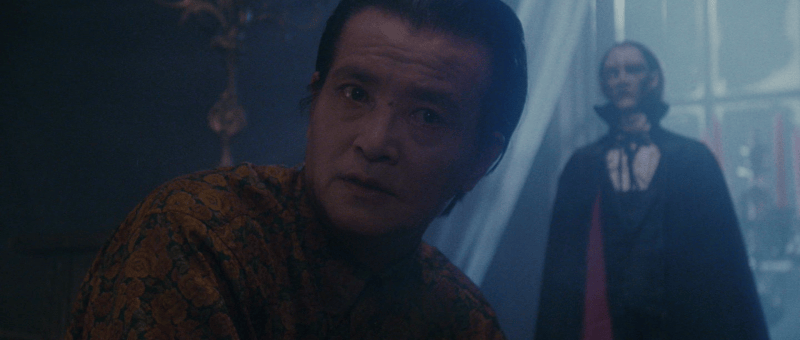
Released at the tail end of the Bubble-era, Shusuke Kaneko’s vampire dramedy My Soul is Slashed (咬みつきたい, Kamitsukitai) is one of a series of films that seems to be filled with a prophetic sense of dread and the feeling that the good times are about to come to an end. Fiercely critical of the costs of the salary man dream along with the amoral capitalism that seems to have accompanied it, the film may also be drawing inspiration from a then recent contaminated blood scandal as haemophiliacs in Tokyo and Osaka sued the government in 1989 after contracting HIV through infected transfusions.

The hero, Ishikawa (Ken Ogata), works for a pharmaceuticals company that has been accused of engaging in corrupt practices and bribing the government to be able to sell unlicensed medical products. Ishikawa is not aware of this and does not believe the rumours, so is keen to find out what’s been going on at his company. After making some enquiries and attempting to get in touch with a friend in the media, however, Ishikawa is involved in a hit-and-run and taken to hospital where he receives a blood transfusion but eventually dies of his injuries.

A researcher at the same facility, Yuzuko (Narumi Yasuda), has secretly come by a pack of Dracula’s blood that was apparently lost during the recent revolution in Romania where deposed dictator Ceausescu had been experimenting with it. For reasons best known to herself, she decides to stash the blood in the “do not use” draw of the medical fridge, only for it to come to life and jump into the shelf below. Though there is some concern among the medical staff that the pack is not properly marked with a blood type or other information, other staff members become indignant on being questioned about it, so the operating team go ahead and use the unmarked pack without proper procedure being followed, which is how Ishikawa ends up receiving contaminated blood, in this case that apparently belonging to “Dracula”. A distraught Yuzuko attends Ishikawa’s funeral and tells his teenage daughter Saeko (Hikari Ishida) that, assuming she is a virgin, she can revive her father by sprinkling her blood on his ashes, which she does, though Ishikawa is not resurrected until a year later.

Ishikawa had been a loyal salaryman who worked hard and believed in his company, which is why he was so shocked by the rumours and by the suggestion of his colleague Kitahara (Takero Morimoto) that the buck stops with the company president. As a consequence of his dedication to the firm, however, Ishikawa has neglected his family and become a ghostly presence within his own home to the extent that he hardly ever sees his daughter and has, in fact, forgotten her birthday, asking his secretary to pick up a dress as a present which turns out to be too small for her to wear. Saeko appears rather indifferent towards him while is alive and has also started rebelling by staying out all night with her queer-coded, motorcycle-riding friend. Though she misses him when he’s gone, Saeko is also in favour of her mother remarrying a much more attentive man, Tokita (Kazuyoshi Kushida), who brought her a cake for her birthday and seems to fill in with all the other paternal tasks that Ishikawa never paid any attention to because he was so focused on his career.

It’s his dedication to his company that Ishikawa most regrets on being resurrected. A year has passed and his family’s already moved on, doing just fine without him, while he was scapegoated for the bribery scandal at work and died in disgrace which might explain why both Saeko and her mother are working around the clock to support themselves. He realises that even though he’s come back, he is not the same person and he cannot simply slot back into his former life even if he’s been able to forge a new relationship with Saeko who declares that she doesn’t care if he’s Dracula, he’s still her father and a good person. At the same time, Ishikawa comes to accept his new Dracula persona as a potential means for good, insisting that there are plenty of bloodsucking people in the contemporary society and Dracula doesn’t seem too bad by comparison.

The interesting this is that Yuzuko’s attraction to him also seems to be bound up with his position as a father, having lost her own at a young age. Yuzuko’s father was apparently one of the foremost Dracula researchers in the world who also helped countless vampires return to being human, even if it didn’t work for everyone and some ended up as ashes once again. Though dating an age-appropriate colleague, she complains that he’s “too young” for her, and longs for the centuries-old embrace of Dracula which is also a reflection of her quasi-incestuous desire for her father whom she never really knew. On the other hand, Saeko comes to a new appreciation of her now anti-corporate dad and resolves that, though she may have his workaholic blood, she won’t sacrifice herself for a company and will earn a living doing something she likes while hanging out with her maybe girlfriend.

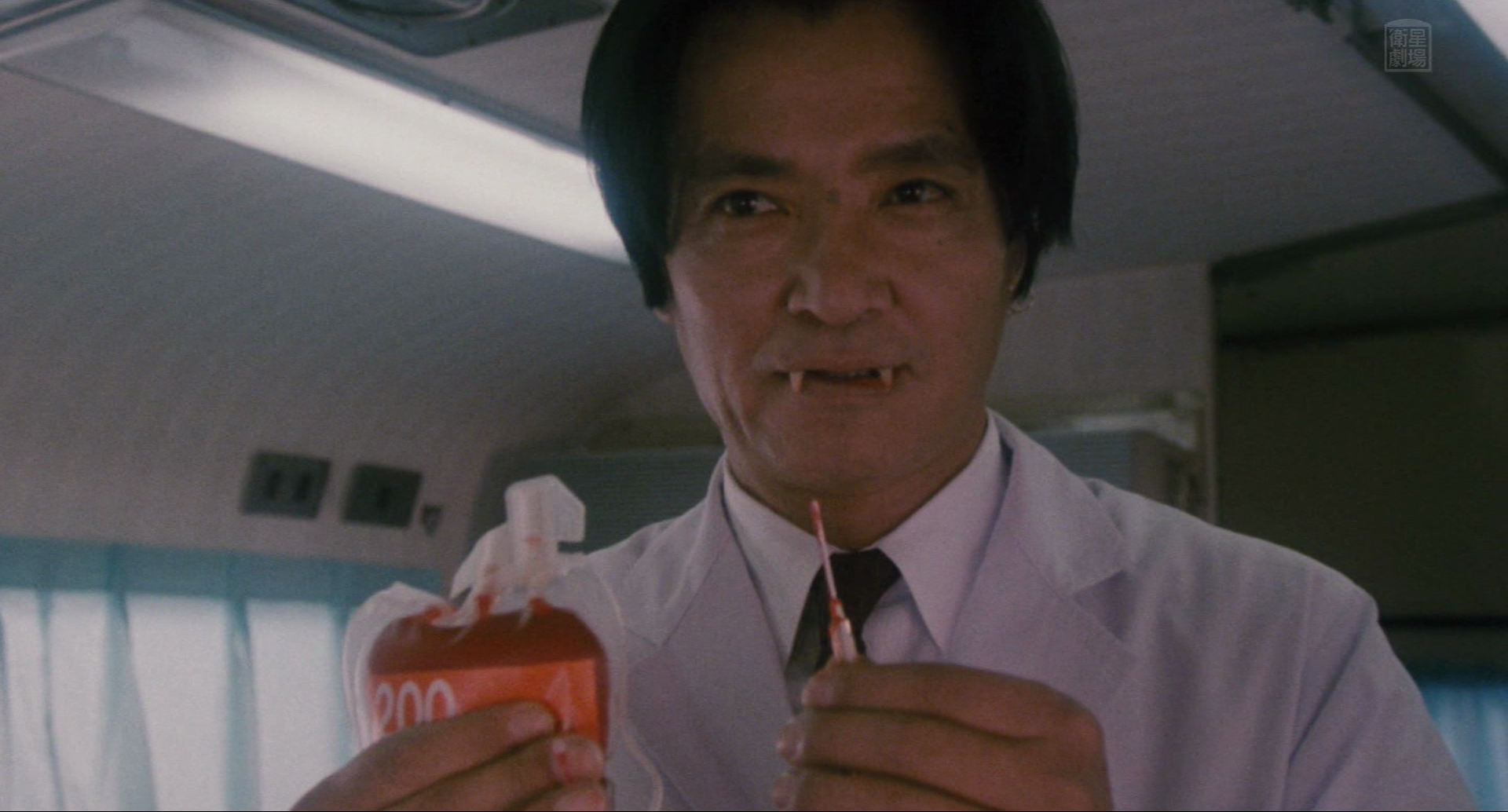
Which is all to say, Ishikawa is more alive now he’s “dead” than he ever was while his heart was still beating. Using his Dracula powers to expose the company’s wrongdoing and force his killer to confess live on air, he turns his back on culturally defined notions of corporate success and retreats to live a quiet life with Yuzuko, who has also become a vampire, in a travelling blood donation van. “Clean blood is rare these days,” Ishikawa reflects hinting at the various corruptions of the late Bubble society which itself heading for an implosion. The project apparently started because Ogata wanted to play a role completely against type, which he undoubtedly does, in embodying an incongruous source of vampiric paternal authority that is determined to live outside the system rather than chase corporate success.
Empire of Kids (ガキ帝国, Kazuyuki Izutsu, 1981)

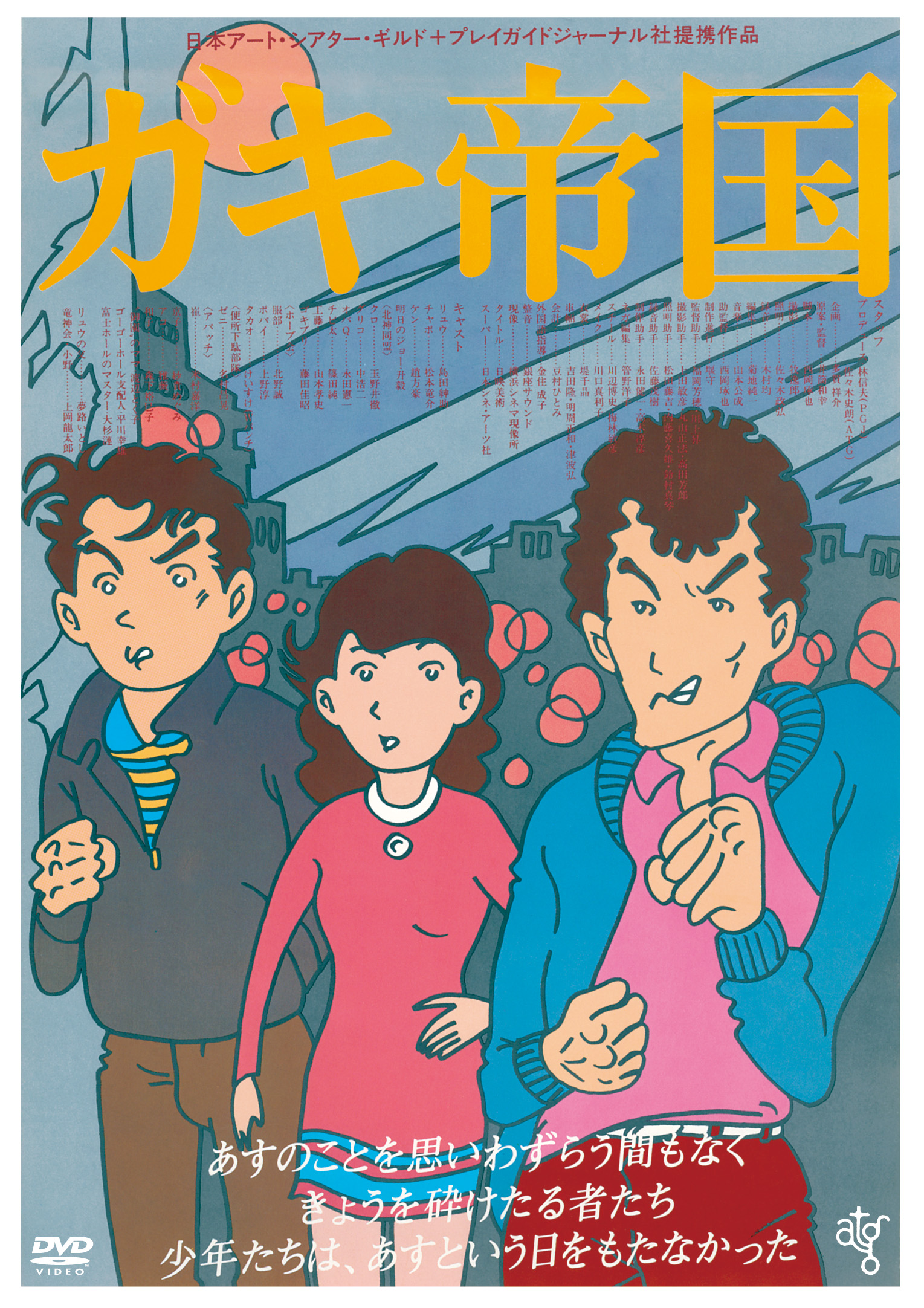
Empire of Kids posterJapan in 1981 was a vastly different place than the Japan of 1967. Rising economic prosperity had produced an amiable social calm in which desire for conventional success and increasingly aspirational consumerism had replaced the firebrand need for social change which had defined the previous decade. Filmmaker, film critic, and sometimes outspoken TV personality Kazuyuki Izutsu was presumedly not a huge fan of consumerism and for this, his first “mainstream” film made for ATG, retreats back to the Osaka of 1967 in which petty street punks lamented their lack of opportunities by banding together and battling for control of their respective neighbourhoods like boys in the schoolyard only armed with knives and filled with nihilistic desperation.

The film opens with our “hero”, Ryu (Shinsuke Shimada), being released from juvie after presumably getting into trouble for his petty punk antics. Waiting for him are his two best friends – soulful zainichi Korean Ken (Cho Bang-ho), and rockabilly Chabo (Ryusuke Matsumoto). Ryu is released alongside another boy, Ko (Takeshi Masu), whom he tries to recruit into their mini gang but quickly becomes an enemy, teaming up with the boys’ rivals – the Hokushin Alliance, while also becoming a potential rival for Ryu’s old girlfriend with dancing dreams, Kyoko (Megumi Sanuki). The boys, still in their last year of high school, become obsessed with trouncing their competition, proving their manhood on the streets while asserting their rightful place as the dominant forces in their native area, but as it increases in intensity the game becomes frighteningly serious and its dangers all too apparent.

Izutsu’s film fits comfortably into the “delinquent” genre but perhaps takes its cues from the Hollywood cinema of alienation more than the tough guy antics of the youth movie past. From Chabo’s bright red jacket and neatly greased quiff, the starting point is Rebel Without a Cause as these otherwise not too bad kids struggle with their place in the world, unable to see a clear path and direction for themselves in the society of 1967 which seemed both frustratingly open and closed to unremarkable lower middle-class boys. Ryu’s brother is going to give up football to go to cram school so he doesn’t end up like Ryu, while Ryu has taken to reading brain training books to try and get back on the academic path to success which he fears may have already passed him by. Ken, idly talking of the future, can’t see much beyond winding up in the yakuza, opening a bowling alley, or maybe becoming a comedian (this is Osaka after all). None of these guys is going to university or getting a salaryman job, they know not much awaits them outside of low-paid manual work, marriage, children, family and death, so they take their frustrations out on each other playing at gangsterism out on the streets.

For Ryu, Ken, and Chabo the reasons for their violence are “honourable” – they want to keep their local space local and are committed to defending it from the “external” threat of the shadier street punks from uptown. Apparently from stable economic backgrounds, the boys’ acts of street justice have no particular economic component, in contrast to those of the Hokushin Alliance which positions itself as a yakuza training school with a brutal hazing regime for new recruits and a business plan which involves hunting young women and trapping them through rape and blackmail to force them into prostitution. 

Aside from lack of direction, Ken – the most introspective of the boys, also has to deal with the constant threat of discrimination due to his roots as an ethnic Korean living in Japan. One of the reasons he hates the Hokushin Alliance and distrusts some of the other gangs is that they deliberately target Koreans in racially motivated attacks. One of his old friends, Zeni (Masaaki Namura), is a member of an all Korean street gang which attempts to defend itself against the strong anti-Korean sentiment out on the streets but finds itself outgunned by the sheer weight of numbers. Ken speaks Korean openly with his friends (even when there are non-Koreans close-by) and has no interest in hiding his ethnic identity even if he uses his Japanese name in his every day life, while Ko (whom we later realise is also ethnically Korean) hides his ethnicity completely and subsumes himself into the Hokushin with a view to finally joining the yakuza even whilst knowing that the gangs he has joined are extremely prejudiced against “foreigners” and Koreans in particular. Ken would never out someone deliberately, but finds Ko’s attitude difficult to stomach, not only in his willingness to hide his roots to fit in with gangster thugs, but in his willingness to persecute his own in order to do it.

The atmosphere that surrounds the boys is one of intense futility. They fight each other pointlessly, like children in the playground, and it’s all fun and games until someone reaches for a knife. Petty disputes quickly escalate when the yakuza gets itself involved in children’s games – an assault rifle, after all, has little place in a kids’ disco where teenagers come to drink Coca Cola and slow dance to a terrible covers band singing the “uncool” music of the day. Despite the melancholy air of frustration and inevitability, Empire of Kids (ガキ帝国, Gaki Teikoku) adopts the otherwise warm and nostalgic tone of the Japanese teen movie, embracing the typically Osakan need for spiky comedy even as our guys fall ever deeper into the hole their society has cut out for them. There are few rays of sunshine to be found here, friendships are broken, trusts betrayed, and futures ruined but then again, that was only life, in Osaka, in 1967.


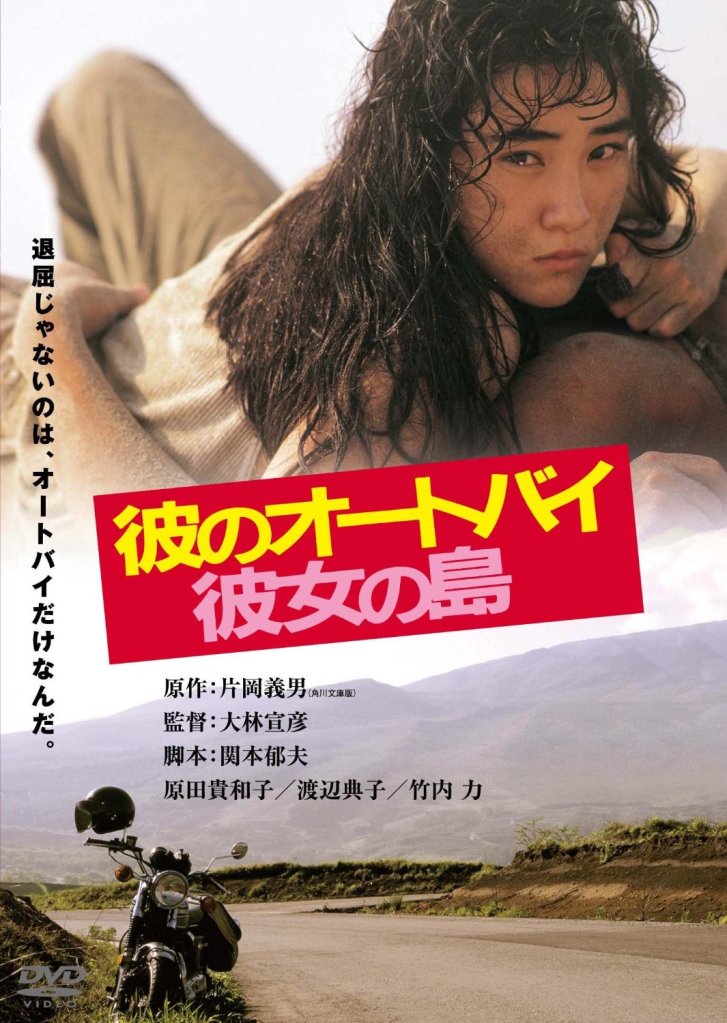
His Motorbike, Her Island (彼のオートバイ彼女の島, Nobuhiko Obayashi, 1986)

His Motorcycle Her IslandLike many directors during the 1980s, Nobuhiko Obayashi was unable to resist the lure of a Kadokawa teen movie but His Motorbike, Her Island (彼のオートバイ彼女の島, Kare no Ootobai, Kanojo no Shima) is a typically strange 1950s throwback with its tale of motorcycle loving youngsters and their ennui filled days. Switching between black and white and colour, Obayashi paints a picture of a young man trapped in an eternal summer from which he has no desire to escape.

Ko (Riki Takeuchi) tells us that he’s an unusual guy because most people dream in colour but all of his dreams are in monochrome. He’s a student and dispatch rider overly attached to his admittedly very handsome Kawasaki motorbike. After getting beaten up by his boss due to deflowering the guy’s sister and then breaking her heart, Ko skips town for the open road, just him and his bike. However, he repeatedly runs into the same mysterious girl who lives on an equally mysterious island and develops a deep seated need for her, secondary only to that for his bike. Miyo (Kiwako Harada) has also taken a liking to the Kawasaki and is intent on getting her full motorcycle license. Her growing obsession with the bike threatens to become an all consuming need driving a wedge between the two young lovers.

Obayashi begins in a black and white sequence window boxed in the centre of the screen before expanding to 4:3 when Ko has his fight with his boss and only hits 16:9 for the first colour scene which sees Ko taking off on his beloved bike. He told us that his dreams are in black and white but the film seems to disagree with him, segueing into various gradated colour schemes as Ko narrates his melancholy tale of tragic lost love. Ko is not necessarily a very reliable narrator in any case, but in each instance the on screen action is always coloured by the recollections of the older man who offers his voice over commentary.

Like many Obayashi films, the overriding feeling is one of melancholy mixed with a youthful apathy.  This is a story about modern young people, but refracted through rebellious ‘50s movies from Rebel Without a Cause to The Wild One and a hundred others inbetween. Ko is a university student (of what we don’t know) but seems to have no great ambitions. He takes things as he finds them and his only passion is the bike itself. When he first meets Miyo and she asks him where he’s going, he simply replies that he’s “looking for the wind” – a motif which recurs throughout the film.

Later on when he arrives at Miyo’s island, it takes on an opposing symbolism to his bike. Just as Miyo can’t get enough of the Kawasaki, Ko is originally attracted to the island much more than to the girl. It’s not quite a coincidence that each time he visits there it’s the Bon festival where the dead are temporarily allowed to return to the world of the living. Later he says that Miyo wasn’t just a girl but an island, and he wan’t just a boy but a bike, and together the two of them became the wind. They became one entity, inseparable one from the other. Finally the esoteric colour scheme begins to make sense, we’ve been watching a ghost story all along. This island is an unreal place, existing only inside Ko’s memory where Miyo waits for him with a full tank of gas.

Once again youth is seen as a brief yet unforgettable period filled with longing and regret. The older man is forever trapped by this one glorious summer, a place to which he can never return but neither can he escape. The nihilistic tone and voice over narration have an edge of the French New Wave but ‘50s American cinema of alienation seems closer to Obayashi’s intentions. An elliptical and strange tale of tragic love retold as a ghost story, filled with phantoms of memory and landscapes coloured by dream and emotion, His Motorbike, Her Island is another characteristically offbeat effort from Obayashi which once again embraces the aimlessness of youth and age’s regret.


Unsubtitled trailer – goes through to a video of Kiwako Harada singing the title song, in case you were in any doubt what this movie is for.

Or, here is the film’s opening (which also features the title song)