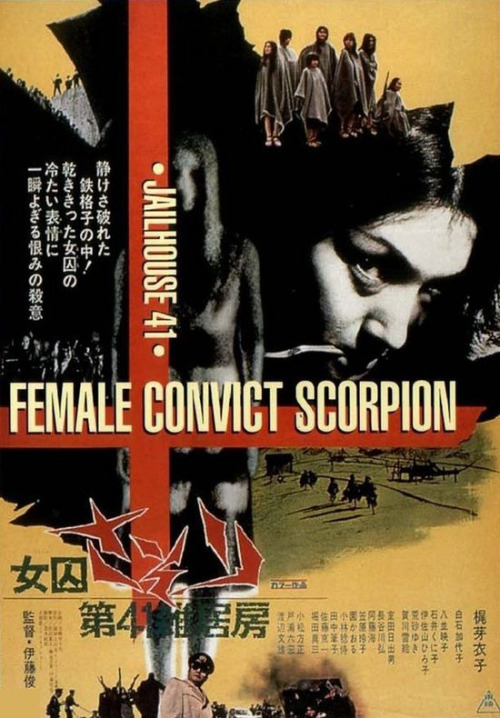
Female Prisoner Scorpion: Jailhouse 41 (女囚さそり第41雑居房, Shunya Ito, 1972)

scorpion-2Female Prisoner Scorpion: Jailhouse 41 (女囚さそり第41雑居房, Joshu Sasori – Dai 41 Zakkyobo) picks up around a year after the end of Female Prisoner #701: Scorpion and finds Matsu (Meiko Kaji) tied up in a dingy prison basement, apparently left bound and in solitary confinement for the entire interval. Once again directed by Shunya Ito, the second instalment in the Female Prisoner Scorpion series is another foray into the women in prison field but Ito resolutely refuses to give in to the exploitative genre norms, overlaying his tale of individualistic rebellion with an arthouse sensibility that has a much wider scope than its ordinary vengeance driven narrative may suggest.
Matsu may have been lying bound and gagged in a dingy underground hole for the best part of a year but today is a special day and sadistic prison warden Goda (Fumio Watanabe) is going to let her out to be shown off in front of a visiting inspector who’s paying a final visit before Goda is promoted to a top job in Tokyo. When Matsu makes a lunge for Goda, the inspector is so afraid that he wets himself, sending the other woman into a frenzy and resulting in a riot. Once again the entirety of the prison is punished, but this time Matsu is singled out for a public punishment gang rape by Goda’s goons. This kind of humiliation is too much for her fellow prisoners who instantly turn on her, but their violence provides an opportunity for escape and before long Matsu is on the run, again.

At the end of the first film, Matsu had accomplished her first round of vengeance – against the man who orchestrated her downfall and the men who secured it, but ultimately she wound up a female prisoner once again. Though Goda may have had her hidden away because of her habitual escapism, Matsu had not given up as we see from her attempts to scrape the floor away with her spoon held tight in her mouth. Barely speaking, Matsu is an unstoppable column of pure rage but an elegant one, supported by her self contained restraint.

Her anger this time is directed towards Goda himself, especially after his despicable organised punishment rape that was designed both to break her own spirit once and for all and also to damage her in the eyes of her fellow inmates who are intended to see her defeated and destroyed. The guards are a stand in for society at large, using sexual dominance and social position to keep their women in line. The visiting prison inspector makes a point of telling Matsu that “they” don’t hate her personally – they’re there for her, to help her “recover” and become a functioning member of society. Which is ironic because Goda does hate her personally as he holds her responsible for the damage to his eye sustained in the previous film. His last act before moving on is one against Mastu – an attempt by the forces of authority to crush her individual rebellion and use their victory as a coercive tool to force others to conform.

In this way, Matsu’s position as a member of a subjugated class is less important than her status as an agitator but these are women who have each suffered at the hands of men. As an extremely theatrical sequence sung in the traditional form informs us, the women who escaped with Matsu committed their crimes out of love or jealousy. Poisoned rivals, dead lovers, even children murdered to get back at their philandering father in some Medea level psychotic rage which ruins the perpetrator even more than the intended victim.

Later while the women are enjoying their brief taste of freedom, one of them is brutally raped and murdered by a troupe of feral men who boast about the wartime atrocities they committed before descending on a lone woman like a pack of rabid dogs. The others take their revenge for their friend, but also for all the women who have met a similar fate inflicted by a male dominated society which sees them as something to be controlled and then made use of, little more that cattle hemmed in and milked until dry.

As in the first film Ito makes use of expressionist techniques and strange angles to give his film a more elevated feeling that might be expected but this time he adds in a surrealist, spiritual dimension as with the old woman who sings the stories of our heroines and then dies only to bury herself in leaves and disappear into the ether, like some forgotten deity of misused women. Likewise, when one of the prisoners is raped and murdered, the men throw her body into a nearby river like an empty beer can but the waterfall behind her suddenly runs with blood as an expression of the violence which pollutes the natural world. A bus suddenly splits in two, separating our subjugated women from the violent men who mentally sentence them, given free reign simply because of their sex. Ironically enough, our last glimpse of of Matsu takes place in the reflection of Goda’s glasses and then in his false eye when she is suddenly rejoined by her compatriots for a triumphant dance of freedom on a city rooftop.

Even stronger than in the original Female Prisoner #701 Scorpion, Jailhouse 41 further advances its ideology of free individuals battling the conformist authority of the state all filtered through the prism of the patriarchy. Matsu’s vengeance is personal, she keeps her distance from the other women who do not seem inclined to band together to oppose the forces which oppress them so much as seek a wary, temporary alliance of necessity, but seeing them all reassembled in spirit at the end brings a larger dimension to Matsu’s victory which now seems much less like solving a practical problem than a deliberate strike at a wall which was solely designed to keep a certain group of people in their place. The jail is broken, all that remains is to choose to escape its restraints.


Original trailer (English subtitles, NSFW/gore)

Twinkle (きらきらひかる, Joji Matsuoka, 1992)

TwinkleThe end of the Bubble Economy created a profound sense of national confusion in Japan, leading to what become known as a “lost generation” left behind in the difficult ‘90s. Yet for all of the cultural trauma it also presented an opportunity and a willingness to investigate hitherto taboo subject matters. In the early ‘90s homosexuality finally began to become mainstream as the “gay boom” saw media embracing homosexual storylines with even ultra independent movies such as A Touch of Fever becoming unexpected box office hits. Based on the book by Kaori Ekuni, Joji Matsuoka’s Twinkle (きらきらひかる, Kira Kira Hikaru) tackles this subject head on in examining the changing nature of the modern family as personal freedom and greater social liberalism conflict with familial duty and centuries old tradition.
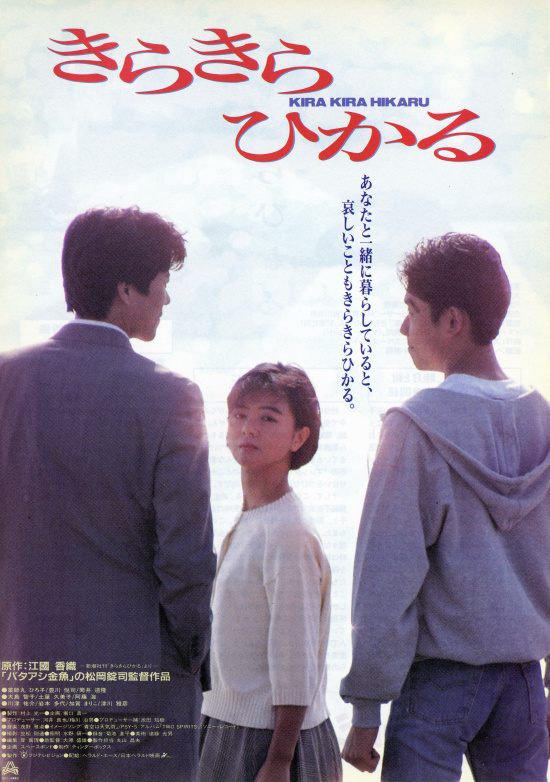
We first meet Shoko (Hiroko Yakushimaru) in the office of a doctor who assures her that her “problems” are nothing to worry about and the best thing to do is find “a nice man” and get married after which she’s sure to feel much better. On the taxi ride home, her mother suddenly pulls out an omiai photo she’s apparently been carrying in her bag the whole time and proposes Shoko try meeting this particular prospect just as the doctor suggested.

Her “date” is Mitsuki (Etsushi Toyokawa) – an unmarried middled aged doctor who doesn’t seem very interested in the omiai business either. After a brief period of bickering, Shoko and Mitsuki get some time to themselves at which point Mitsuki reveals that the reason he isn’t married is because he has a boyfriend. Despite this, the pair come to an understanding and decide to get married to finally get their relatives off their backs. However, if they thought the pressure would go away after the wedding, they were mistaken. Though both sets of parents know about their children’s reasons for originally avoiding marriage, they don’t know about those of the spouses and when they find out it’s just going to get even more complicated.

We don’t find out exactly what “problems” Shoko may have had in the past. On the morning of the omiai her family dog dies meaning she has an obvious reason to appear visibly upset, yet she also displays symptoms of ongoing depression right the way through the film, flitting between upbeat cheerfulness to impulsive behaviour and crying fits. She also has a long standing drink problem which can result in dangerous accidents such as an incident where Mitsuki returns home to find her passed out on the floor with the iron in one hand and an empty glass of whiskey apparently fallen out of the other.

Mitsuki is in a relationship with a much younger college student and, though they don’t seem to go out of their way to hide their relationship, they can’t exactly be open about it either. Kon did not approve of Mitsuki’s decision to get married and has been avoiding him but Shoko is keen for the two men’s relationship to continue, eventually befriending the young man and bringing him home as fully fledged member of their family. Mitsuki finds this arrangement quite confusing, trapped between two spouses and feeling a responsibility to both of them. In one notable exchange he’s asked to make the relatively simple choice between strawberry and vanilla ice-cream, but the question has taken on a much wider implication than just tonight’s dessert.

The arrangement starts out well enough, except that the growing affection between the married couple eventually begins to place a wedge between them, each knowing that they can never truly satisfy the demands of the other. Not satisfied with a marriage, the parents also expect children which is going to require medical assistance given the circumstances, but Mitsuki is still unsure about taking this next step. Shoko, though experiencing a intensification of her emotional volatility, now suggests a truly radical solution for the early ‘90s – that she undergo artificial insemination using the mixed sperm of both Mitsuki and Kon to essentially have “their” baby.

Shoko and Mitsuki are both trapped, in a sense, by their societal obligations – particularly that of producing children. Mitsuki’s parents know he’s gay, though they tolerate more than accept, yet they still pressure him into fathering a child for appearance’s sake alone. His father had come to terms with his son’s sexuality, even if Mitsuki refers to himself as a son who has “betrayed” his father, but he was against the marriage viewing it as cruel and irresponsible. Once Shoko’s parents discover the real reasoning they try to take over, ignoring Shoko’s views (and even her first clear stating of her problems with alcohol), acting as if they were the injured party.

Though slightly older, Shoko and Mitsuki have found themselves at the centre of a generational conflict as they fight to free themselves from parental control even in adulthood. The future they propose for themselves is an unusual one and unlikely to be accepted by society, yet it is finally their own decision and only by unshackling themselves from the same social pressures which brought them together can they learn to forge a new future. Ten years later, Ryosuke Hashiguchi’s Hush! would suggest a similar scenario which, though still not universally accepted, is greeted with much less resistance than the entirely radical arrangement of Shoko, Mitsuki, and Kon. An interesting look at the changing nature of  social bonds in the immediate post-bubble era, Twinkle is a melancholic though ultimately hopeful tale of three individuals who might be able to provide the stability each needs if only they can learn to withstand the overwhelming external pressures.


Original trailer (no subtitles)

https://www.youtube.com/watch?v=zN2m8GMmuqM

No Grave for Us (俺達に墓はない, Yukihiro Sawada, 1979)

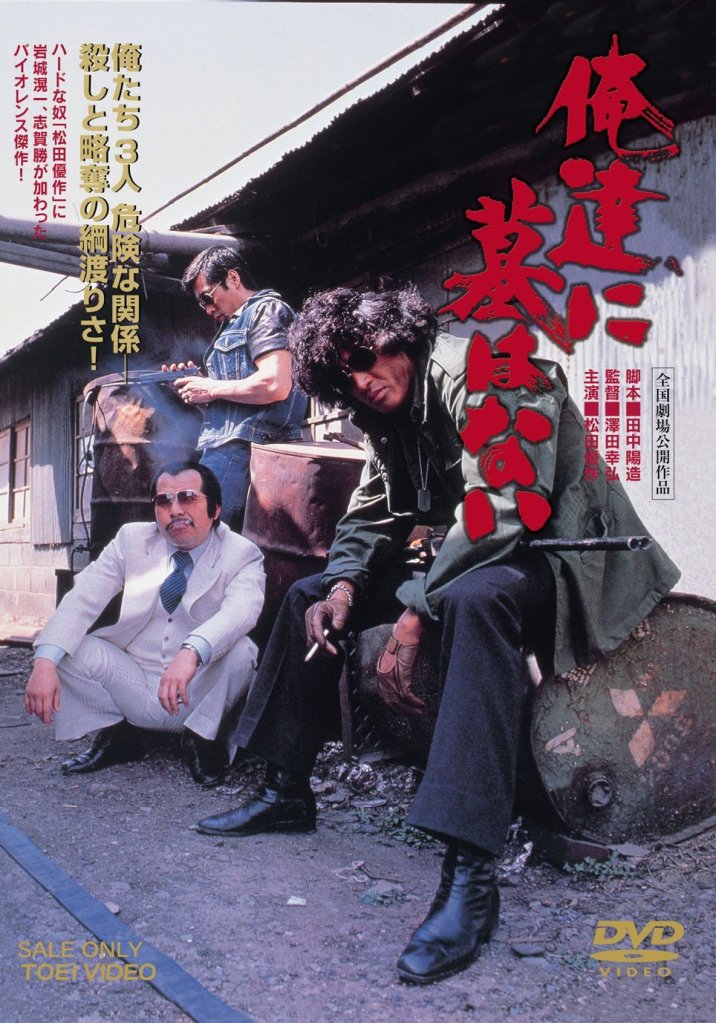
No Grave for Us posterThough he might not exactly be a household name outside of Japan, the late Yusaku Matsuda was one of the most important mainstream stars of the ‘70s and ‘80s. Had he not died at the tragically young age of 40 after refusing chemotherapy for bladder cancer to star in what would become his final film, Ridley Scott’s Black Rain, he’d undoubtedly have continued to move on from the action genre in which he’d made his name. No Grave For Us (俺達に墓はない, Oretachi ni Haka wa Nai) is fairly typical of the kinds of films he was making in the late ‘70s as he once again plays a cool, streetwise hoodlum mixed up in a crazy crime world where no one can be trusted.

The film begins with a humorous incident in which a man sets fire to a small parcel in the ladies’ area of a department store and loudly starts shouting about a bomb before using the resulting panic and chaos to calmly extract the money from the nearby tills. His plan is going perfectly except for one cashier who’s rooted to the spot, confused by the rat who lives under the counter who isn’t perturbed by the presence of a “bomb”. Shima makes off with his money and starts planning a new job which he plans to carry out with his longtime friend and brother in arms Ishikawa. The pair carry out a robbery on a rival gang but an ex-yakuza, Takita, tries to make off with the loot. Shima and Takita bond and agree to split the money but Ishikawa gets captured and subjected to humiliating treatment by the gangsters. The intrusion of Takita and of the resurfacing problematic shopgirl, Michi, slowly drive a wedge between the previously inseparable Shima and Ishikawa.

No Grave for Us is, as the title suggests, a noir inflected B-movie in which the lowlife punk Shima contends with the various trials and tribulations associated with a life of petty crime. Child of an uncaring society, he’s been in and out of trouble since adolescence. He met Ishikawa when the pair were both in reform school together, Shima for assault and Ishikawa for drug related offences. Shima is not a drug user and seems to disapprove of his friend’s habit but makes no great protest against it. When Michi turns up at Ishikawa’s bar (just by coincidence) she’s lost her job at the department store after being accused of taking the money that Shima stole. It turns out that she too is a junkie and has been living a life of dissipation since being picked up for prostitution during middle school. She fits right in with Shima and Ishikawa but, predictably, begins to prefer the more assured Shima to the loose cannon Ishikawa which begins to present something of a problem for the pair.

Shima and Takita originally reach an understanding based on a gangster code of honour which they both understand. Ishikawa aside, the pair would make a good team but their growing comradeship only adds to Ishikawa’s sense of insecurity causing him to take matters into his own hands with fairly disastrous consequences. A misunderstanding makes Takita and Shima mortal enemies putting an end to any kind of alliance that might have been possible. There’s no comradeship here, no true friendship. Every relationship is a possible betrayal waiting to take place, every warmth a weakness.

Director Yukihiro Sawada had mostly worked in Nikkatsu’s Roman Porno line other than co-helming Sogo Ishii’s first feature, Panic High School, the previous year but No Grave for Us is refreshingly light on exploitative content. There is some brief nudity but nothing particularly out of keeping for a regular studio picture of the time. Likewise, the fights are of a more realistic nature and bloodshed kept to a minimum. The look of the film is also very typical of its era though Sawada only rarely uses the extreme zooms which are the hallmark of ‘70s cinema opting for a more straightforward, often static, approach. The film’s jazz inspired score also helps to bring out its noir undertones as these three guys who could have been allies find themselves turning on each other for the most trivial of reasons.

In many ways there’s nothing particularly special about No Grave for Us save for being an excellent example of mainstream action cinema in the late ‘70s. The film is full of knowing references to other recent genre hits as well as popular culture of the time including a lengthy tribute to top idol group Pink Lady whose song Zipangu also features on the soundtrack, and has an all round “cool” sensibility to it that was no doubt very popular at the time of its original release. An enjoyable enough genre effort, No Grave for Us is an impressively handled slice of late ‘70s noir inspired B-movie action but perhaps has little else to recommend it.


Unsubtitled trailer:

and a clip of Pink Lady performing Zipangu, just because