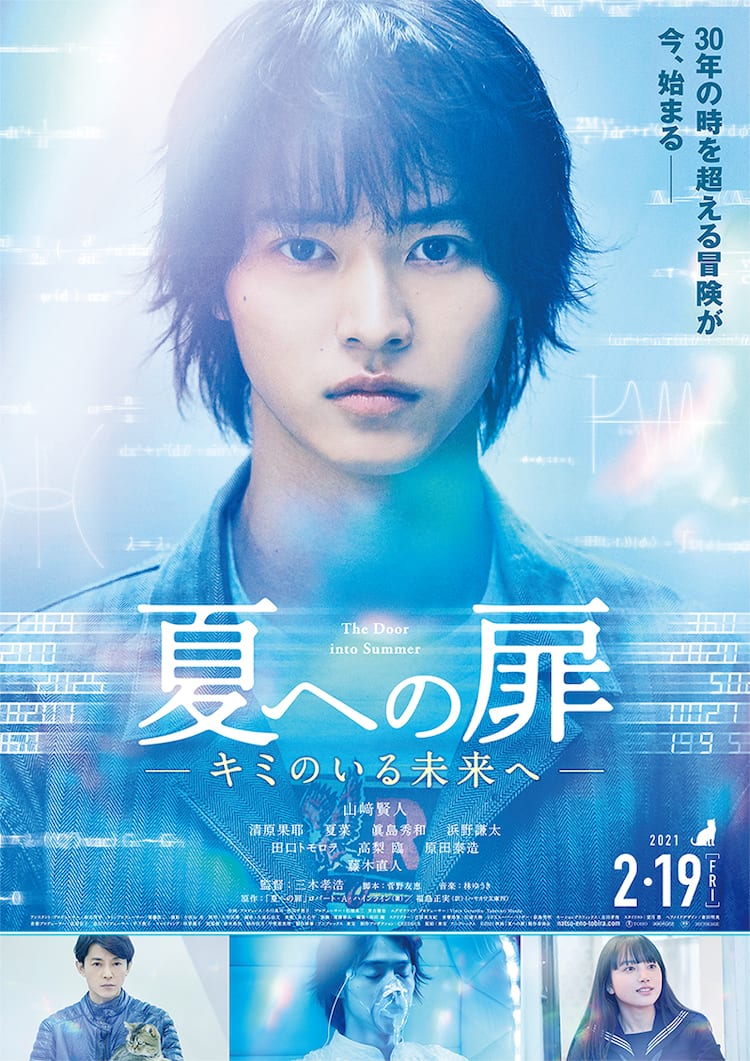
The Door into Summer (夏への扉 ―キミのいる未来へ―, Takahiro Miki, 2021)

Takahiro Miki has made something of a name for himself with a particular brand of bittersweet youthful romance often featuring a fantastical element such in Girl in the Sunny Place, or My Tomorrow, Your Yesterday. Adapted from a novel by Robert A. Heinlein, The Door Into Summer (夏への扉 ―キミのいる未来へ―, Natsu e no Tobira: Kimi on iru Mirai e) is in many ways more of the same, repurposing a sci-fi-inflected, slightly uncomfortable love story as an inspirational tale of never giving up and learning to overcome personal trauma in order to seek true happiness. 

In 1995, 27-year-old Soichiro (Kento Yamazaki) has experienced a lot of loss in his life. His mother passed away soon after he was born, followed by his father when he was 17. He was then taken in by a family friend and became a big brother to then 7-year-old Riko (Kaya Kiyohara), but his adoptive parents then died in a plane crash. While Riko went to live with her uncle Kazuto, Soichiro became a robotics prodigy with an internalised sense of despair that prevents him making lasting connections, believing that his fate is always to lose everything he loves. His prophecy is in a sense fulfilled when he’s duped into signing away some of his shares in the robotics company founded by his adoptive father by an unscrupulous colleague. Filled with despair, he decides to enter a cryostasis programme for 30 years intending to transfer his remaining stocks to Riko, in part avoiding the inappropriate crush she has on him and hoping to escape from reality along with his best friend/cat Pete to start again in another time when the programme promises his investments will have matured leaving him with a good quality of life. Before he can do that, however, an attempt to confront his wrongdoers backfires when he’s placed into their proprietary cryosleep programme to ensure he’s out of the way for the next three decades. 

To that extent, you’d have to wonder why they’d bother rather than just getting rid of him for good. In any case, when he wakes up he realises that the shady company that housed him, Mannix, went bust years ago leaving him with no savings and also no cat because his enemy didn’t give much thought to poor Pete. In the future, however, he gets a fancy new rogue robot companion, also called PETE, who supports him as he tries to adjust to the digital world his inventions helped create before realising that he must have at some point time travelled back to 1995 to put things “right” (to a certain extent) so that could happen and starting in on that. This accidental paradox is never really addressed, Soichiro travelling to the past because he knows he already has, but not giving himself very much time to complete the magic plasma battery that powers the future while remaining in hiding until ready to disrupt his tormentors’ dastardly plan, rescue his beloved cat Pete, save Riko, and return to the future to make sure that nothing else changes in the new 2025. 

It is indeed Pete that inspires the film’s title in his revulsion of winter weather, always insisting on checking all the internal doorways in the hope that one magically leads to summer which is a roundabout metaphor for film’s secondary message in the insistence on perseverance, never giving up or losing hope in a brighter future even it seems impossible. Nevertheless, it can’t be denied that there’s something slightly uncomfortable in the relationship between 27-year-old Soichiro and his 17-year-old adoptive sister Riko even as he repeatedly reminds her she’s still a child and should live her life with people her own age, especially given the implications of the romantic resolution which attempts to smooth over this awkwardness by placing them on a more equal footing if somewhat artificially. In the end, however, the most important tool for saving the future turns out to be companionship and unconditional support of the kind that Pete offered the orphaned Soichiro, a quality he later programs in to his over-curious robot “son”, PETE. Miki doesn’t do much with the hard sci-fi trappings of the original novel, but does in his best tradition craft an innocent romance as the hero learns to look for his eternal summer in the present rather than the past while overcoming his internalised despair in his cursed fate to embrace love and happiness. 


Trailer (no subtitles)
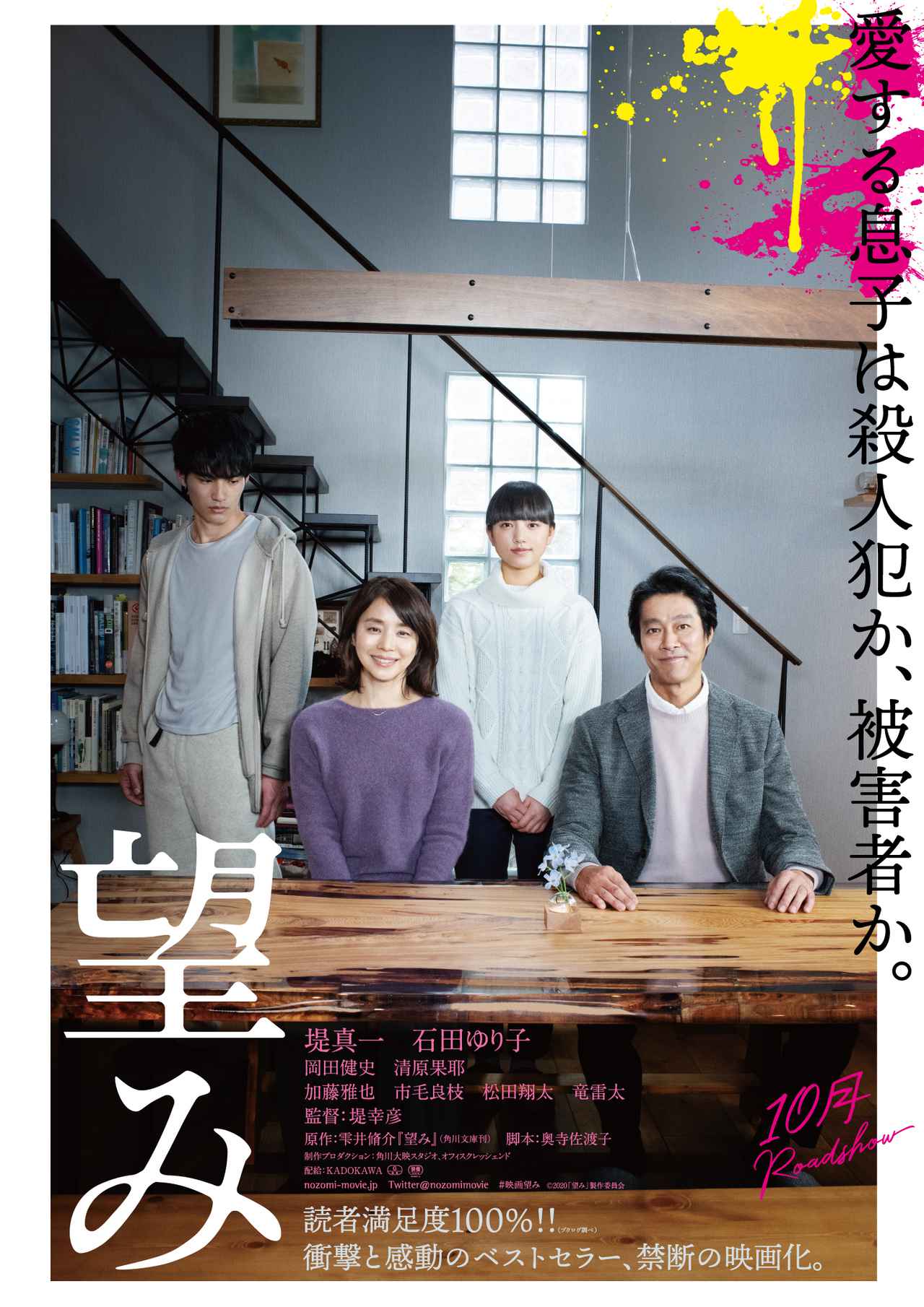
Hope (望み, Yukihiko Tsutsumi, 2020)

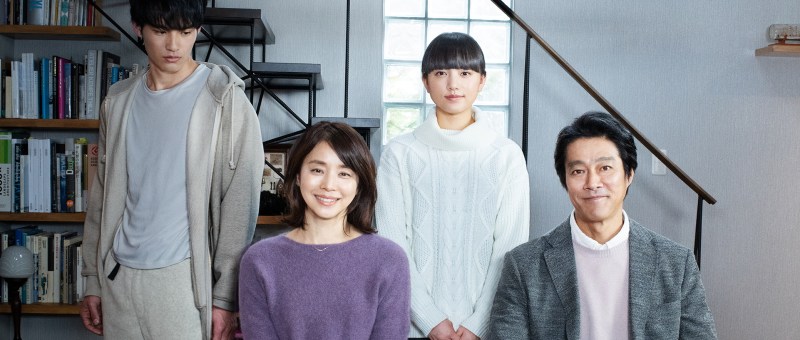
What would you prefer, that your son is alive but a murderer, or that he’s dead but blameless? That’s the dilemma faced by the family at the centre of Yukihiro Tsutsumi’s Hope (望み, Nozomi) who find themselves wondering if they really knew their son at all or had been deluded by an image of familial harmony that was only ever superficial. Meanwhile, they’re also at the centre of a media storm, on the receiving harassment from the press and neighbours, along with the potential financial strain of lost business and fracturing relationships in the local community.

Teenage daughter Miyabi (Kaya Kiyohara) tells her father that she’s read online some families have to move after a relative becomes involved with a crime, that they lose their jobs and place in the community. She’s been studying hard to get into a top high school and is worried that they may not now accept her even if she passed the exam because of something her brother may or may not have done. Some might say that a being a part of the family means that you live or die together, but there is a persistent sense of unfairness felt by all they are being made to suffer because of something over which they had and have no control.

Tadashi (Koshi Mizukami) never explained of this to them and it’s true that he had been behaving differently, was sullen, stayed out all night coming home with bruises, and had in fact recently purchased a knife but it’s difficult for them to believe that he could really have gone on the run after murdering a classmate. At the beginning of the film, architect Kazuto (Shinichi Tsutsumi) had shown off their warm family home to some prospective clients remarking that they wanted to ensure close relationships with the their children and that the design is a good opportunity to plan ahead for the next 10 or 20 years but perhaps there’s something a little hubristic in that statement. Kazuto is trying to sell an image of familial bliss that his house design can bring, but when he knocks on Tadashi’s door the boy is rude and resents the intrusion. Typical teen behaviour, the clients might think, but still it’s a minor crack in the edifice of the image of a perfect family.

But for all that it’s Kazuto who most strongly resists the idea that Tadashi may really have killed his friend and clings fast to the hope that he may be a victim too even though, as mother Kiyomi (Yuriko Ishida) points out, that might mean that he’s already dead and was killed alongside him. For Kiyomi, she just wants Tadashi, whose name means “correctness”, to be alive even if that means he really did do it. If that were the case, the family would also face constant harassment for the rest of their lives, Tadashi would be in prison for the next 15 years, and they would likely have to compensate the other family financially for the boy’s lost future and 50+ years’ worth of lost earning potential. None of that matters to her so long as Tadashi is alive, but to Kazuto it seems more important that Tadashi not be guilty and he reclaim the image he had of his son as a good and honest young man rather than a delinquent killer and bully.

Investigations among the teens turn up contradictory reports, some saying that Tadashi was aloof and arrogant while a group of girls insist on his innocence and even contemplate going to the police to help clear his name. What’s clear is that everyone seems to have taken football far too seriously and a situation among hotheaded young men went way out of control. As a policeman later says, problems often occur at this age because children who are mature enough to think for themselves start wanting to solve their own problems without worrying the adults around them but don’t always know the best way to do it and end up making everything worse. The irony may be that in the end Tadashi may indeed restore a sense of hope for his family that they can turn things around and regain a more genuine sense of familial harmony no matter what the outcome may be.


Hope screens as part of this year’s Japan Foundation Touring Film Programme.

Trailer (English subtitles)

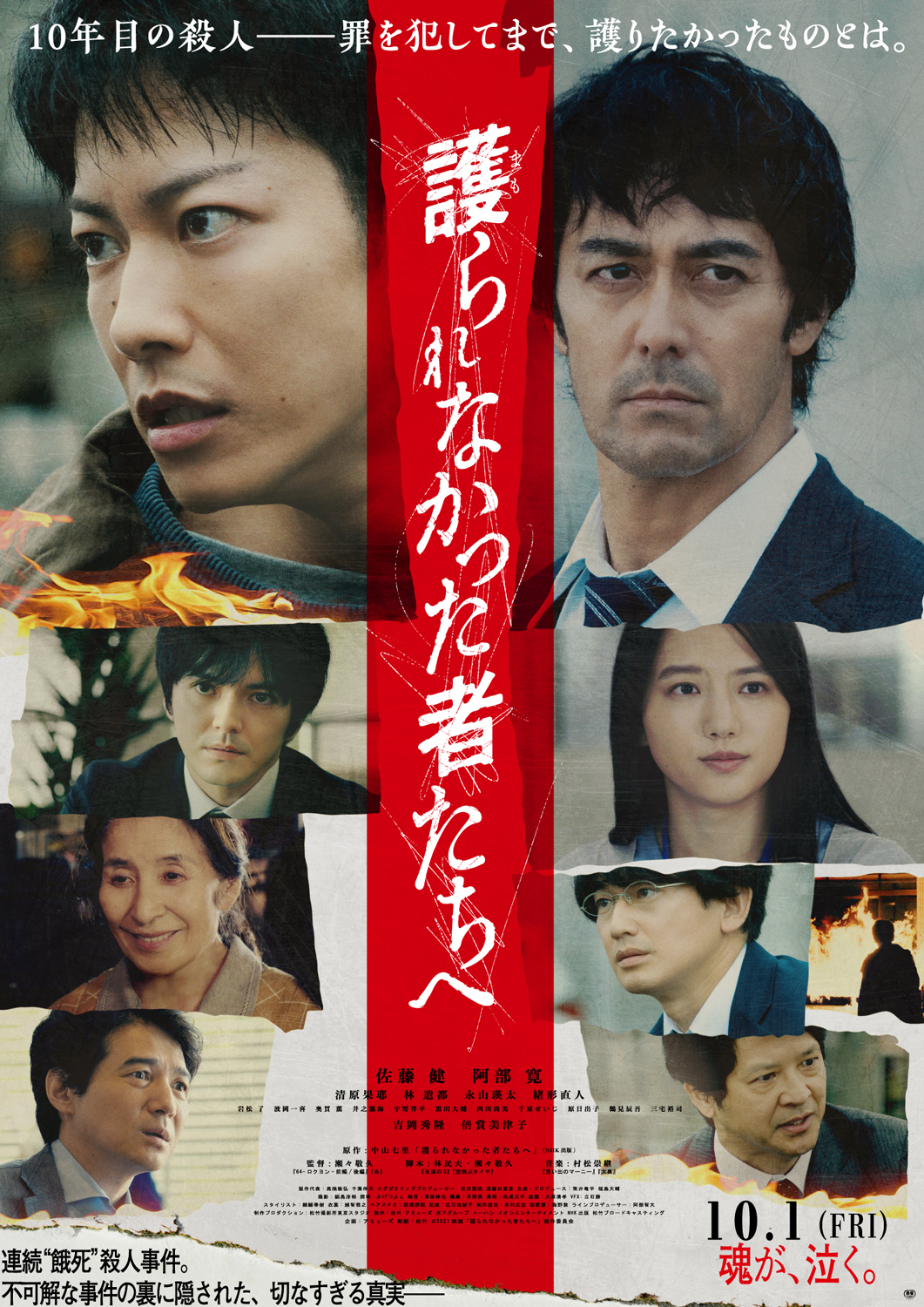
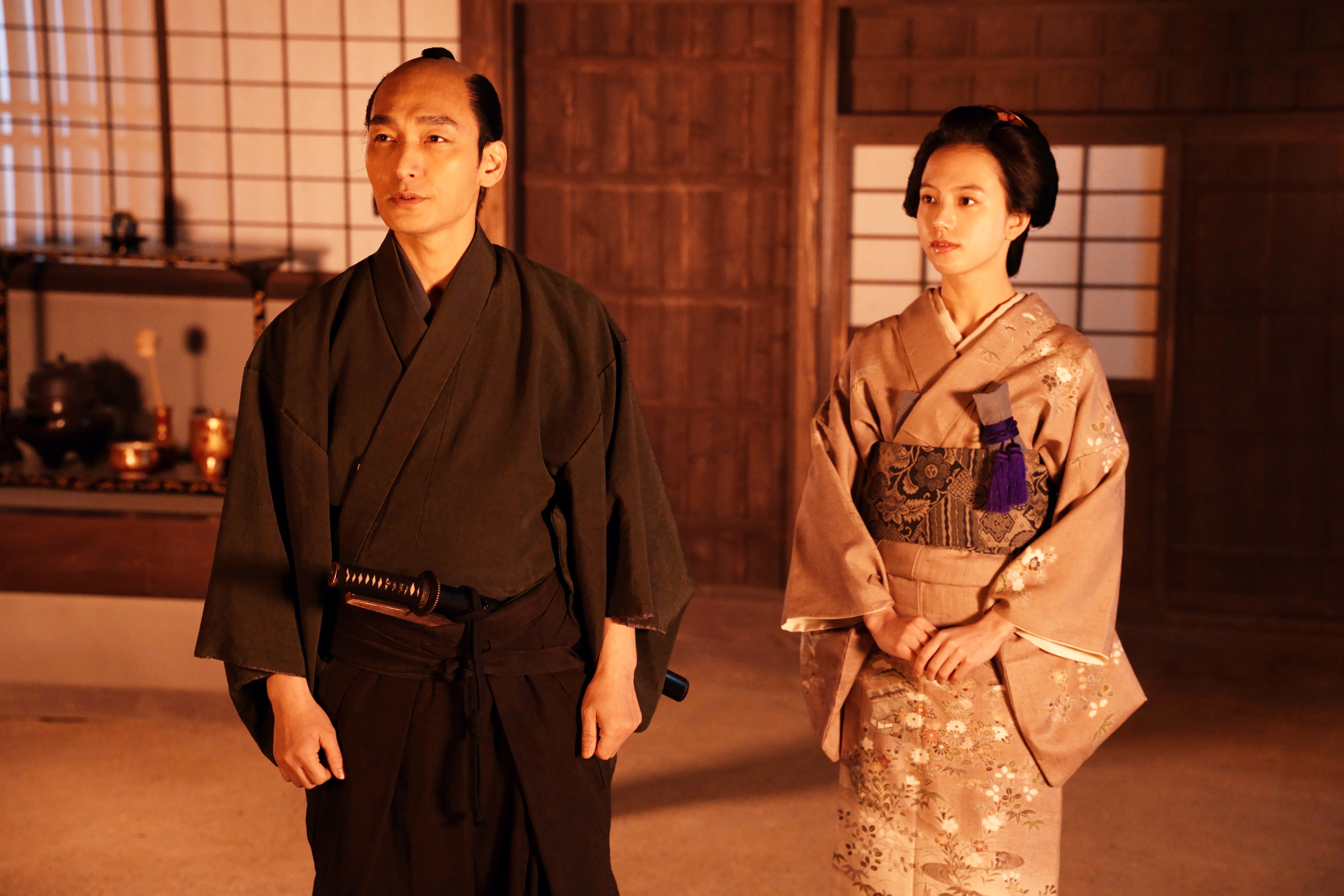
In the Wake (護られなかった者たちへ, Takahisa Zeze, 2021)

According to a young woman at the centre of Takahisa Zeze’s In the Wake (護られなかった者たちへ, Mamorarenakatta Monotachi he), natural disasters are monsters that devour humans with no rhyme or reason, but people close to her have died by human hands while left at the mercy of a hypocritical social welfare system. Though the social workers insist that benefits are something everyone is entitled to when they need support, others go to great lengths to stop anyone getting them. “That’s the country we live in,” one explains with a tone that implies he thinks this is exactly as it should be.

That social worker is the second to be found dead in suspicious circumstances nine years after the devastating 2011 earthquake and tsunami. The police obviously suspect a grudge, that someone who was turned down for benefits got fed up and killed him in revenge. But as assistant Mikiko (Kaya Kiyohara) says, it’s unlikely to be any of them because they are all “too busy trying to survive,” so they don’t have time to waste on things like vengeance. Zeze then switches to the welfare office where a social worker is trying to explain to an elderly applicant all of the different forms and documentation he’ll need to prepare for his claim. These people already have to jump through hoops to prove their “neediness,” while most of them feel defeated and humiliated in even having to ask and would prefer not to have to depend on the government. 

But a lot of Mikiko’s work involves challenging those suspected of committing benefits fraud. The first of two people she talks to is a single mother with mental health issues (Chika Uchida) who’s had to start working full-time and consequently gone over her allowance meaning her benefits should stop and she should pay back what was “wrongfully” claimed. The woman insists she needs the extra money because her daughter was being bullied for being on benefits so she wants to send her to cram school and be able to buy educational supplies, but Mikiko remains unsympathetic. The second is a man who it’s admittedly harder to sympathise with as he appears to have bought quite a fancy car which again takes him over the limit as a car is classed as a luxury item rather than a necessity. Mikiko doesn’t think they should pay out when he could easily sell the car. Of course, it’s not that simple. The man may need the car in order to work and without it would have no choice but to rely on benefits to a greater extent. In any case, he gets on Mikiko’s nerves because to her it’s people like him that prevent them helping more “genuinely” needy cases. 

But on the other hand, when they could and should have helped they refused and effectively blackmailed an old lady into revoking her application even though she had only 6000 yen (£30) left in the bank and was on the brink of starvation with no one else to turn to. Another of the social workers insists that good neighbours are the most effective way of tackling poverty which is equal parts unreasonable and unrealistic. Then again, there was a kind of solidarity that arose in the wake of the earthquake in which an old woman’s kindness saved a young man and little girl from being dragged away by the weight of their despair, giving them a new home and surrogate family along with proof of the fact that there is always someone there to help and that kind of compassion can be a kind of salvation. 

Even so, Mikiko’s insistence that you have to ask to receive, along with the welfare officer’s almost vampiric obsession with getting the applicant themselves to clearly state they need help, seems contrary to her philosophy in which it should just be provided with no questions asked. They know how difficult asking for help can be and deliberately leverage the social stigma of being on benefits to discourage people from applying for them. Citing increased demand and government cut backs in the wake of the earthquake, the social worker confusingly suggests that by declining more cases they can help more people in the long run which doesn’t make a tremendous amount of sense while his eerie grinning hints that he has begun to enjoying sadistically humiliating these vulnerable people who’ve been brave enough to come forward and ask for that to which they are otherwise entitled. 

They are all living in the wake of this disaster, something of which aloof yet empathetic detective Tomashino (Hiroshi Abe) is all too aware having lost his wife and son in the disaster. As his son’s body was never found, he too lives in a state of limbo but through investigating the killings begins to find a kind of closure along with an unexpected sense of understanding with a gloomy young man, Yasuhisa (Takeru Satoh), himself a suspect and struggling to make sense of the past, his survival, and the ongoing injustice of the world around him. The film takes its Japanese title, “those who were not protected”, from a note Mikiko writes about the importance of empathy in social work encouraging her colleagues to rebel even if their bosses tell them not to, but also hints at the grief and guilt felt by those left behind that in the end there were those they were not able to save but they can perhaps make their peace with that by continuing to help those around them even if their society largely refuses to do so.


In the Wake screens as part of this year’s Japan Foundation Touring Film Programme.

Trailer (English subtitles)

Bushido (碁盤斬り, Kazuya Shiraishi, 2024)

The hypocrisies of samurai society have led a dejected ronin into prideful penury but there is perhaps a fine line between properness and priggery that he struggles to accommodate. Like his earlier film Blood of Wolves, Kazuya Shiraishi’s Bushido (碁盤斬り, Gobankiri) is a loving homage to a classic genre, in this case jidaigeki, albeit one with a modern twist in which it’s the murkiness of the society and contradictions of its code that make it impossible to live in rather than the innate corruptions of the samurai class. 

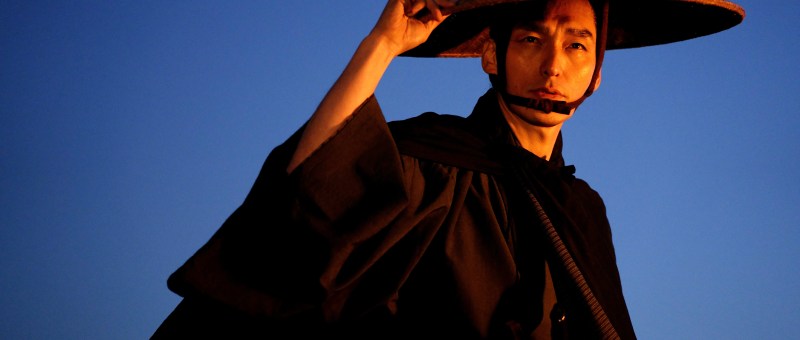
Even so, it’s samurai society which has betrayed Kakunoshin Yanagida (Tsuyoshi Kusanagi), now a seal-carving ronin living in a tenement house and months behind on his rent. Largely silent, Yanagida projects an air of calm but also a dangerous tension that hints at a deeply buried rage often echoed in the hellish glow of the candlelight that bathes his face in red. Not a natural gambler, he is nevertheless a Go enthusiast and talented player who gives the impression that he is always several steps ahead of any game in play. 

But that turns out not quite to be the case when he’s blindsided by a series of unexpected events that quickly destabilise his calmly ordered existence. Cast out of his clan after being accused of thievery, he is accused once again of taking 50 ryo from a pawn broker who had become a friend, Genbei (Jun Kunimura). Behind on his rent as he may be, Yanagida would not steal for stealing is beneath the dignity of a samurai and this stain on his honour is more than he can bear. But for all his righteousness we learn that he is also an ironic victim of his own priggishness and responsible for several other men meeting similar fates, cast out of the clan for something Yanagida turned them in for. In his reduced state, he seems to feel guilty and wavers momentarily on hearing the man who framed him for stealing a scroll from his former lord say he did so to gain money to support disenfranchised samurai but is caught between the spirit of samurai integrity and its letter. As his quarry told him, fish cannot live in water that is too clean and his oppressive enforcement of these arbitrary rules did no one any good. 

Yet his seeming righteousness does seem to improve the world around him, proving an epiphany in pawnbroker Genbei who develops a new determination for doing business fair and square after witnessing Yanagida’s conduct at the Go table. The irony is perhaps that everything on the Go board is black and white whereas Edo society is decidedly grey. Even the madam from the Yoshiwara Yanagida and his daughter are on good terms with (Kyoko Koizumi) can switch from wise mother to heartless gang boss in an instant. One moment, she’s giving maternal advice to Yanagida’s daughter Okinu (Kaya Kiyohara) and the next berating a runaway geisha who’s obviously been beaten while her lover has been killed for his transgression. The theft of 10 ryo will also it seems get you killed in this world of heartless rigidity and universal suspicion. 

Yanagida may not be much better in some respects. He is prideful and reckless, endangering himself and his daughter, whom he allows to pawn herself in the Yoshiwara knowing it’s very unlikely they will be able to repay the debt before the New Year deadline seeing nothing other than his obsession with vengeance against the man who wronged him in so many ways, Shibata (Takumi Saito). Shibata is his opposite number, cynical and amoral he subverted the samurai code for his own gain yet in its way perhaps it’s just a rebellion against the kind of austerity a man like Yanagida represented. In the end he can only escape his self-imposed prison by abandoning his rigour and accepting compromise, slashing the Go board with its black and white mentality in two though it leaves him further exiled. He cannot return to the world of samurai, but neither can he live among these ordinary people and like so many jidaigeki heroes seems to be condemned to wandering in this imperfect world. To that extent, the resolution seems much more cheerful than we might have been expecting. Everything works out, no harm done, but there’s a lingering tension even amidst apparent good fortune in a world of constant watchfulness. 


Bushido screened as part of this year’s New York Asian Film Festival.

Original trailer (no subtitles)

18×2 Beyond Youthful Days (青春18×2 君へと続く道, Michihito Fujii, 2024)

Screenshot

Apparently inspired by a real life viral blog, the latest from the prolific Michihito Fujii, 18×2 Beyond Youthful Days (青春18×2 君へと続く道, Seishun 18×2 Kimi e to Tsudzuku Michi) is in many ways in dialogue with Shunji Iwai’s Lover Letter which itself makes an appearance in the film in a allusion to a love that as the hero says never quite even began. Even so, the he, as the heroine had, undertakes a journey not so much to find himself as to recover the young man he once was before romantic heartbreak and professional strife left him emotionally numb and filled with despair.

Jimmy (Greg Hsu Kuang-han) says he’s on a journey with no destination, and perhaps, he is though it’s clear there is an end point in sight only one he’s reluctant to go to. It’s never quite clear to what extent the film intends its big reveal to be quite so obvious, though it seems clear enough that this is a tale of lost love and a circular journey towards a new beginning. After being kicked off the board at the games company he started, Jimmy catches sight of an old postcard soaked in the perfume of a girl he once new perhaps ironically called the flow of time. It does indeed call him back to the past, sending him on a trip to Japan where he too encounters various people who help him to reaffirm himself during a solo trip towards the nexus of his emotional pain.

Back in Tainan 18 years previously, he developed a crush on a young Japanese woman, Ami (Kaya Kiyohara), who rocked up at the karaoke bar he was working at the summer before uni and asked for a job having lost her wallet. Ami is four years older than him and perhaps sees his clumsy attempts at courtship as childish even as he earnestly brushes up his Japanese to be able to converse with her but otherwise treats him warmly if keeping him at arms length. In his own recollections, Jimmy was a clueless teenager who never really picked up on the pregnant hints Ami was leaving him in her sometimes cryptic comments and confusing behaviour but nevertheless went into a massive sulk on hearing she planned to return to Japan wasting precious time with her and almost ruining the memories of their tentative relationship by allowing it to end on a sour note.

The 36-year-old Jimmy is only a little wiser, a lonely, melancholy man who appeared to have little aside from the work that been taken away from him. This apparent mid-point of his life, a double 18 split in the middle, affords him the opportunity for self-reflection as many of those he meets along his way remind him. What he’s doing in a way is travelling on the flow of time, heading back into the past in order to travel through it and out the other side as he later says leaving this moment of youth behind to move into a more settled adulthood and an end to his frustrated inertia. 

As in Love Letter, he ends up deep in frosty snow country reflecting the emotional coolness of his adult self in contrast with the tropical temperatures of Tainan and sunniness of his memories of the summer with Ami. What he discovers is also a kind of love letter as yet undelivered but waiting for him at the destination he was afraid to approach as a kind of closure that will allow him to begin moving forward while carrying his memories with him rather than remaining trapped inside them. Reflecting that the people we meet along the way each leave something of themselves behind in our hearts, Jimmy is finally able to recognise himself and discover a way forward in reaccepting the memories of his summer that never quite blossomed into love as warm and comforting rather than the chilly sadness of the pure white vistas of snow country on Ami’s postcard. Travel doesn’t as much broaden his horizons as remove them, leaving him with an endless, meandering journey open to the possibilities of life and a spirit of adventure born of a lost but not forgotten love.


18×2 Beyond Youthful Days screened as part of this year’s Nippon Connection

Trailer (English subtitles)

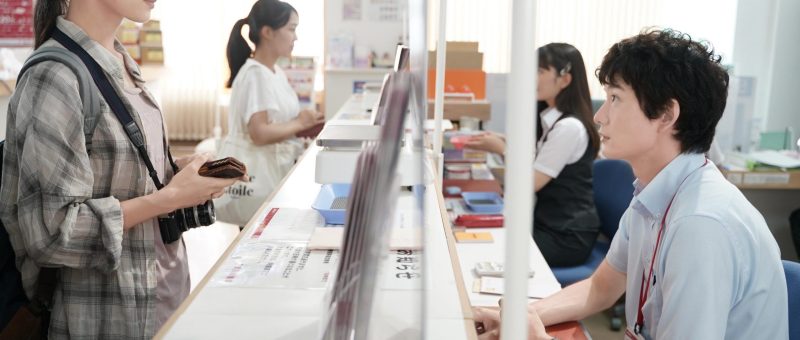
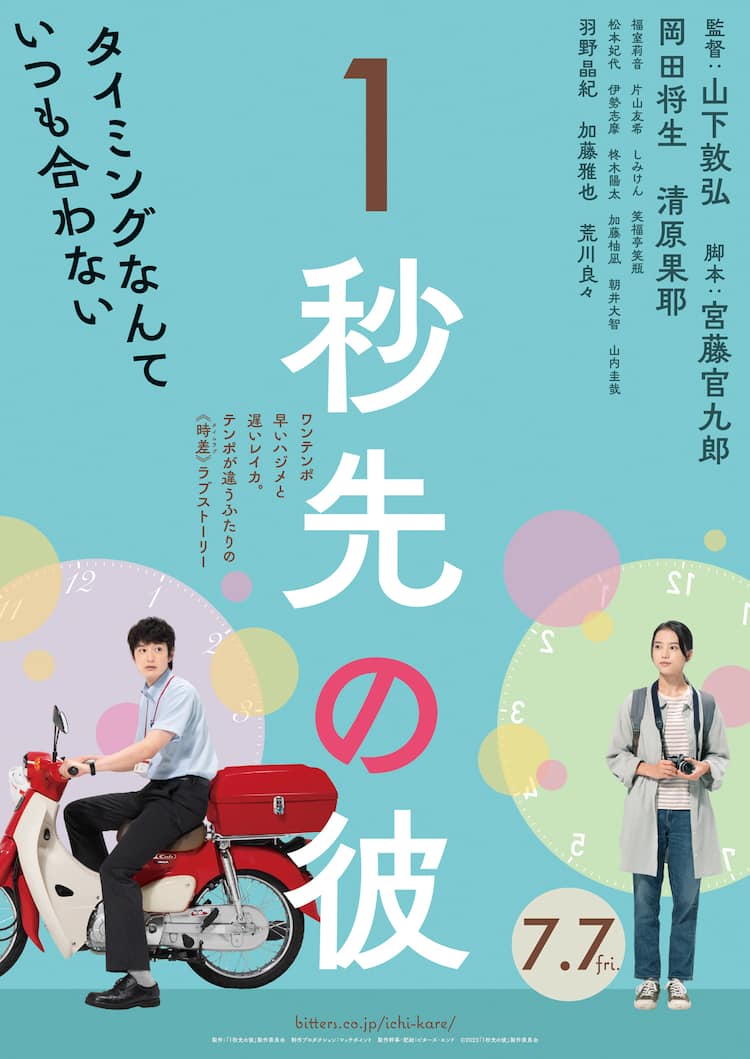
One Second Ahead, One Second Behind (1秒先の彼, Nobuhiro Yamashita, 2023)

If you’re a step ahead and someone else is a step behind, then the gap between you ought to be twice as big but in an odd kind of way it can bring you closer. At least, that’s how it is for the protagonists of Nobuhiro Yamashita’s One Second Behind, One Second Ahead (1秒先の彼, Ichibyo Saki no Kare), a remake of the Taiwanese rom-com My Missing Valentine scripted by Kankuro Kudo. 

Kudo wisely avoids some of the awkwardness of the original by reversing the genders of the misaligned romantics so that it’s now male post office worker Hajime (Masaki Okada) who wakes up to realise that he’s lost an entire day while having no recollection of how he got sunburnt or why there’s sand in his trousers. The host of a radio show he’s fond of listening to asks him about something he’s lost, causing him to remember his father who went out one evening for ginger and then never came back. Hajime’s problem is that he’s always a little ahead of himself, in too much of a hurry to fully grasp the situation around him. That might be one reason that he falls so hard for singer-songwriter Sakura (Rion Fukumuro) and becomes far more invested in the relationship than might be wise for someone you’ve only just met. 

Reika (Kaya Kiyohara), meanwhile, is always a little bit behind. Shy and somewhat reserved she struggles to get her words out and while Hajime has often left before the end of a conversation she is usually left hanging by an inattentive or impatient partner. Out of sync with the world around them, they have each lost something precious besides the obvious and are looking for a way to get it back. Kudo’s script largely drops the magical realism of the Taiwanese original with its strange world of talking lizards and opts for something a little less surreal if just as sweet while maintaining the borrowed time motif that suggests the universe is fair and willingly adjusts itself so that those who find themselves missing out will get that time back though there’s not a lot they can do with it other than reflect. 

Even so within this miraculous dream space regrets can in a sense be cured and anxieties worked out. Those awake to stopped time have the opportunity to set things right, or at least to say their piece even if no one else can hear. There’s something more than time that they can recover, though it may be only small comfort and offer little more than one-sided closure. Rather than the Valentine’s Day setting of the Taiwanese original Kudo and Yamashita shift the action to the summer which with its many fireworks displays has a rather poignant quality focussed more on the loss than the rediscovery while emphasising the short-lived quality of human relationships which can nevertheless leave a warm afterglow even if the memory itself has been lost. 

Setting the film in the historical city of Kyoto also adds to the magical feel, the emerging sunlight at one point appearing almost like a halo around the head of a frozen Hajime while he perhaps comes to accept his mother’s rationale that his father did not leave him but ran away from reality and ironically a world he felt he could not keep up with. In a repeated gag, Hajime calls up a requests show and pours his heart out to the host only for his mother to dial in and dispute everything he’s says especially reminding him that he’s not a loser but should slow down a bit and at least listen to the end of the conversation. Reika meanwhile might have to work herself up to speedier means of communication than the good old fashioned letter but can at least see that she gets there in the end even if it might take a little longer than for others. 

Despite the differences between them, they are in fact perfectly in sync and just waiting for the times to align to bring them back together. Kudo and Yamashita lend their quirky romance a melancholy and heartwarming quality, steering clear of the awkwardness of the otherwise sweet and wholesome Taiwanese original in suggesting that the “date” at the film’s centre is the fulfilment of long forgotten promise rather than the momentary whim of a lovelorn romantic. Suggesting that the things you lose cycle back to you and that the universe itself is fair and kind, the film’s pure-hearted romanticism offers a hopeful reassurance that in the end it all really will work out for the best if only you give it time.


One Second Ahead, One Second Behind screens Nov. 4/5 as part of this year’s San Diego Asian Film Festival.

Original trailer (no subtitles)

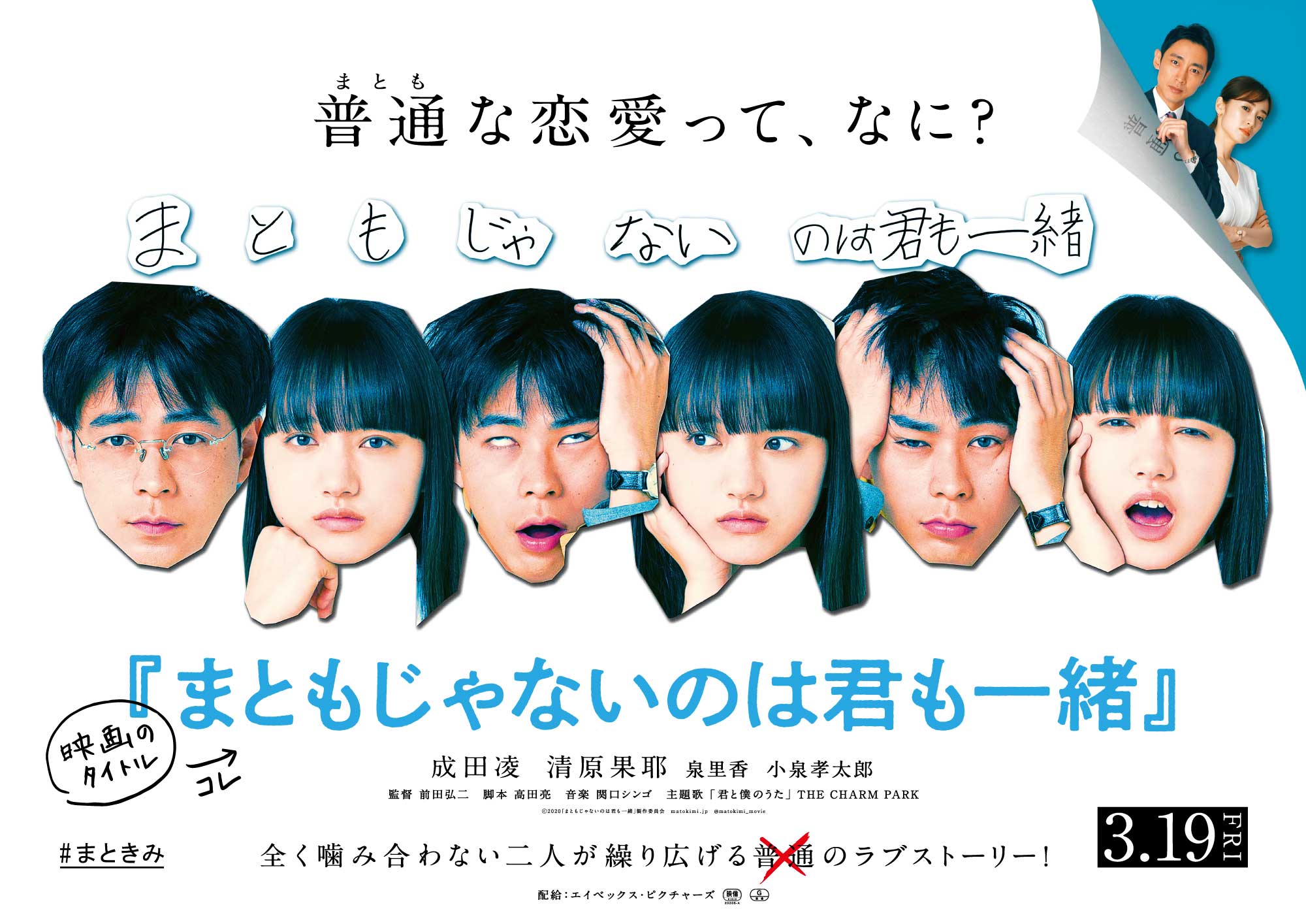
You’re Not Normal, Either! (まともじゃないのは君も一緒, Koji Maeda, 2021)

What’s so great about being “normal” anyway? As the title of Koji Maeda’s quirky screwball comedy You’re Not Normal, Either! (まともじゃないのは君も一緒, Matomo Janai no wa Kimi mo Issho) suggests neither of its heroes is quite in tune with the world around them but then again, is there really such a thing as “normal” or is it more that most people are making themselves unhappy by settling for less simply because they think that’s just how things are and resistance only makes you seem awkward? 

Nerdy cram school maths teacher Yasuomi (Ryo Narita) thought he was OK with being a little different, but just recently he’s begun to feel lonely and fears the possibility of being alone for the rest of his life. Perhaps inappropriately, he looks to one of his students, forthright high schooler Kasumi (Kaya Kiyohara), for romantic and life advice hoping that she will teach him how to be, or at least present as, more “normal”. Unbeknownst to him, however, Kasumi is not quite “normal” herself and is in fact obsessed with a tech entrepreneur, Isao (Kotaro Koizumi), who is all about a new and freer future in which humanity is freed from the burden of labour. Finding out that her crush is already engaged to Minako (Rika Izumi) the daughter of a hotel magnate, Kasumi hatches a plan to break them up while training Yasuomi in the art of seduction. 

Kasumi’s insecurities seem to be down to her failure in her middle school exams, attracted to Isao’s philosophies because they offer a possibility of freedom outside the rigid demands of academic success in Japan. She tells Isao in a not quite by chance meeting that she wants to become a teacher in order to expand children’s minds rather than force them into a fixed perspective as the rather authoritarian, rote learning system of education often does. Yet she also feels out of place among her peers whom she sees as vacuous always gossiping about part-time jobs and boys. She frowns at Yasuomi when he accidentally cuts the conversation dead with an awkward comment while attempting to chat up a pair of bubbly office workers in a bar, but often does the same thing herself while sitting with her high school girl friends who fall silent and then change the subject after she injects a little realism into their mindless chatter. 

Yasuomi had viewed himself as “normal” and never understood why others didn’t, noticing that people often stopped associating with him but not knowing the reason why. Obsessed with pure mathematics, over literal, and overstimulated by the complications of life he takes refuge in the forest and the sensory overload of its nocturnal creatures speaking quite eloquently about the beauty of numbers and actually fairly emotionally intelligent in his understanding of the two women. Resolutely failing at Kasumi’s Cyrano act, he comes into himself only when speaking more honesty much to Kasumi’s annoyance actually hitting it off with Minako who is herself just as lonely and alienated but perhaps wilfully trapped. 

Predictably enough, Isao isn’t exactly “normal” either or perhaps he is but only in the most depressing of ways, his rosy vision of the future delivered with more than a little snake oil and just as much sleaze. Minako may know what sort of man Isao is, that her marriage is largely a dynastic affair set up by her overbearing, authoritarian father, but she too may think this is “normal” and might have preferred not to have to confront her sense of existential disappointment while attempting to fulfil the role of a “normal” woman content with creating a comfortable space in which her husband can thrive.  

Romantically naive, Kasumi wonders how people come to fall in love informed by two relatively mature classmates that for them at least falling in love is a gradual process of increasing intimacy generated through casual conversation. This turns out to be pretty much true for Kasumi too, though in ways she didn’t quite expect watching as Yasuomi opens up to Minako and finding herself unexpectedly jealous while reluctant to let go of the idealised vision she had of Isao as some kind of messiah for a better Japan. There is something a little uncomfortable in the potentially inappropriate relationship between a student and her teacher even as the roles are, on one level at least, reversed but there’s also a kind of innocence in their childish friendship and later determination to start small and let things grow while abandoning the idea of the “normal” altogether to embrace their true selves in a freer future of their own creation. 


You’re Not Normal, Either! screens in Chicago on Oct. 7 as part of the 13th season of Asian Pop-Up Cinema 

Original trailer (English subtitles)

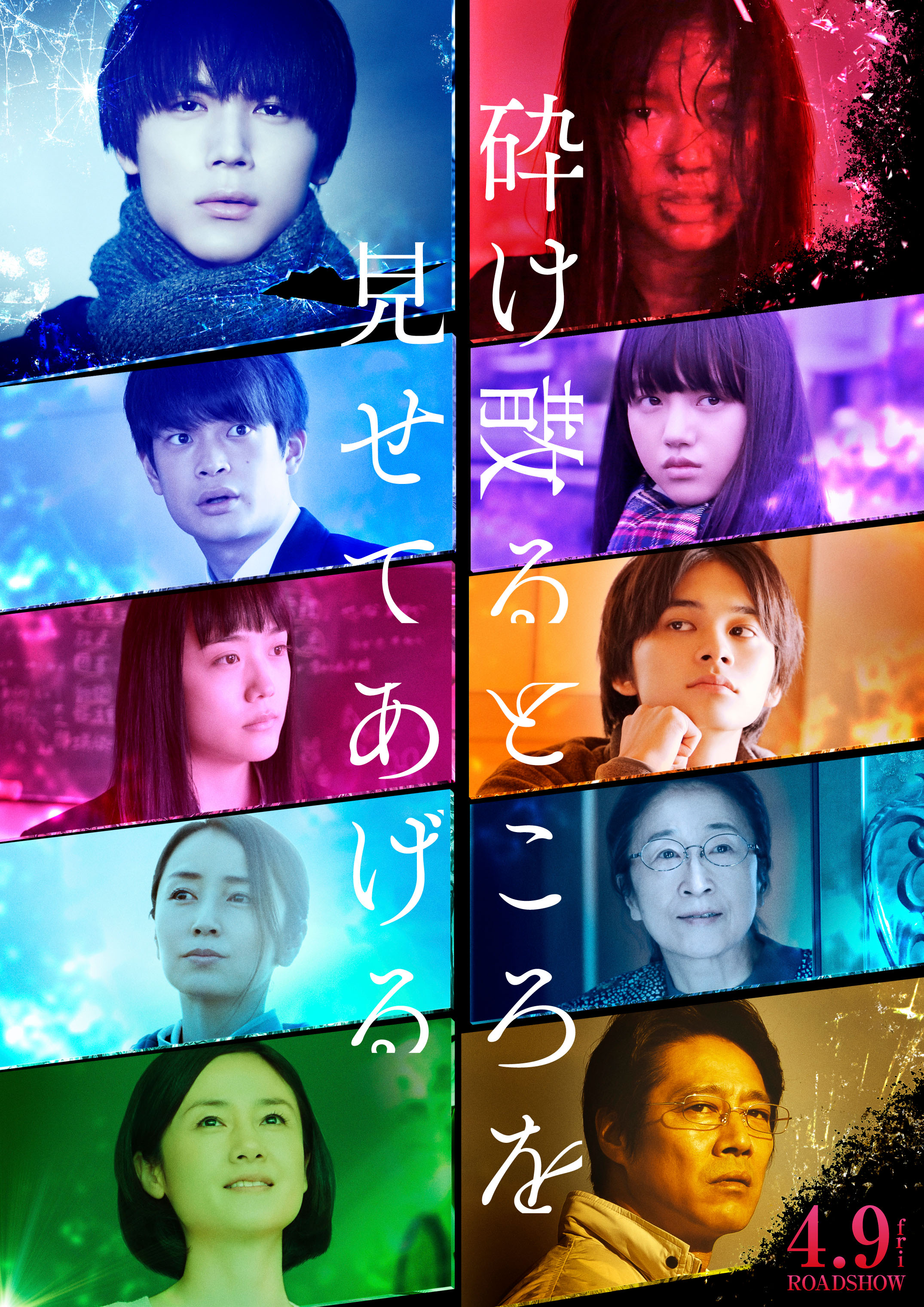
My Blood & Bones in a Flowing Galaxy (砕け散るところを見せてあげる, SABU, 2020)

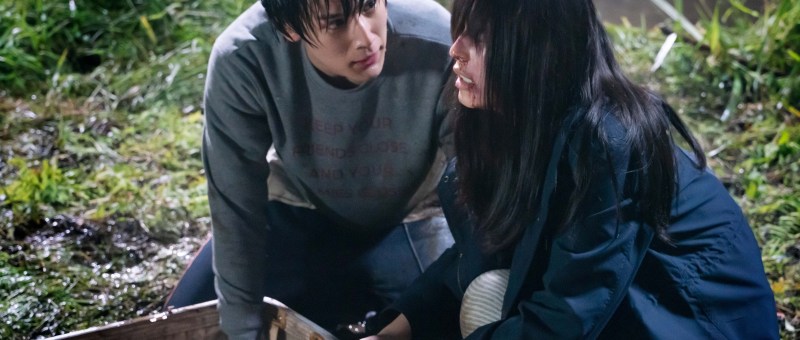
“Do heroes need a reason to be heroes?” asks the hero of SABU’s adaptation of the light novel by Yuyuko Takemiya My Blood & Bones in a Flowing Galaxy (砕け散るところを見せてあげる, Kudakechiru Tokoro wo Misete Ageru). A little lighter than the Japanese title which translates as “I will show you a broken place”, SABU’s latest collaboration with EXILE TRIBE is a sometimes surreal tale of the great confluence of love, undercutting and repurposing a traditional idea of masculinity as the young man at its centre tries and fails to overcome himself to be the hero he longs to be while finally discovering that true heroism lies in the capacity to lend courage to others in a world often haunted by violence and despair. 

SABU opens, however, with a brief framing sequence in which another young man (Takumi Kitamura) meditates on the legacy of his father who died a hero trying to save a little girl from a submerged car. A flashback to sometime in the ‘90s introduces us to Kiyosumi (Taishi Nakagawa) running full pelt late for school and surreptitiously joining the back of the assembly hall behind a class of younger students hoping to avoid detection. Once there, however, he witnesses a young woman being relentlessly bullied by her classmates and intervenes. After the assembly concludes he tries to make sure the girl is OK, but when he touches her in comfort she begins screaming uncontrollably and leaves the room. Kiyosumi, however, is undeterred and continues trying to protect her, eventually earning her trust after rescuing her when she’s doused in water and locked up in a bathroom storage cupboard. The pair soon become friends, Kiyosumi apparently falling for the melancholy young woman but naively failing to realise that her problems may be bigger than he realises and that there are some monsters you can’t fight alone. 

During one of their early conversations, Hari (Anna Ishii), the young woman, outlines her UFO theory of universe in which she visualises each of the forces which oppress her as alien spaceships floating ominously in the sky above. Standing in for unresolved trauma, the ever present threat of violence, and the pain of loneliness, the presence of the UFOs both brings the pair together and overshadows their growing romance, Kiyosumi’s voiceover hinting at an unhappy ending in which he will not fulfil his dream of being forever by her side. He continues to doubt himself, unsure if he can really be the hero that Hari believes him to be while she draws confidence from his kindness to become one herself. 

There is, it has to be said, an air of chauvinism and a mild saviour complex in Kiyosumi’s otherwise altruistic desire to stand up to injustice. He doesn’t stop to ask himself if Hari wants saving or if his intervention may end up making things worse for her as it eventually does if in an unexpected way. Childishly naive, he fails to look beyond the immediate problem of high school bullying, recalling his own days as a lonely first year rejected by the cool crowd only later finding a friend, while certain that he can protect Hari solely with the force of his presence. To begin with, he may be right, his initial intervention allowing other like-minded souls to stand up against the school’s bullying culture and earning Hari another friend in the equally defiant Ozaki (Kaya Kiyohara). But only too late does he begin to realise that the bruises on her wrists may not be caused in class and that her victimisation does not end at the school gates. 

Rescued from the storecupboard, Hari tried to defend her aggressors citing the fact that they used clean tap water the last bucket of which was even warm as a sign of “kindness”. So brutalised is she that she expects nothing more. The irony is Kiyosumi cannot in the end protect her, but does perhaps lend her the strength to protect herself as she in fact saves him. Yet as Kiyosumi points out, the “UFOs” do not simply disappear in the midst of red rain but may strike again at any moment, his attempts to rescue a drowning girl a kind of metaphor for his desire to drag Hari free of the source of her trauma and show her “the glowing beauty of this world”, a desire he can only realise by becoming one with a galaxy of eternal love. True heroism, he eventually realises, is just being there if only in spirit as a source of constant support and reassurance in a world of dizzying anxiety. At times infinitely bleak but coloured with teenage sunniness and youthful naivety, SABU’s empathic drama both recognises and forgives its hero’s chauvinistic self-obsession while allowing the heroine to save herself each bolstered by a sense of mutual solitary born of a deep compassion with love perhaps the best weapon against the circling UFOs of a sometimes cruel existence. 


My Blood & Bones in a Flowing Galaxy streamed as part of this year’s Nippon Connection.

Original trailer (English subtitles)

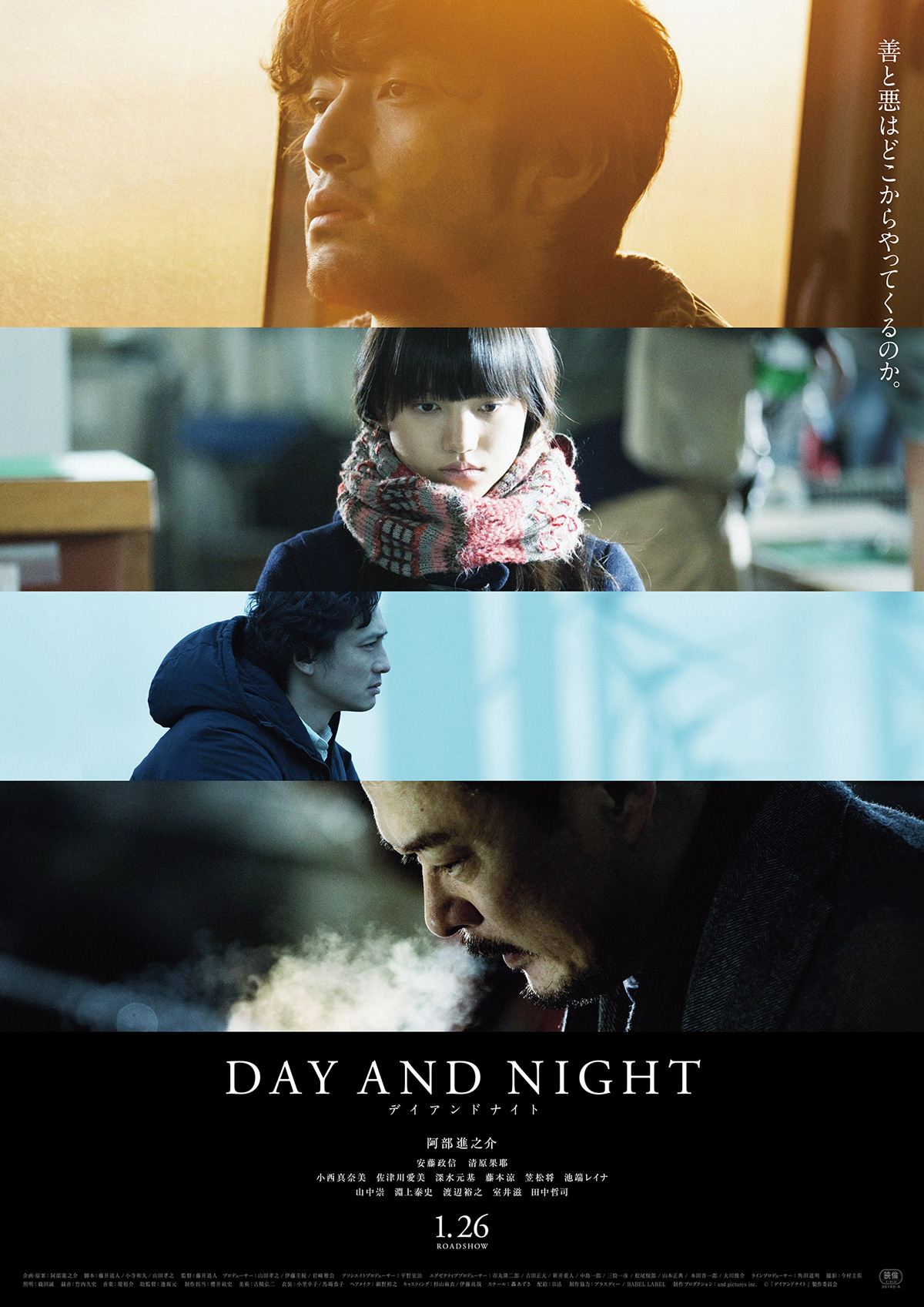
Day and Night (デイアンドナイト, Michihito Fujii, 2019) [Fantasia 2019]

day and night poster 1Can two wrongs ever really make a right? Michihito Fujii’s Day and Night (デイアンドナイト) wants to ask if the difference between good and evil is really as stark as that between dawn and dusk, or if life is really more like twilight in which morality is a relative concept and acts cannot by judged individually but only as a part of the whole. What the hero discovers, however, is that the world is an inherently unfair place and it may not be possible to “win” against the forces of self-interest solely through being pure of heart.

The drama begins with a stunned Koji (Shinnosuke Abe) returning to his small-town home to graffiti scrawled across his fences and his father lying in repose inside after having apparently taken his own life. No one will quite explain to Koji what exactly has happened, but it seems there has been some unpleasantness surrounding his father’s auto business. Though most of the other townspeople including his old friends are civil, they are also frosty and obviously unwilling to address the subject of Mr. Akashi save to press Koji for money they might still be owed as employees.

Meanwhile, poking around the garage in search of answers, he runs into the mysterious figure of Kitamura (Masanobu Ando) who claims to have known his father well though Koji’s mother claims never to have heard of him. Seeing as Kitamura is the only person willing to speak to him, Koji ends up taking a job at the orphanage where he works which turns out to be a little different than he thought seeing as Kitamura is actually the head of a local crime ring which exists with the sole purpose of keeping the orphanage running.

Though Koij, like his father, is an upstanding, law-abiding young man, he is quickly pulled into Kitamura’s world of moral justifications when presented with his personal philosophy in which the greater good remains paramount. Kitamura steals cars by night, stripping the unsellable ones for parts, which is where Mr. Akashi came in having succumbed to a life of “crime” in order to support himself while his business was suffering. He also does some possibly less justifiable work in the red light district while making a point of beating up drug dealers because 80% of the kids in his care have a parent in jail for crimes related to substance abuse. In Kitamura’s view at least, these are all “justifiable”, morally defensible “crimes” given that they are necessary to ensure the protection of the orphans. Though the money is good and Koji does need it, they are not in this for personal gain but to protect something they feel is important.

As Kitamura puts it, Mr. Akashi put his faith in laws that are meant to protect people but in the end it killed him. Having discovered a serious flaw in the auto parts he received from a local company he did the “right thing” and blew the whistle but Nakamichi Autos is the major player in the local economy and many people did not take kindly to having their reputation called into question. Nakamichi rallied its supporters and had Akashi hounded into submission. As one of the former employees tells Koji, the truth “hardly matters anymore”. Nakamichi doesn’t care there is a minor flaw in their products because they feel the chance of a fatal accident is slim enough not to need to worry about and happy to let the risk continue as long as they maximise their profits.

Miyake (Tetsushi Tanaka), Nakamichi’s CEO, also has his justifications, insisting that there’s no such thing as right and wrong only the cold logic of numbers and that the death of one man will not change anything. Increasingly pulled into Kitamura’s world of crime, Koji opts for underhanded methods to expose the truth about Nakamichi and clear his father’s name but finds in the end that no one is interested in facts. Listening in to some of his father’s old employees enjoying their belated severance pay he is dismayed to hear them too justifying their actions as they each insist that they did what they thought was “best” for everyone, for a peaceful life, for their families.

In truth, Koji claims he hated his father. That he resented him for always working all the time. Now however he begins to see that Akashi was only trying to protect his family by providing for it. His father was a “good” man, and he did the “right” thing, but he also became involved with Kitamura’s morally questionable crime syndicate. Kitamura wants to protect the orphans and takes care of them well, but can he really justify his actions solely on the grounds that there is no honest way to care for children who are often victims of an unfair society the pressures of which have pushed their parents from the “moral” path? What Koji’s left with, broadly, is that “good” people do “bad” things for “good” reasons, but bad people do bad things because they’re selfish and so they hardly care about the consequences of their actions. He starts to believe that the only way to resist is to fight fire with fire, but discovers that the little guy is always at a disadvantage when there is too much vested interest in not “making trouble”. It turns out everyone is OK with the status quo, so long as it’s not their car that might suddenly lose its wheels. As Miyake says, “that’s just how society works”.

A bleak meditation on the wider nature of justice and moral greyness of the world, Fujii’s noirish drama suggests good and bad are less like day and night than a shady evening in which the only shining light is the greater good. The world, however, continues on in self interest and the “good” will always lose to the “bad” as long it compromises itself trying to play by the other guy’s rules. Koji finds himself torn between a desire to avenge his father and a new sense of fatherhood fostered by bonding with a teenage girl at the orphanage as he contemplates the existence of a line between good and evil and his own place along it, but his old fashioned “nobility” finds no answer in the infinitely corrupt moral dubiousness of the modern society.


Day and Night was screened as part of the 2019 Fantasia International Film Festival.

Original trailer (no subtitles)

Yurigokoro (ユリゴコロ, Naoto Kumazawa, 2017)

Yurigokoro posterThose who cannot remember the past are doomed to repeat it, as they say, but is it better to acknowledge the dark parts of yourself as part of an inherited legacy or ignore a nagging sense of incompleteness in favour of a harmonious existence? The hero at the centre of Naoto Kumazawa’s Yurigokoro (ユリゴコロ), adapted from the mystery novel by Mahokaru Numata, is about to discover a side of himself he might not like just as storm clouds seem to gather over his previously idyllic childhood home.

For Ryosuke (Tori Matsuzaka), everything had been looking up. He’d set up his own business – a charming cafe and summer lodge, with the woman he intended to marry, Chie (Nana Seino). However, no sooner has he introduced his fiancée to his father than she disappears, gone without trace. Meanwhile, his father informs him that he has stage four pancreatic cancer. Suddenly everything is falling apart and the braver the face he tries to put on it, the worse he seems to feel. Perhaps that’s why he can’t resist opening up a mysterious old box hidden in a cupboard in his father’s study that almost calls out to him to be opened. Inside the box is an old exercise book with the title “Yurigokoro” pencilled on the front. Ryosuke only reads the first few pages but they’re enough to disturb and fascinate him. The book, written in the first person, recounts the dark history of a murderess (Yuriko Yoshitaka) from silent, disconnected child to vengeful spirit.

“Yurigokoro” as the diary’s protagonist later explains is a made-up word, one she childishly misheard from the mouth of a well meaning doctor (who probably meant “yoridokoro” which means something like grounding). It could, however, almost translate as a shaking heart – something the doctor seems to imply the child does not quite have which is why she feels disconnected from the world around her and unable, or unwilling, to speak. The girl in the book travels through life looking for something that makes her heart beat and originally finds it only in the strange pleasure of watching something die, at first by accident and later by design. She drifts into an intense relationship with a damaged young woman (Aimi Satsukawa) who, like her in a fashion at least, resorts to self harm in order to feel alive. She thinks she finds her home, but it slips away from her or perhaps changes in form as it succumbs to inevitable disappointment.

Yet, in the grownup crimes at least, there is a kind of love in amongst grudging resentment. Ryosuke reads the diary and declares he does not relate to it at all but something about it gets under his skin and he can’t let it rest. He hears from an older woman (Tae Kimura) that Chie may have a past he knew nothing about, largely because he failed to ask, and that she may be in danger. He begins to feel rage surfacing within him like the dark violence of the diary’s protagonist and it both frightens and enthrals him.

The owner of the diary likens her experience of existing in the world to being prickled by hundreds of tiny thorns. She seeks relief through bloodletting and violence, as if she could shake herself free of the tiny stings that remind her of nothing other than her sense of emptiness. Later she discovers that love too can shake the heart, but the old darkness remains and even the most positive of emotions may require an act of violence in order to sustain it. The diarist remains ambivalent, knowing that there is no salvation for her except death and that any attempt to stave off the darkness with light will eventually fail, but determined to cling on to her brief moment of wholeness however inauthentic for as long as it lasts.

Ryosuke, meanwhile, who’d apparently never sensed in himself the kind of gaping emptiness that the diary’s owner describes, is forced to wonder if the diary is legacy and destiny, if he too is destined to commit random acts of inescapable violence as someone unfit for living as a human being among other human beings. Love might not have “cured” the darkness inside the diarist, but it did change it in quite a fundamental way, a way that eventually provided him with the means of his “salvation” perhaps at the cost of her own if only he is willing to accept it. Ryosuke might wish he’d never opened that particular box, but in doing so he discovers not only the path towards a fully integrated self but that his own darkness can be tempered precisely because of the sacrifice that was made on his behalf.


Yurigokoro was screened as part of the 2019 Japan Foundation Touring Film Programme.

Original trailer (no subtitles)