Okuni and Gohei (お國と五平, Mikio Naruse, 1952)

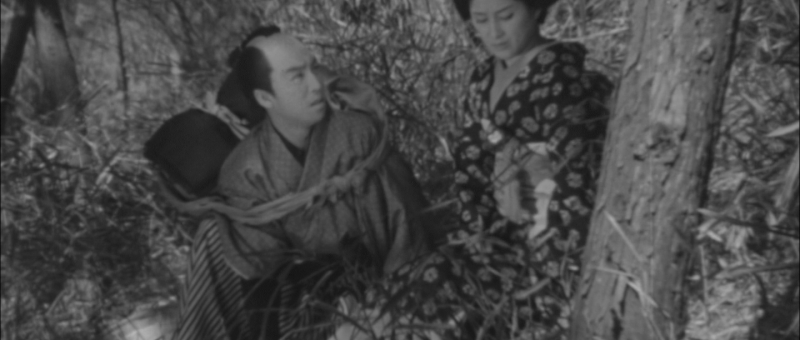
“It’s a rough and difficult road.” The heroes of Mikio Naruse’s Okuni and Gohei (お國と五平, Okuni to Gohei), adapted from a kabuki play by Junichiro Tanizaki, are two displaced between the old world and the possibility of a new one if only they were brave enough to step away from the beaten path. Unbeknownst to them, they are being followed by the man they are seeking whose shakuhachi playing haunts them wherever they go as if taunting them with its presence. 

In this iteration of the tale, Tomonojo (So Yamamura) takes on a slippery quality almost if he were some supernatural devil sent to torment Okuni (Michiyo Kogure) and Gohei (Tomoemon Otani) leading them either towards or away from their salvation or damnation. In Okuni’s flashback, which is obviously coloured with her own nostalgia and regret, he’s a sensitive young man who promised himself in marriage to Okuni. But she is forced to refuse him. Her father rejects Tomonojo because he is without standing or prospects, and instead demands she marry a wellborn man of his choosing, Iori (Jun Tazaki). Iori is then killed in the street, uttering only Tomonojo’s name before he dies. It could then be that this is Tomonojo’s revenge on a society that has rejected him and robbed him of his love, yet the Tomonojo we later meet is much different than this idealised version in Okuni’s memory. He never denies killing Iori and offers no justification for it, but corners Okuni when she’s alone to tell her to free herself by dropping her quest for revenge. He’s also subtly blackmailing her, implying he heard her having sex with her manservant Gohei the previous night and in reality wheedling away pleading for his life.

For her part, Okuni seems torn in her motivations, uncertain whether she’s looking for Tomonojo to reunite with him or kill him, or perhaps is deliberately avoiding finding him at all. She was not married to Iori for very long and he was at the very least an insensitive and emotionally distant husband who spent most of his time at his friend’s house, claiming that it was “boring” to stay home with her. She has no great emotional desire for revenge, but has been told she must accomplish it in order to return to the samurai world, having been condemned to a kind of limbo as the widow of a murdered man. Even so, she has tired of her quest and asks herself what’s to become of them if Tomonojo is already dead. She repeatedly hints to Gohei that they should give up on finding him and on returning home, instead contenting themselves with their life on the road or else find somewhere to settle together in a new world in which a lady and her retainer could live as man and wife.

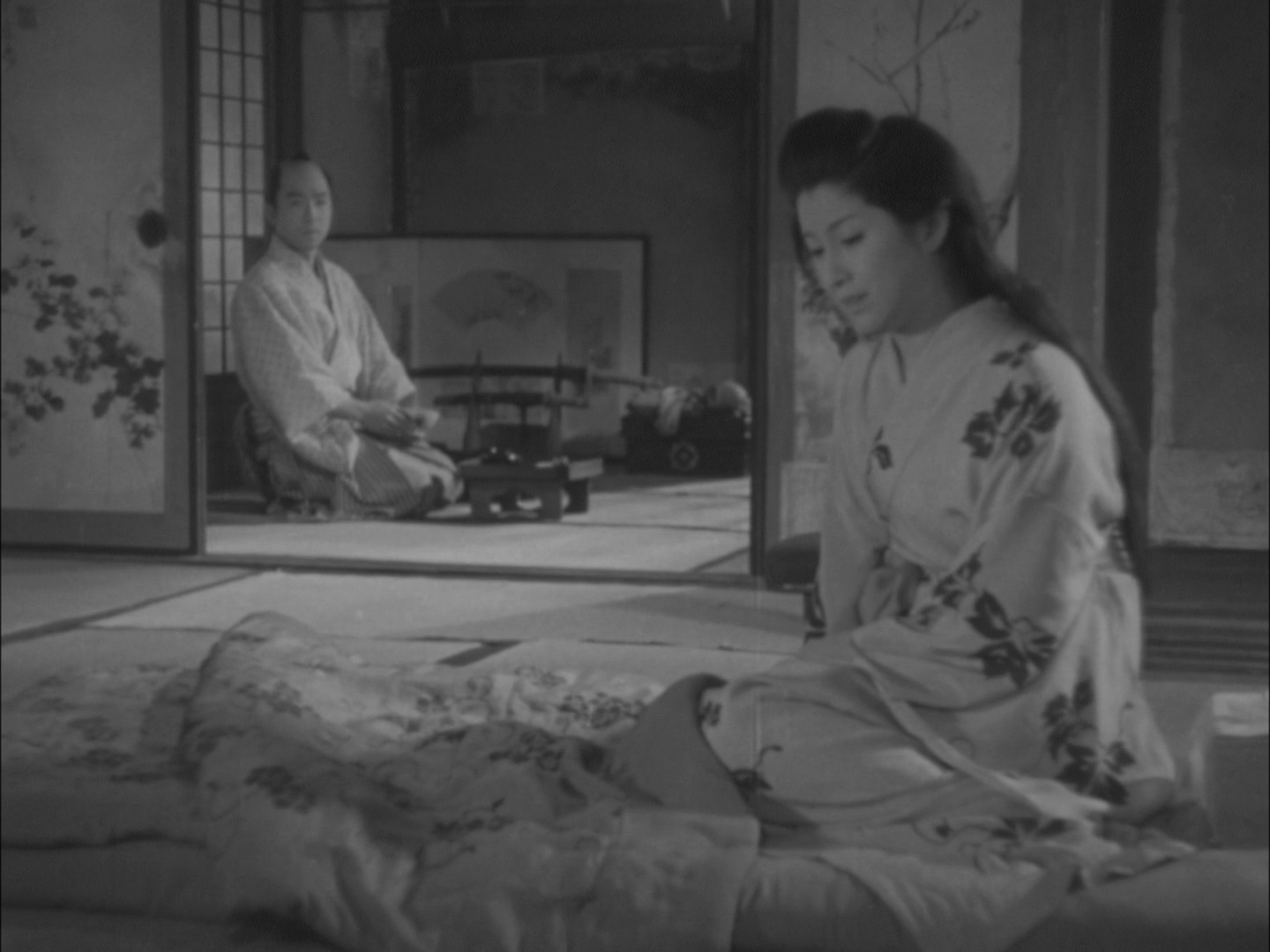
The film is both coy and somewhat transgressive in its depiction of the growing sexual tension between Okuni and Gohei from his taking hold of her injured foot and tender care for her when she falls ill, to the way they draw closer and then instinctively move apart. Passion later gets the better of them and it’s heavily implied that they sleep together, but Gohei instantly regrets it and cannot accept his class transgression. Given this development in their relationship, Okuni asks him to stop calling her “madam” but as she does so she is on one side of the fusuma and he on the other, so they remain in separate rooms divided by the ridge in the tatami. Gohei cannot let go of the old ways and is desperate to complete their quest so that his debt to Iori will be repaid and he can return in glory to be rewarded with position and the esteem of being a true samurai. Even if he tells Okuni that this quest has been his happiness in being on the road with her and knows that killing Tomonojo will end it, he does not turn back.

But the implication is that they can never escape Tomonojo who will, in fact, forever be following them. He taunts the pair with his shakuhachi and visits them in disguise. When they catch up to him, he tries again to convince them to give up their quest and live quietly together in a place free from the constraints of the samurai world, but Gohei cannot do it. Okuni first picks up her dagger and one wonders whether she about to use it on herself, but then turns on Tomonojo though it’s uncertain whether she now does so out of resentment or as revenge of herself for the way Tomonojo has again ruined her life. Just as she was a pawn of her father married off against her will to an indifferent man, she is further imprisoned by patriarchal social codes as Tomonojo needles Gohei that he had slept with her before her marriage. She has in fact already confessed to this to Gohei who transgressed by asking her what exactly Tomonojo was doing with his “shakuhachi” when they were courting, though she did so obliquely in telling him to remember his place and that he should “forget about the past.” Nevertheless she denies it now, but Gohei continues to see her as a “loose” woman with Tomonojo’s words ringing in his ears as a final revenge on the morally compromised lovers.

Their inability to let go of the quest, to do as Okuni suggests and continue on as they are along the rough and difficult path to a more egalitarian future spells their damnation. You can’t go back again. Their “home” is already lost to them. As a pedlar tells the pair along the way, they’ve already been forgotten and the village is filled with other gossip, but now they really have nowhere to go. The message may be for the coming post-occupation era that they shouldn’t try to turn back but keep moving forward into the new Japan or else risk becoming lost in a purgatorial world of confusion like Okuni and Gohei haunted by the choice to betray love for the outdated ideal of samurai honour. Haunted alternately by Tomonojo’s shakuhachi and the words of the villagers who told them they couldn’t be accepted until they fulfilled this quest, they find themselves displaced, unbalanced and uncertain amid the shifting power dynamics of class and gender, their duty and their feelings, but ultimately trapped by their cowardice in their unwillingness to cross the threshold to claim their freedom and happiness.
Portrait of Hell (地獄変, Shiro Toyoda, 1969)

Asked to paint a vision of heaven, an artist replies that he cannot because he sees it nowhere in this present society. “Over my body and my life, you have absolute authority. But you can never command my artist’s soul,” he spits back at his corrupt lord, but in many ways the lord can command his soul as an artist for he creates the world he reflects for all that he attempts to manipulate him as a man and one he assumes to be far inferior to himself. 

Shiro Toyoda’s adaptation of the classic horror story by Ryunosuke Akutagawa, Portrait of Hell (地獄変, Jigokuhen) opens with a brief voiceover narration that explains that this story takes place almost 1000 years ago in the Heian era when the Fujiwara clan was at the height of its power. But after so long at the top of the tree, the Fujiwara have become both restless and indifferent in their complacency. “The common people live lives of hopeless despair,” the narrator explains outlining the Fujiwara’s inability to govern as even minor natural disasters give rise to famines and corpses litter the streets. Even nobles now live “lives of perpetual dread” having gained a sense of their own impermanence. 

Lord Horikawa (Yorozuya Kinnosuke) is however seemingly oblivious to the suffering of his people. Yoshihide (Tatsuya Nakadai), a Korean painter, tells him that his problem is everyone tells him what he wants to hear (because they fear for their lives) rather than what is actually happening. During the opening sequence, Horikawa had abruptly decided to leave a public celebration. An old man appeals to some of the guards for money, but they roughly beat him and he is later trampled to death by Horikawa’s frightened bull which had become loose during a storm. The old man dies cursing him, exclaiming that “he has treated us like slaves. I have become no better than an animal.” Horikawa had been told that the man used his last dying breath to remark on what an honour it was to be trampled by the lord’s bull. Yoshihide paints a picture that drives a court lady out of her mind featuring the corpse of the old man under a cherry tree that seems so vivid to her that it emanates a stench of death. Horikawa doesn’t like it much either, and its uncanny realism unsettles his mind. He thinks he sees the ghost lying in wait for him in his own bed and orders Yoshihide to dismantle the painting as if that would make the ghost disappear. 

Horikawa believes the “ghost” is a manifestation of Yoshihide’s rage rather than his own guilt or incompetence. Yoshihide certainly does not like the world the lord has made, replying that he has seen hell everywhere in the cities and the villages while there is no heaven to be had which is why he cannot paint it. Yet Yoshihide and the lord are almost perfect mirrors of each other. Yoshihide is also rigid and superior. He prides himself on being Korean, pointing out that the foundations of the court and of modern learning were all brought over by Korean scholars even if Horikawa claims to have “improved” upon them. Yet some of his fellow painters worry that the style their Korean ancestors worked so hard to perfect has been eclipsed by Japanese influence while secretly considering returning to Korea which has now become prosperous unlike the conditions in Japan. 

Horikawa later slips and calls Yoshihide a stupid “foreigner” making plain his contempt despite describing him as the greatest artist of his generation which is why he’s commissioned this piece of art in the first place even though he had described all of his previous pieces “ugly” while objecting to their attempt to show him how rotten his kingdom has become. Yet Horikawa is correct when he says that it’s Yoshihide’s “infernal arrogance” that has provoked his downfall. Having caught his daughter Yoshika (Yoko Naito) with one of his pupils, he locked her in a shed and exclaimed that no other man would have her. If he had not done so, she may never have come to the attentions of the lord and suffered her eventual degradation at his hand, nor would Yoshihide have been so easily manipulated into a obsessive desire to effectively depict the depths of hell. 

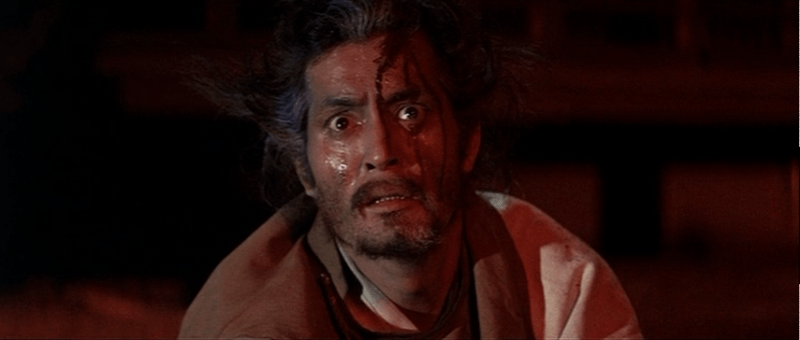
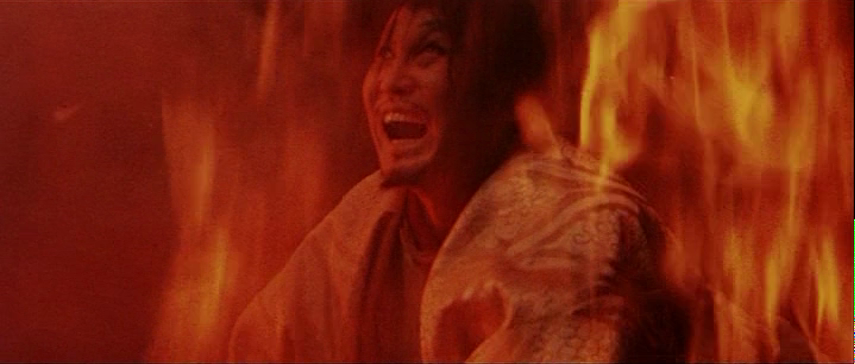
Yoshihide is some kind of method artist who insists he can only paint what he sees. Thus he goes to great lengths to observe hellish cruelty, tying up an apprentice boy in chains and torturing him with snakes, his eyes burning with a fiery intensity. His tragedy is that he comes to realise that the painting reflects not the world but himself. He is hell, hell is here. While his daughter burns, he looks on impassively only to be outdone by her pet monkey who in a gesture of selfless love leaps into the flames. Even so, Horikawa praises the finished painting as a masterpiece, “an impressive depiction of the hell that is our life,” commenting somewhat ironically on the current conditions within his fiefdom. Only latterly does he notice his own role within it, suddenly consumed by his hellishness as if dragged own into the flames despite himself. 

Toyoda shoots in the manner of a classic ghost story, making fantastic use of ghostly effects as Horikawa finds himself haunted by the spirits of those he’s wronged. At times, the screen fills with red light as if soaked in blood or baked in the hellish glow of slow burning flames. He flips between the icy blues of Horikawa’s estate, and the stifling ochre that seems to surround Yoshihide who does after all feed off all this strife rather than seeking to cure it. The two men end up in an impossible game of brinksmanship from which neither can back down, two “arrogant” rivals blindly creating a hell for those around them through their selfishness and vanity. “Life is more hellish than hell itself” runs a final quote from Akutagawa, laying bare the tale’s essential irony in our inability to recognise the hell we create for ourselves and others through our own arrogance and fear.


The Last Gunfight (暗黒街の対決, Kihachi Okamoto, 1960)

“Times may change but there’s always a bunch of greed-blinded old men to rip you off” according to the sidelined noble yakuza pushed into the shadows of Kihachi Okamoto’s anarchic gangster romp The Last Gunfight (暗黒街の対決, Ankokugai no Taiketsu). Another of Okamoto’s early crime movies, Last Gunfight, adapted from the novel by hardboiled king Haruhiko Oyabu, as its name implies finds a stranger in town arriving at the tail end of a gang war in which the wrong side seems to have won hoping to offer a course correction for the post-war future. 

Branded a “dirty cop” and demoted to small-town Kojin, Fujioka (Toshiro Mifune) is a maverick officer exploring the local landscape by getting into fights with foot solders from differing outfits, quickly finding out that the Ooka gang are currently in the ascendent while old school Kozuka flounders. Improbably enough, the local flashpoint is over control of the gravel dredging business currently operated by Kozuka but contested by Ooka. Fujioka meanwhile is caught in a complex web at the nexus of which is Tetsu (Koji Tsuruta), a former Kozuka man who now runs a bar while he plots revenge for the death of his wife in a traffic accident he suspects may have been foul play possibly at the hands of Ooka man Niki, brother of brassy bar girl Sally (Yoko Tsukasa). 

Arriving on the same train as dodgy lawyer Tendo (Akihiko Hirata) and an exotic dancer destined for the club, Fujioka keeps his cards close to his chest leaving his loyalties all but clear. The station are less than thrilled to have him, especially as he spends his first night in town in one of their cells after starting a bar fight, waking up right under a sign which reads “stop violent crime”, while another earnest young officer reminds him that “policemen should never be involved in violence”. Fujioka continues to play both sides, cosying up to both Ooka and Tetsu, walking the line between cop and thug while seemingly scoping out the terrain on either side of the tracks. 

Meanwhile, the town is mired in a battle for its soul as the amoral Ooka gang slowly take over. As Kozuka foot soldier Yata (Makoto Sato) puts it, his boss is the sort who won’t have anything to do with yakuza who don’t obey the code which is why he won’t simply cut a deal with Ooka. According to Kozuka (Jun Tazaki), others might lump him in with “fools and trash” but he’s the old school kind of yakuza providing a genuine service to the community. He dredged the river to stop it flooding and was given the gravel business as a thank you so he resents having it stolen out from under him by the likes of Ooka who makes his money primarily through the drugs trade trafficking “China White” and has seemingly corrupted the entire city council. 

Then again, as Kozuka points out ties based on greed are the most fragile of all and it appears Ooka has secrets he’d rather weren’t exposed. Living in a Western-style mansion complete with open fireplaces and hunting trophies on the walls Ooka is laying claim to a fiefdom as the new inheritor of the feudal legacy. Tetsu’s bar, meanwhile, seems to have a Wild West theme which perhaps speaks of his love of freedom and independence as opposed to Ooka’s elitist authoritarianism. As a representative of legitimate authority Fujioka walks a tightrope between the two but eventually shuns a potential love interest in bargirl Sally, currently Ooka’s squeeze but playing her own game hoping to find out what happened to her brother, in favour of a bromance with the wounded Tetsu.  

Like Okamoto’s other gangster movies from this era however and in contrast to the heaviness of the title, Last Gunfight is imbued with a strong sense of irony and the director’s characteristically cartoonish sense of humour with its ridiculous fight scenes, elaborate production design, and playful subversion of gangster movie tropes right down to the frequent musical numbers starring a trio of minions clad in black suits and lip-syncing to songs about killing the moon. Ending as it began, Okamoto’s elliptical narrative sees the strangers leaving town, job done, but laying themselves bare as they go now shorn of their cover identities and headed back into the heart of corruption in search of new destinations.


Original trailer (no subtitles)

Ironfinger (100発100中, Jun Fukuda, 1965)

Ironfinger posterBy 1965, Japan was back on the international map as the host of the last Olympics. The world was opening up, but the gleefully surreal universe of Toho spy movies isn’t convinced that’s an entirely good thing. Jun Fukuda had begun his career at Toho working on more “serious“ fare but throughout the 1960s began to lean towards comedy of the absurd, slapstick variety. 1965’s Ironfinger (100発100中, Hyappatsu Hyakuchu) boasts a script by Kihachi Okamoto – Okamoto might be best remembered for his artier pieces but even these are underpinned by his noticeably surreal sense of humour and Ironfinger is certainly filled with the director’s cheerful sense of cartoonish fun with its colourful smoke bombs, cigarette lighters filled with cyanide gas, and zany mid-air rescues. The English title is, obviously, a James Bond reference (the Japanese title is the relatively more typical “100 shots, 100 Kills”) and the film would also get a 1968 sequel which added the spytastic “Golden Eye” (though it would be given a more salacious title, Booted Babe, Busted Boss, for export). Strangely the unlikely villains this time around are the French as Tokyo finds itself at the centre of an international arms smuggling conspiracy unwittingly uncovered by a “bumbling vacationer”.

We first meet our hero as he’s writing a postcard to his mum in which he details his excitement in thinking that he’s made a friend of the nice Japanese man in the next seat seeing as he’s finally stopped ignoring him. When they land in Hong Kong, our guy keeps shadowing his “friend” until he decides to ask him about “Le Bois” to which his “friend” seems surprised but is gunned down by bike riding assassins before he can answer though he manages to get out the word “Tokyo” before breathing his last. Picking up his friend’s passport and swanky hat, our guy becomes “Andrew Hoshino” (Akira Takarada) – a “third generation Japanese Frenchman” and “possibly” a member of Interpol.

The bumbling “Andy”, who can’t stop talking about his mother and is very particular about his hat (for reasons which will become clear), is obviously not all he seems. Despite his penchant for pratfalls and cheeky dialogue, he also seems to be a crack shot with a pistol and have an ability to talk himself out of almost any situation – at least with the aid of his various spy gadgets including his beloved cigarette lighter and a knife concealed in his wristwatch for cutting himself free should he get tied up. Andy “said” he was just here on holiday, but are all those postcards really for his dear old mum waiting for him in Paris or could they have another purpose? Why is he so keen on finding out about “Le Bois” and why does he always seem to end up at the centre of the action?

These are all questions which occur to one of his early antagonists – Yumi (Mie Hama), the ace explosives expert who often feels under-appreciated in the otherwise all male Akatsuki gang. Apprehending Andy, Yumi originally falls for his bumbling charm only to quickly see through his act and realise she might be better hedging her bets with him – hence she finally teams up with Andy and straight laced streetcop Tezuka (Ichiro Arishima) who’s been trying to keep a lid on the growing gang violence between the Aonuma who now run the town and the Akatsuki who want to regain control. Andy doesn’t much care about sides in a silly territorial dispute, but it might all prove helpful in his overall mission which is, it turns out, very much in keeping both with that of the gang-affiliated Yumi and law enforcement officer Tezuka.

There isn’t much substance in Ironfinger, but then there isn’t particularly intended to be. There is however a mild degree of international anxiety as our heroes become, in a sense, corrupted by French sophistication whilst “relying” on “Interpol” to solve all their problems (“Interpol” is frequent presence in Toho’s ‘60s spoofs providing a somewhat distant frontline defence against international spy conspiracies). Fukuda keeps things moving to mask the relative absence of plot as the guys get themselves into ever more extreme scrapes before facing certain death on a mysterious island only to save themselves through a series of silly boys own schemes to outwit their captors. Perhaps not as much fun or not quite as interesting as some of Toho’s other humorous ‘60s fare, Ironfinger is nevertheless a good old fashioned espionage comedy filled with zany humour and a cartoonish sense of the absurd.


Akira Takarada shows off his French

Samurai Rebellion (上意討ち 拝領妻始末, Masaki Kobayashi, 1967)

samurai rebellion posterIf Masaki Kobayashi had one overriding concern throughout his relatively short career, it was the place of the individual with an oppressive society. Samurai Rebellion (上意討ち 拝領妻始末, Joi-uchi: Hairyo Tsuma Shimatsu), not quite the crashing chanbara action the title promises, returns to many of the same themes presented in Kobayashi’s earlier Harakiri in its tale of corrupt lords and a vassal who can no longer submit himself to their hypocritical demands. On the film’s original release, distributor Toho added a subtitle to the otherwise stark “Rebellion”, “Hairyo Tsuma Shimatsu”, which means something like “sad story of a bestowed wife” and was intended to help boost attendance among female filmgoers who might be put off by the overly male samurai overtones. The central conflict is that of the ageing samurai Isaburo (Toshiro Mifune), but Kobayashi saves his sympathy for a powerless woman, twice betrayed, and given no means by which to defend herself in a world which values female life cheaply and a woman’s feelings not at all.

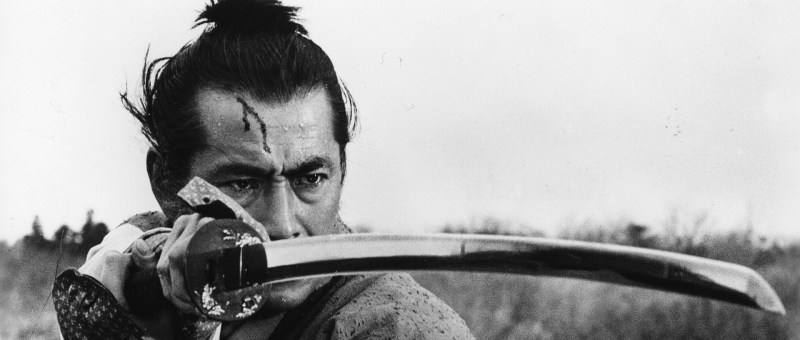
Having the misfortune to live in a time of peace, expert swordsman Isaburo has only the one duty of testing out the lord’s new sword (which he will never draw) on a straw dummy. He and his friend Tatewaki (Tatsuya Nakadai) are of a piece – two men whose skills are wasted daily and who find themselves at odds with the often cruel and arbitrary samurai world, refusing to fight each other because the outcome would only cause pain to one or both of their families. Isaburo has two grownup sons and dreams of becoming a grandpa but needs to find a wife for his eldest, Yogoro (Go Kato). He wants to find a woman who is loyal, loving, and kind. As a young man Isaburo was “forced” into marriage and adopted into his wife’s family but has been miserable ever since as his wife, Suga (Michiko Otsuka), is a sharp tongued, unpleasant woman whose only redeeming features are her stoicism and dedication to propriety.

It is then not particularly good news when the local steward turns up one day and informs Isaburo that the lord is getting rid of his mistress and has decided to marry her off to Yogoro. News travels fast and though others may appear jealous of such an “honour”, Isaburo is quietly angry – not only is he being expected to take on “damaged goods” in a woman who’s already born a son to another man, but they won’t even tell him why she’s being sent away, and the one thing he wanted for his son was not to end up in the same miserable position as he did. Nevertheless when Isaburo repeatedly tries to decline the “kind offer”, he is prevented. A suggestion quickly becomes an order, and Yogoro consents to prevent further conflict.

Against the odds, Ichi (Yoko Tsukasa) is everything Isaburo had wanted in a daughter-in-law and even puts up with Suga’s constant unkindness with patience and humility. Eventually she and Yogoro fall deeply in love and have a baby daughter, Tomi, but when the lord’s oldest heir dies and Ichi’s son becomes the next in line, it’s thought inappropriate for her to remain the wife of a mere vassal. Summoned to the castle, Ichi is once again robbed of her child but also of her happiness.

Ichi’s tale truly is a sad one and emblematic of the fates and positions of upperclass women in the feudal world. Having had the misfortune to catch the lord’s eye, Ichi tries to decline when the steward shows up to take her to the castle, reminding him that she is already betrothed. Sure that her fiancé will protect her, Ichi says she’ll go if he agrees never thinking that he would. Betrayed in love, Ichi is sold to the castle to be raped by the elderly Daimyo who views her as little more than a baby making machine and faceless body to do with as he wishes. When she returns from a post-natal trip to the spa and discovers the lord has already taken a new mistress, her anger is not born of jealously but resentment and disgust. This other woman is proud of her “position” at the lord’s side when she should be raging as Ichi is now, at her powerlessness, at the male society which reduces her to an object traded between men, and at the rapacious assault upon her body by a man older than her father.

Isaburo is also raging, but at the cruel and heartless obsession with order and protocol which has defined his short, unhappy life. Having been a model vassal, Isaburo has lived a life hemmed in by these rules but can bear them no longer in their disregard for human feeling or simple integrity. Isaburo says no, and then refuses to budge. Having retired and surrendered control of the household to Yogoro, Isaburo leaves the decision to his son who refuses to surrender his wife and swears to protect her from being subjected to the same cruel treatment as before. The samurai order is not set up for hearing the word “no”, and the actions of Isaburo, Yogoro, and Ichi threaten to bring the entire system crashing down. Love is the dangerous, destabilising, manifestation of personal desire which the system is in place to crush.

Isaburo’s rebellion, as he later says, is not for himself, or for his son and daughter-in-law whose deep love for each other has reawakened the young man in him, but for all whose personal freedom has been constrained by those who misuse their power to foster fear and oppression. Having picked up his sword, Isaburo will not stand down until his voice is heard, fairly, under these same rules that the authority is so keen on enforcing. He does not want revenge, or even to destroy the system, he just wants it to respect him and his right to refuse requests he feels are unjust or improper. Like many of Kobayashi’s heroes, Isaburo’s fate will be an unhappy one but even so he is alive again at last as the fire of rebellion rekindles his youthful heart. Those caught within the system from the venal stewards and greedy vassals to the selfish lords suddenly terrified the Shogun will discover their mass misconduct are dead men walking, sublimating their better natures in favour of creating the facade of obedience and conformity whilst manipulating those same rules for their own ends, yet the central trio, meeting their ends with defiance, are finally free.


Available with English subtitles on R1 DVD from Criterion Collection.

Original trailer (English subtitles – poor quality)

Farewell Rabaul (さらばラバウル, Ishiro Honda, 1954)

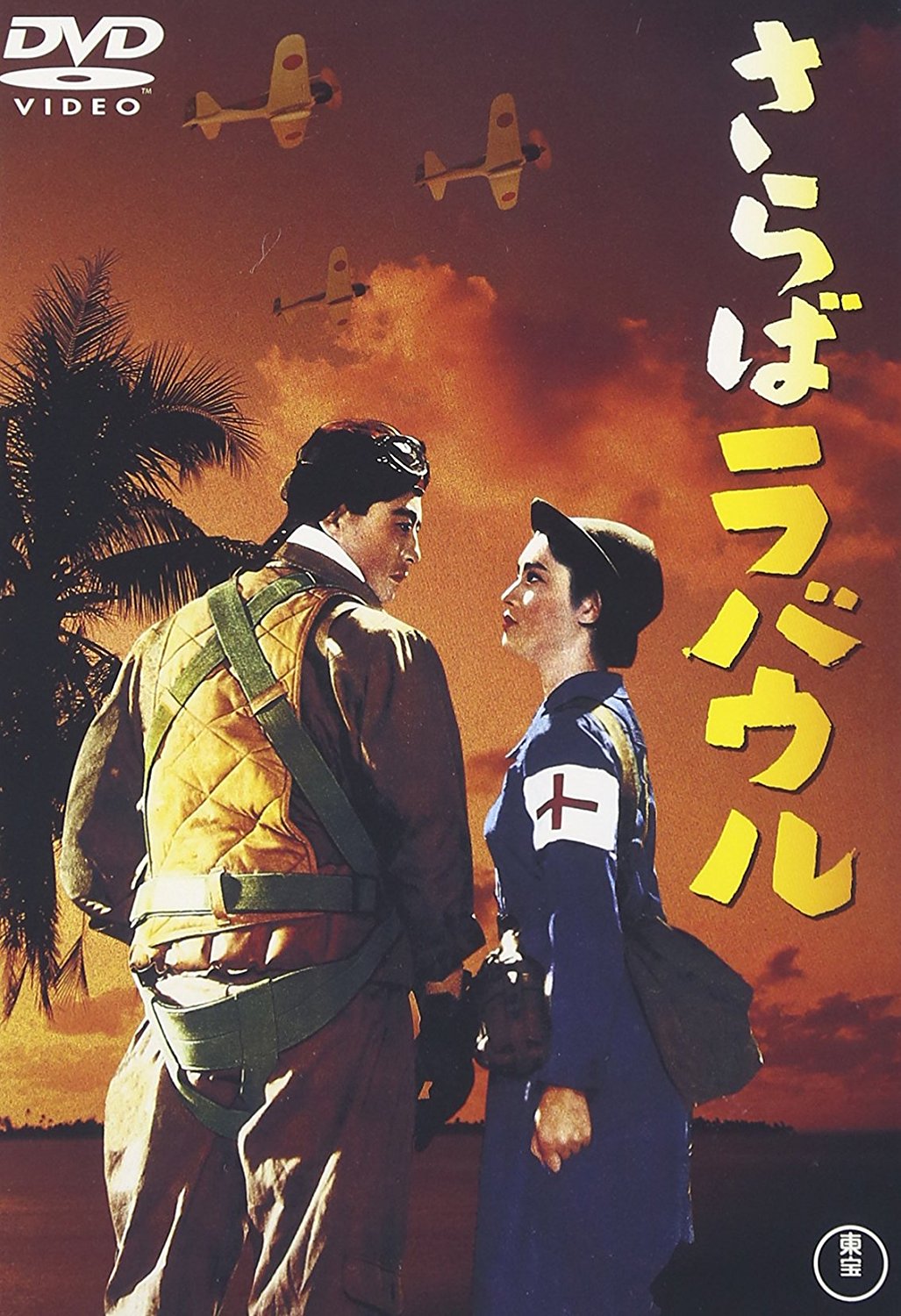
Farewell Rabaul dvd coverReleased in 1954, Farewell Rabaul (さらばラバウル, Saraba Rabaul) was the last in a string of war films directed by Ishiro Honda for Toho immediately before the mega hit Godzilla redefined his career and turned him into a director of science fiction and special effects movies. Like the later tokusatsu classics, Honda worked alongside Eiji Tsuburaya to craft the film’s effects which are largely used to recreate the epic dogfights taking place over the island as the airmen and ground crew come to terms with the imminent arrival of American forces. Though he takes care to show the bravery and determination of the Japanese pilots, Honda’s attitudes to the war and the government who waged it are not so kind.

Late into the conflict, at an outpost in the Papa New Guinean city of Rabaul, ace pilot Captain Wakabayashi (Ryo Ikebe) leads a rapidly depleting squad of airmen trying to defend Japanese forces from American air attacks. Known as “Devil” Wakabayashi, he rules with an iron fist – taking issue with men who spend their time in local bars and pointedly refusing to send rescue craft for crashed pilots. Ruthless and cold as he seems, the war is starting to get to Wakabayashi and his resolve crumbles when faced with a gracious American POW and the attentions of a kindly nurse, Komatsu (Mariko Okada).

Honda keeps the action to a minimum, preferring to focus on the life within the military base. Though the effects on the local population are not much addressed, the opening scenes take place in a bar in which Papa New Guinean women dance to tribal drums while Japanese military personnel drink and watch. The waitresses are largely Japanese women dressed in kimono, though it seems the exoticism of local girl Kim (Akemi Negishi), dancing barefoot with flowers in her hair, is the main draw. Eventually Kim falls in love with a Japanese soldier and the two plan to flee but fate always gets in the way.

Wakabayashi, rechristened the “Devil” by Kim – a nickname which seems to stick, objects to his men blowing off steam in the bar for purely practical reasons – he needs them at top form for an upcoming mission and a hungover pilot could be a risk to the entire squad. Walking around looking sullen and refusing to explain himself, it’s no wonder Wakabayashi is unpopular with some of the men even if his skills are widely recognised. Asked to send a rescue squad for a lost pilot, Wakabayashi’s reply is a flat no with no further details offered. Only when a junior officer interjects during a briefing does he offer his reasoning – the crash site is in enemy territory and it’s too risky to send more men in to fetch one pilot who is probably already dead. His reasoning is sound and probably the correct command decision but the cutting coldness with which he delivers his judgement does little to assuage his reputation as a heartless misanthrope.

This is, however, not quite the case. When an extremely young member of his squad is shot down Wakabayashi shouts out to him, trying to advise the rookie on ways to control the aircraft but all to no avail. The pilot cannot bail out as Japanese pilots, particularly those flying the featherweight 0 fighters, are not equipped with parachutes. This is brought up again when a downed American pilot is brought in as a POW. The journalist attached to the unit is able to speak fluent English and interprets for Wakabayashi and the others as the American gives them an improbably frank analysis of Japanese airborne warfare. He tells them that the Americans were once afraid of the 0s and their high speed manoeuvring but have figured out their weaknesses. In the hands of a skilled pilot, the 0 is a powerful weapon but in unskilled hands it’s a liability – its lightweight form makes it easy pickings when the pilot does not know how to fly defensively. If it weren’t for this fighter they call “Devil” they’d be picking them off with ease. The lack of parachutes came as a surprise to the Americans. The 0s need to be as light as possible, but no one could believe that the Japanese government valued life so cheaply that they’d send a man up there with no way down. That’s why, the American says, they will win – no government so unwilling to look after its own could ever expect to.

The senselessness of it all eventually gets to Wakabayshi, even leading him to reverse his original stance and proceed into enemy territory to rescue a fallen comrade himself. He is, however, wounded, his plane damaged, and his friend doesn’t make it. Rabaul falls, and its hero falls with it in a turn which is both melancholy and defiant. Honda refuses to glorify the destruction but ends on a note of sadness, reprising the titular song sung by the women aboard a boat they hope will take them home but that, like everything else, remains so hopelessly uncertain.


The Secret of the Telegian (電送人間, Jun Fukuda, 1960)

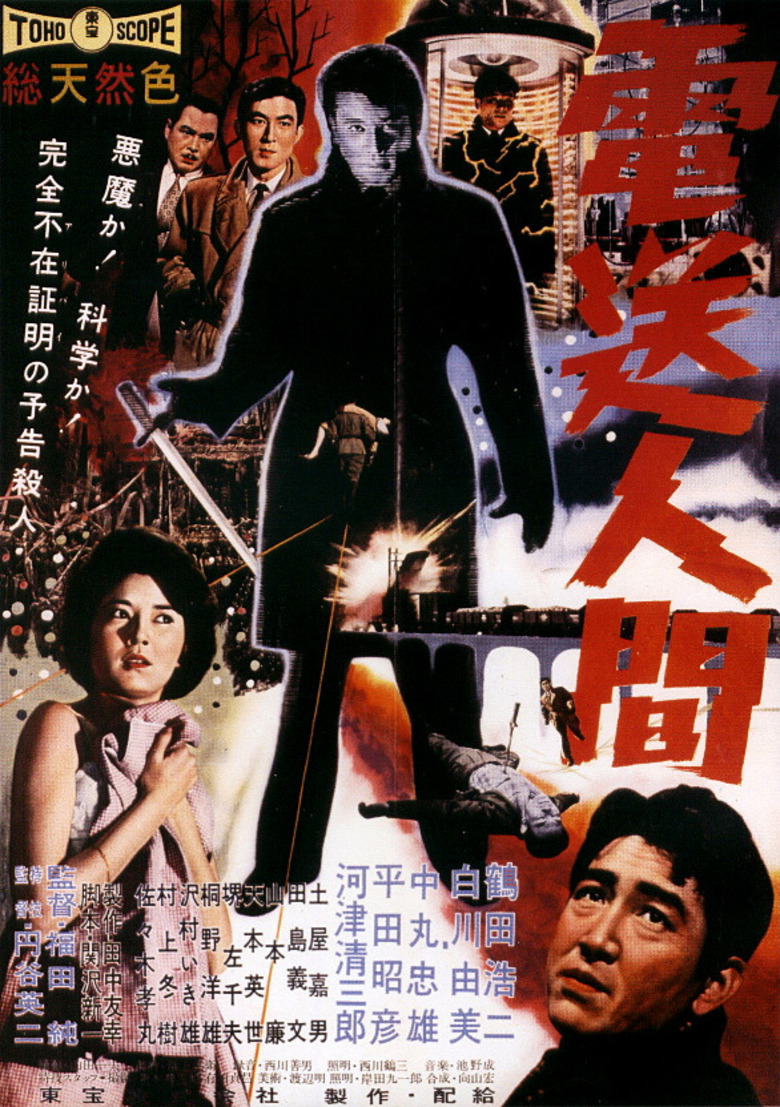
The-Secret-of-the-Telegian-images-df0ac23f-302b-4e88-8ec7-5423f55f51cPlaced between The H-Man and the Human Vapor, The Secret of the Telegian (電送人間, Denso Ningen) is another in Toho’s series of “mutant” movies in which “enhanced” humans find themselves turning monstrous because of ill-advised scientific endeavours. Like many in the series, Telegian has an ambivalent attitude towards scientific research, both proud and fearful. This might be 1960, but the roots of the threat once again stem back to wartime crimes and the impossibility of trust as a man long thought dead teleports himself out of his fictitious grave to wreak a terrifying and bloody revenge on those who have wronged him.

People running screaming out of the “Cave of Horrors” might not be such an unusual sight but this time it’s not papier-mâché ghosts or fancy tricks which have produced such a reaction but a real life bloody murder. The dead man, Tsukamoto, has the end of a bayonet in his chest and a cryptic letter in his pocket asking him to come to this very spot in order to learn “the truth about what happened 14 years ago”. The police are baffled, as is science journalist Kirioka (Koji Tsuruta) who is excited to discover a strange wire at the crime scene. Eventually, the trail leads to a nationalistic, military themed cabaret bar run by former lieutenant Onishi (Seizaburo Kawazu).

The bar is more or less a front for Onishi’s smuggling operation but what has him worried is that a former associate, Taki (Sachio Sakai), may think that he and another former solider, Takahashi, may have reclaimed some stolen gold and declined to share the proceeds. Onishi, Takahashi, and Taki have all received ominous gold discs which seems to point back to their failed bid to pocket some of the Emperor’s gold during the last days of the war. Charged with looking after a top scientist working on teleportation technology, Onishi decided he’d rather have the cash instead stooping so low as to kill both the researcher, Nikki (Takamaru Sasaki), and one of his subordinates who tried to stop him – Tsudo (Tadao Nakamaru). The gang were interrupted stealing the gold but went back a year later only to find the bodies and the treasure vanished without a trace.

Tsudo, now living under an alias, is hellbent on revenge not only against the men who left him for dead but indirectly against their entrenched treacheries as betrayers of their duty, country, and morality. Unlike the the villain of The Invisible Man Vs Human Fly, Tsudo is not among those who feel themselves betrayed or abandoned by their country, left out in the cold in the new post-war world, but one who has a deep seated need to make those who’ve wronged him pay for their treachery. Onishi’s strange militarism themed bar only adds insult to injury given his extremely unpatriotic conduct, though it is perhaps in keeping with the traditionally opportunist nature of nationalists throughout history.

Despite the familiar setup, the science takes a back seat as Fukuda pushes the procedural over the sci-fi and so it remains unclear to what extent, if any, the presence of the teleportation equipment is responsible for Tsudo’s strange behaviour. The teleporting Tsudo is, it has to be said, an odd man. Turning up to complain about late deliveries of the refrigeration equipment he needs for the special metals involved in the experiments,  Tsudo’s manner is creepy in the extreme, robotic yet somehow malevolent. Predictably he develops a fondness for the saleswoman, Akiko (Yumi Shirakawa), who coincidentally lives near to the first murder victim and also becomes the love interest of intrepid reporter Kirioka.

Fukuda keeps things simple over all, stopping to pay an extensive homage to Jacques Tourneur’s Cat People, though there’s a wry sense of humour at play in the bizarre fairground beginning and odd production elements such as the incongruous club and its dancing girls who are, ironically enough, entirely painted in gold. Eiji Tsuburaya’s involvement is largely limited to the transportation effect which is extremely impressive in its execution and has an appropriately unsettling feeling. Not quite as coherent as other examples of its genre, The Secret of the Telegian has a slight tonal oddity in its almost nationalistic discussion of false nationalism, literally taking aim at those who preach patriotism yet cynically betray their country, robbing it not just literally but spiritually. Even so, Fukuda’s take on the mutant formula has enough tongue in cheek humour and sci-fi inflected drama to keep most genre fans happy.


Original trailer (no subtitles)