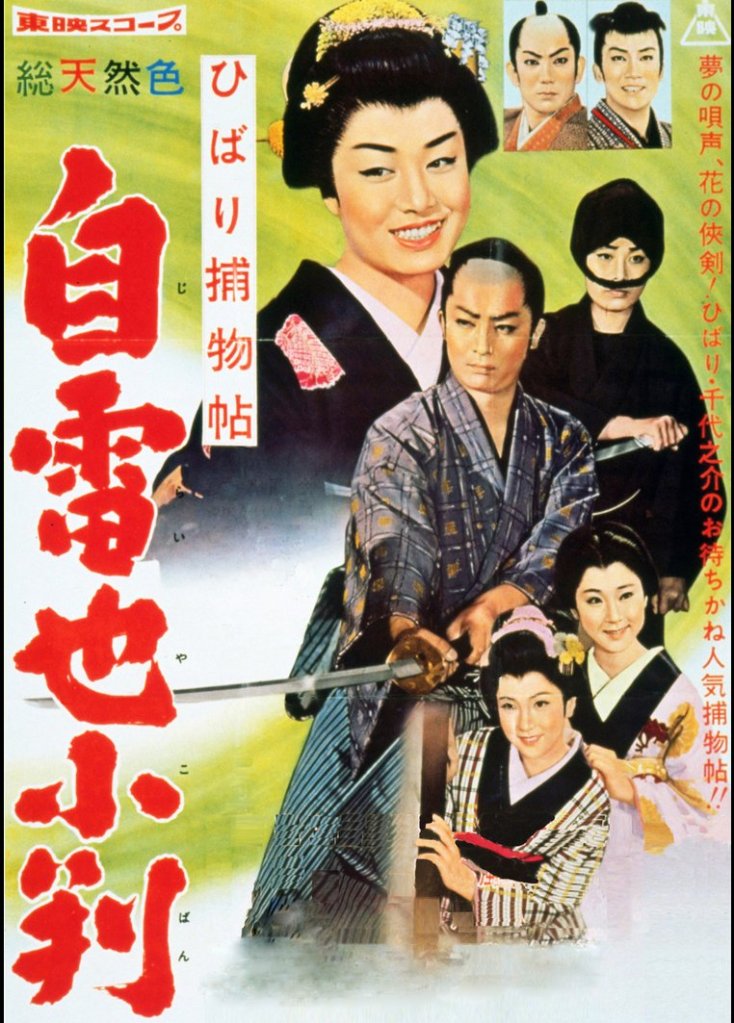
Girl with the Fire Banner (唄祭りかんざし纏, Kinnosuke Fukada, 1958)

Hibari Misora puts out the fires of the Bakumatsu in another musical jidaigeki adventure, Girl with the Fire Banner (唄祭りかんざし纏, Utamatsuri Kanzashi Matoi). Once again co-starring with Chiyonosuke Azuma, Misora plays another feisty young woman taking over the family business from a sickly father only this time the business is the fire brigade and while she calmly points out to those of a differing opinion that firefighting is an equal opportunities, apolitical occupation, she also finds herself at the centre of a coming revolution caught between corrupt Shogunate loyalists and the imperialist advance. 

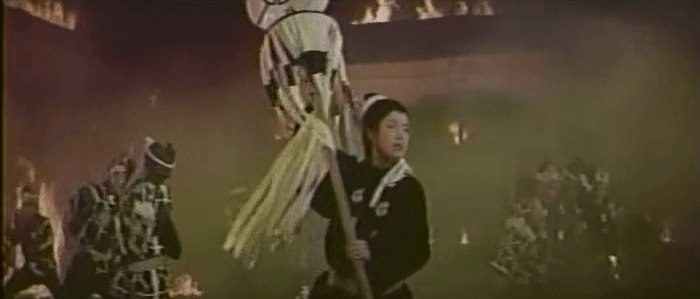
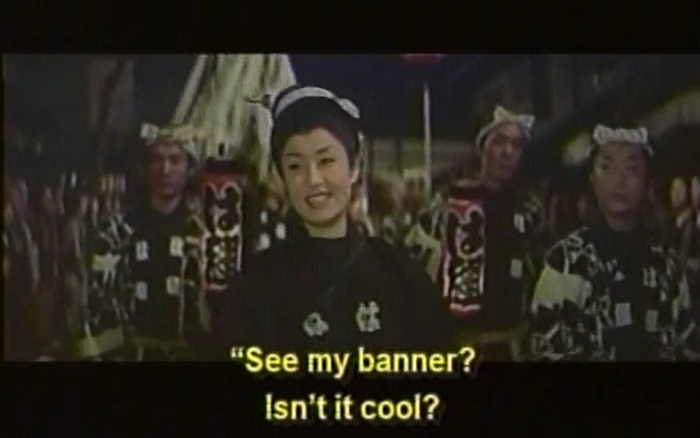
Set in Edo in the climactic year of 1868 in which the Shogunate ultimately falls, the action opens with a fire at a townhouse owned by a member of the Satsuma clan, the leaders of the imperialists aiming to topple the Tokugawa and restore power to the emperor. While Haru (Hibari Misora) and her top team of firefighters rush to the scene, others actively refuse to fight the fire even going so far as to try to stop her. While she reminds them that it doesn’t matter who the house belongs to they have a duty to fight fire if only to prevent it engulfing the rest of the town, a dashing young samurai turns up and fights off the loyalists before daringly retrieving their firefighter’s banner from a burning roof asking only five ryo in return. The mysterious man soon disappears only to turn up a few days later having attempted to charge them for a new kimono and a shave in order to ask for a job as a fireman. Haru tries to dissuade him, not least because of his samurai arrogance as he explains he’s not come to join at the bottom and serve out the three year probationary period but to lead, but eventually relents only to find him continuing to behave like an entitled twit flouting all of their rules. 

Nevertheless, as someone later puts it, Japan will shortly be a “classless society” or at least samurai privilege is about to dissolve. This appears to be the central preoccupation of the villainous lords who describe themselves as Shogunate loyalists but in reality care only for their own cause. Not content with running an obvious protection racket with local vendors, threatening to burn down their stores if they don’t agree to contribute to their fund for restoring the Shogunate, they’ve also been buying up rifles to sell at inflated prices to “young hotheads” eager to die for the Shogun, and stockpiling rice hoping to profit when the city burns as they assume it will when imperialist troops arrive. Realising that their gambles may not pay off as the Shogunate may be planning to cut a deal and surrender in order to protect the people of Edo, the lords, who are technically in charge of the fire brigades, consider burning the city to the ground themselves under the cover of avenging the Shogunate’s honour. 

Of course, Haru, a firefighter through and through, could never support such duplicity though it’s clear many of the others would have gone along with it if no one had resisted. In contrast to some of Misora’s other Bakumatsu-era movies, the Shogunate and more particularly the loyalists are definitely the bad guys though in a rather strange turn of events we also see real life sumo wrestlers Asashio Taro III and Wakamaeda Eiichiro arrive to stand up for justice by knocking some of the loyalists heads together, returning later armed with giant poles and dressed only in their mawashi loincloths while throwing hay bales followed by the actual cart (!) at the arsonist loyalists before physically holding them back with the firefighters’ ladders. 

Misora, meanwhile, remains largely on the sidelines uncharacteristically elbowed out of the fight by the guys while lowkey falling for Shintaro despite his samurai arrogance. Musical numbers are fewer than might be expected, the title Edo Firefighter song reprised at the end while Misora gets a second love song wistfully sewing a kimono for Shintaro in the company of a cat wearing a fancy ruff. Shintaro gets his own number before handing back to Misora for another reprise of the title song. Nevertheless, the pair manage to salvage Edo from the flames of the revolution purifying the corruption while furthering progress towards a more equal society even if the closing scenes leave us clearly still on the march. 

Detective Hibari 2: Secret of the Golden Coin (ひばり捕物帖 自雷也小判, Kinnosuke Fukada, 1958)

Oshichi returns! Two years after her first adventure, the princess in hiding has moved on, still living in the city hiding from the burdens of privilege but fiercely opposing injustice wherever she finds it as a detective in her own right. Unlike Mysteries of Edo and in keeping with Case of the Golden Hairpins, this Oshichi undergoes much less of a softening, remaining largely disinterested in the idea of romance, and cooly rebellious in her refusal to be cowed while strangely OK with Shogunate oppression as a quasi-agent of the state. 

As the film opens, a young woman impersonates Oshichi in order to gain entrance to a prison where her boyfriend is in jail for rebelling against the Shogunate. Meanwhile, Oshichi (Hibari Misora) is teaching a singing class as a favour to her boss who had to go out on an errand, after which she discovers that Hyoma (Chiyonosuke Azuma), currently a retainer of her brother’s, has been sent to bring her home. Once again she refuses because she likes her “ordinary” life. Shortly thereafter, a fire breaks out in the prison and the rebels escape. Oshichi becomes a prime suspect in the jailbreak, not only because the accomplice borrowed her name but because it’s advantageous to the plotters to blame her because they can use her guilt to tarnish her brother’s reputation and get him fired, usurping his position in the process. 

Oshichi, now working as a detective, is technically an agent of the Shogunate against which the rebels are rebelling for reasons which aren’t stated here but are probably easy to guess. They are, in many ways, the same sorts of reasons that Oshichi chose to become a detective, even if she’s coming at them from the other side. She doesn’t like bullies, or corruption, injustice or unfairness. Oshichi won’t stand for unkindness either, which is perhaps why she aligns so strongly behind the woman who blackened her name by impersonating her, knowing that she did it all for love and a little bit for justice, while also forgiving the rebel Seinosuke (Kotaro Satomi) who was preparing to kill the woman he loved because the corrupt samurai had kidnapped his dad and threatened to kill him if he didn’t. 

Despite all that however, Oshichi still insists that “the Shogunate can be compassionate too”, encouraging Seinosuke and his girlfriend Namiji (Hiromi Hanazono) to tell all so she can help them safe in the knowledge that they will be forgiven. It’s a slightly strange position for to her take, essentially authoritarian but arguing for a benevolent paternalism that is just and fair and kind, insisting that the corrupt samurai are bad apples which must be expelled rather than a product of an inherently oppressive social system as they are generally depicted in post-war jidaigeki. 

This insistence on the “compassion” of the Shogunate is perhaps the concession to Oshichi’s femininity which she has otherwise rejected in rejecting her life as a cosseted princess. As Kawashima had in Mysteries of Edo, Oshichi’s “protector” Hyoma asks her how she can take on all those men before challenging her to a contest of masculinity as mediated through a drinking competition which she does not exactly “win” but makes a minor victory all the same. Rather than rely on her brother or Hyoma, Oshichi vows to clear her name herself and starts investigating on her own dressing as a man and fighting bad guys while insisting on her independence. 

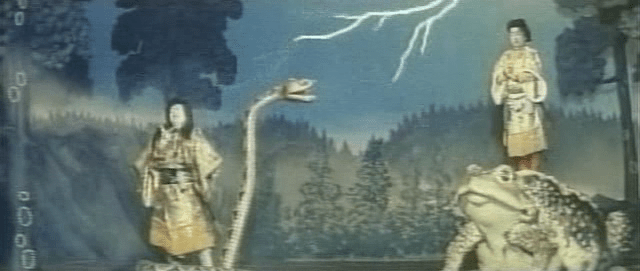
Nevertheless, she is but a pawn in a game of courtly intrigue, manipulated as a means of getting to her brother. The corrupt samurai think nothing of killing anyone who gets in their way, be they princesses or peasants, even going far as to mount an attack on the stage of a theatre mid-performance in front of a room full of spectators, many of whom join Oshichi by throwing projectiles as she tries to fend them off. Once again, she isn’t quite permitted to save herself but is “rescued” by the patriarchal forces representing the greater Shogunate including her protector Hyoma, and her brother, the embodiment of state authority. She is, however, the primary motivator in unmasking the corruption as she both clears her own name, and creates a better future for Namiji in which she can be with the man she loves, reminding her to always remember the compassion the Shogunate has shown her (in case she was minded to mount any more rebellions). As for herself, she manages to slip the loop once again, running off into the wild to claim her independence rather than be forced back into the golden cage of her princesshood while the loyal Hyoma contents himself with following her lead. 


Short clip (no subtitles)