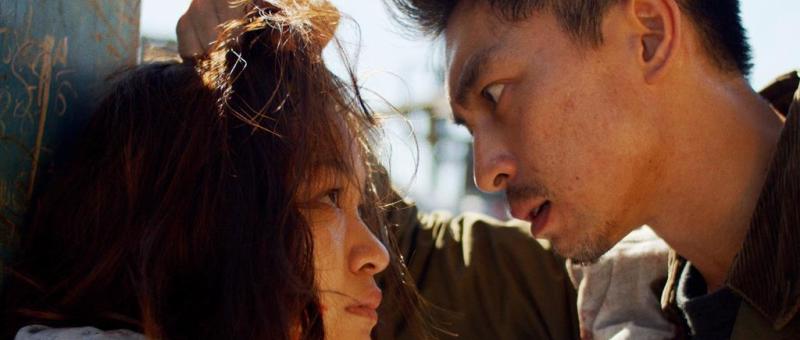

The titular Tatsumi (辰巳) laments that there used to be a line. They used to be better than this. But his incredibly duplicitous boss just laughs at him and says they can’t live on honour and humanity anymore. In any case, there didn’t seem to be much honour or humanity in Tatsumi’s decidedly unglamorous life of petty gangsterdom even before everything went to hell but despite his cynicism and seeming indifference he is the last holdout for some kind of gangster nobility.
Though he has a cover job as a fisherman, Tatsumi’s (Yuya Endo) main hustle is as a cleanup agent getting rid of inconvenient bodies for various gangs. He finds himself mixed up in local drama when a pair of crazed, sadistic gangsters become aware someone’s been skimming their meth supply. They torture and kill a suspect who leads them to another, garage owner Yamaoka (Ryuhei Watabe) who is married to an old flame of Tatsumi’s, Kyoko (Nanami Kameda), while her younger sister, Aoi (Kokoro Morita), is also in trouble with another rival ganger, Goto (Takenori Goto), on the suspicion of having pinched some of his meth supply. Tatsumi ends up agreeing to mediate for Aoi, gets much more than he bargained for when the crazed Ryuji (Tomoyuki Kuramoto) murders Yamaoka and Kyoko and Aoi becomes a secondary target after catching him in the act.
Ryuji doesn’t seem to care about tying up loose ends, but just wants Aoi dead for reasons of total vengeance. It’s his uncontrolled violence that has disrupted the equilibrium of the local gangster society though the proposed solution is simply more violence in allowing him to kill the people he wanted to kill in the hope he’ll then calm down and stop which seems unlikely. Like many similarly themed yakuza dramas, Ryuji’s violence appears to have a sexually charged quality and there is also a hint of a potential relationship between Ryuji and Tatsumi’s boss whom he calls “Skipper.”
Ryuji also has a slightly less crazy sibling in an echo of the relationship Tatsumi once had with his own brother who died of a drugs overdose having become involved in petty crime. The implication is that Tatsumi gave up on his brother and was relieved when he died but also that he harbours a degree of guilt for preventing him ending up the way he did and not trying harder to save him. That may partly be why he decides to help Aoi, seeing echoes of the brother he couldn’t save while she is also friendless alone having unwisely made enemies of almost everyone because of her outrageous behaviour and reckless disregard for authority. Aoi has an unpleasant habit of spitting at people who upset her while otherwise adopting a devil-may-care attitude with those minded to kill her. If she did skim from Goto’s stash, it cost the life of another falsely accused underling.
Despite himself, Tatsumi becomes increasingly determined to help Aoi even though or perhaps because he assumes neither of them is likely to survive this crisis. Desperately trying to stay one step ahead he plays one side against the other and tries to find the best angle for escape while knowing there probably isn’t one. Shoji sets the tale across a series of moribund jetties and shacks laying bare the busy emptiness of this world with only the sea beyond. “Emotion will make you fail,” Tatsumi tells Aoi while describing dead bodies as just things and trying to keep his cool when needled by Ryuji or another dangerous and violent gangster.
Death and life by extension appear to be meaningless and of little value. Tatsumi does perhaps close a circle, or maybe more than one, as the last principled gangster who thought there ought to be a line between what they do and greedy thuggery only to find there never was one and his determination not to cross it is the kind of sentimentality that can get a man killed. Making good use of slow dissolves, Shoji revels in a retro aesthetic in a tale of moral compromise and redemption as Tatsumi determines to safeguard Aoi not only from her own reckless impulses but the meaningless emptiness of the gangster life and the toxic legacy of violence and fallacy of vengeance as a salve for the wounds of the soul.
Tatsumi screened as part of this year’s Camera Japan.
International trailer (English subtitles)











 Windows on Worlds