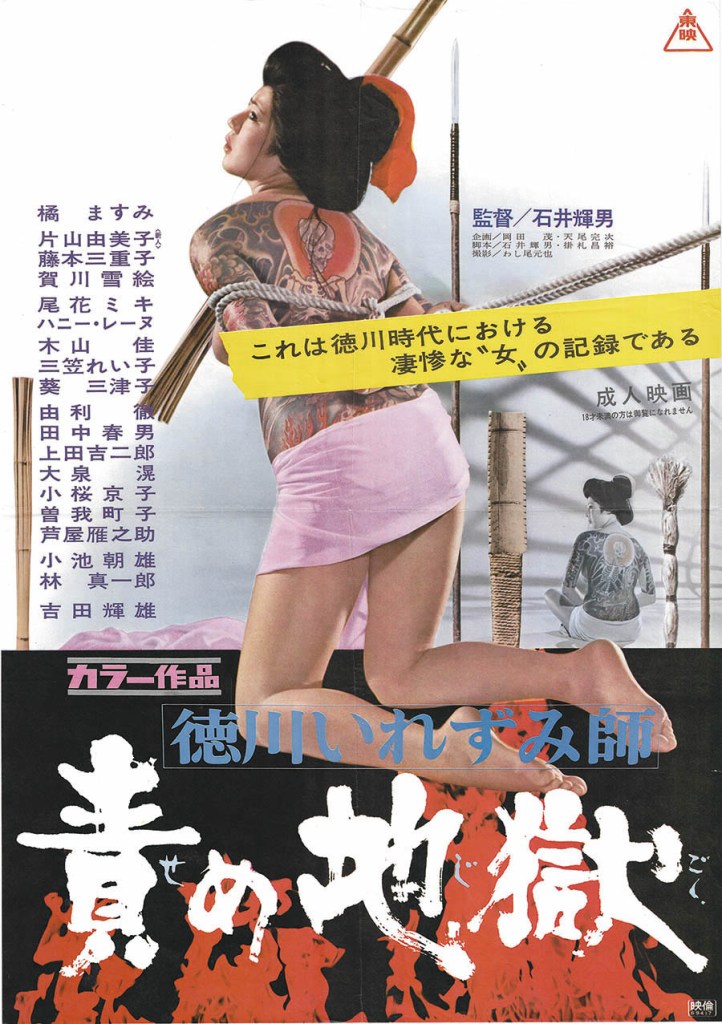
Bohachi Bushido: Code of the Forgotten Eight (ポルノ時代劇 忘八武士道, Teruo Ishii, 1973)

A nihilistic ronin falls into the hellish trap of the Yoshiwara in Teruo Ishii’s dazzlingly psychedelic period drama, Bohachi Bushido (ポルノ時代劇 忘八武士道, Porno Jidaigeki: Bohachi Bushido). Adapted from a manga short by Kazuo Koike, the film once again tackles Edo era corruption as a brothel owner with a special connection to the shogun attempts to wipe out the competition presented by an enterprising merchant class only to find himself hoist by his own petard.

Ishii signals his intentions early on with the artfully staged opening scequence in which wandering ronin Shino (Tetsuro Tanba) is attacked on a bridge at dusk. As he turns to slash at an opponent, the blood splatter morphs into the film’s title while the clang of swords gives off little blue sparks that turn into the listings for the cast and crew. By the time the title sequence has concluded, night has descended on the bridge and Shino finds himself engulfed in darkness. “To die is hell, but to live is also hell” he exclaims as he jumps into the water below, hoping to be free of his empty life of killing. 

Unfortunately, he is rescued and brought to the Yoshiwara where they try to persuade him to join the Bohachi clan so called because to do so you must abandon all eight human virtues. The Bohachi’s main line of work is the sexual torture of women until they become docile dolls for their brothel. Shino describes them as “revolting” but then adds “just like me” and agrees to join anyway only to earn their mistrust when he refuses to play along with their games, buying but not sleeping with a woman brought in over a debt. Though Shirakubi, the guy who recruited him, tries to kick Shino out and calls the police on him for good measure, the big boss, Shirobe (Tatsuo Endo), decides he’ll take him in for use as an attack dog taking down anyone who interferes with business be they lords or officials. 

The irony is that the nihilistic Shiro enthusiastically takes to his work because he dislikes the debauchery of the Edo-era society even while working for the “legitimate” brothel owner who is at least “licensed” to exploit women for financial gain. What Shirobe resents is the rise of quasi-brothels in the various teahouses that are obviously selling more than just tea but continue to undercut his business by selling women even cheaper than he does. He also feels betrayed by the various samurai lords who choose to visit the teahouses over his own establishment and therefore seeks to have them frightened into submission by ordering Shino to kill any man found with one of the tea house sex workers. Later he even declares a kind of sex worker amnesty promising to pay five ryo for any of the teahouse women brought to him, no matter by who, and then joking that he’s actually killing two birds with one stone by getting his hands on a high quantity of new stock for a very low price. 

Shino refuses to sleep with the women and is most offended when his male assistant is killed in an attack by the rival brothel owners yet the team of warrior women sent to protect him did nothing to help because their orders were only to protect Shino and Shirobe’s orders must be followed to the letter on the pain of death. He seems to know he’s living on borrowed time and Shirobe probably intends to finish him off once he’s finished his mission of removing all opposition and restoring Shirobe’s power to manipulate the shogun but barely does anything to resist until faced with the rather ironic punishment of being given opium and then forced to participate in a never-ending orgy intended to result in his death in an extraordinary psychedelic sequence from Ishii . 

Of course, what they didn’t reckon on was Shino’s ironic desire to live or at least not to be beaten in which he actively begins stabbing himself to overcome withdrawal symptoms and carry on fighting even when they try to ram him with a giant spear cart. Ears are cut off, flying across the screen followed by arms and then heads. Ishii lends a poetic sheen to the closing moments as Shino is caught in a hero pose alone in the snow but still standing, if barely, and freed at least from one kind of hell if not from many others. 
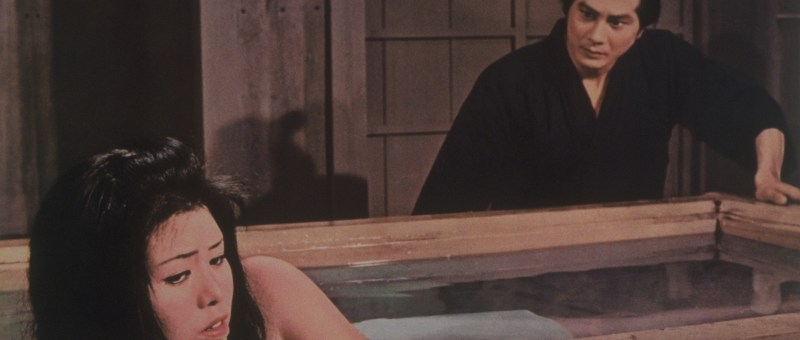

Inferno of Torture (徳川いれずみ師:責め地獄, Teruo Ishii, 1969)

“There’s no hope for us anymore” cries the hero, redeeming himself with one last act of humanity before allowing himself to be consumed by the flames of Edo-era barbarity. Another tale of feudal exploitation, Teruo Ishii’s Inferno of Torture (徳川いれずみ師:責め地獄, Tokugawa Irezumi-shi: Seme Jigoku) opens with an otherwise unrelated scene of female crucifixion followed by an elaborate beheading, presenting both of these events with a degree of historical authenticity they do not perhaps possess. Nevertheless, his central tale which turns out to be less about two women than two men, turns on the exploitation of female bodies, subtly suggesting that the modern society is itself founded on female exploitation. 

Though dropping the portmanteau structure frequently employed in the Joys of Torture series, Ishii returns from the prologue with the end of the first arc in which the presumed heroine, Yumi (Yumiko Katayama), makes a stealthy visit to a ghostly cemetery in which she trashes the grave of a man named Genzo (Shinichiro Hayashi), digs him up and dismembers his body to retrieve a key we later see him swallow which she hopes will unlock her womanhood currently imprisoned by an ornate chastity belt, only the key doesn’t fit. 

Flashing back again, we see Yumi forced into sex work in payment of a debt and imprisoned in a labyrinthine brothel which specialises in bondage and torture under the guidance of lesbian madam Oryu* (Mieko Fujimoto) and her samurai fixer Samejima (Haruo Tanaka). The brothel’s USP is in its tattooed women which neatly leads us into the main narrative as Yumi’s body becomes a battleground contested by two men, top tattoo artists in search of the perfect canvas in order to win, ironically, the hand of their master’s pure and innocent daughter Osuzu (Masumi Tachibana). 

Horihide (Teruo Yoshida) and Osuzu are in love, but the dark and brooding Horitatsu (Asao Koike) is determined to frustrate his rival’s desires by becoming the successor to Osuzu’s dying father, the tattooist Horigoro. The “hori” which prefixes each of the men’s names relates to the process of tattooing and comes from the verb to chisel, hinting at the way they prick and channel their desires into the canvas which is human skin. Horihide is our “hero”, described by Horigoro as the light to Horitatsu’s dark, Horitatsu currently making more of an impact with his designs of violent intensity, but each of them is in a very real way content to use and exploit the bodies of women without their full consent in order to practice their art. It is essentially an act of violence if not of “torture”. 

Meanwhile, Oryu and Samejima are profiting off their “merchandise” more directly in participating in the trafficking of tattooed ladies to lecherous foreigners displaying an early fetishisation of Asian women. This being late Edo, Japan is still in its isolationist period in which fraternising with foreigners was illegal which is why the action eventually takes us to Nagasaki and the Dutch trading port of Dejima, here presented as a nexus of corruption, where Samejima and Oryu prove themselves very much in league with foreign powers dealing with powerful businessman Clayton (Yusuf Hoffman), despite his name apparently a Dutchman, and his Chinese associates. Like Nikkatsu’s borderless action films of the ‘50s and ‘60s, Inferno of Torture indulges in an unpleasant Sinophobia which culminates in a chase through a crowded Chinese wet market in which we catch sight of dogs hanging bound ready for the slaughter in similar poses to those of the women in the brothel, not to mention thrusting snakes, before being confronted by a basket full of adorable puppies presumably headed for a dark destination, while we finally rediscover Hidetatsu collapsed in an opium den after being forcibly addicted by Oryu as a means of control. 

“This is a house of horrors” the Chinese gang leader tells a group of women bought by Samejima from a prison and promised a life of wealth and ease as geisha catering to high class clients. It’s difficult to tell if Ishii is critiquing Edo-era misogyny or that of the present day, or merely revelling in it with increasingly perverse scenes of sexual violence and degradation which continually imply that women have no role or value outside of reflecting the desires of men while those who try to claim their own agency are brutally put down by an inherently misogynistic, patriarchal society. After a Count of Monte Cristo-esque subplot in which Horihide is framed for murder but escapes to plot his revenge, the psychedelic final showdown returns us to the tattooists’ artistic face off as they again weaponise female bodies to embody their own ambitions, Horihide turning a blameless young woman into an iridescent peacock to get back at her father. Nevertheless, he finally reassumes his humanity in ending his mission of vengeance before it takes more innocent lives while accepting that he may now be too corrupted to return to his former life. Elegantly composed often unconsciously recalling the keyhole in Yumi’s chastity belt as it imprisons women within the peephole of the frame, Inferno of Torture ends exactly as it began, with a scene of grim and ironic punishment in which the female form is itself obliterated. 


Inferno of Torture is available on blu-ray from Arrow Video in a set which also includes an in-depth commentary from Tom Mes discussing the treatment of the various actresses involved with the series, Ishii, and Toei in general; Jasper Sharp’s Miskatonic lecture Erotic Grotesque Nonsense & the Foundations of Japan’s Cult Counterculture; and a booklet featuring new writing by Chris D.

Original trailer (no subtitles)

*This character’s name is rendered as “Oryu” in the subtitles but “Otatsu” (different ways of reading the same character which means “dragon”) in the accompanying booklet.

Murder Unincorporated (大日本殺し屋伝, Haryasu Noguchi, 1965)

0089_86_MURDER_UN-INCORPORATED“If you don’t laugh when you see this movie, I’m going to execute you” abacus wielding hitman Komatsu warns us at the beginning of Haryasu Noguchi’s Murder Unincorporated (大日本殺し屋伝, Dai Nihon Koroshiya-den). Luckily for us, it’s unlikely he’ll be forced to perform any “calculations”, and the only risk we currently run is that of accidentally laughing ourselves to death as we witness the absurd slapstick adventures of Japan’s craziest hitman convention when the nation’s “best” (for best read “most unusual”) contract killers descend on a small town looking for “Joe of Spades” – a mysterious assassin known only by the mole on the sole of his foot.

After the amusing Bond style opening, we witness the first victim of Joe of Spades who happens to be one of the five top gangsters in town. Sure enough, the other four then receive a threatening phone call to the effect that they’re next in line for a bullet in the brain. After ringing up an assassins agency and holding a series of auditions, the head honchos wind up with a gang of hitmen bodyguards each of whom have their own theme and wacky back story.

The leader of the gang is Heine Maki – a poetry loving, bowler hatted killer whose signature weapon is a heavy book of poems with a gun hidden inside,. He’s joined by O.N. Kane – an ex-baseball player who missed out on the major leagues through being too good and carries a baseball bat that’s really a gun, “Knife” Tatsu – ex-sushi chef knife thrower with an intense fear of fish, Al Capone III – a midget who claims to be the Japanese grandson of Al Capone and is obsessed with the Untouchables TV show, and of course Komatsu himself whose signature move is to throw his abacus in the air and invite chaos in the process.

The guys are really a little more than this small town can handle though they quickly discover the situation is nowhere near as straightforward as they thought and wind up facing off against some equally eccentric foes. That’s not to mention the mama-san at Bar Joker who turns out to be at the center of the case and a local mechanic who’s suspiciously handy with a pistol.

There really are no words to describe the quick fire, extremely zany universe in which Murder Unincorporated takes place. This is a world ruled by crime in which each of our “heroes” showcase extremely sad backstories which explain why they had absolutely no choice but to turn to killing people to survive. Take “Knife” Tatsu for example, he became a hitman because he was unable to kill the fish gasping away on his cutting board so he decided to kill people instead. O.N. Kane turned murderous after being let down in his baseball dream, Heine has a romantic tale of lost love, Capone III simply has it in the blood, and Komatsu? He wants to be a pharmacist…

This is all inspired by legendary Japanese funnyman Kobako Hanato who is famous for his Southern Japan flavoured absurd comedy routines. Kon Ohmura, who plays Komatsu, was one of his top collaborators for a time and became one of Japan’s all time great comedians. Meta quips such as remarking that the police are about to turn up “for the first time in this film” and involved jokes like the one that sees Komatsu tracking down identical “Joes” in varieties club, diamond, heart (amusingly, dressed as a geisha and playing pachinko), before heading into a punchline it would be a crime to spoil only add to the feeling that absolutely anything could happen and that would be perfectly OK.

Director Noguchi mostly keeps things straightforward but builds a fantastic comedic rhythm managing the quick fire dialogue and general absurdity with ease. Much of the film is told in flashback or reverie but the device never becomes old so much as easily syncing with with general tone of the film. There are some more unusual sequences such the opening itself, keyhole view, and a later sequence where we see directly though Komatsu’s big square glasses but otherwise the deadpan filming approach boosts the inherent comedy in the increasingly surreal situations. Quirky, oddly innocent, absurd, and just extremely laugh out loud funny, Murder Unincorporated is a world away from Nikkatsu’s po-faced crime dramas but exists in a crazy cartoon world all of its own that proves near impossible to resist!


Murder Unincorporated is the third and final film included in the second volume of Arrow’s Nikkatsu Diamond Guys box set.

https://www.youtube.com/watch?v=CbyNaKyefuc