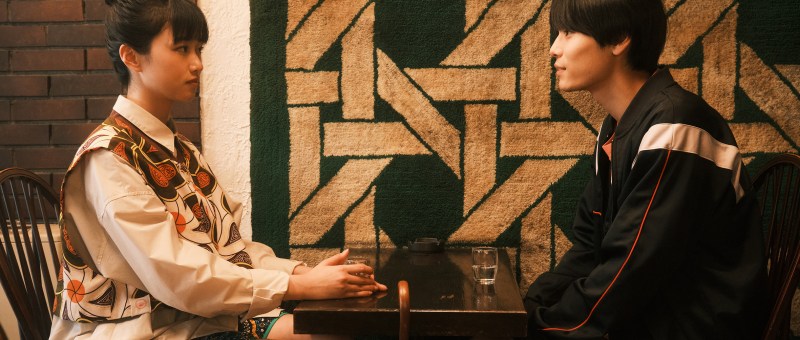

Akiko Ohku’s quirky dramedies have so far mostly focused on an introverted woman’s quest for love, but with She Taught Me Serendipity (今日の空が一番好きとまだ言えない僕は, Kyo no Sora ga Ichiban Suki to Mada Ienai Boku ha) she moves into new territory in adapting the novel by Shusuke Fukutoku in which an alienated college student is unwittingly caught between two women. Set in the picturesque city of Kyoto, the film echoes the work of Tomihiko Morimi and revels in the power of serendipitous connection but equally the melancholy loneliness that underpins it in the legacy of grief and regret.
Returning after a six-month absence following the death of his grandmother, Konishi (Riku Hagiwara) is indeed at odds with his environment. He walks as if in a fog and is slightly out of tune with the world around him while often carrying an umbrella, or parasol depending on the weather, as a bulwark to protect him from prying eyes. Unlike his classmates, he speaks in the standard dialect rather than with an Eastern-inflection which his only friend Yamane (Kodai Kurosaki) has taken to extremes, describing his manner of speech as “Yamane Dialect”. It’s on campus that he begins catching sight of a young woman Yamane has dubbed the “solo soba” diner who seems to be just as solitary as he is, though the pair later strike up a connection precisely because of their shared sense of alienation.
To that extent, it’s not unreasonable that Konishi might doubt his new friendship with his young woman, Hana (Yuumi Kawai), who seems to be tailor-made for him and appeared seemingly from nowhere during his absence. Meanwhile, he’s resumed his old job at a local bathhouse where he cleans after hours with a girl-named Sacchan (Aoi Ito) who, judging by the looks she exchanges with the owner’s daughter Kaho, is secretly in love with him though he hasn’t noticed. While Hana is like him quiet and mysterious, Sacchan is a live wire, a young woman full of life who can’t stop talking and makes each of their cleaning sessions a riot of fun and silliness.
But in keeping with these kinds of stories, Konishi suffers from extreme main character syndrome and never really sees either woman as a whole person rather than as an extension of himself. As Sacchan says in a poignant monologue movingly delivered by Aoi Ito, he never even bothered to ask her full name. He promised to buy her dinner to make up for missing shifts and needing extra help, but most likely never planned to follow through, nor did he ever listen to the song she recommended to him, though he went and read the short story Hana referenced right away. On the one level, there was nothing he could do to avoid hurting her feelings when he couldn’t return them, but at the very least he’s been self-involved and insensitive, just as he is when Hana suddenly drops out of contact and he convinces himself she was only hanging out with him as a joke. Rather than process his pain, he lashes out at Yamane instead and almost loses his only remaining friend before finally growing up a bit and making the effort to say sorry.
The Japanese title translates as something like “I, who still can’t say, ‘Today’s sky is my favourite’,” echoing a common phrase repeated by Hana’s late father and Konishi’s grandmother, and hinting at Konishi’s inability to embrace whatever life gives him and find joy within it. Nevertheless, he does perhaps learn the importance of saying how he feels before it’s too late while taking into account the feelings of others even if his final confession comes at an awkward and insensitive moment, though it’s true enough that he’s really talking to himself. On one of their surreal adventures, he and Hana visit an unusual restaurant where all the dishes have quirky codenames except for one. It turns out the proprietor used to have someone to help him, but for whatever reason they’re not around anymore. Playing with aspect ratios and split screen, Ohku often fills the frame with a sense of absence in which characters simply disappear quite abruptly, echoing the fragility of these connections and, in fact, of everything, but makes plain that the main thing is to embrace them when they come rather than live in the shadow of loss or let the chance for love pass you by in fear of its failure.
She Taught Me Serendipity screened as part of this year’s Toronto Japanese Film Festival.
Trailer (English subtitles)







 Windows on Worlds