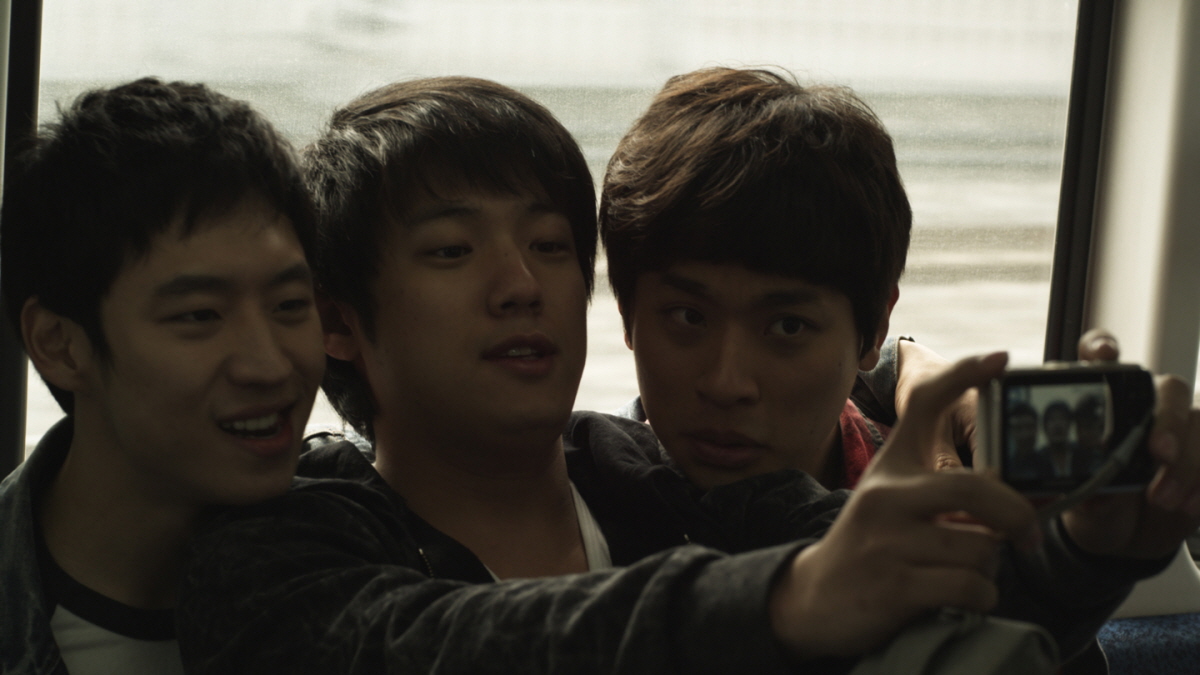
Review of Bleak Night published on UK-anime.net
Review of Bleak Night published on UK-anime.net

 As we’ve seen lately, there are certainly no shortage of films looking at the complicated and often harsh world of high school in Korea. Pluto (명왕성, Myungwangsung) takes a sideways look at the darker side of academic excellence when the praise and prestige of being one of the top students becomes almost like a drug and makes otherwise bright young people do things even a heroin addict in serious need of a fix might at least feel bad about afterwards with an all encompassing sense of entitlement that gives them a lifetime free pass for even the worst transgression.
June (David Lee) is a bright young boy from a regular high school who’s just transferred into an elite boarding school educating the country’s next great hopes. He may have been a top student at his old school, but here he’s merely average as the school hotshots are pretty quick to point out. Here, the top ten students are treated like princelings – a special computerised teaching room, no curfew, better rooms, better resources and they can more or less do what they like so long as they keep their grades up. Occasionally someone manages to bump one of the top ten from the list but they quickly get kicked out again. The top ten operate like some kind of swatters mafia – they all stick rigidly together, swapping hot tips for the upcoming exams that they refuse to share with the others and engaging in a series of increasingly cruel “pranks” they term rabbit hunts.
The film opens with the police finding the body of the previously number one student Yu-jin (Sung Joon) in a wood with June’s phone lying next him having been used to film the entire grisly affair. June is arrested for the murder but is released after his alibi checks out. Sick of all the struggle and unfairness, June puts his particular talents to use to try and teach the world a lesson about the sort of people this system is producing.
The picture Pluto paints of the Korean schools system is a frankly frightening one in which academic success is virtually bought and paid for or guaranteed by class credentials. Yes, the top students obviously must have ability – some of their activities may come close to cheating but interestingly nobody seems to want to try actual deception to get ahead. However, that natural ability has clearly been bolstered by their parents’ wealth. Attending an elite school and spending more than some people earn on private tutors geared towards knowing how to get into the best universities undoubtedly gives them advantages which are out of reach for others no matter how smart they may be. Perhaps that’s fair enough in a capitalist society, they didn’t ask to be born to rich parents and who would turn that sort of help down if offered it? However, though they may possess the virtues of discipline, hard work and a desire to succeed what they lack is any sort of empathy or even common human decency. Engaging in a series of manipulative hazing exercises, the elite group will stop at nothing to protect their status specialising in thuggery, blackmail, rape and even murder. The sort of people this system is advancing are not the sort of people you want running your schools and hospitals, they are morally bankrupt and only care about their own standing in the eyes of others.
Perhaps it’s fitting that this elite boarding school is housed inside a former compound of the Korean secret police, including a subterranean layer of prison-like tunnels once used as a torture chamber. Aside from the obvious school as torture analogies, much of them film seems to be about what people choose to ‘unsee’. The headmaster of the high school is aware of the ‘untoward’ behaviour of some of his pupils but refuses to do anything in case it upsets their well connected parents, damages the reputation of his school or has an adverse effect on those all important test results. The ‘Pluto’ of the title is referenced in June’s university application essay on the demotion of Pluto from the accepted list of planets. He argues that this is unfair and a fallacy as it’s illogical to measure anything by its proximity to the sun which is, after all, just another star which will eventually die like all the others. Just because it’s a little different looking, you shouldn’t necessarily categorise it as being in some way ‘inferior’ based on a set of fairly flimsy criteria. June, like Pluto, hovers in uncertain orbit on the periphery – always wanting in but perpetually locked out. Naturally gifted but from an ‘ordinary’ background where his single mother sells insurance for OK money, June can’t hope to compete with these elite kids even if his capabilities may be greater. A lot of decisions have already been made as to what people choose to see, have chosen to regard as an ideal, even if the reality is painfully obvious.
Though oddly funny in places for such a hard hitting film, Pluto is a difficult watch at times and paints a depressing picture of the high pressured nature of the Korean educational system and of human nature in general. The elite group are universally awful people who run the gamut from arrogant, entitled prigs to snivelling cowards which makes it difficult to feel any sort of sympathy and you start to long for bad things to happen to them which somewhat undermines the film’s premise. Perhaps the problem is just that they were awful people who were enabled by a system rather than people who started out good and were corrupted by it. Stylishly shot and supported by well grounded performances from its young cast, Pluto is a welcome addition to this perhaps overcrowded genre which brings more than a few new thought provoking ideas to the table.
Review of first Pluto published by UK Anime Network.

London was treated to something very special today as Korea’s oldest surviving silent film was screened at the barbican exactly the way its original 1934 audience would have seen it.
Young-bok has been adopted into Bong-Sun’s family as her intended husband. For seven long years he’s done everything that’s been asked of him, no matter how tedious or demanding, without complaint. Now 21, Bong-sun’s father is beginning to think the time for Young-bok’s marriage is near seeing as Bong-sun is now sixteen. However, tragedy strikes as Bong-sun is seduced by another man from the village. Heartbroken, Young-bok takes off for the city to make something of himself there, leaving his mother and sister behind in his home village.
Although Yong-bok is a good and kind young man, his heartbreak leads him to waste his life in drink. When working at the station one day he catches sight of the man who crushed all his young hopes in the village – little does he know of the havoc he is still to wreak on Young-bok’s city life.
Unbeknownst to Young-bok, his younger sister has come to the city to look for him following the death of their mother. Unable to find him she takes a job as hostess in a bar where she falls prey to the same man that ruined Bong-sun and an even worse friend of his. Young-bok also begins a tentative romance with a girl, Ge-soon, who pumps petrol but she has her own problems as her father’s ill health and rising debts have decreed she is to become the third wife of a money lender to satisfy them. Can these three young people find each other and happiness despite the poverty and hardship to which they’ve been subjected?
In contrast to the way silent films were usually seen in the west, in Korea rather than the intertitles we use to give crucial information of the story a live narrator (byeonsa) would interpret the action and/or act some of it out. As I understand it director Ahn’s original script is lost (though fortunately a brief synopsis had survived) and a new version had to be put together by closely watching the film and filling in the gaps. Kim Tae-yong director of Late Autumn and Family Ties effectively re-directed the piece for for the stage along with Cho Hee-bong who fills the role of the narrator. The new script is obviously not afraid to embrace the melodrama of the film’s storyline in a self aware way, even throwing in a few knowing jokes at its own expense.
The performance began with a song by two young actors portraying Ge-soon and Young-bok, both of whom had absolutely wonderful voices and interpretation. Even though there were no subtitles for this first part it didn’t matter as the heartfelt intention of the song came across perfectly. Once this finished the film started playing with English subtitles for what the narrator was saying. Occasionally the subtitles didn’t cover the length of the narrator’s speech or perhaps missed some of the nuances of his humour but there was never a problem knowing what was going on. There was then another song about half way through covering a particularly intense scene between Ge-soon and Young-bok with the narrator adding occasional dialogue in the middle and a final song song functioning as an epilogue. The film was accompanied throughout by a band of four musicians playing an energetic and lively score which worked extremely well with the film and atmosphere.
All in all it was a fascinating and extremely enjoyable experience which deserves to be seen as widely as possible.

Last year’s winner of the Cannes award for screenwriting, Lee Chang-dong’s Poetry is the story of one women’s yearning to see the beauty of life and finding that often it’s only to be found in its blackest tragedies. Mija (Yun Jung-Hee), a sixty-five year old woman, is caring for her grandson in a tiny apartment of the edges of a city when simple aches and pains lead to the discovery of a serious health problem. Having seen a poster for a local adult education class in poetry writing, and recalling a teacher once predicted she’d one day become a poet she decides to enroll. In the midst of this she also discovers that her grandson has done something unthinkable, and that the reactions of others to these events ranges from the nonchalant to the wildly self interested. Bewildered by the conspiracy of these conflicting crises, Mija must reach an understanding of what must happen now and learn to see the beauty of life in all its ugliness so that she can finally write her own poem.
Although it has a gentle melancholy, Poetry is not quite as depressing as it sounds and is in the end deeply beautiful. Yun Jung-Hee’s performance is breathtaking, never straying too far into melodrama she keeps a film that might have become overwrought firmly rooted whilst allowing the audience to totally empathise with her character. It’s no wonder that this won the screen writing prize at Cannes last year as it’s incredibly well written and hugely literate.
Poetry is a beautiful film that everyone would benefit from seeing. It’s a real shame that this is the first of Lee Chang-Dong’s films to be released in the UK, hopefully it won’t be the last!


