When the Buckwheat Blooms (메밀꽃 필 무렵, Lee Seong-gu, 1967)

When the Buckwheat Flowers Bloom posterLife’s little ironies conspire against an ordinary pedlar in Lee Seong-gu’s adaptation of the Lee Hyo-seok short story When the Buckwheat Blooms (메밀꽃 필 무렵, Memilkkot Pil Muryeop). Set in the colonial period, the film tracks the long sad story of an unlucky man and his impossible love as he finds himself continually pushed to the edges of a world which is already disappearing. Yet as bad as things are for the heartbroken pedlar, they’re far worse for his long lost lady who finds herself continually handed from one man to another, abused, and exploited with no possibility of escape.

The story begins with three pedlars – Heo (Park No-sik) who hawks fabric, Jo (Kim Hee-gab) who sells paper, and Yun (Heo Jang-gang) who peddles “medicine”. Heo gets into an altercation with another, younger man, Dong-i (Lee Soon-jae), who he accuses of cutting in on his business. Unable to let the matter drop, Heo starts arguing with Dong-i again at an inn at which point he departs and leaves the old men to it. Heading back on the road, Heo entertains his friends with a familiar story – the one about his night in the buckwheat fields with his one true love.

Flashing back almost 20 years, the pedlars are all young men and only Jo is already married with a pregnant wife (Do Geum-bong) he takes with him on the road. In the marketplace one day, Heo catches sight of Bun-i (Kim Ji-mi), a noblewoman fallen on hard times whose father apparently plans to sell her to pay for his gambling debts. Crestfallen, Heo goes back to his business but catches sight of Bun-i once again and “enjoys” a spot of not exactly consensual sex in the middle of a beautiful buckwheat field. Heo asks Bun-i to wait for him, insisting that he will find the money to buy her from her father before he sells her to someone less nice. After trying several madcap schemes to get the requisite funds (including wrestling to win a bull), Heo sells his beloved donkey but is too late – Bun-i’s dad left in a hurry and sold her off somewhere or other but no one knows where. Heo sets off on a five year quest to find her but remains perpetually too late, only a little way behind but always arriving just after Bun-i and the son which is presumably Heo’s have been sold on to their next “owners.”

When the Buckwheat Blooms is very much Heo’s “depressing” (as he later describes it) life story. We see Bun-i on the periphery of his flashback, but he never finds her and so does not know of all she’s suffered since they parted, nor even that she has a child. Much of his melancholia is born of being old and of being poor. It is clear that his life has been ruined through poverty and lack of prospects – no one chooses to be a pedlar (as the pedlars keep pointing out), it’s what you do when you can’t do anything else. An itinerant existence has deprived each of them of a traditional family life. Jo had a wife in the flashback, but she and her children now live in a permanent home which Jo only rarely visits. Meanwhile Yun’s wife left him after the first time he took off for the road, unable to bear the loneliness and lack of stability involved in being a pedlar’s wife. Heo had remained single because of his lack of financial stability, but meeting Bun-i gave him hope for a different kind of life. He planned to give up peddling and set up as a farmer but, of course, it was not to be.

If that weren’t all the times are changing. The pedlars’ business is disrupted by the arrival of a band of fiddlers, but they haven’t just come to make merry – they’re advertising the “future”. They come to sing the virtues of the newfangled “department store” which is apparently a “foreign” invention and stocks “everything” – it has everything the market has and more, only cheaper and better quality. Dong-i, a young man, plans to give up peddling and try his luck in the gold mine, but there’s precious little hope for old men like Heo who have spent their lives living hand to mouth day by day and are now ill-equipped for anything else.

Heo is, at least, an “honest” man – he drinks but not to excess, and is frugal rather than throwing his money away on sex or gambling. Nevertheless, it’s hard to get away from his quasi-rape of Bun-i as she tries to run from him in the forest. The violence of the initial encounter undermines the romance of Heo’s ongoing tale as he hunts down his missing woman, apparently wanting to save her by buying her back from whoever it is “owns” her at the current time.

Told from Heo’s perspective, Bun-i’s feelings do not much factor in to his narrative but her life has been just as miserable as his, if not more so. A once noble lady, she suffers the humiliation of being “sold” by her father, and then sold on numerous times to other men each of whom abuse and mistreat her. By this time she also has a young son on whose behalf she resolves to suffer, even as her various “husbands” threaten to separate them. Bun-i has no freedom or possibility of escape. She is as chained as Heo’s donkey and treated with far less kindness.

Yet it is Heo to whom the central tragedy to ascribed – he yearns, searches, is frustrated and then forced to give up on his dreams while continuing to harbour enough of a spark of hope as to prevent him from moving forward with his life. He is condemned to grow old walking in circles burdened by an unrealisable dream. Once again shooting entirely on location, Lee aims for a more “sophisticated” aesthetic than many of his contemporaries, co-opting a shooting style much closer to European or Japanese film than is usual in ‘60s Korean cinema. A melancholy tale with an ironic, perhaps “happy” ending, Lee’s sad story of missed opportunities and ruined hopes is an oddly apt one for the post-war world but one which finds its share of cheerfulness even in abject misery.


When the Buckwheat Blooms is the second film included in the Korean Film Archive’s Lee Seong-gu box set. Also available to stream via the Korean Film Archive’s YouTube Channel.
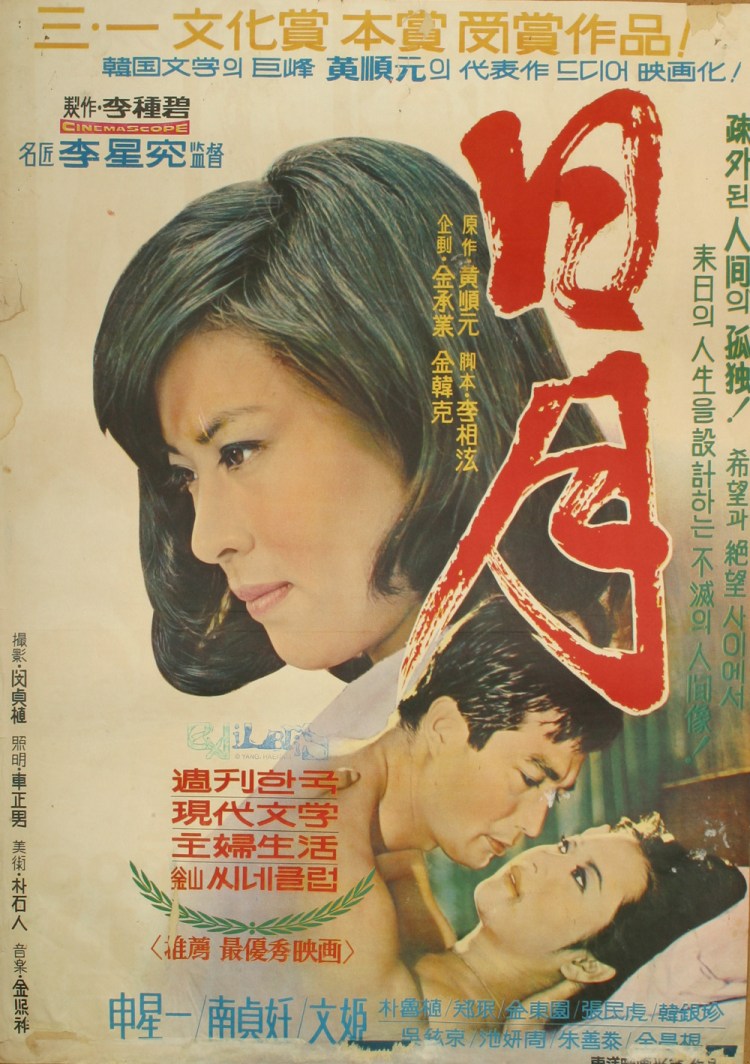
Ilwol: The Sun and the Moon (일월 / 日月, Lee Seong-gu, 1967)

Sun and Moon posterOld habits die hard in Lee Seong-gu’s Ilwol: The Sun and the Moon (일월 / 日月). The feudal past refuses to ease its icy grip even in the new “democratic” era in which freedom and prosperity are promised to all. Lee Seong-gu, closely associated with the Western Modernist movement, flexes his Literary Film muscles with an adaptation of Hwang Sun-won’s novel. Mixing a standard melodrama narrative with an exploration of “outdated” social prejudices and the gradually fracturing psyche of a man who learns a “dark secret” regarding his personal family history, Lee isolates the individual within a changing society as an ordinary man finds himself unable to move forward despite his own desire to be free of the superstitious past.

Lee opens with a scene more in keeping with a romantic comedy. Aspiring architect In-cheol (Shin Seong-il) meets drama student Na-mi (Nam Jeong-im) at an upscale ski resort and is instantly smitten. After spending time with her, In-cheol goes home and visits a childhood friend, Da-hye (Moon Hee). Da-hye is quite obviously in love with In-cheol – a fact of which he is obviously unaware or just completely insensitive since his purpose in coming is to tell her about Na-mi. Despite her personal pain, Da-hye is a good friend and gives In-cheol the appropriate advice regarding his romantic endeavour, reminding him that many of his previous relationships have failed because he was too diffident and he let them drift away.

Meanwhile, In-cheol is called into his father’s study to meet his dad’s new business contact who, it happens, wants a house designed. In a piece of near dynastic finagling, In-cheol gets a new job and, surprise surprise, the house turns out to be for Na-mi who is the daughter of the bank manager In-cheol’s dad wants a loan from. Everything is working out just fine, but then In-cheol’s brother – the Mayor of Gwanju (Jang Min-ho), turns up in a state of agitation and tells them he’s being blackmailed. Someone has discovered their dark family secret – In-cheol’s dad ran away from his family because they were butchers, a near “untouchable” class even in the Korean society of 1967. In-cheol thinks this is all very silly, who cares about things like that anymore? But on another level the discovery profoundly disturbs him in what it says about him as a person and about the society in which he lives.

It does seem ridiculous to stigmatise such commonplace occupation in a supposedly modern society, but In-cheol can’t seem to move past it. He pays a visit to a slaughter house which is just as awful as he’d expected it to be as he watches a once powerful cow twitching helplessly on the floor while other workers dismember the corpses of animals, pulling out entrails and severing heads ready for keener butchery. Still, In-cheol reminds himself it’s just a job and resolves to meet his cousin, but his cousin, insisting that he has no relatives, won’t talk to him. In-cheol takes this for rudeness or rejection, but really his cousin is attempting to protect him. In having internalised the constant abuse he suffers – even once being arrested by the police when a murder took place nearby solely because he is a butcher and had no alibi, In-cheol’s cousin avoids contact with those outside of his group and does not want to taint him with the butcher brush. Yet In-cheol keeps pushing, only for his cousin to roundly tell him to leave it alone unless he has the courage to accept his butcher blood fully for all it is.

The problems are manifold. In-cheol’s father’s first engagement was broken when the bride found out he came from a butcher family, while his wife (who married him without knowing) became a religious obsessive after learning of her husband’s origins. In-cheol’s marriage prospects are almost certainly off the table if anyone finds out, but even if someone agrees to marry him knowing the truth should he really invite them to do so knowing that they (and their children) will share his shame?

Unable to speak, unable to move forward or back, In-cheol spirals into a depressive cycle of inertia and suffering. Da-hye tries to talk to Na-mi to get him to wake up, but Na-mi tells her she’s not much bothered about In-cheol’s mental state and has only been messing around. Nevertheless, she finally draws closer to him as means both of assuming the leading role in her relationship, and as a way of annoying her father whilst potentially getting herself involved in a small scale scandal. Meanwhile, Da-hye who had pointed out that In-cheol’s problem was his passivity, ironically reveals that she too has been waiting for him to wake up and realise her feelings for him, only now realising she has probably missed her chance. The melodramatic device of the love triangle becomes a symbol of In-cheol’s ongoing psychological fracturing as he finds himself caught between two women and realising he can choose neither of them because his “ancestral curse” has effectively disqualified him from living in the modern world.

Using innovative editing techniques, Lee dramatises the tragedy of an isolated generation, supposedly living in a “modern” society but unable to escape the outdated social codes of the past. Rather than attempt to free themselves from irrational and superstitious ways of thinking, they choose self-exile and willingly accept their unhappiness in an otherwise altruistic intention of preventing the spread of a contagion. Melancholy yet urgent, Ilwol: The Sun and the Moon uses the ridiculous survival of an ancient prejudice to lay bare a dark secret at the centre of its own society but finds only tragedy without sense of an escape.


Ilwol: The Sun and the Moon is the first film included in the Korean Film Archive’s Lee Seong-gu box set. (Not currently available to stream via the Korean Film Archive’s YouTube Channel).

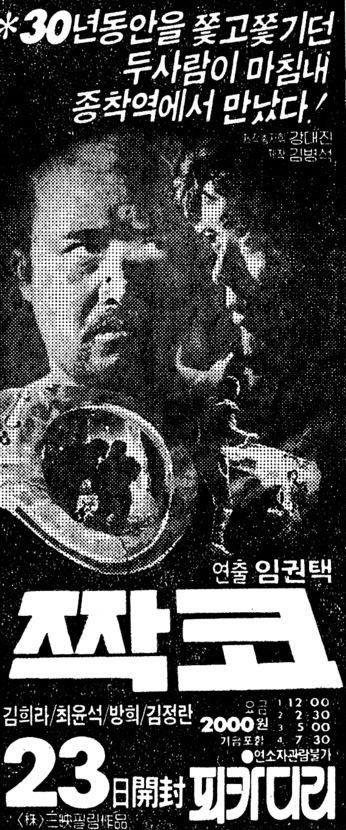
Jagko (짝코, AKA Pursuit of Death, Im Kwon-taek, 1980)

Jagko poster

During the dark days of the dictatorships, the “anti-communist film” was a mainstay of the Korean film industry. Though it wasn’t exactly possible to make a pro-communist film and that therefore any and all films were at least implicitly anti-communist, the authorities had been especially keen on films which took a hardline on anything remotely leftwing. By the late ‘70s however times were changing and a more nuanced view of recent history began to become possible. Im Kwon-taek is thought to be among the first directors whose work precipitated a shift from the “anti-communist” to the “division” film in which the tragedy of the division itself takes precedence over the demonisation of the North (though such views were perhaps not as uncommon as might be assumed in films from the late ‘50s and early ‘60s before the passing of the Motion Picture Law). Jagko’s (짝코) two haunted protagonists are both flawed men betrayed by their country and changing times realising they have wasted their youth on a cat and mouse game over an outdated ideological disagreement when the conflict that defined their lives was merely a proxy war fought by two super powers on Korean soil.

Song (Choi Yoon-seok), a former policeman, is picked up by a vagrancy patrol and taken to a “rehabilitation centre”. Despite the name the centre is more like a debtors’ prison and Song is now a prisoner of poverty who will not be allowed to leave unless redeemed by a family member (of which he has none or he might not be here). Nevertheless, the men are treated well, fed three meals a day, and only asked for a couple of hours of non-strenuous work with the rest of the time marked “free”. Once Song has begun to calm down, he makes a shocking discovery. He is convinced that a man lying ill a few beds over is none other than Jagko (Kim Hee-ra) – a former North Korean partisan and the man he holds responsible for ruining his life.

Im lets us in on the stories of both men via a series of flashbacks. Though he pretends not to know him, the other man, calling himself Kim, is indeed “Jagko” though his life has been just as miserable as Song’s. Back on Mount Jiri at the end of the Korean war, Song was a respected policeman – he left school at 12 and made a name for himself catching partisans. When he catches the legendary Jagko, wanted for a series of atrocities and terrorist acts, all Song can do is boast and talk of his imminent promotion after which he will enjoy a life of comfort. Unsurprisingly, Jagko is not exactly happy for him but allows his captor to prattle on in order to buy time for his escape. It is Song’s own arrogance which permits him to do so. Claiming to need the bathroom, Jagko offers Song a gold ring hidden in his shoe which Song scoffs at, but he does loosen his cuffs to facilitate Jagko’s relief at which point he manages to headbutt him and run away. Song is accused of taking bribes and dismissed. He is humiliated and loses his status, job, and family all in one go. Fixated on Jagko, Song gives up everything to chase him in order to turn him in to his former commander and have him clear his name by confirming that he was not bribed and did not sell out his country for gold.

Almost thirty years later both men are older than their years, broken and defeated. As one of the rehabilitation centre residents puts it, they’re all about to die – what does it matter now if someone was a communist or a partisan, what good could it possibly do to drag the past up all these years later? For Song it’s almost as if there is no “past”, the last few decades have been spent in a relentless pursuit of the man who holds the key to his good name. He wants to undo the folly of his hubris by overwriting it, but time has passed and what he’s lost cannot be reclaimed. Meanwhile, Jagko is not an ideologically crazed leftist, but a lonely old man who is now in poor health and has nothing but regrets. The two men bond in their mutual suffering and work together to escape, but the world they emerge into is not that of their youth. Song was disempowered when he entered the facility – they took his arrest rope away from him, but when he tackles the weakened Jagko to the ground and tries to call two policemen on patrol over to arrest him as an “escaped communist guerrilla” the young officers of the law have no idea what he’s talking about. Those words no longer mean anything. The bemused policemen conclude the old men must be escaped mental patients before spotting the rehabilitation centre uniform and jogging off to phone someone to come and take them back.

The old men’s quarrel is exposed as ridiculous. Jagko, less angry more soulful, remarks that men like he and Song are the most pitiful souls on Earth as he watches America sit down with Russia on the TV and realises he is merely a victim of ongoing global geopolitical manoeuvring. It’s no longer a question of left and right, both men are victims of their times, neither “good” nor “bad” but flawed and human. We do not know if Jagko did the things Song says he did but he has paid a heavy price all the same. Song, by contrast, has shifted all the blame for his fate onto Jagko, believing that if he can catch him he can somehow make it all right, but of course he can’t and is trapped in a spiral of denial in refusing to accept his own responsibility for the tragedies of his life. What is to blame is the folly of war and particularly of an internecine fraternal conflict which remains unresolved and may well be unresolvable unless an attempt is made to address the past with empathy and understanding in place of enmity and rancour.


Jagko is available on blu-ray courtesy of the Korean Film Archive. The set includes subtitles in English, Japanese, and Korean with the audio commentary by Kim Dae-seung and editor of Cine21 Ju Sung-chul also subtitled in English. The audio commentaries from the DVD edition included with the Im Kwon-taek boxset, one by director Im Kwon-taek and film critic Huh Moon-yung, and the other by screenwriter Song Gil-han and film critic and director Kim Hong-joon, unfortunately do not carry over the English subtitles. The set also comes with a bi-lingual Korean/English booklet featuring an essay by film critic and professor Park Yuhee. Not currently available to stream via the Korean Film Archive’s YouTube channel.

The Love Marriage (自由結婚 / 자유결혼, Lee Byung-il, 1958)

The love marriage posteA hot button issue at the centre of the tradition vs modernity debate – who knows best when it comes to love, a bevvy of relatives with lifetimes of experience behind them or the youngsters themselves still filled with youthful idealism? Then again, as the wise father of Lee Byung-il’s The Love Marriage (自由結婚 / 자유결혼, Ja-yugyeolhon) points out, perhaps both options are bad. An arranged marriage may not work out for a variety of reasons, and a love match may only result in heartbreak, but perhaps there is a third way after all – something which he intends to figure out through gentle manipulations of his lovelorn daughters and feisty conservative wife.

Inverting the normal pattern, Lee opens with the wedding. Dr. Ko’s (Choi Nam-Hyun) eldest daughter, Suk-hee (Choi Eun-hee), has scandalised her family by marrying for love, making a modern future in a modernising world. However, her new husband, Seung-il (Seong So-min), is pensive. He has something he feels he needs to get off his chest to start married life on the right foot. Seung-il confesses that he was once in love before, somehow believing this is a terrible secret which his new wife needs to know. Suk-hee is of course sympathetic and understanding, she never assumed herself to be marrying someone without a past. In an effort to console him she makes a confession of her own. She too was once in love with someone else – the older brother of a school friend who died tragically years ago never knowing of her deeply held affection. Despite his earlier plea, Seung-il is horrified, abruptly walks out on his new wife on their wedding night, and sails to America to make a new life for himself alone.

Flashforward four years and Suk-hee, humiliated, has retreated to her bedroom, seldom leaving the house and only then to walk along the paths she used to take with Seung-il when she does. Dr. Ko has two more daughters – Moon-hee (Lee Min-ja) and college student Myeong-hee (Jo Mi-ryeong), as well as a young son, Gwang-sik (Park Gwang-su), still in school. Ko’s wife, Mrs. Ahn (Seok Geum-seong), is convinced all Suk-hee’s problems are down to getting married for love – after all, Mrs. Ahn was always against it. To prevent the same thing happening again she plans to find good matches for her other two daughters, hoping to set Moon-hee up with the son of one of her best friends, Wan-seop (Lee Ryong), who has recently returned from studying abroad. Moon-hee, however, has taken a liking to the timid college student who has been tutoring Gwang-sik, Jun-cheol (Choe Hyeon). Meanwhile, Myeong-hee has also developed a fondness for Ko’s assistant, Yeong-su (Park Am).

The times are changing, but only to an extent. Mrs. Ahn doesn’t like it that they’re changing at all. The romantic destiny of her daughters was, perhaps, one of the few things over which she exercised complete control and control seems to be something she is reluctant to give up. Suk-hee’s decision to get married for love is a new one – a rejection of the oppressive pre-war system of total deference to one’s elders in favour of exercising her individual right to choice. Her choice, however, did not work out, in part at least because of some very old fashioned ideas embedded in the head of Seung-il who is unable to cope with the idea of his wife as a real flesh and blood woman rather than the idealised picture of passive femininity he had conjured for himself.

Love and marriage enter a conflict with each other. Ko and Mrs. Ahn have extremely different temperaments but seem to have built a happy and harmonious home for their four children, raising love between them as they go. Yet not all arranged marriages work out, especially when relatives might not have their children’s future happiness as a priority. Meanwhile, young people in love might not be best placed to make serious decisions about a long term future whilst caught in the throws of passion. Ko, otherwise sympathetic, has his doubts about Moon-hee and Jun-cheol, not because of Jun-cheol’s “weak” character which is his wife’s chief complaint, but because he worries that though they are in “love” they have not yet reached an understanding of each other. Rejecting both ideas – the hyperrationality of the “arranged” marriage, and the emotional volatility of the “love” match, Ko wonders if there isn’t a way to meet in the middle, that if the older generation could perhaps guide the youngsters towards a series of likely candidates they believe to be well suited, love might blossom in a place it can take root.

Ko, quiet yet wise and permanently amused, tries out his idea on his youngest daughter, Myeong-hee, who might be the most like him and also the most modern among her sisters. Spotting the obvious attraction between Myeong-hee and his assitant Yeong-su, Ko tries to set them up and then puts a wedge between them through using Wan-Seop who is at a loose end while Moon-hee pines after Jun-cheol and refuses to meet any other suitor. Wan-seop, despite Mrs. Ahn’s obvious esteem for him, is the very example of the new Korean man who tries to make a virtue of his modernity but only exposes his old fashioned conservatism. Caught in a small debate with Yeong-su and Myeong-hee, Wan-seop who has recently returned from study in America sings the praises of life overseas and declares himself a feminist – he hates the way women are treated in Korea which is why, when he’s married, he plans to 100% obey the housekeeper and not make waves in the domestic domain. Yeong-su, quite fairly, finds this ridiculous and even if his ideas are perhaps no more “progressive” he is at least transparent in his constant verbal sparring with the confident Myeong-hee.

For all its inherent comedy, love is still a painful business and parental rigidity has a potential dark side as we see in an attempted suicide brought about by heartbreak and frustration at not being listened to by parents who insist they know best. Yet in the end love conquers all. Ko’s gentle manipulations eventually work their magic, guiding each of his daughters towards their most hopeful path but leaving the decision to take it entirely up to them. Even Mrs. Ahn begins to see the beauty of young love rather than its destabilising qualities and cannot help being touched by the happiness each of the sisters seems to have found in their chosen men even if they’ve suffered quite a lot along the way. Love is never easy, but it doesn’t need to be so hard and it only takes a little bit of understanding to set it on its way.


The Love Marriage is the second of three films included in the Korean Film Archive’s Romantic Comedy Collection of the 1950s box set. It is also available to stream online from the Korean Film Archive‘s YouTube Channel.

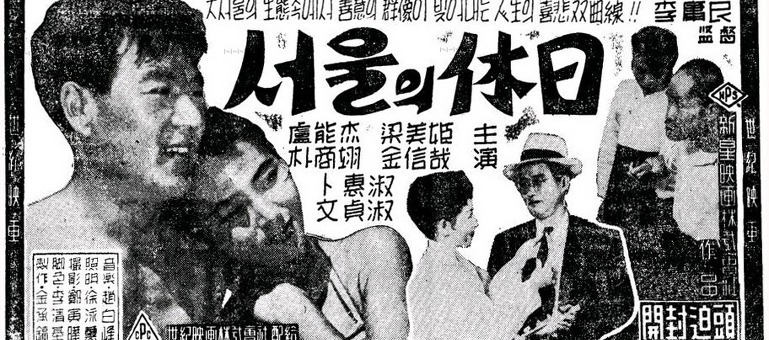
Holiday in Seoul (서울의 休日 / 서울의 휴일, Lee Yong-min, 1956)

Holiday in Seoul title cardUnlike many “golden age” directors, Lee Yong-min was not especially prolific and left behind him only 23 films when he abruptly disappeared without trace. Perhaps a fitting legacy for a director so strongly associated with the horror genre, but Lee had begun his career as a documentarian working for a Japanese company during the Colonial era. It’s Lee’s documentary background rather than his taste for genre which is most strongly in evidence in his second film, Holiday in Seoul (서울의 休日 / 서울의 휴일, Seoul-ui Hyuil), which, while containing a fair few genre elements, is an anarchic romantic comedy set entirely in a small residential area of the capital over the course one day – a public holiday, in which a series of couples are separated by accident or design on this very day which has been specifically set aside for them to spend together.

Lee opens with a series of location shots of various Seoul landmarks, elegantly composed and somewhat romanticised as if to recast the burgeoning city as a capital of love with all the promise and mystery of Roman Holiday’s Italy which even gets a brief namecheck later on. Again unconventionally, he then breaks into a lengthy POV shot with additional voice over from a narrator who locates a drunk snoozing on a bench and follows him home hoping something more interesting is happening over in the residential quarter. The narrator settles on the house opposite which belongs to a young couple recently married – she an obstetrician running a clinic out of the house, and he a hotshot reporter who’s just made a big splash with a story about a violent murder.

This is, however, a public holiday so work should be strictly off limits. Hee-won (Yang Mi-hee) has designed a packed itinerary, while her husband Jae-kwan (No Neung-geol) would rather have just lazed around at home, but as it turns out neither of them is going to get what they wanted. Minor disagreements about how to spend a rare day off aside, Hee-won and Jae-kwan are a happy young couple who have apparently married for love, are each professionally successful, and are living a comfortable middle-class life in a period of increasing economic prosperity. Their marriage is directly contrasted with the families around them which include that of the drunk we first met on the bench whose daughter Ok-i eventually descends on Hee-won for help in fear she may have fallen pregnant out of wedlock to a man who won’t take responsibility, and a middle-aged couple who have the opposite problem to that of Hee-won and Jae-kwan. Mr. Ju, a regular salaryman, is excited about spending the day with his wife but she skips out on him to go to the beauty parlour and spends most of the day with a wealthy friend and her opera loving toyboys on a well appointed yacht.

Nevertheless, marital bliss is indeed tested by the demands of the day. Though Jae-kwan had promised to go along with Hee-won’s carefully crafted plan, he gets a phone call he thinks is an important tip off about the murder case but is actually a trick set up by his colleagues who were hoping to get him to buy them a few drinks. Unfortunately, due to an odd coincidence, Jae-kwan thinks he witnesses a kidnapping that might be related to the killings and takes off in hot pursuit only to find himself dealing with another sad case of a woman brought low by love. While Hee-won is busy trying to help Ok-i sort out her predicament with both her sad/angry father and the boyfriend that’s thrown her over, Jae-kwan finds himself locked in a room with a poor young girl (Moon Jeong-suk) who is apparently also pregnant by a man who’s disappeared and has gone out of her mind with heartbreak, actively adopting the role of Ophelia and reciting potent lines from Hamlet while absolutely convinced that Jae-kwan is her long absent lover.

While the new freedoms of the post-Colonial era have enabled Hee-won not only to find love and an elected marriage but also a successful professional career as the head of her own clinic, other women have not been so lucky and have suffered doubly at the hands of men who feel bolder in their casual pursuits but also know they cannot be held to account for their actions in the same way they might have been before. Ok-i’s story does at least have a happy ending but is symptomatic of the times in which she lives as she recounts going for a job at a factory only to be molested by the foreman who thought she was a “prostitute” because he found out she had a boyfriend, while the boyfriend sort of thought the same in assuming she had been taken advantage of by the foreman. At least Ok-i has her father who might be have been enraged to begin with but later comes to her defence as does the warmhearted Hee-won, while Jae-kwan’s young woman is all alone save for her mother who is worried sick over her daughter’s mental health and has no real way to help her.

Hee-won is indeed a force for good. Despite her worry about her husband’s whereabouts (she ends up going drinking with his work buddies who, along with her other married female friends, have half convinced her he’s gone off with another woman), Hee-won comes to the aid of a crying little girl who’s desperately looking for help because her heavily pregnant mother is in a very bad way at home while dad went out a few days ago and hasn’t come back. Needless to say, Hee-won’s emergency dovetails into Jae-kwan’s dogged pursuit of crime which eventually sees him arrest a murderer after accidentally getting into a cab with him. The killer, perhaps annoyed about the previous article, makes a point of explaining to Jae-kwan that his job isn’t quite as morally upright as he’d like to believe. You can’t just go printing things in papers, he tells him, it ruins people’s lives. Jae-kwan thinks it’s murdering people that ruins lives so anything after that is fair game but his heartless rationality brings him into conflict with Hee-won when he wants to photograph and interview one of her patients who is seriously ill and might not survive if she finds out the unpleasant truth Jae-kwan wants to get her reaction to on camera. To Jae-kwan, people are just his “subjects”, mere materials for his essays, but to Hee-won they are literally flesh and blood – less fortunate than herself, they are her responsibility and she will do all she can to help them even at great personal cost.

Yet in the end the conflicts resolve themselves satisfactorily and the couples are each reunited in time to spend the last of the holiday gazing up at the moon glowing above the twinkling lights of Seoul. Having spent the day apart, each spouse emerges with a greater understanding of their partner (or in Mr. Ju’s case perhaps just a greater talent for (self)deception) and remains committed to working on their relationship. Mostly shooting on location, Lee’s camera is as sophisticated as they come shifting effortlessly from documentary-style naturalism to a silent movie aesthetic while maintaining a high level of cinematic wit throughout. Cheerfully romantic and carefree even considering its darker themes, Holiday in Seoul is an oddly anarchic romantic comedy though one with total faith in true connection and emotional honesty.


Holiday in Seoul is the first of three films included in the Korean Film Archive’s Romantic Comedy Collection of the 1950s box set. It is also available to stream online from the Korean Film Archive‘s YouTube Channel.

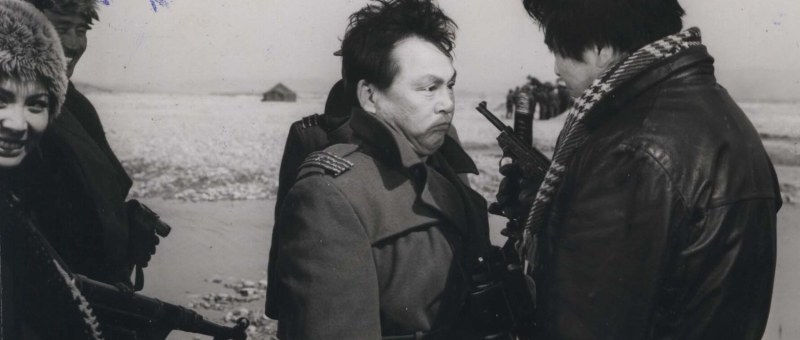
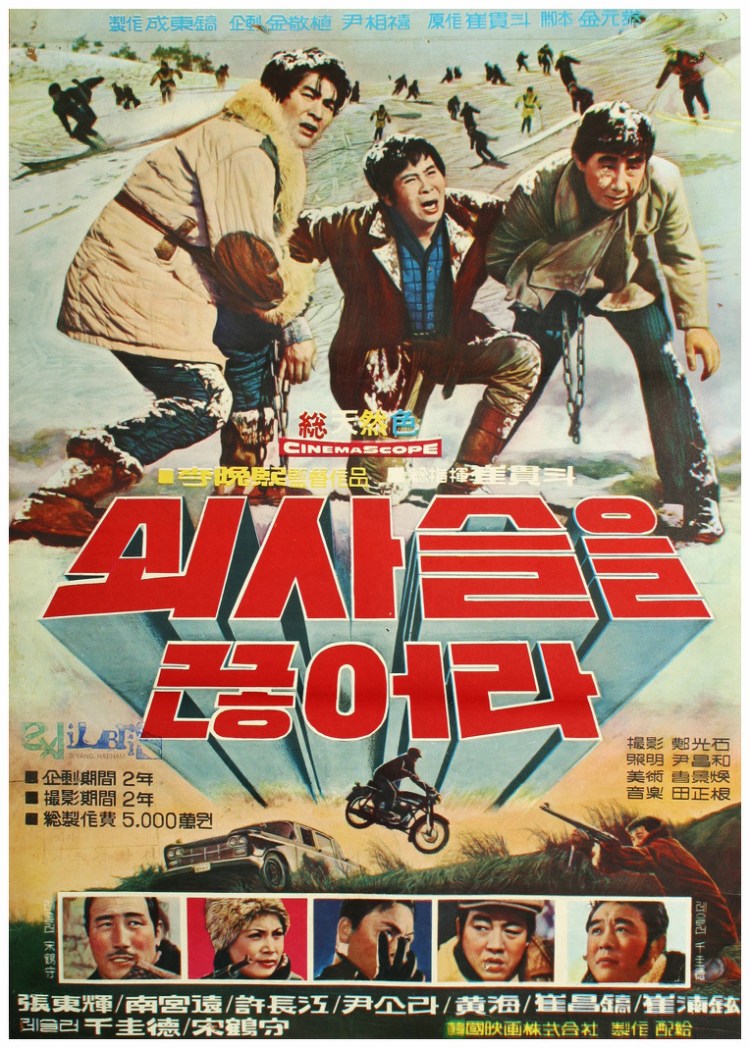
Break up the Chain (쇠사슬을 끊어라, Lee Man-hee, 1971)

Break Up the Chain poster1970 had been a difficult year for Lee Man-hee. A conflict on the set of The Goboi Bridge in which Lee intended to star against the advice of his regular team resulted in the end of his creative relationship with screenwriter Baek Gyeol and cinematographer Lee Suck-ki. Meanwhile, he’d also suffered a crisis in his personal life after parting ways with actress Moon Jeong-suk who had been both a lover and a muse. To top it all off he also had some financial problems and didn’t work at all for the year following Goboi Bridge’s release – a significant period of time in the high-speed world of early ‘70s Korean cinema in which it was not unheard of for a director to make as many as 10 films in one year. Break Up the Chain (쇠사슬을 끊어라, Shwisaseuleul Geunheola) was intended to be something of a “come back” but it finds Lee defeated, doing what he does best but also playing the game he never really wanted to play in succumbing to the patriotism epic (albeit a little tongue in cheek).

Riffing off Sergio Leone, Lee frames his resistance romp as a Manchurian western. A mysterious golden Buddhist statue has more than just monetary value as it also contains a list of the names of resistance operatives which can be revealed with the use of a special chemical formula. Three men are after it – Cheol-su (Namkoong Won), an adventurer for hire who might or might not be working for the resistance; Tae-ho (Jang Dong-hwi), a petty gangster; and Dal-geon (Heo Jang-kang), a collaborator working with the Japanese. The men are each interested in the statue for selfish reasons – Cheol-su for his reputation, Tae-ho for the money, and Dal-geon for the prestige. None of them is interested in the resistance movement itself, the statue’s importance in relation to it, or anything really beyond themselves and their day-to-day lives.

Of course, as this is a patriotism epic, the men eventually come round to the greatness of Korea as their individual quests converge and they find themselves alongside the resistance surrounded by the Japanese. The Japanese are largely a bumbling bunch who remain unaware of the statue’s “real” power even whilst holding it, thinking only of its monetary value as a lump of gold or work of art they could export abroad for financial gain. Confronted and faced with failure, the leader of the Japanese is firstly humiliated by his defeat at the hands of the resistance but then decides to show them the greatness of the Japanese army by committing Harakiri right there on the spot. Stripping off the captain begins to get cold feet, suddenly struck by the enormity of the moment when one of his lieutenants draws his sword ready for the beheading. The Japanese captain then seems to come down with “a cold” and resolves to visit the medical tent instead.

The early drama revolves around the interplay of the three self-interested outsiders as they scheme and plot to make use of each other and get the statue for themselves. Of the three, Cheol-su emerges as the most “noble” even though his quest is mercenary enough – his name is his business and thus he wants the statue to fulfil his contract and maintain his sense of integrity as a gun for hire. Tae-ho is merely interested in financial gain with a mild desire for social revenge and the thrill of outsmarting a rival, but both men are filled with an intense distaste for men like Dal-geon who have “betrayed” the countrymen they too have refused to serve. That aside, Tae-ho and Dal-geon begin to form a weak alliance of the opportunistic as they bond in their mercenary intentions, while Cheol-su lingers on the outside as his quest ties him more closely with the independence movement. Eventually the trio realise they have to work together to get the statue, even if their ultimate intention is to double cross the others and keep it for themselves. They do however suddenly rediscover their patriotic spirit, resolving to give the statue to the people who need to most while they ride off into the sunset in search of other ways to serve their country.

Set in dusty Manchuria (where the resistance movement operated in exile), Break Up the Chain is part of the short-lived boom of Korean “westerns” which were popular in the late ‘60s and early ‘70s. Lee abandons his experimental ambitions and aims squarely for the populist, reaching only for post-modern irony in his boys own adventure story filled with feats of daring do and flight on horseback. Yet he comforts himself with that sense of irony, pulling away from the absurd adventures of our heroes to show the faces of men dying in snow reminding us that their flight from the horror of war was perhaps a rational one rather than an act of cowardice or a failure of patriotism. Nevertheless, Lee seems to be at odds with himself as he gives in (to a point) and presents a silly story of amoral chancers suddenly rediscovering their “Koreanness” in the barren wastelands of Manchuria but does so with a sense of bitterness which conspires to rob the tale of its childish sense of fun.


Available to stream online via the Korean Film Archive’s YouTube Channel.

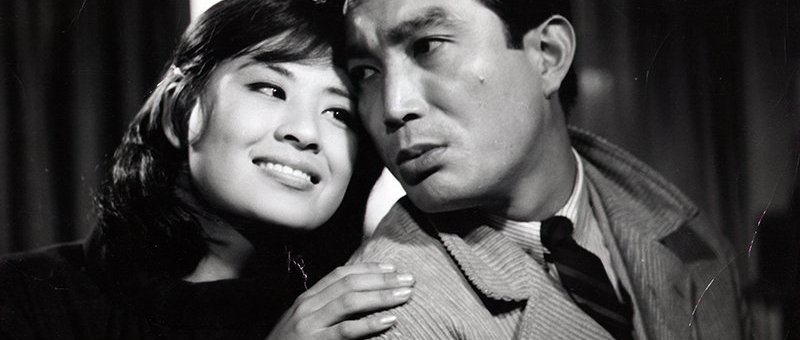
Black Republic (그들도 우리처럼, Park Kwang-su, 1990)

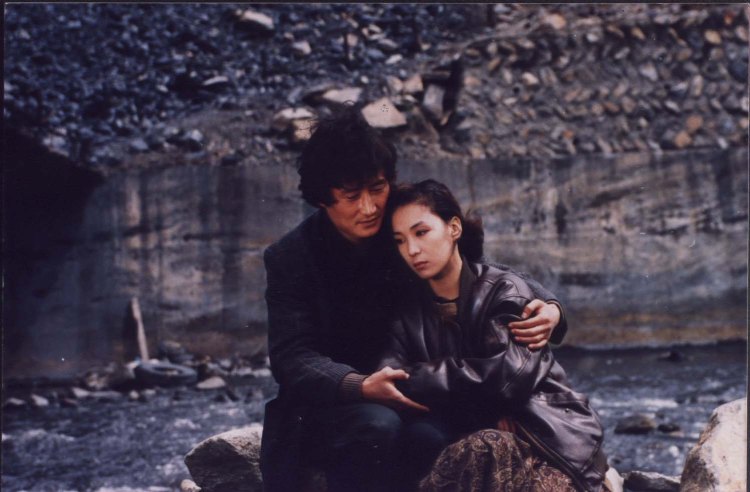
Black Republic still 1In the Korea of 1990, a revolution had been fought, won, and then betrayed by its people. Successfully petitioning for democracy, the newly minted Korean electorate went ahead and voted for the chosen successor of the dictator they’d just spent so long trying to oust. Change comes slow, but it comes even if not quite the way you wanted it. Park Kwang-su’s first film Chilsu and Mansu, released in 1988 and set in the contemporary Seoul running to catch up to its Olympic aspirations, had made its own quiet protest about a hypocritical society’s rising social inequality. His follow up, Black Republic (그들도 우리처럼, Keduldo Urichurum), takes a journey back in time while keeping one foot in the present to show us a nation engulfed by a darkness that crushes love, dreams, and possibility all while dangling the shining hope of a better future that seems impossibly far away.

Tae-hun (Moon Sung-keun), a student protestor wanted by the police, heads into the mountains under an assumed name hoping to get a job in a mine. However, this is a period of intense economic volatility and the mining industry is collapsing. When his attempts to find work as a miner fail, Tae-hun (going under the name Gi-yeong) overhears a conversation in a cafe and manages to get a job in a local briquette factory.

Park opens in darkness as Tae-hun makes a phone call to his mother in which he never speaks and she reassures him that everything will be OK while the sound of a train gradually gathers in the background. When Tae-hun arrives at his destination, he finds himself in a barren, blackened land where everything is quite literally falling apart. The mines are closing and the landscape, desolate as it is, is peppered with derelict buildings and the modest, makeshift homes of the rural poor at the constant mercy of their greedy masters. As a newcomer, Tae-hun is not privy to the town’s secrets, but quickly comes to understand that though he may have escaped Seoul, the struggle is inescapable, because the struggle is Korea. The owner of the briquette factory is also some kind of loanshark involved in a suspiciously close arrangement with the local mine owner who is in the middle of a labour dispute with the miners who are petitioning for fair pay and better conditions. Haunted by the memories of his protest days, Tae-hun finds himself looking on at another candlelight procession calling for workers rights but rendered impotent, forced to remain silent or risk attracting the attention of the police.

Meanwhile, Tae-hun’s silence sees him unwittingly pulled into the orbit of those he would usually oppose. Seong-cheol (Park Joong-hoon), the illegitimate son of the factory boss, takes his own sense of crushing impossibility out on the entire town. Technically the “vice-president” of the factory, Seong-cheol is a sometime enforcer for his father’s greedy loan sharking business and thinks nothing of striding in and helping himself to the petty cash to spend on women and booze while gazing at the photo of his long absent mother. An invitation to dine with Seong-cheol and pals brings Tae-hun into contact with melancholy sex worker Yeong-sook (Shim Hye-Jin) who begins to fall for him when he skips out on her after Seong-cheol has pulled one of his usual tricks in giving her away in an attempt to buy friendship through influence.

Like Tae-hun, Yeong-sook is also trapped, running, and living under an assumed identity. Through her exposure to Tae-hun who is, after all, so different from the other men in the mountains, she begins to rediscover a sense of hope and possibility. Yeong-sook quits the illegal part of her job as a “coffee girl” and deepens her bond with Tae-hun through nursing him after he is arrested and beaten by the police who seem to harbour an innate suspicion towards him despite little evidence, but their love will require another act of faith and flight and the world in which they live may not let them to escape.

Everyone here is trapped, lying to themselves or others, wishing things were different than they are but has long since given up the hope they ever could be. While Tae-hun attempts to ride out the storm by burying his head in the coal dust, feeling it fill his lungs, struggling to breathe, Seong-cheol opposes his order with chaos, laying waste to half the town in a self destructive venting of his rage and resentment towards his selfish, unfeeling father, and a society he feels has already rejected him. Impossibility and hopelessness are the defining qualities of this world of corruption and exploitation in which there can be no escape or salvation, only crushing futility. Park closes with an ironic coda of swapped fates and tragic promise which places Tae-hun right where he was when we first met him, defeated by hope but still in motion, if for an uncertain direction.


Black Republic was screened as part of the Korean Cultural Centre’s Korean Film Nights 2018: Rebels With a Cause screening series. It is also available to stream online via the Korean Film Archive’s YouTube Channel.
The DMZ (비무장지대 / 非武裝地帶, Park Sang-ho, 1965)

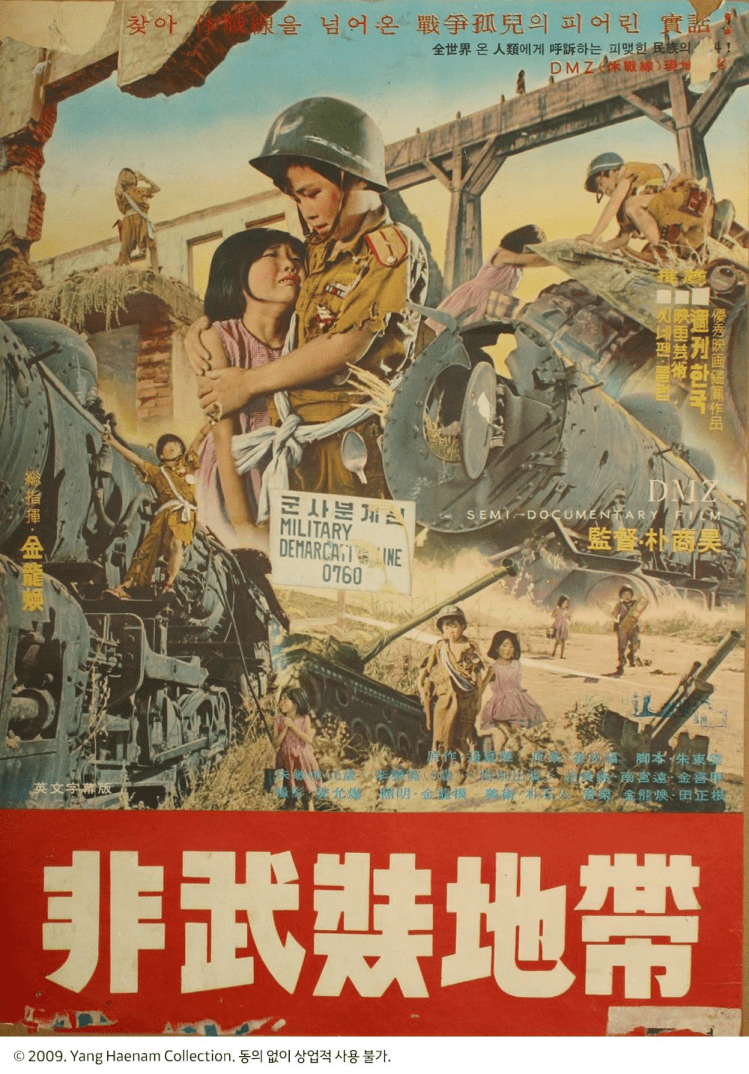
DMZ 1965 posterTalking about the “reunification” of Korea could be a risky business in the increasingly censorious 1960s. Directors had been jailed for less, and the anti-Communism drama was fast becoming a staple genre in the rapidly expanding film industry. Director Park Sang-ho had been at the forefront of Korea’s burgeoning International cinematic success when his 1963 film A Happy Businesswoman had been selected for the Tokyo film festival. Whilst there to present the film (which picked up a best actress award for Do Keum-bong), Park was met with consternation by foreign delegates who assumed he was Japanese and could show them around Tokyo. On learning he was Korean all they wanted to know about was the Demilitarised Zone and the village that was trapped inside it – Panmunjeom. Park had no answers for them. He’d never been to Panmunjeom and knew nothing about it, but he was surprised and concerned that an obscure little village and an ongoing political dispute had come to dominate the thinking surrounding his country with Panmunjeom emerging as a grim tourist destination for those interested in experiencing the “thrill” of life in a dormant war zone.

On return to Korea he knew he had to make a film about the DMZ, but the subject was a difficult, perhaps taboo one which had to be approached carefully. Park’s first cut which was released in theatres ran to 90 minutes and conformed more obviously to the standard commercial cinema of the time. In a radical move, the director then decided to re-edit it with the intention of submitting to foreign film festivals. Cutting most of the scenes with well known actors, Park retained only the stock footage which bookends the film (apparently enough to qualify the remainder as a “documentary” rather than narrative feature), and the central drama focussing on two small children desperately wandering the ruined landscape alone in search of their mothers.

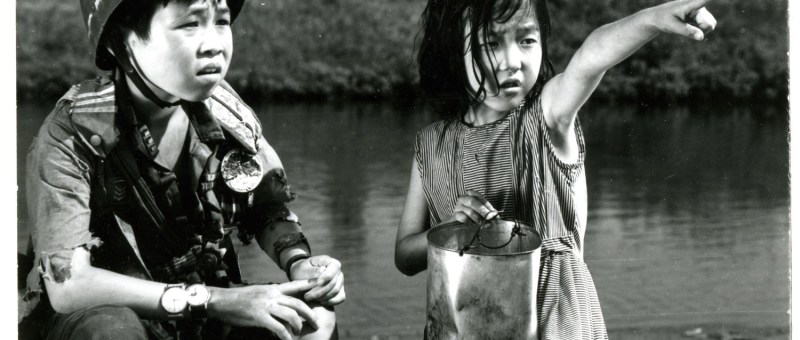
The younger of the two, Yong-ha (Ju Min-a) – a five year old girl, falls into a lake and is rescued by an 8-year-old boy (Lee Yeong-gwan) she originally mistakes for a grown man because of the ragged military uniform and soldier’s helmet he is wearing. The unnamed little boy tells Yong-ha he had a little sister with her name, and there are enough coincidences in their back stories to make one wonder if they really might be related, but in any case the boy “becomes” Yong-ha’s big brother and agrees to protect her while they each look for their long lost mothers.

As the pair are only children, they do not really know that they’re in the “DMZ” or what the DMZ is, they only know they are alone and surrounded by danger. Skeletons and decomposing bodies are a frequent sight, as are abandoned tanks, overturned trucks, broken trains, and rusty equipment. There are no other people, and nature has begun to reclaim the land – wild dogs and foxes are potential perils, while Yong-ha later finds herself separated from her brother after chasing a cute rabbit into a woodland grove and then being unable to find her way back.

The allegory becomes clearer as the children engage in absurd games exposing the arbitrary and destructive nature of the division itself. Walking up to the line, the boy gleefully jumps over to show Yong-ha how meaningless it is. Yong-ha, enjoying the game, thinks “division” seems fun and they should try it out for themselves. Her brother agrees, marking his territory and then insisting that they turn their backs on each other and refuse to speak. He keeps this up for quite a while until Yong-ha becomes distressed, at which point he jumps up and smashes the makeshift division marker to pieces so he can once again embrace his sister.

Nevertheless the anticommunist sentiments are present in the form of a cruel and callous North Korean spy who tries to kidnap the children and take them away with him. To add to the spirit of adventure, the boy sings a nationalist song which honours those who have given their lives to “liberate” the country from “oppression”, while a propaganda broadcast tries to do something similar whilst the children are playing division by offering a message of solidarity to those in the North who might like to come South. Dangerous as the situation is, the children’s innocent naivety eventually leads to a small diplomatic incident when they unwittingly pick up a landmine to use as a firestone but are frightened away by the approach of soldiers just before it explodes, leading both sides to claim the act as one of provocation by the other.

Park takes the dangerous step of shooting directly within the real DMZ with all of its eeriness as a place abandoned by humanity and filled with man made dangers. The children attempt to survive in it alone – foraging for food, using the wood from crosses put up as grave markers to start fires, and looking after each other in the absence of adults. They play when they can, swimming, pretending to commandeer tanks and steal trains, pilfering left behind supplies and always talking about their families and how best to find them. The theatrical version, as was expected at the time, apparently has a more positive ending but Park refuses to soft-pedal the disproportionate suffering experienced by children in time of war, even whilst adding a pointed statement to the end advancing the cause of Korean brotherhood and calling for an end to the unfair and arbitrary separation of a people which feels itself to be of one blood. Unusual for the time but ending on a note of hope (if however bleak), DMZ is part anti-communist propaganda, part unification treatise, and most of all the story of two unlucky orphans created by a war and a diplomatic stalemate who find themselves alone in no-man’s land with no safe refuge in sight.


The DMZ (비무장지대 / 非武裝地帶, Bi-mu-jang Ji-dae) is available on DVD with English subtitles courtesy of the Korean Film Archive. The set also includes an English subtitled documentary about the career of director Park Sang-ho as well as a 32-page bilingual booklet. Not currently available to stream online.

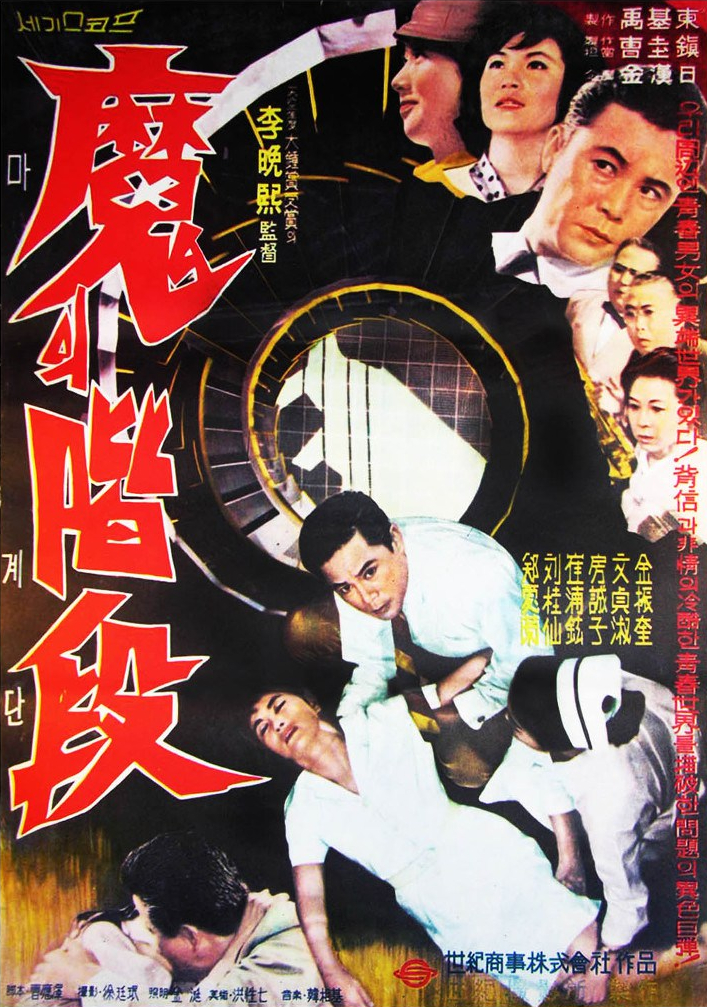
The Devil’s Stairway (마의 계단 / 魔의 階段, Lee Man-hee, 1964)

devils-staircase-poster.jpg

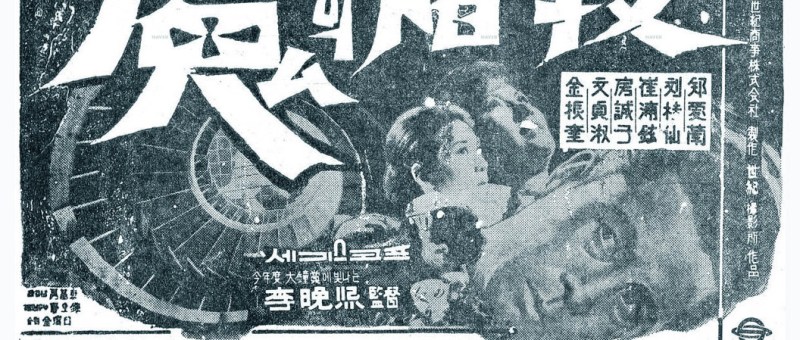
By 1964, Korea’s economic situation was beginning to improve and for many there seemed to be a bright light shining in the distance, a fixed point to which they could aspire and felt was in their grasp if they could only catch a lucky break. Throughout Lee Man-hee’s relatively short career (the director sadly passed away at the young age of only 45 – apparently a casualty of his fondness for drink and intensive work habit which accounts for his high output), his protagonists struggle with a conflict between the desire for the new kind of “success” their society promises them, and a feeling that they can never truly obtain it. Ambitious surgeon Dr. Hyeon (Kim Jin-kyu) attempts to climb The Devil’s Stairway (마의 계단 / 魔의 階段, Maui Gyedan, AKA The Evil Stairs) by abandoning the compassion that ought to define his profession for coldhearted pragmatism but discovers that the path has its price while his victims are not quite so passive as he’d assumed them to be.

When we first meet Dr. Hyeon he’s lounging around in bed while his female companion, Nurse Nam (Moon Jeong-suk), dresses and prepares to leave. Somewhat coldly, Hyeon tells her to exit via the back stairs and avoid being seen by the security guard on her way. Irritated, Nam leaves and the pair go back to work at the hospital the next morning pretending there’s nothing more between them than the relationship between a nurse and a chief surgeon. This situation might have continued indefinitely were it not for the fact that Jeong-ja (Bang Sung-ja), the daughter of the hospital’s head doctor, has taken a liking to Hyeon and seeing as her father has no sons to take over when he retires, an arranged marriage is in the offing. Dr. Hyeon, who is ambitious and emotionally cold, considers accepting the offer but Nurse Nam is unwilling to let him go, especially as she is pregnant with his child. When she threatens to spill the beans about their illicit relationship, he decides to kill her by dosing her up with sedatives and throwing her body in the pool behind the hospital to make it look like she drowned herself in heartbreak and shame, but Nurse Nam refuses to go quietly.

The titular “Devil’s Stairway” is a literal staircase from the hospital floor to the head doctor’s office. There has recently been accident in which the bannister was broken and a woman was killed. The banister is repeatedly mended throughout the film but represents a point of fracture in the spiritual path to success. Nurse Nam is another early casualty when she and Hyeon argue in the middle of the stairs and the recently mended bannister breaks as he struggles with her. Despite the minimal drop to the floor, Nam is left with serious injuries requiring surgery, loses her baby, and gains a conviction that Hyeon bears her ill will. Her position is extremely difficult – the accident has exposed the fact that she had conceived a child outside of wedlock and though she has not yet disclosed the name of the father, Hyeon fears that she will destroy his bright future either by speaking out or through forcing him to marry her to avoid social disgrace.

Hyeon gives in to darker instincts. He tells Nam that his heart is hers, perhaps intending to carry on an arrangement even after he’s decided to accept the marriage proposal, but excuses himself for stringing her along by reminding her of his lack of financial stability and comparatively low social status. We are reminded later that he is old be unmarried and, even stranger, is assumed to be a “virgin” – a solitary, perhaps dull, bachelor not known for mixing with women. This again signals his coldhearted ambition – he waits and he calculates. He wants a hospital of his own and knows his only way to get one is to marry into it, and so he does even if it means sacrificing “love” and emotional happiness for the cold comforts of conventional success and the false acclamation of social status.

Hyeon thinks he’s got away with it, but his crime haunts him. Going slowly out of his mind, Hyeon sees Nam everywhere, placing a strain on his relationship with his new wife who grows wary of his increasing violence and bad temper. His madness culminates in a tense surgery scene in which everyone around him has Nam’s face and he finds himself surrounded by his crime, forced to confess himself as a murderer in order to free himself of her ghost. Yet, things are not quite as they seem and it is not he alone who finds his grand plan floundering.

Hyeon posits his poverty as a reason for his crime, but it’s his greed which guides him towards the Devil’s Stairway. He could have married Nam, had his child, and led an ordinary middle-class life of relative comfort perhaps even opening his own clinic in good time, but he chose the quick fix in marrying for money and (literally) throwing over the woman he claimed to love to ease his feelings of insecurity and resentment at his position in the social order. His murder is cowardly but, as Nam points out, the law may protect him while there are precious few looking out for her, a betrayed woman, pregnant outside of marriage, and without a family to press her case.

As he did in the same year’s Black Hair, Lee co-opts the murkiness of the film noir, sending its sense of betrayed morality into the realms of the gothic with an ever increasing atmosphere of supernatural dread. The pond seems to emanate evil while the stairs beckon ominously, the wind rattles the doors open without warning and the rain pours down outside adding to the claustrophobic gloom of the creepy old hospital as if attempting to embody the evil that lies at its centre. Drawing heavily from Les Diaboliques, Lee declares no winners in his tale of fractured morality and emotional betrayal, painting it as a symptom of a confused era in which all emerge tarnished from a struggle to gain some kind of personal agency in an otherwise oppressive environment. Taut to the last, The Devil’s Stairway is a forgotten masterpiece of psychological horror and a mild condemnation of a society’s slide into national paranoia and greedy consumerism at the cost of true human feeling.


Available to stream online via the Korean Film Archive’s YouTube Channel.

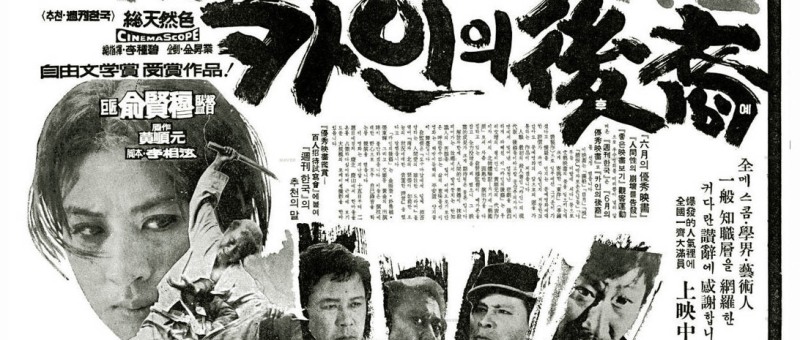
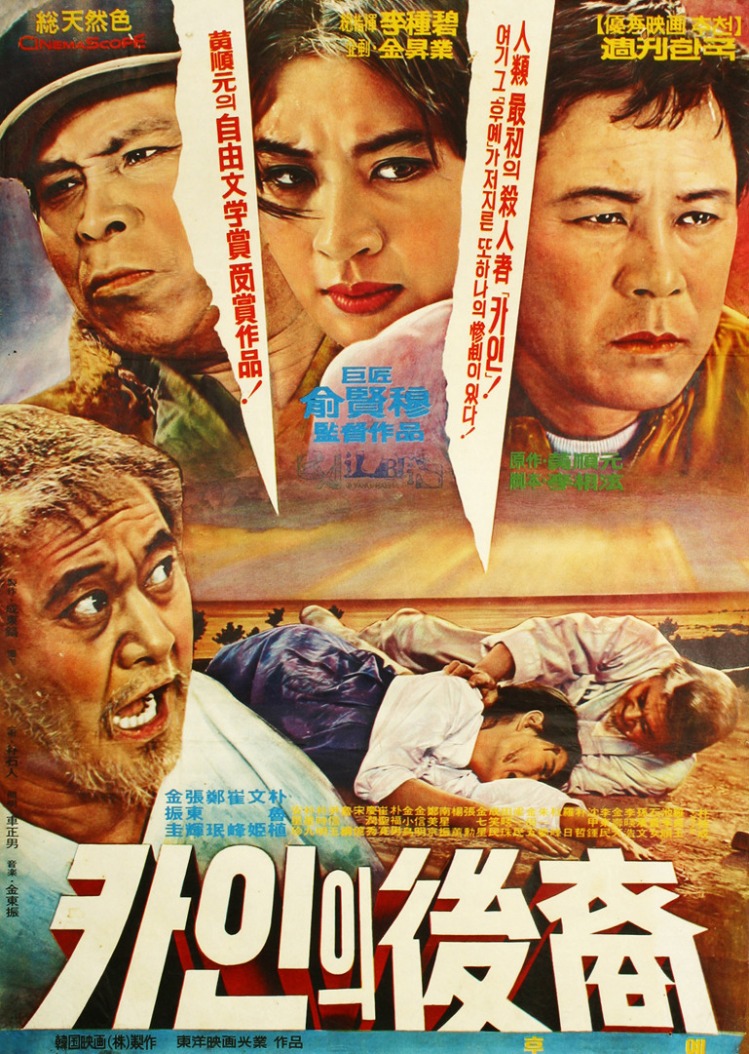
The Descendants of Cain (카인의 후예 / 카인의 後裔, Yu Hyun-mok, 1968)

Descendents of Cain poster 1Yu Hyun-mok, often regarded as among the more “intellectual” of film directors in Korea’s Golden Age, is also among those to have been arrested for violation of the Anti-Communist laws. Yu was later exonerated and went back to filmmaking as before but it remains true that Yu betrays a little more ambivalence to the anti-communist message so often required than many of his colleagues. That is to say, Yu often leans economically left in his frequent criticism of social inequality and his anti-consumerist stance, but remains socially conservative if with a strong desire for social justice. The Descendants of Cain (카인의 후예 / 카인의 後裔, Kainui Huyea), adapted from a novel by Hwang Sun-won, is as anti-communist as they come, but also offers its share of ironies in painting “communism” as a kind of disease born of greed and self-interest which thrives on fear and eventually consumes those who are seduced by its false promises.

Irony is indeed our starting point as our cheerful villagers enjoy a raucous celebration in honour of Independence Day only for the communists to suddenly turn up and spoil the party. Worst of all, one of the communists is a long lost son of the village – Choe is the absentee husband of Ojaknyeo (Moon Hee), a maid, who has developed an affection for her boss, the nephew of the local landlord, Park Hun (Kim Jin-kyu). The communists’ first action is to close down the school that Park Hun opened to provide education for the peasants and co-opt it as their base. Park knows he’s in a dangerous position and has little power to resist, opting to wait it out and see how far the communists really intend to go. The peasants, however, are becoming excited hearing about the land redistribution programme and are starting to forget everything that Park and his family have done for them over the generations, swayed by the false promises of the communists who preach equality while insisting on deference.

The central conflict is, in many ways, between the feudal past and the “democratic” future. Set in what would shortly the “the north” in 1946, Descendants of Cain positions itself on more than one kind of dividing line with the lingering spectre of tragedy always on the horizon. High on a ridge there’s a large stone slab erected as a memorial to the late Park, Park Hun’s grandfather, whose solicitous care for the villagers had earned their eternal respect and perhaps their love. The Parks are “good” landlords. They take their “feudal” responsibilities seriously as evidenced by Park Hun’s school and his father’s desire to finish construction on the local reservoir which is both his legacy and an important failsafe precaution against draught which is in the interests of all. By all appearances this is a well functioning village where no one is hungry or alone. The peasants have not felt “oppressed” or been unhappy, which is not to say they don’t want to better their lot but they have no burning desire for revolution and have nothing in particular to rebel against.

This leaves the communists with a problem – they have little leverage over happy peasantry which has never acknowledged its own oppression let alone longed for freedom from it. Their approach is therefore one of divide and conquer. Cynical in the extreme, the communists set about exploiting petty village disputes to foster discord between people – something which eventually contributes to a murder which they also manipulate for political gain. The “landowners” are of course a prime target, but their judgement must be at the hands of “the people” by means of a farmers’ trial. Having recruited something close to a former village leader, the communists assume they will have the villagers on side but they all (bar two) refuse to indict the Parks. The communist leader, fond of irony, gestures towards towards his armed men and reminds the villagers that no one here is “impinging on their freedom”. That is, their freedom to express the views they are required to express or suffer the consequences.

Threatened with violence and intimidation, feudal deference bends or perhaps shifts to a different master. The villagers, losing their attachment to the Parks, salivate over the possibility of “redistribution” and of being handed “free land”. Their desires are material and not political. Thus when the Parks’ estate is “returned” to the people, they simply walk in and start taking things. Not the most sensible way to redistribute wealth concentrated in the hands of the elite – the fast get horses, the indecisive dented pans which sounds like a recipe for rancour and discontent. When the old village chief becomes disillusioned with his choices and smashes the memorial to old Park, a small fight breaks out among villagers keen to snag the large pieces of stone for various other projects. Happy peasants who once shared everything and wanted for nothing, are now fighting with each other over rubble and trinkets.

The communists, far from fostering collective spirit, have become the evil feudal lords they rail against, oppressing the peasants with their rules and regulations while wilfully creating an atmosphere of fear in order to better oppress them. Their hypocrisy is rammed home early on by the slimy Cheol who complains about his wife’s supposed faithlessness while molesting a barmaid and smugly repeating the story of a large scar he has on his forearm. His superior, believing he got the scar during a labour dispute at a mine, promoted him for his communist spirit, but Cheol really got the scar in a scuffle over a girl (not his wife, incidentally).

Cheol is “a” force which comes between the two lovers, Ojaknyeo and Park Hun, as both are too morally upright to pursue a full romance when Ojaknyeo is still married to another man, even if the other man’s first action on seeing her is to throw her to the ground and begin kicking the living daylights out of her. Later Ojaknyeo gets another, more serious, beating from her father but this time because she’s chosen the wrong side in refusing to step away from the feudal world in her responsibility to Park Hun and his household, even if that responsibility is partly romantic desire. Yet Park Hun and Ojaknyeo are also separated by the feudal world’s rules in their obvious class difference. Communism is supposed to break down these barriers, not to mention removing the “patriarchal tyranny” of marriage, yet the communists would rather award Ojaknyeo to her former husband, little caring that he is abusive and neglectful. Ojaknyeo, at least, will not be freed from her oppression any time soon.

If Yu is making a mild defence of paternalistic feudalism as a metaphor for compassionate government, it is probably a little ambitious given the times in which he lived. Following a regular pattern, Yu paints the world as a terrible place where fear and self interest trump all, only to find small rays of light in the closing moments when an act of violence provokes a series of unexpected epiphanies and reconciliations. He ends on a note of hope in which an older man sacrifices himself for a younger one but is then rewarded with the possibility of salvation and a happier future with the woman he loves (and is now unafraid to pursue) south of the border. Communism seduces and betrays, whereas liberal democracy at least affords the “freedom” to be miserable with personal integrity.


Screened as part of the Korean Novels on Screen season at the Korean Cultural Centre London.