Like a Savage (野蛮人のように, Toru Kawashima, 1985)

Hiroko Yakushimaru had been the breakout star of Haruki Kadokawa’s idol cinema in the early 1980s, but as she approached her 20th birthday had developed an increasing desire to retire and leave the showbiz world behind. Having won the prestigious Blue Ribbon Best Actress award for her role in W’s Tragedy, she ended her contract with the studio but following the outcry over news of her intention to retire ultimately set up on her own as an independent performer with her own management company. 

Like a Savage (野蛮人のように, Yabanjin no Youni) was her first project after moving on from Kadokawa and was intended to signal a new phase in her career though incorporating many of the elements that had made her teen idol films so successful. This time around, she plays a character seemingly a few years above her actual age though in other ways childlike and something of a fantasist. Tamako is a blocked novelist in her mid-20s who had tremendous success with her first work published when she was only 15. Ostensibly, she leads an incredibly aspirational life living in a beautiful cabin on the beach where she tries to write sitting out in the sun on her terrace. In the opening sequences, we see her taking a break by reading a novel in English while she also shows a knowledge of French which adds to her intellectual credentials and sense of contemporary sophistication. 

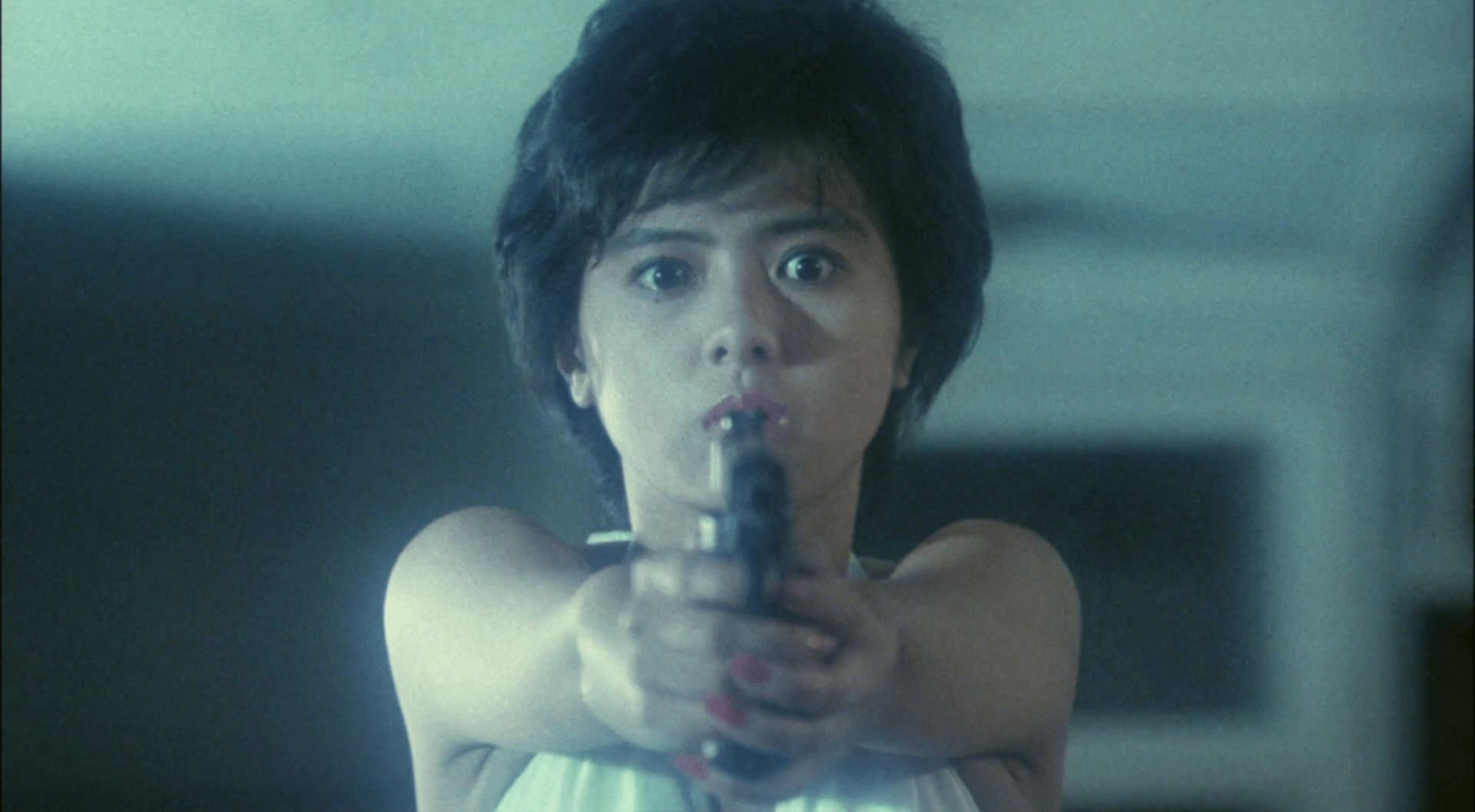
But it seems that she may be bored with this seemingly charmed life and is having trouble gaining inspiration because she’s become too comfortable. She also has a capricious selfish streak, randomly abandoning her friends who’ve come for a fireworks party by driving her open-topped jeep all the way into the centre of Roppongi “to find adventure in the night”. Adventure ends up finding her when she’s unwittingly drawn into underworld intrigue after being mistaken for a sex worker who was with a yakuza boss immediately before he was assassinated, as it turns out by one of his own men intent on succession but trying to disguise his ham-fisted bid for power as turf war. Teaming up with yakuza-adjacent fixer Eiji (Kyohei Shibata) she finds herself on the run before eventually taking him back to the cabin to hide out and recuperate from a stab wound. 

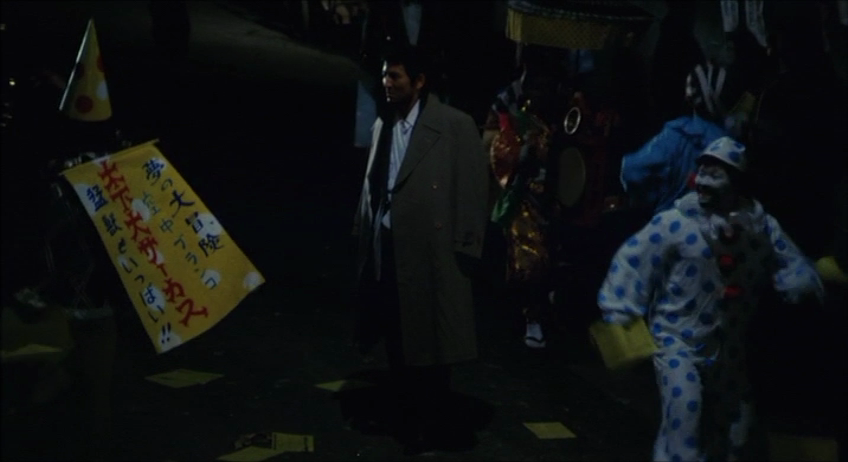
Yakushimaru had played similar roles as a teen star, but adds an adult edge as Tamako chain smokes and is almost always drinking, in fact being seven sheets to the wind while driving the jeep to the city. In other ways, however, she retains a childlike quality most obviously in the film’s repeated to references to Alice in Wonderland which paint the contemporary capital as a fantastical place coloured by her own literary imagination. In her flight through the city, she passes what seems to be a Mad Hatter’s Tea Party, while there’s also a neon sign featuring what looks like the Cheshire Cat grinning wildly in the Cabaret-influenced drag bar where Eiji works in which a performer dressed as Sally Bowles sings in French and many of the waiters are implied to be trans or gay. When the gangsters finally surround the beach house in the final act, a pottery figurine of a rabbit with a stopwatch is obliterated by their bullets as if to remind her that she’s not in Wonderland anymore and all of this is “real” rather than the romanticised fantasy she may have bought into while nursing a handsome yakuza back to health by the sea. 

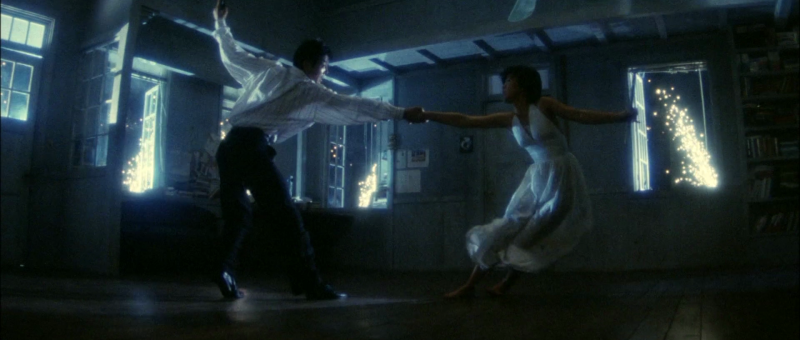
Even so, the city has its darkness. The girl who really was with the yakuza boss when he died twice gives her age as only 15, one of many Eiji shepherded around as part of his yakuza-adjacent job. The head yakuza has an eerie presence deepened by the use of a strange voice effect whenever he speaks, while Kawashima captures a fantastical side of Bubble-era Tokyo lit by the warm glow of hazy neon. In a moment of irony, a large sign on the building where the yakuza boss met his end reads “Desire” with its letters finally flickering out to leave just “Die” as if to tell us this rampantly consumerist city of darkness will eventually consume all those who cannot escape its allure. 

In any case, Tamako finds herself literally blowing up her world to cure her existential crisis reflecting that life is like a firework destined to burn out bright. What she experiences is another kind of rebirth, the climactic shootout occurring on her birthday which Eiji, who does not know his date of birth presumably having been abandoned as a baby, later adopts as his own. Surprisingly stylish and generally upbeat despite the darkness around its edges, Kawashima’s zeitgeisty action drama captures something of an age of ennui in which fantasy is the only escape from the emptiness of a neon-lit Tokyo. 


Original trailer (no subtitles)
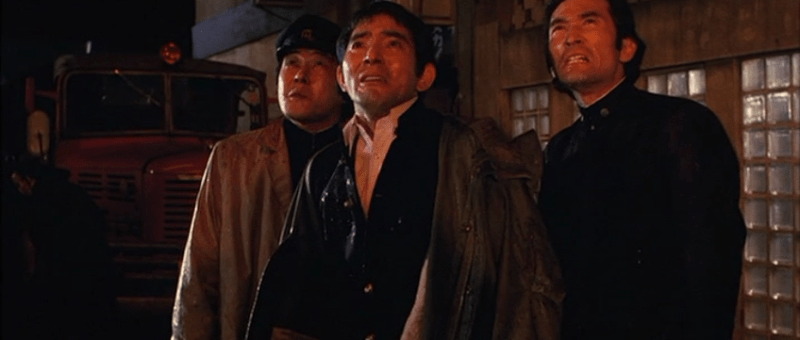
Dead Angle (白昼の死角, Toru Murakawa, 1979)

The jitsuroku yakuza movie which had become dominant in the mid-70s had often told of the rise and fall of the petty street gangster from the chaos of the immediate post-war era to the economically comfortable present day. The jitsuroku films didn’t attempt to glamourise organised crime and often presented their heroes as men born of their times who had been changed by their wartime experiences and were ultimately unable to adjust themselves to life in the new post-war society. Adapted from a serialised novel by Akimitsu Takagi which ran from 1959 to 1960, Toru Murakawa’s Dead Angle (白昼の死角, Hakuchu no Shikaku) by contrast speaks directly to the contemporary era in following a narcissistic conman who has no need to live a life of crime but as he says does evil things for evil reasons. 

Prior to the film’s opening in 1949, the hero Tsuruoka (Isao Natsuyagi) had been a law student at a prestigious Tokyo university where he nevertheless became involved in the Sun Club, a student financial organisation launched by mastermind Sumida (Shin Kishida) who eventually commits suicide by self-immolation when the organisation collapses after being accused of black market trading. An unrepentant Tsuruoka resolves to start again, rebuilding in the ashes as a means of kicking back against hypocritical social institutions and rising corporate power by utilising his legal knowledge to run a series of cons through the use of promissory notes to prove that the law is not justice but power. 

In this Tsuruoka has an ironic point. He doesn’t pretend what he’s doing is legal, only that he’s safeguarded himself against prosecution. When a pair of yakuza thugs break into his office and threaten him in retaliation for a con he ran on a shipping company, he reminds them that as they’ve had him open the safe it would make the charge of killing him robbery plus murder which means automatic life imprisonment rather than the few years they might get for simply killing him without taking any money. He always has some reason why the law can’t touch him, while implicitly placing the blame on his victims who were often too greedy or desperate to read the small print and therefore deserve whatever’s coming to them. In at least one case, Tsuruoka’s victimless crimes end up resulting in death with one old man whom he’d double conned, pretending to give him the money he was owed but getting him drunk and talking him into “re-investing” the money with him, takes his own life by seppuku in the depths of his shame not only in the humiliation of having been swindled but losing his company, who had trusted him, so much money. 

You could never call Tsuruoka’s rebellion an anti-capitalist act, but it is perhaps this sense of corporate tribalism symbolised by the old man’s extremely feudalistic gesture that Tsuruoka is targeting. As his wife Takako (Mitsuko Oka) tells him, Tsuruoka should have no problem making an honest living. After all he graduated in law from a top university, it’s not as if he wouldn’t have been financially comfortable and it doesn’t seem that the money is his primary motive. While Takako continues to insist that he’s a good person who wouldn’t do anything “illegal”, his longterm geisha mistress Ayaka (Yoko Shimada) knows that he’s an evil man who does evil things for evil’s sake and that’s what she likes about him. Elderly businessmen are always harping on about the “irresponsible youth” of the day but all are too quick to fall for Tsuruoka’s patter while he is essentially nothing more than a narcissist who gets off on a sense of superiority laughing at the law, the police, and the corporate landscape while constantly outsmarting them. 

In this, the film seems to be talking to the untapped capitalism of the 1970s. Like Tsuruoka, the nation now has no need to get its hands dirty and should know when enough is enough but is in danger of losing sight of conventional morality in the relentless consumerist dash of the economic miracle. That might explain why unlike the jitsuroku gangster pictures, Murakawa scores the film mainly with an anachronistic contemporary soundtrack along with the ironic use of saloon music in the bar where Tsuruoka’s associates hook an early target, and the circus tunes which envelope him at the film’s opening and closing hinting that this is all in some ways a farce even as Tsuruoka is haunted by the ghosts his narcissistic greed has birthed. Then again perhaps he too is merely a product of his times, cynical, mistrustful of authority, and seeking independence from a hypocritical social order but discovering only failure and exile in his unfeeling hubris. 


Original trailer (no subtitles)

Bloom in the Moonlight (わが愛の譜 滝廉太郎物語, Shinichiro Sawai, 1993)

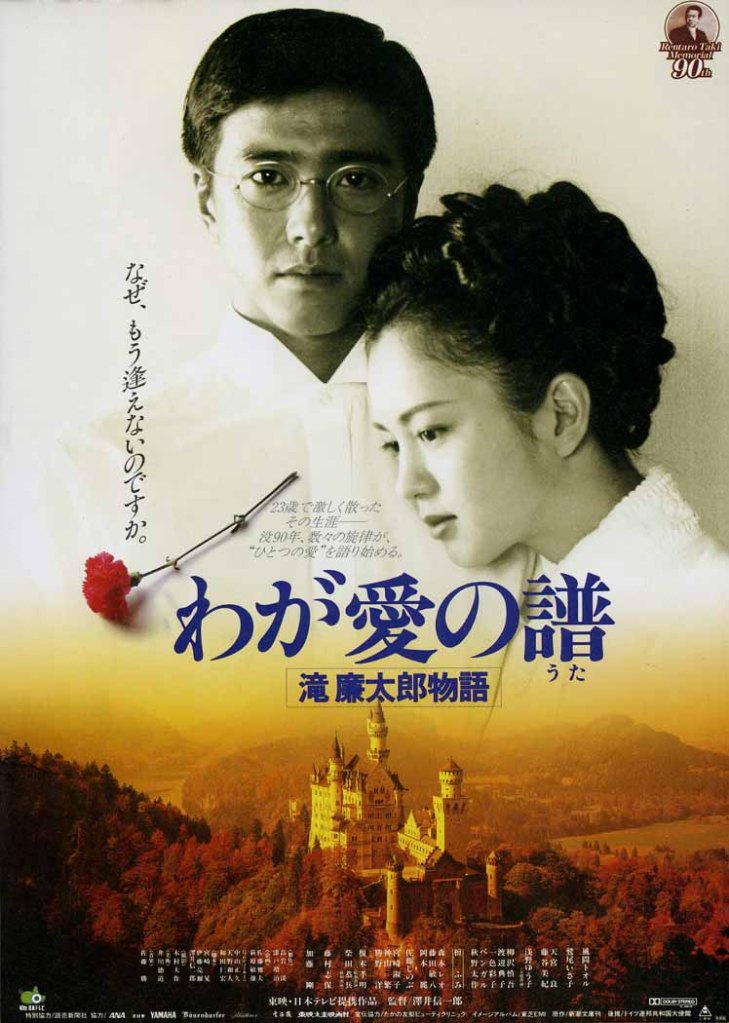
bloom-in-the-moonlightAll those songs and rhymes you learnt as a child, somehow it’s strange to think that someone must have written them once, they seem to just exist independently. In Japan, the name behind many of these familiar tunes is Rentaro Taki – the first composer to set Japanese lyrics to European style “classical” music. It’s important to remember that even classical music was once contemporary, and along with the opening up of the nation during the Meiji era came a desire to engage with the “high culture” of other developed nations. The Tokyo Music School was founded in 1887 and Taki graduated from it just four years later in 1901. However, his career was to be a short one as his health gradually declined until he passed away of tuberculosis at just 23 years old. Bloom in the Moonlight (わが愛の譜 滝廉太郎物語, Waga Ai no Uta: Taki Rentaro Monogatari), also the title of one of his most well known and poignant songs, is the story of his musical career but also of the history of early classic music in Japan as the country found itself in a moment of extreme cultural shift.
Defying his father’s wishes and travelling to Tokyo to pursue a musical education, Rentaro Taki (Toru Kazama) becomes fascinated by the piano and is determined to become a high level pianist. Even knowing how hard it is to conquer the instrument and that many of his contemporaries have been studying since early childhood, Rentaro refuses to lose heart and pushes himself to become the best piano player that he can possibly be. Always a sickly child, Rentaro’s intense devotion to his instrument begins to threaten his health but his ambition knows no limit. The purpose of the school leans more towards the study and dissemination of Western music among ordinary people but soon Rentaro and some of his fellow pupils grow tired of the idea that their role is that of teachers and scholars and begin composing their own work. Rentaro’s songs become what is really the first kind of modern folk music, marrying the European classical music of the foreign elites and the more egalitarian, everyman quality of the accompanying lyrics to create a new kind of Japanese music.

The tale is narrated at times by a fellow pupil, Yuki Nakano (Isako Washio), who encounters Rentaro at the same time as he encounters the piano. The star pupil at the school and sister of an already internationally famous concert pianist, Yuki is nevertheless insecure about her own skills. Rentaro quickly surpasses her though the two become close and eventually a source of mutual inspiration. Adding to the melancholy nature of the tale, Yuki falls in love with Rentaro and his musical intensity but the pair are separated when she is selected as one of the first pupils to be sent abroad to learn from the classical music masters in Germany. A year later, Rentaro is also permitted to go and the pair are briefly reunited but it will be for the last time as Rentaro’s illness intensifies and brings an early end to his musical career.

Times being what they are, Rentaro and Yuki are denied the possibility of pursuing a romance, adding to the theme of poignancy and missed opportunities running through the film. Indeed, the final piece Rentaro composes and which he is still working on right up to the end is for Yuki and is titled “Regret”. Dedicating himself to music above all else, Rentaro leaves behind him a musical legacy but still, as one of his songs puts it, longs for the “brightness of bygone days”.

Rentaro was from a wealthy family, and even if his father did not approve of his decision to study music, he continued to support him even whilst worrying about his constant ill health. Many of his fellow pupils were not so lucky including his good friend Suzuki (Ryo Amamiya) who is forced to leave the school when his father becomes ill leaving him responsible for each of his siblings. Eventually Suzuki is able to return to the world of music as a teacher, playing Rentaro’s folk songs for the local village children and helping to make his friend’s work some of the most well known in Japan.

Little is seen outside of the rarefied world of wealthy students and their internationally focussed cultural pursuits but at times the other world is allowed to slink in, particularly in the case of an inn girl who is charged with looking after Rentaro during one of his periods of convalescence. The girl, Fumi (Miki Fujitani), also becomes fascinated with Rentaro’s intense love music but any attachment on her part can only lead to tragedy. All else aside, Rentaro is the oldest son of a wealthy family and not seriously considering a formal arrangement with someone like Fumi. Eventually she will be sold off as a concubine to a wealthy man, there are no better options for her even in the bright new Meiji era.

As in much of his other work, Sawai neatly avoids the more sentimental elements of the story even if melodrama is a necessary part of its appeal. Bloom in the Moonlight is among his more straightforward efforts sticking to the prestige picture approach without any of the stranger or more expressive sequences which often crop up in films such as W’s Tragedy or Maison Ikkoku. As a neutral biopic, the treatment of its subject is at times superficial, skipping other interesting details of Rentaro Taki’s life such as his late conversion to Christianity preferring to focus on the tragic love story which becomes the genesis of his final, unfinished work. Nevertheless, Bloom in the Midnight succeeds in telling the sad story of a musical genius who poured all of his intensity into a few short years leaving a body of work behind him likely to outlive us all.


Rentaro Taki’s songs are still very popular today and if you’ve spent any time at all watching Japanese films you will definitely have heard them.

One of the most recognisable – Hana

And one of the most well known – Kojo no Tsuki (with footage from Throne of Blood!)


69 (Lee Sang-il, 2004)

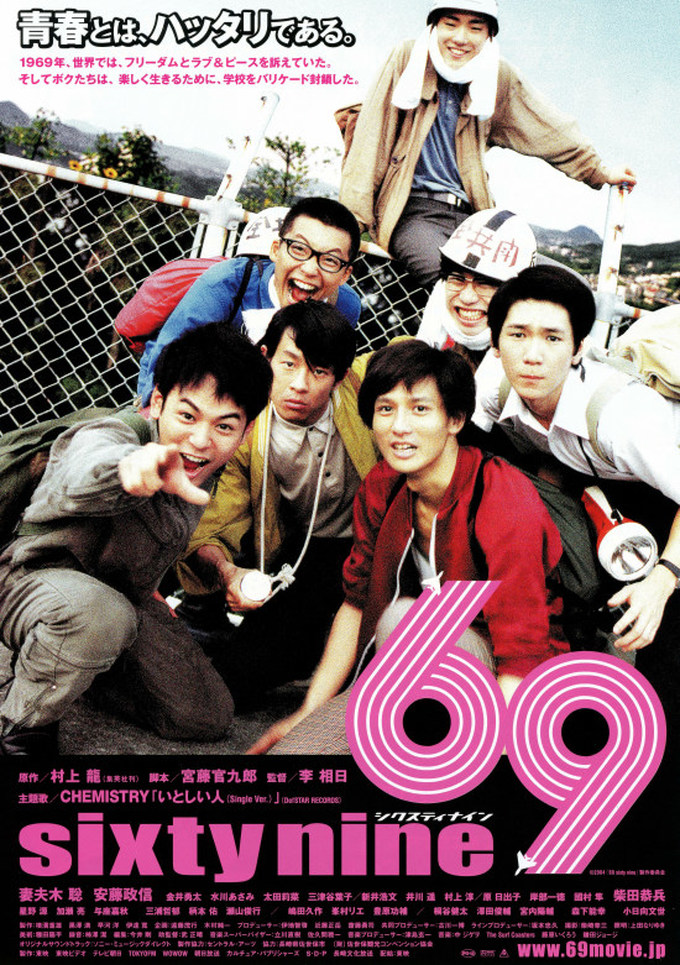
69Ryu Murakami is often thought of as the foremost proponent of Japanese extreme literature with his bloody psychological thriller/horrifying love story Audition adapted into a movie by Takashi Miike which itself became the cornerstone of a certain kind of cinema. However, Murakami’s output is almost as diverse as Miike’s as can be seen in his 1987 semi-autobiographical novel 69. A comic coming of age tale set in small town Japan in 1969, 69 is a forgiving, if occasionally self mocking, look back at what it was to grow up on the periphery of massive social change.
The swinging sixties may have been in full swing in other parts of the world with free love, rock and roll and revolution the buzz words of the day but if you’re 17 years old and you live in a tiny town maybe these are all just examples of exciting things that don’t have an awful lot to do with you. If there’s one thing 69 really wants you know it’s that teenage boys are always teenage boys regardless of the era and so we follow the adventures of a typical 17 year old, Ken (Satoshi Tsumabuki), whose chief interest in life is, you guessed it, girls.

Ken has amassed a little posse around himself that he likes to amuse by making up improbable fantasies about taking off to Kyoto and sleeping with super models (oddly they almost believe him). He talks a big about Godard and Rimbaud, posturing as an intellectual, but all he’s trying to do is seem “cool”. He likes rock music (but maybe only because it’s “cool” to like rock music) and becomes obsessed with the idea of starting his own Woodstock in their tiny town but mostly only because girls get wild on drugs and take their tops off at festivals! When the object of his affection states she likes rebellious guys like the student protestors in Tokyo, Ken gets the idea of barricading the school and painting incomprehensible, vaguely leftist jargon all over the walls as a way of getting her attention (and a degree of kudos for himself).

69 is a teen coming of age comedy in the classic mould but it would almost be a mistake to read it as a period piece. Neither director Lee Sang-il nor any of the creative team are children of the ‘60s so they don’t have any of the nostalgic longing for an innocent period of youth such as perhaps Murakami had when writing the novel (Murakami himself was born in 1952). The “hero”, Ken, is a posturing buffoon in the way that many teenage boys are, but the fact that he’s so openly cynical and honest about his motivations makes him a little more likeable. Ken’s “political action” is merely a means of youthful rebellion intended to boost his own profile and provide some diversion at this relatively uninteresting period of his life before the serious business of getting into university begins and then the arduous yet dell path towards a successful adulthood.

His more intellectual, bookish and handsome buddy Adama (Masanobu Ando) does undergo something of a political awakening after the boys are suspended from school and he holes up at home reading all kinds of serious literature but even this seems like it might be more a kind of stir crazy madness than a general desire to enact the revolution at a tiny high school in the middle of nowhere. Ken’s artist father seems oddly proud of his son’s actions, as if they were part of a larger performance art project rather than the idiotic, lust driven antics of a teenage boy but even if the kids pay lip service to opposing the war in Vietnam which they see on the news every night, it’s clear they don’t really care as much as about opposing a war as they do about being seen to have the “cool” opinion of the day.

Lee takes the period out of the equation a little giving it much less weight than in Murakami’s source novel which is very much about growing up in the wake of a countercultural movement that is actually happening far away from you (and consequently seems much more interesting and sophisticated). Were it not for the absence of mobile phones and a slightly more innocent atmosphere these could easily have been the teenagers of 2003 when the film was made. This isn’t to criticise 69 for a lack of aesthetic but to point out that whereas Murakami’s novel was necessarily backward looking, Lee’s film has half an eye on the future.

Indeed, there’s far less music than one would expect in the soundtrack which includes a few late ‘60s rock songs but none of the folk/protest music that the characters talk about. At one point Ken talks about Simon & Garfunkel with his crush Matsui (Rina Ohta) who reveals her love for the song At the Zoo so Ken claims to have all of the folk duo’s records and agrees to lend them to her though his immediately asking to borrow money from his parents to buy a record suggests he was just pretending to be into a band his girl likes. Here the music is just something which exists to be cool or uncool rather than an active barrier between youth and age or a talisman of a school of thought.

Lee’s emphasis is firmly with the young guys and their late adolescence growth period, even if it seems as if there’s been little progress by the end of the film. There’s no real focus on their conflict with the older generation and the movie doesn’t even try to envisage the similar transformation among the girls outside of the way the boys see them which is necessarily immature. That said, the film is trying to cast a winking, wry look back at youth in all its eager to please insincerity. It’s all so knowingly silly, posturing to enact a revolution even though there’s really no need for one in this perfectly pleasant if slightly dull backwater town. They’ll look back on all this and laugh one day that they could have cared so much about about being cool because they didn’t know who they were, and we can look back with them, and laugh at ourselves too.


Ryu Murakami’s original novel is currently available in the UK from Pushkin Press translated by Ralph McCarthy and was previously published in the US in the same translation by Kodansha USA (but seems to be out of print).

Unsubtitled trailer:

and just because I love it, Simon & Garfunkel At the Zoo

A Chorus of Angels (北のカナリアたち, Junji Sakamoto, 2012)

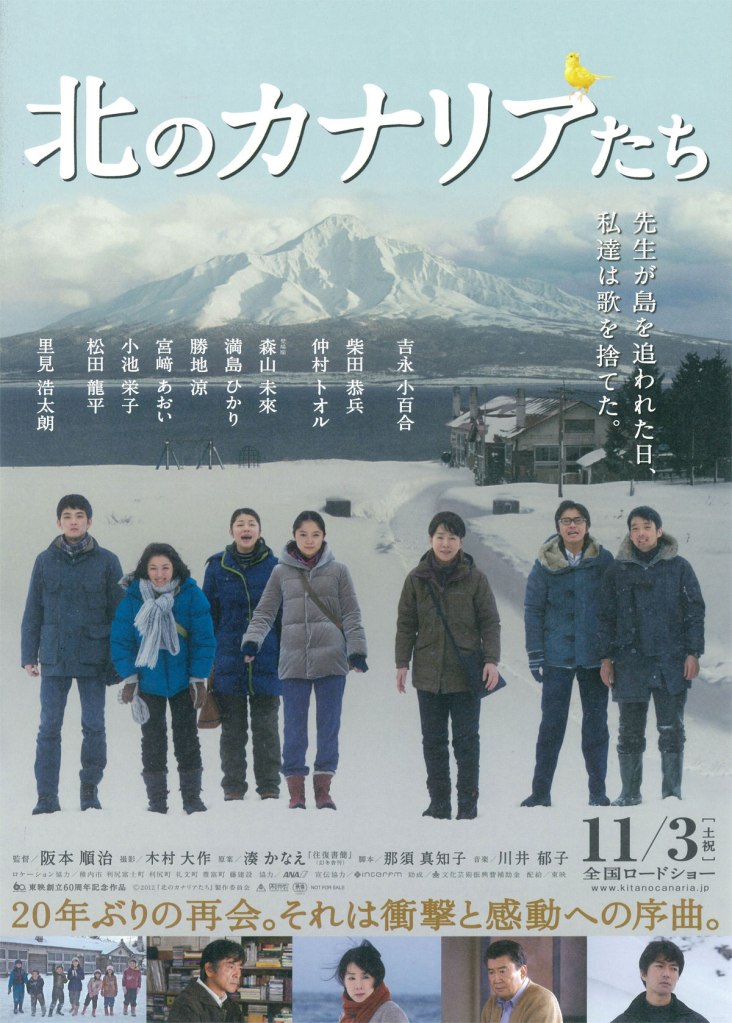
chorus of angelsAs you read the words “adapted from the novel by Kanae Minato” you know that however cute and cuddly the blurb on the back may make it sound, there will be pain and suffering at its foundation. So it is with A Chorus of Angels (北のカナリアたち, Kita no Kanariatachi) which sells itself as a kind of mini-take on Twenty-Four Eyes (“Twelve Eyes” – if you will) as a middle aged former school mistress meets up with her six former charges only to discover that her own actions have cast an irrevocable shadow over the very sunlight she was determined to shine on their otherwise troubled young lives.

Haru has been working as a librarian in the city for the last twenty years and has finally reached retirement age but before that she was a school teacher in Japan’s frozen north. Before she can even think about enjoying her new found freedom, a pair of policeman turn up at her door to ask her a few questions about one of her former pupils, Nobuto, who is a suspect in a murder case. It seems that they found Haru’s address amongst Nobuto’s possessions and are keen to find out what kind of relationship she had with him and anything she might know about his current whereabouts. Haru is shocked to the core but remembers that she always gets a New Year card from one of Nobuto’s classmates, Manami, and decides to return home at long last to try and put to rest some wandering ghosts.

Like much of Kanae Minato’s work, A Chorus of Angels is a perfectly constructed mystery only this time much more of the heart than of the head. Consequently, it would be wrong to reveal too much of the plot but suffice to say that a traumatic incident twenty years ago left a profound effect not only on each of the children but also on their teacher and others in the surrounding area. Re-encountering each of her six pupils again, Haru discovers that each of them has been harbouring a deeply buried sense of guilt and shame, believing themselves to have been responsible for what happened that day. That sense of unresolved trauma has prevented each of them from fully getting on with their lives, as if some part of each of them was frozen in time when they were just primary school children singing in a choir and feeling proud of themselves for the first time in their lives.

Their teacher, Haru, also left a part of herself behind in that snowy northern landscape. Having committed something which some would regard as a sin, she’s hounded off the island – or perhaps allows herself to be, giving in to a punishment that she sees as befitting her own sense of guilt. However, as is customary for Minato, Haru’s “crime” is not such a black and white affair. If she betrayed someone, that person understood and, ultimately, only wanted the best for her. That she sacrificed the things that might have allowed her to go on living a happy life is the kind of tragic irony Minato is known for and the lonely, cold and shut off appearance of Haru’s twenty years of librarianing exile is another perfect example. She didn’t really do anything wrong except for try to live, and yet she’s paid for that with the next twenty years of her life and not only that, in robbing the young children who’d come to see her as something of a guardian angel of her very presence, she’s left them to pay too. Guilt grows like a mountain until it eclipses even the brightest of suns.

Despite its unfeasibly starry cast which radiates around veteran actress Sayuri Yoshinga and includes such young talents as Hikari Mitsushima, Mirai Moriyama, Ryuhei Matsuda, Ryo Katsuji, Aoi Miyazaki and Eiko Koike, A Chorus of Angles is actually fairly ordinary in terms of its directorial style and though it manages to stay on the right side of saccharine, never quite manages to make its tear-jerking set-up quite as moving as it seems to want to be. That said, it does boast some extraordinarily beautiful scenes of the Hokkaido snowscape which is a perfect setting for this chilling, frozen ghost story in which no actual ghosts appear. The children’s childhoods are all blissful blue skies and sunny summer days but in the future there’s only snow and cold winter sunshine. Just stay alive, it would be enough – to live is to suffer, but you have to go on. The important thing to learn is that it’s one thing to forgive everyone else, but there comes a time when you have to forgive yourself, too.


The Hong Kong release of A Chorus of Angels includes English subtitles!

Unsubtitled trailer: