Love and Wolbachia (恋とボルバキア, Sayaka Ono, 2017)

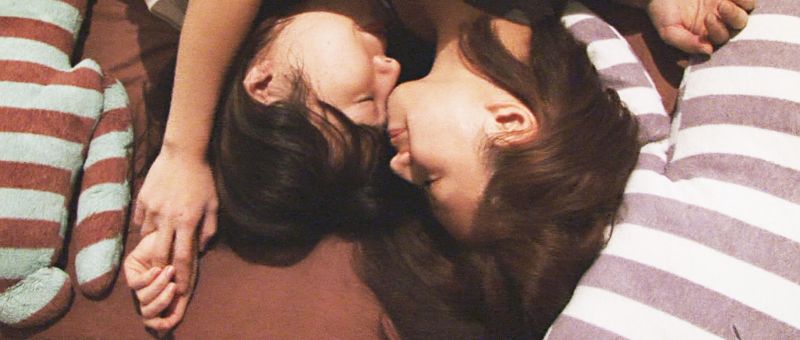
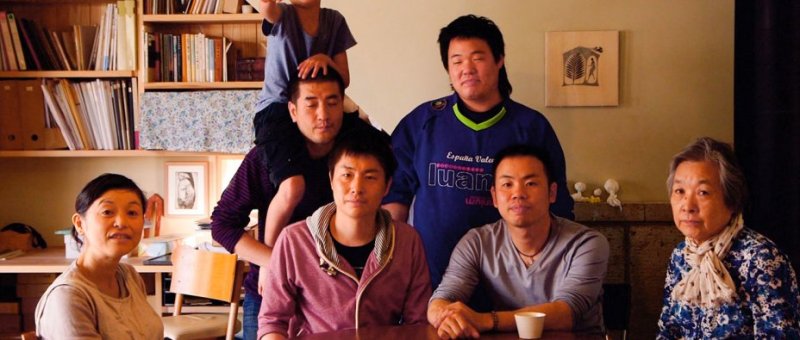
love-and-walbachia-poster-2-e1527641922439.jpgDocumentarian Sayaka Ono turned the camera on herself and her family seven years ago with her graduation project/debut feature The Duckling. Returning with her second feature after spending the intervening years in TV documentary, Ono tackles a subject perhaps more distant from her personal experience in exploring the lives of sexual minorities and particularly of transgender women in generally conformist Japan. Love and Wolbachia (恋とボルバキア, Koi to Wolbachia) takes its name from that of a parasitic bacteria which can cause its host to change sex. Love may very well be a kind of virus, but Ono seems more interested in answering the question of why someone might decide to live as a woman in a society so often hostile to them.

The first two protagonists Ono introduces us two were born intersex. Despite their personal feelings, each was encouraged to take hormones to conform more closely to their external appearance. Forced to make a perhaps false binary choice, or in essence being deprived of the right to make it for themselves, each has attempted to live in the way which bests suits their authentic selves though they often encounter discrimination and/or hostility from those around them.

The question of gender in and of itself appears more important to some than others. Another of our protagonists, Miya, refers to herself as a “makeup man” and runs a bar which acts as a kind of community space and refuge for other transgender and non-binary people who often have nowhere else to turn. Nevertheless, Miya struggles with her partner’s decision to undergo gender confirmation surgery and finds it difficult to understand why someone would be willing to put themselves through so much pain and suffering for something she sees as an external concern. For Miya the question of “gender” seems moot, not quite something requires only an individual identification but which scarcely requires one at all. It is she feels, in essence, something culturally defined which an individual is free to accept or reject in claiming their own personal identity as distinct from from social codes dictated by society.

Yet Miya also finds herself a victim of these social codes in a desire to provide protection to those who need it only to find herself ill equipped to cope with the intense responsibility of accidentally becoming a community leader if one without a particular political agenda save wanting to make other people’s lives easier. The question of gender roles becomes a more obvious problem in the relationship between lesbian Julian and her transgender partner Hazumi. Criticised by some of her friends for dating a transwoman, Julian also struggles with a perceived expectation to adopt a “masculine” role within the relationship, that Hazumi expects her to provide protection while also becoming the dominant partner which she seems to feel does not fit her personality. Conversely, Julian also longs for a conventional home and family as a married couple with children yet Hazumi wants to transition fully and, having left a marriage and a child to live a more authentic life, worries that starting another family with Julian may prevent her from achieving her dream.

A conventional family life also seems to have prevented 50-year-old Ichiko from pursuing her desire to live as a woman, having lived in a time when few knew such things were possible. A father with three children, most of her resources are given over to their care but she still finds time to enjoy a more authentic life and participate in the community. Like Ichiko, Mihiro began wearing women’s clothing after admiring her wife’s outfits only she later decided to leave her marriage and retains a male personality only for work. Having fallen in love with a man who himself feels uncomfortable with the culturally defined notions of “masculinity”, Mihiro is heartbroken to realise he already has a live-in girlfriend and worries his impression of their relationship may not match her own. This rings eerily true given a solo interview in which he jokingly laments Mihiro’s purehearted approach to romance which he believes leaves her open to male manipulation.

Ono does not particularly explore the lives of transmen, perhaps an anomaly seeing as Japan is one of few nations to have elected a transman to office (Japan also elected its first transgender female politician back in 2003), preferring to explore the place of trans and gay women in a society which can be deeply misogynistic and relentlessly conformist. Mihiro’s supportive mother, watching her carefully applying her makeup, remarks on how much time men must save in not needing to bother. Mihiro partially corrects her – wearing makeup is a choice which is open to women but not perhaps to men and choice, it seems, is the main thing or not so much “choice” but freedom to live in the way you choose rather than the way which is chosen for you by your society. 


Screened at Nippon Connection 2018.

Original trailer (no subtitles)

Chedeng and Apple (Si Chedeng at si Apple, Rae Red & Fatrick Tabada, 2017)

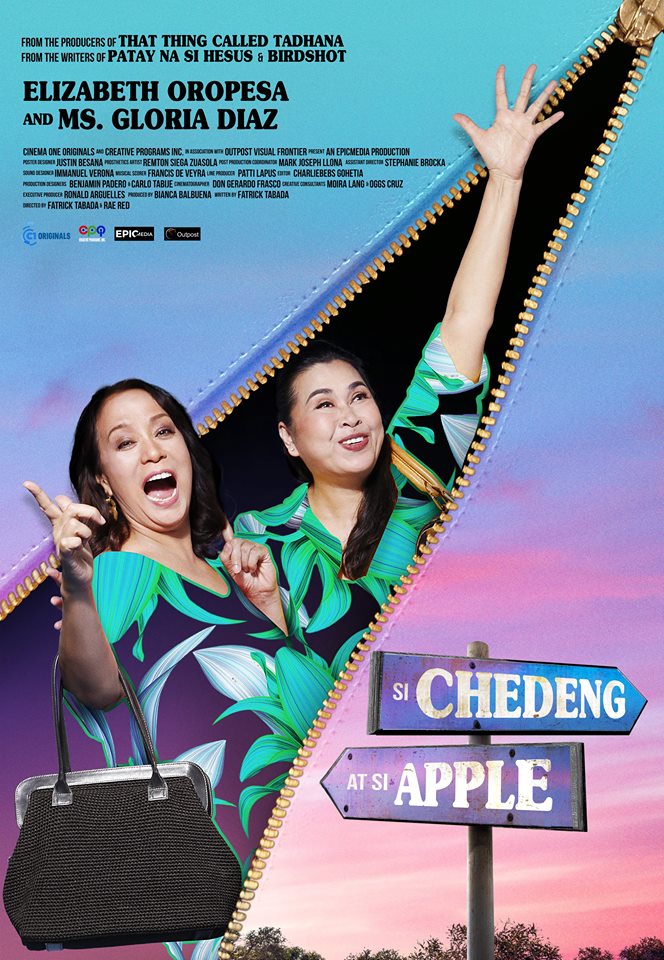
chedeng and apple posterWhen you feel you’ve discharged all your social obligations, you might feel as if you’ve a right to live by your own desires. Whether the dreams you abandoned in youth will still be there waiting for you is, however, something of which you can be far less certain. Following the death of her husband, one Filipina grandma decides to find out, taking to the road with her best friend who is, incidentally, wanted for murder and carrying around the severed head of her late spouse in a Louis Vuitton handbag belonging to her vacuous step-daughter, in search of the one that got away.

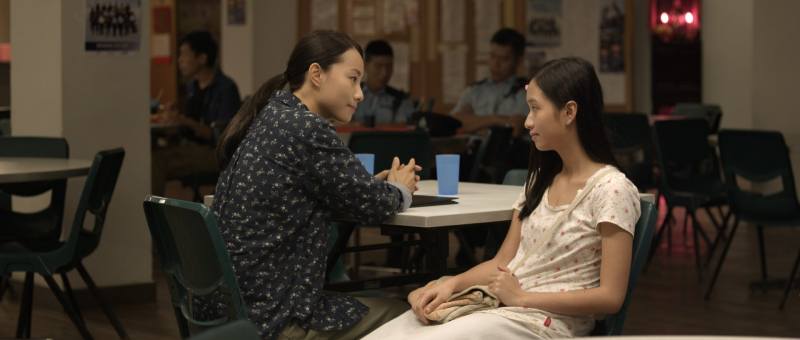
Chedeng (Gloria Diaz), apparently plotting the death of her sickly husband, is shocked to find him already gone when she takes him his breakfast. Shielded by the window which places her in the crematorium and her children outside it, Chedeng decides to make a shock announcement that comes as no surprise to her supportive best friend Apple (Elizabeth Oropesa). Standing front and centre and with intense determination, she announces to her grown up sons that she is a lesbian and will now be embarking on a more authentic life. Her sons are scandalised. Despite the fact that her youngest son is gay himself (and slightly hurt that his apparently supportive mother had never thought to share her own conflicted sexuality with him), the other two cannot get their heads around it and assume their mother has had some kind of mental breakdown.

Meanwhile, Apple whose life has been far less conventionally successful has been married to a wealthy but violent and abusive husband for the last five years. Praying furiously for his demise through black magic, she eventually snaps and kills him. Calling Chedeng for help, the pair dismember (in full view of the “discreet” maid) and bury the body (save for the head which Apple insists on keeping, and his penis which she can’t resist nailing to the wall and ruining the perfect crime in the process). With both their husbands out of the picture the pair decide to go on the run to look for Chedeng’s first love – a woman called Lydia for whom she had promised to return, only that was over 40 years ago.

At heart Chedeng and Apple is a story of liberation. The two women have been consistently impeded by men who prevented them from living the lives they wanted to live, trapping them within the patriarchal system of the conventional family. Chedeng, a serious and earnest woman, has prided herself in conforming so completely to the social role expected of her. A straight laced schoolteacher, she married well and kept a fine home raising three sons and supporting her husband who apparently knew she was gay and just accepted it. With her children grown and her obligation to the man she married at an end, she finally feels herself free to be her true self. Apple meanwhile has had the opposite experience in a series of unfulfilling relationships with useless men on whom she blames (rightly or otherwise) her inability to pursue her dreams of becoming an actress. Finally ending up in an abusive but economically comfortable relationship, she eventually has no choice but to free herself through violent means.

A pervasive sense of melancholy haunts the film as it becomes clear how much Chedeng has suffered in sacrificing her authentic self to live the life society expected of her. Lydia, the lost love of her youth, was braver – she dreamt of escaping to an island for a simple fisherman’s life in which she and the woman she loved could perhaps live together wanting little more than each other’s company. Chedeng, conventional as she is, could not imagine it and, though she vowed to return and reclaim her love after going to the city, she has waited 40 years and fears it may be too late.

Yet the resolution to her problems isn’t found in romance but in the depth of the friendship she shares with the loose cannon that his Apple – a woman her total opposite who follows her desires to destruction and freely speaks her mind little caring what anyone else may think about it. The spiky banter between the two women has an authentic, lived-in quality that brings a degree of realism to the often absurd adventure and proves a comedic counterpoint to the heaviness of the issues. Warm and oddly hopeful for its aged protagonists, if lamenting that they had to wait so long to achieve their “freedom”, Chedeng and Apple is at once a fierce condemnation of an oppressive, misogynistic society and a joyful celebration of friendship and liberation.


Screened at the 20th Udine Far East Film Festival.

Original trailer (no subtitles)

Alifu, the Prince/ss (阿莉芙, Wang Yu-lin, 2017)

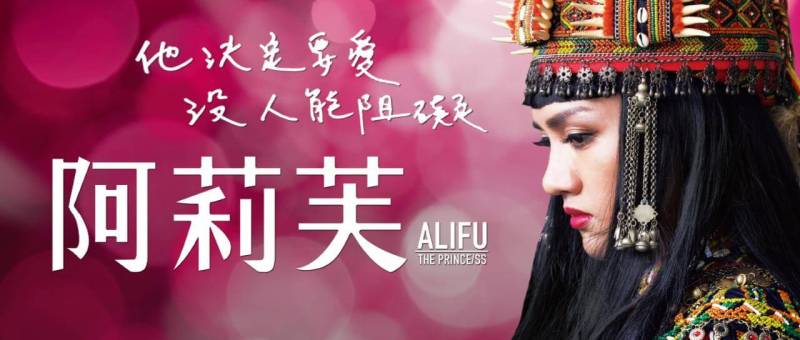
Alifu posterAmong Asian nations, Taiwan has a reputation for being liberal and permissive but if you’re a minority within a minority life is far from easy even if you manage to find support from others in a similar position. So it is for Alifu (Utjung Tjakivalid) – the conflicted soul at the centre of Wang Yu-lin’s nuanced depiction of the road towards self acceptance and actualisation in the face of competing duties and obligations, Alifu, the Prince/ss (阿莉芙, Ālìfú). While Alifu struggles with the demands of being the heir to the Chieftainship of an indigenous tribe with all the rights and obligations that entails, her lesbian roommate struggles with a bad breakup and growing feelings for her transitioning best friend, a drag queen is conflicted about his sexuality, and a transgender bar owner worries for the future of those close to her after she is diagnosed with a terminal illness. Despite the multitude of difficult circumstances, each attempts to deal with their problems in a mature and rational fashion finding love and mutual support from their friends and community even if others sometimes require a little more time.

Alifu, born the son of a tribal chief, identifies as a woman and has been working in a hairdressers in the city to save up for gender reassignment surgery. Her plans for the future are thrown into disarray when she is abruptly called home, walking into a family meeting during which her father (Ara Kimbo) suddenly announces that he is stepping down because of poor health and that his son will be taking over. Though it is possible for a woman to succeed as chief, Alifu has not disclosed her intentions to transition to her traditionally minded father who wears a prominent wooden cross around his neck and does not seem to be particularly understanding of his child’s feelings or emotions, caring only for his appearance in the eyes of the tribe.

Alifu’s transition is subtly revealed in the lengthy opening in which she slowly sheds her “masculine” appearance by discarding her baseball cap, rearranging her hair and stepping into the ladies loos where she puts on colourful lipstick and hoop earrings before making her way to the hairdressers where she earns her living. Meanwhile, her lesbian roommate Pei-Zhen (Chao Yi-Lan) thinks nothing of leaving the house dressed in a way which best makes her feel comfortable only to cause a mini ruckus in the salon when her ex gives her the side-eye for openly flirting with another client apparently after “something special”. After hours, Alifu picks up extra money by doing hair and makeup for the drag acts at a local gay bar where she has also drawn close to the owner, Sherry (Bamboo Chen), who is in a long-term though apparently non-sexual relationship with a former gangster (Wu Pong-fong).

Alifu soon develops a liking for a new drag act at the bar, describing him as somehow “not like the others”. Chris (Cheng Jen-shuo), a local government worker, is a mild mannered sort apparently happily married to a piano teacher (Angie Wang) and living a conventional middle-class life, except that he likes to stay out late on Fridays performing at Sherry’s drag bar. Though it would be a mistake to assume Chris is gay just because he enjoys drag, his “secret life” eventually places a wedge between himself and his wife who is hurt to find out about his alter-ego through a third party. Chris’ wife doesn’t necessarily disapprove of his drag career but is disturbed to discover such a big secret in her married life and, understandably, has a lot of questions about the status of their relationship – something Chris isn’t keen on talking about leading to his wife finally throwing him out. Struggling to reconcile his drag persona with his need for a conventional life, Chris finds himself exiled and unable to integrate himself fully as whole person, torn between his conflicting desires. 

Meanwhile, Alifu’s ever supportive best friend Pei-Zhen has begun to develop feelings for her roommate despite the fact that Alifu has no interest in women and Pei-Zhen is a lesbian with no previous interest in male genitals. Seducing her, Pei-Zhen reassures Alifu that male or female she will always love her – something which becomes a minor theme in arguing for fluidity and self identification over culturally defined notions of gender, echoed in the relationship of Sherry and her partner which seems to be deep and loving but also celibate. Perhaps overly convenient, the union of Alifu and Pei-Zhen does at least provide an opportunity to experience the best of both worlds in allowing Alifu to fulfil her obligations to her tribe while also living an authentic life as a transgender woman.

Warm and filled with a particularly Taiwanese brand of humour, Alifu is a sympathetic exploration of life on the margins, both from the perspectives of the LGBT community and that of the indigenous peoples attempting to preserve their traditional culture whilst acknowledging their place in the modern world. Arriving at an important moment, Wang Yu-lin’s empathetic drama is a celebration of love and equality but most of all of the power of self-acceptance and actualisation in bringing about real social change.


Screened as part of the Chinese Visual Festival 2018.

Original trailer (English subtitles)

Somewhere Beyond the Mist (藍天白雲, Cheung King-wai, 2017)

Somewhere Beyond the Mist posterCheung King-wai, making his narrative feature debut, opens with a quote from Dostoevsky’s The Brothers Karamazov to the effect that people, even bad people, are often far more innocent and pure-hearted than most realise, including we ourselves. The quote, overlaid above the vision of the city at night glowing red like dying furnace, introduces us to the story we are about to hear – one which is dark, too dark perhaps to imagine, but then again all too real. Caught in the twilight half light, Hong Kong is fiery cauldron of hell, yet when the sun rises and the mist rolls in, it’s hard to see what the night made so terrible.

As if to underline the confusion, we begin with a lost old man who is desperately searching either for a way in or a way out. His housekeeper eventually comes to find him and bring him home and we discover he is the father of one of our heroines, Angela (Stephy Tang Lai-yan) – a police detective expecting her first child. Angela’s father, Dr. Ho, is suffering from advanced dementia which is beginning to take its toll on Angela’s home life even if she leaves most of the responsibility to her compassionate husband, Tony.

Meanwhile, the bodies of a middle-aged couple have been discovered at a reservoir. The police set about looking for the couple’s missing daughter, Connie (Rachel Leung Yung-ting), only to find her holed up in the mountains with her best friend Eric (Zeno Koo Ting-hin). Connie reacts with eerie calm when informed of the deaths of her parents, merely repeating that she was already aware before agreeing to accompany the police to the station where she, matter of factly, confesses to having been the one who murdered them.

Cheung’s intention is not to create a murder mystery, Connie freely confesses her crime and isn’t particularly interested in explanations or justifications (though as it turns out, she would have plenty). He is much more interested in the examining the society which made such an “unthinkable” crime possible, exposing the dark heart of an increasingly confused city which finds itself pulled in two directions by various political anxieties.

Back with the original image of the city as a pit of hell, each of our protagonists becomes a link in a circular chain of violence, turning their own feelings of oppression, marginalisation, and despair back on their fellow suffers. Connie, as we find out, comes from an extremely dysfunctional home in which her truck driver father lists small time pimping among his “hobbies”, openly masturbates while watching hardcore Japanese pornography in the family living room only enjoying it more for the thought of taunting his teenage daughter, rapes the family’s disabled mother, and seemingly ignores his grown up son. Catching Connie’s friend Eric hiding in a cupboard in her room, he assumes the pair are up to no good and drags the boy out to viciously beat him with his belt just to remind him who it is that is boss around here, pausing only to remind Connie that “a virgin pussy” is worth more money and if she’s that desperate he can find her a client to satisfy both their needs.

Strangely enough, Eric does not completely object to the beating. He sees it as a sign of validation. Like Connie, Eric is also a lonely, marginalised figure but in his case because he is gay and desperately wants not to be. Being mistaken for Connie’s boyfriend is, in his eyes, a kind of proof of his “manhood” and so it’s a beating he is almost grateful to receive unlike those from his schoolmates who taunt him with broom handles and scream homophobic slurs which only add to his feelings of extreme worthlessness. Eric wanted to be friends with Connie to escape both suspicion and loneliness, but she, in a cutting moment of despair, also uses his insecurity over his sexuality and feelings of inadequacy as a “man” against him to get him to help with her plan to free herself of parental tyranny. Connie hates bullies, but she hates people who don’t stand up to them more. Thus she becomes the gentle defender of another marginalised figure – Jessica, an Indian girl who is targeted because she wears trousers under her school skirt, constantly assailed with slurs about “stinky” curry and various other stereotypical insults that leave her in tears.

Eric points out that his beating at the hands of Connie’s father didn’t bother him because it was “understandable” – a father finds a boy hiding in his daughter’s room and chases him out. The logic is sound, it’s a story you’ve heard before – not like the senseless acts of violence which surround him every day and cannot be explained. Connie’s crime too seems “understandable” given all she’s suffered, a precaution taken to save her from a still more terrible fate she feared might soon come her way. This is the uncomfortable realisation with which Angela is faced during her investigation, forcing her to confront her own difficult relationship with her apparently tyrannical father who made her mother’s life a misery. Angela has to accept that she could easily have been Connie, or Connie her, though she ultimately made the (still taboo) decision to place her father into a home rather than continue to look after him herself. Tube fed and alone, Angela’s father is utterly powerless but however much she wishes she could abandon him she continues to visit even if her resentment is plain. Then again, if a parent breaks the contract first in failing to care for their child in infancy, should the child still be expected to care for them when they are old? Perhaps they owe each other nothing other than civility and an attempt at forgiveness.

Asked why she ran to the mountains, Connie replies that she went to live “the life I deserve”. Dreaming of a world “beyond the mist”, free from the city’s confusion and the constant stream of violence passing from one lonely soul to another, Connie transgressed in order to free herself but has only found greater imprisonment and ongoing mental torment. Beautifully photographed, Cheung’s narrative debut is a bleak and gloomy affair but somehow maintains its belief in a better place Somewhere Beyond the Mist even if it continues to elude us.


Screened as part of the Chinese Visual Festival 2018.

Original trailer (English subtitles)

Soundless Wind Chime (無聲風鈴, Kit Hung, 2009)

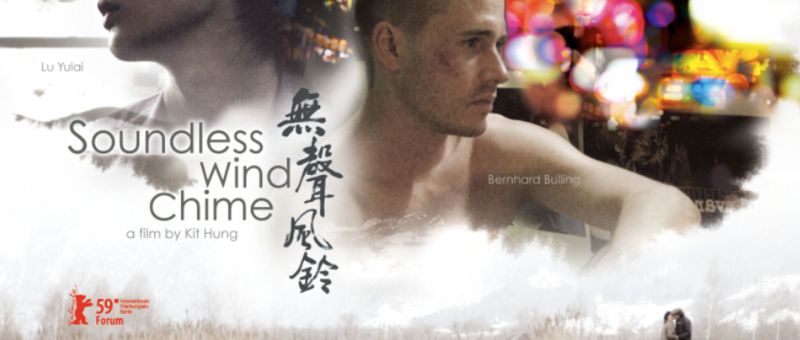
Soundless Wind Chime posterTwo transients find love in the crowded streets of Hong Kong, only to lose it again and long for its return. Deliberately obscure, Kit Hung’s debut Soundless Wind Chime (無聲風鈴, Wúshēng Fēng Líng) is an elegy for lost love, a poetic meditation on the power of memory and a treatise on the art of letting go. Though the lovers manage to construct a world for themselves shielded from the external chaos, its shell gradually fractures under the pressure of real world concerns until tragedy finally intervenes and shatters it forever.

Ricky (Lu Yulai), a mainlander recently arrived in Hong Kong, lives with an aunt (Wella Zhang) who makes a living through prostitution, while he makes ends meet as a delivery boy at neighbourhood eatery. One day, he pauses on the job to watch a foreign juggler (Hannes Lindenblatt) at which point his wallet is stolen by a foreign pickpocket who we later learn to be a German speaking Swiss man named Pascal (Bernhard Bulling). Pascal is currently in an abusive relationship with the juggler whose act is a set up to attract a crowd so that Pascal can rob the captivated spectators. After being beaten up and then brutally raped by his boyfriend, Pascal ups and leaves, eking out a living through juggling on the streets. Arriving at Ricky’s restaurant, he gives him his wallet (and ID card) back and the two strike up a friendship that soon becomes more, living together first at Ricky’s aunt’s and then getting their own place where they can truly be themselves.

To begin with the relationship is a rather happy and open one. Though Ricky decides to leave his aunt’s place immediately after she figures out that he is gay and in a relationship with Pascal, she does not disapprove of his sexuality and only stops to warn him not to invite his ailing mother to Hong Kong because she doesn’t know what the fallout will be from realising her sister is a prostitute and her son is gay all at the same time. Likewise, the lively ladies at the restaurant all seem fairly accepting (or perhaps just oblivious) of Ricky’s relationship with Pascal, impressed by his juggling skill and including him in their after hours mahjong games. The young couple do however have their differences, notably in Pascal’s self destructive streak which sends him back into Hong Kong’s gay nightlife scene while Ricky would rather just spend time home alone together.

The disjointed, non-linear narrative opens in the middle with Ricky making his way to Switzerland in search of Pascal, in a spiritual more than literal sense. Whilst there he runs into another man, Ueli, who looks exactly like Pascal even if he is nothing like him in spirit. The film’s title is inspired by the Chinese belief that a soul lingers after it leaves the body, attaching itself to an animal in order to stay longer and make its last goodbyes. Traditionally, a wind chime is though to reveal the presence of spirits, and it is this Ricky has come looking for as the wind chime outside Ueli’s antique shop gleefully trembles as if it were pleased to see him.

Ricky’s memories spiral away from him as snow covered Switzerland echoes sunny Hong Kong, each thought and action recalling some part of his life with Pascal while he grows closer to the wounded, grieving Ueli whom he believes, on some level, to be Pascal returned to him in another form. Later, Hung shifts the action to the Mainland where Ricky has returned to look after his dying mother, working as a taxi driver to make ends meet. Unable to find Pascal, uncertain whether his soul has flown to Hong Kong where they made their home or the place where he was born, Ricky has himself returned to source and prompted Ueli to make his journey in reverse, bringing him news of Pascal but also perhaps promising an end rather than a beginning.

Hung wears his influences on his sleeves – his style owes much to Wong Kai-Wai but more particularly to Tsai Ming-Liang as his frequent forays into surrealistic musical interludes make plain. Yet his narrative is confused and overly impressionistic, withholding essential pieces of information which would make sense of the more obscure elements such as the lost luggage receipt Ricky takes with him to Switzerland and the contents of the bag he ultimately obtains. Deeply melancholic and filled with a wistful sense of longing – the soundless wind chime of the title lying silent yet attentive, Hung’s dreamlike debut is a strangely affecting exploration of grief and transience as his hero learns how to live after love, abandoning his pain to realms of nostalgia and rediscovering the peaceful emptiness of ordinary silence.


Screened as part of the Chinese Visual Festival 2018.

Original trailer (English subtitles)

Dear Ex (誰先愛上他的, Mag Hsu & Chih-yen Hsu, 2018)

A2oCsHnTaiwan is often thought to be among the most liberal of Asian nations and is one of the few to have legislated for registration of same sex partnerships. This is, however, not to say that there is no homophobia or that it is possible for anyone and everyone to be free to live the way they choose. If Dear Ex (誰先愛上他的, Shuí Xiān Ai Shàng Tā de) is to be believed, there is still quite a long way to go in terms of total acceptance though what the film is really interested in is the emotional fall out from lingering stigma and the various relationships which end up being created because of it.

Teenager Song Chengxi (Joseph Huang) has just lost his father. Or rather, he has just lost him again. Despite what his mother told him, Chengxi already knew that his father, Zhengyuan (Spark Chen), had left the family to be with another man, but the problem now is that Chengxi’s dad has named his lover, Jay (Roy Chiu), as the sole beneficiary for his life insurance policy. Chengxi’s mother Sanlian (Hsieh Ying-xuan) is not very happy about this and is determined to get her hands on an inheritance she believes “rightfully” belongs to her and to her son and which she wants to use to send Chengxi to study abroad so he can become “respectable” and “successful”. Fed up with his nagging mother, Chengxi decamps and, bizarrely enough, moves in with Jay who has barely any opportunity to refuse, eventually brokering something like a rapprochement between the “other woman” and the “other man”.

Though Sanlian emerges as the least sympathetic of the three central characters, she is also the one who has suffered most because of her husband’s decision to opt for a sham marriage in order to become a “normal man”. Having found love with Jay 17 years previously, Zhengyuan eventually left him rather than attempt to live an authentic life as a gay man. Thinking that he needed to force himself to be “normal” he married Sanlian and had a son, but the marriage was always distant and unhappy. Sanlian at her youngest seems shy and girlish, cheerfully helping the nervous Zhengyuan locate a missing parcel, while the version we see of her now is shrewish and embittered, humiliated by her husband’s abandonment and distraught in wondering if the entirety of her married life has been a lie and her husband never loved her at all.

In this respect the intense feelings of shame and resentment are perhaps no different for anyone in a relationship with an adulterous spouse, but for Sanlian they run deeper precisely because Jay is a man which leaves her feeling even more at fault and prone to lashing out. Sanlian is fond of referring to Jay as the “mistress” to which he points out, amusingly recasting himself as a “manstress”, that really she has been the unwelcome third wheel in the relationship between the two men.

Even if her anger is largely down to personal injury, Sanlian’s resentment contains an inescapable kernel of homophobia. Zhengyuan left his lover and got married because because he was too ashamed/afraid to go on living with the man he loved, but his decision ruined the life of the woman he made his wife only to selfishly abandon in order to live his last days as his authentic self safe in the knowledge that society could hardly touch him now. Sanlian has tried her best to turn Chengxi against Jay, not wanting him to become “corrupted” and insisting that Jay is a “bad man” who “stole” his father away. Getting to know him, however, and realising that Jay had cared for his dying father all alone, Chengxi starts to wonder why it is that Jay must be such a “bad” man, especially when he realises that he didn’t even know about the life insurance policy which puts his mother’s gold-digging hypothesis right out of the window.

Arguing with his wife while trying to break the news to her of his leaving, Zhengyuan poignantly reminds her that she doesn’t have the right to define the word “family”. Yet when Jay suggests telling his mother the truth about their relationship, Zhengyuan advises him not to because it would only make her “sad”. Jay wonders why anyone would be “sad” to hear one person tell another that they love them, as does Zhengyuan though he shrugs and replies that that’s just the way it is. Later Sanlian considers trying to blackmail Jay by threatening to out him to his mother whom she assumes will be heartbroken and disgusted despite Jay’s assertion that his mother loves him very much and will probably get over it (though he has evidently not decided to test his hypothesis just yet). Partly out of guilt, and finding a sense of empathy in Jay’s deep grief over the death of a man who regarded him as a husband, Sanlian starts to come around and begins to accept his place in the life of the man she married – a man they both loved and have lost.

Told with warmth and whimsy and filled with cute graphics seemingly lifted from Chengxi’s exercise book, Dear Ex is a timely plea for tolerance and understanding believing each of those things is possible only when one learns to put aside one’s own pain to consider someone else’s, coming to realise they are often the same.


Screened at the 20th Udine Far East Film Festival.

Fish and Elephant (今年夏天, Li Yu, 2001)

513cslBr5wL

The first narrative feature from former documentarian and TV presenter Li Yu, Fish and Elephant (今年夏天, Jīn Nián Xià Tiān) is touted as the first film from mainland China to explicitly deal with lesbian life in modern Beijing. Necessarily shot under the radar to get around China’s strict censorship requirements, the film almost disappeared after “getting lost” on return from the Venice Film Festival (where a mishap with missing reels apparently led to a less than stellar reception though Li did eventually pick up an award) but went on to feature in a number of international festivals even if not quite welcomed at home. Imperfect and somewhat clumsy in execution, Fish and Elephant is nevertheless as whimsical as its title might suggest if only in its ironically abstracted need for detachment.

Xiaoqun is approaching 30 and unmarried. Despite her mother’s pleas and the needling of relatives Xiaoqun has no desire to marry. She supports herself well enough as an elephant keeper at the zoo and lives alone in a small apartment. A desire for independence is not the only reason Xiaoqun chooses to remain single – she is gay. Unable to state this fact openly, Xiaoqun is often forced to attend various blind dates set up by her mother who emotionally blackmails her by bursting into tears on the phone. Nevertheless, she eventually develops a flirtation with a young woman, Xiaoling, who owns her own clothing store at the market. Before long the women have moved in together and established an easy domesticity only for Xiaoqun’s mother to turn up unannounced determined to see her daughter wed. As if that weren’t enough, Xiaoqun’s long lost ex, Junjun, also arrives without warning apparently on the run from the police for “bank robbing”.

Perhaps because of the need to shoot covertly, Li’s script is structurally threadbare involving several large narrative jumps but the quality of unseen incompleteness plays into the film’s central theme in that the lives of women like Xiaoqun and Xiaoling are often invisible and hidden from view. We observe the two women’s courtship obliquely and in stages as they flirt (tentatively), wait for each other, are frustrated by exes, and finally come to a kind of agreement framed against the turquoise of of Xiaoqun’s bedroom wall which makes the pair look uncomfortably like the goldfish trapped inside her aquarium. Even this is unspoken and uncertain, hands tentatively grasped in trying to confirm that the situation has been read correctly until it is quite literally sealed with a kiss.

Xiaoqun, at least, is not so afraid to tell people what she is, only they never seem to believe her. Her uncle, berating her for turning down all the suitors he finds and reminding her that it’s the “proper thing” for women to marry and bear children, asks her what the problem is, to which Xiaoqun replies that she’s told him plenty of times before – she’s “no interest in men”. The uncle cannot process this information and offers to find a therapist to help with Xiaoqun’s supposed “issues”. Similarly, she decides to tell it straight to one of her dates – “I don’t like men, I like women”, but he refuses to listen. It seems he’s familiar with the concept, but doesn’t really believe in it and assumes Xiaoqun is trying to skip out on the date without giving him a proper chance by saying something outrageous.

Each time Xiaoqun calmly explains her life choices, everyone just ignores her. Either they simply don’t understand or refuse to accept that her sexuality is a good enough “excuse” for refusing to conform to the social order. Not until she finally attempts to come out to her mother does Xiaoqun actually say “I am gay” and then only very quickly followed directly by an explicit explanation of what she means. Unfortunately her mother still can’t quite get it, the language and cultural gap too vast to bridge. Like the young person’s pop song she’s always listening to, it’s not that she doesn’t understand, it’s just that the world is moving so fast.   

Eventually Xiaoqun’s mother starts to come round and considers going against the social order by marrying again herself despite her supposedly inappropriate age. Marriage, however, seems an unhappy business all round and none of the men we are introduced to are particularly appealing. The men in Xiaoling’s shop bark at their girlfriends and criticise the slutty clothes, or try to harass Xiaoling into dropping the price while her boyfriend hovers in the background and places a territorial hand on her shoulder almost as if he knew why she just gave a quite massive discount on an expensive shirt to the woman currently trying it on for size. Xiaoqun’s mother is divorced, her father having left the family (and an apparently unhappy marriage) for another woman. Yet everyone seems intent on railroading the two women into this culturally demanded alleyway of misery.

For the most part, Xiaoqun and Xiaoling are content to simply ignore the world around them and live peacefully together like two fish in a bowl. Conspiratorially linking hands under the table as Xiaoqun’s mum reels off her marriage spiel and leaning in close to light one cigarette from another, they perhaps take pleasure in mocking the social order directly under her nose while worrying what the fall out might be should the truth be discovered. The relationship is threatened not particularly by the marriage plots, but by the presence of Junjun who places a wedge between the verbally uncommunicative lovers and another burden of secrecy on the already burdened Xiaoqun.

Li concludes by splitting the narrative into its three component strands, opting for a perhaps unwise slide into absurdity as Junjun embarks on a last stand though it does provide an opportunity for another (accidentally?) misogynistic/homophobic remark from a police officer. The film ends on a wedding, at which Xiaoqun and Xiaoling are conspicuously absent despite being expected and as a couple. Perhaps they are just “busy” having recently recovered from their momentary romantic drama, but their failure to appear also reinforces their committed isolation in which they are content (for good or ill) to hide themselves away, existing only for each other.


US release trailer (English subtitles, NSFW)

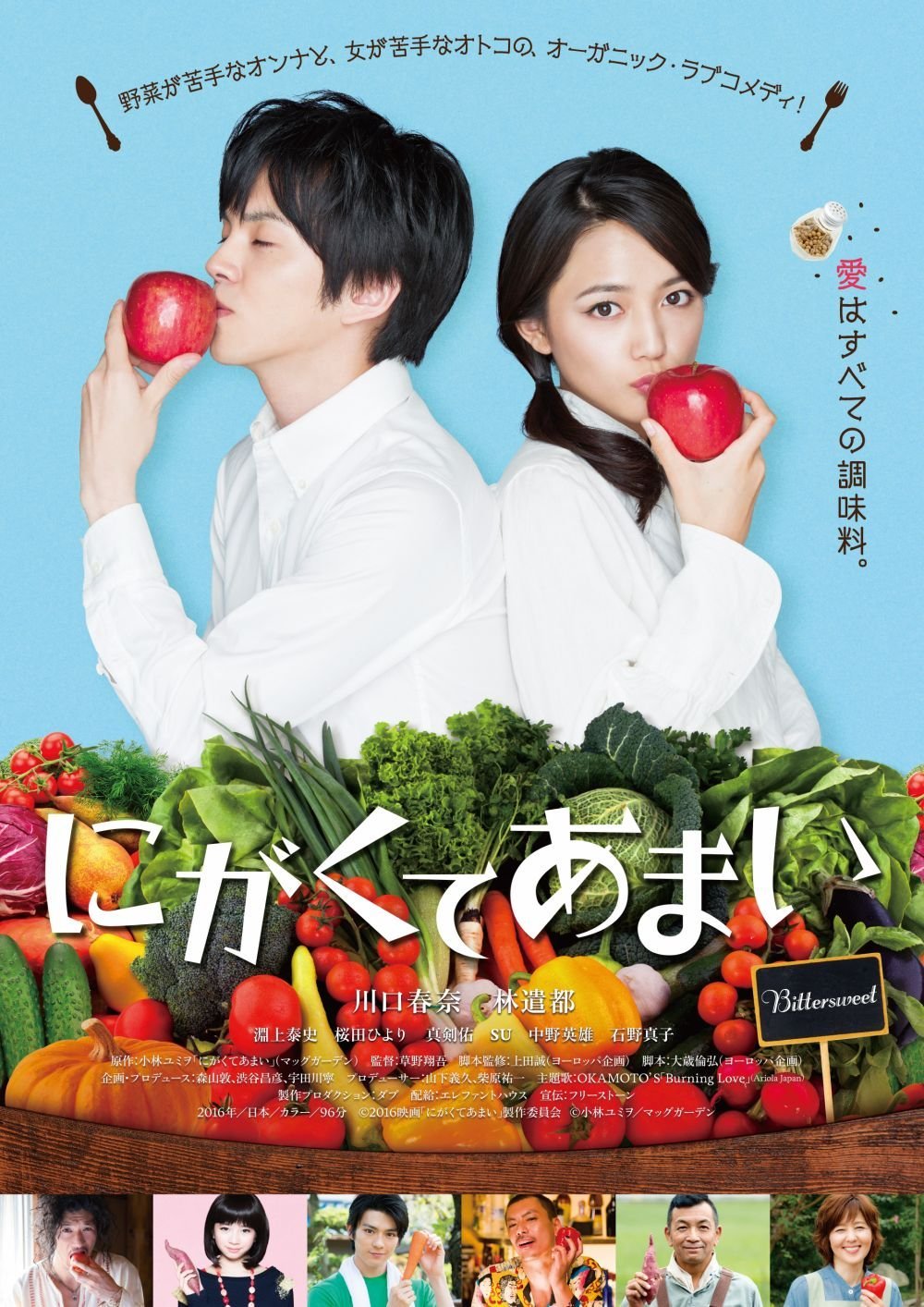
Bittersweet (にがくてあまい, Shogo Kusano, 2016)

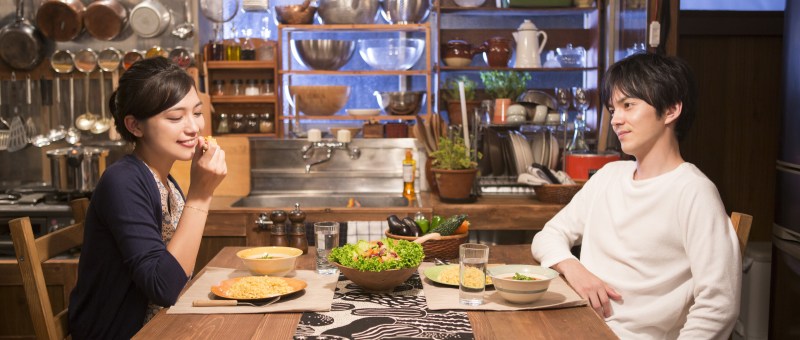
bittersweet poster“Vegetarian Men” became an unlikely buzzword in Japanese pop culture a few years ago. Coined by a confused older generation to describe a perceived decrease in “manliness” among young, urban males who had apparently lost interest in women and gained an interest in personal appearance as an indicator of social status, the term feeds into a series of social preoccupations from the declining birthrate and changing demographics to familial breakdown and economic stagnation. In an odd way, Bittersweet (にがくてあまい, Nigakute Amai) backs into this particular alley by adding an extra dimension in the story of a somewhat “manly” career woman and her non-romance with a gay vegetarian she meets by chance who eventually helps her to escape her arrested adolescence and progress towards a more conventional adulthood.

Maki (Haruna Kawaguchi), an advertising agency employee and workaholic career woman in her late ‘20s, has a philosophical objection to the existence of vegetables. Unable to cook and generally disinterested in food (or house work, clothes, makeup etc), Maki sucks on jelly packs at her desk so she can keep on typing, sometimes treating herself to a store bought bento. She’s told her “friends” at work that she’ll shortly be moving in with a boyfriend, but in reality she’s recently broken up with someone and is being evicted from her flat. Things are looking up when she’s put in charge of a commercial but the commercial turns out to be for goya bitter melon which is both a vegetable and not exactly an easy sell.

Fast forward to a bar where Maki is a regular. After getting blind drunk and going off on an anti-vegetable rant, Maki wakes up at home with Nagisa (Kento Hayashi) – a guy she quite liked the look of the previous night but went off when she noticed he was carrying a giant box of veggies, making her a nutritious breakfast which she then refuses to eat. Paranoid that Nagisa took advantage of her in the night, Maki goes through his bag and discovers that he’s a high school art teacher. Challenging him about what exactly happened, he is forced to tell her that she’s not his type. Nagisa is gay and brought the blackout drunk Maki back to her flat on the instructions of his friend, the gay bartender at Maki’s local. Maki, classy as ever, threatens to blackmail Nagisa by outing him at school unless he agrees to move in with her.

Thankfully, Bittersweet drops the romance angle relatively quickly as Maki begins to grow up and accepts that there’s no point chasing a man who will never be interested in her. Nagisa, originally adopting an almost maternal attitude towards the sullen Maki, later becomes something like a big brother figure, gently coaxing his friend towards self realisation through a series of well cooked meals and hard won life advice. Though there is a degree of stereotyping in his refined, elegant personality, cleanliness, and cooking ability, Nagisa’s sexuality is never much of an issue outside of the obvious fact that he is not “out” at work and that it may be impossible for him to be so. Despite Maki’s original consternation she gets over the shock of Nagisa’s confession fairly quickly and when he eventually meets her parents, they too react with relative positivity (Maki’s mum even slips a copy of a BL manga into her next care package).

Somewhat bizarrely the central drama revolves around Maki’s hatred of vegetables which stems back to a stubborn resentment of her parents’ unconventionality. In combatting her parents’ decision to abandon the world of corporate consumerism, Maki has become a “career woman”, eschewing the feminine arts in favour of the male drive. Where Bittersweet was perhaps progressive in its acceptance of Nagisa’s sexuality, it is less so with Maki’s seeming “maleness” – her drinking, meat eating, and workaholic ambition all painted as aspects of her life which are in need of correction. Though some of her habits are undoubtedly unhealthy – she could definitely benefit from better nutrition and scaling back on the binge drinking, Bittersweet is intent on “restoring” Maki to the cuteness befitting the heroine of a shojo manga rather than allowing her to become a confident modern woman who can have both a career and a love interest with little conflict between the two.

Through meeting Nagisa Maki is able to get over her vegetable hate and repair her strained relationship with her comparatively more down to earth parents while also realising she doesn’t necessarily want the life of empty consumerism symbolised by her relationship with her status obsessed former boyfriend. Meanwhile Nagisa has his own problems in dealing with a past trauma which his new found, quasi-familial relationship with Maki is the key to addressing. A pleasant surprise, Bittersweet is not the awkward romance the synopsis hints at, but a warm and gentle coming of age story in which vegetarian cookery, mutual respect, and a lot of patience, allow two youngsters to become unstuck and find in each other the strength they needed to finally move forward into a more promising future.


Original trailer (English subtitles)

Of Love & Law (愛と法, Hikaru Toda, 2017)

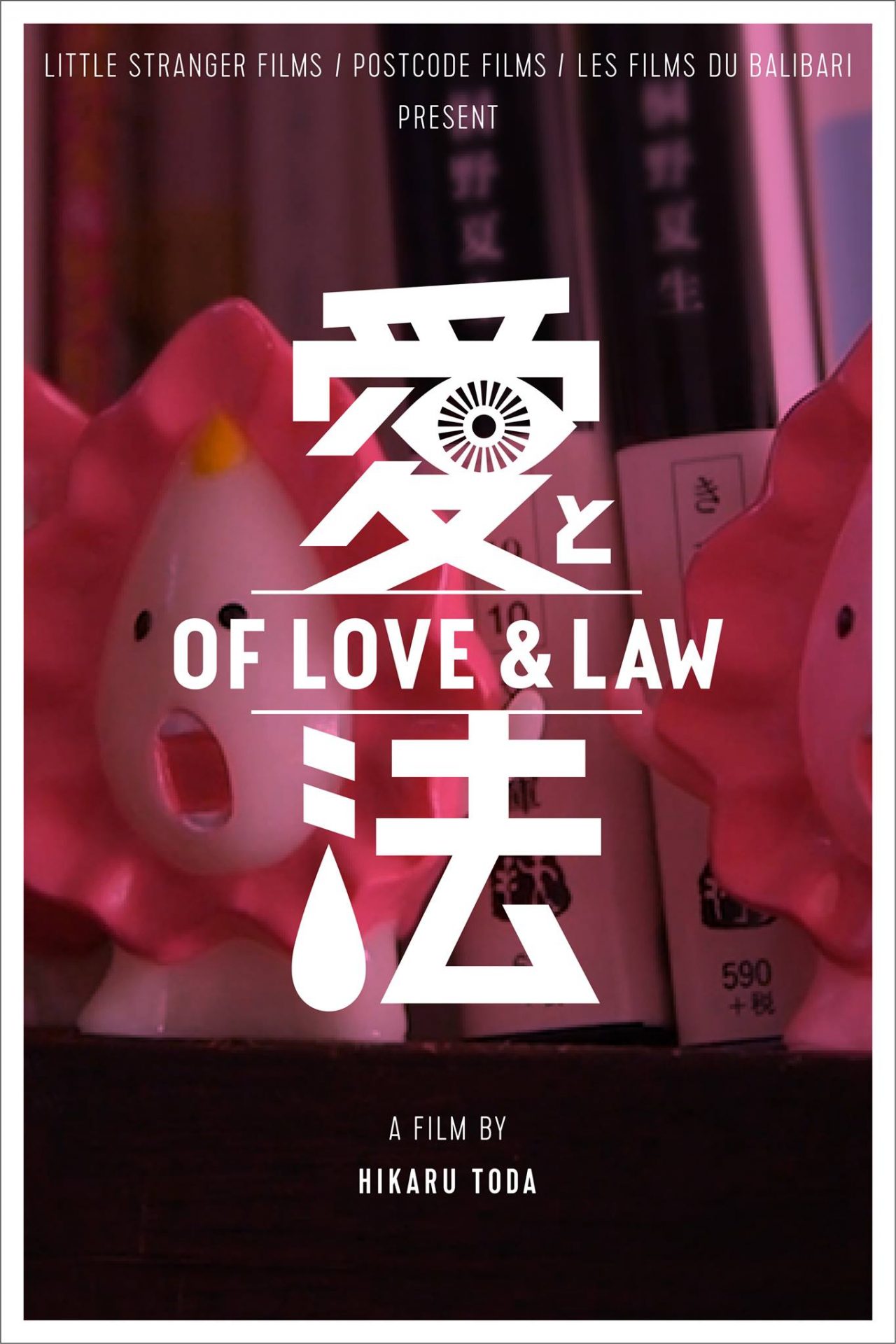
of love and law posterIn Japan the nail which sticks out is hammered down. Conformist societies promise mutual support, but all too often only when it suits the collective – those not deemed part of the club are wilfully left to fend for themselves with the dangled promise of readmission if one promises to reform and abide by the rules. We first met the couple at the centre of Hikaru Toda’s Of Love & Law in her previous documentary, Love Hotel, which documented their struggles with discrimination in frequently being turned away by establishments who did not wish to rent a room to two men. A same sex married couple in Japan’s second city of Osaka, Kazu and Fumi run their own law firm and operate under the mission statement of representing those who often find themselves without a voice in a culture which favours silence.

Opening at a local Pride event, the camera attempts to capture some talking heads but no one will bite. Asked for comments, the visitors each refuse to show their faces, revealing that they aren’t fully out, fearing that it might cause problems for them at work, or just embarrassed to go on the record about something so taboo. Though the law practice is not limited to representing LGBT issues, they are clearly a key concern to Fumi and Kazu who spend their “free” time engaging in outreach projects trying to foster a little more education and understanding of sexual minorities. Kazu brings this home when he tells his own coming out story in which his stunned mother exclaimed that she’d never heard of anything like this and therefore could not understand it. The problem wasn’t prejudice, it was ignorance mixed with fear.

Ignorance mixed with fear could equally well describe most of the cases brought against Kazu and Fumi’s clients. The protagonist of the second strand – artist and mangaka Rokudenashiko whose legal troubles even made the foreign press, attributes many of these issues to an inability to “read the air” or aquedately understand the unspoken rules of society and then silently abide by them. The law firm makes a point of defending those who have chosen to fly in the face of social convention, flying a flag for the freedom of choice in a society which often deliberately suppresses it.

The freedom of choice is certainly a key issue for the teacher suing the Osakan school that fired her for refusing to stand for the national anthem. Arguing that standing when one is forced to stand is hardly a declaration of patriotism and fearing the lurch to the right which has made even implicit indifference to the Imperial family a hot button issue, the teacher puts her foot down but finds that few will listen. Similarly, Rokudenashiko finds herself arrested for obscenity regarding her vagina themed artwork while the court undermines its own argument by accidentally proving that her work has socio-political merit.

Yet Rokudenashiko and the teacher have each, in a sense, made a firm decision to challenge the intransigence of their society, hoping to prevent a further decline even if not overly hopeful of improvement. Other clients on the roster include a fair few who are accidentally undocumented through no fault of their own thanks to Japan’s arcane and idiosyncratic legal system which makes it difficult to register births of children born out of wedlock or in difficult family circumstances meaning that youngsters sometimes grow up without the proper papers leading to problems with accessing education, employment, healthcare and welfare provisions. Getting someone a birth certificate who doesn’t currently “exist” can prove a taxing ordeal, especially as government officials often regard children born to “immoral” women as “unworthy” of care or attention.

Getting a call from the mother of a victim, Fumi is shocked when she makes a point of enquiring about the nationality of the perpetrator. He is unsurprised but disappointed in witnessing the various ways one oppressed person (both the victim and plaintiff are from impoverished, single parent backgrounds) can turn their oppression back on others as an odd kind of social revenge. Luckily, however, there are good people everywhere such as the fine young man Fumi and Kazu end up temporarily fostering after his care home is unexpectedly closed down. Kazuma accepts their relationship without a second thought, enjoys learning to cook from Fumi and blends right into Kazu’s extended family who each seem as warm and accepting as the couple themselves. Family is not about a register, it’s having a place to go where they’ll always take you in. Fumi doesn’t trust society because society shirks its responsibilities, but thankfully there are those who know better and continue on in hope tempered with patience.


Screened at BFI Flare 2018.

Malila: The Farewell Flower (มะลิลา, Anucha Boonyawatana, 2017)

Malila posterAnucha Boonyawatana’s second feature, Malila: The Farewell Flower (มะลิลา), opens with a quotation from a 19th century poem. The poem laments that even a Baisri painstakingly created to honour the gods will eventually be cast away once it has served its purpose. No longer divine, its soul departed, the ornament is just another thing to be disposed of. Like the beautiful Baisri, two men’s souls will briefly intertwine only for the flowers of their love to wither on the vine, fading away with the great work still incomplete. This incompleteness, the lingering sense of absence and irreconcilable longing, propel the one left behind onto a spiritual journey hoping to discover if the answers to his need lie within or are not to be found at all.

Shane (Sukollawat Kanarot), the owner of a jasmine plantation, has recently begun to rebuild his life following a period of heavy drinking during which his wife left him and his young daughter was killed by a python in the jungle. Reuniting with his former lover, Pich (Anuchit Sapanpong), Shane is distraught to find out that he is terminally ill with lung cancer and has decided to give up on conventional medicine and devote the rest of his life doing the things that make him happy. Pich’s one form of “treatment” is in his constant making and dispatching of “Baisri” – ornaments constructed from leaves and flowers for ceremonial occasions which, painstakingly created, must be sent away on the river after they have fulfilled their purpose.

Jasmine flowers are, as Pich remarks, too weak – they wither before the Baisri is completed. Though the two men are able to rekindle their romance, their time is limited. Shane contemplates becoming a monk in the hope that his good karma can be transferred to Pich but it is not to be. Alone, he sets out on a spiritual journey guided by another monk hoping to encounter the ghosts of himself and of his loves to absolve himself of his guilt and loneliness.

Set against the beautiful Thai landscape, Malila is a tale of fading flowers and eternal regrets. The art of Baisri requires intense focus and dedication in order to repurpose and reorder nature into something essentially manmade but beautiful. Later, during his quest, Shane will be met with a terrifying though no less intense experience when his guide and fellow monk instructs him in the art of corpse meditation. The sight of the body, putrid and infested with hungry maggots busily going about their business, presents a strong contrast with the otherwise idyllic scenery and forces a more literal contemplation of the process of decay as the human form dissolves leaving only memory and a ghost of past emotion in its place.

Ironically, or perhaps not, a Baisri is intended to mark a new beginning – a “farewell” on an onward journey. Shane sets off on a spiritual quest, suffering nobly in the forests with their frequent rainstorms and learning to be in the moment in the company of the comparatively better experienced monk who guides him, a former soldier now on the spiritual path. His search is internal but illuminated by the world around him and his gradually increasing connection with it.

Eventually transcending this world for another, Shane begins to find his answers and finally cleanses himself of his loss and suffering. Mixing lyrical poetry with beautifully photographed naturalism, Anucha Boonyawatana tells a painful tale of love lost and found, hearts broken and repaired, and finally of acceptance both of one’s self and of the transience of all things. Malila: The Farewell Flower is a parting gift to a departing love, filled with sorrow and regret but also with beauty even in decay.


Screened at BFI Flare 2018.

Original trailer (English subtitles)