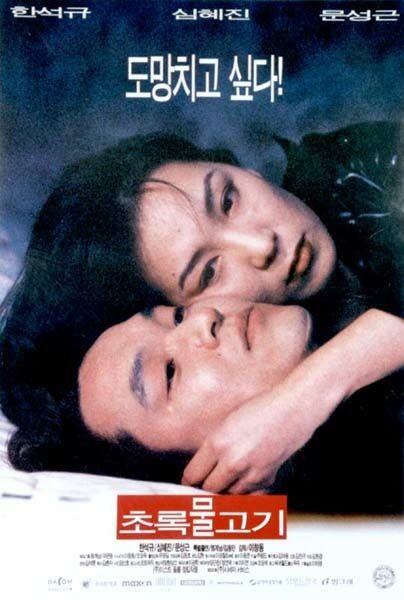
Green Fish (초록 물고기, Lee Chang-dong, 1997)

Green Fish poster

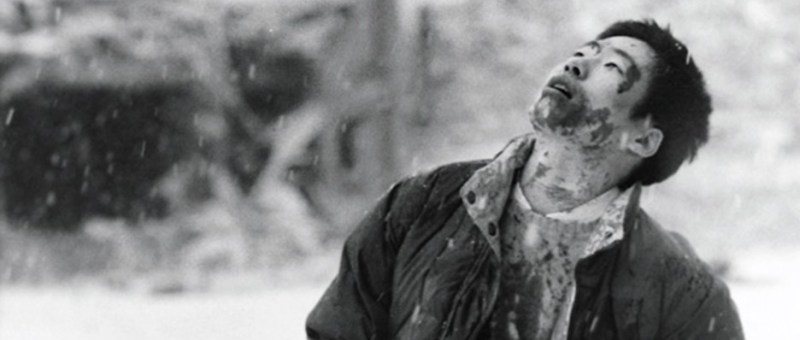
You can never go home again. Lee Chang-dong’s debut, Green Fish (초록 물고기, Chorok Mulgogi), is as much a chronicle of his rapidly modernising nation’s gradual loss of innocence as it is that of its melancholy hero, Makdong (Han Suk-kyu), whose simple dream of family harmony is destroyed by the forces of desire and oppression. Perpetually someone’s little brother, Makdong struggles but finds no schoolyard protectors in his ongoing quest for leadership and direction from someone or something external to himself. All he finds is a gradual descent into darkness and criminality in which misplaced loyalties eventually carry the heaviest of penalties.

Returning home from his mandatory military service, still dressed in his warm weather combats, Makdong inhales a taste of freedom by hanging out of the open train doorway. He notices a woman doing the same thing a few doors down. Her red scarf floats away on the breeze and hits Makdong in the face. Later he notices the same woman being hassled by a gang of louts and decides to intervene. Despite his military uniform, Makdong is no great warrior and he’s quickly beaten up and humiliated, retreating to the bathroom where he soaks the woman’s scarf in water and puts it over his bloodied face, inhaling her scent through the fabric as it somehow expresses his otherwise repressed scream.

Vowing revenge for his humiliation Makdong jumps off the train and attacks the louts with a heavy stone trophy, but he mistimes his attack and ends up running after the departing carriages before being forced to abandon all hope of catching up and concentrate on evading the louts who are once again on his tail. On his arrival home, Makdong discovers nothing is as he left it. His family is scattered – father dead, mother going mad, one brother married and a policeman though apparently also a drunk, other brother a wideboy punk, little sister working as a hostess, where there were fields now there are apartment blocks as far as the eye can see, only his older brother with developmental disabilities remains the same. Unable to find work, Makdong chases the scent of the woman on the train, eventually encountering her in the city. Miae (Shim Hye-jin) is a nightclub singer involved with petty gangster Bae Tae-gon (Moon Sung-keun). Remaining close to her, Makdong finds himself drawn ever further into Maie’s self destructive spiral of desire and darkness.

Makdong, whose name literally means “youngest sibling”, is perpetually looking for a family. Turned away from the chaos of his childhood home, he looks for it in the traditional place of the dispossessed male – the gang. Desperate to prove himself and be accepted, Makdong is willing to undergo any kind of pain and humiliation. Given his first job, he sings a snatch of the karaoke song playing in the bar about a prodigal son who disappoints his parents, looks himself in the mirror then hesitates before slamming the stall door shut across his fingers, leaving them swollen and bloodied. He then picks a fight with a rival gangster to give Bae Tae-gon an excuse to settle a score. Bae, solicitous, expresses irritation with Makdong’s act of self-harm but also gives him a leg up into the organisation, something which does not prove universally popular with the already established crew.

Bae’s decision to make Makdong his latest “little brother” (a sort of pun on his name and Bae’s position as the gang’s “big brother”), is mirrored in Bae’s own turbulent relationship with his superior/rival, Yang-gil (Myung Gye-nam). Yang-gil, setting up shop right across from Bae’s establishment, describes Bae disparagingly as a scrappy puppy dog biting at his master’s heels. Much as he feels humiliated by Yang-gil’s authoritative disdain, he refuses to move against him, ordering his guys to back off even though it makes him look weak and diminishes him in the eyes of his followers. Just as Makdong has placed his faith in Bae, Bae’s is already installed in Yang-gil, something which Makdong tragically fails to understand.

Makdong’s loyalty to Bae also presents a conflict in his desire for Miae. A much stereotyped gangster’s moll, Miae is the melancholy nightclub singer familiar from classic noir. Her world is just as ruined and broken as Makdong’s. She wants to leave Bae and his life of violent chaos in which she’s often pimped out to serve his interests, but she’s looking for someone to help her, just as Makdong is looking for someone to defend him. A long train journey brings the pair together in a moment of innocent tenderness, but presented with a choice Makdong choses Bae and his new world of male chivalry over his original act of white knight rescue which brought him to Miae’s attention in the first place. Later he makes another, more final choice, burning Miae’s scarf which he’d been carrying like a talisman all along. The flames reflected in his sunglasses give him eyes of fire, but behind the frames there are tears too as he bids goodbye to one dream in the mistaken belief of buying himself another.

Facing his end, Makdong rings home and reminisces about a story of idealised childhood innocence in which he spent a day at the river with his siblings, trying to catch the green fish of the title from under a railway bridge. Earlier on the family had another picnic in a similar spot which quickly degenerated into a chaotic family spat with the trains passing ominously behind them. The world that Makdong wants is already fading, he is, in some sense, already its ghost and the future has no place for him. His dreams were small – a modest family restaurant, and a return to the warmth and security he felt as a child surrounded by unconditional love. His family, however, no longer support him, he is alone and unloved. The world has moved past him like a train leaving the station, Makdong runs but he can’t catch up. The future belongs to those who can move fast enough to adapt to the new reality of modern Korean life, not to old romantics like Makdong who still believe in archaic ideals of family and brotherhood. Yet, there is something of that old world remaining in the posthumous fulfilment of Makdong’s only wish, even if he himself is not permitted to witness it.


Screened at London Korean Film Festival 2017.

Cabaret scene (no subtitles)

A Bittersweet Life (달콤한 인생, Kim Jee-woon, 2005)

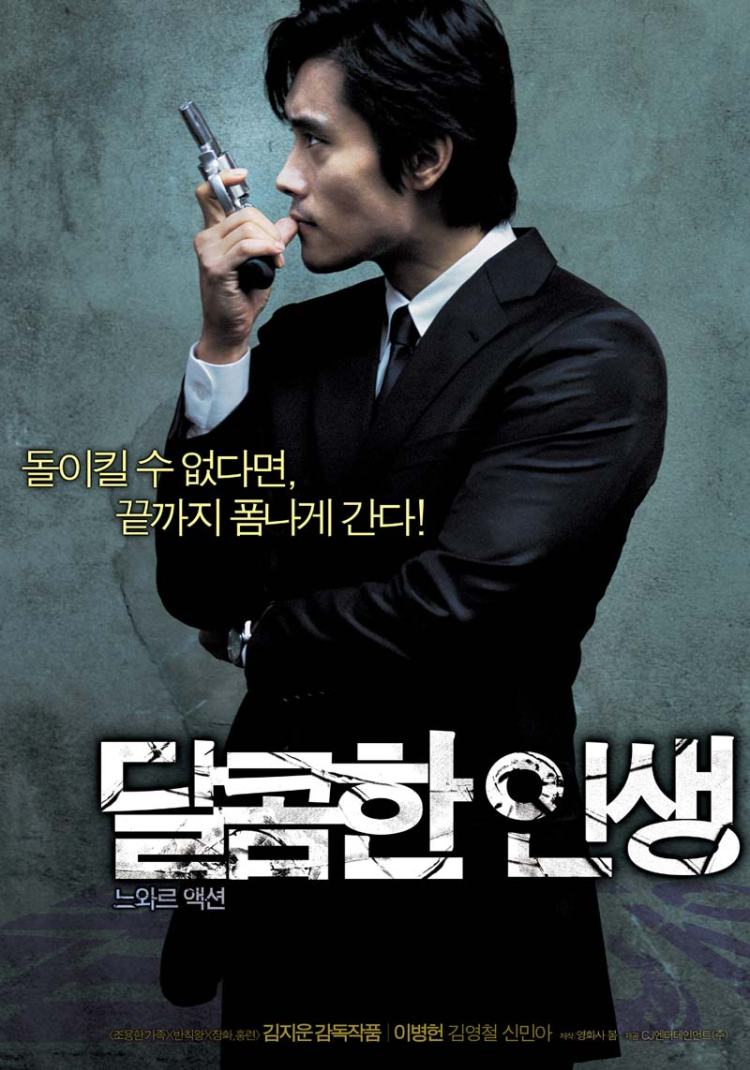
bitterweet life posterAs Boss Kang (Kim Young-chul) tells the hero of Kim Jee-woon’s A Bittersweet Life (달콤한 인생, Dalkomhan Insaeng), no matter how well things are going, it only takes one mistake to make it all float away. Like any good film noir, the forces which conspire to ruin the quiet, orderly life of cooler than thou gangster Sun-woo (Lee Byung-hun) are those of desire as they come in conflict with codes of loyalty and decency. Sun-woo, like many a lonely hitman before him, finally wakes up to the emptiness of his life only to find no point of escape except the one he has often provided for others in precisely the same situation.

Smartly suited, Sun-woo is the trusted manager of the casino bar, Dolce Vita. Taken away from his elegant dessert in the upstairs restaurant, Sun-woo deals with a group of rowdy customers in true gangster fashion by launching in with a series of jump kicks and quickly thrown punches that reveal just why it is Sun-woo rules the roost. Sun-woo’s boss, Kang, has a special mission for his most trusted minion – keep an eye on his much younger girlfriend, Hee-soo (Shin Min-a), while he travels to Shanghai for three days. Kang thinks Hee-soo is having an affair. If she is, Sun-woo’s options are either to call Kang right away or take affirmative action on his own initiative.

Sun-woo investigates, but much to his surprise finds himself taken with Hee-soo. She is indeed having an affair, something which Sun-woo tries to ignore but finally has to be dealt with. A sudden pang of sympathy stops him from contacting Kang or pulling the trigger. Instead he decides to let the pair go on the condition they never see each other again. Thinking it’s all behind him, Sun-woo tries to go back to his regular job but he’s still dealing with the fallout from playing whistleblower on a high ranking gangster’s son.

Kim opens with an arty black and white sequence of tree branches swaying. In the story offered in voice over a disciple asks whether it is the trees or the wind which are moving, but the master replies that is is neither – it is the heart and mind which move. Like the branches, Sun-woo’s heart has begun to stir. Not love exactly, or lust, but movement. Sun-woo gazes at the way Hee-soo’s hair brushes her shoulder, at the way she walks and smiles at him. Listening to her cello rehearsal, his own emotional symphony begins, dangerously unbalancing his previously one-note existence with its identical suits and minimalist apartments.

Yet if Sun-woo’s downfall is Hee-soo and her alluring vitality, it was Kang’s first. An ageing gangster, Kang feels foolish taking up with a young girl but just can’t help himself. He loves the way Hee-soo couldn’t care less about what other people think, but that also worries him because she’ll never care what he thinks. Kang’s childishly romantic gift of a kitschy lamp with two owls huddling together on the base is the perfect symbol of his misplaced hopes – oddly innocent yet ultimately redundant. Notably, the lamp is one of many things shattered when Sun-woo takes Hee-soo’s lover to task.

Realising he has been betrayed, though not quite for the reasons he thinks, Sun-woo vows revenge. Everything has gone wrong, and he no longer believes in any kind of future which has him in it. Pausing only to send a more mature romantic gift to Hee-soo, an elegant lamp she’d admired on one of their shopping trips, he marches off towards certain death no longer caring for own life in his quest for vengeance and retribution. Repeating Kang’s questions back to him, asking for the real reason any of this happened, doesn’t get him very far but even if these two men have shared the same folly, they fail to understand each other even in death.

Returning to the master and his pupil, the closing coda recounts another story in which the pupil wakes up from a dream, weeping. The master asks him if he’s had a nightmare but the pupil says no, he’s had the sweetest of dreams. He’s crying because he’s awake and knows his dream can never come true. Sun-woo too has woken up, he knows there’s nothing for him now except to accept his fate. He has but been asleep, dreaming a sweet dream, and now he must wake and taste life’s bitterness just as he prepares to leave it.


Screened at London Korean Film Festival 2017.

Original trailer (English subtitles)

The Rules of the Game (게임의 법칙, Jang Hyun-soo, 1994)

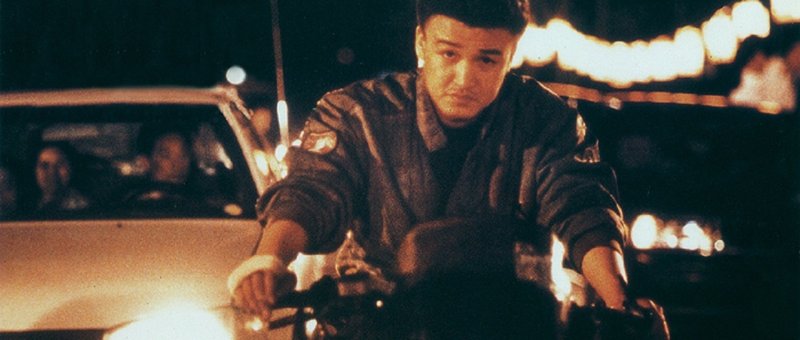
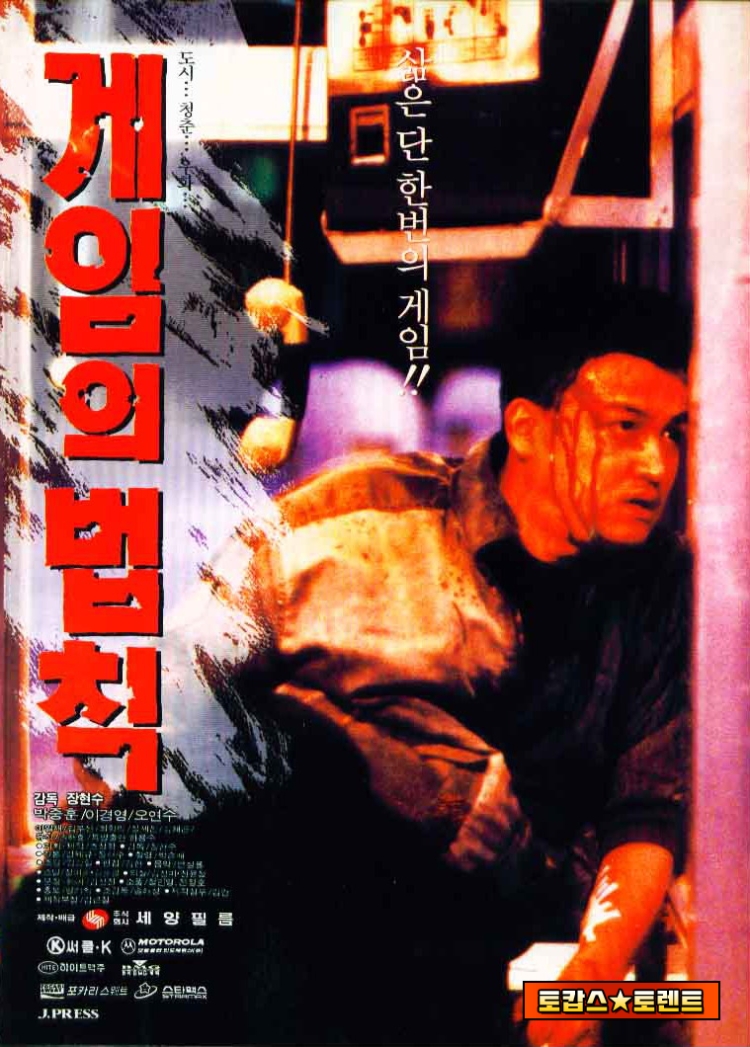
Rules of the GameEvery game has its rules, but then again perhaps the game lies in learning how to bend them to one’s advantage. Owing a debt to a Pacino/De Palma diptych – Scarface and the later but then just released Carlito’s Way, Jang Hyun-soo’s Rules of the Game (게임의 법칙, Gameui beobjig) was the first in a resurgence of contemporary action dramas which had gone out of fashion since their 1970s heyday. The story is a timeless one of a young man looking for gangland fame, his loyal girlfriend, and the duo’s loveable third wheel of a degenerate gambler whose sob story may actually turn out to be truer than it seemed.

Young-dae (Park Joong-hoon) is a young upstart in a tiny town. Bored with his life of daily drudgery washing cars, he decides to upsticks to the city, taking his adoring girlfriend Tae-suk (Oh Yeon-su) with him. Young-dae plans on engineering a meeting with famed ganger Gwang-cheon and pledging his allegiance to him, hoping to set himself on the road to gangland success. Things get off to a bad start when the pair of naive country bumpkins run into to smooth talking conman Man-su (Lee Kyoung-young) on a train. Man-su claims to know Gwang-cheon and writes a letter of recommendation before suddenly announcing they’re at his stop and jumping off the train leaving Young-dae and and Tae-suk with a healthy dinner bill.

The city proves particularly hostile to the out of towers as Young-dae realises joining a gang is not as simple as marching in, dropping to your knees and exclaiming “I will die for you, please accept me”. Repeatedly striking out, Young-dae distances himself from Tae-suk who ends up working as a hostess for the gangster Young-dae still hasn’t been able to meet. Finally spotting an opportunity to prove himself by interrupting a gang raid, Young-dae gets a foot on the ladder but as an outsider in an established gang he’s always going to be a liability.

Meanwhile, Man-su has continued to get himself into trouble with cards and is a constant thorn in the side to Gwang-cheon’s guys. After a beating leaves him crippled, Man-su turns to Young-dae for retribution. Young-dae, Man-su, and Tae-suk form an odd, sometimes volatile trio as they try to survive and make Young-dae’s gangster dreams come true while Man-su dreams to going to Saipan where the sun shines everyday and everything is palm trees and summer fruits.

It doesn’t take a genius to realise Saipan is a place Young-dae will never go, no matter how much he might want to. After getting into the gang and reuniting with Tae-suk, Young-dae does seem to be getting himself together but success soon goes to his head. He begins dressing in snappy suits moving from brown, to blue, to white, and drives a BMW around town as if he really owned it. As Tae-suk points out, he’s just a driver – a driver for a top gangster, but a driver all the same. In his desperation to reach the top, Young-dae makes himself a figure of suspicion in the mind of the boss he is so desperate to impress, inadvertently placing a target on his own back.

Jang may have pegged De Palma as an influence, one which is very much felt in the Tony Montana-esque story arc and Carlito’s Way denouement, but his shooting style is pure Hong Kong by way of John Woo – frantic action shot in slow motion. Young-dae is a slap-happy lover of violence, never one to let to the opportunity of getting into a fight pass him by. This is quite a good quality in an aspiring foot soldier, even if not in a potential boyfriend though Tae-suk does her best to tame him, but his impetuosity and naive faith in others’ ability to abide by the “rules” of gangsterdom are at the heart of his eventual downfall. His later decision to mistreat a fellow would-be minion who echoes his own phrase back to him “I will die for you, please accept me” is a clear indicator of how far he has moved away from the scrappy boy who left his village full of angry dreams even if something of his youthful innocence is later returned in his desire to leave the gangster world far behind for a life of ease and friendship with Man-su and Tae-suk in tranquil Saipan. The rules of the game, however, rarely reward missteps and Young-dae will pay heavily for his misplaced faith.


Screened at London Korean Film Festival 2017.

Die Bad (죽거나 혹은 나쁘거나, Ryoo Seung-wan, 2000)

die bad posterRyoo Seung-wan is now one of Korea’s top directors with such high profile box office hits as Berlin File, Veteran, and Battleship Island to his name. Back in 2000, he was just a young punk trying to make his mark in the film industry. Die Bad (죽거나 혹은 나쁘거나, Jukgeona Hokeun Nabbeugeona), Ryoo’s feature debut is, in reality, a series of four connected shorts (some of which were screened individually) telling an all too familiar story of a life ruined in adolescence giving way to a gangland nightmare and a nihilistic struggle for survival. Shot on grainy, low budget 16mm, Ryoo’s aesthetic is clearly influenced by the cinema of Sogo Ishii and perhaps Shinya Tsukamoto in its intensely kinetic, punk rock rhythms but he brings to it a youthful, angry fatalism so often seen in Korean youth drama.

Told in four chapters each of which is filmed with a different conceit, Die Bad is the story of Sung-bin (Park Sung-bin), a young man whose future is derailed after he kills a boy by accident in a pool room scuffle. When he gets out of jail, his father doesn’t want to know him and his friends have moved on but his brother gets him a job in a garage and it seems as if he’s finding his feet. When he comes across a guy getting beaten up in the street, he’s hesitant to get involved – literally seeing the ghost of the boy he killed in amongst the aggressors. Eventually he intercedes and rescues the guy who turns out to be a well connected mobster.

Meanwhile, while Sung-bin was inside, his friend who started the fight that fateful night, Seok-hwan (Ryoo Seung-wan), has become a policeman. Seok-hwan’s little brother, Sang-hwan, is getting involved in the same typically teenage punk violence which defined the adolescence of Sung-bin and Seok-hwan. A police round up engineers a fateful reunion between Seok-hwan and Sung-bin who discovers a way of getting back at the “friend” he feels destroyed his life though targeting the impressionable little brother with big time gangster dreams.

Given the unusual production circumstances behind Die Bad – the decision to incorporate two existing short films and combine them with two new ones to create a single feature, it’s no surprise that it can feel disjointed. The first segment, The Rumble, is pure punk spectacle. Set to a ferocious beat, the camera becomes a protagonist as Ryoo mixes frequent POV shots careering down narrow streets with more abstract sequences of the boys fighting the camera, extreme close-ups and artful contemplations of the awful beauty of violence.

Nightmare continues in more or less the same vein but “grows up” along with Sung-bin, dropping the frenetic, testosterone fuelled pace for a slower kind of melancholy as Sung-bin tries to find his feet as an ex-con in an unforgiving society. The Rumble was an indictment on the hopeless situation of young men without prospects – unlikely to escape through academic success, Sung-bin and Seok-hwan exorcised their feelings of impotence and impossibility through violence, but The Nightmare is its inescapable aftermath in which Sung-bin, having paid for his crimes, is unable to come to terms with his guilt and is haunted by the face of the boy he killed by accident. Given no real hope for a positive future, Sung-bin gives in to the lure of violence and eventually pursues gangland success rather than a life on the straight and narrow.

The ironically titled Modern Men rams this point home in its deliberate contrasting of Sung-bin and Seok-hwan – the gangster and the cop. Ryu moves away from the naturalism of the earlier scenes for a docudrama conceit as both Seok-hwan and Sung-bin’s mentor Tae-hoon give direct to camera interviews talking about their respective careers. Tae-hoon wound up a gangster for similar reasons to Sung-bin, he was a regular punk teen with no prospects who was handy with his fists so he joined a gang where his talents could be of the most use. Seok-hwan joined the police but his job involves a lot of tussling with thugs and there are times he’s not even sure if he’s a policeman or state sponsored gangster. He no longer has hopes or dreams and his only desire is to work hard without encountering any hassle. Both men define themselves through violence, they dress for the fight and chart their success through defeats and conquests. Yet both also claim that their violence is in the name of “maintaining order” even as they create chaos in facing each other.

For the final segment, Die Bad, Ryoo shifts to black and white as the stories of Seok-hwan and Sung-bin reunite. Times have changed, but not all that much. Sang-hwan, Seok-hwan’s little brother, hangs around in arcades with his buddies but Streetfighter soon gives way to Streefighting as the boys determine to work out their youthful frustrations through violence. Sang-hwan, brought up on an image of violence as masculinity is eager to prove himself, and dreams of the glamorous gangster life. Sung-bin, the jaded, reluctant veteran, makes cynical use of Sang-hwan’s desperation to get revenge on his brother for ruining his life by engineering the fight that cost both Sung-bin and his victim their lives. Cop or thug, there are no winners in Ryoo’s violent world in which the disenfranchised masses are encouraged to scrap to the death for the mere crumbs thrown to them. Fiercely kinetic and filled with the fire of youth Ryoo’s debut is an extraordinary meditation on the fatalism of violence as the most intimate, or perhaps the only, means of communication between men.


Screened at London Korean Film Festival 2017.

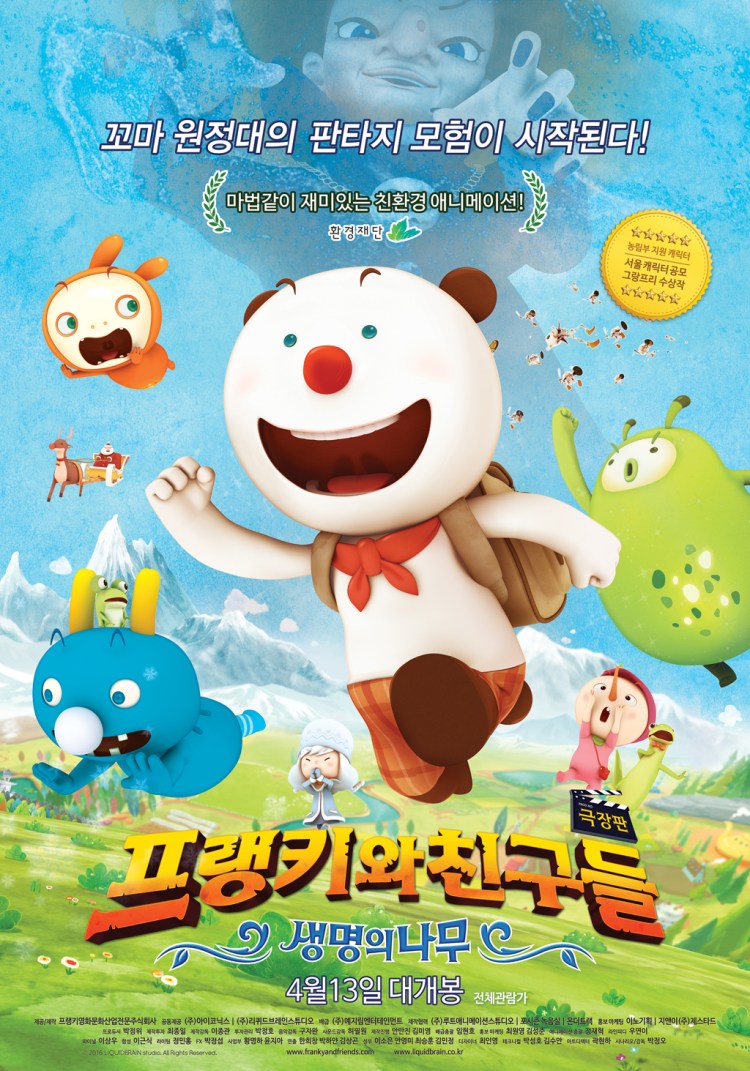
Franky and Friends: A Tree of Life (극장판 프랭키와 친구들: 생명의 나무, Park Jung-oh, 2016)

Franky and Friends tree of life posterChildren’s films are full of messages and advice about how to grow up into a fine, upstanding person. Franky and Friends began life as a TV series in which the titular polar bear, Franky, and his friends live in a world of self sufficiency in which everything they consume they must grow for themselves in their kitchen garden. The problem is Franky is essentially still a child which means he wants everything all at once and doesn’t know the reasoning behind his way of life. In other words, he’s just like the target audience and is about to learn what every parent wants to teach their child – to eat what they’re given and be grateful.

Franky, Kwon, and Pong live in a small cottage with the more mature Doo who cooks all their meals and tends to the house and garden. The boys, however (is it interesting that they’re so obviously male and Doo so obviously female even though they’re all fantasy creatures?), don’t want her sensible, wholesome food. They want everything else but *especially* fried sweet potatoes. Doo gives in and agrees to make some if the boys promise to eat everything all up. Of course, they do, but they’re full long before the pot of potatoes is even half empty. While Doo gets up to answer the door, Franky and Kwon scrape the food into a basket and take it outside to bury in the woods. They keep this up for a few days but weird mushrooms start growing everywhere and when the local insects eat them they grow to giant size and become ravenous, destroying the market garden!

As it turns out there is black magic at play in the strange land in which Franky lives. The only way to save everyone is to safeguard the Tree of Life from the clutches of an evil witch. The Fairytale Kingdom is home to a strange selection of creatures from abstract creations like Kwon, Pong, and Doo to guest appearances from Pinocchio, Santa, and The Monkey King. Later, Franky teams up with another friend, Misa, who seems to be something between the classic Snow Queen (only nice) and Elsa from Frozen but she doesn’t really do very much other than freeze things. Kids film this maybe but the references are retro beginning with a visit from a Godzilla-like creature to a large scale battle with skeletons resembling Harryhausen’s from Jason and the Argonauts.

The jokes, however, are considerably less highbrow with genuinely childish toilet humour providing the bulk of the comedy. Franky and his friends set off on their quest recklessly – not a good message for children, despite the positive reinforcement of Franky acknowledging his responsibility and pledging to correct his mistake, and appear not to have learned very much at the end of their quest. Still, the target audience probably won’t be thinking too hard about all of this and are most likely to pick up on the intended messages of the evils of wastefulness and lying to your mum about eating your vegetables. Hopefully they won’t remember the bit about magic mushrooms and life sucking aphids, but will remember that the Earth is everyone’s responsibility and if we don’t all agree to look after it together the tree will die and the witch will win.


Screened at London Korean Film Festival 2017.

Trailer (no subtitles)

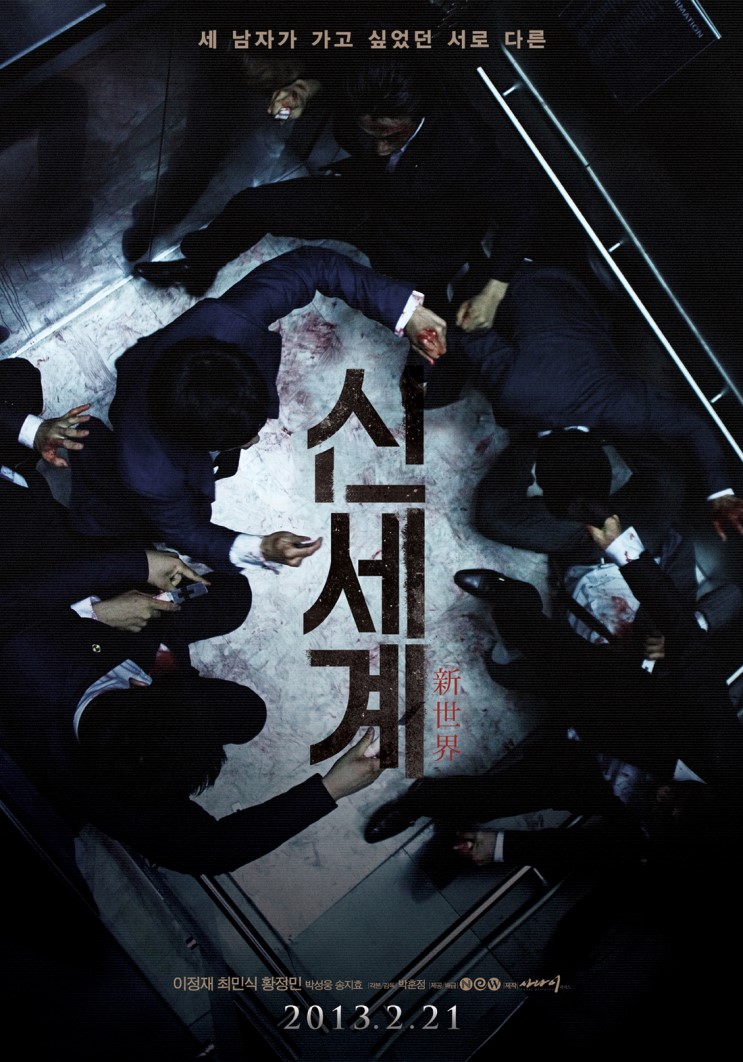
New World (신세계, Park Hoon-jung, 2013)

new world posterUndercover cop dramas have a long history of dealing more delicately with the nature of identity than in just a simple good guy/bad guy dichotomy, but New World’s (신세계, Sinsegye) moody noir setting ensures that the lines are always blurred and there may not in fact be any sides to choose from. Directed by Park Hoon-jung, scriptwriter of I Saw the Devil and The Unjust, New World makes plain that there may not be so much difference between a police officer and a gangster when each acts covertly, breaking their own rules and throwing any idea of honour out of the window in favour of self preservation or aggrandisement. In this worldview the victory of selfishness is assured, the law protects no one – not even its own, and the gangster, well, he only protects himself.

When the “CEO” (Lee Kyoung-young) of the Goldmoon “corporation” is killed in a “freak” car accident, his sudden absence creates a power vacuum in which his prime underlings, supported by their respective factions, vie for the top spot. Unbeknownst to them, police chief Kang (Choi Min-sik) has taken an interest in this suddenly instability in the largest crime syndicate in Korea and intends to launch Operation New World to interfere with the succession and ultimately install his longterm undercover agent in the director’s seat.

Lee Ja-sung (Lee Jung-jae) has been undercover for ten years, during which time he’s become the right hand man to one of the contenders to take over in the flashy Jung Chung (Hwang Jung-min). The opposing number, Lee Joong-gu (Park Sung-woong), is unscrupulous and suspicious – he has it in for Ja-sung and sees the succession as his natural right. Ja-sung, for his part, had assumed the death of the Goldmoon CEO would signal the end of his mission, allowing him to go back to his regular cop life. Soon to be a father, he’s tired of his duplicitous lifestyle and burned out on secret keeping but perhaps so long spent among the gangsters means his more natural home is exactly where he is.

This is certainly a duplicitous world. Grizzled police chief Kang may be on a mission to take down an all powerful crime group, but his methods are anything but orthodox. As usual in deep cover stories, only Kang and one other officer know of Ja-sung’s police background (at least, that’s what he wants Ja-sung to think), but Ja-sung may not be the only undercover operative Kang has on his books. Ja-sung is also sick of Kang’s obsessive surveillance which records the entirety of life in painstaking detail listing everywhere he goes and everything he eats, apparently even down to the sex of his unborn child. No one can be trusted, not even those closest to him, as Kang’s all powerful spy network has eyes and ears in every conceivable place.

Ja-sung’s identity crisis is never the focus of the narrative and a brief coda set three years previously may suggest that he’s already made his choice when comes to picking a side, but then the lines are increasingly blurred between good and bad even when the gangsters are seen committing heinous acts of torture and violence, making their enemies drink cement before dumping them in the nearby harbour. Ja-sung’s friendship with Jung Chung may be the most genuine he’s ever had in contrast to his relationship with Kang in which he remains a tool to be used at will and possibly disposed of at a later date.

Park holds the violence off as long as possible, preferring to focus on the internal psycho-drama rather than the bloody cruelty of the gangster world, but eventually violence is all there is and Park lets go with one expertly choreographed car park corridor fight followed by frenetic lift-set finale. The “New World” that the film posits is a dark and frightening one in which it’s dog eat dog and every man for himself with no room for morality or compassion. When the law fails to uphold its own values, others will prevail, for good or ill.


Screened at London Korean Film Festival 2017. Also screening in Sheffield (13th November), Glasgow (18th November) and Belfast (18th November). New World will also be released on DVD/blu-ray from Eureka Entertainment on their new Montage Pictures sub-label.

International trailer (English subtitles)

Coin Locker Girl (차이나타운, Han Jun-hee, 2015)

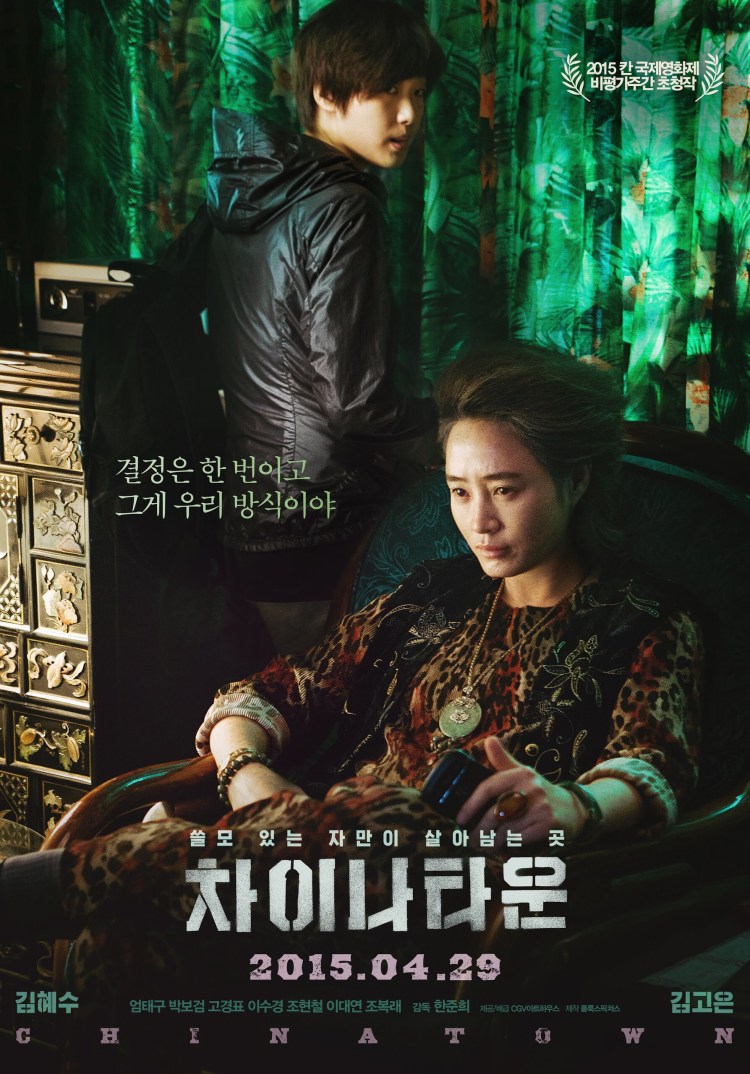
coin locker girl posterFamily in Korean films, unlike those say of Japan, has always been something of a double edged sword. Coin Locker Girl (차이나타운, AKA Chinatown) takes the idea of “family” and twists it around, bites into it to test its veracity, and offers a wry smirk as the metal begins to bend. Set in Incheon’s Chinatown, Han Jun-hee’s noirish thriller sends its heroine down a series of dark alleyways as she both fights and fights to retain her humanity whilst inhabiting an extremely inhuman world.

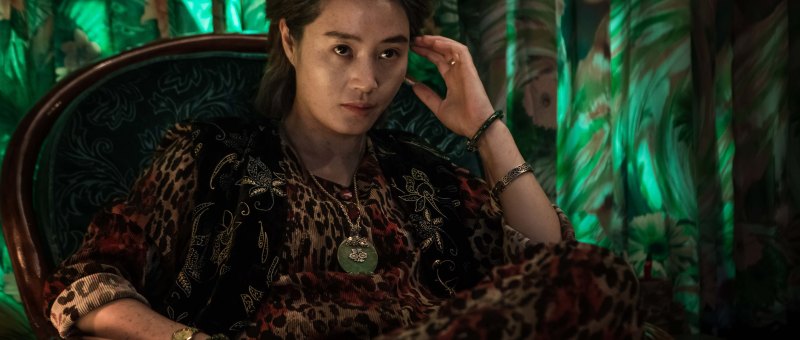
Il-young (Kim Go-eun) was found, covered in blood, hidden away in a coin locker, an abandoned child with no clue as to her identity or that of the woman who gave birth to her. Named and taken in by a collection of beggars at the station, she began her life as a street rat though not, perhaps, entirely unloved or friendless. As a young child she was then taken by gangsters working for a fearless female gang boss known as “Mom” (Kim Hye-soo). Mom is not one to suffer fools and feels no compunction in getting rid of those no longer useful to her. She soon puts Il-young to work, pamphleteering, begging, and eventually debt collecting as she grows older under Mom’s watchful eyes. By the time Il-young is almost come of age, she has an older brother and a sister as well as a younger brother with learning difficulties whom Mom still looks after despite her otherwise unsentimental approach to life.

The trouble starts when Mom sends Il-young to collect a debt from the young son of a man who’s skipped the country. Seok-hyeon (Park Bo-gum) is not like the typical clients she’s met before. He opens his door, invites her in, even offers to feed her before she leaves. Il-young finds all of this very strange. She’s never met anyone “nice” before and wonders what his angle is. Seok-hyeon, however, does not appear to have much of an angle aside from perhaps the usual one. Spending a bit of time with him, Il-young begins to develop certain feelings which see her swapping her Mom-style slacks and jackets for pretty summer dresses. Despite his son’s faith in him, Seok-hyeon’s father has not kept his end of the bargain and so Mom decides it’s time to call in the debt by offing Seok-hyeon and harvesting his organs. Il-young has a choice – between the woman she calls “Mom”, and a naive young man she has come to like though he has no place in her kill or be killed world.

One of the most attractive qualities about the young Il-young was that she didn’t exist. No birth certificate and no identity meant that she could be Mom’s to do with as she pleased. Consequently, adolescent Il-young has a more complicated relationship with her “Mom” than most young women but is also acutely aware of the debt of gratitude which is owed, the precariousness of her position, and the reality that she has nowhere else to go should she decide to try and break away from the world in which she has been raised. Never quite sure what her relationship to Mom is, Il-young has come to think of the other children in the same situations as siblings, but again cannot be sure that they feel the same.

Like many a good film noir, the tragedy lies in not completely closing off one’s heart as the harshness of the world dictates. Mom rejects those who are not useful and terminates those who have betrayed her with extreme prejudice, but despite herself she cannot destroy Il-young. Stepping back from her code, her orders are to let Il-young live, condemning her to a fate perhaps worse than death but alive all the same. Mom is betrayed by another child figure enacting a petty act of revenge, but her decision to let Il-young live is the one which threatens to condemn her. Having believed herself an unloved, unwanted child, Il-young is left with two terrible legacies of abandonment and the feeling that she will never leave that coin locker in which she has been trapped since birth. The cycle of maternal sacrifice continues, though Il-young has the opportunity to change her fate by taking charge of it, picking up where Mom left off but with greater compassion even within the confines of her still cruel world.


Screened at London Korean Film Festival 2017. Also screening at Manchester (11 Nov) and Glasgow (16 Nov).

Original trailer (English subtitles)

The Mimic (장산범, Huh Jung, 2017)

The mimic posterFears of changeling children and their propensity to become cuckoos in the nest is a mainstay of folklore horror, but in recent times the creepy kid has crept his way in from the cold as the current monster of choice. The Mimic (장산범, Jangsanbum), though apparently completed some time earlier, has a few superficial similarities to Na’s The Wailing in its use of powerful, ancient myths and shamanic lore to conjure its particular brand of evil. If Na’s film was sometimes criticised for its obtuse ambiguity Huh has the opposite problem in failing to properly support his internal mythology with an appropriate level of consistency.

Hee-yeon (Yum Jung-ah) packs up her life including husband (Park Hyuk-kwon), mother-in-law (Heo Jin) suffering with dementia, little girl Jun-hee (Jang Liu) and a box of painful memories and moves to Mount Jang – her mother-in-law’s hometown. The move is intended to help the family put the past behind them and move on after Hee-yeon’s son disappeared without trace five years previously, but it’s not long before Hee-yeon is catching sight of small boys in ragged clothes on the streets around Mount Jang and convincing herself she’s seen her little boy despite the distance from the place where he disappeared and that he’d now be five years older than the version she has stored in her memory.

With Hee-yeon’s mental state already strained, she runs into trouble when a pair of earnest children arrive hoping one of the dogs in the kennel facility the family are running might be their missing puppy. It isn’t but their search leads them to a creepy walled up cave where they’re attacked by a malevolent entity. While her husband is helping the children and investigating the cave, Hee-yeon comes across a strange little girl (Shin Rin-ah), apparently lost, and dressed in an old fashioned velvet dress with a lace collar. The girl disappears while the Hee-yeon and her husband are busy with the police but later turns up at the couple’s home and worms her way inside, eventually claiming that her name is Jun-hee too, just like Hee-yeon’s daughter.

The central conceit is that the malevolent entity existing around Mount Jang mimics the voices of (usually dead) loved ones in order to convince its victims to surrender themselves voluntarily. Huh sets up Hee-yeon’s mental instability early on as she nervously guzzles pills to help her regain her grip on reality, but there after abandons it, never questioning the real existence of threat or Hee-yong’s relationship to the little girl whom she at times strangely believes to be her son. The little girl remains a typically creepy kid, originally mute and then mimicking Jun-hee but apparently unthreatening in and of herself. The cuts and bruises across the little girl’s back might explain her silence with her immediate adoption of a Jun-hee persona a kind of rejection of her original personality, but the film has already lost interest in rational explanations.

Hee-yeon, despite a degree of distance towards her daughter, immediately takes to the little girl, bringing her into the house with an intention to keep her despite her husband’s reservations. The desire to save this lost little girl is, of course, a kind of reaction to the loss of her son whom she seems to see in the little girl even without her supernatural gift of mimicry. Hee-yeon blames herself for the unknown fate of her little boy who disappeared after she left him with her mother-in-law (already suffering with dementia) in a busy foodcourt. Granny may have more clues, but if she has they’re irretrievably locked inside her fracturing mind. Having grown up in the surrounding area and being aware of the legends since childhood, granny is also a good person to ask about the strange goings on – only no one does because they assume she is not mentally stable. Hence when she alone knows to cover up mirrors and is suspicious of the little girl, everyone thinks it’s the dementia talking.

Symbolically the choice which is presented is between past and future, life and death, in the knowledge that the two are mutually exclusive. The liminal space of the cave becomes its own purgatorial courtroom in which Hee-yeon, and the other victims, must decide for themselves who or what they believe and which sort of existence they wish to embrace. For Hee-yeon her trial involves the abandonment of another child as a final goodbye to her long absent son, pulling at her fragile maternity and testing each and every aspect of it (though not, perhaps, that related to her remaining daughter who seems to have been temporarily forgotten). Huh makes fantastic use of soundscapes and intriguing use of mirrors, but even the high quality photography and committed performances can’t quite overcome the hollowness of his mythology, robbing his dark fairytale of its essential power.


Screened at London Korean Film Festival 2017. Also screening at Showroom Cinema, Sheffield, 15 November 2017, 8.30 pm

International trailer (English subtitles)

Jamsil (누에치던 방, Lee Wanmin, 2016)

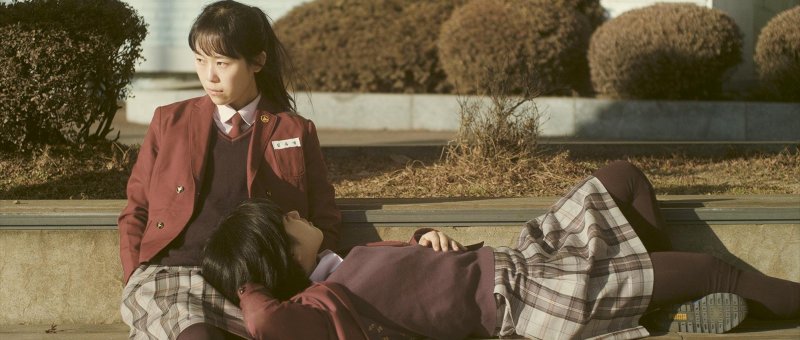
jamsil still 1Have you ever met someone for the first time but felt as if you’ve been friends all your lives? Maybe you’ve been depressed and lonely enough to knock on a stranger’s door wishing you had that kind of friendship because there’s very little else in your life, but you probably didn’t find anyone quite as willing to play along as the increasingly fragile Mihee (Lee Sanghee) does when she marches up to Sungsook’s (Hong Seungyi) home and announces herself as a long lost childhood friend. From that description alone Jamsil (누에치던 방, Nuechideon Bang) sounds as if it could be a dark tale of stolen identity and mental disturbance, but first time feature director Lee Wanmin’s intentions are not so severe. Defying rational explanation and looping back through past traumas and regrets, Jamsil is a tale of female friendship in all of its complexity but also of its immediacy and warmth.

30-something Mihee has taken the bar exam several times, unsuccessfully. Wondering if now is the time to give up on a legal career but afraid she’s left it too late to get any other kind of job, Mihee wanders aimlessly, not really doing much of anything at all. Growing tired of having no money and of having the moping, listless Mihee to contend with, Mihee’s graduate student boyfriend throws her out and ends the relationship. Faced with her lack of money, Mihee can only afford a run down apartment in a dodgy part of town with a strange and invasive landlady. Mihee, going quietly mad through loneliness and feelings of failure, makes the strange decision to knock on a stranger’s door, stating that she and the woman on the other side were once best friends at high school.

This seems improbable as the woman, Sungsook, seems to be around ten year’s older than Mihee, but even so Sungsook lets her in and tries to comfort the obviously distressed woman as best she can. Sungsook’s live-in partner, her childhood sweetheart Ikju (Lim Hyongkook), does not like Sungsook’s habit of letting strangers into their home and sets out to investigate Mihee only to begin having an affair with her whilst keeping his relationship to Sungsook secret. Meanwhile, Sungsook develops an attraction for a younger reporter who wrote something nice about an avant-garde theatre show in which she performed.

Though Mihee and Sungsook have obviously never met before they seem to share an immediate connection and soon become firm friends. Both women are thrown back to the trials and traumas of their teenage years, confronting choices they did and didn’t make or which were made for them. A ghost from Sungsook’s past has literally followed her all the way into the future as the spectre of absent friends continues to mar her relationship with Ikju. Mihee was guided to Sungsook by a teenage girl with the same name as Sungsook’s real teenage best friend, who for some reason reminded her of her younger self, but Mihee’s decision to track down her own high school confidant does not go well as she leaves repeated messages on her voicemail which are never returned before making a final, drastic bid for recognition.

Both Mihee and Sungsook are in some way, stalled, unable to reconcile what it is they want with what they’re supposed to be. Perhaps they, like the silkworms which give their name to this particular part of town, must leave something of themselves behind in order to move forward, but then perhaps those memories can be spun into something finer and softer to the touch than the jagged scars they currently seem to be. Lee’s shooting style leans towards indie naturalism, but mixes in a little avant-garde theatricality with her “actors” and their discussions of political terminology or brief snippets of philosophical musings on the wider nature of existence. Never quite earning its two hour plus running time, Jamsil is nevertheless a deep and fascinating exploration of romanticised pasts and depressed futures in which female friendship is both salvation and destruction but always a strong and abiding connection spun in the larval stage.


Screened at London Korean Film Festival 2017.

Subtitled clip

Interview with director Lee Wanmin conducted at Busan International Film Festival 2016.

Merry Christmas Mr. Mo (메리크리스마스 미스터 모, Lim Dae-hyeong, 2016)

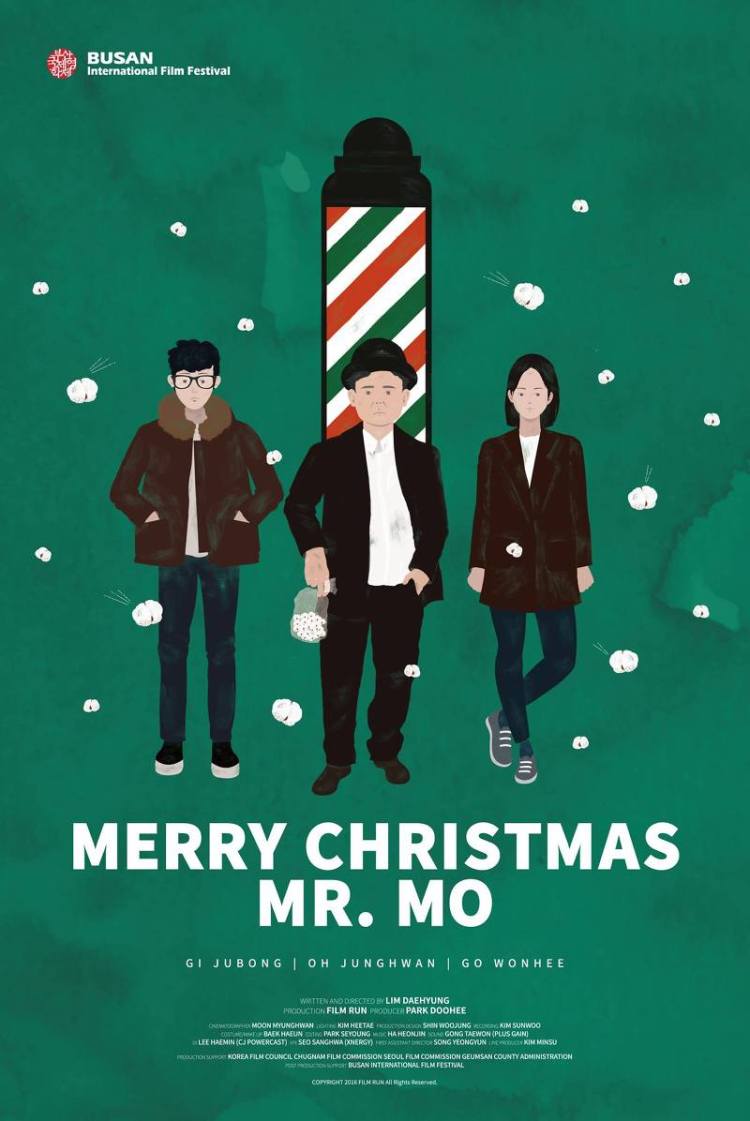
Merry Christmas Mr Mo posterMr. Mo does not at first seem the Christmassy type. He’s gloomy, sullen, and monosyllabic – about as far from festive as it’s possible to get, yet over the course of Lim Dae-hyung’s charming feature debut, he becomes an irresistible hero bravely fighting back against his loneliness and disappointment while there is still time. Shot in black and white with a deadpan, Jarmushian sense of humour, Mr. Mo’s journey of reconnection is one of quiet melancholy yet filled with its own strange warmth for its cast of disconnected characters each finding a point of recognition in the silent world of Mr. Mo.

The local barber, Mr. Mo (Gi Ju-bong) is known around town but does not encourage friendliness outside of his studio. His life begins to diverge from its usual routine when a visit to the doctor, who urges him to quit smoking, causes him to worry about his health. Despite his normally aloof nature, Mr. Mo engages in some slapstick humour in the pool where he swims everyday before asking a young woman, Ja-young (Jeon Yeo-bin), to go for a drink with him on the way home. Ja-young is somewhat taken aback and perhaps worried about an old man asking her to drink with him, replying that she’s quite tired and just wants to go home. Mr. Mo’s intentions are 100% honourable and he just really wanted some company on this quite depressing day. Ja-young decides to go anyway and regales him with horticulture tips and theories on physiognomy, her loquaciousness a perfect match for Mr. Mo’s laconic demeanour.

When he receives even worse news than he feared from the Doctor, Mr. Mo decides it’s time to put his house in order – clearing out a 15 year old Christmas tree but leaving the December 1999 calendar hanging on the door. It’s clear from Mr. Mo’s apartment that he once had a family and now lives alone, though he mostly spends his off time munching popcorn in front of the TV and writing in his diary. His nights are repetitions of insomnia in which he repeatedly thumps his pillow in frustration, sitting up reluctantly in the morning and tearing his eye mask off his face.

Having dreamed of being an actor in his youth, Mr. Mo’s final wish is to make a film with his distant, aspiring filmmaker son. Stephen (Oh Jung-hwan) lives in the city with his girlfriend, Ye-won (Go Won-hee), but he seems to be just as sullen and depressed as his dad though perhaps without so much of the reason. Mr. Mo is a big fan of Ye-won, though he can’t quite understand what she’s doing with his son. She puts up Stephen’s nonsense, his loss of drive and occasional fits of pique and the couple’s relationship seems solid, even if a little strained and sometimes difficult.

Making the movie, a Chaplin-esque slapstick piece, is partly an excuse to reconnect with Stephen but it also affords him an opportunity to revisit and reconsider the past, revealing hitherto hidden details of his son’s early life. Gi Ju-bong excels in the leading role of the vacant Mr. Mo who eventually becomes a hilarious silent movie comedian complete with silly walk and repeated sight gags which also take on and added degree of melancholy given Mr. Mo’s condition and his desire to push his own self-destruct button.

Despite his aloofness, Mr. Mo is a keen observer of people as revealed in the final voiceover of his diary for December (written in the form of letters to his late wife) in which he notes down his various meetings from the overly polite young man who says hello to too many people to picking up on Ja-young’s loneliness, and regretting his hostile reaction to his sister-in-law’s kindness. Getting everyone together at the end to reveal the solution to the enigma which is Mr. Mo, Lim’s debut is a whimsical journey through the loneliness and resignation of late middle age filled with a strange affection for its cast of eccentrics and enlivened by the quirky, acoustic guitar score which considerably adds to the air of mild surreality in strangely framed vistas of emptiness which perfectly capture Mr. Mo’s charming black and white world.


Screened at London Korean Film Festival 2017.

Original trailer (English subtitles)