The Great Chase (華麗なる追跡, Norifumi Suzuki, 1975)

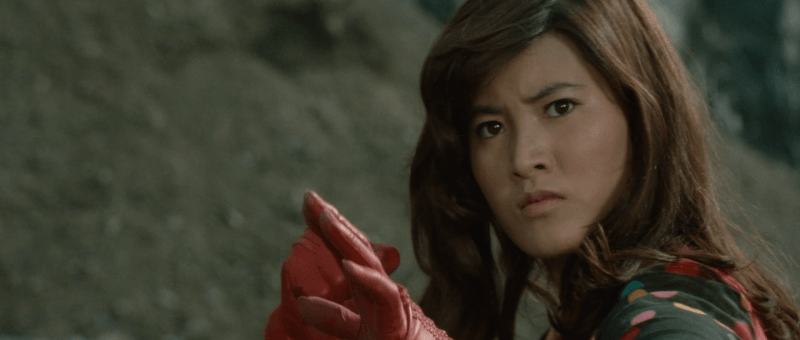
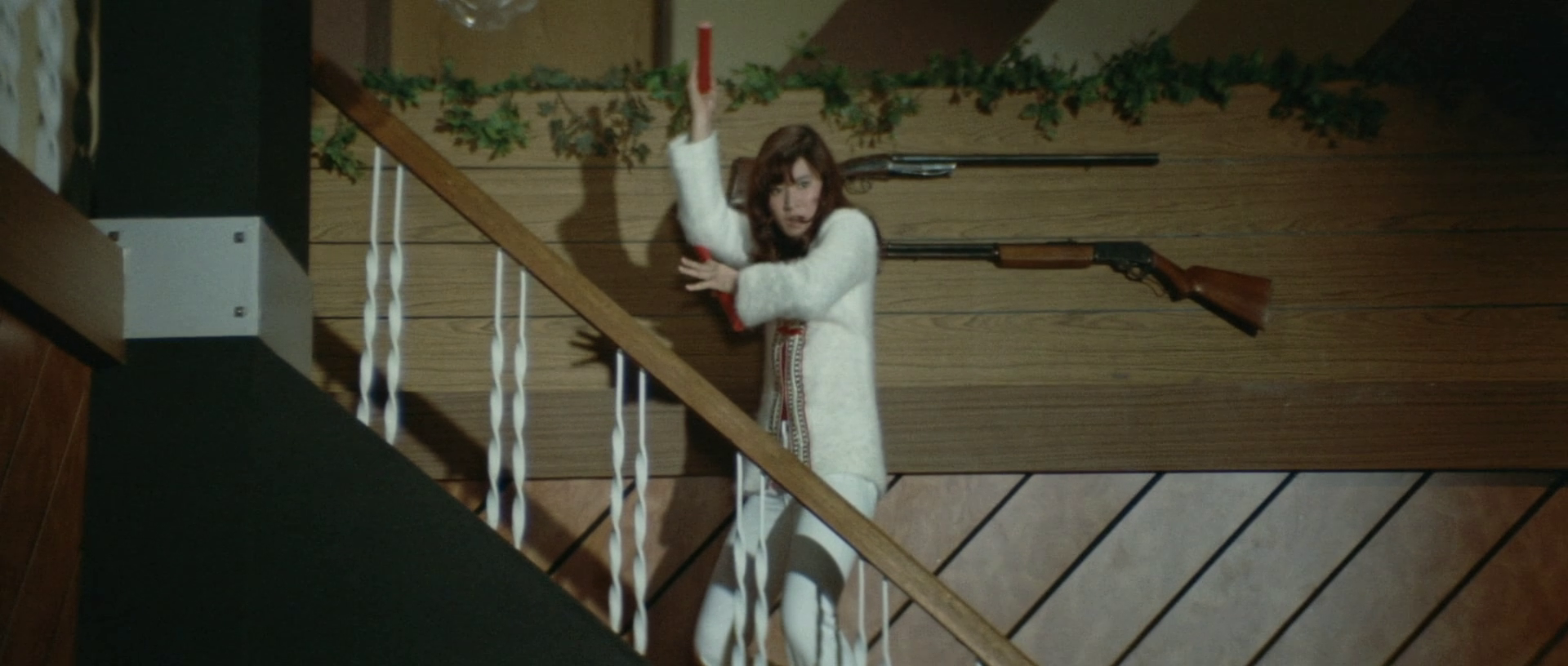
What about if you rebooted the Bannai Tarao series, but the hero was a female spy who is also a champion race driver and martial artist? Norifumi Suzuki did actually make a Bannai Tarao move in 1978 starring Akira Kobayashi, but the heroine of The Great Chase (華麗なる追跡, Karei-naru Tsuiseki) certainly loves a disguise or two and like the famous man of a thousand faces seems to have no trouble pulling them off as she infiltrates a gang of evil traffickers led by a furry which has come up with an ace new plan of packing heroin into coffins and having them shipped to nuns!

Oh, and the gang were also behind the death of her father who “committed suicide” in prison after being framed for drug smuggling. The Great Chase takes place in a world of pure pulp which somehow maintains its sense of cartoonish innocence even after Shinobu (Etsuko Shihomi) has infiltrated the heart of darkness and seen most of her associates killed by sadistic gang boss Inomata (Bin Amatsu). But at the same time, it delves into a deep sense of ‘70s paranoia as it becomes clear that the authority figures are all corrupt. Inomata has become a politician, while Shinobu’s father’s murder was orchestrated by the prison warden who was working with him in return for financial gain. The man who framed her father was a friend of his, implying that no one can really be trusted when there’s money to be made.

In a roundabout way,as this sense of anxiety is only reinforced by Shinobu’s role as some sort of secret agent working for the spy ring run by her uncle which is currently hot on the trail of the drug dealers even if they haven’t yet figured out who their boss is. Conversely, her home life is as wholesome as it could be with her two adopted siblings who run a florist’s along with Shinobu’s fan club. Her status as a kind of race car idol lends Shinobu a particular kind of ‘70s cool and turns her into some sort of superhuman figure capable of triumphing over any kind of adversity like a superhero worthy of any kid’s lunchbox. The siblings, Nagi (Fujika Omori) and Shinpei (Naoyuki Sugano), were taken in as orphans by her father which once again signals his goodness in contrast to the greed and selfishness of the gang that had him killed to cover up their crimes. 

That they peddle in drugs marks them out as a force of social disruption, but they’re also actively heretical in hiding behind the shield of the church. Suzuki frequently uses religious imagery in his films and here again echoes the romanticism of School of the Holy Beast with the use of red roses to decorate the coffin of the unfortunate young woman who has been turned into a vessel for smuggling drugs and has for some reason been laid out otherwise entirely naked. When it comes to retrieving the merchandise, we can see that many of the habits are being worn by men while Inomata himself masquerades as a priest. Then again, perhaps he is merely indulging his love of costume play seeing as he also has a hobby of wearing a furry bear suit to attack and rape women in his living room. 

Inomata’s claws then seem to represent something else, a rapacious, grasping sense of patriarchy in which he also uses drugs to bind women to him. Shinobu’s childhood friend Yukiko (Hisako Tanaka) has apparently fallen victim and laments that she is possessed by him body and soul to the point that the old Yukiko is dead which is why she hasn’t been able to step in and help Shinobu and is doing so now fearing that it may cost her her life. Suddenly, it’s all quite grim with the basement sex cult, whipping and torture, but Shinobu maintains her plucky spirit and is somehow able to lure Inomata towards a cable-car-based showdown. With a cameo from real life wrestler / singer Mach Fumiake, the film enters a kind of meta commentary on a real-life Shinobu (though she was not, as far as anyone knows, one of Japan’s top spies), but otherwise remains within the realms of pulp in which the heroine is able to pull off her difficult mission with the help of her talent for disguises before dramatically unmasking herself as the woman who’s going to take them all down. Camp to the max and incredibly surreal, the film never drops its sense of silliness even as the grim events enveloping Shinobu lead to tragic consequences that she barely has time to deal with before barrelling straight into the next duel with the forces of corruption.


*Norifumi Suzuki’s name is actually “Noribumi” but he has become known as “Norifumi” to English-speaking audiences.
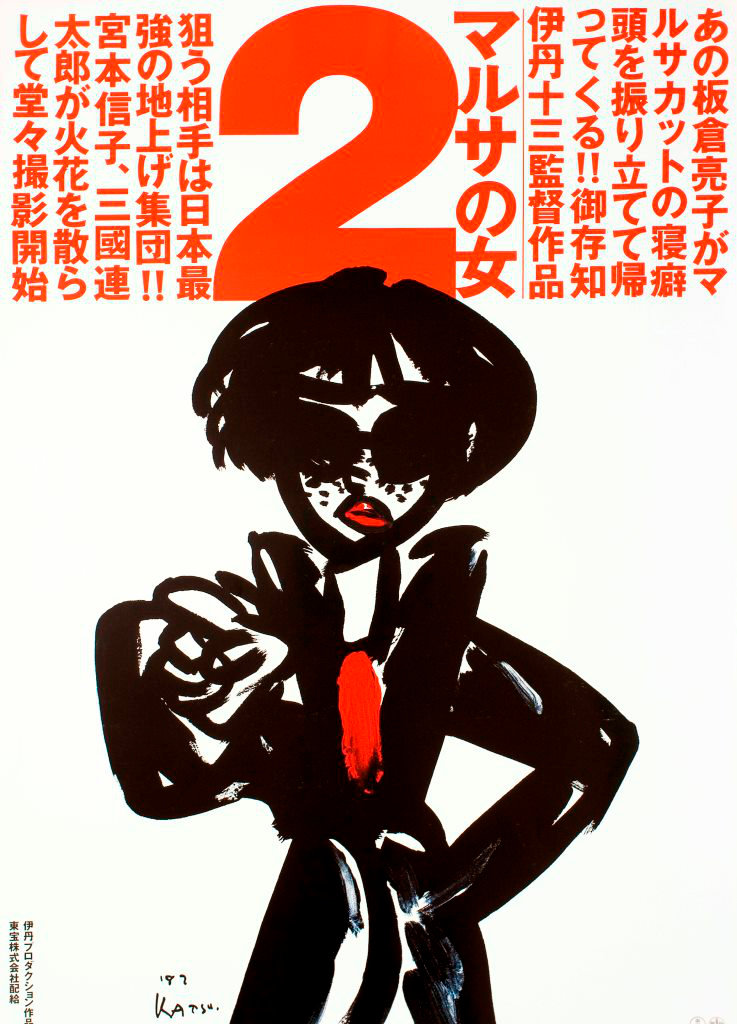
A Taxing Woman’s Return (マルサの女2, Juzo Itami, 1988)

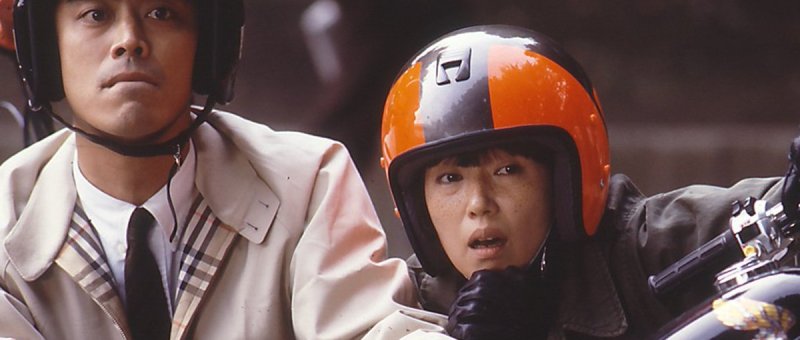
Taxing Woman 2 posterA Taxing Woman introduced us to Ryoko Itakura (Nobuko Miyamoto) – an oddball detective working as an insurance inspector who met her Irene Adler in a tax dodging corporate gangster with a limp. A year later she’s back, still the only woman working with the tax inspectorate and apparently still a dogged pursuer of those who would seek to defraud the Japanese government of its rightful earnings. Ryoko may have been a stickler for the rules who applied the same dog with a bone approach to a mom and pop store chowing down on its own supplies as to a dodgy yakuza led conspiracy, but she also believed in justice – something which stands her in good stead when she rubs up against a dodgy cult which, again, is a yakuza front but adds insult to injury by deliberately manipulating the vulnerable.

The action opens with some kids poking at the dead body of a “landshark” floating in a pond before flashing to a meeting of officials sucking crab meat from the shell and wondering what they’re going to do about this land they need cleared now their heavy is out of the picture. The corrupt politician from the first film, Urushibara (Takeya Nakamura), is apparently still involved in semi-legal land deals but palms the assignment off on a colleague. The big wigs need to empty a dated housing complex on some valuable land so they can build a vanity skyscraper – office space apparently being scarce in mid bubble Tokyo.

To do this they enlist the services of dodgy cult leader Onizawa (Rentaro Mikuni) and his troop of yakuza goons. Most of the tenants have already signed but they have three key holdouts – a diner owner clinging on to the family legacy, a stubborn paparazzo, and an intellectual professor who heads up the housing association. Unlike the yakuza of Taxing Woman, these guys have not reformed – they are the new/old style of lawless thugs who are perfectly prepared to threaten women and children to get their own way. Making it impossible for the tenants to stay through intimidation and noise torture, they stoop to blackmail to seal the deal.

Despite arriving only a year after A Taxing Woman, Taxing Woman’s Return (マルサの女2, Marusa no Onna 2) takes place in a much darker, though more obviously comedic, world. Whereas the earlier film adopted a noticeably ambivalent attitude to the tax inspectors and the enterprising gangsters, the villains of A Taxing Woman’s Return are so heinous and morally bankrupt as to be entirely indefensible even if the inspectorate takes a turn for the bumbling to compensate. The “cult” is, of course, merely a convenient money laundering front and tax dodge for the yakuza – religious organisations are exempt from taxation in the vast majority of cases which may be why the local tax office records hundreds of registered “religious bodies” in its jurisdiction alone. That doesn’t mean it doesn’t have its loyal followers, often vulnerable people looking for spiritual fulfilment but being bled dry by the money hungry cultists while the leader’s wife swans around in sables costing more than the average annual salary. A desperate devotee in need of a loan puts his own teenage daughter up as collateral only to see her raped by Onizawa, eventually becoming pregnant by him at only 16 years of age and thereafter becoming his devoted concubine in a bizarre instance of Stockholm Syndrome.

Yet for all the background darkness of weird cultists and nasty yakuza backed up by corrupt and venial politicians, Itami ups the cartoonish sense of the absurd with our hero Ryoko clambering over rooftops to listen in to the bad guys while her boss throws himself down flights of stairs and has to battle piercing sirens to get into the villains’ secret vault. It is however a dark humour as the opening makes plain with its troupe of little children staring at the strange shape floating in the water – a motif later repeated when a yakuza is gunned down in the street only for another group of children to pour over him as he expires, a single tear rolling down his cheek. The original spongy white body gives way to the businessmen sucking spongy white crab out its shell while insensitively discussing the late land shark, and the yakuza are unafraid to deploy a maggot infested severed hand (thankfully a fake picked up from a friend who makes horror movies) to convince the tenants they mean business.

At the end of A Taxing Woman, the gangster and the inspector reached something of a truce but one which came down, broadly, on the side of right. This time things aren’t quite so simple. The conspiracy is bigger and deeper, stretching all the way into the Diet and about more than just office space in still developing Tokyo. Onizawa, regarding himself as public servant, tries to say he did it all for his country, that if someone didn’t get their hands dirty Tokyo would be eclipsed by Hong Kong or Seoul. A post-war justification for a bubble era problem, but one that takes us straight back to the first film in Onizawa’s second proposition that only through money does he truly feel “immortal”. He may be a liar and a cheat, but he’s only a symptom of rapidly spreading infection, one which Ryoko and her team are powerless to cure, trapped on the wrong side of the fence while the bad guys build monuments to economic hubris, indulging in vanity in an era of bad faith which is about to be brought to a rather abrupt close.


Currently available to stream in the US/UK via FilmStruck.

Original trailer (no subtitles)

A Taxing Woman (マルサの女, Juzo Itami, 1987)

A Taxing Woman posterIn bubble era Japan where the champagne flows and the neon lights sparkle all night long, even the yakuza are incorporating. Having skewered complicated social mores in The Funeral and then poked fun at his nation’s obsession with food in Tampopo, Juzo Itami turns his attention to the twin concerns of money and collective responsibility in the taxation themed procedural A Taxing Woman (マルサの女, Marusa no Onna). Once again starring the director’s wife Nobuko Miyamoto, A Taxing Woman is an accidental chronicle of its age as Japanese society nears the end of a period of intense social change in which acquisition has divorced mergers, and individualism has replaced the post-war spirit of mutual cooperation.

Ryoko Itakura (Nobuko Miyamoto), a single mother and assistant in the tax office, has a keen eye for scammers. She demonstrates this on a stakeout with a younger female colleague in which she keeps a shrewd eye on the till at her local cafe and comes to the conclusion that they’ve been running a system where they don’t declare all of their cheques. Running her eyes over the accounts of a mom and pop grocery store, she notices some irregularities in the figures and figures out the elderly couple feed themselves from the supplies for the shop but don’t “pay” themselves for their own upkeep. That might seem “perfectly reasonable” to most people, but it’s technically a small form of “embezzlement” and Ryoko doesn’t like figures which don’t add up. Seeing as the couple probably didn’t realise what they were doing was “wrong” she lets them off, this time, as long as they go by the book in the future. A more complicated investigation of a pachinko parlour finds a more concrete form of misappropriation, but Ryoko is fooled by the owner’s sudden collapse into inconsolable grief after being caught out and leaves him in the capable hands of his confused accountant.

Nevertheless, Ryoko may have met her match in sleezy corporate yakuza Hideki Gondo (Tsutomu Yamazaki). Dressing in a series of sharp suits, Gondo walks with a pronounced limp that hints at a more violent past but as his rival from the Nakagawa gang points out, violence is a relic of a bygone era – these days gangsters go to jail for “tax evasion” as means of furthering their “business opportunities” and facilitating ongoing political corruption. Gondo’s business empire is wide ranging but mainly centres on hotels, which is how he arouses Ryoko’s interest. She looks at the numbers, does a few quick calculations, and realises either the business isn’t viable or the correct figures aren’t being reported. Ryoko doesn’t like it when the books don’t balance and so she sets her sights on the seedy Gondo, but quickly discovers she has quite a lot in common with her quarry.

Itami was apparently inspired to make A Taxing Woman after the success of Tampopo shoved him into a higher tax bracket. Given Japanese taxes (at the time) were extremely high, getting around them had become something of a national obsession even if, in contrast to the preceding 30 years or so, there was plenty of money around to begin with. More than the unexpected tendency towards civil disobedience the times seemed to cultivate, Itami homes in on the increasingly absurd desire for senseless acquisition the bubble era was engendering. Thus Gondo who owns a large family home well stocked with symbols of his rising social status, also occupies a bachelor pad where he keeps a mistress which reflects the gaudy excess of the age right down to its random stuffed hyena. Nevertheless when one of the tax clerks asks for some advice as to how to have it all, Gondo replies that that’s easy – to save money, you simply avoid spending it. Gondo lets his glass run over and delights in licking the edges. It’s all about delayed gratification, apparently, and having a secret room full of gold bars to gaze at in order to relieve some of that anxiety for the future.

Gondo, like many of his ilk, has “diversified” – yakuza are no longer thuggish gangsters but incorporated organisations operating “legitimate” businesses through “illegitimate” means. Thus we first find him using a nurse who allows herself to be molested by an elderly, terminally ill client whose identity they will steal to found a company they can quickly dissolve when he dies to shift their assets around and avoid the tax man. Later he pulls another real estate scam by pressing a desperate family but his real focus is the love hotels, whose slightly embarrassing existence ensures that not many come poking around. Ryoko, however, is unlikely to let such a large scam slide and delights as much in closing loopholes as Gondo does in finding them. Noticing a kindred spirit, Gondo quite openly asks his new tax inspector “friend” what she’d think if he married his mistress, gave her all his money, and divorced her – divorce proceeds are after all tax free. Sounds great, she tells him, as long as you trust your wife not to skip town with all the doe.

Ryoko, a modern woman of the bubble era, single and career driven, is a slightly odd figure with her officious approach to her job and unforgiving rigour. Unlike her colleague who dresses in the glamorous and gaudy fashions of the times, Ryoko wears dowdy suits and her mentor boss is always reminding her about her “bed hair”, meanwhile she stays late at the office and offers instructions to her five year old son over the phone as to how to microwave his dinner. Though there is another woman working with her at the tax office, when she’s finally promoted to full tax inspector status she finds herself in a room full of guys who apparently hardly ever go home. On her first job she’s only really brought along because she’s a woman and they want to threaten a mob boss’ mistress with a strip search to find a missing key for a safety deposit box. The mistress, however, tries to throw them off the sent by publicly stripping off and encouraging them to check her “cavity” if they’re so keen to find this key, only for Ryoko to find it under the sink while all the guys are busy being shocked. Ryoko’s methods are occasionally as underhanded as Gondo’s and, like his schemes, built on gaming the system but she’s certainly a force to be reckoned with for those considering defrauding the Japanese government.

Gondo’s schemes excel because they aren’t entirely illegal, only clever ways of manipulating the system, but they’re also a symptom of a large conspiracy which encompasses improprieties right up the chain as banks, corporations, and politicians are all part of the same dark economy managed by a corporatising yakuza. Gondo takes frequent calls from a local representative who often “helps him out”. Later the same representative tries to put pressure on the tax office to back off, but Ryoko’s boss points out that he doesn’t need to because the press are already on the story so he should probably get started on his damage control rather than bothering public servants. Gondo and Ryoko, perhaps as bad as each other, lock horns in a battle wills but discover a strange degree of respect arising between them in having discovered a worthy adversary. There’s something undeniably absurd in Ryoko’s firm determination to catch out struggling businesses and the confused elderly with the same tenacity as taking on a yakuza fronted conspiracy, and there’s something undeniably amusing in Gondo’s attempts to beat the man by playing him at his own game, but the overall winner is Itami who once again succeeds in skewering his nation’s often contradictory social codes with gentle humour and a dispassionate, forgiving eye.


Currently available to stream in the US/UK via FilmStruck.

Original trailer (no subtitles)