A Wanderer’s Notebook (放浪記, Mikio Naruse, 1962)

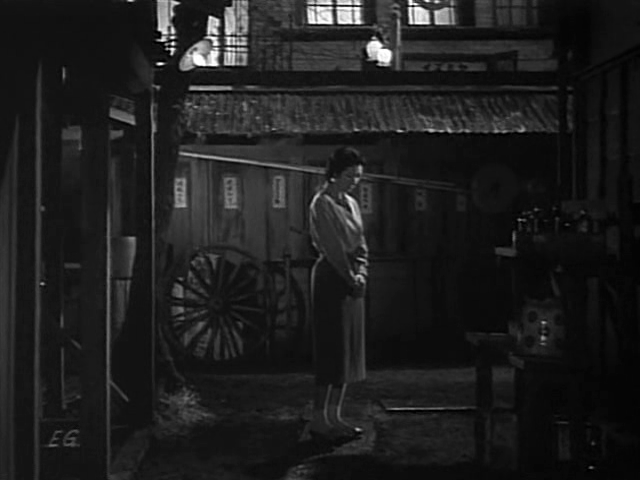
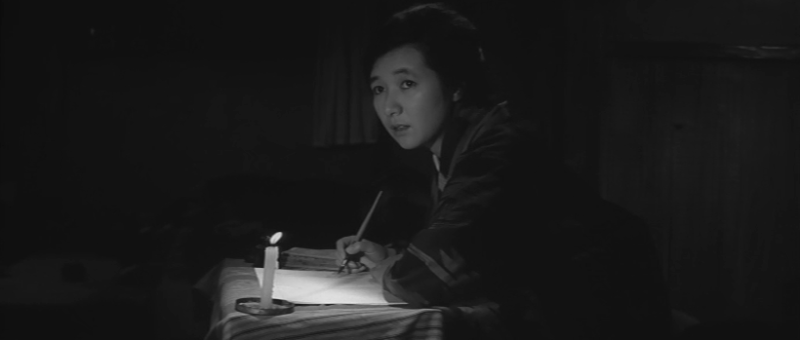
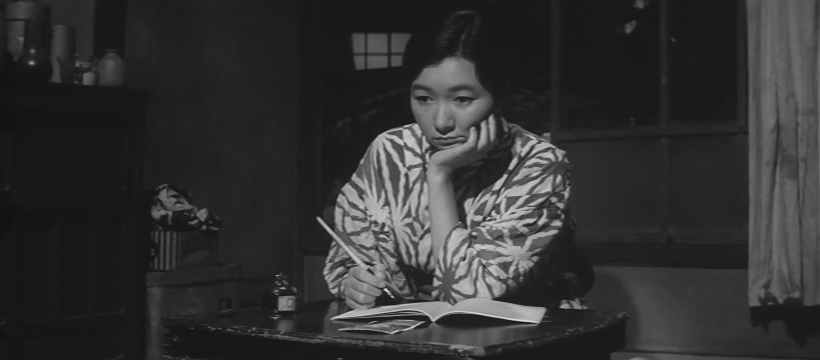
Many of Mikio Naruse’s most famous films are adapted from the work of Fumiko Hayashi, a pioneering female author who chronicled the life of a working class woman with startling frankness. Yet his dramatisation of her life, A Wanderer’s Notebook (放浪記, Horo-ki), is both a little more reactionary than one might have expected and surprisingly unflattering even in the heroine’s eventual triumph in escaping her poverty through artistry. Even so if perhaps sentimentalising the economically difficult society of the 1920s in emphasising the suffering which gave rise to Hayashi’s art, the film does lay bare the divisions of class and gender that she did to some extent transgress in pursuit of her literary destiny. 

Naruse and his screenwriters Toshiro Ide and Sumie Tanaka bookend the the film with a literal “lonely lane” which the young Fumiko walks with her itinerant salespeople parents. As a small child, she sees her father arrested for a snake oil scam peddling some kind of wondrous lotion, setting up both her disdain for men in general and her determination not to be deceived by them at least unwittingly. She has no formal education but is a voracious reader well versed in the literary culture of the time and intensely resentful of if resigned to her poverty. In the frequent sections of text which litter the screen taken directly from her novels, she details her purchases, wages, and longing for the small luxuries she can in no way afford. 

As an uneducated woman in the 1920s her working opportunities are few. She exasperatedly relates standing in a queue with hundreds of other women waiting for an interview for a company job only to be told they’ll let her know, while her other opportunity involves meeting a theatre director at a station who later takes her to his hotel/office and makes it plain he’s not really interested in her CV. She gets a job at the office of a stockbroker, but lies about being able to do accounts and is flummoxed by double entry bookkeeping getting herself fired on day one. After a brief stint in factory painting toys, she leaves with a friend to become a hostess but is also fired on her first day for getting drunk and being unwilling to ingratiate herself with the boorish men who frequent such establishments. 

Despite her animosity, she is drawn towards men who are callous and self-involved, firstly taking up with a poet and actor who praises her work but turns out to have several “wives” on the go, and then begins living with a broody writer, Fukuchi, who is insecure and violent, resentful at her success in wake of his failure. Perhaps because of her experiences, she seems to resent any hint of kindness though sometimes kind herself, lending money to her friend whose mother is in need and often ready to stand up for others whom she feels are being mistreated. A kindly widower in the boarding house where she lives with her mother, Yasuoka, falls in love with her but she repeatedly rejects him partly as someone suggests because he is not handsome, but mainly because of his goodness and kindness towards her. Nevertheless, he continues to support always ready in her time of need though having accepted that she will never return his feelings or accept his proposal. 

Perhaps her might have liked to have been kinder, but was too wounded by her experiences to permit herself. In any case at the film’s conclusion in which she has achieved success and in fact become wealthy it appears to have made her cold and judgemental. She instructs her maid to send a man away believing he is from a charity set up to help the poor, insisting that the poor must work for industry is the only path out of poverty implying that as she managed it herself those who cannot are simply not applying themselves when she of all people should know how fallacious the sentiment is. As if to bear out the chip on her shoulder, she forces her mother to wear a ridiculous kimono from a bygone era that is heavy for an old woman and makes her feel foolish because of her own mental image of the finery she dreamed of providing her on escaping the persistent hardship of their lives. 

As she says, she’s no interest in the socialist politics espoused by the literary circles in which she later comes to move, pointing out that the poor have no time for waving flags. One of her greatest supporters is himself from a noble family despite his progressive politics and in truth can never really understand the lives of women like Fumiko. He describes her work as like upending a rubbish bin and poking through it with a stick, at once fascinated and repulsed by a frankness he may see as vulgar. At one point he accuses her of writing poverty porn, playing on her humble origins for copy and becoming something of a one note writer. 

In truth, the film is not really based on the novel from which it takes its title but on the play that was adapted from it, while the novel itself was apparently reworked and republished several times in response to reader taste giving rise to a series of questions both about its essential authenticity and what it was that it was attempting to convey. In the film at least, moments after her literary success, Fumiko is challenged by a fellow female writer, Kyoko, who was once her love rival, that she cheated in a contest by failing to submit Kyoko’s entry until after the deadline had passed, though as it seems she would have won anyway. She is occasionally underhanded, perhaps because she feels she has no other choice, but then as we can see there is no particular solidarity between women save the kindly landladies who often let her delay her rent payments. Fumiko feels herself to be alone and her quest is not really for literary success but simply for her next meal, though she feels the slights of the bitchy women and arrogant men who mock her commonness while simultaneously exploiting it as entertainment. 

On the one hand, her success seems to signal a triumph of independence having freed herself from the need to depend on terrible men though she also she seems to have met and married a warmhearted painter who cares for her and supports her work while she has also been able to give her mother the level of comfort they both once dreamed of. Even so, the unavoidable fact that she dies at such a young age implies she’s worked herself into an early grave in a sense punishing her for her rejection of contemporary social norms undercutting her achievements with some regressive moralising while the one thing she still desires, rest, is given to her only in death. In Takamine’s highly stylised performance, as some have implied perhaps intended to mimic the silent screen, Fumiko is at once a carefree young woman who dances and sings and a melancholy fatalist with a self-destructive talent for choosing insecure and self-involved men, but above all else a woman walking a lonely road towards her own fulfilment while searching for a way out of poverty that need not transgress her particular sense of righteousness. 


Original trailer (no subtitles)

A Wife’s Heart (妻の心, Mikio Naruse, 1956)

“We’re too late for everything these days,” mutters an overly cheerful geisha whose behaviour is becoming ever more erratic. A sense of fatalism, that everything has already been decided and there is no real escape from the misery of life, hangs over much of Naruse’s filmmaking even if his heroines often do their best to rail against it and on occasion succeed. Kiyoko (Hideko Takamine), the heroine of A Wife’s Heart (妻の心, Tsuma no Kokoro), finds herself faced with just this dilemma while considering which side of a generational divide she might be on and whether she has the power to escape from her disappointing life to chase emotional fulfilment. 

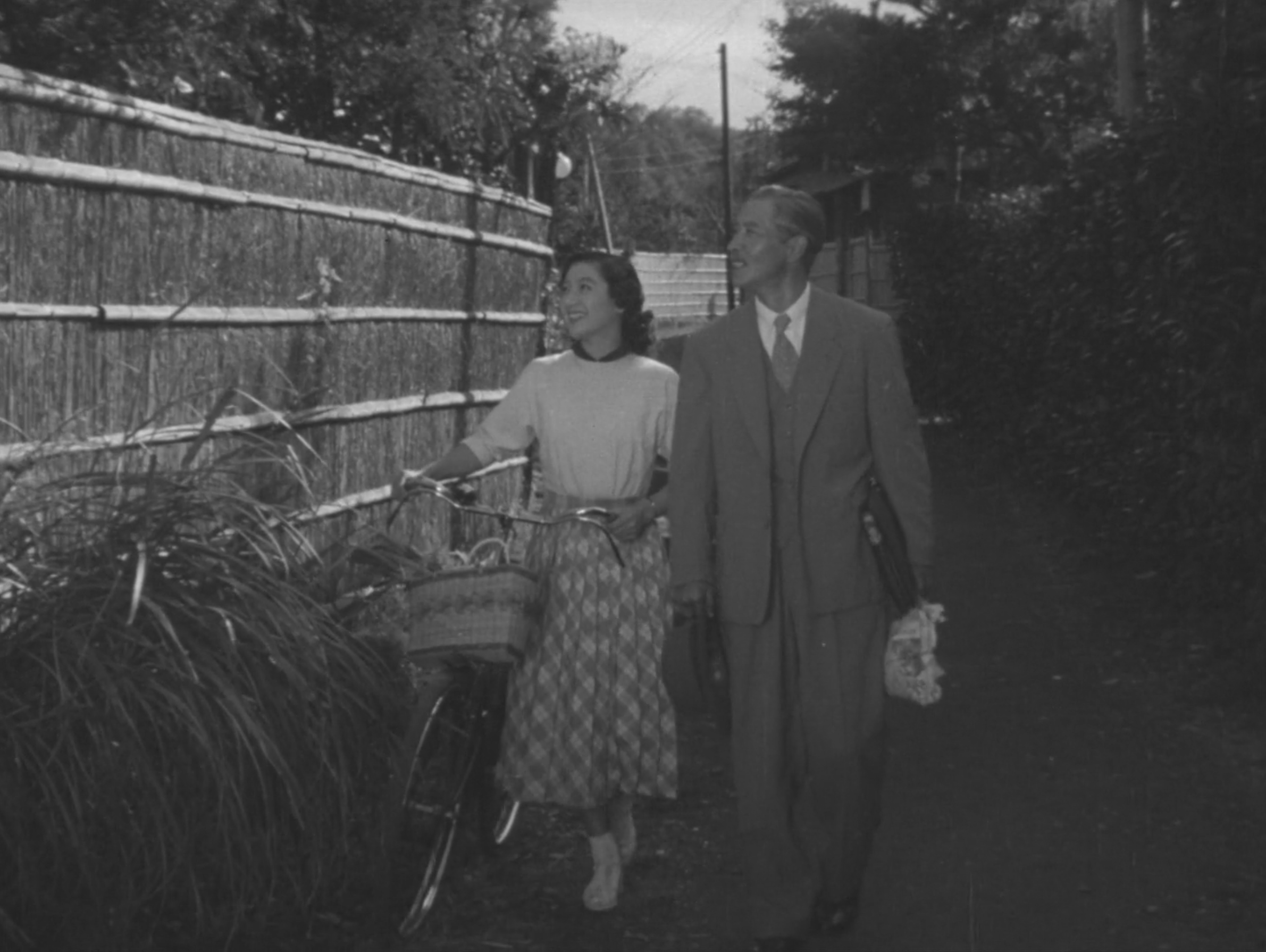
We can see the literal distance between herself and her husband Shinji (Keiju Kobayashi) in the opening sequence as he stands in a vacant lot at the back of their property and she firmly within the domestic space hanging washing. Yet for all that she seems excited, perhaps even a little giddy as they plot their escape together through planning to turn that vacant space into a cafe in an attempt to fend off the economic changes ravaging their town and wider society of Japan in the mid-1950s. Out and about on his bike, Shinji looks anxiously at the construction of a new pharmacy much larger than his own and with flashy modern signage. Their business is failing and they don’t know how to save it so the cafe is their way out and also a break with the depressing past represented by Shinji’s grumpy mother, Ko (Eiko Miyoshi), who is predictably dead against the cafe idea. 

The new business, in its way, is also a stand-in for the child they don’t have and a means for Kiyoko to find domestic fulfilment in a society ruled by motherhood. This one reason that the sudden arrival of her sister-in-law Kaoru (Chieko Nakakita) with her small daughter Rumiko causes so much disruption. Kaoru has fulfilled the social obligations which Kiyoko has not and quickly insinuates herself within the house, taking over the domestic space as symbolised by her otherwise trivial action of putting back a pair of nail clippers in the place she sees fit rather than their usual home. Yet she does this in part because her husband, Zenichi (Minoru Chiaki) who left the family to become a salaryman in Tokyo, is so obviously unreliable and appears to have not for the first time lost his job while employed at a company possibly involved in something untoward. On getting wind of Shinji’s plans to open a cafe, Zenichi announces he’s thinking of opening one himself and gets his mother to put pressure on the couple to give him the money they borrowed for their dream project.

It’s the loan that in part allowed Kiyoko to consider life beyond her marriage in reuniting with the still unmarried brother of her best friend Yumiko (Yoko Sugi). Kenkichi (Toshiro Mifune) is everything Shinji is not, handsome, well dressed, and with a good, middle-class job working at a bank. On a visit to her relatives, Kiyoko’s aunt remarks that everyone wanted to marry her provoking a slight twinge of pain in Kiyoko’s face. Mother-in-law Ko arranges marriages and it’s likely she arranged the one between Kiyoko and her son and that Kiyoko likely agreed out to of social obligation under the rationale that Shinji was a good catch as the proprietor of a successful business. The implication is that if, like Yumiko, she had held out a little longer she probably would have fallen in love and married Kenkichi. As the atmosphere in the family home grows ever more toxic, she grows closer to him yet at least in part as a symbol of the path not taken, what her life may have been like if only she had resisted and claimed a little more freedom for herself. 

Ko has also arranged a marriage for youngest daughter Sumiko (Akemi Negishi) who asks her if all of her matches were happy. An indignant Ko replies that only one or two have split up, but as Sumiko points out just because a couple stays together does not mean they are happy. “Women don’t have the courage, they just give up,” she remarks implying that she, as a representative of the younger generation, might be less minded to simply accept a disappointing situation in the same way as someone of Kiyoko’s age may feel she had to. For these reasons Kiyoko is torn. Yumiko remarks that she and Shinji didn’t even particularly like each other when they married and perhaps remain indifferent to each other now. The cafe may have brought them closer as a couple, but now it’s causing a rift in the wider family while also offering Kiyoko the faintest glimmer of an escape route. When she returns to the cafe where she was learning the ropes as a part-time employee, much to Ko’s chagrin at losing a domestic helper, it’s clear that she’s doing so in part to have a means of supporting herself as she leans closer to the idea of leaving Shinji. 

But for all that it seems unlikely that she has the courage, as Sumiko put it, to break with the traditional social codes of feminity by leaving a husband who was not really bad but that she did not love and made her unhappy. In rebellion, Shinji has an indiscretion with a local geisha who goes missing on the way home from a hot springs and is later found dead having taken her own life because she was trapped in a bad relationship with her husband. The implication is that this is the only way many women find to escape from their dismal circumstances and may soon present itself to Kiyoko if she cannot find a way to reconcile herself to her life with Shinji or find the confidence to leave it. The enemy is the increasingly outdated institution of arranged marriages as advocated by the austere Ko who refuses to hire maids while believing herself entitled to the free labour of her daughters-in-law, and the patriarchal social codes of a modernising nation in which Shinji can have his dalliance with a geisha and his wife is expected to put up with it, but merely being seen walking with a man not one’s husband provokes gossip and jealousy. 

When Shinji implies he suspects her of having an affair with Kenkichi, he tells her that she’s free to follow her heart and he understands if she chooses to leave him but of course by telling her this he seals her fate by making it almost impossible for her to do so. The couple repairs itself, but the resolution is far from comfortable as it becomes clear that each is essentially resigning themselves to misery because of social convention vowing that they’ll build their cafe in the next season though it seems like a dream destined to go unfulfilled while the institution of Rumiko left behind in the family superficially fills the void it was designed to fill. The fades to black between scenes seem to echo an exhalation of bleakness as the interrupted thought of Kenkichi’s dangerous “Kiyoko…” as an admission that the prospect of escape is only ever a torturous fantasy and a heart is something that must be sacrificed in the name of conventional success. 


Sound of the Mountain (山の音, Mikio Naruse, 1954)

“All I can do for you now is set you free”, a failed father laments. Mikio Naruse is renowned as a pessimist according to whom we are always betrayed by the world in which we live, yet bleak as it sometimes is 1954’s Sound of the Mountain (山の音, Yama no Oto) offers us what in Narusean terms at least might be considered a happy ending. Adapting a novel by Yasunari Kawabata, Naruse and his screenwriter Yoko Mizuki stop their story a little before the original’s conclusion offering an “open prospect” in which the chastened patriarch is forced into retreat, setting the young ones free while reflecting on paternal failures both national and personal. 

Now in late middle age, CEO Shingo (So Yamamura) is beginning to notice things he perhaps hadn’t before or had merely brushed aside such as the various ways the women around him continue to suffer because of inherently unfair patriarchal social codes. He dotes on his cheerful daughter-in-law Kikuko (Setsuko Hara) but is also aware his son/employee Shuichi (Ken Uehara) is having an affair. Confronted, Shuichi pledges to end the relationship but asks his father if he has honestly remained faithful all his life. Shingo doesn’t exactly deny anything, but remarks that it justifies nothing and his son ought to know better. 

According to Shingo, a man’s success is affirmed if he lives out his life unharmed but one’s success as a parent depends solely on that of the marriages of one’s children and on that front at least Shingo appears to be a failure. Shuichi offers barbed comments about his wife that sound like jokes but clearly aren’t, responding to query as to why they have no children with an excuse that his wife is a child herself, Kikuko’s face contorting momentarily in pain and shame at her husband’s cutting remark yet the only sign of childishness that we see in her is oft remarked cheerfulness. The Ogata household is currently down a maid and it’s Kikuko who’s been picking up the slack as perhaps a daughter-in-law is expected to do, taking care of the household and ensuring her in-laws are well cared for. Ironically enough, the Ogatas love her like a daughter, in part because of her ability to conform to what is expected of a wife despite their son’s indifference, though Shingo is perhaps learning to see past Kikuko’s placid expression, so like the impassive noh mask passed to him by a deceased friend, in the brief flickers of her discomfort. The old couple discuss a double suicide of a couple their age who have decided to leave quietly of their own volition with bleak humour, a look of such total and abject despair passing over Kikuko’s face as she replies to Shingo’s question if she too would write a note if she planned to die with her husband that she might leave one for him. 

The ill-defined relationship between Kikuko and her father-in-law is in essence paternal but profoundly felt, founded on a shared sense of connection and a deep respect. It stands in contrast, however, to that with his own daughter, Fusako (Chieko Nakakita), who returns home to her parents having discovered that her husband is also having an affair. In a sense, this reaction is a facet of post-war freedom, Shingo’s wife Yasuko (Teruko Nagaoka) may suspect her husband had other women but would have pretended not to and in any case would never leave an otherwise successful marriage over such a “trivial” matter. Fusako, meanwhile, has the freedom to demand better and to leave if she doesn’t get it but continues to hesitate blaming her father’s indifference towards her for her husband’s lack of respect something which she believes also fed into his poor choice of match. 

Cheerful, stoical Kikuko meanwhile finds herself caught between tradition and modernity unhappy in her marriage but uncertain if she has the right to escape it. Despite his parents’ niceness, Shuichi has grown into a cruel and selfish man, running down his wife and neglecting his work to romance his father’s secretary, who is not the mistress (not that she wouldn’t like to be), and apparently a violent drunk who routinely beats his girlfriend, a war widow and independent woman who sees nothing wrong in dating a married man because his wife is only waiting for one certain to return. Mirroring Kikuko, Kinuko (Rieko Sumi) is also pregnant but transgressively plans to have the child and raise it alone (supported by her friend and roommate). Telling no one, Kikuko learns that she is expecting but unilaterally opts for an abortion telling her husband that she cannot in good conscience give birth to his child knowing the kind of man he is. Confronting Shuichi, Shingo describes it as a kind of suicide and he is at least right in that she kills the image of herself as the good wife but does so by choosing her own integrity, seizing her agency in rejecting a dissatisfying present to seek a happier future. 

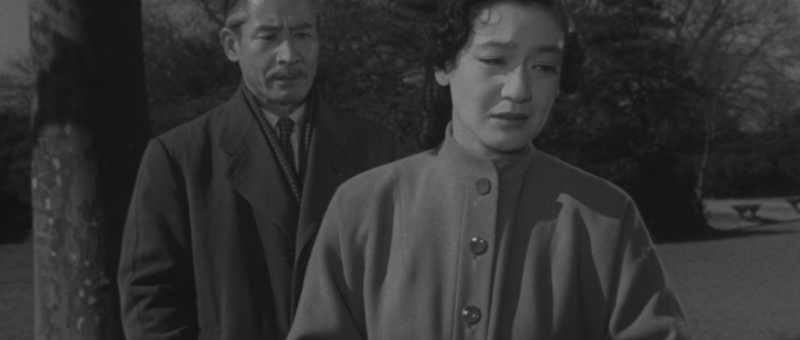
By contrast, we get the impression that Fusako, who has two children already, will likely return to her husband. Shuichi has the talk with his brother-in-law his mother hoped he would, but bonds with him in male solidarity, excusing his affair while advancing that Fusako doesn’t understand that he is merely working hard for their family laying bare a fundamental disconnect in the thinking of men and women further borne out by Yasuko’s assertion that men and women deal with sorrow differently. It’s this series of disconnects, between men and women, parents and children, that Shingo is beginning to bridge only to be confronted with his own patriarchal failures. While he and his wife are seemingly happy enough, he brushing off her self-deprecating remark that he was “unlucky” in marrying her only because her prettier sister died, his children’s marriages have each failed. His failure stands in for that of his generation, realising that he all he can do for them now is set them free. Meeting Kikuko in a park with wide open vistas, oddly like the final meeting of doomed lovers aware they must now part, Shingo vows retreat, planning to retire and move to the country with his wife as if liberating the youth of Japan from the oppressive social codes of the past in ceding the “open prospects” of the post-war society to his surrogate daughter in order that she might at least seize her freedom to chase her own happiness. 


The H-Man (美女と液体人間, Ishiro Honda, 1958)

H-man
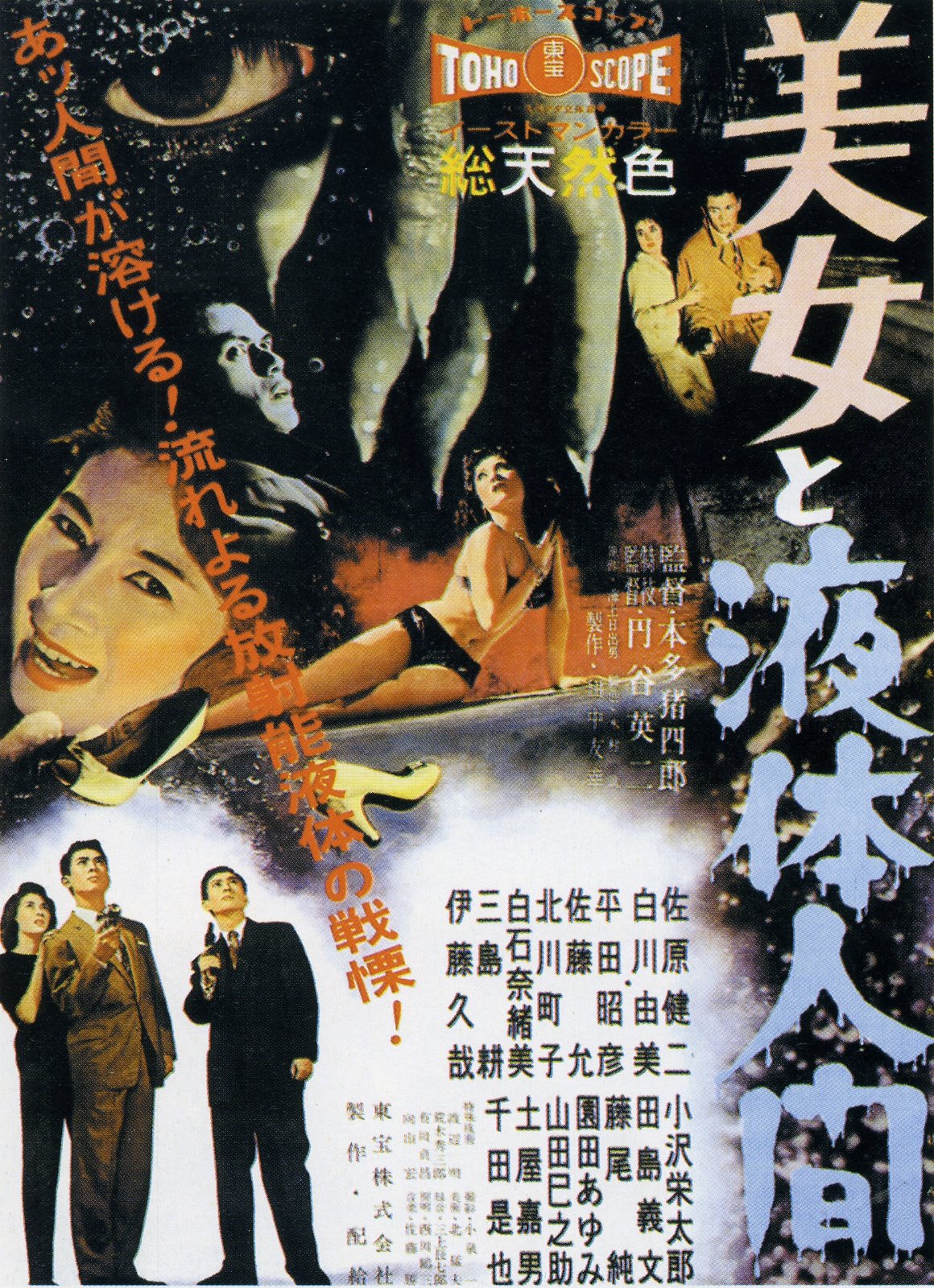
Toho produced a steady stream of science fiction movies in the ‘50s, each with some harsh words directed at irresponsible scientists whose discoveries place the whole world in peril. The H-man (美女と液体人間, Bijo to Ekitainingen), arriving in 1958, finds the genre at something of an interesting juncture but once again casts nuclear technology as the great evil, corrupting and eroding humanity with a barely understood power. Science may have conjured up the child which will one day destroy us, robbing mankind of its place as the dominant species. Still, we’ve never particularly needed science to destroy ourselves and so this particularly creepy mystery takes on a procedural bent infused with classic noir tropes and filled with the seedier elements of city life from gangsters and the drugs trade to put upon show girls with lousy boyfriends who land them in unexpected trouble.

Misaki (Hisaya Itou) is not a man who would likely have been remembered. A petty gangster on the fringes of the criminal underworld, just trying to get by in the gradually improving post-war economy, he’s one of many who might have found himself on the wrong side of a gangland battle and wound up just another name in a file. However, Misaki gets himself noticed by disappearing in the middle of a drugs heist leaving all of his clothes behind. The police immediatetely start hassling his cabaret singer girlfriend, Chikako (Yumi Shirakawa), who knows absolutely nothing but is deeply worried about what may have happened to her no good boyfriend. The police are still working on the assumption Misaki has skipped town, but a rogue professor, Masada (Kenji Sahara), thinks the disappearance may be linked to a strange nuclear incident…..

Perhaps lacking in hard science, the H-Man posits that radiation poisoning can fundamentally change the molecular structure of a living being, rendering it a kind of sentient sludge. This particular hypothesis is effectively demonstrated by doing some very unpleasant looking things to a frog but it seems humans too can be broken down into their component parts to become an all powerful liquid being. The original outbreak is thought to have occurred on a boat out at sea and the scientists still haven’t figured out why the creature has come back to Tokyo though their worst fear is that the H-man, as they’re calling him, retains some of his original memories and has tried to return “home” for whatever reason.

The sludge monster seeps and crawls, working its way in where it isn’t wanted but finally rematerialises in humanoid form to do its deadly business. Once again handled by Eiji Tsuburaya, the effects work is extraordinary as the genuinely creepy slime makes its slow motion assault before fire breaks out on water in an attempt to eradicate the flickering figures of the newly reformed H-men. The scientists think they’ve come up with a way to stop the monstrous threat, but they can’t guarantee there will never be another – think what might happen in a world covered in radioactivity! The H-man may just be another stop in human evolution.

Despite the scientists’ passionate attempts to convince them, the police remain reluctant to consider such an outlandish solution, preferring to work the gangland angle in the hopes of taking out the local drug dealers. The drug lord subplot is just that, but Misaki most definitely inhabited the seamier side of the post-war world with its seedy bars and petty crooks lurking in the shadows, pistols at the ready under their mud splattered macs. Chikako never quite becomes the generic “woman in peril” despite being directly referenced in the Japanese title, though she is eventually kidnapped by very human villains, finding herself at the mercy of violent criminality rather than rogue science. Science wants to save her, Masada has fallen in love, but their relationship is a subtle and mostly one sided one as Chikako remains preoccupied over the fate of the still missing Misaki.

Even amidst the fear and chaos, Honda finds room for a little song and dance with Chikako allowed to sing a few numbers at the bar while the other girls dance around in risqué outfits. The H-man may be another post-war anti-nuke picture from the studio which brought you Godzilla but its target is wider. Nuclear technology is not only dangerous and unpredictable, it has already changed us, corrupting body and soul. The H-men may very well be that which comes after us, but if that is the case it is we ourselves who have sown the seeds of our destruction in allowing our fiery children to break free of our control.


Original trailer (no subtitles)

Sannin Yoreba (三人よれば, Toshio Sugie, 1964)

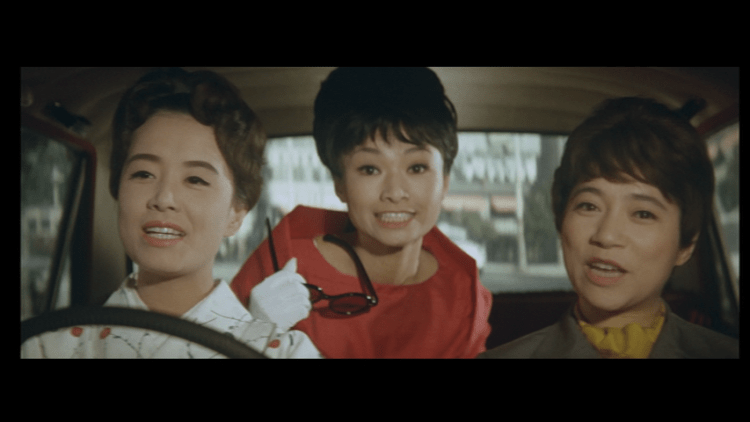
vlcsnap-2016-06-02-01h37m01s384Hibari, Chiemi and Izumi reunite in 1964 for another tale of musical comedy and romantic turmoil in Sannin Yoreba (三人よれば). Beginning as teenagers in So Young, So Bright and Romantic Daughters before progressing to the beginning of their adult lives in On Wings of Love, the girls are all grown up now so the plot of Sannin Yoreba centres around the eternal conflict in the youth of every young woman in ‘60s Japanese cinema – marriage!

At the beginning of the film the three girls are intrigued and excited to receive a call from their old high school teacher who has recently retired. Meeting up to go visit her, the girls relive some old memories with the help of a few repurposed scenes from So Young, So Bright spliced in plus a few additional bits so that it looks like Izumi was also a classmate with them (in the movie she played an apprentice geisha Chiemi and Hibari met in Kyoto) as well as replacing the actress who played the teacher with the woman we’re about to meet. The trio even sing the title song to the first film, Janken Musume, as they drive over to their teacher’s house.

However, once they get there the nostalgic mood begins to dissipate as they realise their teacher has ulterior motives for inviting them. It seems, now that she’s retired, she’s opened a dating agency and wants to introduce our still single ladies to a few “eligible bachelors”. Horrified, the girls each quickly claim to have serious boyfriends already even though Hibari is the only one actually in a relationship. The teacher seems satisfied but invites them all back beaus in tow to give her final verdict. Thus begins the complicated road to true love for our musically inclined heroines.

It’s been seven years since the last Sannin Musume movie and truth to tell things have moved on the meantime leaving the Hollywood inspired musical glamour looking a little old fashioned. Much of Sannin Yoreba is a nostalgia fest despite the fact that it hasn’t really been all that long. Harking back to the first film by singing the title song and reusing the high school era footage seems primed to pull the similarly aged ladies of the audience back to screens across the country.

Sannin Yoreba has the fewest musical sequences and steers clear of large scale production numbers in favour of smaller solo showcases for the leading ladies. There’s more of a blur here into what are really fantasy sequences again taking place as the girls daydream or worry about various things – Chiemi at her place of work (in the production booth of a TV studio), Izumi in her salon, and Hibari at a bar after having a serious argument with her fiancee (once again played by Akira Takarada). That said, the girls end up at a theatre again as they did in the first two movies where they watch themselves perform a tripartite musical set piece which splits off into individual numbers for each one of them. A kind of Chaplin meets Marx Brothers meets Easter Parade theme, the girls dress up as tramps wandering through Times Square where they spot adverts for various shows which inspire their routines including Madame Butterfly where Chiemi plays both the captain and the geisha, and a bullfighting bolero number with Hibari giving it her full on Zorro.

Once again its an elegantly put together fluff fest intended to showcase the entertaining personalities of the three leading ladies who are now some of the biggest performing stars in post-war Japan. As usual the girls have great chemistry together and make a convincing group of lifelong friends whose relationship transcends that of any potential romance on offer. The movie ends with a wedding and another musical finale which incorporates three all three singers so, as expected, everything works out OK in the end which is mostly what people what from a cosy musical comedy starring three giants of the entertainment world. It may be a little sluggish in places and lacks the absurd comedic touch of the earlier movies, but Sannin Yoreba is a welcome return for the idol supergroup even if this kind of movie was evidently on its way out by the mid 1960s.


This is the last of the Sannin Musume movies  😦

Nothing from the film but here’s a video of the three girls some years later singing one of the songs which crops up throughout the movies:

https://www.youtube.com/watch?v=y985zFkUWyE